

Targeting lysosomes in human disease: from basic research to clinical applications
Open accessThe DOI matches its Crossref record; 410 of the 410 references it cites were found in a registry or an index.
Abstract
In recent years, accumulating evidence has elucidated the role of lysosomes in dynamically regulating cellular and organismal homeostasis. Lysosomal changes and dysfunction have been correlated with the development of numerous diseases. In this review, we interpreted the key biological functions of lysosomes in four areas: cellular metabolism, cell proliferation and differentiation, immunity, and cell death. More importantly, we actively sought to determine the characteristic changes and dysfunction of lysosomes in cells affected by these diseases, the causes of these changes and dysfunction, and their significance to the development and treatment of human disease. Furthermore, we outlined currently available targeting strategies: (1) targeting lysosomal acidification; (2) targeting lysosomal cathepsins; (3) targeting lysosomal membrane permeability and integrity; (4) targeting lysosomal calcium signaling; (5) targeting mTOR signaling; and (6) emerging potential targeting strategies. Moreover, we systematically summarized the corresponding drugs and their application in clinical trials. By integrating basic research with clinical findings, we discussed the current opportunities and challenges of targeting lysosomes in human disease.
Overview
The claims and statistics of this paper haven’t been checked yet.
Free: it reads the open-access text and checks the first 5 claims that cite a source we can check. Create a free account to check every claim.
Integrity signals
Registry
Cites
Statistics
Figures
Verification
Claims the paper makes
The claims and statistics of this paper haven’t been checked yet.
Free: it reads the open-access text and checks the first 5 claims that cite a source we can check. Create a free account to check every claim.
Claims other papers make about this one
Each is checked against this paper’s own text: does it say what the citing paper says it does?
The source backs part of the claim, not all of it — or backs it for a different population, condition or comparison.
In the citing paper
“Lysosomal dysfunction is considered a critical factor in the development of many diseases,261 which may manifest as impaired acidification, abnormal expression of lysosomal enzymes, lysosomal membrane stability issues, transport defects, and defects in autophagosome/endosome-lysosome fusion.”
From Recent advances in Alzheimer's disease: Mechanisms, clinical trials and new drug development strategies. (2024) · cites this paper as [261]
Experimental — accuracy not yet measured
Self-check
Percentages, sums and reported differences re-computed from the paper’s own numbers.
The self-check needs the paper’s full text.
Citations
Cites
1 retracted
Items 401–410 of 410
A distinct inhibitory mechanism of the V-ATPase by Vibrio VopQ revealed by cryo-EM
Peng, W., Casey, A. K., Fernandez, J., Carpinone, E. M., Servage, K. A., Chen, Z., Li, Y., Tomchick, D. R., Starai, V. J., & Orth, K. (2020) · Nature Structural & Molecular Biology · doi:10.1038/s41594-020-0429-1 · Cited by 12
Li, L., Niu, H., Sun, B., Xiao, Y., Li, W., Yuan, H., & Lou, H. (2016) · Toxicology and Applied Pharmacology · doi:10.1016/j.taap.2016.09.014 · Cited by 11 · cited 1×
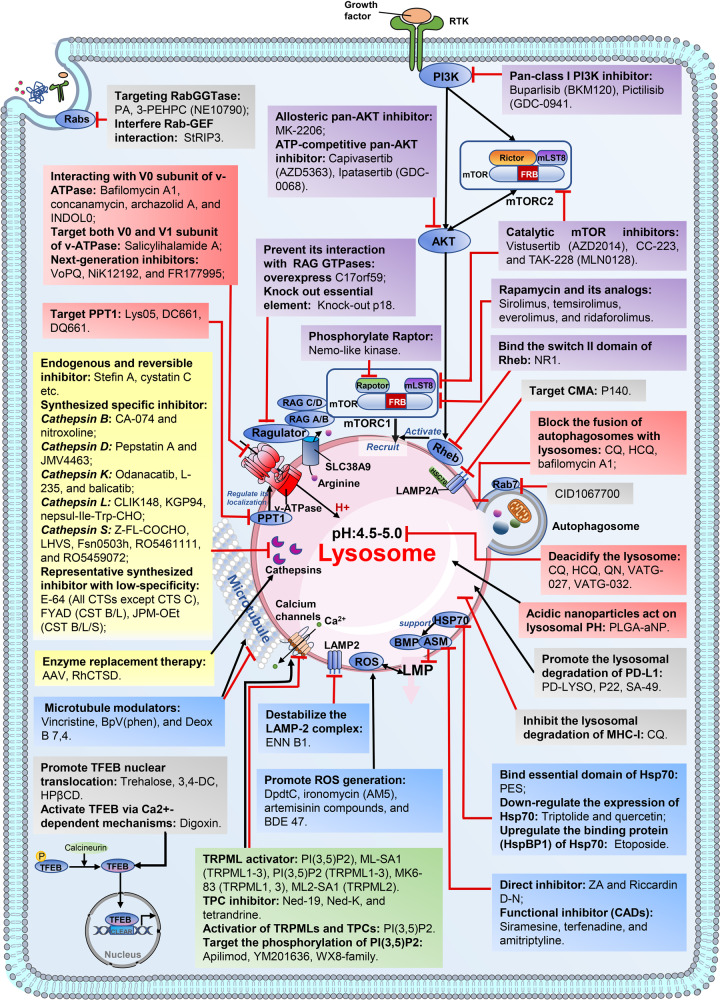
“Direct inhibitors of ASM such as zoledronic acid and Riccardin D-N, as well as functional inhibitors such as cationic amphiphilic drugs (CADs), all show highly efficient ASM inhibition and LMP induction.(26,233,234) CADs are a wide group of chemicals that can permeate lysosomal membranes and accumulate within lysosome…”
BackgroundHipolito, V. E. B., Diaz, J. A., Tandoc, K. V., Oertlin, C., Ristau, J., Chauhan, N., Saric, A., Mclaughlan, S., Larsson, O. S., Topisirović, I., et al. (2018) · bioRxiv (Cold Spring Harbor Laboratory) · doi:10.1101/260257 · Cited by 11
The ubiquitin E2 enzyme UBE2QL1 mediates lysophagy
Mizushima, N. (2019) · EMBO Reports · doi:10.15252/embr.201949104 · Cited by 10
Implication of a lysosomal antigen in the pathogenesis of lupus erythematosus
Wilhelm, M., Bonam, S. R., Schall, N., Bendorius, M., Korganow, A., Lumbroso, C., & Muller, S. (2021) · Journal of Autoimmunity · doi:10.1016/j.jaut.2021.102633 · Cited by 10 · cited 1×
“It has been found that autophagy is not only the survival mechanism of autoreactive B cells in SLE patients, but also the key to plasmablast differentiation and the long-term autoantibody secretion of plasma cells.(141,148) In patients with RA, upregulated autophagy was found to regulate the bone resorption of osteocl…”
BackgroundHadad, E. H., Ahmadzadeh, A., Abooali, A., Malehi, A. S., Shokouhian, M., & Saki, N. (2020) · Journal of Cellular Physiology · doi:10.1002/jcp.29710 · Cited by 8
Inhibiting cathepsin S to treat SLE and lupus nephritis
Bernard, N. J. (2013) · Nature Reviews Rheumatology · doi:10.1038/nrrheum.2013.207 · Cited by 6
Lysosomal retargeting of Myoferlin mitigates membrane stress to enable pancreatic cancer growthPreprint
Gupta, S., Yano, J., Htwe, H. H., et al. (2021) · bioRxiv (Cold Spring Harbor Laboratory) · doi:10.1101/2021.01.04.425106 · Cited by 5
Colafrancesco, S., Minniti, A., Priori, R., Vomero, M., Barbati, C., Arienzo, F., Iannizzotto, V., Pipi, E., Campos, J., Nayar, S., et al. (2019) · Annals of the Rheumatic Diseases · doi:10.1136/annrheumdis-2019-eular.5901 · Cited by 2 · cited 1×
“Upregulated autophagy was also observed in T and B cells that infiltrated minor salivary glands in SS, and was associated with histological severity.(19,146,147) However, there are different views regarding the activation status of the autophagy pathway in the T cells of RA patients.”
BackgroundCheng, L., Zhang, S. X., Song, S., Zheng, C., Sun, X. S., Feng, S., Kong, T., Shi, G., Li, X., He, P. F., et al. (2021) · Annals of the Rheumatic Diseases · doi:10.1136/annrheumdis-2021-eular.1938 · Cited by 1
Research works printed but not linked: 5
- Patel S Homaei A El-Seedi HR Akhtar N Cathepsins: Proteases that are vital for survival but can also be fatal Biomed. Pharmacother. 2018 105 526 532 10.1016/j.biopha.2018.05.148 29885636 PMC7172164 · DOI · Paper page
- Rusmini P Trehalose induces autophagy via lysosomal-mediated TFEB activation in models of motoneuron degeneration Autophagy 2019 15 631 651 10.1080/15548627.2018.1535292 30335591 PMC6526812 · DOI · Paper page
- Marmor MF Recommendations on screening for chloroquine and hydroxychloroquine retinopathy (2016 Revision) Ophthalmology 2016 123 1386 1394 10.1016/j.ophtha.2016.01.058 26992838 · DOI · Paper page
- Peng W A distinct inhibitory mechanism of the V-ATPase by Vibrio VopQ revealed by cryo-EM Nat. Struct. Mol. Biol. 2020 27 589 597 10.1038/s41594-020-0429-1 32424347 · DOI
- Mitrofan LM Castells FB Pelkonen J Mönkkönen J Lysosomal-mitochondrial axis in zoledronic acid-induced apoptosis in human follicular lymphoma cells J. Biol. Chem. 2010 285 1967 1979 10.1074/jbc.M109.038935 19875454 PMC2804355 · DOI
Cited by
Zhang, J., Zhang, Y., Wang, J., Xia, Y., Zhang, J., & Chen, L. (2024) · Signal Transduction and Targeted Therapy · doi:10.1038/s41392-024-01911-3 · Cited by 1,138
“261 – 263 A key factor affecting lysosomal function is the pH controlled by the vacuolar (H + )-ATPase (V-ATPase), which uses the energy from ATP hydrolysis to drive H + from the cytoplasm into the lysosome.”
BackgroundNanomedicine in cancer therapy
Fan, D., Cao, Y., Cao, M., Wang, Y., Cao, Y., & Gong, T. (2023) · Signal Transduction and Targeted Therapy · doi:10.1038/s41392-023-01536-y · Cited by 878
“427,428 Recently, a great many nanoparticles have been designed to target the endo/lysosomal compartments through the endocytic pathway.”
BackgroundSelf-citationThe role of lysosomes in metabolic and autoimmune diseases
Gros, F., & Muller, S. (2023) · Nature Reviews Nephrology · doi:10.1038/s41581-023-00692-2 · Cited by 194
A nitric-oxide driven chemotactic nanomotor for enhanced immunotherapy of glioblastoma
Chen, H., Li, T., Liu, Z., Tang, S., Tong, J., Tao, Y., Zhao, Z., Li, N., Mao, C., Shen, J., et al. (2023) · Nature Communications · doi:10.1038/s41467-022-35709-0 · Cited by 197
Extracellular Vesicles for Clinical Diagnostics: From Bulk Measurements to Single-Vesicle Analysis
Tran, H. L., Zheng, W., Issadore, D., Im, H., Cho, Y., Zhang, Y., Liu, D., Liu, Y., Li, B., Liu, F., et al. (2025) · ACS Nano · doi:10.1021/acsnano.5c00706 · Cited by 124
Metadata
- Authors
- Cao, M., Luo, X., Wu, K., & He, X.
- Affiliations
- Tongji Hospital (CN)
- Zhengzhou University (CN)
- Corresponding author
- He, Xingxing
- Venue
- Signal Transduction and Targeted Therapy
- Published
- 2021-11-08
- Volume
- 6
- Issue
- 1
- Pages
- 379-379
- ISSN
- 2059-3635 (ISSN-L)
- PMC
- PMC8572923
- OpenAlex
- W3214233540
- Cited by
- 225
- References
- 409
- Citations by year
- 2026: 42 · 2025: 78 · 2024: 59 · 2023: 32 · 2022: 14
- FWCI
- 4.02
- Type
- journal article
- Language
- en
- Open access
- gold
- doi.org
- Licence
- cc-by
- creativecommons.org/licenses/by/4.0 (tdm)
- creativecommons.org/licenses/by/4.0 (vor)
- Locations
- Signal Transduction and Targeted Therapy (publishedVersion, cc-by)
- PubMed Central (publishedVersion, cc-by)
- PubMed (publishedVersion)
- DOAJ (DOAJ: Directory of Open Access Journals) (submittedVersion, cc-by-sa)
- Funders
- National Natural Science Foundation of China (No. 82073095)
- Topics
- Life Sciences › Biochemistry, Genetics and Molecular Biology › Cell Biology › Autophagy in Disease and Therapy
- Life Sciences › Biochemistry, Genetics and Molecular Biology › Physiology › Calcium signaling and nucleotide metabolism
- Life Sciences › Biochemistry, Genetics and Molecular Biology › Cell Biology › Cellular transport and secretion
- Keywords
- lysosomes, lysosomal dysfunction, lysosomal acidification, cathepsins, lysosomal membrane permeability, mTOR signaling, lysosomal storage disease, clinical trials, cellular metabolism, cell death, immunity, cell proliferation and differentiation
- MeSH terms
- Cathepsins, Cell Differentiation, Cell Membrane Permeability, Humans, Lysosomes, Lysosomal Storage Diseases, Cell Death, Calcium Signaling, Cell Proliferation, TOR Serine-Threonine Kinases
About these checks
Registry, retraction, Cites and statistics results are computed, not judged, with one exception: a printed reference that no index lists is read once by a model before it counts as a citation error. Claims are extracted by a model and kept only when their quote appears verbatim in the text; each cited source is then checked, with a model’s help, for whether it says what the claim relies on. Those verdicts can be wrong — read the claim’s quote and the cited source before relying on one.
Statistics and arithmetic are recomputed, not judged.
Confidence bands are shown only for fields calibrated on our annotated test set. None is calibrated yet, so no band is shown.
What counts as a claim ›How we measure confidence ›How we check this ›
Are you an author, or do you see a problem with this page? Request a review
Data sources
Bibliographic data: Semantic Scholar, OpenAlex, Crossref.
Contains information from the Semantic Scholar Academic Graph Datasets, made available under the ODC Attribution License (ODC-BY 1.0).
Semantic Scholar’s data is described in: Kinney, R., et al. (2023). The Semantic Scholar Open Data Platform. arXiv:2301.10140.
