

The DOI matches its Crossref record; 435 of the 435 references it cites were found in a registry or an index.
Colorectal liver metastasis: molecular mechanism and interventional therapy
Open accessAbstract
Colorectal cancer (CRC) is one of the most frequently occurring malignancy tumors with a high morbidity additionally, CRC patients may develop liver metastasis, which is the major cause of death. Despite significant advances in diagnostic and therapeutic techniques, the survival rate of colorectal liver metastasis (CRLM) patients remains very low. CRLM, as a complex cascade reaction process involving multiple factors and procedures, has complex and diverse molecular mechanisms. In this review, we summarize the mechanisms/pathophysiology, diagnosis, treatment of CRLM. We also focus on an overview of the recent advances in understanding the molecular basis of CRLM with a special emphasis on tumor microenvironment and promise of newer targeted therapies for CRLM, further improving the prognosis of CRLM patients.
Overview
The claims and statistics of this paper haven’t been checked yet.
Run the check — free, no account needed. It reads the open-access text and checks the sources it cites.
Integrity signals
Registry
Cites
Statistics
Figures
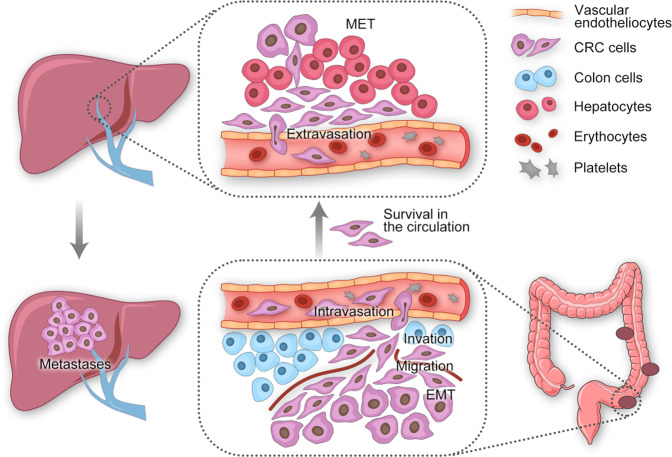
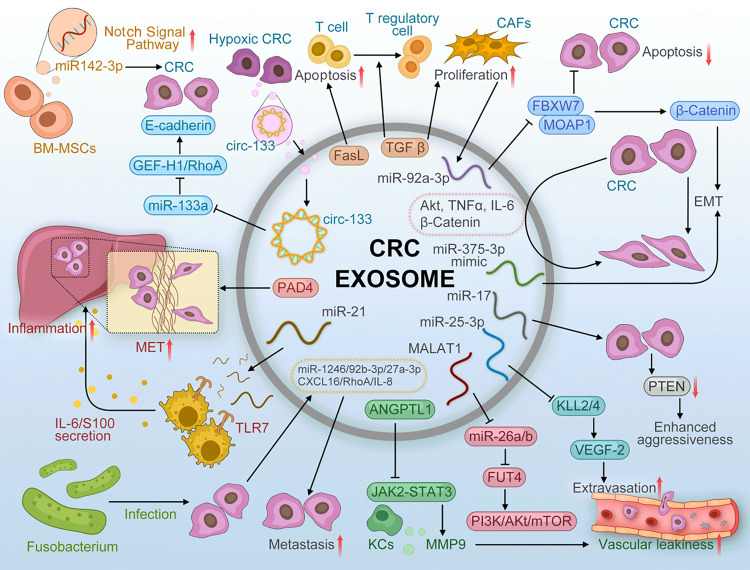
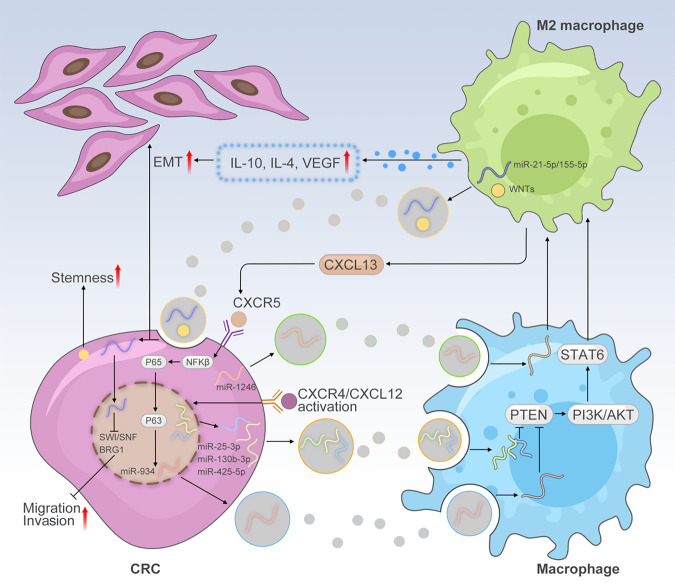
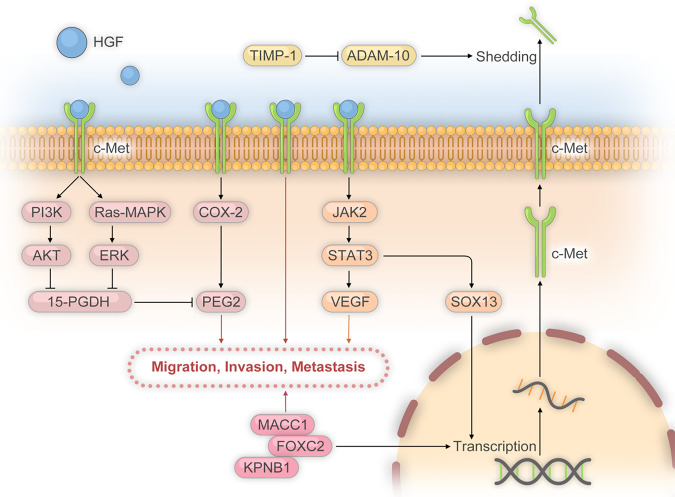
Verification
Claims the paper makes
The claims and statistics of this paper haven’t been checked yet.
Run the check — free, no account needed. It reads the open-access text and checks the sources it cites.
Claims other papers make about this one
Each is checked against this paper’s own text: does it say what the citing paper says it does?
The cited source doesn’t support the claim as written.
In the citing paper
“only 45% can be resected with current methodology.”
From First-in-class MKK4 inhibitors enhance liver regeneration and prevent liver failure (2024) · cites this paper as [43]
Checked by a reasoning model — may be wrong.
Experimental — accuracy not yet measuredThe source backs part of the claim, not all of it — or backs it for a different population, condition or comparison.
In the citing paper
“Of the approximately 1 million patients diagnosed worldwide with colorectal cancer liver metastases each year,43”
From First-in-class MKK4 inhibitors enhance liver regeneration and prevent liver failure (2024) · cites this paper as [43]
Experimental — accuracy not yet measured
Self-check
Percentages, sums and reported differences re-computed from the paper’s own numbers.
The self-check needs the paper’s full text.
Citations
Cites
7 retracted
MicroRNA-20a-5p promotes colorectal cancer invasion and metastasis by downregulating Smad4
Cheng, D., Zhao, S., Tang, H., Zhang, D., Sun, H., Yu, F., Jiang, W., Yue, B., Wang, J., Zhang, M., et al. (2016) · Oncotarget · doi:10.18632/oncotarget.9900 · Cited by 120
Self-citationRetractedZhang, J., Xiao, Z., Lai, D., Sun, J., He, C., Chu, Z., Ye, H., Chen, S., & Wang, J. (2012) · British Journal of Cancer · doi:10.1038/bjc.2012.251 · Cited by 114
RetractedRETRACTED ARTICLE: FOXC2 promotes colorectal cancer metastasis by directly targeting MET
Cui, Y.-M., Jiao, H.-L., Ye, Y.-P., Chen, C.-M., Wang, J.-X., Tang, N., Li, T.-T., Lin, J., Qi, L., Wu, P., et al. (2014) · Oncogene · doi:10.1038/onc.2014.368 · Cited by 82
RetractedZhang, Z., Tan, X., Luo, J., Cui, B., Lei, S., Si, Z., Shen, L., & Yao, H. (2018) · Cancer Medicine · doi:10.1002/cam4.1783 · Cited by 47
RetractedZhang, X., Bai, J., Yin, H., Long, L., Zheng, Z., Wang, Q., Chen, F., Yu, X., & Zhou, Y. (2020) · Molecular Oncology · doi:10.1002/1878-0261.12765 · Cited by 47
RetractedMicroRNA‑432‑5p inhibits cell migration and invasion by targeting CXCL5 in colorectal cancer
Luo, M., Hu, Z., Kong, Y., & Li, L. (2021) · Experimental and Therapeutic Medicine · doi:10.3892/etm.2021.9732 · Cited by 30
RetractedPEA15 promotes liver metastasis of colorectal cancer by upregulating the ERK/MAPK signaling pathway
Tang, B., Liang, W., Liao, Y., Li, Z., Wang, Y., & Yan, C. (2018) · Oncology Reports · doi:10.3892/or.2018.6825 · Cited by 28
Self-citationRetractedSung, H., Ferlay, J., Siegel, R. L., Laversanne, M., Soerjomataram, I., Jemal, A., & Bray, F. (2021) · CA: A Cancer Journal for Clinicians · doi:10.3322/caac.21660 · Cited by 108,699
Bray, F., Ferlay, J., Soerjomataram, I., Siegel, R. L., Torre, L. A., & Jemal, A. (2018) · CA: A Cancer Journal for Clinicians · doi:10.3322/caac.21492 · Cited by 84,109
Jemal, A., Bray, F., Ferlay, J., Ward, E., & Forman, D. (2011) · CA A Cancer Journal for Clinicians · doi:10.3322/caac.20107 · Cited by 55,077
Research works printed but not linked: 1
- Ma, L., Zou, X., Chen, W. & New, A. X-ray Induced Nanoparticle Photosensitizers For Cancer Treatment. J. Biomed. Nanotechnol. 10, 1501–1508 (2014). · DOI
Cited by
Sorted by citations
Advances in single-cell RNA sequencing and its applications in cancer research
Huang, D., Ma, N., Li, X., Gou, Y., Duan, Y., Liu, B., Xia, J., Zhao, X., Wang, X., Li, Q., et al. (2023) · Journal of Hematology & Oncology · doi:10.1186/s13045-023-01494-6 · Cited by 224
IL-10 dampens antitumor immunity and promotes liver metastasis via PD-L1 induction
Shiri, A. M., Zhang, T., Bedke, T., Zazara, D. E., Zhao, L., Lücke, J., Sabihi, M., Fazio, A., Zhang, S., Tauriello, D. V. F., et al. (2023) · Journal of Hepatology · doi:10.1016/j.jhep.2023.12.015 · Cited by 142
Update on Targeted Therapy and Immunotherapy for Metastatic Colorectal Cancer
Underwood, P. W., Ruff, S. M., & Pawlik, T. M. (2024) · Cells · doi:10.3390/cells13030245 · Cited by 130
Nano-enabled colorectal cancer therapy
Pan, Q., Xi, F., Xie, L. W., Wu, D., Liu, R., Gao, W., Luo, K., He, B., & Pu, Y. (2023) · Journal of Controlled Release · doi:10.1016/j.jconrel.2023.09.014 · Cited by 93
Li, Y., Yuan, R., Luo, Y., Guo, X., Yang, G., Li, X., & Zhou, S. (2023) · Advanced Materials · doi:10.1002/adma.202300216 · Cited by 81
Metadata
- Authors
- Zhou, H., Liu, Z., Wang, Y., Wen, X., Amador, E. H., Yuan, L., Ran, X., Xiong, L., Ran, Y., Chen, W., & Wen, Y.
- Affiliations
- Central South University (CN)
- The University of Texas at Arlington (US)
- Sichuan University (CN)
- Corresponding author
- Xiong, Li
- Chen, Wei
- Wen, Yu
- Venue
- Signal Transduction and Targeted Therapy
- Published
- 2022-03-04
- Volume
- 7
- Issue
- 1
- Pages
- 70-70
- ISSN
- 2059-3635 (ISSN-L)
- PMC
- PMC8897452
- OpenAlex
- W4214924743
- Cited by
- 298
- References
- 435
- Citations by year
- 2026: 55 · 2025: 99 · 2024: 68 · 2023: 60 · 2022: 16
- FWCI
- 7.45
- Type
- journal article
- Language
- en
- Open access
- gold
- doi.org
- Locations
- Signal Transduction and Targeted Therapy (publishedVersion, cc-by)
- PubMed Central (publishedVersion, cc-by)
- PubMed (publishedVersion)
- Anglia Ruskin Research Online (Anglia Ruskin University) (submittedVersion)
- DOAJ (DOAJ: Directory of Open Access Journals) (submittedVersion, cc-by-sa)
- Figshare (submittedVersion, cc-by)
- Funders
- University of Texas at Arlington
- National Natural Science Foundation of China (82000756, 81873640, 81970569, 81773293)
- Hunan Provincial Science and Technology Department (2017WK2063, 2015GK3117)
- Topics
- Health Sciences › Medicine › Oncology › Colorectal Cancer Treatments and Studies
- Health Sciences › Medicine › Oncology › Cancer Cells and Metastasis
- Health Sciences › Medicine › Hepatology › Hepatocellular Carcinoma Treatment and Prognosis
- Keywords
- colorectal liver metastases, colorectal cancer, molecular mechanisms, tumor microenvironment, targeted therapy, diagnosis, treatment, prognosis
- MeSH terms
- Humans, Liver Neoplasms, Colorectal Neoplasms, Tumor Microenvironment
About these checks
Registry, retraction, Cites and statistics results are computed, not judged, with one exception: a printed reference that no index lists is read once by a model before it counts as a citation error. Claims are extracted by a model and kept only when their quote appears verbatim in the text; each cited source is then checked, with a model’s help, for whether it says what the claim relies on. Those verdicts can be wrong — read the claim’s quote and the cited source before relying on one.
Statistics and arithmetic are recomputed, not judged.
Confidence bands are shown only for fields calibrated on our annotated test set. None is calibrated yet, so no band is shown.
What counts as a claim ›How we measure confidence ›How we check this ›
Are you an author, or do you see a problem with this page? Request a review
