

The DOI matches its Crossref record; 537 of the 537 references it cites were found in a registry or an index.
Protein neddylation and its role in health and diseases
Open accessAbstract
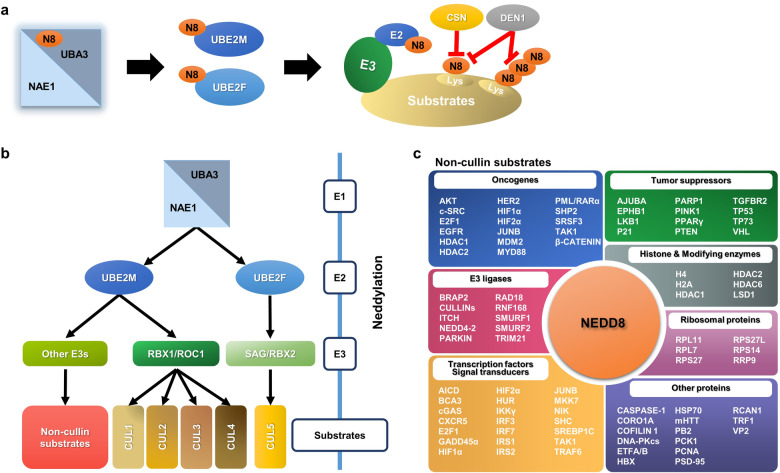
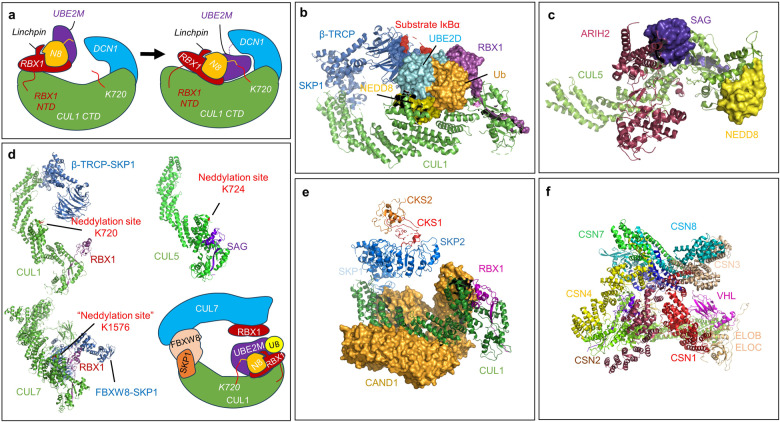
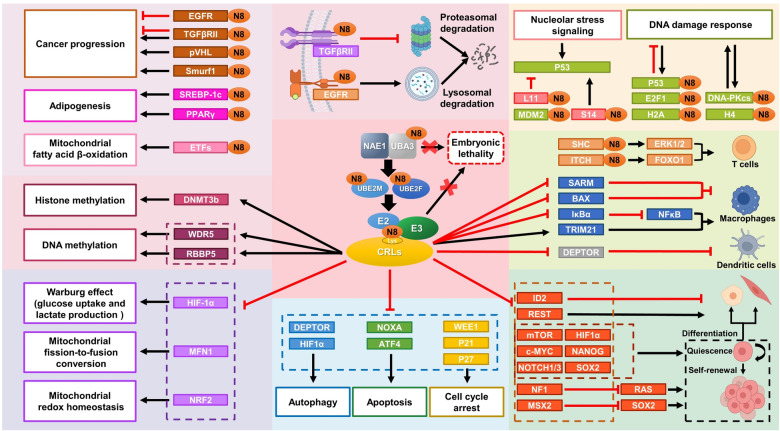
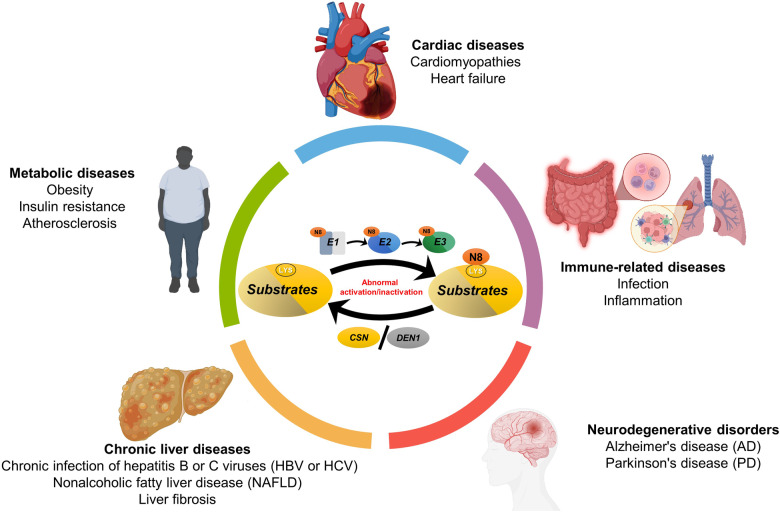
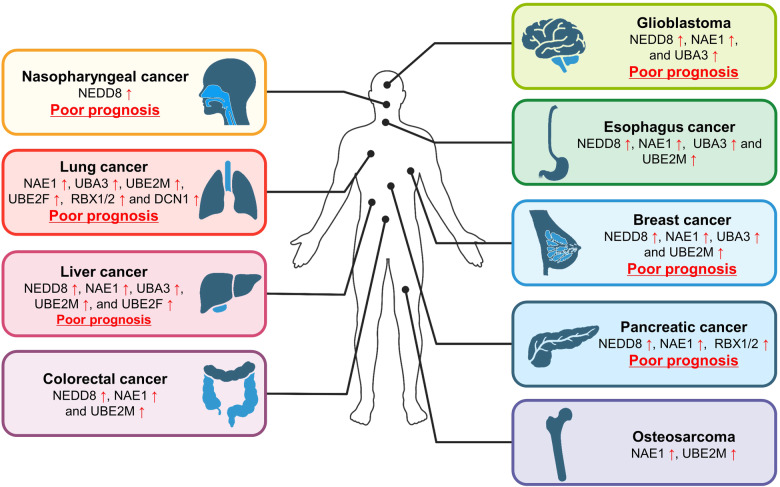
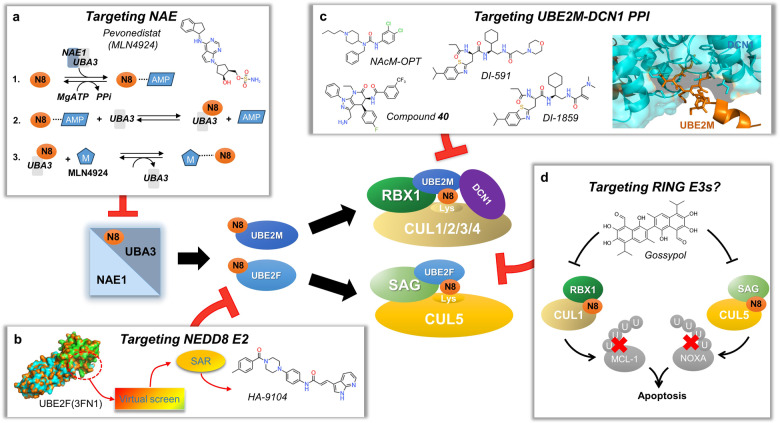
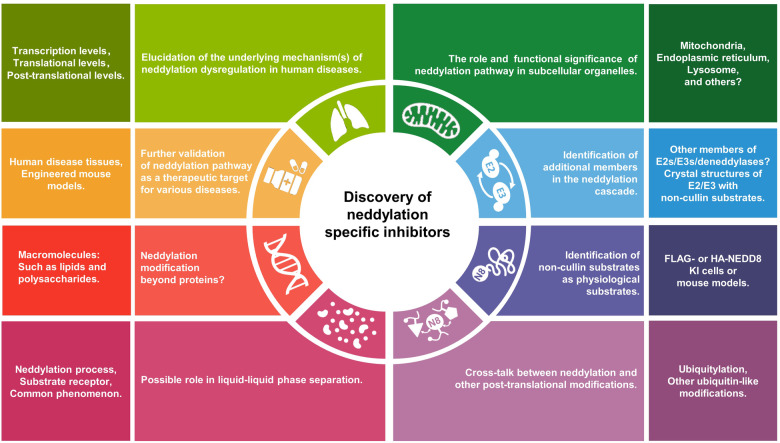
NEDD8 (Neural precursor cell expressed developmentally downregulated protein 8) is an ubiquitin-like protein that is covalently attached to a lysine residue of a protein substrate through a process known as neddylation, catalyzed by the enzyme cascade, namely NEDD8 activating enzyme (E1), NEDD8 conjugating enzyme (E2), and NEDD8 ligase (E3). The substrates of neddylation are categorized into cullins and non-cullin proteins. Neddylation of cullins activates CRLs (cullin RING ligases), the largest family of E3 ligases, whereas neddylation of non-cullin substrates alters their stability and activity, as well as subcellular localization. Significantly, the neddylation pathway and/or many neddylation substrates are abnormally activated or over-expressed in various human diseases, such as metabolic disorders, liver dysfunction, neurodegenerative disorders, and cancers, among others. Thus, targeting neddylation becomes an attractive strategy for the treatment of these diseases. In this review, we first provide a general introduction on the neddylation cascade, its biochemical process and regulation, and the crystal structures of neddylation enzymes in complex with cullin substrates; then discuss how neddylation governs various key biological processes via the modification of cullins and non-cullin substrates. We further review the literature data on dysregulated neddylation in several human diseases, particularly cancer, followed by an outline of current efforts in the discovery of small molecule inhibitors of neddylation as a promising therapeutic approach. Finally, few perspectives were proposed for extensive future investigations.
Overview
The claims and statistics of this paper haven’t been checked yet.
Run the check — free, no account needed. It reads the open-access text and checks the sources it cites.
Integrity signals
Registry
Cites
Statistics
Figures
Verification
Claims the paper makes
The claims and statistics of this paper haven’t been checked yet.
Run the check — free, no account needed. It reads the open-access text and checks the sources it cites.
Claims other papers make about this one
Each is checked against this paper’s own text: does it say what the citing paper says it does?
The cited source says what the claim attributes to it.
In the citing paper
“DCUN1D5 is involved in the neddylation pathway that regulates protein homeostasis, 58 and S100A12 is a pro‐inflammatory mediator that modulates neuroinflammation. 59”
From Unraveling sex differences in Alzheimer's disease and related endophenotypes with brain proteomes (2025) · cites this paper as [58]
The cited source says what the claim attributes to it.
In the citing paper
“Moreover, TRIM46 and TOGARAM1 are proteins that play roles in microtubule functions, 55 , 56 and DCUN1D5 regulates the protein neddylation pathway that has been linked to AD. 58”
From Unraveling sex differences in Alzheimer's disease and related endophenotypes with brain proteomes (2025) · cites this paper as [58]
Self-check
Percentages, sums and reported differences re-computed from the paper’s own numbers.
The self-check needs the paper’s full text.
Citations
Cites
Dendritic cells and the control of immunity
Banchereau, J., & Steinman, R. M. (1998) · Nature · doi:10.1038/32588 · Cited by 14,496
Control of Regulatory T Cell Development by the Transcription Factor Foxp3
Hori, S., Nomura, T., & Sakaguchi, S. (2003) · Science · doi:10.1126/science.1079490 · Cited by 8,187
Cell Signaling by Receptor Tyrosine Kinases
Lemmon, M. A., & Schlessinger, J. (2010) · Cell · doi:10.1016/j.cell.2010.06.011 · Cited by 7,929
Comprehensive molecular characterization of gastric adenocarcinoma
The Cancer Genome Atlas Research Network (2014) · Nature · doi:10.1038/nature13480 · Cited by 6,498
Self-citationHeart Disease and Stroke Statistics—2022 Update: A Report From the American Heart Association
Tsao, C. W., Aday, A. W., Almarzooq, Z. I., Alonso, A., Beaton, A. Z., Bittencourt, M. S., Boehme, A. K., Buxton, A. E., Carson, A. P., Commodore-Mensah, Y., et al. (2022) · Circulation · doi:10.1161/cir.0000000000001052 · Cited by 5,987
Integrated genomic characterization of endometrial carcinoma
The Cancer Genome Atlas Research Network, & Levine, D. A. (2013) · Nature · doi:10.1038/nature12113 · Cited by 5,784
Neutrophil recruitment and function in health and inflammation
Kolaczkowska, E., & Kubes, P. (2013) · Nature Reviews Immunology · doi:10.1038/nri3399 · Cited by 5,472
Mitochondrial Reactive Oxygen Species (ROS) and ROS-Induced ROS Release
Zorov, D. B., Juhaszova, M., & Sollott, S. J. (2014) · Physiological Reviews · doi:10.1152/physrev.00026.2013 · Cited by 5,383
Mutations in the parkin gene cause autosomal recessive juvenile parkinsonism
Kitada, T., Asakawa, S., Hattori, N., Matsumine, H., Yamamura, Y., Minoshima, S., Yokochi, M., Mizuno, Y., & Shimizu, N. (1998) · Nature · doi:10.1038/33416 · Cited by 5,227
Targeting Hypoxia-Inducible Factors for the Treatment of Anemia in Chronic Kidney Disease Patients
Locatelli, F., Fishbane, S. N., Block, G. A., & Macdougall, I. C. (2017) · American Journal of Nephrology · doi:10.1159/000455166 · Cited by 4,836
Cited by
Sorted by citations
Molecular principles underlying aggressive cancers
Nussinov, R., Yavuz, B. R., & Jang, H. (2025) · Signal Transduction and Targeted Therapy · doi:10.1038/s41392-025-02129-7 · Cited by 91
Zhou, Q., Yu, H., Chen, Y., Ren, J., Lü, Y., & Sun, Y. (2024) · Proceedings of the National Academy of Sciences · doi:10.1073/pnas.2320655121 · Cited by 67
Self-citationPromising Therapeutic Strategies for Hematologic Malignancies: Innovations and Potential
Lica, J. J., Pradhan, B., Safi, K., Jakóbkiewicz‐Banecka, J., & Hellmann, A. (2024) · Molecules · doi:10.3390/molecules29174280 · Cited by 29
Post-Translational Modifications of Proteins Orchestrate All Hallmarks of Cancer
Bruno, P. S., Arshad, A., Gogu, M.-R., Waterman, N., Flack, R., Dunn, K., Darie, C. C., & Neagu, A.-N. (2025) · Life · doi:10.3390/life15010126 · Cited by 31
The Double-Edged Effects of MLN4924: Rethinking Anti-Cancer Drugs Targeting the Neddylation Pathway
Tang, H., Pang, X., Li, S., & Tang, L. (2024) · Biomolecules · doi:10.3390/biom14070738 · Cited by 25
Metadata
- Authors
- Zhang, S., Yu, Q., Li, Z., Zhao, Y., & Sun, Y.
- Affiliations
- Second Affiliated Hospital of Zhejiang University (CN)
- Chinese Academy of Sciences (CN)
- First Affiliated Hospital Zhejiang University (CN)
- Corresponding author
- Zhao, Yongchao
- Sun, Yi
- Venue
- Signal Transduction and Targeted Therapy
- Published
- 2024-04-05
- Volume
- 9
- Issue
- 1
- Pages
- 85-85
- ISSN
- 2059-3635 (ISSN-L)
- PMC
- PMC10995212
- OpenAlex
- W4393952844
- Cited by
- 171
- References
- 537
- Citations by year
- 2026: 78 · 2025: 74 · 2024: 19
- FWCI
- 6.99
- Type
- journal article
- Language
- en
- Open access
- gold
- doi.org
- Locations
- Signal Transduction and Targeted Therapy (publishedVersion, cc-by)
- PubMed Central (publishedVersion, cc-by)
- PubMed (publishedVersion)
- DOAJ (DOAJ: Directory of Open Access Journals) (submittedVersion, cc-by-sa)
- Funders
- National Natural Science Foundation of China (U22A20317, 82202838, 82102749, 92053117, 81972591)
- Natural Science Foundation of Zhejiang Province (LD22H300003, LZ22H160003)
- The National Key R&D Program of China
- Topics
- Life Sciences › Biochemistry, Genetics and Molecular Biology › Molecular Biology › Ubiquitin and proteasome pathways
- Life Sciences › Biochemistry, Genetics and Molecular Biology › Molecular Biology › Protein Degradation and Inhibitors
- Health Sciences › Medicine › Oncology › Cancer-related Molecular Pathways
- Keywords
- NEDD8, cullin neddylation, cullin-RING ligases, E3 ubiquitin ligase, neddylation inhibitor, cancer, metabolic disorders, neurodegenerative diseases, liver dysfunction, small molecule inhibitors
- MeSH terms
- Humans, Neoplasms, Protein Processing, Post-Translational, Ubiquitins, Ubiquitin-Protein Ligases, Cullin Proteins
About these checks
Registry, retraction, Cites and statistics results are computed, not judged, with one exception: a printed reference that no index lists is read once by a model before it counts as a citation error. Claims are extracted by a model and kept only when their quote appears verbatim in the text; each cited source is then checked, with a model’s help, for whether it says what the claim relies on. Those verdicts can be wrong — read the claim’s quote and the cited source before relying on one.
Statistics and arithmetic are recomputed, not judged.
Confidence bands are shown only for fields calibrated on our annotated test set. None is calibrated yet, so no band is shown.
What counts as a claim ›How we measure confidence ›How we check this ›
Are you an author, or do you see a problem with this page? Request a review
