

The DOI matches its Crossref record; 62 of the 62 references it cites were found in a registry or an index.
Early-life adversity and cortisol response to social stress: a meta-analysis
Open accessAbstract
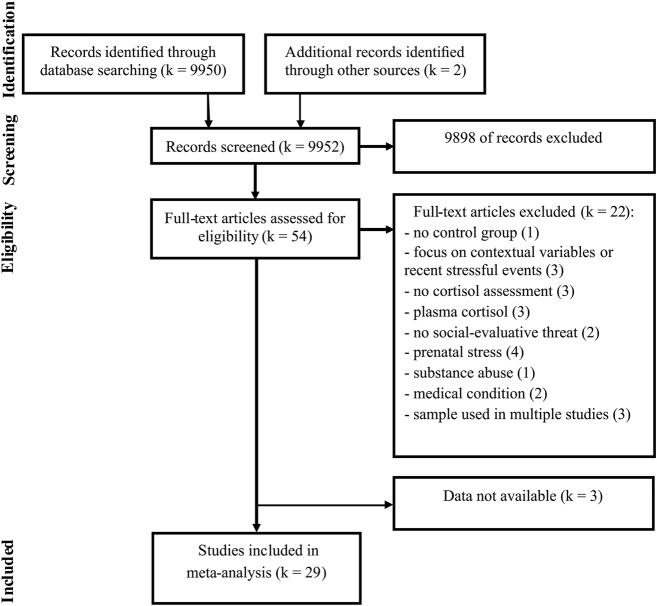
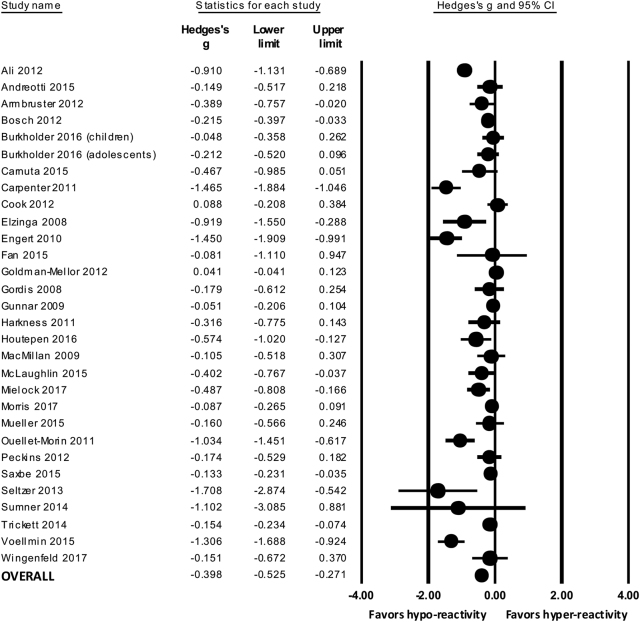
Early-life adversity has been associated with a life-long increased risk for psychopathology and chronic health problems. These long-term negative effects have been explained through stress sensitization, which may involve dysregulation of the hypothalamic-pituitary-adrenal (HPA) axis through either increased or decreased reactivity. The present meta-analysis assessed for the first time the effect of early-life adversity on cortisol response to social stress. Thirty data sets were included in the meta-analysis, in which early-life adversity and salivary cortisol response to social stress were assessed in 4292 individuals of different ages. Results indicated a moderate effect size (g = -0.39) in overall cortisol levels across studies. Separate analyses of cortisol at different stages of response showed large effect sizes at peak and recovery, and a moderate effect at baseline. Heterogeneity was large in this sample of studies and several moderators were identified. The effect size was larger in studies that focused on maltreatment compared to those that included other adversities, and in adults compared to children and adolescents. Percent of women in each sample and methodological quality were positive predictors of the effect size. Publication bias may be present, but the analysis was hampered by the high heterogeneity. Therefore, these results support the association between early-life adversity and blunted cortisol response to social stress, and they suggest that the long-term negative effects of early-life adversity may reach maximum levels in adults.
Overview
The claims and statistics of this paper haven’t been checked yet.
Run the check — free, no account needed. It reads the open-access text and checks the sources it cites.
Integrity signals
Registry
Cites
Statistics
Figures
Verification
Claims the paper makes
The claims and statistics of this paper haven’t been checked yet.
Run the check — free, no account needed. It reads the open-access text and checks the sources it cites.
Claims other papers make about this one
Each is checked against this paper’s own text: does it say what the citing paper says it does?
In the citing paper
“However, dysregulation of allostatic systems can manifest as either hypo- or hyper- responsiveness to stress later in life,(14–16) with consequent impairment in endogenous pain regulation.(17–19)”
Self-check
Percentages, sums and reported differences re-computed from the paper’s own numbers.
The self-check needs the paper’s full text.
Citations
Cites
Borenstein, M., Hedges, L. V., Higgins, J. P. T., & Rothstein, H. R. (2009) · doi:10.1002/9780470743386 · Cited by 14,225
Duval, S., & Tweedie, R. (2000) · Biometrics · doi:10.1111/j.0006-341x.2000.00455.x · Cited by 14,099
Borenstein, M., Hedges, L. V., Higgins, J. P. T., & Rothstein, H. R. (2021) · doi:10.1002/9781119558378 · Cited by 9,799
Sapolsky, R. M., Romero, L. M., & Munck, A. U. (2000) · Endocrine Reviews · doi:10.1210/edrv.21.1.0389 · Cited by 7,541
Effects of stress throughout the lifespan on the brain, behaviour and cognition
Lupien, S. J., McEwen, B. S., Gunnar, M. R., & Heim, C. (2009) · Nature Reviews Neuroscience · doi:10.1038/nrn2639 · Cited by 6,256
Dickerson, S. S., & Kemeny, M. E. (2004) · Psychological Bulletin · doi:10.1037/0033-2909.130.3.355 · Cited by 5,881
Stress, adaptation, and disease. Allostasis and allostatic load
McEWEN, B. S. (1998) · Annals of the New York Academy of Sciences · doi:10.1111/j.1749-6632.1998.tb09546.x · Cited by 5,092
Norman, R. E., Byambaa, M., De, R., Butchart, A., Scott, J., & Vos, T. (2012) · PLoS Medicine · doi:10.1371/journal.pmed.1001349 · Cited by 3,387
Green, J. G., McLaughlin, K. A., Berglund, P. A., Gruber, M. J., Sampson, N. A., Zaslavsky, A. M., & Kessler, R. C. (2010) · Archives of General Psychiatry · doi:10.1001/archgenpsychiatry.2009.186 · Cited by 2,323
Lipsey, M. W., & Wilson, D. B. (1993) · American Psychologist · doi:10.1037/0003-066x.48.12.1181 · Cited by 2,033
Research works printed but not linked: 2
- Kudielka B. M., Hellhammer D. H., Kirschbaum C. in Social Neuroscience: Integrating Biological and Psychological Explanations of Social Behavior (eds Harmon-Jones E., Winkielman P.) 56-83 (Guilford Press, New York, NY, US, 2007).
- Hedges L. V., Olkin I. Statistical Methods for Meta-analysis (Academic Press, Orlando, FL, USA, 1985).
Cited by
Sorted by citations
Stress and Health: A Review of Psychobiological Processes
O'Connor, D. B., Thayer, J. F., & Vedhara, K. (2021) · Annual Review of Psychology · doi:10.1146/annurev-psych-062520-122331 · Cited by 948
Turner, A. I., Smyth, N., Hall, S. J., Torres, S. J., Hussein, M., Jayasinghe, S. U., Ball, K., & Clow, A. J. (2020) · Psychoneuroendocrinology · doi:10.1016/j.psyneuen.2020.104599 · Cited by 503
Developmental Adaptation to Stress: An Evolutionary Perspective
Ellis, B. J., & Giudice, M. D. (2018) · Annual Review of Psychology · doi:10.1146/annurev-psych-122216-011732 · Cited by 479
The effects of social isolation stress and discrimination on mental health
Brandt, L., Liu, S., Heim, C. C., & Heinz, A. (2022) · Translational Psychiatry · doi:10.1038/s41398-022-02178-4 · Cited by 549
Sex differences in stress-related alcohol use
Peltier, M. R., Verplaetse, T. L., Mineur, Y. S., Petrakis, I. L., Cosgrove, K., Picciotto, M. R., & McKee, S. A. (2019) · Neurobiology of Stress · doi:10.1016/j.ynstr.2019.100149 · Cited by 440
Metadata
- Authors
- Bunea, I. M., Szentágotai-Tătar, A., & Miu, A. C.
- Affiliations
- Babeș-Bolyai University (RO)
- Corresponding author
- Miu, Andrei C.
- ORCID
- Miu, Andrei C.
- Venue
- Translational Psychiatry
- Published
- 2017-12-11
- Volume
- 7
- Issue
- 12
- Pages
- 1274-1274
- ISSN
- 2158-3188 (ISSN-L)
- PMC
- PMC5802499
- OpenAlex
- W2771364118
- Cited by
- 392
- References
- 62
- Citations by year
- 2026: 42 · 2025: 42 · 2024: 52 · 2023: 53 · 2022: 52 · 2021: 63 · 2020: 43 · 2019: 28 · 2018: 16
- FWCI
- 2.10
- Type
- journal article
- Language
- en
- Open access
- gold
- doi.org
- Locations
- Translational Psychiatry (publishedVersion, cc-by)
- PubMed Central (publishedVersion, cc-by)
- PubMed (publishedVersion)
- DOAJ (DOAJ: Directory of Open Access Journals) (submittedVersion)
- Funders
- Unitatea Executiva pentru Finantarea Invatamantului Superior, a Cercetarii, Dezvoltarii si Inovarii (PN-III-P4-ID, PN-III-P4-ID-PCE-2016, PN-III-P4-ID-PCE-2016-0840)
- Topics
- Life Sciences › Neuroscience › Behavioral Neuroscience › Stress Responses and Cortisol
- Social Sciences › Psychology › Clinical Psychology › Child Abuse and Trauma
- Social Sciences › Psychology › Clinical Psychology › Posttraumatic Stress Disorder Research
- Keywords
- childhood adversity, cortisol response, social stress, HPA axis dysregulation, stress sensitization, child abuse, blunted cortisol response, salivary cortisol, psychopathology, chronic disease
- MeSH terms
- Adolescent, Adult, Child, Humans, Hydrocortisone, Life Change Events, Middle Aged, Saliva, Stress, Psychological, Young Adult
About these checks
Registry, retraction, Cites and statistics results are computed, not judged, with one exception: a printed reference that no index lists is read once by a model before it counts as a citation error. Claims are extracted by a model and kept only when their quote appears verbatim in the text; each cited source is then checked, with a model’s help, for whether it says what the claim relies on. Those verdicts can be wrong — read the claim’s quote and the cited source before relying on one.
Statistics and arithmetic are recomputed, not judged.
Confidence bands are shown only for fields calibrated on our annotated test set. None is calibrated yet, so no band is shown.
What counts as a claim ›How we measure confidence ›How we check this ›
Are you an author, or do you see a problem with this page? Request a review
