

The DOI matches its Crossref record; 62 of the 62 references it cites were found in a registry or an index.
Early-life adversity and cortisol response to social stress: a meta-analysis
Open accessAbstract
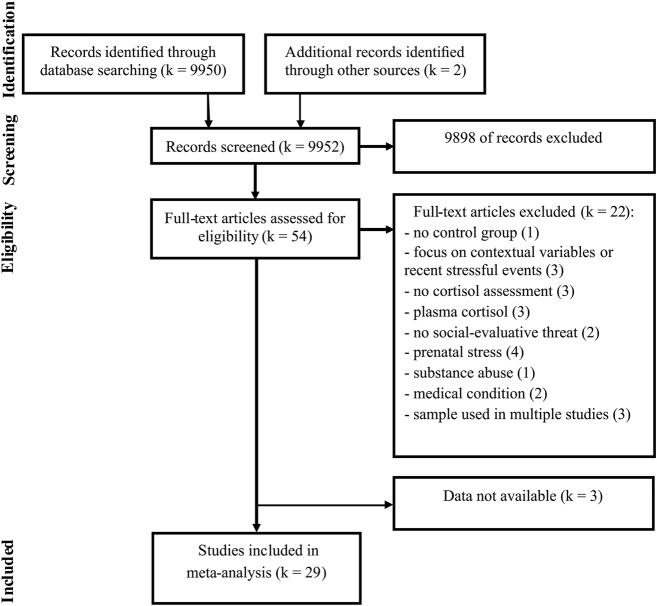
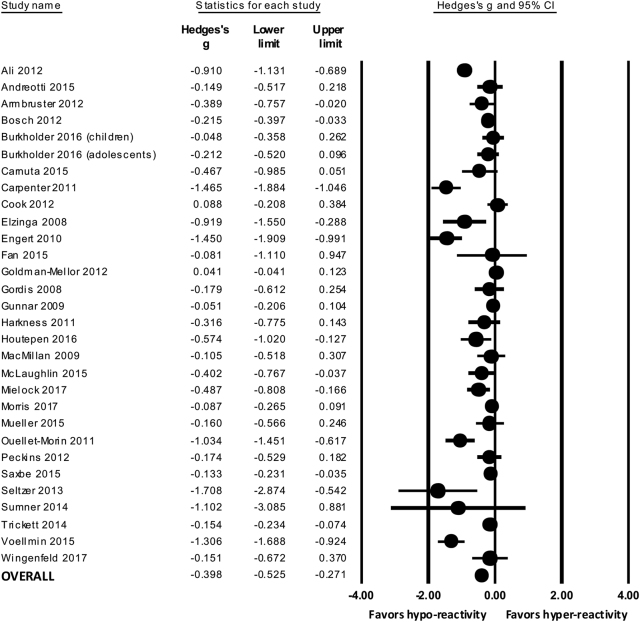
Early-life adversity has been associated with a life-long increased risk for psychopathology and chronic health problems. These long-term negative effects have been explained through stress sensitization, which may involve dysregulation of the hypothalamic-pituitary-adrenal (HPA) axis through either increased or decreased reactivity. The present meta-analysis assessed for the first time the effect of early-life adversity on cortisol response to social stress. Thirty data sets were included in the meta-analysis, in which early-life adversity and salivary cortisol response to social stress were assessed in 4292 individuals of different ages. Results indicated a moderate effect size (g = -0.39) in overall cortisol levels across studies. Separate analyses of cortisol at different stages of response showed large effect sizes at peak and recovery, and a moderate effect at baseline. Heterogeneity was large in this sample of studies and several moderators were identified. The effect size was larger in studies that focused on maltreatment compared to those that included other adversities, and in adults compared to children and adolescents. Percent of women in each sample and methodological quality were positive predictors of the effect size. Publication bias may be present, but the analysis was hampered by the high heterogeneity. Therefore, these results support the association between early-life adversity and blunted cortisol response to social stress, and they suggest that the long-term negative effects of early-life adversity may reach maximum levels in adults.
Overview
The claims and statistics of this paper haven’t been checked yet.
Run the check — free, no account needed. It reads the open-access text and checks the sources it cites.
Integrity signals
Registry
Cites
Statistics
Figures
Verification
Claims the paper makes
The claims and statistics of this paper haven’t been checked yet.
Run the check — free, no account needed. It reads the open-access text and checks the sources it cites.
Claims other papers make about this one
Each is checked against this paper’s own text: does it say what the citing paper says it does?
In the citing paper
“However, dysregulation of allostatic systems can manifest as either hypo- or hyper- responsiveness to stress later in life,(14–16) with consequent impairment in endogenous pain regulation.(17–19)”
Self-check
Percentages, sums and reported differences re-computed from the paper’s own numbers.
The self-check needs the paper’s full text.
Citations
Cites
Borenstein, M., Hedges, L. V., Higgins, J. P. T., & Rothstein, H. R. (2009) · doi:10.1002/9780470743386 · Cited by 14,225
Duval, S., & Tweedie, R. (2000) · Biometrics · doi:10.1111/j.0006-341x.2000.00455.x · Cited by 14,099
Borenstein, M., Hedges, L. V., Higgins, J. P. T., & Rothstein, H. R. (2021) · doi:10.1002/9781119558378 · Cited by 9,799
Sapolsky, R. M., Romero, L. M., & Munck, A. U. (2000) · Endocrine Reviews · doi:10.1210/edrv.21.1.0389 · Cited by 7,541
Effects of stress throughout the lifespan on the brain, behaviour and cognition
Lupien, S. J., McEwen, B. S., Gunnar, M. R., & Heim, C. (2009) · Nature Reviews Neuroscience · doi:10.1038/nrn2639 · Cited by 6,256
Dickerson, S. S., & Kemeny, M. E. (2004) · Psychological Bulletin · doi:10.1037/0033-2909.130.3.355 · Cited by 5,881
Stress, adaptation, and disease. Allostasis and allostatic load
McEWEN, B. S. (1998) · Annals of the New York Academy of Sciences · doi:10.1111/j.1749-6632.1998.tb09546.x · Cited by 5,092
Norman, R. E., Byambaa, M., De, R., Butchart, A., Scott, J., & Vos, T. (2012) · PLoS Medicine · doi:10.1371/journal.pmed.1001349 · Cited by 3,387
Green, J. G., McLaughlin, K. A., Berglund, P. A., Gruber, M. J., Sampson, N. A., Zaslavsky, A. M., & Kessler, R. C. (2010) · Archives of General Psychiatry · doi:10.1001/archgenpsychiatry.2009.186 · Cited by 2,323
Lipsey, M. W., & Wilson, D. B. (1993) · American Psychologist · doi:10.1037/0003-066x.48.12.1181 · Cited by 2,033
Heim, C. (2000) · JAMA · doi:10.1001/jama.284.5.592 · Cited by 1,968
Fries, E., Hesse, J., Hellhammer, J., & Hellhammer, D. H. (2005) · Psychoneuroendocrinology · doi:10.1016/j.psyneuen.2005.04.006 · Cited by 1,204
Stress, sensitive periods and maturational events in adolescent depression
Andersen, S. L., & Teicher, M. H. (2008) · Trends in Neurosciences · doi:10.1016/j.tins.2008.01.004 · Cited by 1,005
McLaughlin, K. A., Conron, K. J., Koenen, K. C., & Gilman, S. E. (2010) · Psychological Medicine · doi:10.1017/s0033291709992121 · Cited by 855
Adjusting for publication bias in the presence of heterogeneity
Terrin, N., Schmid, C. H., Lau, J., & Olkin, I. (2003) · Statistics in Medicine · doi:10.1002/sim.1461 · Cited by 809
Paradise lost: the neurobiological and clinical consequences of child abuse and neglect
Nemeroff, C. B. (2016) · Neuron · doi:10.1016/j.neuron.2016.01.019 · Cited by 768
Child maltreatment and the developing HPA axis
Tarullo, A. R., & Gunnar, M. R. (2006) · Hormones and Behavior · doi:10.1016/j.yhbeh.2006.06.010 · Cited by 737
Cortisol stress reactivity across psychiatric disorders: a systematic review and meta-analysis
Zorn, J. V., Schür, R. R., Boks, M. P., Kahn, R. S., Joëls, M., & Vinkers, C. H. (2017) · Psychoneuroendocrinology · doi:10.1016/j.psyneuen.2016.11.036 · Cited by 697
The cortisol awakening response: More than a measure of HPA axis function
Clow, A., Hucklebridge, F., Stalder, T., Evans, P., & Thorn, L. (2010) · Neuroscience & Biobehavioral Reviews · doi:10.1016/j.neubiorev.2009.12.011 · Cited by 635
Depression and sensitization to stressors among young women as a function of childhood adversity
Hammen, C., Henry, R., & Daley, S. E. (2000) · Journal of Consulting and Clinical Psychology · doi:10.1037/0022-006x.68.5.782 · Cited by 598
Future Directions in Childhood Adversity and Youth Psychopathology
McLaughlin, K. A. (2016) · Journal of Clinical Child & Adolescent Psychology · doi:10.1080/15374416.2015.1110823 · Cited by 576 · cited 3×
“, history of institutionalization and adoption); (2) an assessment of the severity of early-life adversity; (3) no other task during saliva-sampling in addition to the social stress test; (4) social stress test scheduled in the afternoon (i.”
BackgroundCarpenter, L. L., Carvalho, J. P., Tyrka, A. R., Wier, L. M., Mello, A. F., Mello, M. F., Anderson, G. M., Wilkinson, C. W., & Price, L. H. (2007) · Biological Psychiatry · doi:10.1016/j.biopsych.2007.05.002 · Cited by 564
McLaughlin, K. A., Green, J. G., Gruber, M. J., Sampson, N. A., Zaslavsky, A. M., & Kessler, R. C. (2010) · Archives of General Psychiatry · doi:10.1001/archgenpsychiatry.2009.187 · Cited by 528
Cicchetti, D. (2016) · Annual Review of Psychology · doi:10.1146/annurev-psych-122414-033259 · Cited by 459
McLaughlin, K. A., Sheridan, M. A., Tibu, F., Fox, N. A., Zeanah, C. H., & Nelson, C. A. (2015) · Proceedings of the National Academy of Sciences · doi:10.1073/pnas.1423363112 · Cited by 426
Attenuation of cortisol across development for victims of sexual abuse
Trickett, P. K., Noll, J. G., Susman, E. J., Shenk, C. E., & Putnam, F. W. (2010) · Development and Psychopathology · doi:10.1017/s0954579409990332 · Cited by 405
Diminished cortisol responses to psychosocial stress associated with lifetime adverse events
Elzinga, B. M., Roelofs, K., Tollenaar, M. S., Bakvis, P., van Pelt, J., & Spinhoven, P. (2008) · Psychoneuroendocrinology · doi:10.1016/j.psyneuen.2007.11.004 · Cited by 364
Gunnar, M. R., Frenn, K., Wewerka, S. S., & Van Ryzin, M. J. (2009) · Psychoneuroendocrinology · doi:10.1016/j.psyneuen.2008.08.013 · Cited by 363
Effect of childhood physical abuse on cortisol stress response
Carpenter, L. L., Shattuck, T. T., Tyrka, A. R., Geracioti, T. D., & Price, L. H. (2011) · Psychopharmacology · doi:10.1007/s00213-010-2007-4 · Cited by 307
Ouellet‐Morin, I., Odgers, C. L., Danese, A., Bowes, L., Shakoor, S., Papadopoulos, A. S., Caspi, A., Moffitt, T. E., & Arseneault, L. (2011) · Biological Psychiatry · doi:10.1016/j.biopsych.2011.06.017 · Cited by 284
MacMillan, H. L., Georgiades, K., Duku, E. K., Shea, A., Steiner, M., Niec, A., Tanaka, M., Gensey, S., Spree, S., Vella, E., et al. (2009) · Biological Psychiatry · doi:10.1016/j.biopsych.2008.12.014 · Cited by 281
Liu, J. J. W., Ein, N., Peck, K., Huang, V., Pruessner, J. C., & Vickers, K. (2017) · Psychoneuroendocrinology · doi:10.1016/j.psyneuen.2017.04.007 · Cited by 274
Houtepen, L. C., Vinkers, C. H., Carrillo-Roa, T., Hiemstra, M., van Lier, P. A., Meeus, W., Branje, S., Heim, C. M., Nemeroff, C. B., Mill, J., et al. (2016) · Nature Communications · doi:10.1038/ncomms10967 · Cited by 242
Harkness, K. L., Stewart, J. G., & Wynne‐Edwards, K. E. (2010) · Psychoneuroendocrinology · doi:10.1016/j.psyneuen.2010.07.006 · Cited by 222
Salivary alpha amylase-cortisol asymmetry in maltreated youth
Gordis, E. B., Granger, D. A., Susman, E. J., & Trickett, P. K. (2008) · Hormones and Behavior · doi:10.1016/j.yhbeh.2007.09.002 · Cited by 211
Ali, N., & Pruessner, J. C. (2011) · Physiology & Behavior · doi:10.1016/j.physbeh.2011.10.003 · Cited by 211
Maltreatment and diurnal cortisol regulation: a meta-analysis
Bernard, K., Frost, A., Bennett, C. B., & Lindhiem, O. (2017) · Psychoneuroendocrinology · doi:10.1016/j.psyneuen.2017.01.005 · Cited by 180
McLaughlin, K. A., Green, J. G., Gruber, M. J., Sampson, N. A., Zaslavsky, A. M., & Kessler, R. C. (2009) · Psychological Medicine · doi:10.1017/s0033291709991115 · Cited by 172
Bosch, N. M., Riese, H., Reijneveld, S. A., Bakker, M. P., Verhulst, F. C., Ormel, J., & Oldehinkel, A. J. (2012) · Psychoneuroendocrinology · doi:10.1016/j.psyneuen.2012.01.013 · Cited by 163
Voellmin, A., Winzeler, K., Hug, E., Wilhelm, F. H., Schaefer, V., Gaab, J., La Marca, R., Pruessner, J. C., & Bader, K. (2015) · Psychoneuroendocrinology · doi:10.1016/j.psyneuen.2014.09.008 · Cited by 144
The disease burden of childhood adversities in adults: A population-based study
Cuijpers, P. J., Smit, F., Unger, F., Stikkelbroek, Y. A. J., ten Have, M., & de Graaf, R. (2011) · Child Abuse & Neglect · doi:10.1016/j.chiabu.2011.06.005 · Cited by 127
Seltzer, L. J., Ziegler, T. E., Connolly, M. J., Prososki, A. R., & Pollak, S. D. (2013) · Child Development · doi:10.1111/cdev.12136 · Cited by 121
Stress reactivity in maltreated and comparison male and female young adolescents
Trickett, P. K., Gordis, E., Peckins, M. K., & Susman, E. J. (2014) · Child Maltreatment · doi:10.1177/1077559513520466 · Cited by 98
Mueller‐Alcazar, A., Armbruster, D., Moser, D., Canli, T., Lesch, K., Brocke, B., & Kirschbaum, C. (2011) · Neuropsychopharmacology · doi:10.1038/npp.2011.11 · Cited by 89
Goldman-Mellor, S. J., Hamer, M., & Steptoe, A. (2012) · Psychoneuroendocrinology · doi:10.1016/j.psyneuen.2012.03.010 · Cited by 88
Armbruster, D., Mueller, A., Strobel, A., Lesch, K.-P., Brocke, B., & Kirschbaum, C. (2012) · The International Journal of Neuropsychopharmacology · doi:10.1017/s1461145711001763 · Cited by 87
Perceived early-life maternal care and the cortisol response to repeated psychosocial stress
Engert, V. (2010) · Journal of Psychiatry & Neuroscience · doi:10.1503/jpn.100022 · Cited by 86
The Longitudinal Impact of Exposure to Violence on Cortisol Reactivity in Adolescents
Peckins, M. K., Dockray, S., Eckenrode, J. L., Heaton, J., & Susman, E. J. (2012) · Journal of Adolescent Health · doi:10.1016/j.jadohealth.2012.01.005 · Cited by 76
Fan, Y., Pestke, K., Feeser, M., Aust, S., Pruessner, J. C., Böker, H., Bajbouj, M., & Grimm, S. (2015) · Neuropsychopharmacology · doi:10.1038/npp.2015.123 · Cited by 75
The role of childhood abuse in HPA-axis reactivity in Social Anxiety Disorder: A pilot study
Elzinga, B. M., Spinhoven, P., Berretty, E. W., de Jong, P., & Roelofs, K. (2009) · Biological Psychology · doi:10.1016/j.biopsycho.2009.09.006 · Cited by 73
Evaluating Childhood Adversity
Thabrew, H., de Sylva, S., & Romans, S. E. (2011) · Advances in psychosomatic medicine · doi:10.1159/000330002 · Cited by 69
The Stress Response and Adolescents’ Adjustment: The Impact of Child Maltreatment
Cook, E. C., Chaplin, T. M., Sinha, R., Tebes, J. K., & Mayes, L. C. (2012) · Journal of Youth and Adolescence · doi:10.1007/s10964-012-9746-y · Cited by 53
CRHR1 genotype and history of maltreatment predict cortisol reactivity to stress in adolescents
Sumner, J. A., McLaughlin, K. A., Walsh, K., Sheridan, M. A., & Koenen, K. C. (2014) · Psychoneuroendocrinology · doi:10.1016/j.psyneuen.2014.02.002 · Cited by 52
Saxbe, D., Negriff, S. L., Susman, E. J., & Trickett, P. K. (2014) · Development and Psychopathology · doi:10.1017/s0954579414000790 · Cited by 47
Early Life Stress: Effects on the Regulation of Anxiety Expression in Children and Adolescents
Burkholder, A. R., Koss, K. J., Hostinar, C. E., Johnson, A. E., & Gunnar, M. R. (2015) · Social Development · doi:10.1111/sode.12170 · Cited by 46
Wingenfeld, K., Kuehl, L. K., Boeker, A., Schultebraucks, K., Ritter, K., Hellmann‐Regen, J., Otte, C., & Spitzer, C. (2017) · Psychoneuroendocrinology · doi:10.1016/j.psyneuen.2017.03.014 · Cited by 46
Emotional non-acceptance links early life stress and blunted cortisol reactivity to social threat
Cărnuţă, M., Crişan, L. G., Vulturar, R., Opre, A. N., & Miu, A. C. (2014) · Psychoneuroendocrinology · doi:10.1016/j.psyneuen.2014.09.026 · Cited by 44
Self-citationDepressive symptom composites associated with cortisol stress reactivity in adolescents
Morris, M. C., Kouros, C. D., Mielock, A. S., & Rao, U. (2016) · Journal of Affective Disorders · doi:10.1016/j.jad.2016.12.023 · Cited by 40
Wang, L.-H., Paul, N. A., Stanton, S. J., Greeson, J. M., & Smoski, M. (2013) · Frontiers in Psychology · doi:10.3389/fpsyg.2013.00320 · Cited by 37
Patterns of cortisol and alpha-amylase reactivity to psychosocial stress in maltreated women
Mielock, A. S., Morris, M. C., & Rao, U. (2016) · Journal of Affective Disorders · doi:10.1016/j.jad.2016.11.009 · Cited by 28
Andreotti, C., Garrard, P., Venkatraman, S., & Compas, B. E. (2014) · Cognitive Therapy and Research · doi:10.1007/s10608-014-9659-z · Cited by 20
Cortisol Responses to Psychosocial Stress: The Role of Childhood Maltreatment and Depression.
Rao, U., & Morris, M. C. (2015) · PubMed · Cited by 6
Research works printed but not linked: 2
- Kudielka B. M., Hellhammer D. H., Kirschbaum C. in Social Neuroscience: Integrating Biological and Psychological Explanations of Social Behavior (eds Harmon-Jones E., Winkielman P.) 56-83 (Guilford Press, New York, NY, US, 2007).
- Hedges L. V., Olkin I. Statistical Methods for Meta-analysis (Academic Press, Orlando, FL, USA, 1985).
Cited by
Sorted by citations
Stress and Health: A Review of Psychobiological Processes
O'Connor, D. B., Thayer, J. F., & Vedhara, K. (2021) · Annual Review of Psychology · doi:10.1146/annurev-psych-062520-122331 · Cited by 948
Turner, A. I., Smyth, N., Hall, S. J., Torres, S. J., Hussein, M., Jayasinghe, S. U., Ball, K., & Clow, A. J. (2020) · Psychoneuroendocrinology · doi:10.1016/j.psyneuen.2020.104599 · Cited by 503
Developmental Adaptation to Stress: An Evolutionary Perspective
Ellis, B. J., & Giudice, M. D. (2018) · Annual Review of Psychology · doi:10.1146/annurev-psych-122216-011732 · Cited by 479
The effects of social isolation stress and discrimination on mental health
Brandt, L., Liu, S., Heim, C. C., & Heinz, A. (2022) · Translational Psychiatry · doi:10.1038/s41398-022-02178-4 · Cited by 549
Sex differences in stress-related alcohol use
Peltier, M. R., Verplaetse, T. L., Mineur, Y. S., Petrakis, I. L., Cosgrove, K., Picciotto, M. R., & McKee, S. A. (2019) · Neurobiology of Stress · doi:10.1016/j.ynstr.2019.100149 · Cited by 440
Metadata
- Authors
- Bunea, I. M., Szentágotai-Tătar, A., & Miu, A. C.
- Affiliations
- Babeș-Bolyai University (RO)
- Corresponding author
- Miu, Andrei C.
- ORCID
- Miu, Andrei C.
- Venue
- Translational Psychiatry
- Published
- 2017-12-11
- Volume
- 7
- Issue
- 12
- Pages
- 1274-1274
- ISSN
- 2158-3188 (ISSN-L)
- PMC
- PMC5802499
- OpenAlex
- W2771364118
- Cited by
- 392
- References
- 62
- Citations by year
- 2026: 42 · 2025: 42 · 2024: 52 · 2023: 53 · 2022: 52 · 2021: 63 · 2020: 43 · 2019: 28 · 2018: 16
- FWCI
- 2.10
- Type
- journal article
- Language
- en
- Open access
- gold
- doi.org
- Locations
- Translational Psychiatry (publishedVersion, cc-by)
- PubMed Central (publishedVersion, cc-by)
- PubMed (publishedVersion)
- DOAJ (DOAJ: Directory of Open Access Journals) (submittedVersion)
- Funders
- Unitatea Executiva pentru Finantarea Invatamantului Superior, a Cercetarii, Dezvoltarii si Inovarii (PN-III-P4-ID, PN-III-P4-ID-PCE-2016, PN-III-P4-ID-PCE-2016-0840)
- Topics
- Life Sciences › Neuroscience › Behavioral Neuroscience › Stress Responses and Cortisol
- Social Sciences › Psychology › Clinical Psychology › Child Abuse and Trauma
- Social Sciences › Psychology › Clinical Psychology › Posttraumatic Stress Disorder Research
- Keywords
- childhood adversity, cortisol response, social stress, HPA axis dysregulation, stress sensitization, child abuse, blunted cortisol response, salivary cortisol, psychopathology, chronic disease
- MeSH terms
- Adolescent, Adult, Child, Humans, Hydrocortisone, Life Change Events, Middle Aged, Saliva, Stress, Psychological, Young Adult
About these checks
Registry, retraction, Cites and statistics results are computed, not judged, with one exception: a printed reference that no index lists is read once by a model before it counts as a citation error. Claims are extracted by a model and kept only when their quote appears verbatim in the text; each cited source is then checked, with a model’s help, for whether it says what the claim relies on. Those verdicts can be wrong — read the claim’s quote and the cited source before relying on one.
Statistics and arithmetic are recomputed, not judged.
Confidence bands are shown only for fields calibrated on our annotated test set. None is calibrated yet, so no band is shown.
What counts as a claim ›How we measure confidence ›How we check this ›
Are you an author, or do you see a problem with this page? Request a review
