

Lateral habenula perturbation reduces default-mode network connectivity in a rat model of depression
Open accessThe DOI matches its Crossref record; 71 of the 71 references it cites were found in a registry or an index.
Abstract
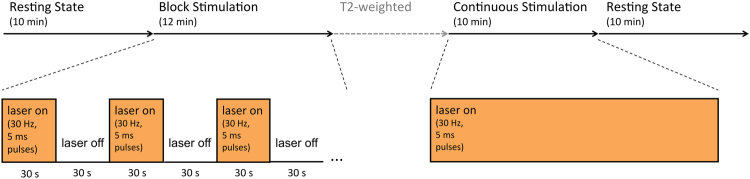
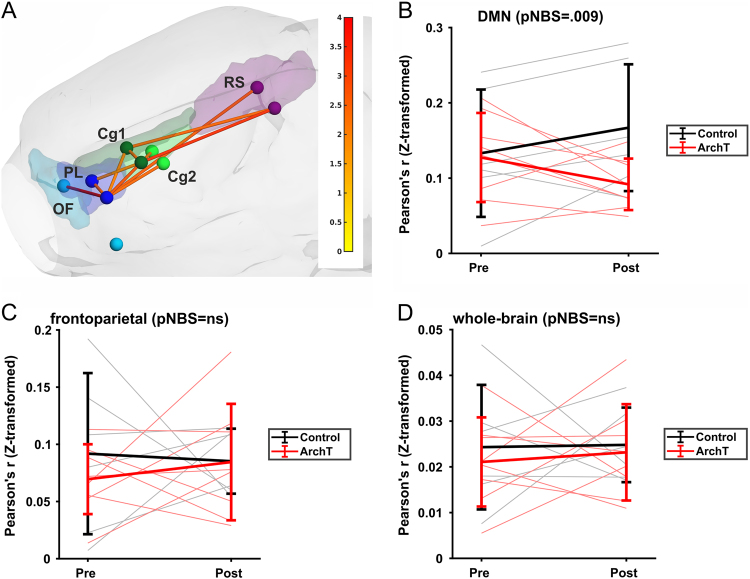
Hyperconnectivity of the default-mode network (DMN) is one of the most widely replicated neuroimaging findings in major depressive disorder (MDD). Further, there is growing evidence for a central role of the lateral habenula (LHb) in the pathophysiology of MDD. There is preliminary neuroimaging evidence linking LHb and the DMN, but no causal relationship has been shown to date. We combined optogenetics and functional magnetic resonance imaging (fMRI), to establish a causal relationship, using an animal model of treatment-resistant depression, namely Negative Cognitive State rats. First, an inhibitory light-sensitive ion channel was introduced into the LHb by viral transduction. Subsequently, laser stimulation was performed during fMRI acquisition on a 9.4 Tesla animal scanner. Neural activity and connectivity were assessed, before, during and after laser stimulation. We observed a connectivity decrease in the DMN following laser-induced LHb perturbation. Our data indicate a causal link between LHb downregulation and reduction in DMN connectivity. These findings may advance our mechanistic understanding of LHb inhibition, which had previously been identified as a promising therapeutic principle, especially for treatment-resistant depression.
Overview
The claims and statistics of this paper haven’t been checked yet.
Free: it reads the open-access text and checks the first 5 claims that cite a source we can check. Create a free account to check every claim.
Integrity signals
Registry
Cites
Statistics
Figures
Verification
Claims the paper makes
The claims and statistics of this paper haven’t been checked yet.
Free: it reads the open-access text and checks the first 5 claims that cite a source we can check. Create a free account to check every claim.
Claims other papers make about this one
Each is checked against this paper’s own text: does it say what the citing paper says it does?
The source backs part of the claim, not all of it — or backs it for a different population, condition or comparison.
In the citing paper
“Causal manipulations that attenuate default-mode drive reduce its pathological coupling: optogenetic silencing of the lateral habenula diminishes default mode network (DMN) hyperconnectivity in a depression model, while chemogenetic suppression of anterior cingulate cortex reconfigures DMN edges and improves behavior aligned with reduced rumination liability [284,285,286].”
From Synaptic Plasticity—Intrinsic Excitability and Antidepressant Discovery (2026) · cites this paper as [285]
Experimental — accuracy not yet measuredThe source backs part of the claim, not all of it — or backs it for a different population, condition or comparison.
In the citing paper
“Network-level corroboration comes from white-matter disruption of forceps minor that perturbs DMN connectivity, increases anxiety, and normalizes with recovery, linking DMN integrity to affective behavior and strengthening the translational rationale for calibrated HCN modulation to curb rumination-like and anxiety-related outcomes [284,285].”
From Synaptic Plasticity—Intrinsic Excitability and Antidepressant Discovery (2026) · cites this paper as [285]
Experimental — accuracy not yet measuredThe check wasn’t confident either way, so it gives no verdict — never disputed.
In the citing paper
“Causal manipulations that attenuate default-mode drive reduce its pathological coupling: optogenetic silencing of the lateral habenula diminishes default mode network (DMN) hyperconnectivity in a depression model, while chemogenetic suppression of anterior cingulate cortex reconfigures DMN edges and improves behavior aligned with reduced rumination liability [284,285,286].”
From Synaptic Plasticity—Intrinsic Excitability and Antidepressant Discovery (2026) · cites this paper as [285]
Experimental — accuracy not yet measured
Self-check
Percentages, sums and reported differences re-computed from the paper’s own numbers.
The self-check needs the paper’s full text.
Citations
Cites
Scoville, W. B. (1949) · Journal of neurosurgery · doi:10.3171/jns.1949.6.1.0065 · Cited by 7,381
Millisecond-timescale, genetically targeted optical control of neural activity
Boyden, E. S., Zhang, F., Bamberg, E., Nagel, G., & Deisseroth, K. (2005) · Nature Neuroscience · doi:10.1038/nn1525 · Cited by 4,861
Network-based statistic: identifying differences in brain networks
Zalesky, A., Fornito, A., & Bullmore, E. T. (2010) · NeuroImage · doi:10.1016/j.neuroimage.2010.06.041 · Cited by 2,750
Kaiser, R. H., Andrews-Hanna, J. R., Wager, T. D., & Pizzagalli, D. A. (2015) · JAMA Psychiatry · doi:10.1001/jamapsychiatry.2015.0071 · Cited by 2,281
Greicius, M. D., Flores, B. H., Menon, V., Glover, G. H., Solvason, H. B., Kenna, H., Reiss, A. L., & Schatzberg, A. F. (2007) · Biological Psychiatry · doi:10.1016/j.biopsych.2006.09.020 · Cited by 2,214
A toolbox of Cre-dependent optogenetic transgenic mice for light-induced activation and silencing
Madisen, L., Mao, T., Koch, H., Zhuo, J.-M., Berenyi, A., Fujisawa, S., Hsu, Y.-W. A., Garcia, A. J., Gu, X., Zanella, S., et al. (2012) · Nature Neuroscience · doi:10.1038/nn.3078 · Cited by 1,398
Input-specific control of reward and aversion in the ventral tegmental area
Lammel, S., Lim, B. K., Ran, C., Huang, K. W., Betley, M. J., Tye, K. M., Deisseroth, K., & Malenka, R. C. (2012) · Nature · doi:10.1038/nature11527 · Cited by 1,300
Lateral habenula as a source of negative reward signals in dopamine neurons
Matsumoto, M., & Hikosaka, O. (2007) · Nature · doi:10.1038/nature05860 · Cited by 1,292
Depressive rumination, the default-mode network, and the dark matter of clinical neuroscience
Hamilton, J. P., Farmer, M., Fogelman, P., & Gotlib, I. H. (2015) · Biological Psychiatry · doi:10.1016/j.biopsych.2015.02.020 · Cited by 952
Resting-state functional connectivity in major depressive disorder: A review
Mulders, P. C., van Eijndhoven, P. F., Schene, A. H., Beckmann, C. F., & Tendolkar, I. (2015) · Neuroscience & Biobehavioral Reviews · doi:10.1016/j.neubiorev.2015.07.014 · Cited by 884
Cited by
Sleep, insomnia, and depression
Riemann, D., Krone, L. B., Wulff, K., & Nissen, C. (2020) · Neuropsychopharmacology · doi:10.1038/s41386-019-0411-y · Cited by 819
Animal models of depression: pros and cons
Harro, J. (2018) · Cell and Tissue Research · doi:10.1007/s00441-018-2973-0 · Cited by 118
miR-323a regulates ERBB4 and is involved in depression
Fiori, L. M., Kos, A., Lin, R., Théroux, J.-F., Lopez, J. P., Kühne, C., Eggert, C., Holzapfel, M., Huettl, R.-E., Mechawar, N., et al. (2021) · Molecular Psychiatry · doi:10.1038/s41380-020-00953-7 · Cited by 88
Rahimi, S., Peeri, M., Azarbayjani, M. A., Anoosheh, L., Ghasemzadeh, E., Khalifeh, N., Noroozi-Mahyari, S., Deravi, S., Saffari-Anaraki, S., Zangeneh, F. H., et al. (2020) · Physiology & Behavior · doi:10.1016/j.physbeh.2020.113130 · Cited by 63
Enayati, M., Mosaferi, B., Homberg, J. R., Diniz, D. M., & Salari, A.-A. (2020) · Life Sciences · doi:10.1016/j.lfs.2020.117597 · Cited by 52
Altered directed functional connectivity of the right amygdala in depression: high-density EEG study
Damborská, A., Honzírková, E., Barteček, R., Hořínková, J., Fedorová, S., Ondruš, Š., Michel, C. M., & Rubega, M. (2020) · Scientific Reports · doi:10.1038/s41598-020-61264-z · Cited by 50
Kohtala, S., Alitalo, O., Rosenholm, M., Rozov, S. V., & Rantamäki, T. (2020) · Pharmacology & Therapeutics · doi:10.1016/j.pharmthera.2020.107741 · Cited by 50
Case Report: Lateral Habenula Deep Brain Stimulation for Treatment-Resistant Depression
Wang, Z., Cai, X., Qiu, R., Chen, Y., Tian, Y., Gong, C., Zhang, Y., Xu, B., Zhang, D., Zang, Y., et al. (2021) · Frontiers in Psychiatry · doi:10.3389/fpsyt.2020.616501 · Cited by 43
Bashiri, H., Houwing, D. J., Homberg, J. R., & Salari, A. (2021) · Scientific Reports · doi:10.1038/s41598-021-87800-z · Cited by 43
Abnormal habenula functional connectivity characterizes treatment-resistant depression
Barreiros, A. R., Breukelaar, I. A., Mayur, P. M., Andepalli, J., Tomimatsu, Y., Funayama, K., Foster, S., Boyce, P. M., Malhi, G. S., Harris, A. W. F., et al. (2022) · NeuroImage Clinical · doi:10.1016/j.nicl.2022.102990 · Cited by 31
Chen, G., Guo, Z., Chen, P., Yang, Z., Yan, H., Sun, S., Ma, W., Zhang, Y., Qi, Z., Fang, W., et al. (2024) · International Journal of Clinical and Health Psychology · doi:10.1016/j.ijchp.2024.100483 · Cited by 28
Winkelmeier, L., Filosa, C., Hartig, R., Scheller, M. F., Sack, M., Reinwald, J., Becker, R., Wolf, D., Gerchen, M. F., Sartorius, A., et al. (2022) · Nature Communications · doi:10.1038/s41467-022-30978-1 · Cited by 26
Self-citationWang, H., Li, F., Zheng, X., Meng, L., Chen, M., Hui, Y., Li, Y., Xie, K., Zhang, J., & Guo, G. (2022) · Translational Psychiatry · doi:10.1038/s41398-022-02151-1 · Cited by 26
GABAB modulate NF-κB/NLRP3 pathways in electroacupuncture prevention of depression in CUMS rats
Li, J., Dong, Y., Zhang, T., Tong, T., Shen, J., Yan, S., Zeng, J., Aslam, M. S., Li, M., You, Z., et al. (2024) · Brain Research Bulletin · doi:10.1016/j.brainresbull.2024.111108 · Cited by 24
Fakhraei, L., Francoeur, M. J., Balasubramani, P. P., Tang, T., Hulyalkar, S., Buscher, N., Mishra, J., & Ramanathan, D. (2021) · Cerebral Cortex Communications · doi:10.1093/texcom/tgab034 · Cited by 22
Wang, M., Chen, X., Hu, Y., Zhou, Y., Wang, C., Zheng, W., Liu, W., Lan, X., Ning, Y., & Zhang, B. (2021) · Depression and Anxiety · doi:10.1002/da.23238 · Cited by 21
Pang, L., Cui, M., Dai, W., Kong, J., Chen, H., & Wu, S. (2020) · Frontiers in Pharmacology · doi:10.3389/fphar.2020.586104 · Cited by 19
Reinwald, J., Weber‐Fahr, W., Cosa‐Linan, A., Becker, R., Sack, M., Falfán-Melgoza, C., Gass, N., Braun, U., von Hohenberg, C. C., Chen, J., et al. (2022) · International Journal of Molecular Sciences · doi:10.3390/ijms232415547 · Cited by 17
Self-citationJakobs, M., Pitzer, C., Sartorius, A., Unterberg, A. W., & Kiening, K. L. (2019) · Brain Research · doi:10.1016/j.brainres.2019.06.002 · Cited by 16
Self-citationMulti-level variations of lateral habenula in depression: A comprehensive review of current evidence
Zhang, G., Wu, H.-Y., Cui, W., & Peng, W. (2022) · Frontiers in Psychiatry · doi:10.3389/fpsyt.2022.1043846 · Cited by 16
The habenula in mood disorders: A systematic review of human studies
Fortin, J., Lafleur, M., Parisien, C., & Hétu, S. (2025) · Molecular Psychiatry · doi:10.1038/s41380-025-03105-x · Cited by 15
Xu, X., Zhang, Y.-Q., Zang, F., Lu, C., Liu, L., Wang, J., Salvi, R., Chen, Y., & Teng, G. (2022) · Brain Imaging and Behavior · doi:10.1007/s11682-022-00643-8 · Cited by 12
Prospects for improved prevention and treatment of neuropsychiatric disorders: Neuroscience Applied
Meyer‐Lindenberg, A., Dickson, S. L., Millan, M. J., & Knudsen, G. M. (2022) · Neuroscience Applied · doi:10.1016/j.nsa.2022.100103 · Cited by 9
Self-citationCao, Q., Xu, X., Wang, X., He, F., Lin, Y., Guo, D., Bai, W., Guo, B., Zheng, X., & Liu, T. (2025) · Translational Psychiatry · doi:10.1038/s41398-025-03375-7 · Cited by 6
McVoy, M. K., Chumachenko, S. Y., Briggs, F. B. S., Kaffashi, F., & Loparo, K. A. (2022) · Journal of Child and Adolescent Psychopharmacology · doi:10.1089/cap.2022.0041 · Cited by 6
Blue light influences negative thoughts of self
Burge, M. T., Lumapas, R. A., Lander, A. C., Thomas, B. G., Phillips, A. J. K., & Cain, S. W. (2025) · SLEEP · doi:10.1093/sleep/zsaf034 · Cited by 5
Cui, Z., Jiang, C. Q., Hu, C., Tian, Y., Ling, Z., Wang, J., Fan, T., Hao, H., Wang, Z., & Li, L. (2023) · Frontiers in Neurology · doi:10.3389/fneur.2023.1113545 · Cited by 5
Vitkauskas, M., & Mathuru, A. S. (2020) · International Journal of Molecular Sciences · doi:10.3390/ijms21186525 · Cited by 5
Altered habenular and whole brain functional connectivity in early Parkinson’s disease using 7 T MRI
Samancı, B., Ay, U., Kuijf, M. L., Tan, S. K. H., & Temel, Y. (2025) · npj Parkinson s Disease · doi:10.1038/s41531-025-00973-6 · Cited by 4
Investigating Resistance to Antidepressants in Animal Models
Peña, J. E., Corbett, B. F., Tamminga, C. A., Bhatnagar, S., & Hitti, F. L. (2024) · Neuroscience · doi:10.1016/j.neuroscience.2024.04.013 · Cited by 4
Zhou, R., Yuan, R., Ye, J.-R., Wang, S., Chen, Y., Zhou, X., Chu, S., Zhang, Z., & Chen, N. (2025) · International Immunopharmacology · doi:10.1016/j.intimp.2025.115741 · Cited by 3
Zhu, J., Liu, M., Lu, Z., Dong, X., Zhou, Y., Kang, Y., Cheng, A. S. K., & Xie, J. (2025) · Journal of Psychiatric Research · doi:10.1016/j.jpsychires.2025.12.027 · Cited by 3
Neurovascular coupling in the basolateral amygdala modulates negative emotions
Ruan, J., Quan, X., Xie, H., Zhang, Y., Zhang, D., Wang, W., Zhao, B., Lu, D., Niu, Y., Diao, M., et al. (2026) · Cell Research · doi:10.1038/s41422-026-01256-2 · Cited by 3
Brain networks in pharmacological fMRI of NMDA antagonists
Becker, R. (2019) · heiDOK (Heidelberg University) · doi:10.11588/heidok.00027272 · Cited by 1
Self-citationMRI analysis of brain connectivity in a mouse model of Alzheimer’s disease
Degiorgis, L. (2019) · theses.fr (ABES) · doi:10.70675/5334d86bz9cc5z451cz865fzcf91895a5400 · Cited by 1
Synaptic Plasticity—Intrinsic Excitability and Antidepressant Discovery
Tanaka, M. (2026) · Biomedicines · doi:10.3390/biomedicines14061265
Aktuelle Forschungsergebnisse aus dem Bereich der biologischen Psychiatrie
Meyer‐Lindenberg, A. (2018) · Der Nervenarzt · doi:10.1007/s00115-018-0614-1
Self-citationMakedona, E.-A., Kuo, M.-E., Harvey, M., & Rainer, G. (2025) · iScience · doi:10.1016/j.isci.2025.113885
Parkinson's disease and the habenula: an ultra-high field MRI study beyond the basal ganglia
Samancı, B. (2026) · Research Publications (Maastricht University) · doi:10.26481/dis.20261001bs
Cui, Z., Jiang, C., Hu, C., Tian, Y., Ling, Z., Wang, J., Fan, T., Hao, H., Wang, Z., & Li, L. (2023) · doi:10.3389/fneur.2023.1113545.s002
Metadata
- Authors
- Clemm von Hohenberg, C., Weber-Fahr, W., Lebhardt, P., Ravi, N., Braun, U., Gass, N., Becker, R., Sack, M., Cosa Linan, A., Gerchen, M. F., Reinwald, J. R., Oettl, L.-L., Meyer-Lindenberg, A., Vollmayr, B., Kelsch, W., & Sartorius, A.
- Affiliations
- Heidelberg University (DE)
- ORCID
- Venue
- Translational Psychiatry
- Published
- 2018-03-27
- Volume
- 8
- Issue
- 1
- Pages
- 68-68
- ISSN
- 2158-3188 (ISSN-L)
- PMC
- PMC5913319
- OpenAlex
- W2794463406
- Cited by
- 39
- References
- 71
- Citations by year
- 2026: 1 · 2025: 7 · 2024: 4 · 2023: 1 · 2022: 8 · 2021: 5 · 2020: 7 · 2019: 4 · 2018: 2
- FWCI
- 2.90
- Type
- journal article
- Language
- en
- Open access
- gold
- doi.org
- Licence
- cc-by
- creativecommons.org/licenses/by/4.0 (tdm)
- creativecommons.org/licenses/by/4.0 (vor)
- Locations
- Translational Psychiatry (publishedVersion, cc-by)
- Europe PMC (PubMed Central) (publishedVersion, other-oa)
- PubMed Central (publishedVersion, cc-by)
- PubMed (publishedVersion)
- DOAJ (DOAJ: Directory of Open Access Journals) (submittedVersion)
- Funders
- Eli Lilly and Company
- F. Hoffmann-La Roche
- European Commission (115300, 115008, 602805)
- Deutsche Forschungsgemeinschaft (SFB-1158, 602805, SA 1869/11-2, DFG SA 1869/11-2, GA 2109/2-1, DFG GA 2109/2-1)
- Bundesministerium für Bildung und Forschung (115008, 01ZX1314G, DFG SA 1869/11-2)
- Lundbeckfonden
- Servier
- H. Lundbeck A/S
- Grupo Ferrer Internacional, S.A
- Lilly Deutschland
- Cilag
- Topics
- Health Sciences › Medicine › Pharmacology (medical) › Treatment of Major Depression
- Life Sciences › Neuroscience › Cognitive Neuroscience › Functional Brain Connectivity Studies
- Life Sciences › Neuroscience › Cellular and Molecular Neuroscience › Neurotransmitter Receptor Influence on Behavior
- Keywords
- lateral habenula, default mode network, major depressive disorder, treatment-resistant depression, optogenetics, laser stimulation, functional connectivity, causal manipulation, viral transduction
- MeSH terms
- Animals, Brain, Brain Mapping, Disease Models, Animal, Magnetic Resonance Imaging, Male, Neural Pathways, Habenula, Rats, Depressive Disorder, Treatment-Resistant, Optogenetics
About these checks
Registry, retraction, Cites and statistics results are computed, not judged, with one exception: a printed reference that no index lists is read once by a model before it counts as a citation error. Claims are extracted by a model and kept only when their quote appears verbatim in the text; each cited source is then checked, with a model’s help, for whether it says what the claim relies on. Those verdicts can be wrong — read the claim’s quote and the cited source before relying on one.
Statistics and arithmetic are recomputed, not judged.
Confidence bands are shown only for fields calibrated on our annotated test set. None is calibrated yet, so no band is shown.
What counts as a claim ›How we measure confidence ›How we check this ›
Are you an author, or do you see a problem with this page? Request a review
Data sources
Bibliographic data: Semantic Scholar, OpenAlex, Crossref.
Contains information from the Semantic Scholar Academic Graph Datasets, made available under the ODC Attribution License (ODC-BY 1.0).
Semantic Scholar’s data is described in: Kinney, R., et al. (2023). The Semantic Scholar Open Data Platform. arXiv:2301.10140.
