

Lateral habenula perturbation reduces default-mode network connectivity in a rat model of depression
Open accessThe DOI matches its Crossref record; 71 of the 71 references it cites were found in a registry or an index.
Abstract
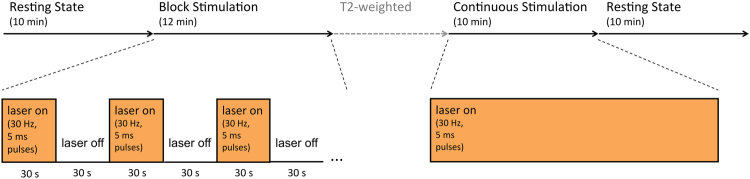
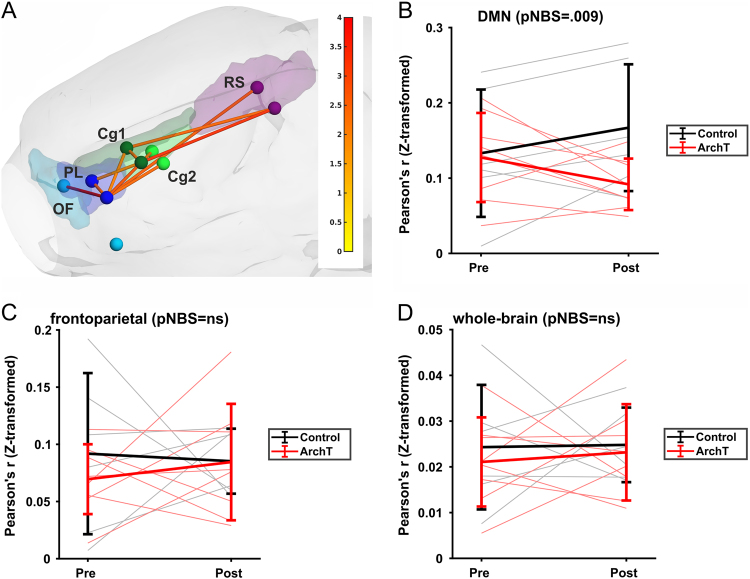
Hyperconnectivity of the default-mode network (DMN) is one of the most widely replicated neuroimaging findings in major depressive disorder (MDD). Further, there is growing evidence for a central role of the lateral habenula (LHb) in the pathophysiology of MDD. There is preliminary neuroimaging evidence linking LHb and the DMN, but no causal relationship has been shown to date. We combined optogenetics and functional magnetic resonance imaging (fMRI), to establish a causal relationship, using an animal model of treatment-resistant depression, namely Negative Cognitive State rats. First, an inhibitory light-sensitive ion channel was introduced into the LHb by viral transduction. Subsequently, laser stimulation was performed during fMRI acquisition on a 9.4 Tesla animal scanner. Neural activity and connectivity were assessed, before, during and after laser stimulation. We observed a connectivity decrease in the DMN following laser-induced LHb perturbation. Our data indicate a causal link between LHb downregulation and reduction in DMN connectivity. These findings may advance our mechanistic understanding of LHb inhibition, which had previously been identified as a promising therapeutic principle, especially for treatment-resistant depression.
Overview
The claims and statistics of this paper haven’t been checked yet.
Free: it reads the open-access text and checks the first 5 claims that cite a source we can check. Create a free account to check every claim.
Integrity signals
Registry
Cites
Statistics
Figures
Verification
Claims the paper makes
The claims and statistics of this paper haven’t been checked yet.
Free: it reads the open-access text and checks the first 5 claims that cite a source we can check. Create a free account to check every claim.
Claims other papers make about this one
Each is checked against this paper’s own text: does it say what the citing paper says it does?
The source backs part of the claim, not all of it — or backs it for a different population, condition or comparison.
In the citing paper
“Causal manipulations that attenuate default-mode drive reduce its pathological coupling: optogenetic silencing of the lateral habenula diminishes default mode network (DMN) hyperconnectivity in a depression model, while chemogenetic suppression of anterior cingulate cortex reconfigures DMN edges and improves behavior aligned with reduced rumination liability [284,285,286].”
From Synaptic Plasticity—Intrinsic Excitability and Antidepressant Discovery (2026) · cites this paper as [285]
Experimental — accuracy not yet measuredThe source backs part of the claim, not all of it — or backs it for a different population, condition or comparison.
In the citing paper
“Network-level corroboration comes from white-matter disruption of forceps minor that perturbs DMN connectivity, increases anxiety, and normalizes with recovery, linking DMN integrity to affective behavior and strengthening the translational rationale for calibrated HCN modulation to curb rumination-like and anxiety-related outcomes [284,285].”
From Synaptic Plasticity—Intrinsic Excitability and Antidepressant Discovery (2026) · cites this paper as [285]
Experimental — accuracy not yet measuredThe check wasn’t confident either way, so it gives no verdict — never disputed.
In the citing paper
“Causal manipulations that attenuate default-mode drive reduce its pathological coupling: optogenetic silencing of the lateral habenula diminishes default mode network (DMN) hyperconnectivity in a depression model, while chemogenetic suppression of anterior cingulate cortex reconfigures DMN edges and improves behavior aligned with reduced rumination liability [284,285,286].”
From Synaptic Plasticity—Intrinsic Excitability and Antidepressant Discovery (2026) · cites this paper as [285]
Experimental — accuracy not yet measured
Self-check
Percentages, sums and reported differences re-computed from the paper’s own numbers.
The self-check needs the paper’s full text.
Citations
Cites
Scoville, W. B. (1949) · Journal of neurosurgery · doi:10.3171/jns.1949.6.1.0065 · Cited by 7,381
Millisecond-timescale, genetically targeted optical control of neural activity
Boyden, E. S., Zhang, F., Bamberg, E., Nagel, G., & Deisseroth, K. (2005) · Nature Neuroscience · doi:10.1038/nn1525 · Cited by 4,861
Network-based statistic: identifying differences in brain networks
Zalesky, A., Fornito, A., & Bullmore, E. T. (2010) · NeuroImage · doi:10.1016/j.neuroimage.2010.06.041 · Cited by 2,750
Kaiser, R. H., Andrews-Hanna, J. R., Wager, T. D., & Pizzagalli, D. A. (2015) · JAMA Psychiatry · doi:10.1001/jamapsychiatry.2015.0071 · Cited by 2,281
Greicius, M. D., Flores, B. H., Menon, V., Glover, G. H., Solvason, H. B., Kenna, H., Reiss, A. L., & Schatzberg, A. F. (2007) · Biological Psychiatry · doi:10.1016/j.biopsych.2006.09.020 · Cited by 2,214
A toolbox of Cre-dependent optogenetic transgenic mice for light-induced activation and silencing
Madisen, L., Mao, T., Koch, H., Zhuo, J.-M., Berenyi, A., Fujisawa, S., Hsu, Y.-W. A., Garcia, A. J., Gu, X., Zanella, S., et al. (2012) · Nature Neuroscience · doi:10.1038/nn.3078 · Cited by 1,398
Input-specific control of reward and aversion in the ventral tegmental area
Lammel, S., Lim, B. K., Ran, C., Huang, K. W., Betley, M. J., Tye, K. M., Deisseroth, K., & Malenka, R. C. (2012) · Nature · doi:10.1038/nature11527 · Cited by 1,300
Lateral habenula as a source of negative reward signals in dopamine neurons
Matsumoto, M., & Hikosaka, O. (2007) · Nature · doi:10.1038/nature05860 · Cited by 1,292
Depressive rumination, the default-mode network, and the dark matter of clinical neuroscience
Hamilton, J. P., Farmer, M., Fogelman, P., & Gotlib, I. H. (2015) · Biological Psychiatry · doi:10.1016/j.biopsych.2015.02.020 · Cited by 952
Resting-state functional connectivity in major depressive disorder: A review
Mulders, P. C., van Eijndhoven, P. F., Schene, A. H., Beckmann, C. F., & Tendolkar, I. (2015) · Neuroscience & Biobehavioral Reviews · doi:10.1016/j.neubiorev.2015.07.014 · Cited by 884
Global and local fMRI signals driven by neurons defined optogenetically by type and wiring
Lee, J. H., Durand, R., Gradinaru, V., Zhang, F., Goshen, I., Kim, D.-S., Fenno, L. E., Ramakrishnan, C., & Deisseroth, K. (2010) · Nature · doi:10.1038/nature09108 · Cited by 729
Zhu, X., Wang, X., Xiao, J., Liao, J., Zhong, M., Wang, W., & Yao, S. (2012) · Biological Psychiatry · doi:10.1016/j.biopsych.2011.10.035 · Cited by 638
Synaptic potentiation onto habenula neurons in the learned helplessness model of depression
Li, B., Piriz, J., Mirrione, M., Chung, C., Proulx, C. D., Schulz, D., Henn, F., & Malinow, R. (2011) · Nature · doi:10.1038/nature09742 · Cited by 634
Rat brains also have a default mode network
Lu, H., Zou, Q., Gu, H., Raichle, M. E., Stein, E. A., & Yang, Y. (2012) · Proceedings of the National Academy of Sciences · doi:10.1073/pnas.1200506109 · Cited by 603
Depression, rumination and the default network
Berman, M. G., Peltier, S., Nee, D. E., Kross, E., Deldin, P. J., & Jonides, J. (2011) · Social Cognitive and Affective Neuroscience · doi:10.1093/scan/nsq080 · Cited by 568
Dougherty, D. D., Rezai, A. R., Carpenter, L. L., Howland, R. H., Bhati, M. T., O’Reardon, J. P., Eskandar, E. N., Baltuch, G. H., Machado, A. D., Kondziolka, D., et al. (2015) · Biological Psychiatry · doi:10.1016/j.biopsych.2014.11.023 · Cited by 558
Han, X., Chow, B. Y., Zhou, H., Klapoetke, N. C., Chuong, A., Rajimehr, R., Yang, A., Baratta, M. V., Winkle, J., Desimone, R., et al. (2011) · Frontiers in Systems Neuroscience · doi:10.3389/fnsys.2011.00018 · Cited by 491
Alexopoulos, G. S., Hoptman, M. J., Kanellopoulos, D., Murphy, C. F., Lim, K. O., & Gunning, F. M. (2012) · Journal of Affective Disorders · doi:10.1016/j.jad.2011.12.002 · Cited by 437
βCaMKII in Lateral Habenula Mediates Core Symptoms of Depression
Li, K., Zhou, T., Liao, L., Yang, Z., Wong, C., Henn, F., Malinow, R., Yates, J. R., & Hu, H. (2013) · Science · doi:10.1126/science.1240729 · Cited by 411
Ji, H., & Shepard, P. D. (2007) · Journal of Neuroscience · doi:10.1523/jneurosci.0958-07.2007 · Cited by 388
Manoliu, A., Meng, C., Brandl, F., Doll, A., Tahmasian, M., Scherr, M., Schwerthöffer, D., Zimmer, C., Förstl, H., Bäuml, J., et al. (2014) · Frontiers in Human Neuroscience · doi:10.3389/fnhum.2013.00930 · Cited by 382
Biophysical constraints of optogenetic inhibition at presynaptic terminals
Mahn, M., Prigge, M., Ron, S., Levy, R., & Yizhar, O. (2016) · Nature Neuroscience · doi:10.1038/nn.4266 · Cited by 360
Form and distribution of neurons in rat cingulate cortex: Areas 32, 24, and 29
Vogt, B. A., & Peters, A. (1981) · Journal of Comparative Neurology · doi:10.1002/cne.901950406 · Cited by 341
A Treatment-Resistant Default Mode Subnetwork in Major Depression
Li, B., Liu, L., Friston, K. J., Shen, H., Wang, L., Zeng, L.-L., & Hu, D. (2013) · Biological Psychiatry · doi:10.1016/j.biopsych.2012.11.007 · Cited by 333
Schwarz, A. J., Danckaert, A., Reese, T., Gozzi, A., Paxinos, G., Watson, C., Merlo-Pich, E. V., & Bifone, A. (2006) · NeuroImage · doi:10.1016/j.neuroimage.2006.04.214 · Cited by 316
Covariation of activity in habenula and dorsal raphe nuclei following tryptophan depletion
Morris, J. S., Smith, K. A., Cowen, P. J., Friston, K. J., & Dolan, R. J. (1999) · NeuroImage · doi:10.1006/nimg.1999.0455 · Cited by 288
Stress models of depression: forming genetically vulnerable strains
Henn, F. A., & Vollmayr, B. (2005) · Neuroscience & Biobehavioral Reviews · doi:10.1016/j.neubiorev.2005.03.019 · Cited by 274
Self-citationAntidepressants Normalize the Default Mode Network in Patients With Dysthymia
Posner, J., Hellerstein, D. J., Gat, I., Mechling, A., Klahr, K., Wang, Z., McGrath, P. J., Stewart, J. W., & Peterson, B. S. (2013) · JAMA Psychiatry · doi:10.1001/jamapsychiatry.2013.455 · Cited by 268
Increased neural resources recruitment in the intrinsic organization in major depression
Zhou, Y., Yu, C., Zheng, H., Liu, Y., Song, M., Qin, W., Li, K., & Jiang, T. (2010) · Journal of Affective Disorders · doi:10.1016/j.jad.2009.05.029 · Cited by 228
Ambiguous-Cue Interpretation is Biased Under Stress- and Depression-Like States in Rats
Enkel, T., Gholizadeh, D., von Bohlen und Halbach, O., Sanchis-Segura, C., Hurlemann, R., Spanagel, R., Gass, P., & Vollmayr, B. (2010) · Neuropsychopharmacology · doi:10.1038/npp.2009.204 · Cited by 224
Self-citationDeep brain stimulation for treatment-resistant depression: systematic review of clinical outcomes
Morishita, T., Fayad, S. M., Higuchi, M.-A., Nestor, K. A., & Foote, K. D. (2014) · Neurotherapeutics · doi:10.1007/s13311-014-0282-1 · Cited by 216
Wu, Q., Li, D., Kuang, W., Zhang, T., Lui, S., Huang, X., Chan, R. C. K., Kemp, G. J., & Gong, Q. (2011) · Human Brain Mapping · doi:10.1002/hbm.21108 · Cited by 212
Disrupted habenula function in major depression
Lawson, R. P., Nord, C. L., Seymour, B., Thomas, D. L., Dayan, P., Pilling, S., & Roiser, J. P. (2017) · Molecular Psychiatry · doi:10.1038/mp.2016.81 · Cited by 210
Amat, J., Sparks, P. D., Matus-Amat, P., Griggs, J., Watkins, L. R., & Maier, S. F. (2001) · Brain Research · doi:10.1016/s0006-8993(01)02934-1 · Cited by 185
Ranft, K., Dobrowolny, H., Krell, D., Bielau, H., Bogerts, B., & Bernstein, H.-G. (2010) · Psychological Medicine · doi:10.1017/s0033291709990821 · Cited by 183
Lecca, S., Pelosi, A., Tchenio, A., Moutkine, I., Lujan, R., Hervé, D., & Mameli, M. (2016) · Nature Medicine · doi:10.1038/nm.4037 · Cited by 176
Abbott, C. C., Lemke, N. T., Gopal, S., Thoma, R. J., Bustillo, J., Calhoun, V. D., & Turner, J. A. (2013) · Frontiers in Psychiatry · doi:10.3389/fpsyt.2013.00010 · Cited by 163
The Lateral Habenula Circuitry: Reward Processing and Cognitive Control
Baker, P. M., Jhou, T., Li, B., Matsumoto, M., Mizumori, S. J. Y., Stephenson-Jones, M., & Vicentic, A. (2016) · The Journal of Neuroscience · doi:10.1523/jneurosci.2350-16.2016 · Cited by 162
Learned helplessness: unique features and translational value of a cognitive depression model
Vollmayr, B., & Gass, P. (2013) · Cell and Tissue Research · doi:10.1007/s00441-013-1654-2 · Cited by 155
Self-citationResting state functional connectivity and treatment response in late-life depression
Andreescu, C., Tudorascu, D. L., Butters, M. A., Tamburo, E., Patel, M., Price, J., Karp, J. F., Reynolds, C. F., & Aizenstein, H. (2013) · Psychiatry Research: Neuroimaging · doi:10.1016/j.pscychresns.2013.08.007 · Cited by 153
Winter, C., Vollmayr, B., Djodari-Irani, A., Klein, J., & Sartorius, A. (2011) · Behavioural Brain Research · doi:10.1016/j.bbr.2010.07.034 · Cited by 145
Self-citationDifferential modulation of the default mode network via serotonin-1A receptors
Hahn, A., Wadsak, W., Windischberger, C., Baldinger, P., Höflich, A. S., Losak, J., Nics, L., Philippe, C., Kranz, G. S., Kraus, C., et al. (2012) · Proceedings of the National Academy of Sciences · doi:10.1073/pnas.1117104109 · Cited by 130
Manoliu, A., Riedl, V., Doll, A., Bäuml, J. G., Mühlau, M., Schwerthöffer, D., Scherr, M., Zimmer, C., Förstl, H., Bäuml, J., et al. (2013) · Frontiers in Human Neuroscience · doi:10.3389/fnhum.2013.00216 · Cited by 128
Lecourtier, L., DeFrancesco, A., & Moghaddam, B. (2008) · European Journal of Neuroscience · doi:10.1111/j.1460-9568.2008.06130.x · Cited by 125
Local cortical thinning links to resting-state disconnectivity in major depressive disorder
van Tol, M.-J., Li, M., Metzger, C. D., Hailla, N., Horn, D. I., Li, W., Heinze, H. J., Bogerts, B., Steiner, J., He, H., et al. (2014) · Psychological Medicine · doi:10.1017/s0033291713002742 · Cited by 123
The Effects of Tryptophan Depletion on Neural Responses to Emotional Words in Remitted Depression
Roiser, J. P., Levy, J., Fromm, S. J., Nugent, A. C., Talagala, S. L., Hasler, G., Henn, F. A., Sahakian, B. J., & Drevets, W. C. (2009) · Biological Psychiatry · doi:10.1016/j.biopsych.2009.05.002 · Cited by 123
Cardiorespiratory effects on default‐mode network activity as measured with fMRI
van Buuren, M., Gladwin, T. E., Zandbelt, B. B., van den Heuvel, M., Ramsey, N. F., Kahn, R. S., & Vink, M. (2009) · Human Brain Mapping · doi:10.1002/hbm.20729 · Cited by 119
Gass, N., Schwarz, A. J., Sartorius, A., Schenker, E., Risterucci, C., Spedding, M., Zheng, L., Meyer‐Lindenberg, A., & Weber‐Fahr, W. (2013) · Neuropsychopharmacology · doi:10.1038/npp.2013.290 · Cited by 111
Self-citationConstituents and functional implications of the rat default mode network
Hsu, L.-M., Liang, X., Gu, H., Brynildsen, J. K., Stark, J. A., Ash, J. A., Lin, C.-P., Lu, H., Rapp, P. R., Stein, E. A., et al. (2016) · Proceedings of the National Academy of Sciences · doi:10.1073/pnas.1601485113 · Cited by 101
Abnormal Default-Mode Network Homogeneity in First-Episode, Drug-Naive Major Depressive Disorder
Guo, W., Liu, F., Zhang, J., Zhang, Z., Yu, L., Liu, J., Chen, H., & Xiao, C. (2014) · PLoS ONE · doi:10.1371/journal.pone.0091102 · Cited by 96
Ely, B. A., Xu, J., Goodman, W. K., Lapidus, K. A., Gabbay, V., & Stern, E. R. (2016) · Human Brain Mapping · doi:10.1002/hbm.23179 · Cited by 96
Karim, H. T., Andreescu, C., Tudorascu, D., Smagula, S. F., Butters, M. A., Karp, J. F., Reynolds, C., & Aizenstein, H. J. (2017) · Molecular Psychiatry · doi:10.1038/mp.2016.55 · Cited by 95
Advantages and Challenges of Small Animal Magnetic Resonance Imaging as a Translational Tool
Hoyer, C., Gass, N., Weber‐Fahr, W., & Sartorius, A. (2014) · Neuropsychobiology · doi:10.1159/000360859 · Cited by 90
Self-citationKahn, I., Knoblich, U., Desai, M., Bernstein, J., Graybiel, A. M., Boyden, E. S., Buckner, R. L., & Moore, C. I. (2013) · Brain Research · doi:10.1016/j.brainres.2013.03.011 · Cited by 87
Kunisato, Y., Okamoto, Y., Okada, G., Aoyama, S., Demoto, Y., Munakata, A., Nomura, M., Onoda, K., & Yamawaki, S. (2010) · Neuroscience Research · doi:10.1016/j.neures.2010.11.005 · Cited by 75
Elevated spectroscopic glutamate/γ-amino butyric acid in rats bred for learned helplessness
Sartorius, A., Mahlstedt, M. M., Vollmayr, B., Henn, F. A., & Ende, G. (2007) · NeuroReport · doi:10.1097/wnr.0b013e3282742153 · Cited by 73
Self-citationA new translational target for deep brain stimulation to treat depression
Kiening, K., & Sartorius, A. (2013) · EMBO Molecular Medicine · doi:10.1002/emmm.201302947 · Cited by 70
Self-citationGerchen, M. F., Bernal‐Casas, D., & Kirsch, P. (2014) · Human Brain Mapping · doi:10.1002/hbm.22532 · Cited by 66
Self-citationEscitalopram Decreases Cross-Regional Functional Connectivity within the Default-Mode Network
van de Ven, V., Wingen, M., Kuypers, K. P. C., Ramaekers, J. G., & Formisano, E. (2013) · PLoS ONE · doi:10.1371/journal.pone.0068355 · Cited by 65
Stress triggers anhedonia in rats bred for learned helplessness
Enkel, T., Spanagel, R., Vollmayr, B., & Schneider, M. (2010) · Behavioural Brain Research · doi:10.1016/j.bbr.2010.01.042 · Cited by 65
Self-citationResting state connectivity of the human habenula at ultra-high field
Torrisi, S., Nord, C. L., Balderston, N. L., Roiser, J. P., Grillon, C., & Ernst, M. (2017) · NeuroImage · doi:10.1016/j.neuroimage.2016.10.034 · Cited by 64
Anti-Correlated Cortical Networks of Intrinsic Connectivity in the Rat Brain
Schwarz, A. J., Gass, N., Sartorius, A., Risterucci, C., Spedding, M., Schenker, E., Meyer-Lindenberg, A., & Weber-Fahr, W. (2013) · Brain Connectivity · doi:10.1089/brain.2013.0168 · Cited by 58
Self-citationWidge, A. S., Deckersbach, T., Eskandar, E. N., & Dougherty, D. D. (2015) · Biological Psychiatry · doi:10.1016/j.biopsych.2015.06.005 · Cited by 55
Nasrallah, F. A., Lew, S. K., Low, A. S.-M., & Chuang, K. (2013) · NeuroImage · doi:10.1016/j.neuroimage.2013.08.004 · Cited by 52
Opto-fMRI analysis for exploring the neuronal connectivity of the hippocampal formation in rats
Abe, Y., Sekino, M., Terazono, Y., Ohsaki, H., Fukazawa, Y., Sakai, S., Yawo, H., & Hisatsune, T. (2012) · Neuroscience Research · doi:10.1016/j.neures.2012.08.007 · Cited by 48
Schrantee, A., Ferguson, B., Stoffers, D., Booij, J., Rombouts, S. A. R. B., & Reneman, L. (2015) · Brain Imaging and Behavior · doi:10.1007/s11682-015-9419-z · Cited by 44
Defining the brain circuits involved in psychiatric disorders: IMI-NEWMEDS
Artigas, F., Schenker, E., Celada, P., Spedding, M., Lladó-Pelfort, L., Jurado, N., Núñez, M., Santana, N., Troyano‐Rodriguez, E., Riga, M. S., et al. (2016) · Nature Reviews Drug Discovery · doi:10.1038/nrd.2016.205 · Cited by 41
Self-citationMeyer, B. M., Huemer, J., Rabl, U., Boubela, R. N., Kalcher, K., Berger, A., Banaschewski, T., Barker, G., Bokde, A., Büchel, C., et al. (2016) · Brain Structure and Function · doi:10.1007/s00429-014-0895-5 · Cited by 39
Gass, N., Cleppien, D., Zheng, L., Schwarz, A. J., Meyer-Lindenberg, A., Vollmayr, B., Weber-Fahr, W., & Sartorius, A. (2014) · European Neuropsychopharmacology · doi:10.1016/j.euroneuro.2013.12.004 · Cited by 36
Self-citationGass, N., Becker, R., Schwarz, A. J., Weber‐Fahr, W., von Hohenberg, C. C., Vollmayr, B., & Sartorius, A. (2016) · Translational Psychiatry · doi:10.1038/tp.2016.233 · Cited by 31
Self-citationGlover (2000) · doi:10.1002/1522-2594(200007)44:1<162::aid-mrm23>3.0.co;2-e
Cited by
Sleep, insomnia, and depression
Riemann, D., Krone, L. B., Wulff, K., & Nissen, C. (2020) · Neuropsychopharmacology · doi:10.1038/s41386-019-0411-y · Cited by 819
Animal models of depression: pros and cons
Harro, J. (2018) · Cell and Tissue Research · doi:10.1007/s00441-018-2973-0 · Cited by 118
miR-323a regulates ERBB4 and is involved in depression
Fiori, L. M., Kos, A., Lin, R., Théroux, J.-F., Lopez, J. P., Kühne, C., Eggert, C., Holzapfel, M., Huettl, R.-E., Mechawar, N., et al. (2021) · Molecular Psychiatry · doi:10.1038/s41380-020-00953-7 · Cited by 88
Rahimi, S., Peeri, M., Azarbayjani, M. A., Anoosheh, L., Ghasemzadeh, E., Khalifeh, N., Noroozi-Mahyari, S., Deravi, S., Saffari-Anaraki, S., Zangeneh, F. H., et al. (2020) · Physiology & Behavior · doi:10.1016/j.physbeh.2020.113130 · Cited by 63
Enayati, M., Mosaferi, B., Homberg, J. R., Diniz, D. M., & Salari, A.-A. (2020) · Life Sciences · doi:10.1016/j.lfs.2020.117597 · Cited by 52
Metadata
- Authors
- Clemm von Hohenberg, C., Weber-Fahr, W., Lebhardt, P., Ravi, N., Braun, U., Gass, N., Becker, R., Sack, M., Cosa Linan, A., Gerchen, M. F., Reinwald, J. R., Oettl, L.-L., Meyer-Lindenberg, A., Vollmayr, B., Kelsch, W., & Sartorius, A.
- Affiliations
- Heidelberg University (DE)
- ORCID
- Venue
- Translational Psychiatry
- Published
- 2018-03-27
- Volume
- 8
- Issue
- 1
- Pages
- 68-68
- ISSN
- 2158-3188 (ISSN-L)
- PMC
- PMC5913319
- OpenAlex
- W2794463406
- Cited by
- 39
- References
- 71
- Citations by year
- 2026: 1 · 2025: 7 · 2024: 4 · 2023: 1 · 2022: 8 · 2021: 5 · 2020: 7 · 2019: 4 · 2018: 2
- FWCI
- 2.90
- Type
- journal article
- Language
- en
- Open access
- gold
- doi.org
- Licence
- cc-by
- creativecommons.org/licenses/by/4.0 (tdm)
- creativecommons.org/licenses/by/4.0 (vor)
- Locations
- Translational Psychiatry (publishedVersion, cc-by)
- Europe PMC (PubMed Central) (publishedVersion, other-oa)
- PubMed Central (publishedVersion, cc-by)
- PubMed (publishedVersion)
- DOAJ (DOAJ: Directory of Open Access Journals) (submittedVersion)
- Funders
- Eli Lilly and Company
- F. Hoffmann-La Roche
- European Commission (115300, 115008, 602805)
- Deutsche Forschungsgemeinschaft (SFB-1158, 602805, SA 1869/11-2, DFG SA 1869/11-2, GA 2109/2-1, DFG GA 2109/2-1)
- Bundesministerium für Bildung und Forschung (115008, 01ZX1314G, DFG SA 1869/11-2)
- Lundbeckfonden
- Servier
- H. Lundbeck A/S
- Grupo Ferrer Internacional, S.A
- Lilly Deutschland
- Cilag
- Topics
- Health Sciences › Medicine › Pharmacology (medical) › Treatment of Major Depression
- Life Sciences › Neuroscience › Cognitive Neuroscience › Functional Brain Connectivity Studies
- Life Sciences › Neuroscience › Cellular and Molecular Neuroscience › Neurotransmitter Receptor Influence on Behavior
- Keywords
- lateral habenula, default mode network, major depressive disorder, treatment-resistant depression, optogenetics, laser stimulation, functional connectivity, causal manipulation, viral transduction
- MeSH terms
- Animals, Brain, Brain Mapping, Disease Models, Animal, Magnetic Resonance Imaging, Male, Neural Pathways, Habenula, Rats, Depressive Disorder, Treatment-Resistant, Optogenetics
About these checks
Registry, retraction, Cites and statistics results are computed, not judged, with one exception: a printed reference that no index lists is read once by a model before it counts as a citation error. Claims are extracted by a model and kept only when their quote appears verbatim in the text; each cited source is then checked, with a model’s help, for whether it says what the claim relies on. Those verdicts can be wrong — read the claim’s quote and the cited source before relying on one.
Statistics and arithmetic are recomputed, not judged.
Confidence bands are shown only for fields calibrated on our annotated test set. None is calibrated yet, so no band is shown.
What counts as a claim ›How we measure confidence ›How we check this ›
Are you an author, or do you see a problem with this page? Request a review
Data sources
Bibliographic data: Semantic Scholar, OpenAlex, Crossref.
Contains information from the Semantic Scholar Academic Graph Datasets, made available under the ODC Attribution License (ODC-BY 1.0).
Semantic Scholar’s data is described in: Kinney, R., et al. (2023). The Semantic Scholar Open Data Platform. arXiv:2301.10140.
