

The DOI matches its Crossref record; 53 of the 54 references it cites were found in a registry or an index.
A longitudinal study on deep brain stimulation of the medial forebrain bundle for treatment-resistant depression
Open accessAbstract
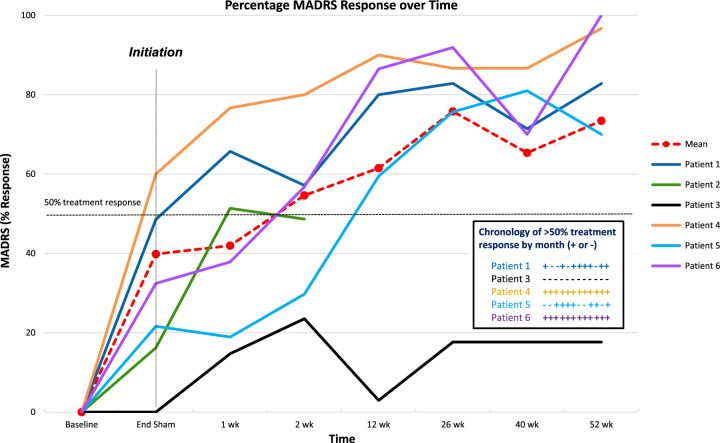
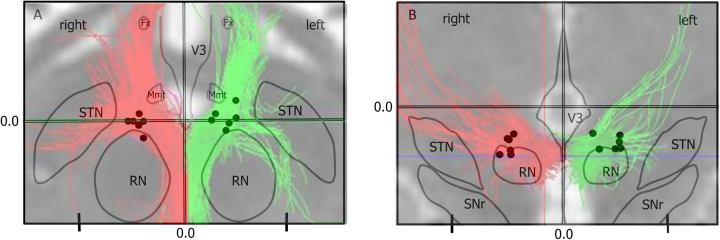
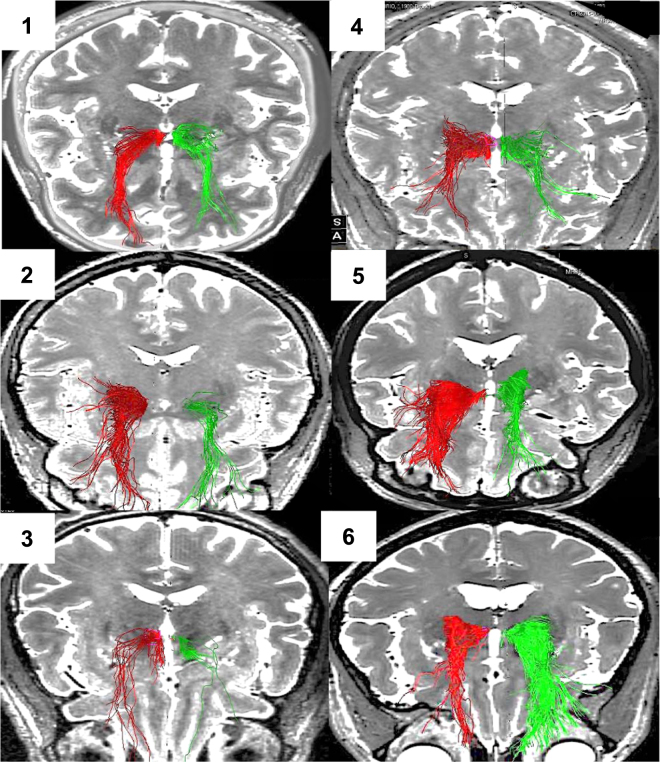
Abstract Deep brain stimulation (DBS) to the superolateral branch of the medial forebrain bundle (MFB) has been reported to lead to rapid antidepressant effects. In this longitudinal study, we expand upon the initial results we reported at 26 weeks (Fenoy et al., 2016), showing sustained antidepressant effects of MFB DBS on six patients with treatment-resistant depression (TRD) over 1 year. The Montgomery-Åsberg Depression Rating Scale (MADRS) was used as the primary assessment tool. Deterministic fiber tracking was used to individually map the target area; analysis was performed to compare modulated fiber tracts between patients. Intraoperatively, upon stimulation at target, responders reported immediate increases in energy and motivation. An insertional effect was seen during the 4-week sham stimulation phase from baseline (28% mean MADRS reduction,p = 0.02). However, after 1 week of initiating stimulation, three of six patients had a > 50% decrease in MADRS scores relative to baseline (43% mean MADRS reduction,p = 0.005). One patient withdrew from study participation. At 52 weeks, four of remaining five patients have > 70% decrease in MADRS scores relative to baseline (73% mean MADRS reduction,p = 0.007). Evaluation of modulated fiber tracts reveals significant common orbitofrontal connectivity to the target region in all responders. Neuropsychological testing and18F-fluoro-deoxyglucose-positron emission tomography cerebral metabolism evaluations performed at baseline and at 52 weeks showed minimal changes and verified safety. This longitudinal evaluation of MFB DBS demonstrated rapid antidepressant effects, as initially reported by Schlaepfer et al. (2013), and supports the use of DBS for TRD.
Overview
The claims and statistics of this paper haven’t been checked yet.
Run the check — free, no account needed. It reads the open-access text and checks the sources it cites.
Integrity signals
Registry
Cites
Statistics
Figures

Verification
Claims the paper makes
The claims and statistics of this paper haven’t been checked yet.
Run the check — free, no account needed. It reads the open-access text and checks the sources it cites.
Claims other papers make about this one
Each is checked against this paper’s own text: does it say what the citing paper says it does?
In the citing paper
“promising response and remission rates were observed at 1 week of MFB DBS (RS: 50%)”
From Deep brain stimulation for depression. (2022) · cites this paper as [71]
In the citing paper
“Results do not indicate any significant difference between blinded on/off conditions”
From Deep brain stimulation for depression. (2022) · cites this paper as [71]
In the citing paper
“at 1 year (RS: 66%, RM: 50%)”
From Deep brain stimulation for depression. (2022) · cites this paper as [71]
In the citing paper
“carryover antidepressant effects of at least 1 week have been observed after transient intraoperative stimulation of the SCC [81] or MFB [71]”
From Deep brain stimulation for depression. (2022) · cites this paper as [71]
Self-check
Percentages, sums and reported differences re-computed from the paper’s own numbers.
The self-check needs the paper’s full text.
Citations
Cites
Development and validation of brief measures of positive and negative affect: The PANAS scales.
Watson, D., Clark, L. A., & Tellegen, A. (1988) · Journal of Personality and Social Psychology · doi:10.1037/0022-3514.54.6.1063 · Cited by 32,433
A new depression scale designed to be sensitive to change
Montgomery, S. A., & Åsberg, M. (1979) · British Journal of Psychiatry · doi:10.1192/bjp.134.4.382 · Cited by 13,962
A Rating Scale for Mania: Reliability, Validity and Sensitivity
Young, R. C., Biggs, J. T., Ziegler, V. E., & Meyer, D. A. (1978) · British Journal of Psychiatry · doi:10.1192/bjp.133.5.429 · Cited by 8,744
Development of a Rating Scale for Primary Depressive Illness
Hamilton, M. (1967) · British Journal of Social and Clinical Psychology · doi:10.1111/j.2044-8260.1967.tb00530.x · Cited by 8,410
Selective Cortical Undercutting As a Means of Modifying and Studying Frontal Lobe Function in Man
Scoville, W. B. (1949) · Journal of neurosurgery · doi:10.3171/jns.1949.6.1.0065 · Cited by 7,374
Affective Neuroscience: The Foundations of Human and Animal Emotions
Panksepp, J. (1998) · doi:10.1093/oso/9780195096736.001.0001 · Cited by 4,428
Deep Brain Stimulation for Treatment-Resistant Depression
Mayberg, H. S., Lozano, A. M., Voon, V., McNeely, H. E., Seminowicz, D., Hamani, C., Schwalb, J. M., & Kennedy, S. H. (2005) · Neuron · doi:10.1016/j.neuron.2005.02.014 · Cited by 4,059
(1998) · Cited by 4,012
The reward circuit: linking primate anatomy and human imaging
Haber, S. N., & Knutson, B. (2010) · Neuropsychopharmacology · doi:10.1038/npp.2009.129 · Cited by 3,718
Structured clinical interview for DSM-IV axis I disorders : SCID-I : clinical version : scoresheet
First, M. B., Spitzer, R. L., Gibbon, M., & Williams, J. B. W. (1997) · American Psychiatric Press eBooks · Cited by 3,101
Research works printed but not linked: 1
- Russo, S. J. & Nestler, E. J. The brain reward circuitry in mood disorders. Nat. Rev. Neurosci. 14, 609–625 (2013). · DOI · Paper page
Cited by
Sorted by citations
On what motivates us: a detailed review of intrinsic v. extrinsic motivation
Morris, L. S., Grehl, M. M., Rutter, S., Mehta, M., & Westwater, M. L. (2022) · Psychological Medicine · doi:10.1017/s0033291722001611 · Cited by 377
Deep brain stimulation for depression.
Figee, M., Riva-Posse, P., Choi, K. S., Bederson, L., Mayberg, H. S., & Kopell, B. H. (2022) · Neurotherapeutics · doi:10.1007/s13311-022-01270-3 · Cited by 175
Superolateral medial forebrain bundle deep brain stimulation in major depression: a gateway trial
Coenen, V. A., Bewernick, B. H., Kayser, S., Kilian, H., Boström, J., Greschus, S., Hurlemann, R., Klein, M. E., Spanier, S., Sajonz, B., et al. (2019) · Neuropsychopharmacology · doi:10.1038/s41386-019-0369-9 · Cited by 176
Coenen, V. A., Sajonz, B., Reisert, M., Boström, J. P., Bewernick, B. H., Urbach, H., Jenkner, C., Reinacher, P. C., Schlaepfer, T. E., & Mädler, B. (2018) · NeuroImage Clinical · doi:10.1016/j.nicl.2018.08.020 · Cited by 90
Deep brain stimulation for refractory major depressive disorder: a comprehensive review
Johnson, K. A., Okun, M. S., Scangos, K. W., Mayberg, H. S., & de Hemptinne, C. (2024) · Molecular Psychiatry · doi:10.1038/s41380-023-02394-4 · Cited by 85
Metadata
- Authors
- Fenoy, A. J., Schulz, P. E., Selvaraj, S., Burrows, C. L., Zunta-Soares, G., Durkin, K., Zanotti-Fregonara, P., Quevedo, J., & Soares, J. C.
- Affiliations
- The University of Texas Health Science Center at Houston (US)
- Corresponding author
- Fenoy, Albert J.
- Venue
- Translational Psychiatry
- Published
- 2018-06-04
- Volume
- 8
- Issue
- 1
- Pages
- 111-111
- ISSN
- 2158-3188 (ISSN-L)
- PMC
- PMC5986795
- OpenAlex
- W2805696691
- Cited by
- 118
- References
- 54
- Citations by year
- 2026: 6 · 2025: 11 · 2024: 19 · 2023: 15 · 2022: 17 · 2021: 24 · 2020: 16 · 2019: 9 · 2018: 1
- FWCI
- 8.49
- Type
- journal article
- Language
- en
- Open access
- gold
- doi.org
- Locations
- Translational Psychiatry (publishedVersion, cc-by)
- Europe PMC (PubMed Central) (publishedVersion, cc-by)
- PubMed Central (publishedVersion, cc-by)
- PubMed (publishedVersion)
- DOAJ (DOAJ: Directory of Open Access Journals) (submittedVersion)
- Funders
- Medtronic
- John S. Dunn Foundation
- National Institutes of Health (UL1TR000371)
- National Center for Advancing Translational Sciences
- Topics
- Health Sciences › Medicine › Clinical Neurology › Deep Brain Stimulation and Movement Disorders
- Health Sciences › Medicine › Pharmacology (medical) › Treatment of Major Depression
- Social Sciences › Psychology › Clinical Psychology › Obsessive-Compulsive Spectrum Disorders
- Keywords
- deep brain stimulation, medial forebrain bundle, treatment-resistant depression, deterministic fiber tracking, sham stimulation, brain glucose metabolism
- MeSH terms
- Adult, Female, Humans, Longitudinal Studies, Male, Medial Forebrain Bundle, Middle Aged, Motivation, Neuropsychological Tests, Psychiatric Status Rating Scales, Texas, Treatment Outcome, Deep Brain Stimulation, Positron-Emission Tomography, Young Adult, Depressive Disorder, Treatment-Resistant
About these checks
Registry, retraction, Cites and statistics results are computed, not judged, with one exception: a printed reference that no index lists is read once by a model before it counts as a citation error. Claims are extracted by a model and kept only when their quote appears verbatim in the text; each cited source is then checked, with a model’s help, for whether it says what the claim relies on. Those verdicts can be wrong — read the claim’s quote and the cited source before relying on one.
Statistics and arithmetic are recomputed, not judged.
Confidence bands are shown only for fields calibrated on our annotated test set. None is calibrated yet, so no band is shown.
What counts as a claim ›How we measure confidence ›How we check this ›
Are you an author, or do you see a problem with this page? Request a review
