

Autism, Early Psychosis, and Social Anxiety Disorder: a transdiagnostic examination of executive function cognitive circuitry and contribution to disability
Open accessThe DOI matches its Crossref record; 40 of the 40 references it cites were found in a registry or an index.
Abstract
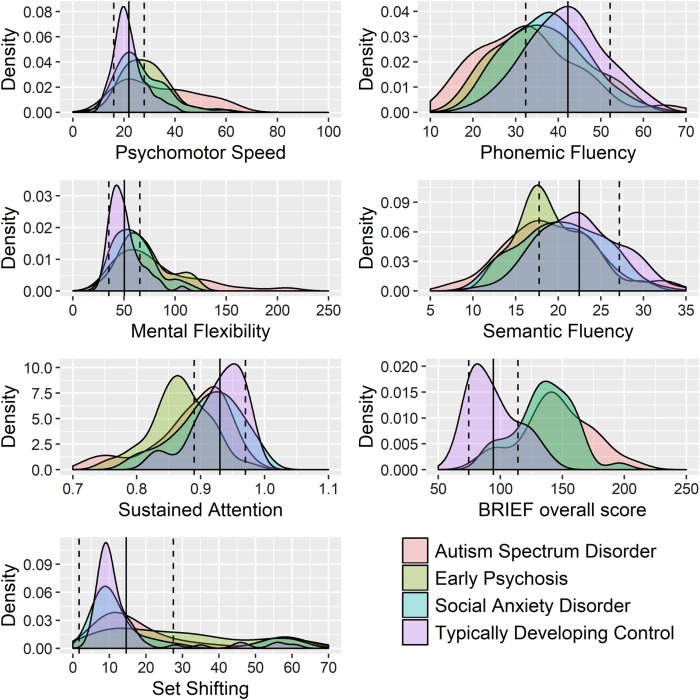
The disability burden in clinical cohorts with social impairment is significant, leading to poor functional outcomes. Some of this impairment has been linked to executive dysfunction. In this study, a transdiagnostic approach was taken to identify executive function (EF) processes in young adults that may underpin social impairment and to evaluate their contribution to disability. Comparisons were made between three prominent disorders that are characterized by social impairments, Autism Spectrum Disorder (ASD), Early Psychosis (EP) and Social Anxiety Disorder (SAD), as well as a neurotypically developing group (TYP). We examined whether overall disability could be predicted by neuropsychological and self-report assessments of EF. Our study showed that ASD participants demonstrated impaired performance on most domains of EF compared to the TYP group (mental flexibility, sustained attention and fluency) while the EP group showed impairment on sustained attention and attentional shifting. The SAD participants showed EF impairment on self-report ratings, even though their objective performance was intact. Self-reports of EF explained a significant percentage (17%) of disability in addition to the variance explained by other predictors, and this was particularly important for ASD. This is the first study to compare EF measures across clinical groups of social impairment and suggests unique cognitive-circuitry that underpins disability within groups. Impairments in EF were broad in ASD and predicted disability, EP impairments were specific to attentional processes and SAD impairments likely relate to negative self-monitoring. Self-report, as opposed to performance-based EF, provided best capacity to predict disability. These findings contribute to transdiagnostic circuitry models and intervention strategies.
Overview
The claims and statistics of this paper haven’t been checked yet.
Free: it reads the open-access text and checks the first 5 claims that cite a source we can check. Create a free account to check every claim.
Integrity signals
Registry
Cites
Statistics
Figures
Verification
Claims the paper makes
The claims and statistics of this paper haven’t been checked yet.
Free: it reads the open-access text and checks the first 5 claims that cite a source we can check. Create a free account to check every claim.
Claims other papers make about this one
Each is checked against this paper’s own text: does it say what the citing paper says it does?
In the citing paper
“Their results showed that deficits in these executive functions are not the primary contributors to disability for SAD.”
From Response inhibition, cognitive flexibility and working memory in obsessive-compulsive disorder, generalized anxiety disorder and social anxiety disorder (2021) · cites this paper as [20]
Self-check
Percentages, sums and reported differences re-computed from the paper’s own numbers.
The self-check needs the paper’s full text.
Citations
Cites
Toplak, M. E., West, R. F., & Stanovich, K. E. (2013) · Journal of Child Psychology and Psychiatry · doi:10.1111/jcpp.12001 · Cited by 1,381
Anxiety and affective style: role of prefrontal cortex and amygdala
Davidson, R. J. (2002) · Biological Psychiatry · doi:10.1016/s0006-3223(01)01328-2 · Cited by 1,135
Braun, M., Tupper, D., Kaufmann, P., McCrea, M., Postal, K., Westerveld, M., Wills, K., & Deer, T. (2011) · Cognitive and Behavioral Neurology · doi:10.1097/wnn.0b013e3182351289 · Cited by 1,056
Autism spectrum disorders: a meta-analysis of executive function
Demetriou, E. A., Lampit, A., Quintana, D. S., Naismith, S. L., Song, Y. J. C., Pye, J. E., Hickie, I., & Guastella, A. J. (2018) · Molecular Psychiatry · doi:10.1038/mp.2017.75 · Cited by 841
Self-citationNormative data from the CANTAB I: development of executive function over the lifespan
De Luca, C. R., Wood, S. J., Anderson, V., Buchanan, J.-A., Proffitt, T. M., Mahony, K., & Pantelis, C. (2003) · Journal of Clinical and Experimental Neuropsychology · doi:10.1076/jcen.25.2.242.13639 · Cited by 710
Disability and Quality of Life in Social Phobia: Epidemiologic Findings
Stein, M. B., & Kean, Y. M. (2000) · American Journal of Psychiatry · doi:10.1176/appi.ajp.157.10.1606 · Cited by 685
Understanding Executive Control in Autism Spectrum Disorders in the Lab and in the Real World
Kenworthy, L., Yerys, B. E., Anthony, L. G., & Wallace, G. L. (2008) · Neuropsychology Review · doi:10.1007/s11065-008-9077-7 · Cited by 504
Quality of life in autism across the lifespan: A meta-analysis
van Heijst, B. F., & Geurts, H. M. (2015) · Autism · doi:10.1177/1362361313517053 · Cited by 460
Autism spectrum disorder: outcomes in adulthood
Howlin, P., & Magiati, I. (2017) · Current Opinion in Psychiatry · doi:10.1097/yco.0000000000000308 · Cited by 457
Social re-orientation and brain development: An expanded and updated view
Nelson, E. E., Jarcho, J. M., & Guyer, A. E. (2016) · Developmental Cognitive Neuroscience · doi:10.1016/j.dcn.2015.12.008 · Cited by 447
Research works printed but not linked: 1
- Lezak M Howieson D Bigler E Tranel D Neuropsychological Assessment 2012 New York Oxford University Press
Cited by
Demetriou, E. A., DeMayo, M. M., & Guastella, A. J. (2019) · Frontiers in Psychiatry · doi:10.3389/fpsyt.2019.00753 · Cited by 274
“These include impacts of EF on social cognition (16, 17), mental health (18), disability (19, 20), and lifelong functioning outcomes (21).”
BackgroundSelf-citationAutism spectrum disorder and schizophrenia: An updated conceptual review
Jutla, A., Foss‐Feig, J. H., & Veenstra-VanderWeele, J. M. (2021) · Autism Research · doi:10.1002/aur.2659 · Cited by 189
Pasqualotto, A., Mazzoni, N., Bentenuto, A., Mulè, A., Benso, F., & Venuti, P. (2021) · Brain Sciences · doi:10.3390/brainsci11101280 · Cited by 130
A review of executive functioning challenges and strengths in autistic adults
John, T. S., Woods, S. E. O., Bode, T., Ritter, C., & Estes, A. M. (2021) · The Clinical Neuropsychologist · doi:10.1080/13854046.2021.1971767 · Cited by 83
“…and comorbidities, one reported that worse fluency was related to social anxiety and one reported no significant association of fluency with depression, anxiety, and OCD symptoms (Baxter et al., 2019; Demetriou et al., 2018; Kimura et al., 2020; Marinopoulou et al., 2016; Wilson et al., 2014).”
BackgroundResultInfluentialAssistive Technology for Cognition to Support Executive Functions in Autism: a Scoping Review
Desideri, L., Santantonio, A. D., Varrucciu, N., Bonsi, I. I., & Sarro, R. D. (2020) · Advances in Neurodevelopmental Disorders · doi:10.1007/s41252-020-00163-w · Cited by 57
Morea, A., & Calvete, E. (2021) · Journal of Youth and Adolescence · doi:10.1007/s10964-021-01402-6 · Cited by 35
Demetriou, E. A., Pepper, K. L., Park, S. H., Pellicano, E., Song, Y. J. C., Naismith, S. L., Hickie, I. B., Thomas, E. E., & Guastella, A. J. (2021) · Autism · doi:10.1177/13623613211014991 · Cited by 34
Self-citationRosa-Alcázar, A. I., Rosa-Alcázar, Á., Martínez-Esparza, I. C., Storch, E. A., & Olivares-Olivares, P. J. (2021) · International Journal of Environmental Research and Public Health · doi:10.3390/ijerph18073642 · Cited by 33
Anxiety disorders and executive functions: A three-level meta-analysis of reaction time and accuracy
Majeed, N. M., Chua, Y. J., Kothari, M., Kaur, M., Quek, F. Y. X., Ng, M. H. S., Ng, W. Q., & Hartanto, A. (2023) · Psychiatry Research Communications · doi:10.1016/j.psycom.2022.100100 · Cited by 31
Mazza, M., Pino, M. C., Keller, R., Vagnetti, R., Attanasio, M., Filocamo, A., Donne, I. L., Masedu, F., & Valenti, M. (2021) · Journal of Autism and Developmental Disorders · doi:10.1007/s10803-021-05035-3 · Cited by 29
Woolard, A. J., Stratton, E., Demetriou, E. A., Boulton, K., Pellicano, E., Glozier, N., Gibbs, V., Rogerson, N., Quinn, P., Hickie, I. B., et al. (2021) · Autism · doi:10.1177/13623613211013664 · Cited by 27
“Cognitive models (Bishop, 2009; Eysenck, 1979; Eysenck et al., 2005; Shields et al., 2016) suggest that mood interacts with EF by dominating existing cognitive resources and further reducing attention and strategic processes to increase potential for poor outcomes (Demetriou et al., 2021).”
BackgroundMethodSelf-citationDemetriou, E. A., Park, S. H., Ho, N., Pepper, K. L., Song, Y. J. C., Naismith, S. L., Thomas, E. E., Hickie, I. B., & Guastella, A. J. (2020) · Frontiers in Psychiatry · doi:10.3389/fpsyt.2020.00545 · Cited by 27
“A recent comparison between EP and ASD (20) showed the former was significantly more impaired on attentional processes.”
BackgroundResultInfluentialSelf-citationFerrara, M., Curtarello, E. M. A., Simonelli, G., Sykes, L. Y., Fusar‐Poli, L., Folesani, F., Murri, M. B., Aguglia, E., Politi, P., & Grassi, L. G. (2023) · International Journal of Mental Health · doi:10.1080/00207411.2023.2276872 · Cited by 22
“As reported by Demetriou et al. (2018) attention switching difficulties were part of the core diagnostic criteria for both ASD and schizophrenia, and these skills were hypothesized to underlie problem solving abilities in the general population, suggesting that this may be a potential mediator…”
BackgroundInfluentialDemetriou, E. A., Park, S. H., Pepper, K. L., Naismith, S. L., Song, Y. J., Thomas, E. E., Hickie, I. B., & Guastella, A. J. (2021) · Journal of Affective Disorders · doi:10.1016/j.jad.2020.11.089 · Cited by 17
Self-citationKırca, B., Saruhan, V., Aydoğdu, B. N., & Avcu, A. (2023) · Current Psychology · doi:10.1007/s12144-023-04495-3 · Cited by 15
“There are also some studies that reported no relationship (Demetriou et al., 2018; Liang, 2018).”
Autism is associated with in vivo changes in gray matter neurite architecture
Christensen, Z. P., Freedman, E. G., & Foxe, J. J. (2024) · Autism Research · doi:10.1002/aur.3239 · Cited by 15
“…of literature identifying similarities between ASD ’ s heterogenous presentation and other psychiatric symptomatology (altered executive functioning (Demetriou et al., 2018), social function (Sugranyes et al., 2011), emotional regulation (Weiss, 2014), and attention (Krakowski et al., 2022)).”
Larson, F. V., Wagner, A. P., Chisholm, K., Reniers, R. L. E. P., & Wood, S. J. (2020) · Frontiers in Psychiatry · doi:10.3389/fpsyt.2020.00712 · Cited by 15
Cell Therapies for Autism Spectrum Disorder Based on New Pathophysiology: A Review
Nabetani, M., Mukai, T., & Taguchi, A. (2023) · Cell Transplantation · doi:10.1177/09636897231163217 · Cited by 13
Jain, T., Shukla, R., & Panwar, N. (2024) · Psychological Reports · doi:10.1177/00332941241268625 · Cited by 13
“This paucity of contemporary research has focused on the impairment of overall executive functioning or even set-shifting issues in social anxiety (Demetriou et al., 2018; Fathi et al., 2016; Fujii et al., 2013; Holder et al., 2021; Reinholdt-Dunne et al., 2022), yet no research in the recent past…”
Abu-Akel, A. M., Philip, R. C. M., Lawrie, S. M., Johnstone, E. C., & Stanfield, A. C. (2020) · Frontiers in Psychiatry · doi:10.3389/fpsyt.2020.00798 · Cited by 13
Sarro, R. D., Santantonio, A. D., Desideri, L., & Varrucciu, N. (2021) · International Journal of Developmental Disabilities · doi:10.1080/20473869.2020.1871311 · Cited by 11
Domain-specific associations between psychopathology and neurocognitive functioning
Zoupou, E., Moore, T. M., Calkins, M. E., Gur, R. E., Gur, R. C., & Scott, J. C. (2024) · Psychological Medicine · doi:10.1017/s0033291724001302 · Cited by 9
“For example, studies have examined generalized and disorder-specific executive functioning across multiple disorders with social impairment, including social anxiety, autism, and early psychosis (Demetriou et al., 2018).”
Dorsal anterior cingulate cortex activity during cognitive challenge in social anxiety disorder
Wlad, M., Frick, A., Engman, J., Hjorth, O. R., Hoppe, J. M., Faria, V., Wahlstedt, K., Björkstrand, J., Månsson, K. N. T., Hultberg, S., et al. (2023) · Behavioural Brain Research · doi:10.1016/j.bbr.2023.114304 · Cited by 8
“4 but not all (Demetriou et al., 2018) neuropsychological studies have found lower executive function in SAD compared with healthy controls.”
Keller, R., & Bari, S. (2019) · Springer eBooks · doi:10.1007/978-3-030-26276-1_4 · Cited by 7
Cengiz, Ş. N. K., Güney, E., Özaslan, A., & Sarıpınar, E. G. (2025) · Child and Adolescent Psychiatry and Mental Health · doi:10.1186/s13034-025-00968-4 · Cited by 6
Are Perceived Executive Functions Beneficial for Adolescents Who Experience Peer Victimization?
Morea, A., & Calvete, E. (2022) · Journal of Psychopathology and Behavioral Assessment · doi:10.1007/s10862-022-10005-9 · Cited by 7
“, 2013); although there is evidence that executive functions assessed by self-report questionnaires are impaired in adults with social phobia (Demetriou et al., 2018).”
BackgroundExecutive Function and Social Cognition Performance Predicts Social Difficulty for Autistic Adults
Wong, T. R., Boulton, K., Demetriou, E. A., Thomas, E., Phillips, N. L., Hankin, L., Park, S. H., Hickie, I. B., & Guastella, A. J. (2025) · Autism Research · doi:10.1002/aur.70090 · Cited by 5
Self-citationRoberto Canitano, Y. B., Canitano, R., Bozzi, Y., & Dhossche, D. (2020) · Frontiers research topics · doi:10.3389/978-2-88963-869-7 · Cited by 5
The relationships between anxiety, psychotic-like experiences and autism: a systematic review
Rowe, M., Shergill, S. S., & Maitra, R. (2025) · Frontiers in Psychology · doi:10.3389/fpsyg.2025.1549886 · Cited by 4
Harrison, A. A., Nguyen, L., Murphy, K., & Neumann, D. L. (2025) · Journal of Anxiety Disorders · doi:10.1016/j.janxdis.2025.103056 · Cited by 3
Future perspectives on cell therapy for autism spectrum disorder
Nabetani, M., & Mukai, T. (2021) · Biocell · doi:10.32604/biocell.2022.018218 · Cited by 3
“The main cognitive and behavioral characteristics of ASD are impairment of communication, cognition, perception, motor skills, executive function, theory of mind and emotion control (Gabrielsen et al., 2018; Robertson and BaronCohen, 2017; Mottron et al., 2006; Ketcheson et al., 2017; Demetriou et al., 2018; Jones et…”
BackgroundAnderson, A. C., Robinson, A. H., Lubman, D. I., & Verdejo‐García, A. (2022) · Contemporary Clinical Trials Communications · doi:10.1016/j.conctc.2022.100969 · Cited by 4
Supporting Shy & Neurodivergent Children in Social Play
Currin, F. H. (2022) · CHI Conference Extended Abstracts on Human Factors in Computing Systems (CHI EA) · doi:10.1145/3491101.3503800 · Cited by 1
Yamada, S., Nakakoga, S., Kinzuka, Y., Nakagawa, Y., & Minami, T. (2025) · Perception · doi:10.1177/03010066251344509 · Cited by 1
“However, other studies have reported that widespread disorders in facial expression cognition in individuals with ASD are not typical (Demetriou et al., 2018; Song & Hakoda, 2018).”
Özgür, B. G., Coşgun, G. B. Y., & Özaydın, B. C. (2025) · Turkish Journal of Psychiatry · doi:10.5080/u27671 · Cited by 1
Walker, N. A., Sharma, M. L., & Tiwari, A. (2022) · Advances in psychology, mental health, and behavioral studies (APMHBS) book series · doi:10.4018/978-1-7998-9075-1.ch011 · Cited by 1
An empirical evaluation of executive function in Autism Spectrum Disorder
Demetriou, E. (2018) · The Sydney eScholarship Repository (The University of Sydney) · Cited by 1
Self-citationAnxiety disorders and executive functions: A three-level meta-analysis of reaction time and accuracyPreprint
Majeed, N. M., Chua, Y. J., Kothari, M., Kaur, M., Quek, F. Y. X., Ng, M. H. S., Ng, W. Q., & Hartanto, A. (2023) · PsyArXiv (OSF Preprints) · doi:10.31234/osf.io/2w87x · Cited by 1
Heart Rate Variability in Autism Spectrum Disorder
Thapa, R. (2020) · The Sydney eScholarship Repository (The University of Sydney)
Sammenhengen mellom sosial fungering og sosial angst hos barn, ungdom og voksne med autisme
Kaland, N. (2019) · NORA - Norwegian Open Research Archives
Lami, F. (2018) · Minerva Access (University of Melbourne)
Çocukluk Çağında Otizm Spektrum Bozukluğu: Multidisipliner Yaklaşım
Kırık, S., Sargın, F., Ferahkaya, H., Güven, A. S., ŞAHİN, M., Demirci, E., Şener, E. F., Oney, C., Yıldız, E. P., Yılmaz, E. A., et al. (2026) · Akademisyen Kitabevi eBooks · doi:10.37609/akya.3934
Li, L., Zhang, P., Wang, C., & Gu, X. (2026) · Advances in Engineering Technology Research · doi:10.56028/aetr.17.1.650.2026
Meinert, H., Gruber, M., Brügge, E., Bruwer, L., Sindermann, L., Winter, A., Slump, T. M., Breuer, F., Schrammen, E., Meinert, S., et al. (2026) · Translational Psychiatry · doi:10.1038/s41398-026-04466-9
Attanasio, M. (n.d.) · Archivio Istituzionale della Ricerca - Università degli Studi dell Aquila
Cognitive flexibility and persistent pain
Howlett, C. (2023) · Adelaide Research & Scholarship (AR&S) (University of Adelaide)
Metadata
- Authors
- Demetriou, E. A., Song, C. Y., Park, S. H., Pepper, K. L., Naismith, S. L., Hermens, D. F., Hickie, I. B., Thomas, E. E., Norton, A., White, D., & Guastella, A. J.
- Affiliations
- The University of Sydney (AU)
- Corresponding author
- Guastella, Adam J.
- ORCID
- Venue
- Translational Psychiatry
- Published
- 2018-09-24
- Volume
- 8
- Issue
- 1
- Pages
- 200-200
- ISSN
- 2158-3188 (ISSN-L)
- PMC
- PMC6155256
- OpenAlex
- W2890978495
- Cited by
- 35
- References
- 40
- Citations by year
- 2026: 1 · 2025: 5 · 2024: 2 · 2023: 6 · 2022: 4 · 2021: 10 · 2020: 5 · 2019: 2
- FWCI
- 2.53
- Type
- journal article
- Language
- en
- Open access
- gold
- doi.org
- Licence
- cc-by
- creativecommons.org/licenses/by/4.0 (tdm)
- creativecommons.org/licenses/by/4.0 (vor)
- Locations
- Translational Psychiatry (publishedVersion, cc-by)
- Europe PMC (PubMed Central) (publishedVersion, cc-by)
- PubMed Central (publishedVersion, cc-by)
- PubMed (publishedVersion)
- DOAJ (DOAJ: Directory of Open Access Journals) (submittedVersion)
- Funders
- Medical Research Council
- National Health and Medical Research Council (APP 511921, LP110100513, 1056587, 511921)
- Topics
- Life Sciences › Neuroscience › Cognitive Neuroscience › Autism Spectrum Disorder Research
- Health Sciences › Medicine › Psychiatry and Mental health › Schizophrenia research and treatment
- Life Sciences › Neuroscience › Cognitive Neuroscience › Neural and Behavioral Psychology Studies
- Keywords
- executive function, autism spectrum disorder, early psychosis, social anxiety disorder, social dysfunction, disability, transdiagnostic model, sustained attention, attentional shift, cognitive flexibility, young adults
- MeSH terms
- Autism Spectrum Disorder, Phobia, Social, Adult, Attention, Female, Humans, Male, Neuropsychological Tests, Psychotic Disorders, Young Adult, Executive Function, Self Report
About these checks
Registry, retraction, Cites and statistics results are computed, not judged, with one exception: a printed reference that no index lists is read once by a model before it counts as a citation error. Claims are extracted by a model and kept only when their quote appears verbatim in the text; each cited source is then checked, with a model’s help, for whether it says what the claim relies on. Those verdicts can be wrong — read the claim’s quote and the cited source before relying on one.
Statistics and arithmetic are recomputed, not judged.
Confidence bands are shown only for fields calibrated on our annotated test set. None is calibrated yet, so no band is shown.
What counts as a claim ›How we measure confidence ›How we check this ›
Are you an author, or do you see a problem with this page? Request a review
Data sources
Bibliographic data: Semantic Scholar, OpenAlex, Crossref.
Contains information from the Semantic Scholar Academic Graph Datasets, made available under the ODC Attribution License (ODC-BY 1.0).
Semantic Scholar’s data is described in: Kinney, R., et al. (2023). The Semantic Scholar Open Data Platform. arXiv:2301.10140.
