

Autism, Early Psychosis, and Social Anxiety Disorder: a transdiagnostic examination of executive function cognitive circuitry and contribution to disability
Open accessThe DOI matches its Crossref record; 40 of the 40 references it cites were found in a registry or an index.
Abstract
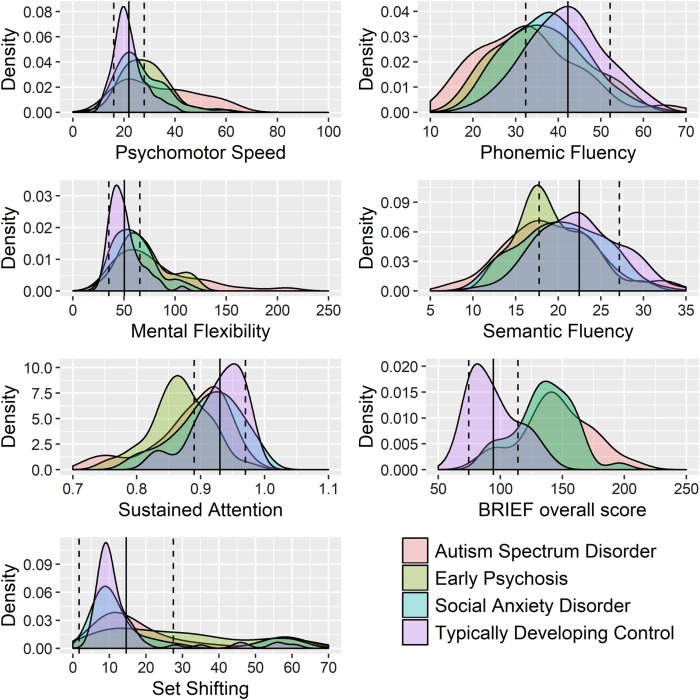
The disability burden in clinical cohorts with social impairment is significant, leading to poor functional outcomes. Some of this impairment has been linked to executive dysfunction. In this study, a transdiagnostic approach was taken to identify executive function (EF) processes in young adults that may underpin social impairment and to evaluate their contribution to disability. Comparisons were made between three prominent disorders that are characterized by social impairments, Autism Spectrum Disorder (ASD), Early Psychosis (EP) and Social Anxiety Disorder (SAD), as well as a neurotypically developing group (TYP). We examined whether overall disability could be predicted by neuropsychological and self-report assessments of EF. Our study showed that ASD participants demonstrated impaired performance on most domains of EF compared to the TYP group (mental flexibility, sustained attention and fluency) while the EP group showed impairment on sustained attention and attentional shifting. The SAD participants showed EF impairment on self-report ratings, even though their objective performance was intact. Self-reports of EF explained a significant percentage (17%) of disability in addition to the variance explained by other predictors, and this was particularly important for ASD. This is the first study to compare EF measures across clinical groups of social impairment and suggests unique cognitive-circuitry that underpins disability within groups. Impairments in EF were broad in ASD and predicted disability, EP impairments were specific to attentional processes and SAD impairments likely relate to negative self-monitoring. Self-report, as opposed to performance-based EF, provided best capacity to predict disability. These findings contribute to transdiagnostic circuitry models and intervention strategies.
Overview
The claims and statistics of this paper haven’t been checked yet.
Free: it reads the open-access text and checks the first 5 claims that cite a source we can check. Create a free account to check every claim.
Integrity signals
Registry
Cites
Statistics
Figures
Verification
Claims the paper makes
The claims and statistics of this paper haven’t been checked yet.
Free: it reads the open-access text and checks the first 5 claims that cite a source we can check. Create a free account to check every claim.
Claims other papers make about this one
Each is checked against this paper’s own text: does it say what the citing paper says it does?
In the citing paper
“Their results showed that deficits in these executive functions are not the primary contributors to disability for SAD.”
From Response inhibition, cognitive flexibility and working memory in obsessive-compulsive disorder, generalized anxiety disorder and social anxiety disorder (2021) · cites this paper as [20]
Self-check
Percentages, sums and reported differences re-computed from the paper’s own numbers.
The self-check needs the paper’s full text.
Citations
Cites
Toplak, M. E., West, R. F., & Stanovich, K. E. (2013) · Journal of Child Psychology and Psychiatry · doi:10.1111/jcpp.12001 · Cited by 1,381
Anxiety and affective style: role of prefrontal cortex and amygdala
Davidson, R. J. (2002) · Biological Psychiatry · doi:10.1016/s0006-3223(01)01328-2 · Cited by 1,135
Braun, M., Tupper, D., Kaufmann, P., McCrea, M., Postal, K., Westerveld, M., Wills, K., & Deer, T. (2011) · Cognitive and Behavioral Neurology · doi:10.1097/wnn.0b013e3182351289 · Cited by 1,056
Autism spectrum disorders: a meta-analysis of executive function
Demetriou, E. A., Lampit, A., Quintana, D. S., Naismith, S. L., Song, Y. J. C., Pye, J. E., Hickie, I., & Guastella, A. J. (2018) · Molecular Psychiatry · doi:10.1038/mp.2017.75 · Cited by 841
Self-citationNormative data from the CANTAB I: development of executive function over the lifespan
De Luca, C. R., Wood, S. J., Anderson, V., Buchanan, J.-A., Proffitt, T. M., Mahony, K., & Pantelis, C. (2003) · Journal of Clinical and Experimental Neuropsychology · doi:10.1076/jcen.25.2.242.13639 · Cited by 710
Disability and Quality of Life in Social Phobia: Epidemiologic Findings
Stein, M. B., & Kean, Y. M. (2000) · American Journal of Psychiatry · doi:10.1176/appi.ajp.157.10.1606 · Cited by 685
Understanding Executive Control in Autism Spectrum Disorders in the Lab and in the Real World
Kenworthy, L., Yerys, B. E., Anthony, L. G., & Wallace, G. L. (2008) · Neuropsychology Review · doi:10.1007/s11065-008-9077-7 · Cited by 504
Quality of life in autism across the lifespan: A meta-analysis
van Heijst, B. F., & Geurts, H. M. (2015) · Autism · doi:10.1177/1362361313517053 · Cited by 460
Autism spectrum disorder: outcomes in adulthood
Howlin, P., & Magiati, I. (2017) · Current Opinion in Psychiatry · doi:10.1097/yco.0000000000000308 · Cited by 457
Social re-orientation and brain development: An expanded and updated view
Nelson, E. E., Jarcho, J. M., & Guyer, A. E. (2016) · Developmental Cognitive Neuroscience · doi:10.1016/j.dcn.2015.12.008 · Cited by 447
Toplak, M. E., Bucciarelli, S. M., Jain, U., & Tannock, R. (2008) · Child Neuropsychology · doi:10.1080/09297040802070929 · Cited by 444
Seidman, L. J., Shapiro, D. I., Stone, W. S., Woodberry, K. A., Ronzio, A., Cornblatt, B. A., Addington, J., Bearden, C. E., Cadenhead, K. S., Cannon, T. D., et al. (2016) · JAMA Psychiatry · doi:10.1001/jamapsychiatry.2016.2479 · Cited by 270
Wallace, G. L., Kenworthy, L., Pugliese, C. E., Popal, H. S., White, E. I., Brodsky, E., & Martin, A. (2016) · Journal of Autism and Developmental Disorders · doi:10.1007/s10803-015-2655-7 · Cited by 261
WIERSMA, D., WANDERLING, J., DRAGOMIRECKA, E., GANEV, K., HARRISON, G., AN DER HEIDEN, W., NIENHUIS, F. J., & WALSH, D. (2000) · Psychological Medicine · doi:10.1017/s0033291799002627 · Cited by 251
Executive Function, Neural Circuitry, and Genetic Mechanisms in Schizophrenia
Eisenberg, D. P., & Berman, K. F. (2010) · Neuropsychopharmacology · doi:10.1038/npp.2009.111 · Cited by 246
The role of executive functions in social impairment in Autism Spectrum Disorder
Leung, R. C., Vogan, V. M., Powell, T. L., Anagnostou, E., & Taylor, M. J. (2016) · Child Neuropsychology · doi:10.1080/09297049.2015.1005066 · Cited by 236
Silton, R. L., Heller, W., Towers, D. N., Engels, A. S., Spielberg, J. M., Edgar, J. C., Sass, S. M., Stewart, J. L., Sutton, B. P., Banich, M. T., et al. (2010) · NeuroImage · doi:10.1016/j.neuroimage.2009.12.061 · Cited by 233
Pugliese, C. E., Anthony, L. G., Strang, J. F., Dudley, K., Wallace, G. L., Naiman, D. Q., & Kenworthy, L. (2016) · Journal of Autism and Developmental Disorders · doi:10.1007/s10803-015-2584-5 · Cited by 218
Brain connectomics predict response to treatment in social anxiety disorder
Whitfield-Gabrieli, S., Ghosh, S. S., Nieto-Castanon, A., Saygin, Z., Doehrmann, O., Chai, X. J., Reynolds, G. O., Hofmann, S. G., Pollack, M. H., & Gabrieli, J. D. E. (2016) · Molecular Psychiatry · doi:10.1038/mp.2015.109 · Cited by 210
Wood, S. J., Pantelis, C., Velakoulis, D., Yucel, M., Fornito, A., & McGorry, P. D. (2007) · Schizophrenia Bulletin · doi:10.1093/schbul/sbm149 · Cited by 195
SPSS Statistics Version 22: A Practical Guide
Allen, P., & Bennett, K. (2014) · Murdoch University Research Portal · Cited by 193
Goldin, P. R., Ziv, M., Jazaieri, H., Hahn, K., Heimberg, R., & Gross, J. J. (2013) · JAMA Psychiatry · doi:10.1001/jamapsychiatry.2013.234 · Cited by 174
Dryman, M. T., Gardner, S., Weeks, J. W., & Heimberg, R. G. (2015) · Journal of Anxiety Disorders · doi:10.1016/j.janxdis.2015.12.003 · Cited by 166
Libero, L. E., DeRamus, T. P., Lahti, A. C., Deshpande, G., & Kana, R. K. (2015) · Cortex · doi:10.1016/j.cortex.2015.02.008 · Cited by 140
Lee, R. S. C., Hermens, D. F., Redoblado-Hodge, M. A., Naismith, S. L., Porter, M. A., Kaur, M., White, D., Scott, E. M., & Hickie, I. B. (2013) · PLoS ONE · doi:10.1371/journal.pone.0058176 · Cited by 122
Self-citationNeural correlates of self-focused attention in social anxiety
Boehme, S., Miltner, W. H. R., & Straube, T. (2015) · Social Cognitive and Affective Neuroscience · doi:10.1093/scan/nsu128 · Cited by 88
D'Cruz, A.-M., Mosconi, M. W., Ragozzino, M. E., Cook, E. H., & Sweeney, J. A. (2016) · Translational Psychiatry · doi:10.1038/tp.2016.161 · Cited by 77
Fu, S., Czajkowski, N. O., Rund, B. R., & Torgalsbøen, A. (2017) · Schizophrenia Research · doi:10.1016/j.schres.2017.03.002 · Cited by 77
Severity of generalized social anxiety disorder correlates with low executive functioning
Fujii, Y., Kitagawa, N., Shimizu, Y., Mitsui, N., Toyomaki, A., Hashimoto, N., Kako, Y., Tanaka, T., Asakura, S., Koyama, T., et al. (2013) · Neuroscience Letters · doi:10.1016/j.neulet.2013.02.059 · Cited by 72
Woon, P. S., Chia, M. Y., Chan, W. Y., & Sim, K. (2010) · Progress in Neuro-Psychopharmacology and Biological Psychiatry · doi:10.1016/j.pnpbp.2010.01.014 · Cited by 71
Neural correlates of set-shifting in children with autism
Yerys, B. E., Antezana, L., Weinblatt, R., Jankowski, K. F., Strang, J., Vaidya, C. J., Schultz, R. T., Gaillard, W. D., & Kenworthy, L. (2015) · Autism Research · doi:10.1002/aur.1454 · Cited by 71
Social anxiety disorder: a critical overview of neurocognitive research
Cremers, H. R., & Roelofs, K. (2016) · WIREs Cognitive Science · doi:10.1002/wcs.1390 · Cited by 69
Wiersma, D., WANDERLING, J. A., Dragomirecká, E., Ganev, K., Harrison, G. L., der Heiden, W. A., Nienhuis, F. J., & Walsh, D. (2000) · Schizophrenia Research · doi:10.1016/s0920-9964(00)90721-7 · Cited by 65
A systematic review of neuropsychological performance in social anxiety disorder
O'Toole, M. S., & Pedersen, A. D. (2011) · Nordic Journal of Psychiatry · doi:10.3109/08039488.2011.565801 · Cited by 59
Evaluating differential developmental trajectories to adolescent-onset mood and psychotic disorders
Hickie, I. B., Hermens, D. F., Naismith, S. L., Guastella, A. J., Glozier, N., Scott, J., & Scott, E. M. (2013) · BMC Psychiatry · doi:10.1186/1471-244x-13-303 · Cited by 51
Self-citationDiagnosis and neurocognitive profiles in first-episode non-affective psychosis patients
Ayesa‐Arriola, R., Rodríguez-Sánchez, J. M., Setién‐Suero, E., Reeves, L. E., Tabarés‐Seisdedos, R., & Crespo‐Facorro, B. (2016) · European Archives of Psychiatry and Clinical Neuroscience · doi:10.1007/s00406-015-0667-0 · Cited by 46
McGrath, L. M., Braaten, E. B., Doty, N. D., Willoughby, B. L., Wilson, H. K., O'Donnell, E. H., Colvin, M. K., Ditmars, H. L., Blais, J. E., Hill, E. N., et al. (2016) · Journal of Child Psychology and Psychiatry · doi:10.1111/jcpp.12463 · Cited by 43
Lieb, R. W., & Bohnert, A. M. (2017) · Journal of Autism and Developmental Disorders · doi:10.1007/s10803-017-3205-2 · Cited by 43
The RDoC Controversy: Alternate Paradigm or Dominant Paradigm?
Carpenter, W. T. (2016) · American Journal of Psychiatry · doi:10.1176/appi.ajp.2016.16030347 · Cited by 28
Lowengrub, K., Stryjer, R., Birger, M., & Iancu, I. (2015) · PubMed · Cited by 15
Research works printed but not linked: 1
- Lezak M Howieson D Bigler E Tranel D Neuropsychological Assessment 2012 New York Oxford University Press
Cited by
Demetriou, E. A., DeMayo, M. M., & Guastella, A. J. (2019) · Frontiers in Psychiatry · doi:10.3389/fpsyt.2019.00753 · Cited by 274
“These include impacts of EF on social cognition (16, 17), mental health (18), disability (19, 20), and lifelong functioning outcomes (21).”
BackgroundSelf-citationAutism spectrum disorder and schizophrenia: An updated conceptual review
Jutla, A., Foss‐Feig, J. H., & Veenstra-VanderWeele, J. M. (2021) · Autism Research · doi:10.1002/aur.2659 · Cited by 189
Pasqualotto, A., Mazzoni, N., Bentenuto, A., Mulè, A., Benso, F., & Venuti, P. (2021) · Brain Sciences · doi:10.3390/brainsci11101280 · Cited by 129
A review of executive functioning challenges and strengths in autistic adults
John, T. S., Woods, S. E. O., Bode, T., Ritter, C., & Estes, A. M. (2021) · The Clinical Neuropsychologist · doi:10.1080/13854046.2021.1971767 · Cited by 83
“…and comorbidities, one reported that worse fluency was related to social anxiety and one reported no significant association of fluency with depression, anxiety, and OCD symptoms (Baxter et al., 2019; Demetriou et al., 2018; Kimura et al., 2020; Marinopoulou et al., 2016; Wilson et al., 2014).”
BackgroundResultInfluentialAssistive Technology for Cognition to Support Executive Functions in Autism: a Scoping Review
Desideri, L., Santantonio, A. D., Varrucciu, N., Bonsi, I. I., & Sarro, R. D. (2020) · Advances in Neurodevelopmental Disorders · doi:10.1007/s41252-020-00163-w · Cited by 57
Metadata
- Authors
- Demetriou, E. A., Song, C. Y., Park, S. H., Pepper, K. L., Naismith, S. L., Hermens, D. F., Hickie, I. B., Thomas, E. E., Norton, A., White, D., & Guastella, A. J.
- Affiliations
- The University of Sydney (AU)
- Corresponding author
- Guastella, Adam J.
- ORCID
- Venue
- Translational Psychiatry
- Published
- 2018-09-24
- Volume
- 8
- Issue
- 1
- Pages
- 200-200
- ISSN
- 2158-3188 (ISSN-L)
- PMC
- PMC6155256
- OpenAlex
- W2890978495
- Cited by
- 35
- References
- 40
- Citations by year
- 2026: 1 · 2025: 5 · 2024: 2 · 2023: 6 · 2022: 4 · 2021: 10 · 2020: 5 · 2019: 2
- FWCI
- 2.53
- Type
- journal article
- Language
- en
- Open access
- gold
- doi.org
- Licence
- cc-by
- creativecommons.org/licenses/by/4.0 (tdm)
- creativecommons.org/licenses/by/4.0 (vor)
- Locations
- Translational Psychiatry (publishedVersion, cc-by)
- Europe PMC (PubMed Central) (publishedVersion, cc-by)
- PubMed Central (publishedVersion, cc-by)
- PubMed (publishedVersion)
- DOAJ (DOAJ: Directory of Open Access Journals) (submittedVersion)
- Funders
- Medical Research Council
- National Health and Medical Research Council (APP 511921, LP110100513, 1056587, 511921)
- Topics
- Life Sciences › Neuroscience › Cognitive Neuroscience › Autism Spectrum Disorder Research
- Health Sciences › Medicine › Psychiatry and Mental health › Schizophrenia research and treatment
- Life Sciences › Neuroscience › Cognitive Neuroscience › Neural and Behavioral Psychology Studies
- Keywords
- executive function, autism spectrum disorder, early psychosis, social anxiety disorder, social dysfunction, disability, transdiagnostic model, sustained attention, attentional shift, cognitive flexibility, young adults
- MeSH terms
- Autism Spectrum Disorder, Phobia, Social, Adult, Attention, Female, Humans, Male, Neuropsychological Tests, Psychotic Disorders, Young Adult, Executive Function, Self Report
About these checks
Registry, retraction, Cites and statistics results are computed, not judged, with one exception: a printed reference that no index lists is read once by a model before it counts as a citation error. Claims are extracted by a model and kept only when their quote appears verbatim in the text; each cited source is then checked, with a model’s help, for whether it says what the claim relies on. Those verdicts can be wrong — read the claim’s quote and the cited source before relying on one.
Statistics and arithmetic are recomputed, not judged.
Confidence bands are shown only for fields calibrated on our annotated test set. None is calibrated yet, so no band is shown.
What counts as a claim ›How we measure confidence ›How we check this ›
Are you an author, or do you see a problem with this page? Request a review
Data sources
Bibliographic data: Semantic Scholar, OpenAlex, Crossref.
Contains information from the Semantic Scholar Academic Graph Datasets, made available under the ODC Attribution License (ODC-BY 1.0).
Semantic Scholar’s data is described in: Kinney, R., et al. (2023). The Semantic Scholar Open Data Platform. arXiv:2301.10140.
