

The DOI matches its Crossref record; 36 of the 37 references it cites were found in a registry or an index.
Predicting the naturalistic course of depression from a wide range of clinical, psychological, and biological data: a machine learning approach
Open accessAbstract
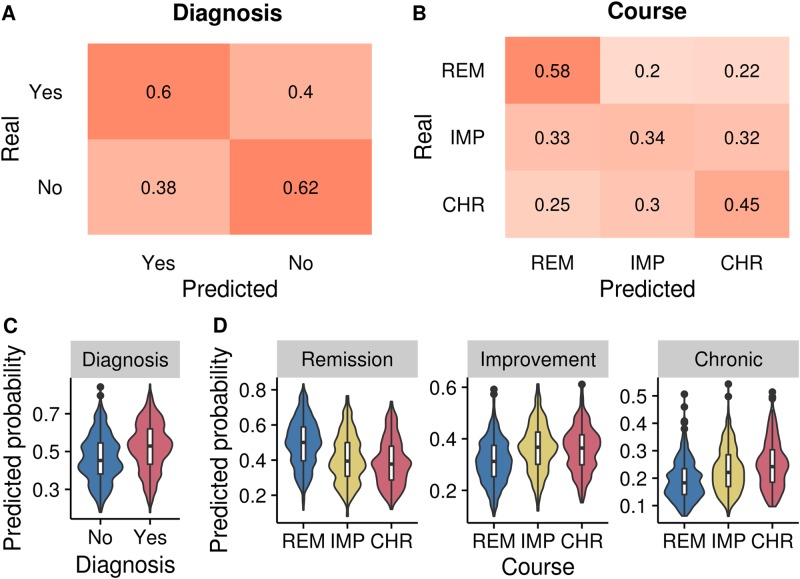
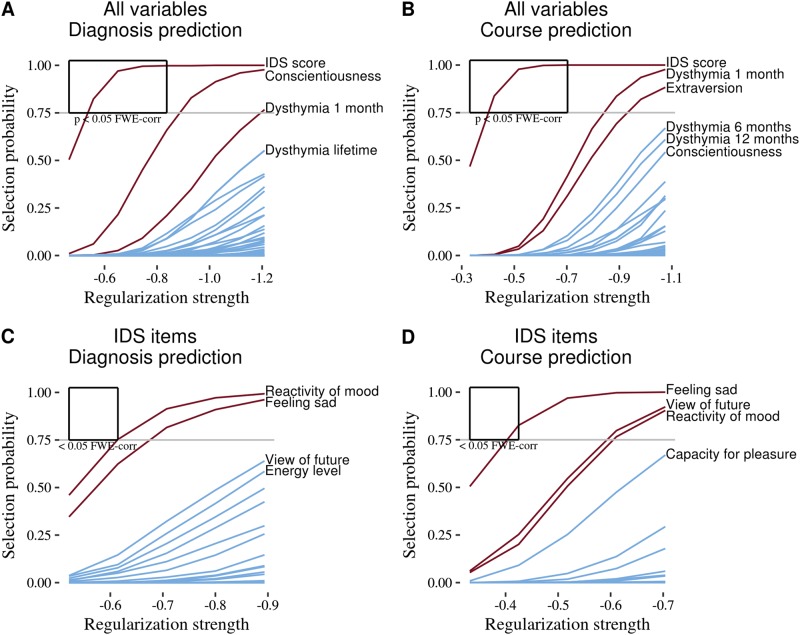
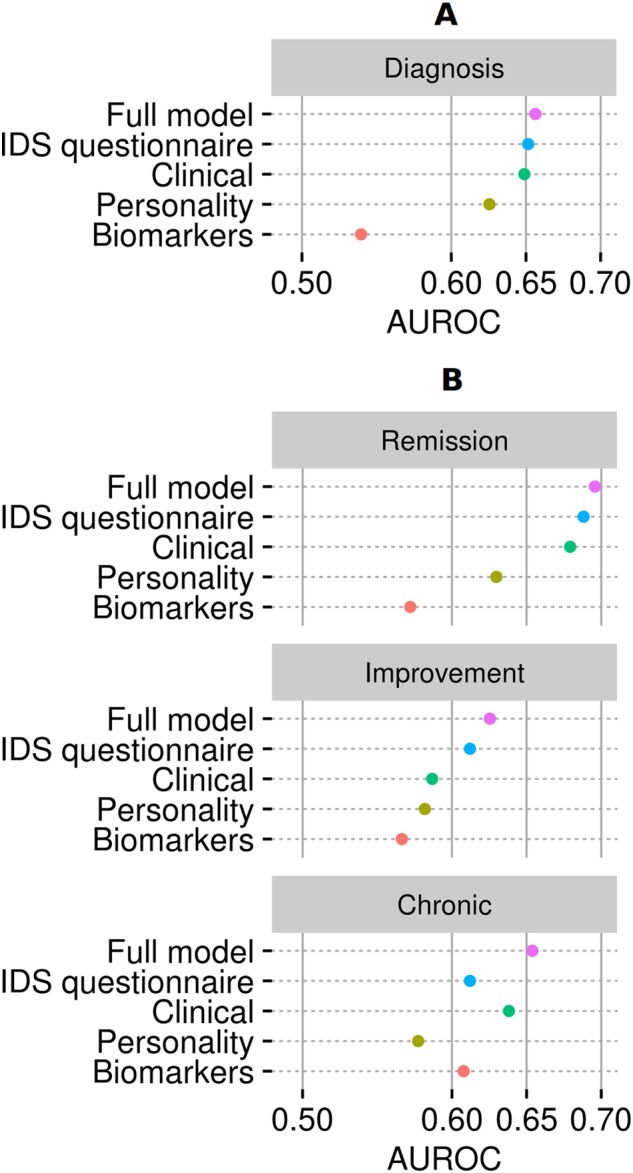
Many variables have been linked to different course trajectories of depression. These findings, however, are based on group comparisons with unknown translational value. This study evaluated the prognostic value of a wide range of clinical, psychological, and biological characteristics for predicting the course of depression and aimed to identify the best set of predictors. Eight hundred four unipolar depressed patients (major depressive disorder or dysthymia) patients were assessed on a set involving 81 demographic, clinical, psychological, and biological measures and were clinically followed-up for 2 years. Subjects were grouped according to (i) the presence of a depression diagnosis at 2-year follow-up (yes n = 397, no n = 407), and (ii) three disease course trajectory groups (rapid remission, n = 356, gradual improvement n = 273, and chronic n = 175) identified by a latent class growth analysis. A penalized logistic regression, followed by tight control over type I error, was used to predict depression course and to evaluate the prognostic value of individual variables. Based on the inventory of depressive symptomatology (IDS), we could predict a rapid remission course of depression with an AUROC of 0.69 and 62% accuracy, and the presence of an MDD diagnosis at follow-up with an AUROC of 0.66 and 66% accuracy. Other clinical, psychological, or biological variables did not significantly improve the prediction. Among the large set of variables considered, only the IDS provided predictive value for course prediction on an individual level, although this analysis represents only one possible methodological approach. However, accuracy of course prediction was moderate at best and further improvement is required for these findings to be clinically useful.
Overview
The claims and statistics of this paper haven’t been checked yet.
Run the check — free, no account needed. It reads the open-access text and checks the sources it cites.
Integrity signals
Registry
Cites
Statistics
Figures
Verification
Claims the paper makes
The claims and statistics of this paper haven’t been checked yet.
Run the check — free, no account needed. It reads the open-access text and checks the sources it cites.
Claims other papers make about this one
Each is checked against this paper’s own text: does it say what the citing paper says it does?
The source backs part of the claim, not all of it — or backs it for a different population, condition or comparison.
In the citing paper
“The model predicted who would develop TRD (defined as chronic depression with no improvement after two years of any or no treatments), found that about half (47%) of the TRD patients were correctly predicted to be so.”
From Irremediability in psychiatric euthanasia: examining the objective standard (2023) · cites this paper as Dinga et al., 2018
Experimental — accuracy not yet measuredThe source backs part of the claim, not all of it — or backs it for a different population, condition or comparison.
In the citing paper
“This is the only prediction model built on naturalistic study data that we found, and the study with the longest prediction endpoint.”
From Irremediability in psychiatric euthanasia: examining the objective standard (2023) · cites this paper as Dinga et al., 2018
Experimental — accuracy not yet measuredThe cited source says what the claim attributes to it.
In the citing paper
“However, it lacks external validation.”
From Irremediability in psychiatric euthanasia: examining the objective standard (2023) · cites this paper as Dinga et al., 2018
The cited source says what the claim attributes to it.
In the citing paper
“only one study involved long-term follow-up of sustained remission (Dinga et al., 2018)”
From Irremediability in psychiatric euthanasia: examining the objective standard (2023) · cites this paper as Dinga et al., 2018
Self-check
Percentages, sums and reported differences re-computed from the paper’s own numbers.
The self-check needs the paper’s full text.
Citations
Cites
The Elements of Statistical Learning
Hastie, T., Tibshirani, R., & Friedman, J. (2009) · Springer Series in Statistics · doi:10.1007/978-0-387-84858-7 · Cited by 25,970
Regularization Paths for Generalized Linear Models via Coordinate Descent
Friedman, J., Hastie, T., & Tibshirani, R. (2010) · Journal of Statistical Software · doi:10.18637/jss.v033.i01 · Cited by 19,927
An inventory for measuring clinical anxiety: Psychometric properties.
Beck, A. T., Epstein, N., Brown, G., & Steer, R. A. (1988) · Journal of Consulting and Clinical Psychology · doi:10.1037/0022-006x.56.6.893 · Cited by 14,407
Murray, C. J. L., Vos, T., Lozano, R., Naghavi, M., Flaxman, A. D., Michaud, C., Ezzati, M., Shibuya, K., Salomon, J. A., Abdalla, S., et al. (2012) · The Lancet · doi:10.1016/s0140-6736(12)61689-4 · Cited by 8,888
Robins, L. N. (1988) · Archives of General Psychiatry · doi:10.1001/archpsyc.1988.01800360017003 · Cited by 2,909
Meinshausen, N., & Bühlmann, P. (2010) · Journal of the Royal Statistical Society Series B (Statistical Methodology) · doi:10.1111/j.1467-9868.2010.00740.x · Cited by 2,463
Domains and Facets: Hierarchical Personality Assessment Using the Revised NEO Personality Inventory
Costa, P. T., & McCrae, R. R. (1995) · Journal of Personality Assessment · doi:10.1207/s15327752jpa6401_2 · Cited by 2,080
Comparing effect sizes in follow-up studies: ROC Area, Cohen's d, and r.
Rice, M. E., & Harris, G. T. (2005) · Law and Human Behavior · doi:10.1007/s10979-005-6832-7 · Cited by 1,608
Kapur, S., Phillips, A. G., & Insel, T. R. (2012) · Molecular Psychiatry · doi:10.1038/mp.2012.105 · Cited by 980
The Netherlands Study of Depression and Anxiety (NESDA): rationale, objectives and methods
Penninx, B. W. J. H., Beekman, A. T. F., Smit, J. H., Zitman, F. G., Nolen, W. A., Spinhoven, P., Cuijpers, P. J., de Jong, P. J., van Marwijk, H., Assendelft, W. J., et al. (2008) · International Journal of Methods in Psychiatric Research · doi:10.1002/mpr.256 · Cited by 930
Self-citation
Cited by
Sorted by citations
Applications of Machine Learning Predictive Models in the Chronic Disease Diagnosis
Battineni, G., Sagaro, G. G., Chintalapudi, N., & Amenta, F. (2020) · Journal of Personalized Medicine · doi:10.3390/jpm10020021 · Cited by 418
de Pablo, G. S., Studerus, E., Vaquerizo‐Serrano, J., Irving, J., Catalán, A., Oliver, D., Baldwin, H., Danese, A., Fazel, S., Steyerberg, E. W., et al. (2020) · Schizophrenia Bulletin · doi:10.1093/schbul/sbaa120 · Cited by 234
Penninx, B. W. J. H., Eikelenboom, M., Giltay, E. J., van Hemert, A. M., Riese, H., Schoevers, R. A., & Beekman, A. T. F. (2021) · Journal of Affective Disorders · doi:10.1016/j.jad.2021.03.026 · Cited by 100
Self-citationTran, B. X., McIntyre, R. S., Latkin, C. A., Phan, H. T., Vu, G. T., Nguyen, H. L. T., Gwee, K. K., Ho, C. S. H., & Ho, R. (2019) · International Journal of Environmental Research and Public Health · doi:10.3390/ijerph16122150 · Cited by 93
A systematic review on AI/ML approaches against COVID-19 outbreak
Dogan, O., Tiwari, S., Jabbar, M. A., & Guggari, S. (2021) · Complex & Intelligent Systems · doi:10.1007/s40747-021-00424-8 · Cited by 87
Nicolini, M. E., Kim, S. Y. H., Churchill, M. E., & Gastmans, C. (2020) · Psychological Medicine · doi:10.1017/s0033291720001543 · Cited by 77
An insight into diagnosis of depression using machine learning techniques: a systematic review
Bhadra, S., & Kumar, C. J. (2022) · Current Medical Research and Opinion · doi:10.1080/03007995.2022.2038487 · Cited by 84
Mental health in the UK Biobank: A roadmap to self‐report measures and neuroimaging correlates
Dutt, R., Hannon, K., Easley, T. O., Griffis, J. C., Zhang, W., & Bijsterbosch, J. D. (2021) · Human Brain Mapping · doi:10.1002/hbm.25690 · Cited by 71
Santamaría‐García, H. A., Báez, S., Gómez, C., Rodríguez‐Villagra, O. A., Huepe, D., Portela, M., Reyes, P. A., Klahr, J., Matallana, D., & Ibáñez, A. M. (2020) · Translational Psychiatry · doi:10.1038/s41398-020-0852-4 · Cited by 81
Na, K., Cho, S., Geem, Z. W., & Kim, Y. (2020) · Neuroscience Letters · doi:10.1016/j.neulet.2020.134804 · Cited by 68
Novel Cuckoo Search-Based Metaheuristic Approach for Deep Learning Prediction of Depression
Jawad, K., Mahto, R., Das, A., Ahmed, S. U., Aziz, R. M., & Kumar, P. (2023) · Applied Sciences · doi:10.3390/app13095322 · Cited by 60
Predicting treatment outcome in depression: an introduction into current concepts and challenges
Rost, N., Binder, E. B., & Brückl, T. M. (2022) · European Archives of Psychiatry and Clinical Neuroscience · doi:10.1007/s00406-022-01418-4 · Cited by 66
Predicting individual clinical trajectories of depression with generative embedding
Frässle, S., Marquand, A. F., Schmaal, L., Dinga, R., Veltman, D. J., van der Wee, N. J. A., van Tol, M., Schöbi, D., Penninx, B. W. J. H., & Stephan, K. E. (2020) · NeuroImage Clinical · doi:10.1016/j.nicl.2020.102213 · Cited by 52
Self-citationHeyat, M. B. B., Akhtar, F., Munir, F., Sultana, A., Muaad, A. Y. M., Gul, I., Sawan, M., Asghar, W., Iqbal, S. M. A., Baig, A. A., et al. (2024) · Complex & Intelligent Systems · doi:10.1007/s40747-024-01346-x · Cited by 58
van Eeden, W. A., Luo, C. W., van Hemert, A. M., Carlier, I. V. E., Penninx, B. W. J. H., Wardenaar, K. J., Hoos, H. H., & Giltay, E. J. (2021) · Psychiatry Research · doi:10.1016/j.psychres.2021.113823 · Cited by 59
Self-citationCearns, M., Amare, A. T., Schubert, K. O., Thalamuthu, A., Frank, J., Streit, F., Adli, M., Akula, N., Akiyama, K., Ardau, R., et al. (2022) · The British Journal of Psychiatry · doi:10.1192/bjp.2022.28 · Cited by 48
Lalousis, P. A., Schmaal, L., Wood, S. J., Reniers, R. L. E. P., Barnes, N. M., Chisholm, K., Griffiths, S. L., Stainton, A., Wen, J., Hwang, G., et al. (2022) · Biological Psychiatry · doi:10.1016/j.biopsych.2022.03.021 · Cited by 48
Self-citationTran, T. A., Trang, L. T. T., An, T. D., Nghĩa, N. H., & Loan, D. T. T. (2024) · Journal of Human Earth and Future · doi:10.28991/hef-2024-05-01-01 · Cited by 48
The Future of Artificial Intelligence in Mental Health Nursing Practice: An Integrative Review
Milasan, L. H., & Scott, D. (2025) · International Journal of Mental Health Nursing · doi:10.1111/inm.70003 · Cited by 50
Choi, B., Shim, G., Jeong, B., & Jo, S. (2020) · Scientific Reports · doi:10.1038/s41598-020-64709-7 · Cited by 38
Bokma, W. A., Zhutovsky, P., Giltay, E. J., Schoevers, R. A., Penninx, B. W. J. H., van Balkom, A. J. L. M., Batelaan, N. M., & van Wingen, G. A. (2020) · Psychological Medicine · doi:10.1017/s0033291720001658 · Cited by 36
Self-citationKumar, R., Mukherjee, S., Choi, T., & Dhamotharan, L. (2022) · Decision Support Systems · doi:10.1016/j.dss.2022.113792 · Cited by 35
Toenders, Y. J., Kottaram, A., Dinga, R., Davey, C. G., Banaschewski, T., Bokde, A. L. W., Quinlan, E. B., Desrivières, S., Flor, H., Grigis, A., et al. (2021) · Biological Psychiatry Cognitive Neuroscience and Neuroimaging · doi:10.1016/j.bpsc.2021.03.005 · Cited by 37
Self-citationAbdulazeem, H. M., Whitelaw, S., Schauberger, G., & Klug, S. J. (2023) · PLoS ONE · doi:10.1371/journal.pone.0274276 · Cited by 40
Intelligent Internet of Medical Things for Depression: Current Advancements, Challenges, and Trends
Heyat, M. B. B., Adhikari, D., Akhtar, F., Parveen, S., Zeeshan, H. M., Ullah, H., Chen, Y.-H., Wang, L., & Sawan, M. (2025) · International Journal of Intelligent Systems · doi:10.1155/int/6801530 · Cited by 34
Lin, S., Wu, Y., He, L., & Fang, Y. (2022) · Aging & Mental Health · doi:10.1080/13607863.2022.2031868 · Cited by 32
Xiang, Q., Chen, K., Peng, L., Luo, J., Jiang, J., Chen, Y., Lan, L., Song, H., & Zhou, X. (2022) · Journal of Affective Disorders · doi:10.1016/j.jad.2022.05.020 · Cited by 33
Prediction of depression treatment outcome from multimodal data: a CAN-BIND-1 report
Sajjadian, M., Uher, R., Ho, K. T., Hassel, S., Milev, R. V., Frey, B. N., Farzan, F., Blier, P., Foster, J. A., Parikh, S. V., et al. (2022) · Psychological Medicine · doi:10.1017/s0033291722002124 · Cited by 33
Lorenzo‐Luaces, L., Rodríguez‐Quintana, N., & Bailey, A. J. (2020) · Behaviour Research and Therapy · doi:10.1016/j.brat.2020.103637 · Cited by 30
de Nijs, J., Burger, T. J., Janssen, R. J., Kia, S. M., van Opstal, D. P. J., de Koning, M. B., de Haan, L., GROUP investigators, Alizadeh, B. Z., Bartels‐Velthuis, A. A., et al. (2021) · Schizophrenia · doi:10.1038/s41537-021-00162-3 · Cited by 36
Predicting Depression in Community Dwellers Using a Machine Learning Algorithm
Cho, S., Geem, Z. W., & Na, K. (2021) · Diagnostics · doi:10.3390/diagnostics11081429 · Cited by 31
Irremediability in psychiatric euthanasia: examining the objective standard
Nicolini, M. E., Jardas, E., Zarate, C. A., Gastmans, C., & Kim, S. Y. H. (2023) · Psychological Medicine · doi:10.1017/s0033291722002951 · Cited by 31
“Acc F1 Other Section B. Predicting depressed patients’ development of TRD Dinga et al. (2018) Multinomial generalization of penalized elastic net logistic regression classifiers with 10-fold cross-validation Cross-validation No 0.66 0.47 0.61 Chang et al. (2019) Neural network architecture with a…”
BackgroundMethodResultInfluentialGiesemann, J., Delgadillo, J., Schwartz, B., Bennemann, B., & Lutz, W. (2023) · Psychotherapy Research · doi:10.1080/10503307.2022.2161432 · Cited by 26
Predicting outcomes of psychotherapy for depression with electronic health record data
Coley, R. Y., Boggs, J. M., Beck, A., & Simon, G. E. (2021) · Journal of Affective Disorders Reports · doi:10.1016/j.jadr.2021.100198 · Cited by 29
Predicting mental health using smart-phone usage and sensor data
Thakur, S. S., & Roy, R. B. (2020) · Journal of Ambient Intelligence and Humanized Computing · doi:10.1007/s12652-020-02616-5 · Cited by 30
Impact of serotonergic medication on interoception in major depressive disorder
Burrows, K., DeVille, D. C., Cosgrove, K. T., Kuplicki, R. T., Paulus, M. P., Aupperle, R., Khalsa, S. S., Stewart, J. L., Bodurka, J., Guinjoan, S., et al. (2022) · Biological Psychology · doi:10.1016/j.biopsycho.2022.108286 · Cited by 24
Habets, P. C., Thomas, R. M., Milaneschi, Y., Jansen, R., Pool, R., Peyrot, W. J., Penninx, B. W. J. H., Meijer, O. C., van Wingen, G. A., & Vinkers, C. H. (2023) · Biological Psychiatry · doi:10.1016/j.biopsych.2023.05.024 · Cited by 32
Self-citationLin, S., Wu, Y., & Fang, Y. (2022) · BMC Psychiatry · doi:10.1186/s12888-022-04439-4 · Cited by 32
Es-safi, I., Mechchate, H., Amaghnouje, A., Kamaly, O. M. A., Jawhari, F. Z., Imtara, H., Grafov, A., & Bousta, D. (2021) · Molecules · doi:10.3390/molecules26072009 · Cited by 27
Lin, S., Wu, Y., & Fang, Y. (2022) · Frontiers in Psychiatry · doi:10.3389/fpsyt.2021.764806 · Cited by 28
Belief updating in bipolar disorder predicts time of recurrence
Ossola, P., Garrett, N., Sharot, T., & Marchesi, C. (2020) · eLife · doi:10.7554/elife.58891 · Cited by 24
Friedl, N., Berger, T., Krieger, T., Caspar, F., & Holtforth, M. G. (2019) · Psychotherapy Research · doi:10.1080/10503307.2019.1664782 · Cited by 18
Park, Y., Park, S., & Lee, M. (2024) · Journal of Affective Disorders · doi:10.1016/j.jad.2024.06.035 · Cited by 24
Multifactorial prediction of depression diagnosis and symptom dimensions
McNamara, M. E., Shumake, J., Stewart, R. A., Labrada, J., Alario, A., Allen, J. J. B., Palmer, R., Schnyer, D. M., McGeary, J. E., & Beevers, C. G. (2021) · Psychiatry Research · doi:10.1016/j.psychres.2021.113805 · Cited by 23
Wardenaar, K. J., Riese, H., Giltay, E. J., Eikelenboom, M., van Hemert, A. M., Beekman, A. T. F., Penninx, B. W. J. H., & Schoevers, R. A. (2021) · Journal of Affective Disorders · doi:10.1016/j.jad.2021.06.029 · Cited by 23
Self-citationSoldatos, R. F., Cearns, M., Nielsen, M. Ø., Kollias, C. T., Xenaki, L., Stefanatou, P., Ralli, I., Dimitrakopoulos, S., Hatzimanolis, A., Kosteletos, I., et al. (2021) · Schizophrenia Bulletin · doi:10.1093/schbul/sbab107 · Cited by 22
Lemke, H., Klute, H., Skupski, J., Thiel, K., Waltemate, L., Winter, A., Breuer, F., Meinert, S. L., Klug, M., Enneking, V., et al. (2022) · Translational Psychiatry · doi:10.1038/s41398-022-02113-7 · Cited by 21
Ahmed, M. S., & Ahmed, N. (2023) · JMIR Formative Research · doi:10.2196/28848 · Cited by 22
Friedl, N., Krieger, T., Chevreul, K., Hazo, J., Holtzmann, J., Hoogendoorn, M., Kleiboer, A. M., Mathiasen, K., Urech, A., Riper, H. M., et al. (2020) · Journal of Clinical Medicine · doi:10.3390/jcm9020490 · Cited by 20
Depressive symptoms in older adults: the role of physical activity and social support
Moya, C. A. M., Soares, F. C., Lima, R. A., de Barros, M. V. G., & Bezerra, J. (2021) · Trends in Psychiatry and Psychotherapy · doi:10.47626/2237-6089-2020-0093 · Cited by 18
Vetter, J., Schultebraucks, K., Galatzer‐Levy, I. R., Boeker, H., Brühl, A. B., Seifritz, E., & Kleim, B. (2022) · Scientific Reports · doi:10.1038/s41598-022-09226-5 · Cited by 21
Colombo, F., Calesella, F., Bravi, B., Fortaner-Uyà, L., Monopoli, C., Tassi, E., Carminati, M., Zanardi, R., Bollettini, I., Poletti, S., et al. (2024) · European Neuropsychopharmacology · doi:10.1016/j.euroneuro.2024.05.015 · Cited by 18
Machine Learning Methods to Evaluate the Depression Status of Chinese Recruits: A Diagnostic Study
Zhao, M., & Feng, Z. (2020) · Neuropsychiatric Disease and Treatment · doi:10.2147/ndt.s275620 · Cited by 16
Teutenberg, L., Stein, F., Thomas‐Odenthal, F., Usemann, P. L., Brosch, K., Winter, N. R., Goltermann, J., Leenings, R., Konowski, M., Barkhau, C., et al. (2025) · Journal of Affective Disorders · doi:10.1016/j.jad.2025.01.060 · Cited by 16
Ciobanu, L. G., Sachdev, P. S., Trollor, J. N., Reppermund, S., Thalamuthu, A., Mather, K. A., Cohen‐Woods, S., Stacey, D., Toben, C. G., Schubert, K. O., et al. (2020) · Journal of Affective Disorders · doi:10.1016/j.jad.2020.02.001 · Cited by 16
Bø, R., Kraft, B., Jonassen, R., Harmer, C. J., Hilland, E., Stiles, T. C., Haaland, V. Ø., Aspesletten, M. E. B., Sletvold, H., & Landrø, N. I. (2021) · Journal of Psychiatric Research · doi:10.1016/j.jpsychires.2021.04.027 · Cited by 15
Jensen, K. H. R., Dam, V. H., Ganz, M., Fisher, P. M., Ip, C.-T., Sankar, A., Marstrand-Joergensen, M. R., Ozenne, B., Osler, M., Penninx, B. W. J. H., et al. (2023) · BMC Psychiatry · doi:10.1186/s12888-023-04618-x · Cited by 16
Self-citationEdavally, S., Miller, D. D., & Youssef, N. A. (2021) · Annals of Clinical Psychiatry · doi:10.12788/acp.0041 · Cited by 14
Lorenzo‐Luaces, L., Rodríguez‐Quintana, N., Riley, T. N., & Weisz, J. R. (2020) · Psychotherapy Research · doi:10.1080/10503307.2020.1747657 · Cited by 14
Berwian, I. M., Wenzel, J. G., Kuehn, L., Schnuerer, I., Seifritz, E., Stephan, K. E., Walter, H., & Huys, Q. J. M. (2022) · Scientific Reports · doi:10.1038/s41598-022-13893-9 · Cited by 13
Rost, N., Dwyer, D., Gaffron, S., Rechberger, S., Maier, D., Binder, E. B., & Brückl, T. M. (2023) · Journal of Affective Disorders · doi:10.1016/j.jad.2023.02.007 · Cited by 15
Whole Person Modeling: a transdisciplinary approach to mental health research
Felsky, D., Cannitelli, A., & Pipitone, J. (2023) · Discover Mental Health · doi:10.1007/s44192-023-00041-6 · Cited by 16
Fritz, J., Stochl, J., Goodyer, I. M., van Harmelen, A.-L., & Wilkinson, P. O. (2020) · Translational Psychiatry · doi:10.1038/s41398-020-00944-w · Cited by 13
New Analytic Framework of Public Mental Health Prediction Using Data Science
Marrapu, H. K., Maram, B., & Reddi, P. (2022) · International Conference on Smart Technologies and Systems for Next Generation Computing (ICSTSN) · doi:10.1109/icstsn53084.2022.9761324 · Cited by 12
Salem, H., Huynh, T., Topolski, N., Mwangi, B., Trivedi, M. H., Soares, J. C., Rush, A. J., & Selvaraj, S. (2022) · Journal of Affective Disorders · doi:10.1016/j.jad.2022.12.076 · Cited by 12
Lee, D. Y., Cho, Y. H., Kim, M.-S., Jeong, C., Cha, J. M., Won, G. H., Noh, J. S., Son, S. J., & Park, R. W. (2023) · European Psychiatry · doi:10.1192/j.eurpsy.2023.10 · Cited by 14
Li, B., Guo, S., Xu, H. Y., Zhou, Y., Zhang, M., Wang, J., Chen, Y., Chen, H., Song, J., & Tan, S. (2024) · Journal of Affective Disorders · doi:10.1016/j.jad.2024.06.102 · Cited by 12
Depression Risk Prediction among Tech Employees in Bangladesh using Adaboosted Decision Tree
Uddin, J. M. I., Fatema, K., & Dhar, P. K. (2020) · IEEE International Women in Engineering (WIE) Conference on Electrical and Computer Engineering (WIECON-ECE) · doi:10.1109/wiecon-ece52138.2020.9397999 · Cited by 11
Mallawaarachchi, S. R., Amminger, G. P., Farhall, J., Bolt, L. K., Nelson, B., Yuen, H. P., McGorry, P. D., Markulev, C., Schäfer, M. R., Mossaheb, N., et al. (2020) · Schizophrenia Research · doi:10.1016/j.schres.2020.03.008 · Cited by 11
Deep Neural Networks Carve the Brain at its JointsPreprint
Bertolero, M. A., & Bassett, D. S. (2020) · bioRxiv (Cold Spring Harbor Laboratory) · doi:10.1101/2020.02.20.958082 · Cited by 13
Lavelle-Hill, R. E., Smith, G., & Murayama, K. (2025) · Advances in Methods and Practices in Psychological Science · doi:10.1177/25152459251345696 · Cited by 11
Black, D. W., & Allen, J. (2021) · Journal of Gambling Studies · doi:10.1007/s10899-021-10003-8 · Cited by 9
Tagliaferri, S. D., Han, L. K. M., Khetan, M., Nguyen, J., Markulev, C., Rice, S., Cotton, S., Berk, M., Byrne, E. M., Rickwood, D., et al. (2025) · Journal of the American Academy of Child & Adolescent Psychiatry · doi:10.1016/j.jaac.2025.03.019 · Cited by 10
Self-citationBrandes-Aitken, A. N., Lazerwitz, M. C., Eash, A., Hattangadi, N., Mukherjee, P., Marco, E. J., & Shapiro, K. A. (2025) · Translational Psychiatry · doi:10.1038/s41398-025-03592-0 · Cited by 8
Guiñazú, M. F., González, M., Ruiz, R. B., Hernández, V., Diez, S. B., & Velásquez, J. D. (2023) · Information Fusion · doi:10.1016/j.inffus.2023.101960 · Cited by 9
Alkattan, A., Alzeer, A. H., Alsaawi, F., Alyahya, A., Alnasser, R. A., Alsarhan, R., Almusawi, M. A., Alabdulaali, D., Mahmoud, N., Al‐Jafar, R., et al. (2024) · Expert Review of Endocrinology & Metabolism · doi:10.1080/17446651.2024.2400706 · Cited by 8
Cousins, A., Nakano, L., Schofield, E. C., & Kabaila, R. (2022) · Neural Computing and Applications · doi:10.1007/s00521-021-06710-3 · Cited by 7
Freeman, C. R., Olino, T. M., Barbeau, É. B., Weinberg, A., & Chai, X. J. (2022) · Biological Psychiatry Cognitive Neuroscience and Neuroimaging · doi:10.1016/j.bpsc.2022.09.015 · Cited by 8
Long-Term Outcomes of Depression Treatment With Hypnotherapy or Cognitive Behavioral Therapy
Fuhr, K., Meisner, C., & Batra, A. (2023) · The Journal of Nervous and Mental Disease · doi:10.1097/nmd.0000000000001647 · Cited by 9
Depression: Screening, Assessment, and Interventions in Oncology Nursing
Decker, V. B., & Tofthagen, C. (2021) · Clinical journal of oncology nursing · doi:10.1188/21.cjon.413-421 · Cited by 6
Poirot, M. G., Boucherie, D. E., Caan, M. W. A., Goya‐Maldonado, R., Belov, V. S., Corruble, E., Colle, R., Couvy‐Duchesne, B., Kamishikiryo, T., Shinzato, H., et al. (2025) · Human Brain Mapping · doi:10.1002/hbm.70053 · Cited by 6
Self-citationComparing three neural networks to predict depression treatment outcomes in psychological therapies
Schwartz, B., Giesemann, J., Delgadillo, J., Schaffrath, J., Hehlmann, M. I., Moggia, D., Baumann, C., & Lutz, W. (2025) · Behaviour Research and Therapy · doi:10.1016/j.brat.2025.104752 · Cited by 5
Folesani, F., Luviè, L., Palazzi, C., Marchesi, C., Rossi, R., Murri, M. B., & Ossola, P. (2023) · Diagnostics · doi:10.3390/diagnostics13050915 · Cited by 5
Prediction models for longitudinal trajectories of depression and anxiety: a systematic review
Fairweather, S., Fraser, H., Lam, N., Gilbody, S., Paton, L. W., Jones, H., & Khandaker, G. M. (2026) · Journal of Affective Disorders · doi:10.1016/j.jad.2026.121255 · Cited by 6
Rost, N., Brückl, T. M., Koutsouleris, N., Binder, E. B., & Müller-Myhsok, B. (2022) · BMC Medical Informatics and Decision Making · doi:10.1186/s12911-022-01926-2 · Cited by 6
Enhancing prediction of major depressive disorder onset in adolescents: A machine learning approach
LoParo, D., Matos, A. P., Arnarson, E. Ö., & Craighead, W. E. (2025) · Journal of Psychiatric Research · doi:10.1016/j.jpsychires.2025.01.007 · Cited by 4
Machine Learning Approaches for Detecting Early-Stage Depression using Text
Suhas, G. H., Suraj, L., Varun, J., Veda, D. V., & Jayanna, H. S. (2021) · International Conference on Electrical, Electronics, Communication, Computer and Optimization Techniques (ICEECCOT) · doi:10.1109/iceeccot52851.2021.9707950 · Cited by 4
Hodsoll, J. P., Strawbridge, R., King, S., Taylor, R., Breen, G. D., Grant, N., Grey, N., Hepgul, N., Hotopf, M. H., Kitsune, V., et al. (2024) · Psychological Medicine · doi:10.1017/s0033291724001582 · Cited by 4
Lee, S. H., Hwang, G., Lee, D. Y., Jeon, J. Y., Kwag, S.-J., Sohn, S. Y., Park, S. J., Choi, D., Rhee, S. Y., & Park, R. W. (2025) · Diabetes Research and Clinical Practice · doi:10.1016/j.diabres.2025.112378 · Cited by 3
Lancashire, L., Lancaster, S. L., Linkh, D. J., Hassan, A. M., Haas, M., & Gage, A. T. (2024) · Journal of Psychiatric Research · doi:10.1016/j.jpsychires.2024.12.007 · Cited by 4
Potential Major Depressive Disorder Biomarkers in Pediatric Population – a Pilot Study
Krivosova, M., Grendár, M., Hrtánek, I., Ondrejka, I., Tonhajzerová, I., Sekaninova, N., Olexova, L. B., Mokrá, D., & Mokrý, J. (2021) · Physiological Research · doi:10.33549/physiolres.934590 · Cited by 3
Ojokoh, B. A., Olaku, O. A., Sarumi, O. A., & Olotu, S. I. (2021) · Scientific African · doi:10.1016/j.sciaf.2021.e01056 · Cited by 3
Berwian, I. M., Wenzel, J. G., Kuehn, L., Schnuerer, I., Seifritz, E., Stephan, K. E., Walter, H., & Huys, Q. J. M. (2020) · Biological Psychiatry · doi:10.1101/2020.01.28.922500 · Cited by 3
Depressive Störungen: Major Depression und Persistierende Depressive Störung (Dysthymie)
Beesdo‐Baum, K., & Wïttchen, H. (2020) · Springer eBooks · doi:10.1007/978-3-662-61814-1_46 · Cited by 3
Machine Learning and Deep Learning Algorithms in the Diagnosis of Chronic Diseases
Battineni, G. (2021) · Studies in computational intelligence · doi:10.1007/978-981-16-0935-0_7 · Cited by 5
Abdulazeem, H. M., Whitelaw, S., Schauberger, G., & Klug, S. J. (2022) · medRxiv · doi:10.1101/2022.08.25.22279229 · Cited by 3
Smolynets, R., Barroso, J., Pasquina, P. F., & Cohen, S. P. (2026) · EClinicalMedicine · doi:10.1016/j.eclinm.2026.103891 · Cited by 2
Chen, Y., Lai, Y., Xiang, Q., Fan, L., Chen, X., Gao, J., Cheng, Q., & Luo, X. (2026) · Frontiers in Nutrition · doi:10.3389/fnut.2026.1808180 · Cited by 2
Intelligent Multiple Diseases Prediction System Using Machine Learning Algorithm
Punuri, S. B., Kumar, D. A., & Krishna, K. S. (2022) · Lecture notes in networks and systems · doi:10.1007/978-981-19-1412-6_55 · Cited by 2
Liu, B., He, D., Li, J., Li, X., & An, L. (2025) · Alexandria Engineering Journal · doi:10.1016/j.aej.2025.03.061 · Cited by 2
Metadata
- Authors
- Dinga, R., Marquand, A. F., Veltman, D. J., Beekman, A. T. F., Schoevers, R. A., van Hemert, A. M., Penninx, B. W. J. H., & Schmaal, L.
- Affiliations
- Amsterdam Neuroscience (NL)
- University Medical Center Groningen (NL)
- Leiden University Medical Center (NL)
- The University of Melbourne (AU)
- Corresponding author
- Schmaal, Lianne
- ORCID
- Venue
- Translational Psychiatry
- Published
- 2018-11-05
- Volume
- 8
- Issue
- 1
- Pages
- 241-241
- ISSN
- 2158-3188 (ISSN-L)
- PMC
- PMC6218451
- OpenAlex
- W2900054827
- Cited by
- 125
- References
- 37
- Citations by year
- 2026: 11 · 2025: 16 · 2024: 10 · 2023: 17 · 2022: 25 · 2021: 22 · 2020: 22 · 2019: 2
- FWCI
- 7.42
- Type
- journal article
- Language
- en
- Open access
- gold
- doi.org
- Locations
- Translational Psychiatry (publishedVersion, cc-by)
- Europe PMC (PubMed Central) (publishedVersion, other-oa)
- PubMed Central (publishedVersion, cc-by)
- PubMed (publishedVersion)
- Pure Amsterdam UMC (publishedVersion, cc-by)
- Amsterdam UMC (VU Amsterdam) - Institutional Repository (publishedVersion, other-oa)
- Leiden Repository (Leiden University) (submittedVersion)
- Minerva Access (University of Melbourne) (submittedVersion, cc-by)
- Radboud Repository (Radboud University) (submittedVersion)
- Data Archiving and Networked Services (DANS) (submittedVersion, other-oa)
- DOAJ (DOAJ: Directory of Open Access Journals) (submittedVersion)
- University of Groningen research database (University of Groningen / Centre for Information Technology) (submittedVersion, cc-by)
- Radboud Repository (Radboud University) (submittedVersion, other-oa)
- Funders
- Nederlandse Organisatie voor Wetenschappelijk Onderzoek (016.156.415)
- Topics
- Health Sciences › Medicine › Pharmacology (medical) › Treatment of Major Depression
- Social Sciences › Psychology › Experimental and Cognitive Psychology › Anxiety, Depression, Psychometrics, Treatment, Cognitive Processes
- Social Sciences › Psychology › Experimental and Cognitive Psychology › Mental Health Research Topics
- Keywords
- major depressive disorder, dysthymia, rapid remission, chronic depression, Inventory of Depressive Symptomatology, prognostic factors, latent class growth analysis, penalized logistic regression
- MeSH terms
- Machine Learning, Adult, Major Depressive Disorder, Depressive Disorder, Major, Female, Follow-Up Studies, Humans, Male, Middle Aged, Prognosis, Disease Progression, Dysthymic Disorder
About these checks
Registry, retraction, Cites and statistics results are computed, not judged, with one exception: a printed reference that no index lists is read once by a model before it counts as a citation error. Claims are extracted by a model and kept only when their quote appears verbatim in the text; each cited source is then checked, with a model’s help, for whether it says what the claim relies on. Those verdicts can be wrong — read the claim’s quote and the cited source before relying on one.
Statistics and arithmetic are recomputed, not judged.
Confidence bands are shown only for fields calibrated on our annotated test set. None is calibrated yet, so no band is shown.
What counts as a claim ›How we measure confidence ›How we check this ›
Are you an author, or do you see a problem with this page? Request a review
