

The DOI matches its Crossref record; 54 of the 55 references it cites were found in a registry or an index.
Efficacy of omega-3 PUFAs in depression: A meta-analysis
Open accessAbstract
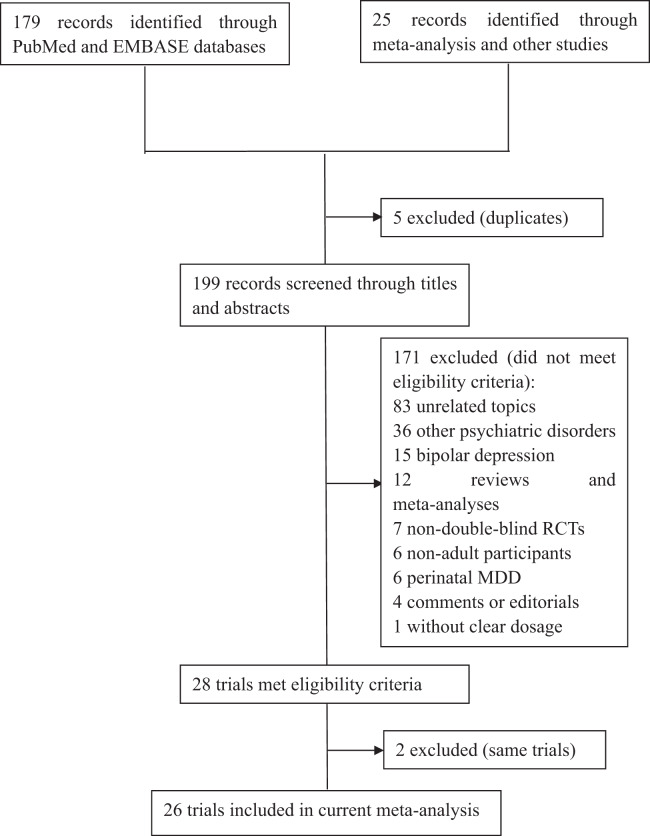
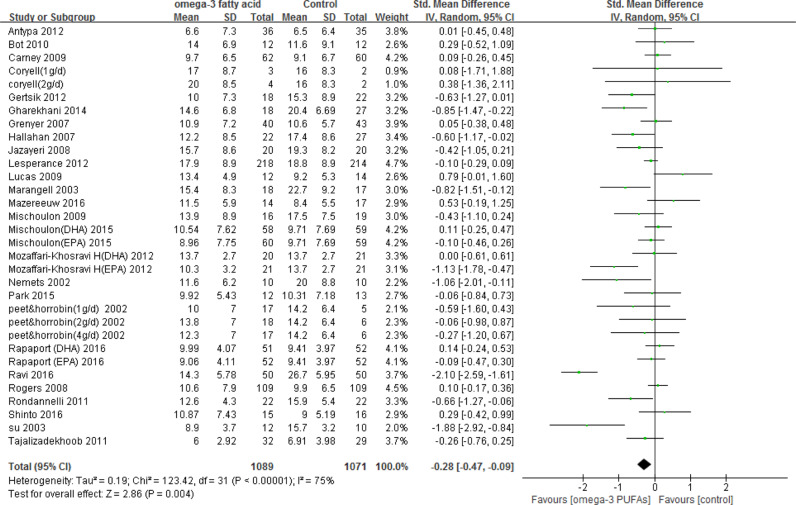
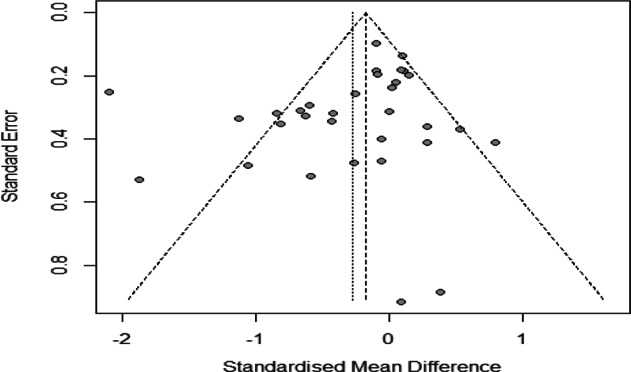
We conducted this meta-analysis of double-blind randomized placebo-controlled trials to estimate the efficacy of omega-3 polyunsaturated fatty acids (PUFAs), especially docosahexaenoic acid (DHA) and eicosapentaenoic acid (EPA), in the improvement of depression. We applied a systematic bibliographic search in PubMed and EMBASE for articles published prior to 20 December 2017. This meta-analysis was performed using RevMan 5.3 and R 3.4.3, and means and standard deviations were calculated in fixed- or random-effects models based on the results of the Q-test. A sensitivity analysis was also conducted to evaluate the stability of the results, and publication bias was evaluated by a funnel plot and Egger’s linear regression analysis. Our search resulted in 180 articles; we analyzed 26 studies, which included 2160 participants. The meta-analysis showed an overall beneficial effect of omega-3 polyunsaturated fatty acids on depression symptoms (SMD = −0.28,P = 0.004). Compared with placebo, EPA-pure (=100% EPA) and EPA-major formulations (≥60% EPA) demonstrated clinical benefits with an EPA dosage ≤1 g/d (SMD = −0.50,P = 0.003, and SMD = −1.03,P = 0.03, respectively), whereas DHA-pure and DHA-major formulations did not exhibit such benefits. Current evidence supports the finding that omega-3 PUFAs with EPA ≥ 60% at a dosage of ≤1 g/d would have beneficial effects on depression. Further studies are warranted to examine supplementation with omega-3 PUFAs for specific subgroups of subjects with inflammation, severity of depression, and the dose response for both EPA and DHA supplementation.
Overview
The claims and statistics of this paper haven’t been checked yet.
Run the check — free, no account needed. It reads the open-access text and checks the sources it cites.
Integrity signals
Registry
Cites
Statistics
Figures
Verification
Claims the paper makes
The claims and statistics of this paper haven’t been checked yet.
Run the check — free, no account needed. It reads the open-access text and checks the sources it cites.
Claims other papers make about this one
Each is checked against this paper’s own text: does it say what the citing paper says it does?
In the citing paper
“DHA-pure and DHA-major formulations, on the contrary, did not exhibit such benefits.”
From Role of n-3 long-chain polyunsaturated fatty acids in human nutrition and health: Review of recent studies and recommendations (2021) · cites this paper as [127]
In the citing paper
“A 2019 meta-analysis of double-blind randomized placebo-controlled trials (including 26 studies; 2,160 participants) showed an overall beneficial effect of n-3 LCPUFA on depression symptoms, and both EPA-pure (= 100% EPA) and EPA-major formulations (≥ 60% EPA) demonstrated clinical benefits at an EPA dosage of ≤ 1 g/day [127].”
From Role of n-3 long-chain polyunsaturated fatty acids in human nutrition and health: Review of recent studies and recommendations (2021) · cites this paper as [127]
Self-check
Percentages, sums and reported differences re-computed from the paper’s own numbers.
The self-check needs the paper’s full text.
Citations
Cites
Molecular recognition of fatty acids by peroxisome proliferator-activated receptors
Xu, H. E., Lambert, M. H., Montana, V. G., Parks, D. J., Blanchard, S. G., Brown, P. J., Sternbach, D. D., Lehmann, J. M., Wisely, G. B., Willson, T. M., et al. (1999) · Molecular Cell · doi:10.1016/s1097-2765(00)80467-0 · Cited by 1,169
Caughey, G. E., Mantzioris, E., Gibson, R. A., Cleland, L., & James, M. (1996) · American Journal of Clinical Nutrition · doi:10.1093/ajcn/63.1.116 · Cited by 866
Nemets, B., Stahl, Z., & Belmaker, R. H. (2002) · American Journal of Psychiatry · doi:10.1176/appi.ajp.159.3.477 · Cited by 627
Omega-3 fatty acids in major depressive disorder
Su, K.-P., Huang, S.-Y., Chiu, C.-C., & Shen, W. W. (2003) · European Neuropsychopharmacology · doi:10.1016/s0924-977x(03)00032-4 · Cited by 596
Wu, A., Ying, Z., & Gomez-Pinilla, F. (2004) · Journal of Neurotrauma · doi:10.1089/neu.2004.21.1457 · Cited by 518
Grosso, G., Pajak, A., Marventano, S., Castellano, S., Galvano, F., Bucolo, C., Drago, F., & Caraci, F. (2014) · PLoS ONE · doi:10.1371/journal.pone.0096905 · Cited by 449
Meta-Analysis of the Effects of Eicosapentaenoic Acid (EPA) in Clinical Trials in Depression
Sublette, M. E., Ellis, S. P., Geant, A. L., & Mann, J. J. (2011) · The Journal of Clinical Psychiatry · doi:10.4088/jcp.10m06634 · Cited by 434
Marangell, L. B., Martinez, J. M., Zboyan, H. A., Kertz, B. L., Kim, H. F. S., & Puryear, L. J. (2003) · American Journal of Psychiatry · doi:10.1176/appi.ajp.160.5.996 · Cited by 379
Peet, M., & Horrobin, D. F. (2002) · Journal of Psychiatric Research · doi:10.1016/s0022-3956(01)00048-6 · Cited by 329
Mocking, R. J. T., Harmsen, I. M., Assies, J., Koeter, M. W. J., Ruhé, H. G., & Schene, A. H. (2016) · Translational Psychiatry · doi:10.1038/tp.2016.29 · Cited by 284
Research works printed but not linked: 2
- Higgins. in Cochrane Handbook for Systematic Reviews of Interventions (version:5.1.0) (eds Higgins, J. P. T. & Green, S.) (Chichester, UK: The Cochrane Collaboration & John Wiley & Sons, Ltd. 2011). http://handbook-5-1.cochrane.org/.
- Peet, M. & Horrobin, D. F., Group EEMS. A dose-ranging exploratory study of the effects of ethyl-eicosapentaenoate in patients with persistent schizophrenic symptoms. J. Psychiatr. Res. 36, 7 (2002). · DOI
Cited by
Sorted by citations
Management of Rheumatoid Arthritis: An Overview
Radu, A.-F., & Bungau, S. G. (2021) · Cells · doi:10.3390/cells10112857 · Cited by 1,089
Djuricic, I. D., & Calder, P. C. (2021) · Nutrients · doi:10.3390/nu13072421 · Cited by 1,094
Diet and depression: Exploring the biological mechanisms of action
Marx, W., Lane, M., Hockey, M., Aslam, H., Berk, M., Walder, K., Borsini, A., Firth, J., Pariante, C. M., Berding, K., et al. (2021) · Molecular Psychiatry · doi:10.1038/s41380-020-00925-x · Cited by 685
Apoptosis and Oxidative Stress in Neurodegenerative Diseases
Radi, E., Formichi, P., Battisti, C., & Federico, A. (2014) · Journal of Alzheimer s Disease · doi:10.3233/jad-132738 · Cited by 641
Malhi, G. S., Bell, E., Bassett, D., Boyce, P., Bryant, R., Hazell, P., Hopwood, M., Lyndon, B., Mulder, R., Porter, R., et al. (2021) · Australian & New Zealand Journal of Psychiatry · doi:10.1177/0004867420979353 · Cited by 614
Metadata
- Authors
- Liao, Y., Xie, B., Zhang, H., He, Q., Guo, L., Subramanieapillai, M., Fan, B., Lu, C., & McIntyre, R. S.
- Affiliations
- Shenzhen Nanshan Center for Chronic Disease Control (CN)
- Sun Yat-sen University (CN)
- University Health Network (CA)
- Corresponding author
- Fan, Beifang
- Lu, Ciyong
- Venue
- Translational Psychiatry
- Published
- 2019-08-05
- Volume
- 9
- Issue
- 1
- Pages
- 190-190
- ISSN
- 2158-3188 (ISSN-L)
- PMC
- PMC6683166
- OpenAlex
- W2965334743
- Cited by
- 404
- References
- 55
- Citations by year
- 2026: 35 · 2025: 62 · 2024: 75 · 2023: 77 · 2022: 65 · 2021: 52 · 2020: 35 · 2019: 2
- FWCI
- 5.23
- Type
- journal article
- Language
- en
- Update notices
- correction (2021-09-07)
- Open access
- gold
- doi.org
- Locations
- Translational Psychiatry (publishedVersion, cc-by)
- PubMed Central (publishedVersion, cc-by)
- PubMed (publishedVersion)
- DOAJ (DOAJ: Directory of Open Access Journals) (submittedVersion)
- Funders
- National Natural Science Foundation of China
- Topics
- Health Sciences › Nursing › Nutrition and Dietetics › Fatty Acid Research and Health
- Life Sciences › Neuroscience › Biological Psychiatry › Tryptophan and brain disorders
- Health Sciences › Medicine › Pharmacology (medical) › Treatment of Major Depression
- Keywords
- omega-3 polyunsaturated fatty acids, depression, docosahexaenoic acid, eicosapentaenoic acid, DHA supplementation, dietary supplementation, depressive symptoms, dose-response relationship
- MeSH terms
- Depressive Disorder, Double-Blind Method, Humans, Fatty Acids, Omega-3, Randomized Controlled Trials as Topic, Treatment Outcome
About these checks
Registry, retraction, Cites and statistics results are computed, not judged, with one exception: a printed reference that no index lists is read once by a model before it counts as a citation error. Claims are extracted by a model and kept only when their quote appears verbatim in the text; each cited source is then checked, with a model’s help, for whether it says what the claim relies on. Those verdicts can be wrong — read the claim’s quote and the cited source before relying on one.
Statistics and arithmetic are recomputed, not judged.
Confidence bands are shown only for fields calibrated on our annotated test set. None is calibrated yet, so no band is shown.
What counts as a claim ›How we measure confidence ›How we check this ›
Are you an author, or do you see a problem with this page? Request a review
