

Evidence-based umbrella review of 162 peripheral biomarkers for major mental disorders
Open accessThe DOI matches its Crossref record; 176 of the 176 references it cites were found in a registry or an index.
Abstract
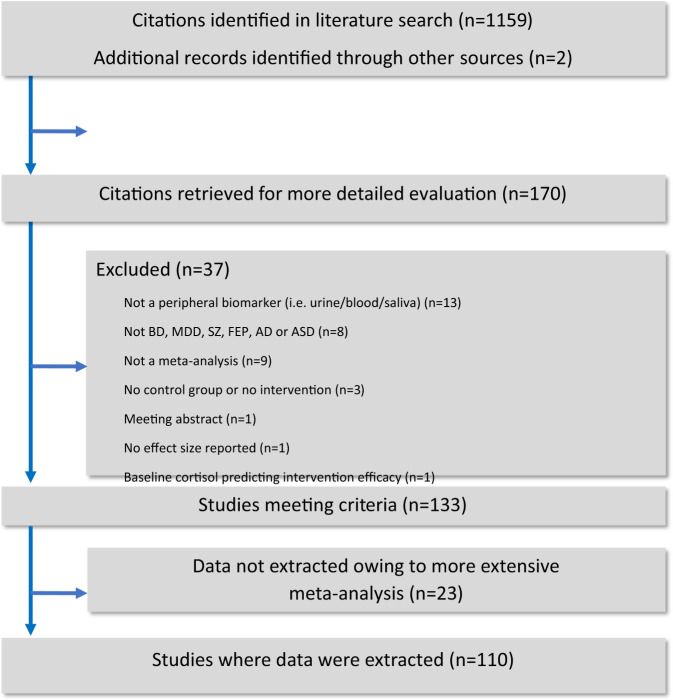
The literature on non-genetic peripheral biomarkers for major mental disorders is broad, with conflicting results. An umbrella review of meta-analyses of non-genetic peripheral biomarkers for Alzheimer’s disease, autism spectrum disorder, bipolar disorder (BD), major depressive disorder, and schizophrenia, including first-episode psychosis. We included meta-analyses that compared alterations in peripheral biomarkers between participants with mental disorders to controls (i.e., between-group meta-analyses) and that assessed biomarkers after treatment (i.e., within-group meta-analyses). Evidence for association was hierarchically graded using a priori defined criteria against several biases. The Assessment of Multiple Systematic Reviews (AMSTAR) instrument was used to investigate study quality. 1161 references were screened. 110 met inclusion criteria, relating to 359 meta-analytic estimates and 733,316 measurements, on 162 different biomarkers. Only two estimates met a priori defined criteria for convincing evidence (elevated awakening cortisol levels in euthymic BD participants relative to controls and decreased pyridoxal levels in participants with schizophrenia relative to controls). Of 42 estimates which met criteria for highly suggestive evidence only five biomarker aberrations occurred in more than one disorder. Only 15 meta-analyses had a power >0.8 to detect a small effect size, and most (81.9%) meta-analyses had high heterogeneity. Although some associations met criteria for either convincing or highly suggestive evidence, overall the vast literature of peripheral biomarkers for major mental disorders is affected by bias and is underpowered. No convincing evidence supported the existence of a trans-diagnostic biomarker. Adequately powered and methodologically sound future large collaborative studies are warranted.
Overview
The claims and statistics of this paper haven’t been checked yet.
Free: it reads the open-access text and checks the first 5 claims that cite a source we can check. Create a free account to check every claim.
Integrity signals
Registry
Cites
Statistics
Figures
Verification
Claims the paper makes
The claims and statistics of this paper haven’t been checked yet.
Free: it reads the open-access text and checks the first 5 claims that cite a source we can check. Create a free account to check every claim.
Claims other papers make about this one
Each is checked against this paper’s own text: does it say what the citing paper says it does?
The source backs part of the claim, not all of it — or backs it for a different population, condition or comparison.
In the citing paper
“the search for biomarkers to improve diagnosis and stratification has largely been unsuccessful [4]”
From Towards a youth mental health paradigm: a perspective and roadmap (2023) · cites this paper as [4]
Experimental — accuracy not yet measuredThe cited source says what the claim attributes to it.
In the citing paper
“No convincing evidence supports the existence of a truly transdiagnostic biomarker 147”
From Preventive psychiatry: a blueprint for improving the mental health of young people (2021) · cites this paper as [147]
In the citing paper
“Among 733,316 measurements on 162 different peripheral biomarkers for psychosis, bipolar disorder and depression, only two were found to be reliably associated with these disorders 147”
From Preventive psychiatry: a blueprint for improving the mental health of young people (2021) · cites this paper as [147]
Self-check
Percentages, sums and reported differences re-computed from the paper’s own numbers.
The self-check needs the paper’s full text.
Citations
Cites
1 retracted
A significant causal association between C-reactive protein levels and schizophrenia
Inoshita, M., Numata, S., Tajima, A., Kinoshita, M., Umehara, H., Nakataki, M., Ikeda, M., Maruyama, S., Yamamori, H., Kanazawa, T., et al. (2016) · Scientific Reports · doi:10.1038/srep26105 · Cited by 44
RetractedMeasuring inconsistency in meta-analyses
Higgins, J. P. T., Thompson, S. G., Deeks, J. J., & Altman, D. G. (2003) · BMJ · doi:10.1136/bmj.327.7414.557 · Cited by 63,139
Bias in meta-analysis detected by a simple, graphical test
Egger, M., Smith, G. D., Schneider, M., & Minder, C. (1997) · BMJ · doi:10.1136/bmj.315.7109.629 · Cited by 56,722
Power failure: why small sample size undermines the reliability of neuroscience
Button, K. S., Ioannidis, J. P. A., Mokrysz, C., Nosek, B. A., Flint, J., Robinson, E. S. J., & Munafò, M. R. (2013) · Nature Reviews Neuroscience · doi:10.1038/nrn3475 · Cited by 7,641
Development of AMSTAR: A measurement tool to assess the methodological quality of systematic reviews
Shea, B. J., Grimshaw, J. M., Wells, G. A., Boers, M., Andersson, N., Hamel, C., Porter, A. C., Tugwell, P., Moher, D., & Bouter, L. M. (2007) · BMC Medical Research Methodology · doi:10.1186/1471-2288-7-10 · Cited by 4,374
Nestler, E. J., Barrot, M., DiLeone, R. J., Eisch, A. J., Gold, S. J., & Monteggia, L. M. (2002) · Neuron · doi:10.1016/s0896-6273(02)00653-0 · Cited by 3,217
Toward the future of psychiatric diagnosis: the seven pillars of RDoC
Cuthbert, B. N., & Insel, T. R. (2013) · BMC Medicine · doi:10.1186/1741-7015-11-126 · Cited by 3,053
Redefine statistical significance
Benjamin, D. J., Berger, J. O., Johannesson, M., Nosek, B. A., Wagenmakers, E.-J., Berk, R., Bollen, K. A., Brembs, B., Brown, L., Camerer, C., et al. (2017) · Nature Human Behaviour · doi:10.1038/s41562-017-0189-z · Cited by 2,772
Quantitative Synthesis in Systematic Reviews
Lau, J., Ioannidis, J. P. A., & Schmid, C. H. (1997) · Annals of Internal Medicine · doi:10.7326/0003-4819-127-9-199711010-00008 · Cited by 2,517
Plea for routinely presenting prediction intervals in meta-analysis.
IntHout, J., Ioannidis, J. P. A., Rovers, M. M., & Goeman, J. J. (2016) · BMJ Open · doi:10.1136/bmjopen-2015-010247 · Cited by 2,264
Cited by
Diet and depression: Exploring the biological mechanisms of action
Marx, W., Lane, M., Hockey, M., Aslam, H., Berk, M., Walder, K., Borsini, A., Firth, J., Pariante, C. M., Berding, K., et al. (2021) · Molecular Psychiatry · doi:10.1038/s41380-020-00925-x · Cited by 685
Self-citationPreventive psychiatry: a blueprint for improving the mental health of young people
Fusar‐Poli, P., Correll, C. U., Arango, C., Berk, M., Patel, V., & Ioannidis, J. P. A. (2021) · World Psychiatry · doi:10.1002/wps.20869 · Cited by 497
Self-citationCandidate biomarkers in psychiatric disorders: state of the field
Abi‐Dargham, A., Moeller, S. J., Ali, F., DeLorenzo, C., Domschke, K., Horga, G., Jutla, A., Kotov, R., Paulus, M. P., Rubio, J. M., et al. (2023) · World Psychiatry · doi:10.1002/wps.21078 · Cited by 372
Risk and protective factors for mental disorders beyond genetics: an evidence‐based atlas
Arango, C., Dragioti, E., Solmi, M., Cortese, S., Domschke, K., Murray, R. M., Jones, P. B., Uher, R., Carvalho, A. F., Reichenberg, A., et al. (2021) · World Psychiatry · doi:10.1002/wps.20894 · Cited by 319
“Fullana et al(36) Neurotic, stress-related and somatoform disorders 19 1 (1-1) 100 (54-224) 427 2000-2017”
Self-citationStein, D. J., Shoptaw, S. J., Vigo, D. V., Lund, C., Cuijpers, P., Bantjes, J., Sartorius, N., & Maj, M. (2022) · World Psychiatry · doi:10.1002/wps.20998 · Cited by 331
Towards a youth mental health paradigm: a perspective and roadmap
Uhlhaas, P. J., Davey, C. G., Mehta, U. M., Shah, J., Torous, J., Allen, N. B., Avenevoli, S., Bella-Awusah, T., Chanen, A., Chen, E. Y. H., et al. (2023) · Molecular Psychiatry · doi:10.1038/s41380-023-02202-z · Cited by 318
“Despite the promises of genetics and translational neuroscience, insights into the causal mechanisms of major syndromes remain rudimentary [3], and the search for biomarkers to improve diagnosis and strati fi cation has largely been unsuccessful [4].”
BackgroundSelf-citationOxidative Stress‐Related Mechanisms in Schizophrenia Pathogenesis and New Treatment Perspectives
Ermakov, E. A., Dmitrieva, E. M., Parshukova, D. A., Kazantseva, D. V., Vasilieva, A. R., & Smirnova, L. P. (2021) · Oxidative Medicine and Cellular Longevity · doi:10.1155/2021/8881770 · Cited by 233
“The most reliable proof of predominance of prooxidant processes is the increase of thiobarbituric acid reactive substances in drug-naïve first-episode psychosis, stable medicated outpatients, and chronic inpatients, which is confirmed by the results of meta-analysis [40, 46].”
ResultHeart-brain connections: Phenotypic and genetic insights from magnetic resonance images
Zhao, B., Li, T., Fan, Z., Yang, Y., Shu, J., Yang, X., Wang, X., Luo, T., Tang, J., Xiong, D., et al. (2023) · Science · doi:10.1126/science.abn6598 · Cited by 240
Solmi, M., Suresh Sharma, M., Osimo, E. F., Fornaro, M., Bortolato, B., Croatto, G., Miola, A., Vieta, E., Pariante, C. M., Smith, L., et al. (2021) · Brain, Behavior, and Immunity · doi:10.1016/j.bbi.2021.07.014 · Cited by 196
Self-citationImmune System Abnormalities in Schizophrenia: An Integrative View and Translational Perspectives
Ermakov, E. A., Melamud, M. M., Buneva, V. N., & Ivanova, S. A. (2022) · Frontiers in Psychiatry · doi:10.3389/fpsyt.2022.880568 · Cited by 179
Peripheral Markers of Depression
Nobis, A., Zalewski, D., & Waszkiewicz, N. (2020) · Journal of Clinical Medicine · doi:10.3390/jcm9123793 · Cited by 197
“Some studies have reported that IL-1RA is elevated in depression [90,98], but no such association was found in a recent umbrella review by Carvalho [40].”
BackgroundMethodResultInfluentialBipolar disorders: an update on critical aspects
Oliva, V., Fico, G., Prisco, M. D., Gonda, X., Rosa, A. R., & Vieta, E. (2024) · The Lancet Regional Health - Europe · doi:10.1016/j.lanepe.2024.101135 · Cited by 229
“38 However, these markers are not speci fi c to bipolar disorders, as they also appear in other psychiatric or in fl ammatory conditions.”
Self-citationWaller, L., Erk, S., Pozzi, E., Toenders, Y. J., Haswell, C. C., Büttner, M., Thompson, P. M., Schmaal, L., Morey, R. A., Walter, H., et al. (2022) · Human Brain Mapping · doi:10.1002/hbm.25829 · Cited by 136
Epigenomic Dysregulation in Schizophrenia: In Search of Disease Etiology and Biomarkers
Khavari, B., & Cairns, M. J. (2020) · Cells · doi:10.3390/cells9081837 · Cited by 145
Althubaity, N., Schubert, J. J., Martins, D., Yousaf, T., Nettis, M. A., Mondelli, V., Pariante, C. M., Harrison, N. A., Bullmore, E. T., Dima, D., et al. (2021) · NeuroImage Clinical · doi:10.1016/j.nicl.2021.102926 · Cited by 126
Gosling, C. J., Solanes, A., Fusar-Poli, P., & Radua, J. (2023) · BMJ Mental Health · doi:10.1136/bmjment-2022-300534 · Cited by 100
Self-citationBiological hypotheses, risk factors, and biomarkers of schizophrenia.
Fišar, Z. (2022) · Progress in Neuro-psychopharmacology and Biological Psychiatry · doi:10.1016/j.pnpbp.2022.110626 · Cited by 89
Biomarkers of post-covid depression
Lorkiewicz, P., & Waszkiewicz, N. (2021) · Journal of Clinical Medicine · doi:10.3390/jcm10184142 · Cited by 102
Closing the life-cycle of normative modeling using federated hierarchical Bayesian regression
Kia, S. M., Huijsdens, H., Rutherford, S. E., de Boer, A. A. A., Dinga, R., Wolfers, T., Berthet, P., Mennes, M., Andreassen, O. A., Westlye, L. T., et al. (2022) · PLoS ONE · doi:10.1371/journal.pone.0278776 · Cited by 107
Reay, W. R., Kiltschewskij, D. J., Geaghan, M. P., Atkins, J., Carr, V. J., Green, M. J., & Cairns, M. J. (2022) · Science Advances · doi:10.1126/sciadv.abj8969 · Cited by 109
Depression diagnosis by deep learning using EEG signals: A systematic review
Safayari, A., & Bolhasani, H. (2021) · Medicine in Novel Technology and Devices · doi:10.1016/j.medntd.2021.100102 · Cited by 105
Hansen, J. Y., Shafiei, G., Markello, R. D., Smart, K. A., Cox, S. M. L., Nørgaard, M., Beliveau, V., Wu, Y., Gallezot, J., Aumont, É., et al. (2021) · bioRxiv (Cold Spring Harbor Laboratory) · doi:10.1101/2021.10.28.466336 · Cited by 83
Inflammation in the pathogenesis of depression: a disorder of neuroimmune origin
Corrigan, M., O’Rourke, A. M., Moran, B., Fletcher, J. M., & Harkin, A. (2023) · Neuronal Signaling · doi:10.1042/ns20220054 · Cited by 86
“For a comprehensive meta-analysis of the most prominent peripheral blood biomarkers in depression, see Carvalho et al. (2020) [281].”
Oxytocin neurons mediate the effect of social isolation via the VTA circuits
Musardo, S., Contestabile, A., Knoop, M., Baud, O., & Bellone, C. (2022) · eLife · doi:10.7554/elife.73421 · Cited by 77
Miola, A., Dal Porto, V., Tadmor, T., Croatto, G., Scocco, P., Manchia, M., Carvalho, A. F., Maes, M., Vieta, E., Sambataro, F., et al. (2021) · Acta Psychiatrica Scandinavica · doi:10.1111/acps.13351 · Cited by 73
Self-citationPopulation heterogeneity in clinical cohorts affects the predictive accuracy of brain imaging
Benkarim, O. M., Paquola, C., Park, B., Kebets, V., Hong, S., de Wael, R. V., Zhang, S., Yeo, B. T. T., Eickenberg, M., Ge, T., et al. (2022) · PLoS Biology · doi:10.1371/journal.pbio.3001627 · Cited by 70
Murphy, J. M., Sweeney, M. R., & McGrane, B. (2020) · Physical Activity and Health · doi:10.5334/paah.58 · Cited by 78
Jiménez-Fernández, S., Gurpegui, M., Garrote-Rojas, D., Gutiérrez-Rojas, L., Carretero, M. D., & Correll, C. U. (2022) · Journal of Affective Disorders · doi:10.1016/j.jad.2022.07.015 · Cited by 56
Shin, H., Kang, Y., Choi, K. W., Kim, S., Ham, B., & Choi, Y. (2023) · Analytical Chemistry · doi:10.1021/acs.analchem.3c00215 · Cited by 62
Speech Prosody in Mental Disorders
Ding, H., & Zhang, Y. (2022) · Annual Review of Linguistics · doi:10.1146/annurev-linguistics-030421-065139 · Cited by 69
Obsessive–compulsive symptoms and information seeking during the Covid-19 pandemic
Loosen, A. M., Skvortsova, V., & Hauser, T. U. (2021) · Translational Psychiatry · doi:10.1038/s41398-021-01410-x · Cited by 56
Ferreira, A. C., & Osório, F. D. L. (2022) · Progress in Neuro-Psychopharmacology and Biological Psychiatry · doi:10.1016/j.pnpbp.2022.110561 · Cited by 56
Fernandes, B. S., Dai, Y., Jia, P., & Zhao, Z. (2022) · European Neuropsychopharmacology · doi:10.1016/j.euroneuro.2022.06.001 · Cited by 50
Self-citationDepressive and Neurocognitive Disorders in the Context of the Inflammatory Background of COVID-19
Dąbrowska, E., Galińska-Skok, B., & Waszkiewicz, N. (2021) · Life · doi:10.3390/life11101056 · Cited by 51
Addiction Cue-Reactivity Initiative (ACRI) Network, Sangchooli, A., Zare-Bidoky, M., Jouzdani, A. F., Schacht, J. P., Bjork, J. M., Claus, E. D., Prisciandaro, J. J., Wilson, S. J., Wüstenberg, T., et al. (2024) · JAMA Psychiatry · doi:10.1001/jamapsychiatry.2023.5483 · Cited by 46
Kirkpatrick, R. H., Munoz, D. P., Khalid-Khan, S., & Booij, L. (2021) · Journal of Psychiatric Research · doi:10.1016/j.jpsychires.2020.11.023 · Cited by 41
Janiaud, P., Agarwal, A., Tzoulaki, I., Theodoratou, E., Tsilidis, K. K., Evangelou, E., & Ioannidis, J. P. A. (2021) · BMC Medicine · doi:10.1186/s12916-021-02020-6 · Cited by 39
Sadoyu, S., Tanni, K. A., Punrum, N., Paengtrai, S., Kategaew, W., Promchit, N., Lai, N. M., Thakkinstian, A., Ngorsuraches, S., Bangpan, M., et al. (2022) · PLOS ONE · doi:10.1371/journal.pone.0269009 · Cited by 40
Lessons Learned From the Resilience of Chinese Hospitals to the COVID-19 Pandemic: Scoping Review
Traverson, L., Stennett, J., Mathevet, I., Zacarias, A. C. P., de Sousa, K. M. P., Andrade, A., Zinszer, K., & Ridde, V. (2022) · JMIRx Med · doi:10.2196/31272 · Cited by 47
Herselman, M. F., Bailey, S., Deo, P., Zhou, X., Gunn, K. M., & Bobrovskaya, L. (2022) · Nutrients · doi:10.3390/nu14224776 · Cited by 39
“This is in contrast to a recent umbrella meta-analysis suggesting that decreased total cholesterol levels are highly indicative of depression [57].”
ResultWainberg, M., Kloiber, S. M., Diniz, B. S., McIntyre, R. S., Felsky, D., & Tripathy, S. J. (2021) · Translational Psychiatry · doi:10.1038/s41398-021-01505-5 · Cited by 43
Jefferies, P., Vanstone, R., & Ungar, M. T. (2021) · Applied Research in Quality of Life · doi:10.1007/s11482-021-09953-3 · Cited by 36
Toriumi, K., Miyashita, M., Suzuki, K., Yamasaki, N., Yasumura, M., Horiuchi, Y., Yoshikawa, A., Asakura, M., Usui, N., Itokawa, M., et al. (2021) · Translational Psychiatry · doi:10.1038/s41398-021-01381-z · Cited by 40
Role of glyoxalase 1 in methylglyoxal detoxification–the broad player of psychiatric disorders
Toriumi, K., Miyashita, M., Suzuki, K., Tabata, K., Horiuchi, Y., Ishida, H., Itokawa, M., & Arai, M. (2021) · Redox Biology · doi:10.1016/j.redox.2021.102222 · Cited by 35
Toriumi, K., Berto, S., Koike, S., Usui, N., Dan, T., Suzuki, K., Miyashita, M., Horiuchi, Y., Yoshikawa, A., Asakura, M., et al. (2021) · Redox Biology · doi:10.1016/j.redox.2021.102057 · Cited by 38
“Also, a recent review has shown the decreased VB6 in patients with schizophrenia as the most convincing evidence in peripheral biomarkers for major mental disorders [11].”
BackgroundDaray, F. M., Grendas, L. N., Arena, Á. R., Tifner, V., Casiani, R. I. Á., Olaviaga, A., Chiapella, L. C., Vázquez, G. H., Penna, M. B., Hunter, F., et al. (2024) · Translational Psychiatry · doi:10.1038/s41398-024-02902-2 · Cited by 36
Baek, S.-H., Kim, H., Kim, J., Ryu, S., Lee, J., Kim, J., Shin, I., & Kim, S. (2022) · Journal of Personalized Medicine · doi:10.3390/jpm12071137 · Cited by 34
“Moreover, activation of peripheral immunity is thought to contribute to cognitive dysfunction in patients with recurring bipolar disorder [13,14].”
BackgroundEEG-based spatio-temporal relation signatures for the diagnosis of depression and schizophrenia
Shor, O., Yaniv-Rosenfeld, A., Valevski, A., Weizman, A., Khrennikov, A., & Benninger, F. (2023) · Scientific Reports · doi:10.1038/s41598-023-28009-0 · Cited by 30
“(4) PUDHS = number of edges, Vi < Tpersonal universal dendrogram”
BackgroundOptimising the use of electronic medical records for large scale research in psychiatry
Newby, D., Taylor, N., Joyce, D. W., & Winchester, L. M. (2024) · Translational Psychiatry · doi:10.1038/s41398-024-02911-1 · Cited by 39
“However, in many psychiatric disorders, translation to clinical applications is limited [148, 149] and further work will be necessary to validate these potential candidates in suitable cohorts.”
BackgroundResultSolís-Ortiz, S., Arriaga-Ávila, V. S., Trejo-Bahena, A., & Guevara‐Guzmán, R. (2021) · Nutrients · doi:10.3390/nu13113875 · Cited by 34
“However, most results related to biomarkers are inconsistent due to the heterogeneity of depression and the diverse methodology used, such as the inclusion of individuals of different ages, sexes and diagnoses [18].”
BackgroundAnimal Behavior in Psychedelic Research
Odland, A. U., Kristensen, J. L., & Andreasen, J. T. (2022) · Pharmacological Reviews · doi:10.1124/pharmrev.122.000590 · Cited by 32
Gong, W., Chen, J., Xu, S., Li, Y., Zhou, Y., & Qin, X. (2023) · Journal of Ethnopharmacology · doi:10.1016/j.jep.2023.117217 · Cited by 35
Mooney, M. A., Hermosillo, R. J. M., Feczko, E., Miranda-Domínguez, Ó., Moore, L. A., Perrone, A. J., Byington, N., Grimsrud, G. J., Rueter, A., Nousen, E. K., et al. (2024) · Journal of Neuroscience · doi:10.1523/jneurosci.1202-23.2023 · Cited by 35
Almulla, A. F., & Maes, M. H. J. (2025) · CNS Drugs · doi:10.1007/s40263-025-01195-3 · Cited by 33
“Elevated levels of antibodies against the N-methyl-D-aspartate receptor (NMDA-R) were observed in BD and SCZ, while brain-derived neurotrophic factor (BDNF) decreased in MDD. Insulin-like growth factor 1 (IGF-1) levels were higher in bipolar mania and MDD compared with controls [89].”
Self-citationNeuroimaging biomarkers of addiction
Ekhtiari, H., Sangchooli, A., Carmichael, O. T., Moeller, F. G., O’Donnell, P., Oquendo, M. A., Paulus, M. P., Pizzagalli, D. A., Ramey, T., Schacht, J. P., et al. (2024) · Nature Mental Health · doi:10.1038/s44220-024-00334-x · Cited by 32
“…development and theoretical progress in both addiction medicine and psychiatry as a whole is the fact that the Diagnostic and Statistical Manual of Mental Disorders 4 is a descriptive diagnostic manual, and its constructs are neither domain-based nor necessarily grounded in neurobiology 176 .”
Self-citationHeterogeneity in major depressive disorder: The need for biomarker-based personalized treatments
Suseelan, S., & Pinna, G. (2022) · Advances in clinical chemistry · doi:10.1016/bs.acc.2022.09.001 · Cited by 33
Liu, F., Jia, Y., Zhao, L., Xiao, L., Cheng, X., Yingying, X., Zhang, Y., Zhang, Y., Yu, H., Deng, Q.-E., et al. (2024) · European Journal of Pharmacology · doi:10.1016/j.ejphar.2024.177063 · Cited by 27
Veer, E., & Dobele, A. R. (2021) · Journal of Strategic Marketing · doi:10.1080/0965254x.2021.1965190 · Cited by 28
Oral Administration of Oxytocin, Like Intranasal Administration, Decreases Top-Down Social Attention
Zhuang, Q., Zheng, X., Yao, S., Zhao, W., Becker, B., Xu, X., & Kendrick, K. M. (2022) · The International Journal of Neuropsychopharmacology · doi:10.1093/ijnp/pyac059 · Cited by 30
Psychiatry and/or recovery: a critical analysis
Crowe, M. (2022) · International Journal of Mental Health Nursing · doi:10.1111/inm.13072 · Cited by 28
Biomarkers of Postpartum Depression: A Narrative Review
Modzelewski, S., Oracz, A. J., Iłendo, K., Sokół, A., & Waszkiewicz, N. (2023) · Journal of Clinical Medicine · doi:10.3390/jcm12206519 · Cited by 32
“A review by Carvalho et al. confirmed elevated blood levels of sIL-2R in patients with MDD [124].”
BackgroundThomas, T., Koomar, T., Casten, L. G., Tener, A. J., Bahl, E., & Michaelson, J. J. (2022) · Translational Psychiatry · doi:10.1038/s41398-022-01982-2 · Cited by 29
Biomarkers for Psychosis: Are We There Yet? Umbrella Review of 1478 Biomarkers
Fuentes‐Claramonte, P., Estradé, A., Solanes, A., Ramella‐Cravaro, V., García‐León, M. Á., de Diego-Adeliño, J., Molins, C., Fung, E., Valentí, M., Anmella, G., et al. (2024) · Schizophrenia Bulletin Open · doi:10.1093/schizbullopen/sgae018 · Cited by 28
“41 As such, to the best of our knowledge, no comprehensive umbrella review of biomarkers for psychosis has been published to date.”
BackgroundMethodInfluentialSelf-citationKannan, K. D., Jagatheesaperumal, S. K., Rajesh, K. N. V. P. S., Lotfaliany, M., Alizadehsanid, R., & Mohebbi, M. (2026) · Journal of Affective Disorders Reports · doi:10.1016/j.jadr.2026.101100 · Cited by 35
Stein, F., & Kircher, T. T. J. (2025) · Journal of Affective Disorders · doi:10.1016/j.jad.2025.119464 · Cited by 25
A complex systems view on the current hypotheses of epilepsy pharmacoresistance
Servilha‐Menezes, G., & Garcia‐Cairasco, N. (2022) · Epilepsia Open · doi:10.1002/epi4.12588 · Cited by 33
Kuo, C.-Y., Lin, C., & Lane, H. (2022) · CNS Drugs · doi:10.1007/s40263-022-00959-5 · Cited by 23
“Higher levels of thiobarbituric acid–reactive substances (TBARS) and lower catalase (CAT) and superoxide dismutase (SOD) activity were observed in schizophrenia [86, 87].”
BackgroundHenning, D., Lüno, M., Jiang, C., Meyer-Lotz, G., Hoeschen, C., & Frodl, T. (2023) · Journal of Psychiatry and Neuroscience · doi:10.1503/jpn.220139 · Cited by 24
Genetic evidence for causal effects of immune dysfunction in psychiatric disorders: where are we?
Iakunchykova, O. P., Leonardsen, E. H., & Wang, Y. (2024) · Translational Psychiatry · doi:10.1038/s41398-024-02778-2 · Cited by 25
“In addition, it has been shown that in most psychiatric patients the pro-in fl ammatory cytokine levels (e.g., interleukin 6 (IL6), IL1b, C-reactive protein (CRP)) were higher than in healthy controls [22, 23].”
BackgroundBiomarkers and detection methods of bipolar disorder
Hu, X., Yu, C., Dong, T., Yang, Z., Fang, Y., & Jiang, Z. (2022) · Biosensors and Bioelectronics · doi:10.1016/j.bios.2022.114842 · Cited by 23
Giménez‐Palomo, A., Guitart‐Mampel, M., Meseguer, A., Borràs, R., García‐García, F. J., Tobías, E., Valls‐Roca, L., Alsina‐Restoy, X., Roqué, G., Sánchez, E., et al. (2023) · Acta Psychiatrica Scandinavica · doi:10.1111/acps.13635 · Cited by 22
“23,24 Even though mitochondrial changes have been described in BD at different levels, the available studies often compare this population with healthy controls (HCs).”
BackgroundSelf-citationAnmella, G., Mas, A., Sanabra, M., Valenzuela‐Pascual, C., Valentí, M., Pacchiarotti, I., Benabarre, A., Grande, I., Prisco, M. D., Oliva, V., et al. (2023) · Journal of Affective Disorders · doi:10.1016/j.jad.2023.10.125 · Cited by 21
Self-citationInnovative approaches in CNS drug discovery
Charvériat, M., Lafon, V., Mouthon, F., & Zimmer, L. (2020) · Therapies · doi:10.1016/j.therap.2020.12.006 · Cited by 21
Brown, J. C., Dainton‐Howard, H., Woodward, J. J., Palmer, C., Karamchandani, M. M., Williams, N., & George, M. S. (2023) · Journal of Neuropsychiatry · doi:10.1176/appi.neuropsych.21120312 · Cited by 23
Ruiz-Sastre, P., Sánchez-Lafuente, C. G., Martín‐Martín, J., Herrera-Imbroda, J., Mayoral, F., Santos-Amaya, I. M., de Fonseca, F. R., Parra, J. G., Rivera, P., & Suárez, J. (2024) · Progress in Neuro-Psychopharmacology and Biological Psychiatry · doi:10.1016/j.pnpbp.2024.111056 · Cited by 21
Digital Media, Cognition, and Brain Development in Adolescence
Marciano, L., Dubicka, B., Magis‐Weinberg, L., Morese, R., Viswanath, K., & Weber, R. (2024) · Springer eBooks · doi:10.1007/978-3-031-69362-5_4 · Cited by 34
Napoli, E., Flores, A., Mansuri, Y., Hagerman, R. J., & Giulivi, C. (2021) · Neurobiology of Disease · doi:10.1016/j.nbd.2021.105427 · Cited by 20
Jarbin, H., Höglund, K., Skarphéðinsson, G., & Bremander, A. (2021) · Clinical Child Psychology and Psychiatry · doi:10.1177/13591045211000782 · Cited by 20
“Emerging data suggests that effects of exercise on depression are mediated by neuroprotective and anti-inflammatory mechanisms and possibly detected through such markers (Carvalho et al., 2020; de Azevedo et al., 2019).”
BackgroundHow Does the Psychiatrist Know? On the Epistemology of Psychiatric Diagnostic Reasoning
Kind, A. (2024) · Bioethik - Medizinethik · doi:10.14361/9783839476741 · Cited by 19
Nayem, J., Sarker, R., Roknuzzaman, A. S. M., Qusar, M. S., Raihan, S. Z., Islam, M. R., & Mahmud, Z. A. (2023) · PLoS ONE · doi:10.1371/journal.pone.0294288 · Cited by 18
Oxygen-induced stress reveals context-specific gene regulatory effects in human brain organoids
Umans, B. D., & Gilad, Y. (2025) · Genome Research · doi:10.1101/gr.280219.124 · Cited by 20
Biomarkers for Deep Brain Stimulation in Animal Models of Depression
Yuen, J., Rusheen, A. E., Price, J. B., Barath, A. S., Shin, H., Kouzani, A. Z., Berk, M., Blaha, C. D., Lee, K. H., & Oh, Y. (2021) · Neuromodulation Technology at the Neural Interface · doi:10.1111/ner.13483 · Cited by 18
Self-citationHuang, X., Lu, Q.-L., Zhu, X., Zeng, Y., Liu, Y., & Hao-ying, H. (2021) · Frontiers in Psychiatry · doi:10.3389/fpsyt.2021.792560 · Cited by 17
“The most reliable proof of predominance of pro-oxidant processes is the increase in thiobarbituric acid reactive substances in drug-naive first-episode psychosis, stable medicated outpatients, and chronic inpatients, which is confirmed by the results of meta-analysis (7, 8).”
ResultKiltschewskij, D. J., Reay, W. R., & Cairns, M. J. (2022) · Translational Psychiatry · doi:10.1038/s41398-022-02141-3 · Cited by 16
“An array of studies has identified many other blood-based biochemical traits with potential diagnostic or prognostic utility [10, 11], however a major drawback of these observational studies is their inability to discriminate between correlations and causal relationships, thus any biological effects resulting in alter…”
BackgroundMeta-analytical transdiagnostic neural correlates in common pediatric psychiatric disorders
Dugre, J. R., Eickhoff, S. B., & Potvin, S. (2022) · Scientific Reports · doi:10.1038/s41598-022-08909-3 · Cited by 18
Kirshenbaum, J. S., Chahal, R., Ho, T. C., King, L. S., Gifuni, A. J., Mastrovito, D., Coury, S. M., Weisenburger, R. L., & Gotlib, I. H. (2021) · Journal of Child Psychology and Psychiatry · doi:10.1111/jcpp.13512 · Cited by 14
Meta-analysis of soluble tumour necrosis factor receptors in severe mental illnesses
Goh, X. X., Tang, P. Y., & Tee, S. F. (2023) · Journal of Psychiatric Research · doi:10.1016/j.jpsychires.2023.07.014 · Cited by 16
Lengvenytė, A., Aouizerate, B., Aubin, V., Loftus, J., Marlinge, E., Belzeaux-R, R., Dubertret, C., Gard, S., Haffen, É., Schwan, R., et al. (2021) · Journal of Affective Disorders · doi:10.1016/j.jad.2021.09.097 · Cited by 15
From Biomarkers to Behavior: Mapping the Neuroimmune Web of Pain, Mood, and Memory
Tanaka, M., & Battaglia, S. (2025) · Biomedicines · doi:10.3390/biomedicines13092226 · Cited by 13
Branchi, I. (2024) · European Journal of Neuroscience · doi:10.1111/ejn.16331 · Cited by 14
“Accordingly, biological markers predictive of mental disorders, such as major depression, have not yet been identified and current results are not yet useful for clinical practice (Carvalho et al., 2020; Kennis et al., 2020; Stein et al., 2022).”
Gagliano, A., Cucinotta, F., Giunta, I., Modica, I. D., Domenico, C. D., Costanza, C., Germanò, E., & Frankovich, J. (2025) · International Journal of Molecular Sciences · doi:10.3390/ijms26167767 · Cited by 15
“As a result of this new integrated perspective, there is increasing recognition of inflammation/immune-mediated neuropsychiatric disorders [11,12].”
Fingertip advanced glycation end products and psychotic symptoms among adolescents
Miyashita, M., Yamasaki, S., Ando, S., Suzuki, K., Toriumi, K., Horiuchi, Y., Yoshikawa, A., Imai, A., Nagase, Y., Miyano, Y., et al. (2021) · Schizophrenia · doi:10.1038/s41537-021-00167-y · Cited by 18
Urine 3-Nitrotyrosine and serum HDL as potential biomarkers of depression
Nobis, A., Zalewski, D., Samaryn, E., Maciejczyk, M., Zalewska, A., & Waszkiewicz, N. (2023) · Journal of Clinical Medicine · doi:10.3390/jcm12010377 · Cited by 12
“[25] points at some promising biomarkers of depression: interleukin-6, C-reactive protein, tumor necrosis factor-α, malondialdehyde, F2-isoprostanes, glutamate, total cholesterol, brain-derived neurotrophic factor, fibroblast growth factor-2, and insulin-like growth factor-1.”
BackgroundMurphy, J. M., McGrane, B., & Sweeney, M. R. (2021) · Physical Activity and Health · doi:10.5334/paah.127 · Cited by 15
Measuring Health-Related Quality of Life With Multimodal Data: Viewpoint
Clay, I., Cormack, F. K., Fedor, S., Foschini, L., Gentile, G., Hoof, C. A. V., Kumar, P., Lipsmeier, F., Sano, A., Smarr, B. L., et al. (2022) · Journal of Medical Internet Research · doi:10.2196/35951 · Cited by 13
“[13-15] Background: Anxiety and depression are defined with clinical interviews in RCTsf, possibly inflating intervention’s/placebo’s effects.”
BackgroundThe Coaching for Cognition in Alzheimer's (COCOA) trial: Study design
Roach, J. C., Hara, J., Fridman, D., Lovejoy, J. C., Jade, K., Heim, L., Romansik, R., Swietlikowski, A., Phillips, S., Rapozo, M. K., et al. (2022) · Alzheimer s & Dementia Translational Research & Clinical Interventions · doi:10.1002/trc2.12318 · Cited by 14
Park, B., Lee, S., Jang, Y., & Park, H. Y. (2024) · Brain Behavior and Immunity · doi:10.1016/j.bbi.2024.02.017 · Cited by 12
Kumar, R., Núñez, N. A., Joshi, N. S., Joseph, B., Verde, A., Seshadri, A., Barboza, A. B. C., Prokop, L. J., Medeiros, G. C., & Singh, B. (2024) · Bipolar Disorders · doi:10.1111/bdi.13412 · Cited by 12
Demars, F., Todorova, R., Makdah, G., Forestier, A., Krebs, M., Godsil, B. P., Jay, T. M., Wiener, S. I., & Pompili, M. N. (2022) · Current Biology · doi:10.1016/j.cub.2022.05.050 · Cited by 14
Batty, G. D., & Kivimäki, M. (2021) · Journal of Epidemiology & Community Health · doi:10.1136/jech-2020-215870 · Cited by 12
Metadata
- Authors
- Carvalho, A. F., Solmi, M., Sanches, M., Machado, M. O., Stubbs, B., Ajnakina, O., Sherman, C., Sun, Y. R., Liu, C. S., Brunoni, A. R., Pigato, G., Fernandes, B. S., Bortolato, B., Husain, M. I., Dragioti, E., Firth, J., Cosco, T. D., Maes, M., Berk, M., Lanctôt, K. L., Vieta, E., Pizzagalli, D. A., Smith, L., Fusar-Poli, P., Kurdyak, P. A., Fornaro, M., Rehm, J., & Herrmann, N.
- Affiliations
- University of Padua (IT)
- Centre for Addiction and Mental Health (CA)
- Women's College Hospital (CA)
- King's College London (GB)
- Sunnybrook Research Institute (CA)
- The University of Texas Health Science Center at Houston (US)
- Azienda ULSS 8 Berica (IT)
- Linköping University (SE)
- University of Manchester (GB)
- Simon Fraser University (CA)
- Deakin University (AU)
- Centro de Investigación Biomédica en Red de Salud Mental (ES)
- Harvard University (US)
- Anglia Ruskin University (GB)
- Federico II University Hospital (IT)
- University of Toronto (CA)
- ORCID
- Carvalho, André F.
- Solmi, Marco
- Sanches, Marcos
- Machado, Myrela O.
- Stubbs, Brendon
- Ajnakina, Olesya
- Sun, Yue Ran
- Liu, Celina S.
- Brunoni, Andre R.
- Fernandes, Brisa S.
- Husain, Muhammad I.
- Dragioti, Elena
- Firth, Joseph
- Cosco, Theodore D.
- Maes, Michael
- Lanctôt, Krista L.
- Vieta, Eduard
- Pizzagalli, Diego A.
- Smith, Lee
- Fusar-Poli, Paolo
- Kurdyak, Paul A.
- Fornaro, Michele
- Rehm, Jürgen
- Herrmann, Nathan
- Venue
- Translational Psychiatry
- Published
- 2020-05-18
- Volume
- 10
- Issue
- 1
- Pages
- 152-152
- ISSN
- 2158-3188 (ISSN-L)
- PMC
- PMC7235270
- OpenAlex
- W3025745413
- Cited by
- 204
- References
- 175
- Citations by year
- 2026: 23 · 2025: 26 · 2024: 33 · 2023: 25 · 2022: 36 · 2021: 52 · 2020: 9
- FWCI
- 5.04
- Type
- journal article
- Language
- en
- Open access
- gold
- doi.org
- Licence
- cc-by
- creativecommons.org/licenses/by/4.0 (tdm)
- creativecommons.org/licenses/by/4.0 (vor)
- Locations
- Translational Psychiatry (publishedVersion, cc-by)
- PubMed Central (publishedVersion, cc-by)
- PubMed (publishedVersion)
- Minerva Access (University of Melbourne) (submittedVersion, cc-by)
- DiVA (Linkoping University) (submittedVersion, other-oa)
- Anglia Ruskin Research Online (Anglia Ruskin University) (submittedVersion)
- Dipòsit Digital de la Universitat de Barcelona (Universitat de Barcelona) (submittedVersion, cc-by)
- UCL Discovery (University College London) (submittedVersion)
- Figshare (submittedVersion, cc-by)
- Figshare (submittedVersion, cc-by-nc-nd)
- Research Explorer (The University of Manchester) (submittedVersion, other-oa)
- Padua Research Archive (University of Padova) (submittedVersion, cc-by)
- Funders
- Alzheimer's Association (PTC-18-543823)
- Stanley Medical Research Institute
- National Alliance for Research on Schizophrenia and Depression
- Ministerio de Ciencia, Innovación y Universidades
- Alzheimer Society (15-17)
- National Institute for Health and Care Research (PDF-2018-11-ST2-020, ICA-CL-2017-03-001, 2018-11-ST2-020, NIHR-INF-0685)
- Department of Health and Social Care
- Beyond Blue
- Generalitat de Catalunya
- Conselho Nacional de Desenvolvimento Científico e Tecnológico (R37MH068376)
- Universidade de São Paulo
- Centro de Investigación Biomédica en Red de Salud Mental
- National Institutes of Health (1059660)
- Medical Research Council
- National Health and Medical Research Council (1059660 and 1156072, 1156072, 1059660)
- National Institute on Aging (R01AG046543)
- National Institute of Mental Health (1059660, 1156072, R37MH068376)
- Topics
- Health Sciences › Medicine › Psychiatry and Mental health › Schizophrenia research and treatment
- Health Sciences › Medicine › Psychiatry and Mental health › Bipolar Disorder and Treatment
- Health Sciences › Medicine › Pharmacology (medical) › Treatment of Major Depression
- Keywords
- peripheral biomarkers, severe mental illness, Alzheimer's disease, autism spectrum disorder, bipolar disorder, major depressive disorder, schizophrenia, first-episode psychosis, cortisol, pyridoxal, level of evidence, statistical power, heterogeneity
- MeSH terms
- Autism Spectrum Disorder, Mental Disorders, Bipolar Disorder, Major Depressive Disorder, Humans, Schizophrenia, Biomarkers
About these checks
Registry, retraction, Cites and statistics results are computed, not judged, with one exception: a printed reference that no index lists is read once by a model before it counts as a citation error. Claims are extracted by a model and kept only when their quote appears verbatim in the text; each cited source is then checked, with a model’s help, for whether it says what the claim relies on. Those verdicts can be wrong — read the claim’s quote and the cited source before relying on one.
Statistics and arithmetic are recomputed, not judged.
Confidence bands are shown only for fields calibrated on our annotated test set. None is calibrated yet, so no band is shown.
What counts as a claim ›How we measure confidence ›How we check this ›
Are you an author, or do you see a problem with this page? Request a review
Data sources
Bibliographic data: Semantic Scholar, OpenAlex, Crossref.
Contains information from the Semantic Scholar Academic Graph Datasets, made available under the ODC Attribution License (ODC-BY 1.0).
Semantic Scholar’s data is described in: Kinney, R., et al. (2023). The Semantic Scholar Open Data Platform. arXiv:2301.10140.
