

Psychological and biological resilience modulates the effects of stress on epigenetic aging
Open accessThe DOI matches its Crossref record; 89 of the 89 references it cites were found in a registry or an index.
Abstract
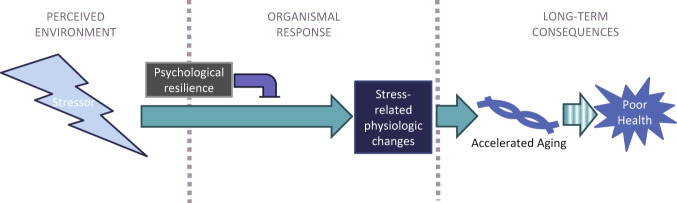
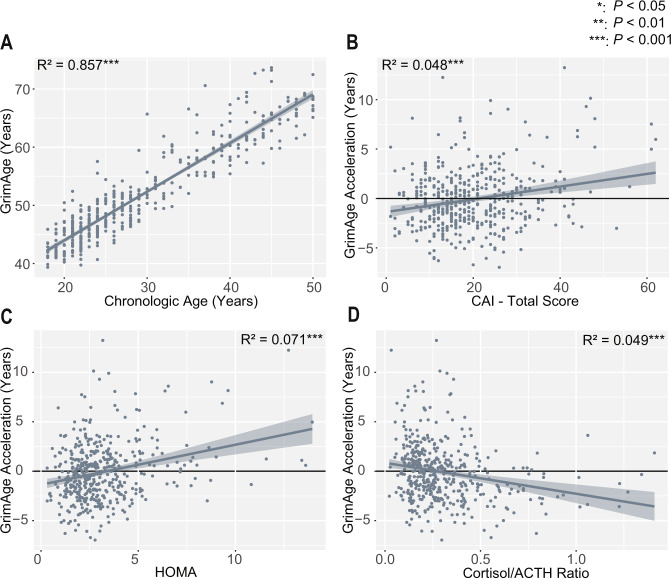
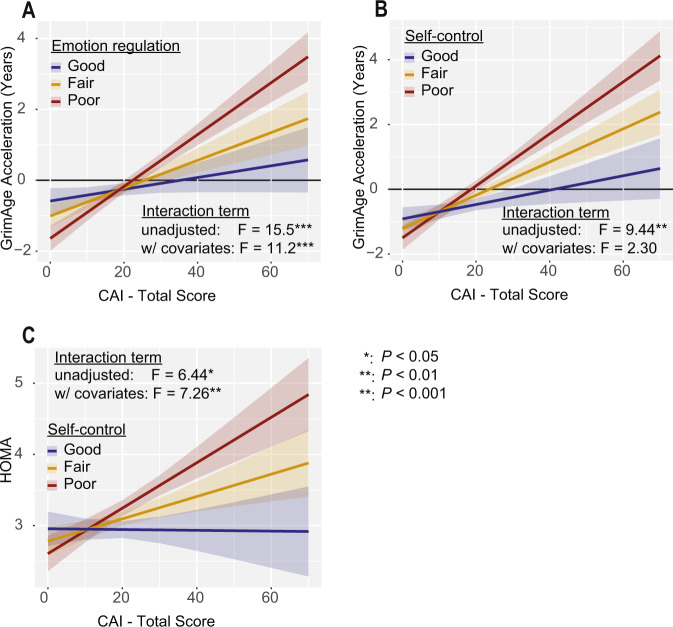
Our society is experiencing more stress than ever before, leading to both negative psychiatric and physical outcomes. Chronic stress is linked to negative long-term health consequences, raising the possibility that stress is related to accelerated aging. In this study, we examine whether resilience factors affect stress-associated biological age acceleration. Recently developed “epigenetic clocks” such as GrimAge have shown utility in predicting biological age and mortality. Here, we assessed the impact of cumulative stress, stress physiology, and resilience on accelerated aging in a community sample ( N = 444). Cumulative stress was associated with accelerated GrimAge ( P = 0.0388) and stress-related physiologic measures of adrenal sensitivity (Cortisol/ACTH ratio) and insulin resistance (HOMA). After controlling for demographic and behavioral factors, HOMA correlated with accelerated GrimAge ( P = 0.0186). Remarkably, psychological resilience factors of emotion regulation and self-control moderated these relationships. Emotion regulation moderated the association between stress and aging ( P = 8.82e−4) such that with worse emotion regulation, there was greater stress-related age acceleration, while stronger emotion regulation prevented any significant effect of stress on GrimAge. Self-control moderated the relationship between stress and insulin resistance ( P = 0.00732), with high self-control blunting this relationship. In the final model, in those with poor emotion regulation, cumulative stress continued to predict additional GrimAge Acceleration even while accounting for demographic, physiologic, and behavioral covariates. These results demonstrate that cumulative stress is associated with epigenetic aging in a healthy population, and these associations are modified by biobehavioral resilience factors.
Overview
The claims and statistics of this paper haven’t been checked yet.
Free: it reads the open-access text and checks the first 5 claims that cite a source we can check. Create a free account to check every claim.
Integrity signals
Registry
Cites
Statistics
Figures
Verification
Claims the paper makes
The claims and statistics of this paper haven’t been checked yet.
Free: it reads the open-access text and checks the first 5 claims that cite a source we can check. Create a free account to check every claim.
Claims other papers make about this one
Each is checked against this paper’s own text: does it say what the citing paper says it does?
The check wasn’t confident either way, so it gives no verdict — never disputed.
In the citing paper
“Moreover, several studies have shown that oestrogen disturbances and increased GCs elicit mitochondrial dysfunction, ultimately leading to neuronal and cognitive impairment.352,365”
From Antiageing strategy for neurodegenerative diseases: from mechanisms to clinical advances (2025) · cites this paper as [352]
Experimental — accuracy not yet measuredIn the citing paper
“Furthermore, insulin resistance has been found to reduce life expectancy through epigenetic clocks.352”
From Antiageing strategy for neurodegenerative diseases: from mechanisms to clinical advances (2025) · cites this paper as [352]
Self-check
Percentages, sums and reported differences re-computed from the paper’s own numbers.
The self-check needs the paper’s full text.
Citations
Cites
lavaan : An R Package for Structural Equation Modeling
Rosseel, Y. (2012) · Journal of Statistical Software · doi:10.18637/jss.v048.i02 · Cited by 27,955 · cited 1×
“Serial mediation was calculated via R using the Lavaan package [71], with an indirect effect defined as the product of the coefficients of the effect of stress on BMI, of BMI on HOMA, and of HOMA on GAA.”
MethodGratz, K. L., & Roemer, L. (2004) · Journal of Psychopathology and Behavioral Assessment · doi:10.1023/b:joba.0000007455.08539.94 · Cited by 8,942 · cited 3×
“First, is cumulative stress related to epigenetic markers of biological aging in a healthy young-to-middleaged community population? Second, if stress is associated with epigenetic aging, does stress-related physiology contribute to stress-associated biological aging? And finally, how do psychological factors that con…”
BackgroundMethodDNA methylation age of human tissues and cell types
Horvath, S. (2013) · Genome Biology · doi:10.1186/gb-2013-14-10-r115 · Cited by 7,075
High self-control predicts good adjustment, less pathology, better grades, and interpersonal success
Tangney, J. P., Baumeister, R. F., & Boone, A. L. (2004) · Journal of Personality · doi:10.1111/j.0022-3506.2004.00263.x · Cited by 6,557 · cited 5×
“There are no sub-scores provided by the SCS-B, and the overall SCS-B has been reported to have an alpha reliability >0.80 [66].”
BackgroundMethodInfluentialEgo depletion: Is the active self a limited resource?
Baumeister, R. F., Bratslavsky, E., Muraven, M., & Tice, D. M. (1998) · Journal of Personality and Social Psychology · doi:10.1037//0022-3514.74.5.1252 · Cited by 5,312
Self-regulation and depletion of limited resources: Does self-control resemble a muscle?
Muraven, M., & Baumeister, R. F. (2000) · Psychological Bulletin · doi:10.1037/0033-2909.126.2.247 · Cited by 4,510
mediation:R Package for Causal Mediation Analysis
Tingley, D., Yamamoto, T., Hirose, K., Keele, L., & Imai, K. (2014) · Journal of Statistical Software · doi:10.18637/jss.v059.i05 · Cited by 4,155 · cited 1×
“Simple mediation effects were calculated via R using 10,000 simulations without bootstrapping using the mediation package [79].”
MethodAn epigenetic biomarker of aging for lifespan and healthspan
Levine, M. E., Lu, A. T., Quach, A., Chen, B. H., Assimes, T. L., Bandinelli, S., Hou, L., Baccarelli, A. A., Stewart, J. D., Li, Y., et al. (2018) · Aging · doi:10.18632/aging.101414 · Cited by 3,675
Eta squared and partial eta squared as measures of effect size in educational research
Richardson, J. T. E. (2011) · Educational Research Review · doi:10.1016/j.edurev.2010.12.001 · Cited by 3,465
DNA methylation arrays as surrogate measures of cell mixture distribution
Houseman, E. A., Accomando, W. P., Koestler, D. C., Christensen, B. C., Marsit, C. J., Nelson, H. H., Wiencke, J. K., & Kelsey, K. T. (2012) · BMC Bioinformatics · doi:10.1186/1471-2105-13-86 · Cited by 3,175 · cited 1×
“The Houseman method was used to determine cell type proportion [76], and the inclusion of cell fractions as covariates in a linear model does not impact the primary conclusions of this paper (see Supplementary material).”
Method
Research works printed but not linked: 1
- Roy B Riley C Sinha R Emotion regulation moderates the association between chronic stress and cardiovascular disease risk in humans: a cross-sectional study Stress (Amst, Neth) 2018 21 548 55 10.1080/10253890.2018.1490724 PMC6367063 30084712 · DOI
Cited by
Items 101–138 of 138
What we get wrong about stress in sports psychology: an opinion
Kabeer, D. A., Vinu, W., Safad, A. K., Govindasamy, K., Balaji, E., Logeswaran, A., Rajkumar, M., K., S. K., K., M., & Pramitha, M. (2026) · Frontiers in Psychology · doi:10.3389/fpsyg.2026.1752653 · Cited by 1
Webb, E. K., Zannas, A. S., Linnstaedt, S. D., House, S. L., Beaudoin, F. L., An, X., Stevens, J. S., Neylan, T. C., Clifford, G. D., Jovanović, T., et al. (2026) · Journal of Psychiatric Research · doi:10.1016/j.jpsychires.2026.03.045 · Cited by 1
Yuan, Q., Jia, S., Yue, X., Li, Y., Wang, M., Chen, M., Pan, J., Xia, L., Mao, Z., Xiangyu, D., et al. (2026) · Experimental Gerontology · doi:10.1016/j.exger.2026.113151 · Cited by 3
Ge, X., Jiang, C., Wu, C., Fang, X., & Zhang, X. (2026) · European Archives of Psychiatry and Clinical Neuroscience · doi:10.1007/s00406-026-02325-8 · Cited by 1
Badawy, M. A. M., Soliman, T. M., & Nemt-allah, M. A. (2025) · International Journal of Evaluation and Research in Education (IJERE) · doi:10.11591/ijere.v14i4.32845 · Cited by 1
Pervaiz, R., & Malik, T. A. (2025) · medRxiv · doi:10.1101/2025.09.09.25334787 · Cited by 1
Hidden stressors and patient motivations: the role of the aesthetic nurse
Cairns, K. (2023) · Journal of Aesthetic Nursing · doi:10.12968/joan.2023.12.4.170
Neuhaus, C. A., Metzler, Y. A., Taibi, Y., Müller, A., & Bellingrath, S. (2024) · International Journal of Occupational Safety and Ergonomics · doi:10.1080/10803548.2024.2383058 · Cited by 1
“Whereas ERI has been shown to produce a stressful state, it isusefultoconsiderindividualstresslevelsasfactorsleadingto negative health outcomes [64].”
Invisible Scars: Unraveling the Epigenetic and Mental Health Consequences of Victimization
Gonggrijp, B. M. A. (2025) · doi:10.5463/thesis.1050
Espinoza, C. N., Goering, M., Dahlman, A. E., Patki, A., Tiwari, H. K., Richter, C. G., & Mrug, S. (2025) · Applied Psychology Health and Well-Being · doi:10.1111/aphw.70026 · Cited by 1
“Ultimately, this reduced time under stress may contribute to a slower rate of epigenetic aging (Harvanek et al., 2021).”
Waite‐Jones, J. M., & Rodriguez, A. (2025) · Springer eBooks · doi:10.1007/978-3-031-88177-0_6
Barha, C. K., on behalf of the Canadian Longitudinal Study on Aging (CLSA) Team, Liu-Ambrose, T. Y. L., Inkster, A. M., Falck, R. S., Burma, J. S., Kirkland, S., Griffith, L. E., Thompson, M., Basta, N. E., et al. (2025) · Aging · doi:10.18632/aging.206337
Epidemiology, Ergonomics, and Epigenetics: Performance Traumatic Stress Disorder (PTSD)
Chong, J. P., & Cottrell, K. (2025) · Springer eBooks · doi:10.1007/978-3-032-06243-7_2 · Cited by 1
Profiles of Aging Based on Cognition, Affect, and Brain ReservePreprint
Jarukasemkit, S., Stahl, L., Tam, K. M., Feng, B., Rincon, S. N., Luo, X., Modi, H., Hamilton, K., Lenzini, P. A., Ahmad, F., et al. (2025) · bioRxiv (Cold Spring Harbor Laboratory) · doi:10.64898/2025.12.04.692428
“Prior work has indicated psychological resilience moderates epigenetic aging [51].”
Willems, Y. E., deSteiguer, A. J., Tanksley, P. T., Vinnik, L., Fraemke, D., Okbay, A., Richter, D., Wagner, G. G., Hertwig, R., Koellinger, P., et al. (2024) · Figshare · doi:10.6084/m9.figshare.26678819
Aizpurua‐Perez, I. (2024) · Communities in ADDI (University of the Basque Country) · Cited by 1
The traumatic effect of a terrorist threat on a person
Finogenova, T. A. (2026) · Психология и Психотехника · doi:10.7256/2454-0722.2026.1.77953
On the impact of the COVID-19 pandemic on the manifestations of aging
Эргашев, О. Н., Сагинбаев, У. Р., & Михайлович, К. И. (2026) · Сибирский научный медицинский журнал · doi:10.18699/ssmj20250615
COVID‐19 Impacts on Children and Resources for Resilience: What is the Direction of Causation?
Du, H., Little, C. W., & Hart, S. A. (2026) · Developmental Science · doi:10.1111/desc.70172
Koirala, A., Shields, J., Vijan, A., Wemm, S., Xu, K., Ku, B. S., Sinha, R., & Harvanek, Z. M. (2026) · medRxiv · doi:10.64898/2026.04.24.26351669
Self-citationLoscalzo, Y., Giannini, M., & Ungvari, Z. I. (2026) · GeroScience · doi:10.1007/s11357-026-02326-4
“Such processes are increasingly recognized as measurable through integrative biomarkers of aging, including composite physiological indices and emerging molecular markers (e.g., epigenetic clocks) [25–28].”
Recent Advances in Wearable Biosensors for Stress and Emotion Monitoring
Y, X., Wang, J., Gao, X., Zhang, Y., & Wen, D. (2026) · Advanced Sustainable Systems · doi:10.1002/adsu.70509
“Chronic or excessive stress not only disrupts mental well-being but is also associated with accelerated cellular aging [7], heightened vulnerability to chronic diseases [8], and increased prevalence of mental health disorders, including depression, anxiety, and post-traumatic stress disorder (PTSD)…”
Li, Y., Liu, Z. H., Hu, B., Xu, J., Xiao, J., Chen, B., Tian, T., He, Y., Qin, S., & Lin, D. (2026) · Development and Psychopathology · doi:10.1017/s0954579426101564
“…or even eliminate the detrimental effects of adversity on psychological and physiological outcomes, including depression (Poole et al., 2017b), anxiety (Poole et al., 2017a), physical health (Wojujutari et al., 2019), epigenetic aging (Harvanek et al., 2021), and cortisol levels (Sun et al., 2023).”
Domfe, G., Kohlmann, J., & Atta‐Ankomah, R. (2026) · Discover Sustainability · doi:10.1007/s43621-026-03459-4
“Overall, farmers adapting to climate change may experience reduced psychosocial stress and, as a result of enhanced resilience, enjoy a longer life [32, 51].”
Adverse life events and cognition in older adults: the role of gender and psychological resilience
Leung, Y., Eramudugolla, R., Mortby, M. E., & Anstey, K. J. (2026) · The Journals of Gerontology Series B · doi:10.1093/geronb/gbag100
“For instance, individuals with lower resilience exhibit greater stress-related physiological age acceleration, whereas higher resilience attenuates the association between stress and markers of aging such as insulin resistance (Harvanek et al., 2021).”
Հովհաննիսյան, Ս. (2026) · Bulletin of Yerevan University E Philosophy Psychology · doi:10.46991/bysu.e/2026.17.2.107
Toward a context-aware geroscience: integrating structural and social context into aging biology
Bellizzi, K. M., Kuchel, G. A., Redeker, N. S., & Nwakasi, C. C. (2026) · The Gerontologist · doi:10.1093/geront/gnag179
Sun, Y., Qiao, B., Meng, X., Wang, M., Zhang, H., Wang, Z., Sun, S., Zheng, D., Yan, Y., Wu, L., et al. (2026) · Experimental Gerontology · doi:10.1016/j.exger.2026.113283
Mposhi, A., Uvnäs‐Moberg, K., & Turner, J. D. (2026) · Ageing Research Reviews · doi:10.1016/j.arr.2026.103343
Fighting Stress With AI, Positive Psychology, and Persuasive Technology
Orji, J. (2023) · DalSpace (Dalhousie University)
Enoma, E., Adu-Gyamfi, A., Carter, J., Wu, S., Nemesure, B. B., & Williams, J. L. (2026) · Frontiers in Oncology · doi:10.3389/fonc.2026.1823995
“Stress has been shown to shorten telomere length which leads to premature aging (29).”
Integrative Aesthetics: Shaping the Emerging Frontier of Modern Aesthetic Medicine
Goldie, K., Gooneratne, M., Goh, J. P., & Corduff, N. (2026) · Clinical Cosmetic and Investigational Dermatology · doi:10.2147/ccid.s618850
Zhang, J., Su, W., Duan, J., Sun, Y., & Liu, B. (2026) · The Innovation Life · doi:10.59717/j.xinn-life.2026.100262
Travmaya Bağlı Maksiller Santral Kesici Eksikliğinin Ortodontik Yönetimi: Olgu Sunumu
Cengiz, S. M., Baki, Ö. F., & Cengiz, A. F. (2026) · Mersin Üniversitesi Açık Erişim Sistemi/Mersin University Open Access System
Minoretti, P., & Emanuele, E. (2026) · Methods and Protocols · doi:10.3390/mps9060161
Сучасний стан проблеми темпів старіння молоді
Леонт’єва, З. Р., Dutka, R. Y., & Chmyr, N. V. (2026) · Науковий вісник Ужгородського університету Серія Медицина · doi:10.32782/2415-8127.2026.74.18
Metadata
- Authors
- Harvanek, Z. M., Fogelman, N., Xu, K., & Sinha, R.
- Affiliations
- Yale University (US)
- Corresponding author
- Sinha, Rajita
- Venue
- Translational Psychiatry
- Published
- 2021-11-27
- Volume
- 11
- Issue
- 1
- Pages
- 601-601
- ISSN
- 2158-3188 (ISSN-L)
- PMC
- PMC8627511
- OpenAlex
- W3217148206
- Cited by
- 123
- References
- 89
- Citations by year
- 2026: 24 · 2025: 29 · 2024: 29 · 2023: 30 · 2022: 10 · 2021: 1
- FWCI
- 5.49
- Type
- journal article
- Language
- en
- Open access
- gold
- doi.org
- Licence
- cc-by
- creativecommons.org/licenses/by/4.0 (tdm)
- creativecommons.org/licenses/by/4.0 (vor)
- Locations
- Translational Psychiatry (publishedVersion, cc-by)
- PubMed Central (publishedVersion, cc-by)
- PubMed (publishedVersion)
- DOAJ (DOAJ: Directory of Open Access Journals) (submittedVersion, cc-by-sa)
- Funders
- U.S. Department of Health & Human Services | National Institutes of Health (UL1-DE019586, PL1-DA24859, R01-AA013892, R25MH071584, T32MH019961, R01DA047063)
- Topics
- Life Sciences › Biochemistry, Genetics and Molecular Biology › Molecular Biology › Epigenetics and DNA Methylation
- Life Sciences › Neuroscience › Behavioral Neuroscience › Stress Responses and Cortisol
- Social Sciences › Psychology › Clinical Psychology › Resilience and Mental Health
- Keywords
- cumulative stress, biological aging, epigenetic clocks, GrimAge, psychological resilience, emotion regulation, self-control, insulin resistance, stress physiology, accelerated aging
- MeSH terms
- Health Status, Stress, Psychological, DNA Methylation, Epigenesis, Genetic, Resilience, Psychological, Epigenomics
About these checks
Registry, retraction, Cites and statistics results are computed, not judged, with one exception: a printed reference that no index lists is read once by a model before it counts as a citation error. Claims are extracted by a model and kept only when their quote appears verbatim in the text; each cited source is then checked, with a model’s help, for whether it says what the claim relies on. Those verdicts can be wrong — read the claim’s quote and the cited source before relying on one.
Statistics and arithmetic are recomputed, not judged.
Confidence bands are shown only for fields calibrated on our annotated test set. None is calibrated yet, so no band is shown.
What counts as a claim ›How we measure confidence ›How we check this ›
Are you an author, or do you see a problem with this page? Request a review
Data sources
Bibliographic data: Semantic Scholar, OpenAlex, Crossref.
Contains information from the Semantic Scholar Academic Graph Datasets, made available under the ODC Attribution License (ODC-BY 1.0).
Semantic Scholar’s data is described in: Kinney, R., et al. (2023). The Semantic Scholar Open Data Platform. arXiv:2301.10140.
