

Evaluating cognitive disturbances as treatment target and predictor of antidepressant action in major depressive disorder: A NeuroPharm study
Open accessThe DOI matches its Crossref record; 31 of the 31 references it cites were found in a registry or an index.
Abstract
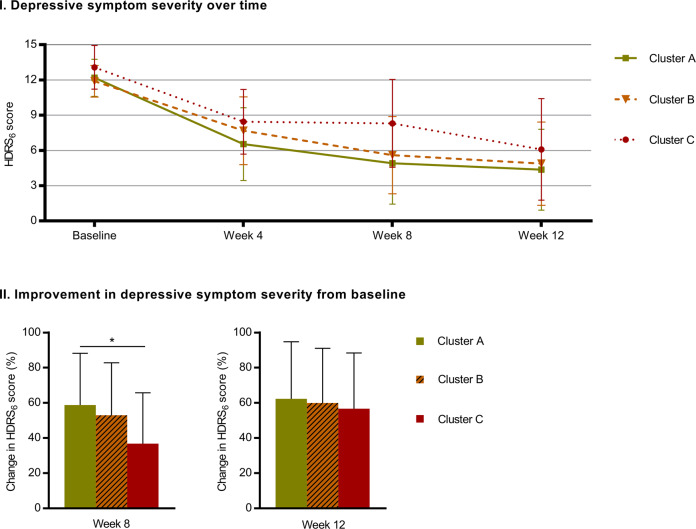
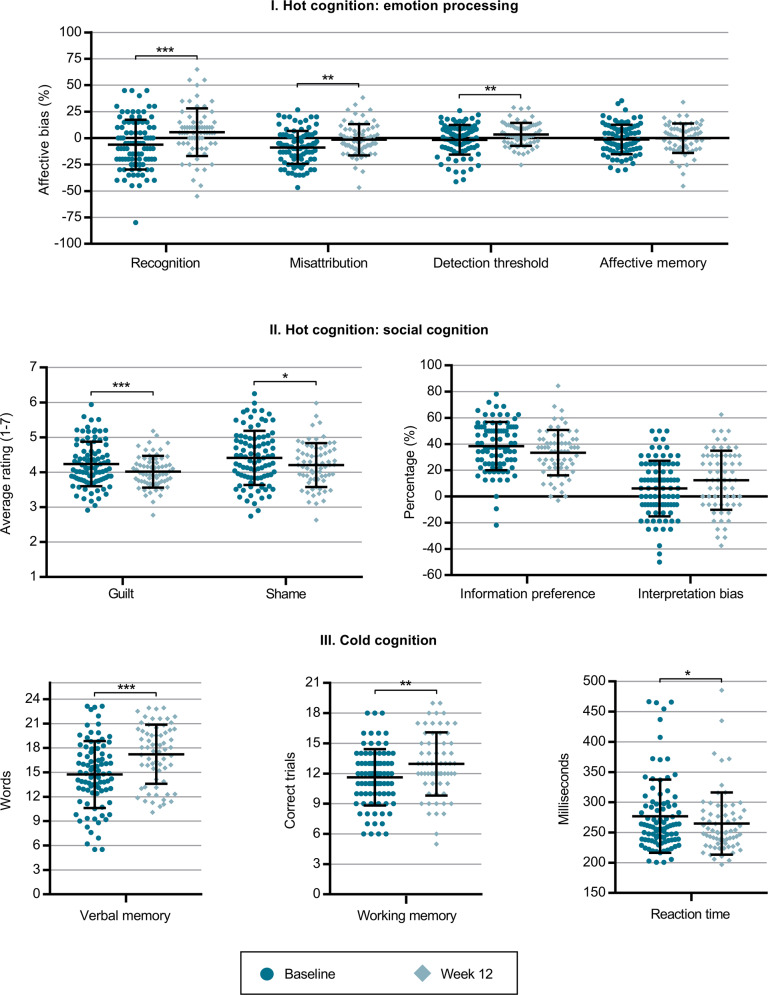
Cognitive disturbances in major depressive disorder (MDD) constitute a critical treatment target and hold promise as an early predictor of antidepressant treatment response; yet their clinical relevance is not fully established. Therefore, we here investigate if (1) cognitive performance improves over the course of antidepressant treatment and (2) cognitive performance at baseline is predictive of antidepressant treatment response. In the NeuroPharm study (clinical trial id: NCT02869035), 92 antidepressant-free patients with a moderate to severe depressive episode were assessed with a comprehensive cognitive test battery including both cold (emotion-independent) and hot (emotion-dependent) tasks. Patients were tested before and after 12 weeks of standard antidepressant treatment with escitalopram in flexible doses of 10–20 mg. Performance improved across most cognitive domains over the course of antidepressant treatment. Notably, these improvements were independent of improvement in mood symptoms, emphasizing that cognitive disturbances are a distinct symptom and therefore treatment target in MDD. Results did not suggest that performance on any single cognitive measure at baseline was associated with later clinical response to antidepressant treatment. However, a small cluster of patients (N = 28) with globally disturbed cognition at baseline exhibited poorer clinical response after 8 but not 12 weeks of antidepressant treatment, suggesting that severe cognitive disturbances may delay treatment response. Thus, while pretreatment cognitive performance on individual tests may not be useful as clinical markers of treatment response, profiles capturing performance across different cognitive domains may be useful for stratification of patients with MDD and could be helpful in future intervention trials.
Overview
The claims and statistics of this paper haven’t been checked yet.
Free: it reads the open-access text and checks the first 5 claims that cite a source we can check. Create a free account to check every claim.
Integrity signals
Registry
Cites
Statistics
Figures
Verification
Claims the paper makes
The claims and statistics of this paper haven’t been checked yet.
Free: it reads the open-access text and checks the first 5 claims that cite a source we can check. Create a free account to check every claim.
Claims other papers make about this one
Each is checked against this paper’s own text: does it say what the citing paper says it does?
In the citing paper
“symptoms of depression indicate global affection of the brain, with deficits related to, e.g., memory and executive function, that can improve independent of change in depression scores following SSRI treatment [32].”
From Effects of escitalopram on synaptic density in the healthy human brain: a randomized controlled trial (2023) · cites this paper as [32]
Self-check
Percentages, sums and reported differences re-computed from the paper’s own numbers.
The self-check needs the paper’s full text.
Citations
Cites
Rush, A. J., Trivedi, M. H., Wisniewski, S. R., Nierenberg, A. A., Stewart, J. W., Warden, D., Niederehe, G., Thase, M. E., Lavori, P. W., Lebowitz, B. D., et al. (2006) · American Journal of Psychiatry · doi:10.1176/ajp.2006.163.11.1905 · Cited by 5,643 · cited 1×
“Importantly, for every failed treatment attempt, chances of remission decrease [3] and clinicians, therefore, face an urgent need for new strategies to optimize antidepressant choices early in the course of the illness.”
BackgroundTrivedi, M. H., Rush, A. J., Wisniewski, S. R., Nierenberg, A. A., Warden, D., Ritz, L., Norquist, G., Howland, R. H., Lebowitz, B., McGrath, P. J., et al. (2006) · American Journal of Psychiatry · doi:10.1176/appi.ajp.163.1.28 · Cited by 3,879
Cognitive impairment in depression: a systematic review and meta-analysis
Rock, P. L., Roiser, J. P., Riedel, W. J., & Blackwell, A. D. (2014) · Psychological Medicine · doi:10.1017/s0033291713002535 · Cited by 2,161 · cited 1×
“Patients with MDD have consistently been shown to exhibit small to moderate deficits in cold cognitive functions such as processing speed, attention, memory, and executive functions [7].”
BackgroundGrand challenges in global mental health
Collins, P. Y., Patel, V., Joestl, S. S., March, D., Insel, T. R., Daar, A. S., Bordin, I. A., Costello, E. J., Durkin, M., Fairburn, C., et al. (2011) · Nature · doi:10.1038/475027a · Cited by 2,043 · cited 1×
“This requires the identification of biomarkers that can help stratify patients into clinically meaningful subgroups [4].”
BackgroundSelf-citationMcIntyre, R. S., Cha, D. S., Soczynska, J. K., Woldeyohannes, H. O., Gallaugher, L. A., Kudlow, P., Alsuwaidan, M., & Baskaran, A. (2013) · Depression and Anxiety · doi:10.1002/da.22063 · Cited by 765 · cited 1×
“Apart from their potential as biomarkers, cognitive disturbances also constitute a critical treatment target in MDD [12] as impaired cognition negatively impacts patients’ everyday functioning and contributes to work presenteeism and absenteeism [13, 14].”
BackgroundCleare, A., Pariante, C., Young, A., Anderson, I., Christmas, D., Cowen, P., Dickens, C., Ferrier, I., Geddes, J., Gilbody, S., et al. (2015) · Journal of Psychopharmacology · doi:10.1177/0269881115581093 · Cited by 759 · cited 1×
“This is important because current guidelines suggest that patients should be switched to a different antidepressant drug if adequate treatment response is not observed within 4–8 weeks [26].”
BackgroundCognitive function following a major depressive episode: a systematic review and meta-analysis
Semkovska, M., Quinlivan, L., O'Grady, T., Johnson, R., Collins, A., O'Connor, J., Knittle, H., Ahern, E., & Gload, T. (2019) · The Lancet Psychiatry · doi:10.1016/s2215-0366(19)30291-3 · Cited by 631 · cited 1×
“For example, a recent meta-analysis reported small to medium impairments in processing speed, learning and memory, attention, and executive functions in remitted patients compared to healthy individuals [18].”
BackgroundCognitive impairment in euthymic major depressive disorder: a meta-analysis
Bora, E., Harrison, B. J., Yücel, M., & Pantelis, C. (2013) · Psychological Medicine · doi:10.1017/s0033291712002085 · Cited by 551 · cited 1×
“, mood, energy, hedonia, and somatic) symptoms [17].”
Cognitive Mechanisms of Treatment in Depression
Roiser, J. P., Elliott, R., & Sahakian, B. J. (2012) · Neuropsychopharmacology · doi:10.1038/npp.2011.183 · Cited by 535 · cited 1×
“Over time, the changes in affective biases enable positive restructuring of dysfunctional cognitive processes, which ultimately leads to alleviation of mood symptoms [29].”
BackgroundSelf-citationMcIntyre, R. S., Lophaven, S., & Olsen, C. K. (2014) · The International Journal of Neuropsychopharmacology · doi:10.1017/s1461145714000546 · Cited by 433 · cited 1×
“This is supported by other large clinical studies which also found no or only partial overlap between treatment effects on cognition and core depressive symptoms [27, 28].”
Result
Research works printed but not linked: 1
- Holm S A simple sequentially rejective multiple test procedure Scand J Stat 1979 6 65 70
Cited by
Johansen, A., Armand, S., Plavén-Sigray, P., Nasser, A., Ozenne, B., Petersen, I. N., Keller, S. H., Madsen, J., Beliveau, V., Møller, K., et al. (2023) · Molecular Psychiatry · doi:10.1038/s41380-023-02285-8 · Cited by 53
Self-citationEscitalopram increases synaptic density in the human brain over weeks: A randomized controlled trial
(2023) · doi:10.21203/rs.3.rs-2989150/v1 · Cited by 53
Ahern, E., White, J., & Slattery, E. J. (2024) · Neuropsychology Review · doi:10.1007/s11065-023-09629-9 · Cited by 51
“…et al., 2020; Annette et al., 2020; Bastos et al., 2013; Biringer et al., 2007; Boeker et al., 2012; Borkowska et al., 2007; Cokmus et al., 2021; Dam et al., 2022; Dannehl et al., 2019; Gallagher et al., 2007; Greer et al., 2014, 2015; Groves et al., 2015; Gudayol-Ferré et al., 2015; Halappa et…”
Chen, C., Zhai, R., Lan, X., Yang, S., Tang, S., Xiong, X., He, Y., Lin, J., Feng, J., Chen, D., et al. (2024) · Ibrain · doi:10.1002/ibra.12167 · Cited by 16
“162 However, a systematic review suggests mixed outcomes, with some studies indicating no significant cognitive effects or even potential memory function harm.”
BackgroundJensen, K. H. R., Dam, V. H., Ganz, M., Fisher, P. M., Ip, C.-T., Sankar, A., Marstrand-Joergensen, M. R., Ozenne, B., Osler, M., Penninx, B. W. J. H., et al. (2023) · BMC Psychiatry · doi:10.1186/s12888-023-04618-x · Cited by 19
“Recently, researchers have begun to explore the potential of cognitive markers to inform clinical decision-making in the treatment of depression [94] and as a specific treatment target [95].”
BackgroundSelf-citationDam, V. H., Köhler‐Forsberg, K., Ozenne, B., Larsen, S. V., Ip, C.-T., Jorgensen, A., Stenbæk, D. S., Madsen, J., Svarer, C., Jørgensen, M. B., et al. (2024) · Biological Psychiatry · doi:10.1016/j.biopsych.2024.08.009 · Cited by 13
Self-citationde Cates, A. N., Martens, M., Wright, L. C., Gibson, D., Spitz, G., van Praag, C. G., Suri, S., Cowen, P. J., Murphy, S. E., & Harmer, C. J. (2023) · Biological Psychiatry Cognitive Neuroscience and Neuroimaging · doi:10.1016/j.bpsc.2023.03.014 · Cited by 17
“For example, in a recent study, 12 weeks of escitalopram (a selective serotonin reuptake inhibitor) was associated with a general improvement in cognition in patients with depression, but this was independent of any change in mood (15).”
BackgroundCognitive changes in patients with unipolar TRD treated with IV ketamine: A systematic review
Grasso, V., Gutiérrez, G., Alzbeidi, N., Hernandorena, C. V., & Vázquez, G. H. (2024) · Progress in Neuro-Psychopharmacology and Biological Psychiatry · doi:10.1016/j.pnpbp.2024.111095 · Cited by 14
Bîlc, M. I., Iacob, A., Szekely‐Copîndean, R. D., Kiss, B., Ștefan, M.-G., Muresan, R. C., Pop, C. F., Pițur, S., Szentágotai-Tătar, A., Vulturar, R., et al. (2023) · Cognitive Affective & Behavioral Neuroscience · doi:10.3758/s13415-023-01116-1 · Cited by 14
“However, it is noteworthy that in contrast with the nonsignificant effects of ATD on working memory (Harrison et al., 2004; Luciana et al., 2001), standard SSRI treatment for 12 weeks has been shown to improve working memory in depressed patients (Dam et al., 2022).”
ResultMałujło-Balcerska, E., & Pietras, T. (2024) · Journal of Psychiatric Research · doi:10.1016/j.jpsychires.2024.01.026 · Cited by 11
Bruzzone, S. E. P., Ozenne, B., Fisher, P. M., Ortega, G., Jensen, P. S., Dam, V. H., Svarer, C., Knudsen, G. M., Lesch, K., & Frøkjær, V. G. (2024) · Clinical Epigenetics · doi:10.1186/s13148-024-01678-y · Cited by 12
Self-citationCognitive Decline and Its Associated Factors in Patients with Major Depressive Disorder
Latiff, H. Z. A., Ariaratnam, S., Shuib, N., & Isa, M. R. (2023) · Healthcare · doi:10.3390/healthcare11070950 · Cited by 10
“However, this association with depressive symptoms remains relatively unknown [2], including its clinical relevance, in particular whether a specific cognitive domain could relate to biological phenotypes that in turn could impact the choices of anti-depressant and/or non-pharmacological interventions [8].”
BackgroundPan, Y., Xu, P., & Sun, X. (2025) · PLoS ONE · doi:10.1371/journal.pone.0328886 · Cited by 8
“It may be correlated with a diminished response to treatment, an elevated risk of recurrence, and potential long-term occupational and social dysfunction [7,8]; however, effective treatment options are currently lacking [9].”
Kang, Y., Jung, J., Han, K., Auer, D. P., & Ham, B. (2025) · Journal of Affective Disorders · doi:10.1016/j.jad.2025.120607 · Cited by 8
Jensen, K. H. R., Dam, V. H., Köhler‐Forsberg, K., Ozenne, B., Stenbæk, D. S., Ganz, M., Fisher, P. M., Frøkjær, V. G., Knudsen, G. M., & Jørgensen, M. B. (2024) · Journal of Psychiatric Research · doi:10.1016/j.jpsychires.2024.11.043 · Cited by 7
Self-citationVulpius, G. M., Köhler‐Forsberg, K., Ozenne, B., Larsen, S. V., Nasser, A., Svarer, C., Gillings, N., Keller, S. H., Jørgensen, M. B., Knudsen, G. M., et al. (2023) · The International Journal of Neuropsychopharmacology · doi:10.1093/ijnp/pyad041 · Cited by 13
“This is also in line with previous findings suggesting that single predictors provide negligible improvements in predicting treatment outcomes (Beliveau et al., 2022; Dam et al., 2022; Fisher et al., 2022) while models combining a set of predictors may be more helpful (Zhou et al.”
ResultSelf-citationJohnson, D. E., Meshkat, S., Kaczmarek, E. S., Rabin, J. S., Brudner, R. M., Chisamore, N., Doyle, Z., Bawks, J., Riva-Cambrin, J., Mansur, R. B., et al. (2025) · Progress in Neuro-Psychopharmacology and Biological Psychiatry · doi:10.1016/j.pnpbp.2025.111565 · Cited by 2
Xu, P., Huang, J., Xiu, Y., Sun, X., & Pan, Y. (2025) · Psychiatry Research Neuroimaging · doi:10.1016/j.pscychresns.2025.111984 · Cited by 1
Sinanoğlu, G. K., Güler, Ö., & çalış, Z. (2025) · Turkish Journal of Psychiatry · doi:10.5080/u27539 · Cited by 1
Cognitive flexibility and depression remission: A narrative review
Roberge, C., Borgmann, L., & Batail, J.-M. V. (2026) · L Encéphale · doi:10.1016/j.encep.2026.03.022 · Cited by 1
Geraci, J., Qorri, B., Cumbaa, C. A., Tsay, M. J., Marrella, C. A., Zappulla, S., Leonczyk, P., Gogacz, A., & Pani, L. (2026) · AI · doi:10.3390/ai7090349 · Cited by 1
“…plausible because anhedonia and social motivation reflect reward-processing domains linked to antidepressant response, while neurovegetative symptoms, functional impairment, and cognitive symptoms are established components of depression heterogeneity and treatment-outcome assessment [43–45].”
Ye, P., Zhou, Y., Gu, L., Zhan, M., Zheng, D., Zhang, G., & Zhao, M. (2025) · Geriatric Nursing · doi:10.1016/j.gerinurse.2025.103666
Bruzzone, S. E. P., Ozenne, B., Fisher, P. M., Ortega, G., Jensen, P. S., Dam, V. H., Svarer, C., Knudsen, G. M., Lesch, K., & Frokjaer, V. G. (2024) · Figshare · doi:10.6084/m9.figshare.26726351
Self-citationBruzzone, S. E. P., Ozenne, B., Fisher, P. M., Ortega, G., Jensen, P. S., Dam, V. H., Svarer, C., Knudsen, G. M., Lesch, K., & Frokjaer, V. G. (2024) · Figshare · doi:10.6084/m9.figshare.26726357
Self-citationBruzzone, S. E. P., Ozenne, B., Fisher, P. M., Ortega, G., Jensen, P. S., Dam, V. H., Svarer, C., Knudsen, G. M., Lesch, K., & Frokjaer, V. G. (2024) · Figshare · doi:10.6084/m9.figshare.26726354
Self-citationBruzzone, S. E. P., Ozenne, B., Fisher, P. M., Ortega, G., Jensen, P. S., Dam, V. H., Svarer, C., Knudsen, G. M., Lesch, K., & Frokjaer, V. G. (2024) · Figshare · doi:10.6084/m9.figshare.26726342
Self-citationBruzzone, S. E. P., Ozenne, B., Fisher, P. M., Ortega, G., Jensen, P. S., Dam, V. H., Svarer, C., Knudsen, G. M., Lesch, K., & Frokjaer, V. G. (2024) · Figshare · doi:10.6084/m9.figshare.26726348
Self-citationBruzzone, S. E. P., Ozenne, B., Fisher, P. M., Ortega, G., Jensen, P. S., Dam, V. H., Svarer, C., Knudsen, G. M., Lesch, K., & Frokjaer, V. G. (2024) · Figshare · doi:10.6084/m9.figshare.26726345
Self-citationJensen, K. H. R., Dam, V. H., Ganz, M., Fisher, P. M., Ip, C.-T., Sankar, A., Marstrand-Joergensen, M. R., Ozenne, B., Osler, M., Penninx, B. W. J. H., et al. (2023) · Figshare · doi:10.6084/m9.figshare.22623808
Self-citationBruzzone, S. E. P., Ozenne, B., Fisher, P. M., Ortega, G., Jensen, P. S., Dam, V. H., Svarer, C., Knudsen, G. M., Lesch, K., & Frokjaer, V. G. (2024) · Figshare · doi:10.6084/m9.figshare.26726339
Self-citationBruzzone, S. E. P., Ozenne, B., Fisher, P. M., Ortega, G., Jensen, P. S., Dam, V. H., Svarer, C., Knudsen, G. M., Lesch, K., & Frokjaer, V. G. (2024) · Figshare · doi:10.6084/m9.figshare.26726336
Self-citationBruzzone, S. E. P., Ozenne, B., Fisher, P. M., Ortega, G., Jensen, P. S., Dam, V. H., Svarer, C., Knudsen, G. M., Lesch, K., & Frokjaer, V. G. (2024) · Figshare · doi:10.6084/m9.figshare.26726360
Self-citationJensen, K. H. R., Dam, V. H., Ganz, M., Fisher, P. M., Ip, C.-T., Sankar, A., Marstrand-Joergensen, M. R., Ozenne, B., Osler, M., Penninx, B. W. J. H., et al. (2023) · Figshare · doi:10.6084/m9.figshare.22623805
Self-citationJensen, K. H. R., Dam, V. H., Ganz, M., Fisher, P. M., Ip, C.-T., Sankar, A., Marstrand-Joergensen, M. R., Ozenne, B., Osler, M., Penninx, B. W. J. H., et al. (2023) · Figshare · doi:10.6084/m9.figshare.22623802
Self-citationMorimoto, S. S., Lindbergh, C. A., Conley, A. C., Jones, D. R., & Steffens, D. C. (2026) · JMIR Mental Health · doi:10.2196/94246
Tang, Y., Mu, Q., Gao, S., Feng, W., Liu, B., Ju, Y., Wang, M., Gao, K., Zhang, Y., Liao, M., et al. (2026) · Journal of Affective Disorders · doi:10.1016/j.jad.2026.122535
Metadata
- Authors
- Dam, V. H., Stenbæk, D. S., Köhler-Forsberg, K., Ip, C., Ozenne, B., Sahakian, B. J., Knudsen, G. M., Jørgensen, M. B., & Frokjaer, V. G.
- Affiliations
- University of Copenhagen (DK)
- University of Cambridge (GB)
- Corresponding author
- Dam, Vibeke Høyrup
- ORCID
- Venue
- Translational Psychiatry
- Published
- 2022-11-08
- Volume
- 12
- Issue
- 1
- Pages
- 468-468
- ISSN
- 2158-3188 (ISSN-L)
- PMC
- PMC9643376
- OpenAlex
- W4308525203
- Cited by
- 27
- References
- 31
- Citations by year
- 2026: 5 · 2025: 6 · 2024: 7 · 2023: 9
- FWCI
- 4.64
- Type
- journal article
- Language
- en
- Open access
- gold
- doi.org
- Licence
- cc-by
- creativecommons.org/licenses/by/4.0 (tdm)
- creativecommons.org/licenses/by/4.0 (vor)
- Locations
- Translational Psychiatry (publishedVersion, cc-by)
- PubMed Central (publishedVersion, cc-by)
- PubMed (publishedVersion)
- Research at the University of Copenhagen (University of Copenhagen) (publishedVersion, cc-by)
- DOAJ (DOAJ: Directory of Open Access Journals) (submittedVersion, cc-by-sa)
- Apollo (University of Cambridge) (submittedVersion, cc-by)
- Apollo
- Apollo (cc-by)
- Funders
- Augustinus Fonden (16-0058)
- Innovationsfonden (4108-00004B)
- Topics
- Health Sciences › Medicine › Pharmacology (medical) › Treatment of Major Depression
- Social Sciences › Psychology › Experimental and Cognitive Psychology › Anxiety, Depression, Psychometrics, Treatment, Cognitive Processes
- Life Sciences › Neuroscience › Cognitive Neuroscience › Neural and Behavioral Psychology Studies
- Keywords
- major depressive disorder, cognitive disorders, antidepressant response, treatment response prediction, escitalopram, cognitive performance, patient stratification
- MeSH terms
- Antidepressive Agents, Cognition, Depressive Disorder, Major, Major Depressive Disorder, Humans, Neuropsychological Tests, Cognitive Dysfunction
About these checks
Registry, retraction, Cites and statistics results are computed, not judged, with one exception: a printed reference that no index lists is read once by a model before it counts as a citation error. Claims are extracted by a model and kept only when their quote appears verbatim in the text; each cited source is then checked, with a model’s help, for whether it says what the claim relies on. Those verdicts can be wrong — read the claim’s quote and the cited source before relying on one.
Statistics and arithmetic are recomputed, not judged.
Confidence bands are shown only for fields calibrated on our annotated test set. None is calibrated yet, so no band is shown.
What counts as a claim ›How we measure confidence ›How we check this ›
Are you an author, or do you see a problem with this page? Request a review
Data sources
Bibliographic data: Semantic Scholar, OpenAlex, Crossref.
Contains information from the Semantic Scholar Academic Graph Datasets, made available under the ODC Attribution License (ODC-BY 1.0).
Semantic Scholar’s data is described in: Kinney, R., et al. (2023). The Semantic Scholar Open Data Platform. arXiv:2301.10140.
