

Evaluating cognitive disturbances as treatment target and predictor of antidepressant action in major depressive disorder: A NeuroPharm study
Open accessThe DOI matches its Crossref record; 31 of the 31 references it cites were found in a registry or an index.
Abstract
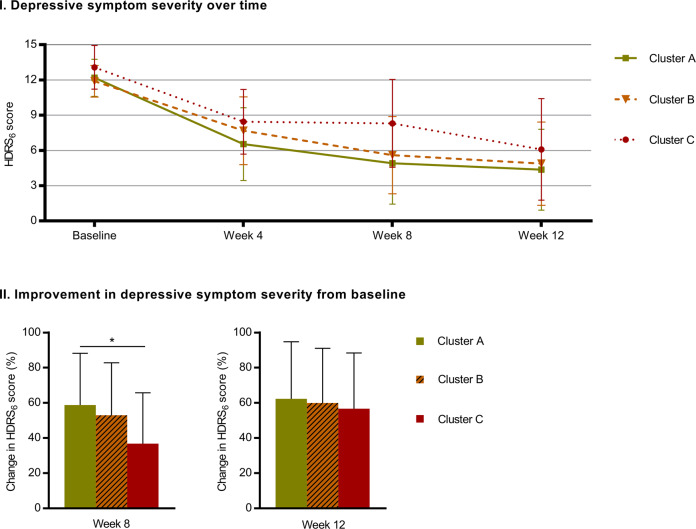
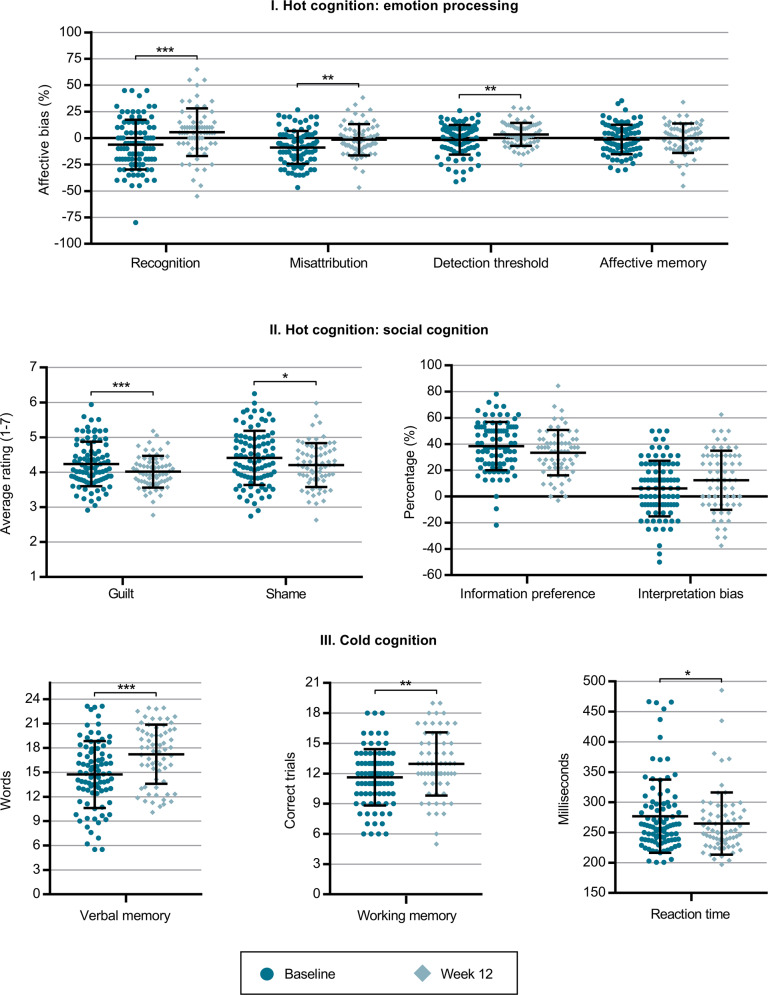
Cognitive disturbances in major depressive disorder (MDD) constitute a critical treatment target and hold promise as an early predictor of antidepressant treatment response; yet their clinical relevance is not fully established. Therefore, we here investigate if (1) cognitive performance improves over the course of antidepressant treatment and (2) cognitive performance at baseline is predictive of antidepressant treatment response. In the NeuroPharm study (clinical trial id: NCT02869035), 92 antidepressant-free patients with a moderate to severe depressive episode were assessed with a comprehensive cognitive test battery including both cold (emotion-independent) and hot (emotion-dependent) tasks. Patients were tested before and after 12 weeks of standard antidepressant treatment with escitalopram in flexible doses of 10–20 mg. Performance improved across most cognitive domains over the course of antidepressant treatment. Notably, these improvements were independent of improvement in mood symptoms, emphasizing that cognitive disturbances are a distinct symptom and therefore treatment target in MDD. Results did not suggest that performance on any single cognitive measure at baseline was associated with later clinical response to antidepressant treatment. However, a small cluster of patients (N = 28) with globally disturbed cognition at baseline exhibited poorer clinical response after 8 but not 12 weeks of antidepressant treatment, suggesting that severe cognitive disturbances may delay treatment response. Thus, while pretreatment cognitive performance on individual tests may not be useful as clinical markers of treatment response, profiles capturing performance across different cognitive domains may be useful for stratification of patients with MDD and could be helpful in future intervention trials.
Overview
The claims and statistics of this paper haven’t been checked yet.
Free: it reads the open-access text and checks the first 5 claims that cite a source we can check. Create a free account to check every claim.
Integrity signals
Registry
Cites
Statistics
Figures
Verification
Claims the paper makes
The claims and statistics of this paper haven’t been checked yet.
Free: it reads the open-access text and checks the first 5 claims that cite a source we can check. Create a free account to check every claim.
Claims other papers make about this one
Each is checked against this paper’s own text: does it say what the citing paper says it does?
In the citing paper
“symptoms of depression indicate global affection of the brain, with deficits related to, e.g., memory and executive function, that can improve independent of change in depression scores following SSRI treatment [32].”
From Effects of escitalopram on synaptic density in the healthy human brain: a randomized controlled trial (2023) · cites this paper as [32]
Self-check
Percentages, sums and reported differences re-computed from the paper’s own numbers.
The self-check needs the paper’s full text.
Citations
Cites
Rush, A. J., Trivedi, M. H., Wisniewski, S. R., Nierenberg, A. A., Stewart, J. W., Warden, D., Niederehe, G., Thase, M. E., Lavori, P. W., Lebowitz, B. D., et al. (2006) · American Journal of Psychiatry · doi:10.1176/ajp.2006.163.11.1905 · Cited by 5,643 · cited 1×
“Importantly, for every failed treatment attempt, chances of remission decrease [3] and clinicians, therefore, face an urgent need for new strategies to optimize antidepressant choices early in the course of the illness.”
BackgroundTrivedi, M. H., Rush, A. J., Wisniewski, S. R., Nierenberg, A. A., Warden, D., Ritz, L., Norquist, G., Howland, R. H., Lebowitz, B., McGrath, P. J., et al. (2006) · American Journal of Psychiatry · doi:10.1176/appi.ajp.163.1.28 · Cited by 3,879
Cognitive impairment in depression: a systematic review and meta-analysis
Rock, P. L., Roiser, J. P., Riedel, W. J., & Blackwell, A. D. (2014) · Psychological Medicine · doi:10.1017/s0033291713002535 · Cited by 2,161 · cited 1×
“Patients with MDD have consistently been shown to exhibit small to moderate deficits in cold cognitive functions such as processing speed, attention, memory, and executive functions [7].”
BackgroundGrand challenges in global mental health
Collins, P. Y., Patel, V., Joestl, S. S., March, D., Insel, T. R., Daar, A. S., Bordin, I. A., Costello, E. J., Durkin, M., Fairburn, C., et al. (2011) · Nature · doi:10.1038/475027a · Cited by 2,043 · cited 1×
“This requires the identification of biomarkers that can help stratify patients into clinically meaningful subgroups [4].”
BackgroundSelf-citationMcIntyre, R. S., Cha, D. S., Soczynska, J. K., Woldeyohannes, H. O., Gallaugher, L. A., Kudlow, P., Alsuwaidan, M., & Baskaran, A. (2013) · Depression and Anxiety · doi:10.1002/da.22063 · Cited by 765 · cited 1×
“Apart from their potential as biomarkers, cognitive disturbances also constitute a critical treatment target in MDD [12] as impaired cognition negatively impacts patients’ everyday functioning and contributes to work presenteeism and absenteeism [13, 14].”
BackgroundCleare, A., Pariante, C., Young, A., Anderson, I., Christmas, D., Cowen, P., Dickens, C., Ferrier, I., Geddes, J., Gilbody, S., et al. (2015) · Journal of Psychopharmacology · doi:10.1177/0269881115581093 · Cited by 759 · cited 1×
“This is important because current guidelines suggest that patients should be switched to a different antidepressant drug if adequate treatment response is not observed within 4–8 weeks [26].”
BackgroundCognitive function following a major depressive episode: a systematic review and meta-analysis
Semkovska, M., Quinlivan, L., O'Grady, T., Johnson, R., Collins, A., O'Connor, J., Knittle, H., Ahern, E., & Gload, T. (2019) · The Lancet Psychiatry · doi:10.1016/s2215-0366(19)30291-3 · Cited by 631 · cited 1×
“For example, a recent meta-analysis reported small to medium impairments in processing speed, learning and memory, attention, and executive functions in remitted patients compared to healthy individuals [18].”
BackgroundCognitive impairment in euthymic major depressive disorder: a meta-analysis
Bora, E., Harrison, B. J., Yücel, M., & Pantelis, C. (2013) · Psychological Medicine · doi:10.1017/s0033291712002085 · Cited by 551 · cited 1×
“, mood, energy, hedonia, and somatic) symptoms [17].”
Cognitive Mechanisms of Treatment in Depression
Roiser, J. P., Elliott, R., & Sahakian, B. J. (2012) · Neuropsychopharmacology · doi:10.1038/npp.2011.183 · Cited by 535 · cited 1×
“Over time, the changes in affective biases enable positive restructuring of dysfunctional cognitive processes, which ultimately leads to alleviation of mood symptoms [29].”
BackgroundSelf-citationMcIntyre, R. S., Lophaven, S., & Olsen, C. K. (2014) · The International Journal of Neuropsychopharmacology · doi:10.1017/s1461145714000546 · Cited by 433 · cited 1×
“This is supported by other large clinical studies which also found no or only partial overlap between treatment effects on cognition and core depressive symptoms [27, 28].”
ResultShilyansky, C., Williams, L. M., Gyurak, A., Harris, A., Usherwood, T., & Etkin, A. (2016) · The Lancet Psychiatry · doi:10.1016/s2215-0366(16)00012-2 · Cited by 249 · cited 1×
“This is supported by other large clinical studies which also found no or only partial overlap between treatment effects on cognition and core depressive symptoms [27, 28].”
ResultCognitive dysfunction in major depressive disorder
Knight, M. J., & Baune, B. T. (2018) · Current Opinion in Psychiatry · doi:10.1097/yco.0000000000000378 · Cited by 207 · cited 1×
“Apart from their potential as biomarkers, cognitive disturbances also constitute a critical treatment target in MDD [12] as impaired cognition negatively impacts patients’ everyday functioning and contributes to work presenteeism and absenteeism [13, 14].”
BackgroundPitsillou, E., Bresnehan, S. M., Kagarakis, E. A., Wijoyo, S. J., Liang, J., Hung, A., & Karagiannis, T. C. (2020) · Molecular Biology Reports · doi:10.1007/s11033-019-05129-3 · Cited by 206 · cited 1×
“Despite decades of effort, we still do not fully understand the etiology behind MDD and it has been suggested that the diagnosis describes several brain pathologies [1].”
BackgroundPrado, C. E., Watt, S., & Crowe, S. F. (2018) · Neuropsychology Review · doi:10.1007/s11065-018-9369-5 · Cited by 188 · cited 2×
“Antidepressants appear to have a modest positive effect on cold cognition in patients with MDD [15] and hot cognitive processes in both patients and healthy individuals [16].”
BackgroundResultHarmer, C. J., & Cowen, P. J. (2013) · Philosophical Transactions of the Royal Society B: Biological Sciences · doi:10.1098/rstb.2012.0407 · Cited by 183 · cited 2×
“Antidepressants appear to have a modest positive effect on cold cognition in patients with MDD [15] and hot cognitive processes in both patients and healthy individuals [16].”
BackgroundResultGodlewska, B. R., Browning, M., Norbury, R., Cowen, P. J., & Harmer, C. J. (2016) · Translational Psychiatry · doi:10.1038/tp.2016.130 · Cited by 181 · cited 1×
“In addition, the study design did not allow us to investigate early changes (1–2 weeks) in cognitive performance as a predictor of long-term clinical outcomes despite both theoretical [9] and recent empirical [30, 31] support for such an association.”
BackgroundEtkin, A., Patenaude, B., Song, Y. J. C., Usherwood, T., Rekshan, W. R., Schatzberg, A. F., Rush, A. J., & Williams, L. M. (2014) · Neuropsychopharmacology · doi:10.1038/npp.2014.333 · Cited by 144 · cited 2×
“Importantly, the study found that the impaired group had poorer clinical response after 8 weeks of antidepressant treatment and that treatment response could be predicted by baseline performance within the impaired group for patients who received treatment with escitalopram [10].”
BackgroundGoss, A. J., Kaser, M., Costafreda, S. G., Sahakian, B. J., & Fu, C. H. Y. (2013) · The Journal of Clinical Psychiatry · doi:10.4088/jcp.13r08560 · Cited by 133
Self-citationGodlewska, B. R., & Harmer, C. J. (2021) · Psychopharmacology · doi:10.1007/s00213-019-05448-0 · Cited by 123 · cited 4×
“For example, antidepressants have been shown to normalize brain networks associated with hot cognitive negative affective bias formation in MDD including prefrontal and limbic circuitries [9].”
BackgroundInfluentialA Systematic Review of Cognitive Predictors of Treatment Outcome in Major Depression
Groves, S. J., Douglas, K. M., & Porter, R. J. (2018) · Frontiers in Psychiatry · doi:10.3389/fpsyt.2018.00382 · Cited by 105 · cited 3×
“In recent years, cognitive functions have been highlighted as a promising candidate for monitoring and even predicting treatment response to antidepressant drugs [5, 6].”
BackgroundCognition as a treatment target in depression
Kaser, M., Zaman, R., & Sahakian, B. J. (2017) · Psychological Medicine · doi:10.1017/s0033291716003123 · Cited by 96 · cited 1×
“Apart from their potential as biomarkers, cognitive disturbances also constitute a critical treatment target in MDD [12] as impaired cognition negatively impacts patients’ everyday functioning and contributes to work presenteeism and absenteeism [13, 14].”
BackgroundSelf-citationBrowning, M., Kingslake, J., Dourish, C. T., Goodwin, G. M., Harmer, C. J., & Dawson, G. R. (2019) · European Neuropsychopharmacology · doi:10.1016/j.euroneuro.2018.11.1102 · Cited by 83 · cited 1×
“Meanwhile, early changes in emotion processing after administration of antidepressant drugs have shown promise as a tool for guiding clinical decision-making in MDD treatment [11].”
MethodKöhler‐Forsberg, K., Jorgensen, A., Dam, V. H., Stenbæk, D. S., Fisher, P. M., Ip, C.-T., Ganz, M., Poulsen, H. E., Giraldi, A. G. E., Ozenne, B., et al. (2020) · Frontiers in Psychiatry · doi:10.3389/fpsyt.2020.00641 · Cited by 72
Self-citation‘Hot’ Cognition in Major Depressive Disorder: A Systematic Review
Miskowiak, K., & Carvalho, A. (2015) · CNS & Neurological Disorders - Drug Targets · doi:10.2174/1871527313666141130205713 · Cited by 67 · cited 2×
“Disturbances in hot cognitive functions including negative affective biases in emotion recognition and disrupted mentalization are also closely associated with depressive psychopathology [8] and have been posited to play a key role in antidepressant drug actions [9].”
BackgroundØstergaard, S. D., Bech, P., & Miskowiak, K. W. (2016) · Journal of Affective Disorders · doi:10.1016/j.jad.2014.10.047 · Cited by 55
Predicting antidepressant response using early changes in cognition: A systematic review
Park, C., Pan, Z., Brietzke, E. M., Subramaniapillai, M., Rosenblat, J. D., Zuckerman, H., Lee, Y. L., Fus, D., & McIntyre, R. S. (2018) · Behavioural Brain Research · doi:10.1016/j.bbr.2018.07.011 · Cited by 47 · cited 1×
“In recent years, cognitive functions have been highlighted as a promising candidate for monitoring and even predicting treatment response to antidepressant drugs [5, 6].”
BackgroundDunlop, B. W., Parikh, S. V., Rothschild, A. J., Thase, M. E., DeBattista, C., Conway, C. R., Forester, B. P., Mondimore, F. M., Shelton, R. C., Macaluso, M., et al. (2019) · BMC Psychiatry · doi:10.1186/s12888-019-2410-2 · Cited by 43 · cited 1×
“Although HDRS17 scores are more widely reported in the literature, we choose the HDRS6 as it specifically captures core depressive symptoms and has been shown to be more sensitive to antidepressant treatment response [21, 22].”
BackgroundDam, V. H., Stenbæk, D. S., Köhler‐Forsberg, K., Ip, C.-T., Ozenne, B., Sahakian, B. J., Knudsen, G. M., Jørgensen, M. B., & Frøkjær, V. G. (2020) · Psychological Medicine · doi:10.1017/s0033291720000938 · Cited by 38 · cited 6×
“This is perhaps not surprising, as we did not observe any disturbances on these task outcomes when we compared the same cohort of MDD patients with healthy controls at baseline [19], suggesting that they may not be sensitive and/or relevant to MDD pathology.”
BackgroundMethodResultSelf-citationPsychometric Properties and Validation of the EMOTICOM Test Battery in a Healthy Danish Population
Dam, V. H., Thystrup, C. K., Jensen, P. S., Bland, A. R., Mortensen, E. L., Elliott, R., Sahakian, B. J., Knudsen, G. M., Frøkjær, V. G., & Stenbæk, D. S. (2019) · Frontiers in Psychology · doi:10.3389/fpsyg.2019.02660 · Cited by 20 · cited 3×
“The social cognition domain included ratings of guilt and shame from the Moral Emotions task and social information preference and social interpretation bias from the Social Information Preference task [23].”
BackgroundMethodSelf-citationHjordt, L. V., Ozenne, B., Armand, S., Dam, V. H., Jensen, C. G., Köhler‐Forsberg, K., Knudsen, G. M., & Stenbæk, D. S. (2020) · Frontiers in Psychology · doi:10.3389/fpsyg.2020.00961 · Cited by 14 · cited 2×
“Lastly, the cold cognitive domain included verbal memory assessed with the VAMT-26; working memory assessed with the Letter Number Sequence task; and reaction time assessed with a Simple Reaction Time task.”
MethodSelf-citationAng, Y.-S., Bruder, G. E., Keilp, J. G., Rutherford, A., Alschuler, D. M., Pechtel, P., Webb, C. A., Carmody, T., Fava, M., Cusin, C., et al. (2022) · Psychological Medicine · doi:10.1017/s0033291720004286 · Cited by 12 · cited 1×
“In addition, the study design did not allow us to investigate early changes (1–2 weeks) in cognitive performance as a predictor of long-term clinical outcomes despite both theoretical [9] and recent empirical [30, 31] support for such an association.”
Background
Research works printed but not linked: 1
- Holm S A simple sequentially rejective multiple test procedure Scand J Stat 1979 6 65 70
Cited by
Johansen, A., Armand, S., Plavén-Sigray, P., Nasser, A., Ozenne, B., Petersen, I. N., Keller, S. H., Madsen, J., Beliveau, V., Møller, K., et al. (2023) · Molecular Psychiatry · doi:10.1038/s41380-023-02285-8 · Cited by 53
Self-citationEscitalopram increases synaptic density in the human brain over weeks: A randomized controlled trial
(2023) · doi:10.21203/rs.3.rs-2989150/v1 · Cited by 53
Ahern, E., White, J., & Slattery, E. J. (2024) · Neuropsychology Review · doi:10.1007/s11065-023-09629-9 · Cited by 51
“…et al., 2020; Annette et al., 2020; Bastos et al., 2013; Biringer et al., 2007; Boeker et al., 2012; Borkowska et al., 2007; Cokmus et al., 2021; Dam et al., 2022; Dannehl et al., 2019; Gallagher et al., 2007; Greer et al., 2014, 2015; Groves et al., 2015; Gudayol-Ferré et al., 2015; Halappa et…”
Chen, C., Zhai, R., Lan, X., Yang, S., Tang, S., Xiong, X., He, Y., Lin, J., Feng, J., Chen, D., et al. (2024) · Ibrain · doi:10.1002/ibra.12167 · Cited by 16
“162 However, a systematic review suggests mixed outcomes, with some studies indicating no significant cognitive effects or even potential memory function harm.”
BackgroundJensen, K. H. R., Dam, V. H., Ganz, M., Fisher, P. M., Ip, C.-T., Sankar, A., Marstrand-Joergensen, M. R., Ozenne, B., Osler, M., Penninx, B. W. J. H., et al. (2023) · BMC Psychiatry · doi:10.1186/s12888-023-04618-x · Cited by 19
“Recently, researchers have begun to explore the potential of cognitive markers to inform clinical decision-making in the treatment of depression [94] and as a specific treatment target [95].”
BackgroundSelf-citation
Metadata
- Authors
- Dam, V. H., Stenbæk, D. S., Köhler-Forsberg, K., Ip, C., Ozenne, B., Sahakian, B. J., Knudsen, G. M., Jørgensen, M. B., & Frokjaer, V. G.
- Affiliations
- University of Copenhagen (DK)
- University of Cambridge (GB)
- Corresponding author
- Dam, Vibeke Høyrup
- ORCID
- Venue
- Translational Psychiatry
- Published
- 2022-11-08
- Volume
- 12
- Issue
- 1
- Pages
- 468-468
- ISSN
- 2158-3188 (ISSN-L)
- PMC
- PMC9643376
- OpenAlex
- W4308525203
- Cited by
- 27
- References
- 31
- Citations by year
- 2026: 5 · 2025: 6 · 2024: 7 · 2023: 9
- FWCI
- 4.64
- Type
- journal article
- Language
- en
- Open access
- gold
- doi.org
- Licence
- cc-by
- creativecommons.org/licenses/by/4.0 (tdm)
- creativecommons.org/licenses/by/4.0 (vor)
- Locations
- Translational Psychiatry (publishedVersion, cc-by)
- PubMed Central (publishedVersion, cc-by)
- PubMed (publishedVersion)
- Research at the University of Copenhagen (University of Copenhagen) (publishedVersion, cc-by)
- DOAJ (DOAJ: Directory of Open Access Journals) (submittedVersion, cc-by-sa)
- Apollo (University of Cambridge) (submittedVersion, cc-by)
- Apollo
- Apollo (cc-by)
- Funders
- Augustinus Fonden (16-0058)
- Innovationsfonden (4108-00004B)
- Topics
- Health Sciences › Medicine › Pharmacology (medical) › Treatment of Major Depression
- Social Sciences › Psychology › Experimental and Cognitive Psychology › Anxiety, Depression, Psychometrics, Treatment, Cognitive Processes
- Life Sciences › Neuroscience › Cognitive Neuroscience › Neural and Behavioral Psychology Studies
- Keywords
- major depressive disorder, cognitive disorders, antidepressant response, treatment response prediction, escitalopram, cognitive performance, patient stratification
- MeSH terms
- Antidepressive Agents, Cognition, Depressive Disorder, Major, Major Depressive Disorder, Humans, Neuropsychological Tests, Cognitive Dysfunction
About these checks
Registry, retraction, Cites and statistics results are computed, not judged, with one exception: a printed reference that no index lists is read once by a model before it counts as a citation error. Claims are extracted by a model and kept only when their quote appears verbatim in the text; each cited source is then checked, with a model’s help, for whether it says what the claim relies on. Those verdicts can be wrong — read the claim’s quote and the cited source before relying on one.
Statistics and arithmetic are recomputed, not judged.
Confidence bands are shown only for fields calibrated on our annotated test set. None is calibrated yet, so no band is shown.
What counts as a claim ›How we measure confidence ›How we check this ›
Are you an author, or do you see a problem with this page? Request a review
Data sources
Bibliographic data: Semantic Scholar, OpenAlex, Crossref.
Contains information from the Semantic Scholar Academic Graph Datasets, made available under the ODC Attribution License (ODC-BY 1.0).
Semantic Scholar’s data is described in: Kinney, R., et al. (2023). The Semantic Scholar Open Data Platform. arXiv:2301.10140.
