

From movement to motivation: a proposed framework to understand the antidepressant effect of exercise
Open accessThe DOI matches its Crossref record; 213 of the 213 references it cites were found in a registry or an index.
Abstract
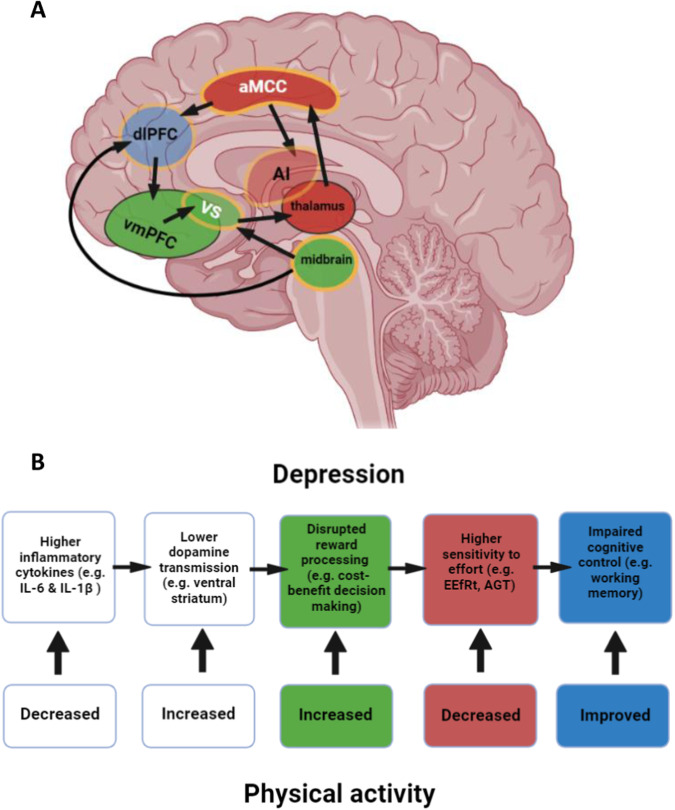
Depression is the leading cause of disability worldwide, exerting a profound negative impact on quality of life in those who experience it. Depression is associated with disruptions to several closely related neural and cognitive processes, including dopamine transmission, fronto-striatal brain activity and connectivity, reward processing and motivation. Physical activity, especially aerobic exercise, reduces depressive symptoms, but the mechanisms driving its antidepressant effects are poorly understood. Here we propose a novel hypothesis for understanding the antidepressant effects of exercise, centred on motivation, across different levels of explanation. There is robust evidence that aerobic exercise decreases systemic inflammation. Inflammation is known to reduce dopamine transmission, which in turn is strongly implicated in effort-based decision making for reward. Drawing on a broad range of research in humans and animals, we propose that by reducing inflammation and boosting dopamine transmission, with consequent effects on effort-based decision making for reward, exercise initially specifically improves ‘interest-activity’ symptoms of depression—namely anhedonia, fatigue and subjective cognitive impairment - by increasing propensity to exert effort. Extending this framework to the topic of cognitive control, we explain how cognitive impairment in depression may also be conceptualised through an effort-based decision-making framework, which may help to explain the impact of exercise on cognitive impairment. Understanding the mechanisms underlying the antidepressant effects of exercise could inform the development of novel intervention strategies, in particular personalised interventions and boost social prescribing.
Overview
The claims and statistics of this paper haven’t been checked yet.
Free: it reads the open-access text and checks the first 5 claims that cite a source we can check. Create a free account to check every claim.
Integrity signals
Registry
Cites
Statistics
Figures
Verification
Claims the paper makes
The claims and statistics of this paper haven’t been checked yet.
Free: it reads the open-access text and checks the first 5 claims that cite a source we can check. Create a free account to check every claim.
Claims other papers make about this one
Each is checked against this paper’s own text: does it say what the citing paper says it does?
In the citing paper
“The mechanism of the antidepressant effect of exercise is not precisely known, and is likely multi-factorial, with alterations in neurotransmitters, inflammatory cytokines, neuroendocrine pathways, dopamine processing, oxidative stress, neuroplasticity, reward processing, body image, self-efficacy, functional independence, and many other pathways likely operative [455]”
From Global consensus on optimal exercise recommendations for enhancing healthy longevity in older adults (ICFSR) (2025) · cites this paper as [455]
Self-check
Percentages, sums and reported differences re-computed from the paper’s own numbers.
The self-check needs the paper’s full text.
Citations
Cites
Trivedi, M. H., Rush, A. J., Wisniewski, S. R., Nierenberg, A. A., Warden, D., Ritz, L., Norquist, G., Howland, R. H., Lebowitz, B., McGrath, P. J., et al. (2006) · American Journal of Psychiatry · doi:10.1176/appi.ajp.163.1.28 · Cited by 3,879
Fitness Effects on the Cognitive Function of Older Adults: A Meta-Analytic Study
Colcombe, S., & Kramer, A. F. (2003) · Psychological Science · doi:10.1111/1467-9280.t01-1-01430 · Cited by 3,782
The reward circuit: linking primate anatomy and human imaging
Haber, S. N., & Knutson, B. (2010) · Neuropsychopharmacology · doi:10.1038/npp.2009.129 · Cited by 3,718 · cited 1×
“Anhedonia is associated with disruption to both dopamine function [53, 54] and striatal activation [52], consistent with preclinical studies implicating the mesolimbic dopamine system in motivational dysfunction [55, 56].”
ResultMacrophages, inflammation, and insulin resistance
Olefsky, J. M., & Glass, C. K. (2010) · Annual Review of Physiology · doi:10.1146/annurev-physiol-021909-135846 · Cited by 2,733
Cognition and Depression: Current Status and Future Directions
Gotlib, I. H., & Joormann, J. (2010) · Annual Review of Clinical Psychology · doi:10.1146/annurev.clinpsy.121208.131305 · Cited by 2,420
The expected value of control: an integrative theory of anterior cingulate cortex function
Shenhav, A., Botvinick, M. M., & Cohen, J. D. (2013) · Neuron · doi:10.1016/j.neuron.2013.07.007 · Cited by 2,321 · cited 1×
“The expected value of control (EVC) theory proposes that cognitive control is modulated by a decision-making process weighing up the potential gain of control against its cost [99].”
BackgroundInflammatory mechanisms linking obesity and metabolic disease
Saltiel, A. R., & Olefsky, J. M. (2017) · Journal of Clinical Investigation · doi:10.1172/jci92035 · Cited by 2,212
Cognitive impairment in depression: a systematic review and meta-analysis
Rock, P. L., Roiser, J. P., Riedel, W. J., & Blackwell, A. D. (2014) · Psychological Medicine · doi:10.1017/s0033291713002535 · Cited by 2,161 · cited 2×
“Poorer performance on tests of cognitive control in depression is accompanied by other cognitive impairments, including on selective attention and memory tasks, which are not resolved by standard antidepressant treatment [79].”
Self-citationThe Bidirectional Relationship of Depression and Inflammation: Double Trouble
Beurel, E., Toups, M., & Nemeroff, C. B. (2020) · Neuron · doi:10.1016/j.neuron.2020.06.002 · Cited by 2,136
Cooney, G. M., Dwan, K., Greig, C. A., Lawlor, D. A., Rimer, J., Waugh, F. R., McMurdo, M., & Mead, G. E. (2013) · Cochrane Database of Systematic Reviews · doi:10.1002/14651858.cd004366.pub6 · Cited by 1,834
Research works printed but not linked: 2
- American Psychiatric Association. Multiaxial assessment.DSM-IV-TR: diagnostic and statistical manual of mental disorders. 2002 Washington, DC American Psychiatric Association
- Rock PL Roiser JP Riedel WJ Blackwell AD Cognitive impairment in depression: a systematic review and meta-analysis Psychol Med 2014 44 2029 40 10.1017/S0033291713002535 24168753 · DOI · Paper page
Cited by
Izquierdo, M., de Souto Barreto, P., Arai, H., Bischoff-Ferrari, H. A., Cadore, E. L., Cesari, M., Chen, L.-K., Coen, P. M., Courneya, K. S., Duque, G., et al. (2025) · The Journal of nutrition, health and aging · doi:10.1016/j.jnha.2024.100401 · Cited by 273
Immuno-metabolic depression: from concept to implementation
Penninx, B. W. J. H., Lamers, F., Jansen, R., Berk, M., Khandaker, G. M., Picker, L. D., & Milaneschi, Y. (2024) · The Lancet Regional Health - Europe · doi:10.1016/j.lanepe.2024.101166 · Cited by 171
“91 In the TREAD study investigating effects of an exercise intervention, higher TNF-a levels were associated with larger reductions in depressive symptoms.”
Gerber, M., Cheval, B., Cody, R., Colledge, F., Hohberg, V., Klimentidis, Y. C., Lang, C., Looser, V. N., Ludyga, S., Stults‐Kolehmainen, M., et al. (2025) · Physiological Reviews · doi:10.1152/physrev.00021.2024 · Cited by 73
Ye, M., Song, T., Xia, H., Hou, Y., & Chen, A. (2024) · International Journal of Nursing Studies · doi:10.1016/j.ijnurstu.2024.104912 · Cited by 54
From energy metabolism to mood regulation: The rise of lactate as a therapeutic target
Zhang, S., Xia, J., He, W., Zou, Y., Liu, W., Li, L., Huang, Z., Li, Q., Li, Q. X., & Liu, W. (2025) · Journal of Advanced Research · doi:10.1016/j.jare.2025.04.018 · Cited by 32
An interoceptive model of energy allostasis linking metabolic and mental health
Mehrhof, S. Z., Fleming, H. A., & Nord, C. L. (2025) · Science Advances · doi:10.1126/sciadv.ady4356 · Cited by 25
“A recent large cohort study ( N = 672,823) found that psychiatric conditions in early adulthood increased later cardiometabolic risk ( 114 ).”
Stress, coping profiles, and depression among nurses: a latent profile and mediation analysis
Lin, P., Yang, L., Su, J., & Xue, J.-M. (2024) · BMC Nursing · doi:10.1186/s12912-024-02565-w · Cited by 13
Xiao, Y., Shi, C., Zhang, X., & Liu, H. (2025) · BMC Public Health · doi:10.1186/s12889-025-22904-z · Cited by 19
“This mechanism is supported by recent research from Hird et al., who found that excessive high-intensity exercise can disrupt glucocorticoid receptor sensitivity and HPA axis function in ways that may exacerbate rather than ameliorate depressive symptoms [62].”
Umbrella review of nonpharmacological interventions for intrinsic capacity in older adults
Lo, Y., Su, H., Chuenchomnoy, C., Liao, T.-W., Wu, Y., Tam, S.-H., Liu, C.-H., Chou, C.-W., Yang, Y., Chen, Y., et al. (2025) · Ageing Research Reviews · doi:10.1016/j.arr.2025.102742 · Cited by 11
Integrating Physical Activity Into Routine Psychiatric Care: A Review
Stubbs, B., Ma, R., Teychenne, M. J., Kinnafick, F., Mossaheb, N., Korman, N., Trott, M., Rosenbaum, S., Schuch, F. B., Firth, J., et al. (2026) · JAMA Psychiatry · doi:10.1001/jamapsychiatry.2026.0026 · Cited by 12
Soini, E., Rosenström, T. H., Määttänen, I., & Jokela, M. M. (2024) · American Journal of Geriatric Psychiatry · doi:10.1016/j.jagp.2024.08.020 · Cited by 8
Yadav, N., Singh, K., Singh, A., Kumar, P., & Kaushik, M. (2026) · Journal of Drug Delivery Science and Technology · doi:10.1016/j.jddst.2026.108151 · Cited by 8
Chen, H., Lu, T., Sui, H., Tao, B., Chen, H., & Yan, J. (2025) · Scientific Reports · doi:10.1038/s41598-025-00947-x · Cited by 13
“Elderly people with high levels of depressive symptoms tend to lack interest and motivation to engage in everyday activities 41 , which can lead to a decrease in self-confidence, a build-up of negative emotions, and difficulties in maintaining social interactions with others, which in turn…”
Beltrán, J., Jacob, Y., Mehta, M., Hossain, M. T., Adams, A., Fontaine, S., Torous, J. B., McDonough, C., Johnson, M., Delgado, A. D., et al. (2024) · medRxiv · doi:10.1101/2024.08.06.24311477 · Cited by 10
Digital measures of activity and motivation impact depression and anxiety in the real world
Beltrán, J., Jacob, Y., Mehta, M., Hossain, T., Adams, A., Fontaine, S., Torous, J. B., McDonough, C., Johnson, M., Delgado, A. D., et al. (2025) · npj Digital Medicine · doi:10.1038/s41746-025-01669-0 · Cited by 11
“Previous work demonstrates a link between higher physical activity and lower mood and anxiety symptoms 68,69,73 .”
Park, J.-H., Kong, S., Lim, Y., Oh, Y. H., Chawanid, P., Gökbulut, B., Kim, J.-W., Park, S. J., Kim, H. J., Cheon, S., et al. (2026) · Scientific Reports · doi:10.1038/s41598-026-41932-2 · Cited by 10
Foscue, E. P., Trinko, R., Jiménez, J. L., Kong, E., Thompson, S. L., Stankewich, K., Corstens, A. M., Serlie, M. J. M., Taylor, J. R., & Dileone, R. (2025) · bioRxiv (Cold Spring Harbor Laboratory) · doi:10.1101/2025.10.08.681212 · Cited by 7
Goñi, V. D., López-Gil, J. F., Rodríguez‐Gutiérrez, E., Visier‐Alfonso, M. E., Jiménez‐López, E., Sequí‐Domínguez, I., Ortega, F. B., Castro‐Piñero, J., Mesas, A. E., Sánchez-López, M., et al. (2026) · Nature Mental Health · doi:10.1038/s44220-026-00599-4 · Cited by 5
Zhang, J., Liu, Y., & Zhao, K. (2026) · Behavioural Brain Research · doi:10.1016/j.bbr.2026.116268 · Cited by 6
Guo, H., Man, M., Hu, Z., Liu, Y., Chen, W., Wang, S., Tang, X., Geng, A., Ruan, W., Xu, W., et al. (2026) · Frontiers in Public Health · doi:10.3389/fpubh.2026.1782512 · Cited by 6
Abubakar, S. R., Sri Yuliani, M., & Ashar, D. S. (2024) · Lentera Pendidikan Jurnal Ilmu Tarbiyah dan Keguruan · doi:10.24252/lp.2024v27n2i10 · Cited by 4
Hlynsson, J. I., Kristjánsson, T., Andersson, G., & Carlbring, P. (2025) · Frontiers in Psychology · doi:10.3389/fpsyg.2025.1568141 · Cited by 5
Aedo, S., Blümel, J. E., Vallejo, M. S., Rey, C., Rodrigues, M. A., Rodríguez-Vidal, D., Salinas, C., Tserotas, K., Calle, A., Dextre, M., et al. (2025) · Menopause The Journal of The North American Menopause Society · doi:10.1097/gme.0000000000002620 · Cited by 3
de Oca, M. P.-M., Jaimes-Hoy, L., Garduño, K., García-Herrera, R., Charli, J., & Joseph‐Bravo, P. (2025) · International Journal of Molecular Sciences · doi:10.3390/ijms26199425 · Cited by 4
“Regular physical exercise improves metabolism and alleviates stress-related pathologies, such as depression, contributing to disease prevention or mitigation [7,8].”
Niemeyer, H., Opper, F., Sjöström, L. M., Knaevelsrud, C., & Nohr, L. (2025) · European Journal of Psychotraumatology · doi:10.1080/20008066.2025.2589025 · Cited by 3
Fleming, H. A., Stasiak, M. K., Lau, I. H. W., Whines, A., Mehrhof, S. Z., & Nord, C. L. (2025) · Biological Psychiatry Global Open Science · doi:10.1016/j.bpsgos.2025.100645 · Cited by 6
Werneck, A. O., Tian, X., Lu, W., Li, D., Liu, T., Wu, S., Li, X., Wang, R., Gao, Y., Li, X., et al. (2025) · Journal of Psychiatric Research · doi:10.1016/j.jpsychires.2025.12.025 · Cited by 5
Zhang, L., Wang, J., Dong, X., Sakakibara, S., Guitart‐Masip, M., Yang, W., Liu, X., Wang, C., Wang, Z., Welmer, A., et al. (2026) · Journal of Affective Disorders · doi:10.1016/j.jad.2026.121214 · Cited by 3
Zhang, J., Li, Y., Cai, M., Xiao, J., Liu, Y., Wu, B., Qianrige, Ma, Z., Xiang, H., Feng, X., et al. (2026) · Foods · doi:10.3390/foods15040636 · Cited by 3
Anhedonia in patients with major depressive disorder (MDD): State-of-the-art consensus review
Cutler, A. J., Clayton, A. H., Krystal, A. D., Maletic, V., McIntyre, R. S., & Nemeroff, C. B. (2026) · Psychiatry Research · doi:10.1016/j.psychres.2026.117225 · Cited by 4
Badea, A., Mahzarnia, A., Reddy, D., Dong, Z., Anderson, R. J., Moon, H. S., Stout, J. A., Williams, J., Hirschler, L., Barbier, E., et al. (2025) · Magnetic Resonance Imaging · doi:10.1016/j.mri.2025.110406 · Cited by 5
Nishiyama, R., Hashizume, H., Minamide, A., Murata, S., Yoshida, M., & Yamada, H. (2026) · Clinical Rehabilitation · doi:10.1177/02692155251414025 · Cited by 2
“…the role of regular physical activity in mood stabilization, in line with previous evidence of exercise-related neuropsychological bene fi ts. 14,37 Home-based video-guided exercise programmes represent a practical and scalable approach to post-operative rehabilitation, particularly for older…”
Cardiorespiratory fitness, grip strength and depression symptoms: A Mendelian Randomization study
Vincent, J., Pereira, S. M. P., Maddock, J., Williams, D. M., Hamer, M., Roiser, J. P., & Taylor, A. E. (2026) · Journal of Affective Disorders · doi:10.1016/j.jad.2026.121437 · Cited by 3
Self-citationRen, F.-F., Chen, F., Zhou, W.-S., Guo, Y.-F., Dou, R.-R., Lin, Y.-X., Pan, X.-F., Wu, Y., Brazaitis, M., Liang, W.-M., et al. (2026) · Psychiatry Research · doi:10.1016/j.psychres.2026.117023 · Cited by 2
Khalil, M. H., & Steemers, K. (2026) · Buildings · doi:10.3390/buildings16101950 · Cited by 2
Raslescu, A., Guru, A., Delattre, B., Park, J., Harmer, C. J., & Murphy, S. E. (2024) · Mental Health Science · doi:10.1002/mhs2.57 · Cited by 2
Sato, M., Chatham, S. A., Aguiar, E. J., Fedewa, M. V., MacDonald, H. V., Richardson, M. T., Wingo, J. E., & Crombie, K. M. (2025) · European Journal of Psychotraumatology · doi:10.1080/20008066.2025.2492934 · Cited by 2
“For example, anhedonia is associated with impaired motivation and reward processing, and a lower propensity to exert effort in pursuit of reward (Halahakoon et al., 2020; Hird et al., 2024; Treadway, 2023; Treadway et al., 2012; Yang et al., 2014).”
Alostasis y los tres esenciales para el cuidado de la salud: Articulo de reflexión
González-Santamaría, J., & García, C. J. L. (2025) · Revista Médica de Risaralda · doi:10.22517/25395203.25824 · Cited by 1
Study on Physical Health and Exercise Prescription Intervention for College Students
Huang, W. (2026) · International Journal of Healthcare Information Systems and Informatics · doi:10.4018/ijhisi.400900 · Cited by 1
Poostchi, A. J., Collett, G., & Gupta, A. K. (2026) · European Journal of Preventive Cardiology · doi:10.1093/eurjpc/zwag144 · Cited by 1
Molecules of mood: the integrated molecular transducers of exercise’s antidepressant effects
Yuan, D. (2026) · Molecular Genetics and Genomics · doi:10.1007/s00438-026-02404-4 · Cited by 1
Wan, Y., Li, N., Zhuang, S., Gu, Y., Shen, L., & Ye, J. (2026) · Risk Management and Healthcare Policy · doi:10.2147/rmhp.s597629 · Cited by 1
“38 Family support and regular exercise may work together to help maintain social engagement among prostate cancer patients.”
The Impact of Running on Mental Health - A Literature Review
Łopińska, J., Strużyńska, E., Majchrzycka, M., Graczyk, M., Majchrzak, M., Czapla, N., Graczyk, N., Ziółkowska, W., Wisoky, W., & Ignyś, P. K. (2026) · Quality in Sport · doi:10.12775/qs.2026.54.70473 · Cited by 1
Wang, Y. C., & Xia, Q. (2026) · Frontiers in Psychology · doi:10.3389/fpsyg.2026.1806116 · Cited by 1
“Despite extensive evidence linking physical activity to improved mood and reduced depressive symptoms, the underlying psychological mechanisms remain insufficiently understood (Hird et al., 2024).”
Ma, W., Hou, W., Zhai, J., Yang, H., Zhang, B., & Luo, L. (2026) · Frontiers in Nutrition · doi:10.3389/fnut.2026.1832858 · Cited by 1
“During the reward processing stage, the available evidence suggests that regular moderate-intensity aerobic exercise may be a promising direction for future EUE-focused intervention studies, rather than an established intervention prescription (91).”
Zheng, Z., Xu, W., Shen, J., Yu, W., & Xu, W. (2026) · Frontiers in Psychology · doi:10.3389/fpsyg.2026.1838963 · Cited by 1
“Hird et al. (2024) suggested that exercise may be related to biological processes involving inflammation, reward systems, dopamine, and serotonergic function, whereas Chang (2025) emphasized the roles of self-efficacy and social support in the association between physical activity and depressive…”
Xia, F., Mao, S., Wang, J., Chen, B., Li, Y., & Zheng, M. (2026) · Frontiers in Psychology · doi:10.3389/fpsyg.2026.1817598 · Cited by 1
“Blinding participants to exercise allocation is practically unachiev-able given the nature of physical activity intervention (Hird et al., 2024).”
InfluentialWhy motivation fluctuates: A physiological perspective on drive and energy
Gupta, D. K., & Chaudhuri, A. (2026) · Industrial Psychiatry Journal · doi:10.4103/ipj.ipj_8_26 · Cited by 1
Chen, L., Wei, P.-J., Zuo, H.-J., Zhang, D.-Y., Lou, H., Yu, S.-H., & Li, B. (2026) · BMC Public Health · doi:10.1186/s12889-026-28549-w · Cited by 1
“A possible explanation is that depressive symptoms may be linked to lower motivation, reduced energy, or lower behavioral engagement, which may in turn be associated with reduced PA [65].”
Kong, J. (2026) · Exploration of neuroscience · doi:10.37349/en.2026.1006142 · Cited by 1
Cox, C. M. M., Værbak, N., & Parsons, C. E. (2026) · Clinical Psychological Science · doi:10.1177/21677026261459934 · Cited by 1
Halabitska, I., Kamyshna, I. I., Buchynskyi, M., Petakh, P., & Kamyshnyi, O. (2026) · Frontiers in Rehabilitation Sciences · doi:10.3389/fresc.2026.1891994 · Cited by 1
“Depressive symptoms can additionally reduce the level of motivation and the ability to engage in long-term repetitive training, which is key to consolidating motor skills (69 – 72).”
Взаимосвязь депрессии, ожирения и воспаления. Роль физических упражнений в их коррекции
Avdeeva, K. S., Kicherova, O. A., Петелина, Т. И., Gorbachevskii, A. V., & Guskova, O. A. (2025) · Психиатрия психотерапия и клиническая психология · doi:10.34883/pi.2025.16.2.011 · Cited by 5
Sex-Specific Effects of Exercise on Motor Coordination and Extended Basal Ganglia PhysiologyPreprint
Lewitus, V. J., Russ, L. A., Scott, C. B., Kruszewski, O. M., Shautidze, G., Colon, Z. A., Zhang, S. Q., Walker, J. A., Fernandez, A. B., Croom, M. R., et al. (2026) · SSRN Electronic Journal · doi:10.2139/ssrn.6690544 · Cited by 1
张, 雨. (2025) · Advances in Clinical Medicine · doi:10.12677/acm.2025.152568
Lee, C.-M. J., Nguyen, J., Pope, B., Imami, A. S., Ryan, V. W. G., Sahay, S., Mathis, V., Pulvender, P., Eby, H., Arvay, T. O., et al. (2025) · PLoS ONE · doi:10.1371/journal.pone.0321596 · Cited by 1
“This finding aligns with prior studies demonstrating that exercise modulates dopamine pathways, thereby influencing motor activity and motivational states [45–47].”
Krell‐Roesch, J., Syrjanen, J. A., Kremers, W. K., Barisch‐Fritz, B., Krafft, J., Johnson, D., Fields, J. A., Petersen, R. C., Wöll, A., Vassilaki, M. E., et al. (2025) · Journal of Neuropsychiatry · doi:10.1176/appi.neuropsych.20240255 · Cited by 1
Tous‐Espelosin, M., Etxaniz‐Oses, J., & Maldonado‐Martín, S. (2025) · IkerGazte Nazioarteko ikerketa euskaraz · doi:10.26876/ikergazte.vi.04.09
“Hala ere, hazten ari diren ebidentziek iradokitzen dute bai ariketa fisikoa egiteak baita depresioaren aurkako medikazioak depresioa arindu dezaketela antzeko neuromolekularraren bidez (Garza et al. , 2004; Hird et al. , 2024).”
The Relationship between Thyroid Dysfunction and Bipolar Disorder
Skryabin, V. Y., Sokolova, S. I., & Petrovskiy, V. P. (2025) · Psikhiatriya · doi:10.30629/2618-6667-2025-23-3-97-110
Tous‐Espelosin, M., Pavón, C., Etxaniz‐Oses, J., Cañas-García, M. T., Maldonado‐Martín, S., Orruño-Vivar, J., Corres, P., & Iriarte‐Yoller, N. (2025) · PeerJ · doi:10.7717/peerj.20356 · Cited by 2
Mehrhof, S. Z. (2024) · Apollo (University of Cambridge) · doi:10.17863/cam.117708
Multimodal neuroimaging in adverse childhood experiences and related PTSD
Nkrumah, R. O. (2025) · heiDOK (Heidelberg University) · doi:10.11588/heidok.00037665
Physical activity level, depression and anxiety of physical education student
Sousa, I. G. D., Sobreira, S., & Pedretti, A. (2025) · Revista Andaluza de Medicina del Deporte · doi:10.33155/ramd.v18i1.1222
Zhong, X., Ren, Y., Liu, C., & Cao, N. (2026) · Scientific Reports · doi:10.1038/s41598-025-33659-3
“The increased functionality of this system is posited to be a direct contributor to the positive mood states following activity 40 .”
Zhang, Y., Chen, Y., Wu, K., & Huang, Z. (2026) · Journal of the Renin-Angiotensin-Aldosterone System · doi:10.1177/14703203251412728
Nemati, D., Sommer, A. J., Zhao, S., Williams, A., Hauben, J., Luthy, J., OMAR, M., Lartey, K., Brengartner, A., Ojembe, N., et al. (2026) · Medicine & Science in Sports & Exercise · doi:10.1249/mss.0000000000003967
“Additionally, physical activity promotes neuroplasticity through brain-derived neurotrophic factors, which improves cognitive function and self-esteem (42).”
Eliasson, E. T., Sütöri, S., Mura, F., Ortiz, V., Catrambone, V., Hadlaczky, G., Todorov, I., Alfeo, A. L., Cardi, V., Cimino, M. G. C. A., et al. (2026) · JMIR Formative Research · doi:10.2196/80120
“Motivation is thus seen as a key factor to understanding depression, not only regarding contributing to its onset but also as a crucial mechanism underpinning symptom relief following successful treatment regimens [17,18].”
Keskin, D. Ö. Y., & Bayram, L. (2026) · Herkes için Spor ve Rekreasyon Dergisi · doi:10.56639/jsar.1888112
Han, K., Kim, H. S., LEE, Y. K., & Lee, C.-W. (2026) · PLoS ONE · doi:10.1371/journal.pone.0345509
“Depressive symptoms may exacerbate these barriers by reducing motivation, impairing executive function, or increasing the perceived burden of treatment [26, 27].”
Emerging approaches to difficult-to-manage axial spondyloarthritis
Yuan-Doré, J. S. J., Yin, L., Tahir, S. H., Bamford, S., & Tahir, H. (2026) · Expert Opinion on Pharmacotherapy · doi:10.1080/14656566.2026.2657996
Wang, W., Huang, Z., Xu, B., Qian, P., Yan, L., & Ge, R. (2026) · Scientific Reports · doi:10.1038/s41598-026-49786-4 · Cited by 2
“Conversely, depressive symptoms may reduce motivation for exercise, leading to lower levels of PA and reinforcing a negative feedback loop 17,18 .”
Depression, Immune Mechanisms, and Anti-inflammatory Treatment Strategies
Loftis, J. M. (2026) · Springer eBooks · doi:10.1007/978-3-032-14465-2_24
Cognitive Dysfunction and Suicide
Sunzeri, F. (2026) · Springer eBooks · doi:10.1007/978-3-032-14465-2_19
Fu, S., Chen, J., Zhang, Z., & Wang, X. (2026) · Mental health and physical activity · doi:10.1016/j.mhpa.2026.100782
Physical activity and mental health
Czyż, P., & Nowobilski, R. (2026) · Psychiatria i Psychologia Kliniczna · doi:10.15557/pipk.2026.0012
Eker, Ö. O., Şimşek, Y., Özsoy, S., & Kılıç, C. (2026) · Critical Public Health · doi:10.1080/09581596.2026.2676424
Jin, B., Zhang, X., Yan, T., Yao, M., Fei, J., Zheng, Y., Yang, H., & Li, H. (2026) · European Archives of Psychiatry and Clinical Neuroscience · doi:10.1007/s00406-026-02287-x
“This may directly counteract the neurochemical imbalance and chronic inflammatory state induced by social adversity [ 57].”
Activité physique et santé mentale : fondements conceptuels et enjeux contemporains
Palazzolo, J. (2026) · Bulletin de l Académie Nationale de Médecine · doi:10.1016/j.banm.2026.04.021
Exercise-induced BDNF signaling mediates neuroplasticity in depression
Turzyńska, P. P., Liedtke, M. M., Biskup, A., Wnęk, A., Martynowska, W., Misiaszek, D., Grabowska, N., & Wolszczak, A. (2026) · Quality in Sport · doi:10.12775/qs.2026.64.73626
Lyu, Y., Chen, J., & Zeng, S. (2026) · PLoS ONE · doi:10.1371/journal.pone.0354206
“However, these mechanisms were not directly examined in the present study [26–28].”
Verrienti, G. (2026) · Exploration of neuroscience · doi:10.37349/en.2026.1006141
Monteiro, F. C., Filho, C. L. V., Britto, T. D. A., Zettel, C. M., da Silva, L. K. S., Schuch, F. B., Cheniaux, E., Matias, T. S., Carneiro, L. S. R. D. S. F., & Deslandes, A. C. (2026) · PLoS ONE · doi:10.1371/journal.pone.0354264
“Most existing literature on motivational regulation focuses on general mental illness or major depressive disorder [13], often overlooking the unique clinical challenges of BD, such as the fluctuating nature of mood episodes (mania, hypomania, and depression) and their distinct impacts on…”
Murimbechi, Z. (2026) · World Journal of Advanced Research and Reviews · doi:10.30574/wjarr.2026.31.2.2070
Vitošević, J., Filipović, M., Bogićević, D., Popović, M., Vitošević, B., Ilić, I., Sterkowicz-Przybycień, K., Dobrijević, S., & Purenović-Ivanović, T. (2026) · Behavioral Sciences · doi:10.3390/bs16091508
“Altered effort-based decision-making has now been documented across a range of conditions: depression (Hird et al., 2024), schizophrenia (Décombe et al., 2020), Parkinson’s disease (Colón-Semenza et al., 2021), anorexia nervosa (King et al., 2025), attention-deficit/hyperactivity disorder (Bernacer…”
Armstrong, N., Ciorciari, A., & Woolf, K. (2026) · Nutrients · doi:10.3390/nu18172797
“The three RCTs of lifestyle interventions reported no changes in symptoms of mental illness by the end of the study [63–65].”
InfluentialVetrano, D. L., Gregorio, C., Triolo, F., Soraci, L., Cherubini, A., Tosato, M., von Haehling, S., Marzetti, E., Landi, F., & Calvani, R. (2026) · Nature Aging · doi:10.1038/s43587-026-01188-x
Wang, Z., 谭支内, Zhang, Y., Li, Y., Lin, J., Xu, Y., Li, Y., & Chen, T. (2026) · Acta Neurologica Belgica · doi:10.1007/s13760-026-03168-9
Tian, S., Suliman, M., Barakat, F., Xue, F., & Qi, M. (2026) · Journal of Aging and Physical Activity · doi:10.1123/japa.2025-0274
Sharma, A., Sharma, M., & Ekhtiari, H. (2026) · Progress in brain research · doi:10.1016/bs.pbr.2026.09.001
Exercise for depression: strong option with clinical benefits
Beckers, L. L. M., Borges, D., & Delattre, B. (2026) · BJPsych Advances · doi:10.1192/bja.2026.10243
Zhang, Q., Wang, S.-W., Tu, H., Zeng, L.-S., Ma, M.-H., Ou, W., Lv, G.-Y., Qin, X., Zhao, X.-T., Deng, A., et al. (2026) · Journal of Affective Disorders · doi:10.1016/j.jad.2026.122642
Yin, T., Peng, Y., Liu, X., Zhu, Y., Wang, J., Pan, T., & Xie, C. (2026) · Frontiers in Psychology · doi:10.3389/fpsyg.2026.1861638
“…be associated with PD through unmea-sured pathways, such as physiological recovery, sleep improvement, or social connectedness, the nonsignificant PE → PD path in the moderated model suggests that its independent direct effect should be interpreted cautiously (Hird et al., 2024; Du et al., 2026).”
Effort-based decision-making: A value-guided dissection and arousal-focused synthesis
Clairis, N., & Tobler, P. N. (2026) · Neuroscience & Biobehavioral Reviews · doi:10.1016/j.neubiorev.2026.107062 · Cited by 1
Zhang, L., Zhang, J., Wen, L., Pan, X., Mao, H., Lang, X., Liu, J., & Zhang, X. (2026) · ALPHA PSYCHIATRY · doi:10.31083/ap53584
Ohayon, M. M., Schatzberg, A. F., & Côté, M.-L. (2026) · Journal of Psychiatric Research · doi:10.1016/j.jpsychires.2026.10.047
Metadata
- Authors
- Hird, E. J., Slanina-Davies, A., Lewis, G., Hamer, M., & Roiser, J. P.
- Affiliations
- University College London (GB)
- Corresponding author
- Hird, E. J.
- Venue
- Translational Psychiatry
- Published
- 2024-07-04
- Volume
- 14
- Issue
- 1
- Pages
- 273-273
- ISSN
- 2158-3188 (ISSN-L)
- PMC
- PMC11222551
- OpenAlex
- W4400307804
- Cited by
- 79
- References
- 213
- Citations by year
- 2026: 50 · 2025: 22 · 2024: 7
- FWCI
- 4.95
- Type
- journal article
- Language
- en
- Open access
- gold
- doi.org
- Licence
- cc-by
- creativecommons.org/licenses/by/4.0 (tdm)
- creativecommons.org/licenses/by/4.0 (vor)
- Locations
- Translational Psychiatry (publishedVersion, cc-by)
- PubMed Central (publishedVersion, cc-by)
- PubMed (publishedVersion)
- UCL Discovery (University College London) (submittedVersion, cc-by)
- DOAJ (DOAJ: Directory of Open Access Journals) (submittedVersion, cc-by-sa)
- PsyArXiv (OSF Preprints) (submittedVersion)
- PsyArXiv (OSF Preprints) (submittedVersion, public-domain)
- Funders
- Wellcome Trust (226777/Z/22/Z)
- Rosetrees Trust (PGL21/10005)
- UCLH Biomedical Research Centre
- Topics
- Health Sciences › Medicine › Pharmacology (medical) › Treatment of Major Depression
- Health Sciences › Medicine › Public Health, Environmental and Occupational Health › Physical Activity and Health
- Life Sciences › Neuroscience › Cellular and Molecular Neuroscience › Neurotransmitter Receptor Influence on Behavior
- Keywords
- physical activity, antidepressant effects, depression, motivation, effort-based decision making, reward processing, dopamine signaling, systemic inflammation, anhedonia, fatigue, cognitive impairment, cognitive control, frontostriatal connectivity, social prescribing, personalized interventions
- MeSH terms
- Animals, Decision Making, Depression, Depressive Disorder, Dopamine, Exercise Therapy, Humans, Inflammation, Motivation, Reward, Exercise, Cognitive Dysfunction
About these checks
Registry, retraction, Cites and statistics results are computed, not judged, with one exception: a printed reference that no index lists is read once by a model before it counts as a citation error. Claims are extracted by a model and kept only when their quote appears verbatim in the text; each cited source is then checked, with a model’s help, for whether it says what the claim relies on. Those verdicts can be wrong — read the claim’s quote and the cited source before relying on one.
Statistics and arithmetic are recomputed, not judged.
Confidence bands are shown only for fields calibrated on our annotated test set. None is calibrated yet, so no band is shown.
What counts as a claim ›How we measure confidence ›How we check this ›
Are you an author, or do you see a problem with this page? Request a review
Data sources
Bibliographic data: Semantic Scholar, OpenAlex, Crossref.
Contains information from the Semantic Scholar Academic Graph Datasets, made available under the ODC Attribution License (ODC-BY 1.0).
Semantic Scholar’s data is described in: Kinney, R., et al. (2023). The Semantic Scholar Open Data Platform. arXiv:2301.10140.
