

Epigenetic mechanisms of rapid-acting antidepressants
Open accessThe DOI matches its Crossref record; 270 of the 272 references it cites were found in a registry or an index.
Abstract
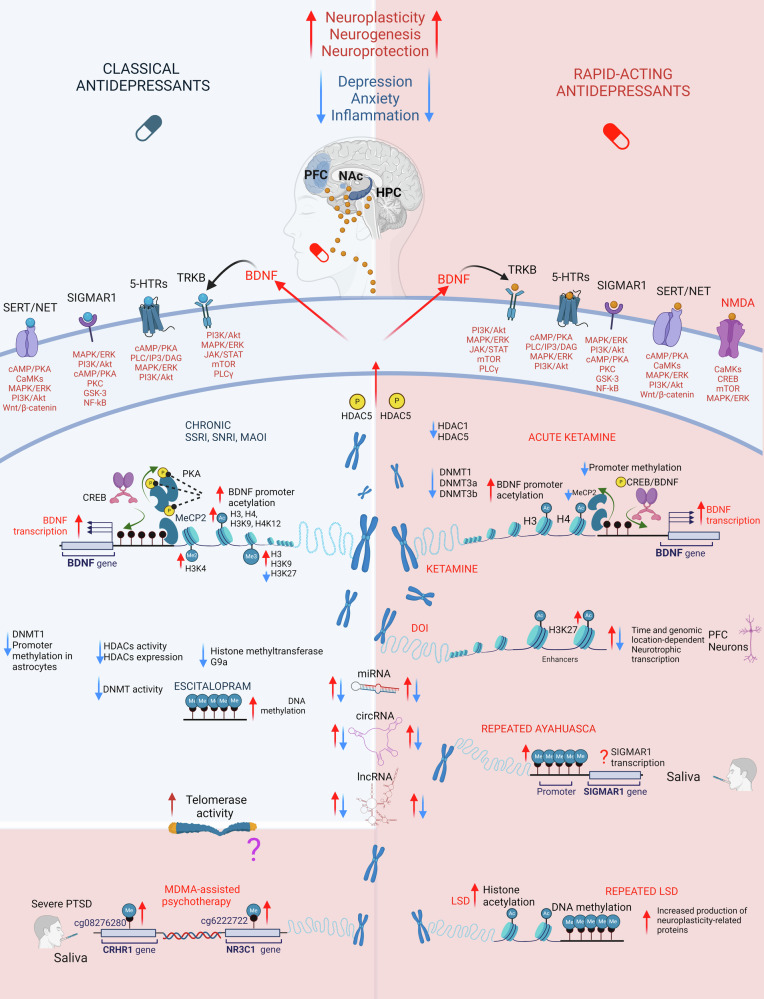
BACKGROUND: Rapid-acting antidepressants (RAADs), including dissociative anesthetics, psychedelics, and empathogens, elicit rapid and sustained therapeutic improvements in psychiatric disorders by purportedly modulating neuroplasticity, neurotransmission, and immunity. These outcomes may be mediated by, or result in, an acute and/or sustained entrainment of epigenetic processes, which remodel chromatin structure and alter DNA accessibility to regulate gene expression. METHODS: In this perspective, we present an overview of the known mechanisms, knowledge gaps, and future directions surrounding the epigenetic effects of RAADs, with a focus on the regulation of stress-responsive DNA and brain regions, and on the comparison with conventional antidepressants. MAIN BODY: Preliminary correlative evidence indicates that administration of RAADs is accompanied by epigenetic effects which are similar to those elicited by conventional antidepressants. These include changes in DNA methylation, post-translational modifications of histones, and differential regulation of non-coding RNAs in stress-responsive chromatin areas involved in neurotrophism, neurotransmission, and immunomodulation, in stress-responsive brain regions. Whether these epigenetic changes causally contribute to the therapeutic effects of RAADs, are a consequence thereof, or are unrelated, remains unknown. Moreover, the potential cell type-specificity and mechanisms involved are yet to be fully elucidated. Candidate mechanisms include neuronal activity- and serotonin and Tropomyosine Receptor Kinase B (TRKB) signaling-mediated epigenetic changes, and direct interaction with DNA, histones, or chromatin remodeling complexes. CONCLUSION: Correlative evidence suggests that epigenetic changes induced by RAADs accompany therapeutic and side effects, although causation, mechanisms, and cell type-specificity remain largely unknown. Addressing these research gaps may lead to the development of novel neuroepigenetics-based precision therapeutics.
Overview
The claims and statistics of this paper haven’t been checked yet.
Free: it reads the open-access text and checks the first 5 claims that cite a source we can check. Create a free account to check every claim.
Integrity signals
Registry
Cites
Statistics
Figures
Verification
Claims the paper makes
The claims and statistics of this paper haven’t been checked yet.
Free: it reads the open-access text and checks the first 5 claims that cite a source we can check. Create a free account to check every claim.
Claims other papers make about this one
Each is checked against this paper’s own text: does it say what the citing paper says it does?
The source backs part of the claim, not all of it — or backs it for a different population, condition or comparison.
In the citing paper
“For instance, ketamine reduces the hypermethylation of the BDNF gene promoter, a process often heightened in stress-related conditions, thereby enhancing BDNF transcription and promoting neuroplasticity [64].”
From Variations in BDNF and Their Role in the Neurotrophic Antidepressant Mechanisms of Ketamine and Esketamine: A Review (2024) · cites this paper as [64]
Experimental — accuracy not yet measured
Self-check
Percentages, sums and reported differences re-computed from the paper’s own numbers.
The self-check needs the paper’s full text.
Citations
Cites
1 retracted
Epigenetic Enhancement of BDNF Signaling Rescues Synaptic Plasticity in Aging
Zeng, Y., Tan, M., Kohyama, J., Sneddon, M., Watson, J. B., Sun, Y. E., & Xie, C.-W. (2011) · The Journal of Neuroscience · doi:10.1523/jneurosci.3878-11.2011 · Cited by 124
RetractedNon-coding RNAs in human disease
Esteller, M. (2011) · Nature Reviews Genetics · doi:10.1038/nrg3074 · Cited by 4,825
The multilayered complexity of ceRNA crosstalk and competition
Tay, Y., Rinn, J., & Pandolfi, P. P. (2014) · Nature · doi:10.1038/nature12986 · Cited by 3,910 · cited 1×
“Circular RNAs (circRNAs), ncRNAs generated by back-splicing, have extensive complementarity to target mRNAs and can encode proteins or increase the expression of the target gene(s) [163].”
BackgroundEpigenetic regulation of the glucocorticoid receptor in human brain associates with childhood abuse
McGowan, P. O., Sasaki, A., D'Alessio, A. C., Dymov, S., Labonté, B., Szyf, M., Turecki, G., & Meaney, M. J. (2009) · Nature Neuroscience · doi:10.1038/nn.2270 · Cited by 3,531 · cited 1×
“Chromatin is a plastic entity, which adapts to external stimuli such as a changing environment and stress [1, 2].”
BackgroundDNA methylation and human disease
Robertson, K. D. (2005) · Nature Reviews Genetics · doi:10.1038/nrg1655 · Cited by 2,864 · cited 1×
“This modi fi cation generally modulates transcription by inhibiting the binding of transcription factors or recruiting proteins involved in gene repression [27].”
BackgroundGriffiths, R. R., Johnson, M. W., Carducci, M. A., Umbricht, A., Richards, W. A., Richards, B. D., Cosimano, M. P., & Klinedinst, M. A. (2016) · Journal of Psychopharmacology · doi:10.1177/0269881116675513 · Cited by 2,201 · cited 1×
“Considering that psychedelic-assisted psychotherapy is a promising treatment to attenuate psychological and existential distress in individuals facing a life-threatening conditions such as cancer, it is important to assess the neoplastic potential of RAADs [254 – 256].”
BackgroundNibuya, M., Morinobu, S., & Duman, R. (1995) · The Journal of Neuroscience · doi:10.1523/jneurosci.15-11-07539.1995 · Cited by 2,109 · cited 1×
“…promoters hypermethylation and circadian-related gene expression changes, coupled to cardiac hypertrophy and progressive damage MDMA abuse affects cardiac DNA methylation, and this might be involved in cardiotoxicity [217] and in vitro, while increasing BDNF and decreasing apoptosis [147 – 149].”
BackgroundNMDA receptor blockade at rest triggers rapid behavioural antidepressant responses
Autry, A. E., Adachi, M., Nosyreva, E., Na, E. S., Los, M. F., Cheng, P.-F., Kavalali, E. T., & Monteggia, L. M. (2011) · Nature · doi:10.1038/nature10130 · Cited by 1,926 · cited 1×
“The outcome is the reopening of a period of structural and functional plasticity within the CNS that can be harnessed therapeutically [182 – 184, 189, 190].”
BackgroundSustained hippocampal chromatin regulation in a mouse model of depression and antidepressant action
Tsankova, N. M., Berton, O., Renthal, W., Kumar, A., Neve, R. L., & Nestler, E. J. (2006) · Nature Neuroscience · doi:10.1038/nn1659 · Cited by 1,780 · cited 5×
“…causes an epigenetic remodeling of stress-responsive DNA and chromatin regions, and associated histone proteins in susceptible brain areas such as the ventral hippocampus [1, 5], amygdala [6], nucleus accumbens (NAc) [7], and the prefrontal cortex (PFC) [8] – dorsal raphe nucleus loop [9 – 11].”
BackgroundInfluentialNichols, D. E. (2016) · Pharmacological Reviews · doi:10.1124/pr.115.011478 · Cited by 1,762 · cited 2×
“Rapid-acting antidepressants (referred herein as RAADs) are being investigated as novel therapeutics in psychiatry [14 – 16].”
Background
Cited by
Pardossi, S., Fagiolini, A., & Cuomo, A. (2024) · International Journal of Molecular Sciences · doi:10.3390/ijms252313098 · Cited by 51
Psychedelics in neuroinflammation: Mechanisms and therapeutic potential
de Deus, J. L., Maia, J. M., Soriano, R. N., Amorim, M. R., & Branco, L. G. S. (2025) · Progress in Neuro-Psychopharmacology and Biological Psychiatry · doi:10.1016/j.pnpbp.2025.111278 · Cited by 40
The science of psychedelic medicine
Siegel, J. S., Liston, C. M., Nicol, G. E., Carhart-Harris, R. L., & Bogenschutz, M. P. (2026) · Nature Medicine · doi:10.1038/s41591-025-04194-5 · Cited by 29
“It may also be possible to measure epigenetic modifications in circulating cells that reflect transcriptional programs relevant to plasticity 90,91 .”
Werle, I., & Bertoglio, L. J. (2024) · Neuroscience & Biobehavioral Reviews · doi:10.1016/j.neubiorev.2024.105899 · Cited by 26
Psilocybin treatment extends cellular lifespan and improves survival of aged mice
Kato, K., Kleinhenz, J., Shin, Y.-J., Coarfa, C., Zarrabi, A. J., & Hecker, L. (2025) · npj Aging · doi:10.1038/s41514-025-00244-x · Cited by 22
“Priorstudieshavedemonstratedthat thelong-lastingimpactsofpsychedelictreatmentsmaybedueto epigenomic-drivenalterations,includingchromatinremodelingandDNA methylation 19 – 21 .”
Bose, M. M., Govindula, A., Nampoothiri, M., Arora, D. S., & Mudgal, J. (2025) · Pharmacological Reports · doi:10.1007/s43440-025-00806-6 · Cited by 19
“-Epigenetic drugs (e.g., HDAC inhibitors) to restore BBB function -Lifestyle interventions (e.g., exercise, diet) that influence epigenetic changes [89] Nanotechnol-ogy-based drug delivery Conventional antidepressants struggle to penetrate the dysfunctional BBB. Limited CNS bioavailability of…”
Epigenetic changes caused by early life stress in the pathogenesis of depression
Bi, H., Jin, J., Sun, M., Chen, M., Li, X., & Wang, Y. (2025) · European Journal of Pharmacology · doi:10.1016/j.ejphar.2025.177671 · Cited by 10
Castanheira, S., Gomes, C. V., Bicker, J., & Fortuna, A. C. (2025) · Drug Discovery Today · doi:10.1016/j.drudis.2025.104371 · Cited by 11
Non-hallucinogenic psychedelics for mood and anxiety disorders: A systematic review
Chen, M. J. Q., Chen-Li, D. C. J., Chisamore, N., Husain, M. I., Vincenzo, J. D. D., Mansur, R. B., Phan, L., Johnson, D. E., McIntyre, R. S., & Rosenblat, J. D. (2025) · Psychiatry Research · doi:10.1016/j.psychres.2025.116532 · Cited by 11
Sakopoulos, S., & Todman, M. (2025) · International Journal of Molecular Sciences · doi:10.3390/ijms26146673 · Cited by 12
“Mechanistically, ketamine’s cascade effects activate downstream PI3K/Akt and mTOR signaling pathways that promote synaptic protein synthesis, structural remodeling, and emotional relearning [52].”
InfluentialKamaly, N. A., Kamel, A. S. E. D., Sadik, N. A. H., & Shahin, N. N. (2025) · Molecular Neurobiology · doi:10.1007/s12035-025-04723-w · Cited by 9
“A recent study discovered miRNA-135 was downregulated in peripheral blood in patients with major depressive disorder [91, 92].”
Cortical Mechanisms Contributing to Ketamine-Induced Dissociation
Bera, K., Looger, L. L., Proekt, A., & Cichon, J. (2025) · The Neuroscientist · doi:10.1177/10738584251403946 · Cited by 10
“We propose that dissociative dosing augments the pharmacodynamic mechanisms engaged at antidepressant levels with additional dose-dependent epigenetic processes that can rapidly and enduringly reconfigure neural circuit function (Inserra et al 2024; Lewis et al 2024).”
InfluentialLi, J., Liu, L., Sun, S., Liu, C., & Yin, P. (2026) · Medicine · doi:10.1097/md.0000000000046851 · Cited by 7
“[147] Notably, specific miRNAs like miR-132 and miR-146 exhibit co-regulation with neurotrophic signaling pathways, responding to neuronal activity while modulating synaptic protein and neurotrophic factor expression.”
MicroRNAs: A Novel Approach for Monitoring Treatment Response in Major Depressive Disorder?
Cătană, C.-S., Marta, M. M., Ungureanu, D., & Crișan, C. (2025) · Non-Coding RNA · doi:10.3390/ncrna11020021 · Cited by 5
The compulsive eating paradigm: can psychedelics help in treating obesity?
Ammineni, D., & Park, R. J. (2025) · Journal of Eating Disorders · doi:10.1186/s40337-024-01186-7 · Cited by 2
“Interestingly, psychedelics have been shown to influence the epigenetic landscape, enhancing gene expression relating to neurogenesis and synaptic plasticity [59].”
Is there a place for psychedelics in sports practice?
Portes, M. A. M., Werle, I., & Bertoglio, L. J. (2025) · Acta Neuropsychiatrica · doi:10.1017/neu.2025.13 · Cited by 4
“…release (White et al ., 1996; Mason et al ., 2020), increased expression of the brain-derived neurotrophic factor ( BDNF ; He et al ., 2005; de Almeida et al ., 2019; Marton et al ., 2019; Hutten et al ., 2020b; Shafiee et al ., 2024), and epigenetic changes (Inserra et al ., 2024).”
Epigenome-wide association study of psilocybin-induced methylome changes in alcohol use disorder
Urban, M. M., Zillich, E., Rieser, N. M., Herdener, M., Spanagel, R., Vollenweider, F. X., Preller, K. H., & Meinhardt, M. W. (2026) · Translational Psychiatry · doi:10.1038/s41398-026-03961-3 · Cited by 2
“This chain of effects might also include the level of epigenetics [13, 14].”
Neuropeptide receptors as entry points for developmental vulnerability to drug abuse
Harkany, T., Hevesi, Z., & Hökfelt, T. (2025) · Current Opinion in Neurobiology · doi:10.1016/j.conb.2025.103125 · Cited by 2
The epigenetic mechanisms of ketamine in the treatment of depression: a systematic review
Leccisotti, I., Moretti, M. C., Altamura, M., Bellomo, A., Laurello, R., Carapellese, M., Sborgia, G., Dibello, V., Robert, G. H., Panza, F., et al. (2025) · Epigenomics · doi:10.1080/17501911.2025.2583892 · Cited by 2
Trials, trips, and tribulations: pathways for implementing psychedelic therapy in Ireland
Kelly, J. R., Sheridan, C., Iusan, P., Coakley, L., Burke, L., Brennan, C., MacDonald, A. A., Ivers, J., Trépel, D., Tormey, G., et al. (2026) · The International Journal of Neuropsychopharmacology · doi:10.1093/ijnp/pyag028 · Cited by 1
Zhang, Y., Du, X., Fu, M., Hu, H., Lu, J., Pan, T., Yuan, L., Wu, Y., & Tong, J. (2026) · Molecular Biology Reports · doi:10.1007/s11033-026-12462-x · Cited by 1
Gojani, E. G., Farzin, H., Sutherland, R. J., & Mohajerani, M. H. (2026) · Neuroscience & Biobehavioral Reviews · doi:10.1016/j.neubiorev.2026.106619
Psychedelics and Mental Health in Endurance Athletes: A Cross-Sectional Study in Brazil
Portes, M. A. M., & Bertoglio, L. J. (2026) · Journal of Psychoactive Drugs · doi:10.1080/02791072.2026.2644865
Estela-Fernandez, C. A., Elsheikh, R. M. Y., Beatrice, D. F., Alhendal, A. A., Ewe, C. I., Montesinos, S. Y., Wensel, J., Mishra, A. P., Yousif, A. A., & Ali, H. T. (2026) · Neuropsychiatrie · doi:10.1007/s40211-026-00584-4
Lin, C. T., & Wang, X. (2026) · Molecular Psychiatry · doi:10.1038/s41380-026-03744-8
Wilkowska, A., Nizgorska-Ohler, J., & Cubała, W. J. (2026) · Molecular Neurobiology · doi:10.1007/s12035-026-06086-2
Nepton, A., Faber, S. C., Kaminsky, Z. A., Nucci, M., Farahani, H., Williams, M. T., & Rosal, S. P. (2026) · Epigenetics · doi:10.1080/15592294.2026.2731659
“Together, these findings suggest that ketamine-associated epigenetic changes are organized and selective, consistent with emerging evidence that rapid-acting antidepressants engage downstream regulatory systems rather than producing widespread epigenomic disruption [7,8].”
Influential
Metadata
- Authors
- Inserra, A., Campanale, A., Rezai, T., Romualdi, P., & Rubino, T.
- Affiliations
- Universidade do Sul de Santa Catarina (BR)
- McGill University (CA)
- University of Bologna (IT)
- University of Insubria (IT)
- Corresponding author
- Inserra, Antonio
- Venue
- Translational Psychiatry
- Published
- 2024-09-04
- Volume
- 14
- Issue
- 1
- Pages
- 359-359
- ISSN
- 2158-3188 (ISSN-L)
- PMC
- PMC11375021
- OpenAlex
- W4402221259
- Cited by
- 27
- References
- 272
- Citations by year
- 2026: 11 · 2025: 14 · 2024: 2
- FWCI
- 1.69
- Type
- journal article
- Language
- en
- Open access
- gold
- doi.org
- Licence
- cc-by-nc-nd
- creativecommons.org/licenses/by-nc-nd/4.0 (tdm)
- creativecommons.org/licenses/by-nc-nd/4.0 (vor)
- Locations
- Translational Psychiatry (publishedVersion, cc-by-nc-nd)
- PubMed Central (publishedVersion, cc-by-nc-nd)
- PubMed (publishedVersion)
- Archivio istituzionale della ricerca (Alma Mater Studiorum Università di Bologna) (submittedVersion, cc-by-nc-nd)
- DOAJ (DOAJ: Directory of Open Access Journals) (submittedVersion, cc-by-sa)
- IrInSubria (University of Insubria) (submittedVersion)
- Funders
- Gouvernement du Canada | Instituts de Recherche en Santé du Canada | CIHR Skin Research Training Centre
- Fonds de Recherche du Québec-Société et Culture
- Quebec Autism Research Training Program
- Topics
- Health Sciences › Medicine › Pharmacology (medical) › Treatment of Major Depression
- Social Sciences › Psychology › Clinical Psychology › Psychedelics and Drug Studies
- Life Sciences › Biochemistry, Genetics and Molecular Biology › Molecular Biology › Epigenetics and DNA Methylation
- Keywords
- rapid-acting antidepressants, epigenetics, dissociative anesthetics, psychedelics, DNA methylation, histone modifications, non-coding RNA, neuroplasticity, neurotrophism, serotonin signaling, TrkB signaling, chromatin remodeling, neuroepigenetics, depression treatment
- MeSH terms
- Animals, Antidepressive Agents, Brain, Histones, Humans, Neuronal Plasticity, Stress, Psychological, DNA Methylation, Epigenesis, Genetic
About these checks
Registry, retraction, Cites and statistics results are computed, not judged, with one exception: a printed reference that no index lists is read once by a model before it counts as a citation error. Claims are extracted by a model and kept only when their quote appears verbatim in the text; each cited source is then checked, with a model’s help, for whether it says what the claim relies on. Those verdicts can be wrong — read the claim’s quote and the cited source before relying on one.
Statistics and arithmetic are recomputed, not judged.
Confidence bands are shown only for fields calibrated on our annotated test set. None is calibrated yet, so no band is shown.
What counts as a claim ›How we measure confidence ›How we check this ›
Are you an author, or do you see a problem with this page? Request a review
Data sources
Bibliographic data: Semantic Scholar, OpenAlex, Crossref.
Contains information from the Semantic Scholar Academic Graph Datasets, made available under the ODC Attribution License (ODC-BY 1.0).
Semantic Scholar’s data is described in: Kinney, R., et al. (2023). The Semantic Scholar Open Data Platform. arXiv:2301.10140.
