

Research progress on sarcopenia in the musculoskeletal system
Open accessThe DOI matches its Crossref record; 247 of the 247 references it cites were found in a registry or an index.
Abstract
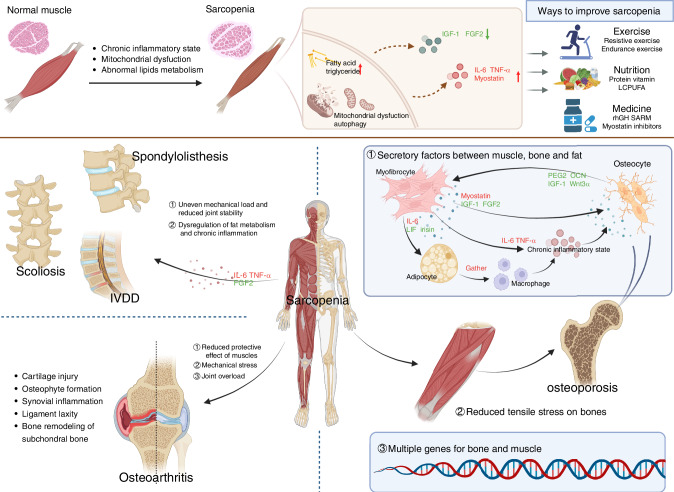
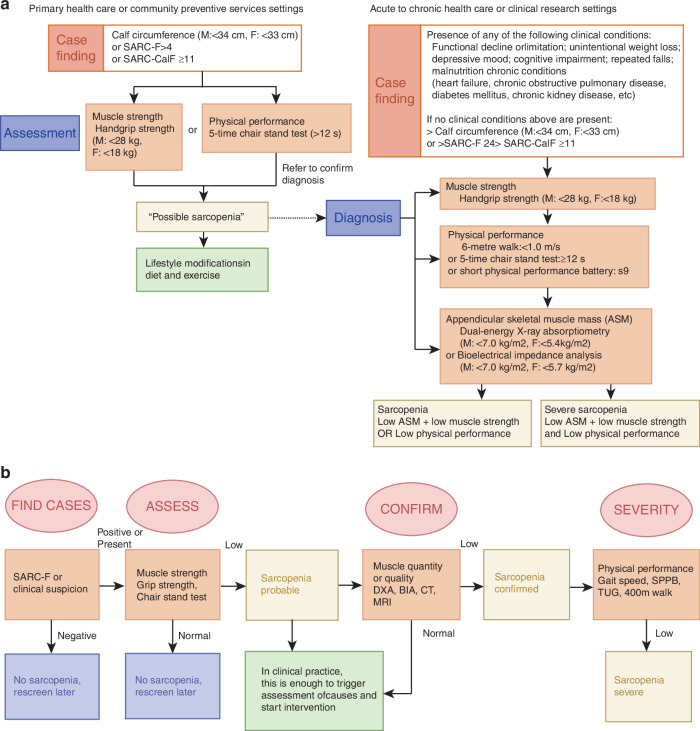
Sarcopenia, a progressive and systemic skeletal muscle disorder marked by the accelerated deterioration of both muscle function and mass, is highly prevalent among the elderly population, significantly contributing to an elevated risk of adverse outcomes, including falls, fractures, and muscle weakness. Clinical investigations have identified a strong correlation between sarcopenia and several prevalent degenerative skeletal muscle disorders. This correlation is attributed to imbalances in joint mechanics resulting from localized muscle atrophy and the influence of musculoskeletal secretory factors. In this review, we discuss the broader implications of sarcopenia and critically evaluate the currently established assessment methods. Furthermore, the clinical significance of prevalent musculoskeletal disorders (including osteoporosis, osteoarthritis, and spinal pathologies) in relation to sarcopenia, alongside the underlying mechanisms influencing this relationship, is summarized. Additionally, the effects of sarcopenia on the therapeutic efficacy of medications and surgical interventions for musculoskeletal conditions are reviewed. Sarcopenia is intricately linked to the onset, progression, and prognosis of musculoskeletal disorders. Future research should prioritize elucidating the potential mechanisms that connect muscle loss with skeletal muscle diseases, and investigating whether mitigating sarcopenia symptoms could decelerate the progression of these disorders, thereby paving new pathways for therapeutic interventions.
Overview
The claims and statistics of this paper haven’t been checked yet.
Free: it reads the open-access text and checks the first 5 claims that cite a source we can check. Create a free account to check every claim.
Integrity signals
Registry
Cites
Statistics
Figures
Verification
Claims the paper makes
The claims and statistics of this paper haven’t been checked yet.
Free: it reads the open-access text and checks the first 5 claims that cite a source we can check. Create a free account to check every claim.
Claims other papers make about this one
Each is checked against this paper’s own text: does it say what the citing paper says it does?
The check wasn’t confident either way, so it gives no verdict — never disputed.
In the citing paper
“Studies utilizing dual-energy X-ray absorptiometry (DEXA) and physical performance tests—such as the Short Physical Performance Battery (SPPB) and handgrip strength assessments—have documented declines in functional status in a subset of patients receiving GLP-1 RAs, particularly in those who do not engage in concurrent physical activity interventions [57].”
From A Narrative Review on GLP-1 Receptor Agonists for Obesity in Older Women: Maximizing Weight Loss While Preserving Lean Mass (2026) · cites this paper as [57]
Experimental — accuracy not yet measuredThe check wasn’t confident either way, so it gives no verdict — never disputed.
In the citing paper
“These effects appear to be mediated, at least in part, by reductions in systemic and local low-grade inflammation and improvements in metabolic and mitochondrial efficiency [56,57,58].”
From A Narrative Review on GLP-1 Receptor Agonists for Obesity in Older Women: Maximizing Weight Loss While Preserving Lean Mass (2026) · cites this paper as [57]
Experimental — accuracy not yet measured
Self-check
Percentages, sums and reported differences re-computed from the paper’s own numbers.
The self-check needs the paper’s full text.
Citations
Cites
Items 201–247 of 247
Lifelong exposure to dietary isoflavones reduces risk of obesity in ovariectomized Wistar rats
Kurrat, A., Blei, T., Kluxen, F. M., Mueller, D. R., Piechotta, M., Soukup, S. T., Kulling, S. E., & Diel, P. R. (2015) · Molecular Nutrition & Food Research · doi:10.1002/mnfr.201500240 · Cited by 40
Yazıcı, A., & Yerlikaya, T. (2022) · Journal of Orthopaedic Surgery and Research · doi:10.1186/s13018-022-03444-3 · Cited by 40
Du, Y., Xu, T., Yin, Z., Espinoza, S., Xie, Y., Gentry, C., Tian, Q., Zhao, L.-J., Shen, H., Luo, Z., et al. (2022) · BMC Public Health · doi:10.1186/s12889-022-13288-5 · Cited by 39 · cited 1×
“6 9 Age-related skeletal muscle remodeling is characterized by a shift from fast-twitch (type II) to slow-twitch (type I) fi ber composition, accompanied by progressive intramuscular and intermuscular fat in fi ltration (myosteatosis) and a reduction in type II fi ber-associated satellite cell…”
Cauza, E., Strehblow, C., Metz-Schimmerl, S., Strasser, B., Hanusch-Enserer, U., Kostner, K., Dunstan, D., Fasching, P., & Haber, P. (2009) · Wiener Medizinische Wochenschrift · doi:10.1007/s10354-009-0641-4 · Cited by 36 · cited 1×
“42 Or the midpoint between the femur and lateral condyle, 43 etc. 35 Further research is needed to assess how variations in measurement site localization affect cross-sectional area (CSA), muscle area (MA), intermuscular adipose tissue (IMAT), and other parameters related to muscle mass and fat in…”
Agha, O., Mueller‐Immergluck, A., Liu, M., Zhang, H., Theologis, A. A., Clark, A., Kim, H. T., Liu, X., Feeley, B. T., & Bailey, J. F. (2020) · JOR Spine · doi:10.1002/jsp2.1091 · Cited by 36
Liu, C., Xue, J., Liu, J., Ma, G., Moro, A., Liang, T., Zeng, H., Zhang, Z., Xu, G., Lu, Z., et al. (2021) · BMC Musculoskeletal Disorders · doi:10.1186/s12891-021-03970-x · Cited by 36
Association of Lumbar Paraspinal Muscle Morphometry with Degenerative Spondylolisthesis
Lee, E. T., Lee, S. A., Soh, Y., Yoo, M. C., Lee, J. H., & Chon, J. (2021) · International Journal of Environmental Research and Public Health · doi:10.3390/ijerph18084037 · Cited by 36 · cited 1×
“230,231 The paraspinal muscles play a critical role in providing functional support and maintaining spinal stability.”
Multifidus Degeneration, A New Risk Factor for Lumbar Spinal Stenosis: A Case–Control Study
Jiang, J., Wang, H., Wang, L., Zhang, B., Guo, Q., Yuan, W., & Lu, X. (2016) · World Neurosurgery · doi:10.1016/j.wneu.2016.11.142 · Cited by 35
Sarcopenia does not affect clinical outcomes following lumbar fusion
McKenzie, J. C., Wagner, S. C., Sebastian, A. S., Casper, D. S., Mangan, J. J., Stull, J. D., Hilibrand, A. S., Vaccaro, A. R., & Kepler, C. K. (2019) · Journal of Clinical Neuroscience · doi:10.1016/j.jocn.2019.03.015 · Cited by 33
Duan, P., Mummaneni, P. V., Guinn, J. M. V., Rivera, J. J., Berven, S., & Chou, D. (2020) · Journal of Neurosurgery Spine · doi:10.3171/2020.6.spine20238 · Cited by 33
Puolakkainen, T., Ma, H., Kainulainen, H., Pasternack, A. H., Rantalainen, T., Ritvos, O., Heikinheimo, K., Hulmi, J. J., & Kiviranta, R. (2017) · BMC Musculoskeletal Disorders · doi:10.1186/s12891-016-1366-3 · Cited by 32 · cited 1×
“188 These fi ndings position myostatin modulation as a promising therapeutic strategy for musculoskeletal disorders, particularly in patients with limited mobility.”
Isokinetic Strength Test of Muscle Strength and Motor Function in Total Knee Arthroplasty
Wang, X., Ma, Z., & Teng, X. (2020) · Orthopaedic Surgery · doi:10.1111/os.12699 · Cited by 32 · cited 2×
“163 In addition, sarcopenia may increase the risk of prosthetic infection after joint replacement surgery.”
Clinical Features of Sarcopenia in Patients With Lumbar Spinal Stenosis
Matsuo, S., Kawakami, M., Minetama, M., Nakagawa, M., Teraguchi, M., Kagotani, R., Mera, Y., Yamamoto, Y., Sakon, N., Nakatani, T., et al. (2020) · Spine · doi:10.1097/brs.0000000000003498 · Cited by 31
Peterson, M. J., Morey, M. C., Giuliani, C., Pieper, C. F., Evenson, K. R., Mercer, V. S., Visser, M., Brach, J. S., Kritchevsky, S. B., Goodpaster, B. H., et al. (2010) · Metabolic Syndrome and Related Disorders · doi:10.1089/met.2009.0090 · Cited by 30 · cited 1×
“85 Nutritional supplementation .”
Zhang, X., He, L., Wang, L., Wang, Y., Yan, E., Wan, B., Zeng, Q., Zhang, P., Zhao, X., & Yin, J. (2024) · Science Advances · doi:10.1126/sciadv.adq6795 · Cited by 30 · cited 1×
“146,147 Lin et al. comprehensively reviewed the regulatory potential of Wnt/ β -catenin signaling in skeletal muscle-bone interactions.”
Actions and interactions of IGF-I and MMPs during muscle regeneration
Kok, H. J., & Barton, E. R. (2021) · Seminars in Cell and Developmental Biology · doi:10.1016/j.semcdb.2021.04.018 · Cited by 29 · cited 1×
“156 While the liver serves as the primary source of circulating IGF-1 in humans, skeletal muscle and bone tissues contribute to local IGF-1 availability through autocrine/ paracrine secretion.”
Chua, M., Hochberg, U., Regev, G. J., Ophir, D., Salame, K., Lidar, Z., & Khashan, M. (2021) · The Spine Journal · doi:10.1016/j.spinee.2021.06.007 · Cited by 29
The influence of isoflavone for denervation-induced muscle atrophy
Tabata, S., Aizawa, M., Kinoshita, M., Ito, Y., Kawamura, Y., Takebe, M., Pan, W., & Sakuma, K. (2017) · European Journal of Nutrition · doi:10.1007/s00394-017-1593-x · Cited by 27
Veronese, N., Koyanagi, A., Barbagallo, M., Dominguez, L. J., Maggi, S., Soysal, P., Bolzetta, F., Ruotolo, G., Castagna, A., & Smith, L. (2023) · The Journals of Gerontology Series A · doi:10.1093/gerona/glad062 · Cited by 27
Analysis of skeletal muscle mass in women over 40 with degenerative lumbar scoliosis
Eguchi, Y., Toyoguchi, T., Inage, K., Fujimoto, K., Orita, S., Suzuki, M., Kanamoto, H., Abe, K., Norimoto, M., Umimura, T., et al. (2018) · European Spine Journal · doi:10.1007/s00586-018-5845-0 · Cited by 26 · cited 4×
“166,167 miRNAs expressed by TOM1L2 are implicated in osteogenic differentiation and skeletal muscle development, 168,169 although the speci fi c role of this gene in the musculoskeletal system remains to be clari fi ed.”
InfluentialZhang, J., Wang, E., Li, Q., Peng, Y., Jin, H., Naseem, S., Sun, B., Park, S., Choi, S. H., & Li, X. (2024) · International Journal of Biological Macromolecules · doi:10.1016/j.ijbiomac.2024.133639 · Cited by 25
Self-citationHey, H. W. D., Lam, W. M. R., Chan, C. X., Zhuo, W., Crombie, E. M., Tan, T. C., Chen, W. C., Cool, S. M., & Tsai, S. (2021) · The Spine Journal · doi:10.1016/j.spinee.2021.09.003 · Cited by 24 · cited 1×
“Hey HWD et al. 221 successfully simulated human paraspinal muscle atrophy using TSC1 gene knockout mice, and their fi ndings revealed that paraspinal muscle atrophy signi fi cantly accelerated intervertebral disc degeneration and height loss in the mice.”
Kuriyama, K., Matsui, Y., Suzuki, Y., Mizuno, T., Watanabe, T., Takemura, M., Ishizuka, S., Yamashita, S., Imagama, S., & Arai, H. (2022) · Bone · doi:10.1016/j.bone.2022.116487 · Cited by 24
Mizuno, T., Matsui, Y., Tomida, M., Suzuki, Y., Ishizuka, S., Watanabe, T., Takemura, M., Nishita, Y., Tange, C., Shimokata, H., et al. (2023) · Frontiers in Endocrinology · doi:10.3389/fendo.2023.1259350 · Cited by 23 · cited 1×
“38,39 CT imaging of these regions offers a more comprehensive assessment of muscle mass loss, muscle weakness, and overall muscle function.”
Mitochondrial DNA deletions and depletion within paraspinal muscles
Campbell, G. R., Reeve, A. K., Ziabreva, I., Polvikoski, T. M., Taylor, R. W., Reynolds, R., Turnbull, D. M., & Mahad, D. (2013) · Neuropathology and Applied Neurobiology · doi:10.1111/j.1365-2990.2012.01290.x · Cited by 21
Maas, H., Noort, W., Hodges, P. W., & van Dieën, J. H. (2018) · Journal of Biomechanics · doi:10.1016/j.jbiomech.2018.01.004 · Cited by 20
Cao, B., Zuo, Y.-Q., Xu, Y., Wu, F., Du, H., Hou, Y., & Tian, Y. (2022) · Asian Journal of Surgery · doi:10.1016/j.asjsur.2022.08.097 · Cited by 20
Qi, W., Mei, Z., Mao, X., Zhu, L., Shao, Y., Ge, G., Zhang, W., Pan, H., & Wang, D. (2024) · European Spine Journal · doi:10.1007/s00586-024-08291-w · Cited by 19
Self-citationChen, X., Hodges, P. W., James, G., & Diwan, A. D. (2020) · Spine · doi:10.1097/brs.0000000000003863 · Cited by 18
3D analysis of fatty infiltration of the paravertebral lumbar muscles using T2 images—a new approach
Hoppe, S., Maurer, D., Valenzuela, W., Benneker, L. M., Bigdon, S. F., Häckel, S., Wangler, S., & Albers, C. E. (2021) · European Spine Journal · doi:10.1007/s00586-021-06810-7 · Cited by 18
Eguchi, Y., Toyoguchi, T., Inage, K., Fujimoto, K., Orita, S., Yamauchi, K., Suzuki, M., Kanamoto, H., Abe, K., Norimoto, M., et al. (2017) · European Spine Journal · doi:10.1007/s00586-017-5370-6 · Cited by 17 · cited 3×
“166,167 miRNAs expressed by TOM1L2 are implicated in osteogenic differentiation and skeletal muscle development, 168,169 although the speci fi c role of this gene in the musculoskeletal system remains to be clari fi ed.”
InfluentialNaghdi, N., Elliott, J. M., Weber, M. H., Fehlings, M. G., & Fortin, M. (2022) · Global Spine Journal · doi:10.1177/21925682221136492 · Cited by 17
LRP5 regulates cardiomyocyte proliferation and neonatal heart regeneration by the AKT/P21 pathway
Zhou, H., Zhang, F., Wu, Y., Liu, H., Duan, R., Liu, Y., Wang, Y., He, X., Zhang, Y., Ma, X., et al. (2022) · Journal of Cellular and Molecular Medicine · doi:10.1111/jcmm.17311 · Cited by 16 · cited 1×
“162 However, the current understanding of LRP5/LRP6-mediated muscle regulation remains limited, and their precise molecular mechanisms require further experimental validation.”
Xu, G., Liang, Z., Tian, T., Meng, Q., Bertin, K. M., & Mo, F. (2023) · Computer Methods and Programs in Biomedicine · doi:10.1016/j.cmpb.2023.107709 · Cited by 15
Diallo, T. D., Rospleszcz, S., Fabian, J., Walter, S. S., Maurer, E., Storz, C., Roemer, F. W., Rathmann, W., Peters, A., Jungmann, P. M., et al. (2023) · Journal of Cachexia Sarcopenia and Muscle · doi:10.1002/jcsm.13192 · Cited by 13 · cited 2×
“185,207 Qi et al. 208 explored the causal relationship between sarcopenia-related traits — such as appendicular lean mass (ALM), grip strength (GS), and walking speed (WP) — and intervertebral disc degeneration (IVDD) using a two-sample Mendelian randomization approach.”
Camino-Willhuber, G. O., Schönnagel, L., Chiapparelli, E. A., Amoroso, K., Tani, S., Caffard, T., Arzani, A., Guven, A. E., Verna, B., Zhu, J., et al. (2024) · European Spine Journal · doi:10.1007/s00586-023-08120-6 · Cited by 13 · cited 1×
“Camino Willhuber, Gaston et al. 219 found that patients who underwent lumbar decompression surgery exhibited a higher degree of intervertebral vacuum phenomenon (IVP).”
Tzartza, C. L., Karapalis, N., Voulgaridou, G., Zidrou, C., Beletsiotis, A., Chatziprodromidou, I. P., Giaginis, C., & Papadopoulou, S. Κ. (2023) · Diseases · doi:10.3390/diseases11010036 · Cited by 12 · cited 1×
“205 Overall, patients with advanced osteoarthritis, whether or not they have sarcopenia, have shown signi fi cant clinical improvements in muscle mass, strength, function, pain, and daily living abilities following TKA surgery.”
Gessler, L., Kurtek, C., Merholz, M., Jian, Y., & Hashemolhosseini, S. (2022) · Cells · doi:10.3390/cells11243968 · Cited by 11
Sañudo, B., Reverte-Pagola, G., Seixas, A., & Masud, T. (2024) · Physical Therapy · doi:10.1093/ptj/pzae025 · Cited by 9
RANKL inhibition improves muscle strength and insulin sensitivity and restores bone mass
Bonnet, N., Bourgoin, L., Biver, E., Douni, E. K., & Ferrari, S. (2023) · Journal of Clinical Investigation · doi:10.1172/jci169317 · Cited by 8
Reis-Silva, A., Coelho-Oliveira, A. C., Moura-Fernandes, M. C., Bessa, M.-O. B., Batouli-Santos, D., Bernardo-Filho, M., & de Sá-Caputo, D. D. C. (2023) · Frontiers in Physiology · doi:10.3389/fphys.2023.1202613 · Cited by 8 · cited 1×
“173 Nutritional supplementation has proven equally effective in managing osteomyopenia.”
Ma, Y., Zhao, D., Yu, X., Zhou, S., Yue, X., Meng, L., Xu, L., Chou, Z., Feng, N., & Jiang, G. (2024) · Journal of Orthopaedic Surgery and Research · doi:10.1186/s13018-024-04935-1 · Cited by 8
Yuan, H., Dong, L., Zhang, O., Wang, X., Chen, Z., Li, Y., He, H., Lü, G., Li, J., & Kuang, L. (2024) · BMC Musculoskeletal Disorders · doi:10.1186/s12891-024-07337-w · Cited by 6
Ikeda, N., Yokoyama, K., Ito, Y., Tanaka, H., Yamada, M., Sugie, A., Takami, T., Wanibuchi, M., & Kawanishi, M. (2024) · Acta Neurochirurgica · doi:10.1007/s00701-024-05924-3 · Cited by 5
Proposal of definition and diagnostic criteria for sarcopenic obesity by ESPEN and EASO
Kaido, T. (2023) · HepatoBiliary Surgery and Nutrition · doi:10.21037/hbsn-23-199 · Cited by 4
Hu, J.-S., Jin, Y.-P., Wu, J.-K., & Ni, J.-G. (2024) · Frontiers in Medicine · doi:10.3389/fmed.2024.1387807 · Cited by 3
Chiu, C.-M., Yang, K., Chang, H., Lu, C., Chiang, C., & Huang, K. (2023) · Gerontology · doi:10.1159/000528868 · Cited by 2
Research works printed but not linked: 1
- Binotto, M. A., Lenardt, M. H. & Rodríguez-Martínez, M. D. C. Physical frailty and gait speed in community elderly: a systematic review. Rev. da Esc. de. Enferm. da U S P 52, e03392 (2018). 30570081
Cited by
Araújo, L. P., Godoy, A. C. F., Frota, F. F., Lamas, C. B., Quesada, K. R., Detregiachi, C. R. P., Araújo, A. C., Miglino, M. A., Guiguer, É. L., Haber, R. S. D. A., et al. (2025) · International Journal of Molecular Sciences · doi:10.3390/ijms262412147 · Cited by 41
“…Working Group on Sarcopenia in Older People 2 (EWGSOP2) study, as a muscle disorder characterized by progressive and generalized loss of the quality and quantity of skeletal muscle structure [1], resulting in adverse events such as difficulty in locomotion [2] and, in extreme cases, mortality [3].”
Moscucci, F., Baratta, F., Pastori, D., Menichelli, D., Mattioli, A. V., Gallina, S., Lospinuso, I., Sciomer, S., Piccirillo, G., & Desideri, G. (2026) · Nutrients · doi:10.3390/nu18040632 · Cited by 11
“…physical performance tests—such as the Short Physical Performance Battery (SPPB) and handgrip strength assessments—have documented declines in functional status in a subset of patients receiving GLP-1 RAs, particularly in those who do not engage in concurrent physical activity interventions [57].”
Zhang, X., Wang, Z., Wang, J., Wu, F., Xia, L., Shi, S., Zhu, M., & Zhuang, J. (2025) · Journal of Multidisciplinary Healthcare · doi:10.2147/jmdh.s560139 · Cited by 6
“46 However, due to various limitations, they are not typically used as routine bedside tools.”
Skeletal Fiber Type in Muscle Pain and Dysfunction
Cardia, M. L., Carneiro, B. D., Tavares, I., & Pozza, D. H. (2026) · Biomedicines · doi:10.3390/biomedicines14040794 · Cited by 2
“…in Type II fibers, associated satellite cell pools, and progressive intramuscular fat infiltration, changes that are further exacerbated by systemic metabolic dysregulation, particularly insulin resistance, which promotes ectopic lipid accumulation and impaired muscle glucose metabolism [72–74].”
Azim, M. M. N., Lee, Y. K., Alam, M. J., Kim, J., & Park, J. H. (2026) · Biomedicine & Pharmacotherapy · doi:10.1016/j.biopha.2026.119441 · Cited by 7
Metadata
- Authors
- Mao, X., Lv, K., Qi, W., Cheng, W., Li, T., Sun, Y., Jin, H., Pan, H., & Wang, D.
- Affiliations
- Zhejiang Chinese Medical University (CN)
- Corresponding author
- Jin, Hongting
- Pan, Hao
- Wang, Dong
- Venue
- Bone Research
- Published
- 2025-09-23
- Volume
- 13
- Issue
- 1
- Pages
- 78-78
- ISSN
- 2095-4700 (ISSN-L)
- 2095-6231
- PMC
- PMC12457612
- OpenAlex
- W4414418007
- Cited by
- 37
- References
- 244
- Citations by year
- 2026: 34 · 2025: 3
- FWCI
- 4.80
- Type
- journal article
- Language
- en
- Open access
- gold
- doi.org
- Licence
- cc-by
- creativecommons.org/licenses/by/4.0 (tdm)
- creativecommons.org/licenses/by/4.0 (vor)
- Locations
- Bone Research (publishedVersion, cc-by)
- Europe PMC (PubMed Central) (publishedVersion, cc-by)
- PubMed (publishedVersion)
- PubMed Central (publishedVersion, cc-by)
- DOAJ (DOAJ: Directory of Open Access Journals) (submittedVersion, cc-by-sa)
- Funders
- National Natural Science Foundation of China (82405429)
- Topics
- Health Sciences › Medicine › Physiology (medical) › Nutrition and Health in Aging
- Life Sciences › Biochemistry, Genetics and Molecular Biology › Molecular Biology › Muscle Physiology and Disorders
- Health Sciences › Medicine › Geriatrics and Gerontology › Frailty in Older Adults
- Keywords
- sarcopenia, skeletal muscle atrophy, musculoskeletal disorders, osteoporosis, osteoarthritis, spinal pathology, falls and fractures, muscle weakness, joint mechanics, sarcopenia assessment
- MeSH terms
- Humans, Musculoskeletal Diseases, Musculoskeletal System, Muscle, Skeletal, Sarcopenia
About these checks
Registry, retraction, Cites and statistics results are computed, not judged, with one exception: a printed reference that no index lists is read once by a model before it counts as a citation error. Claims are extracted by a model and kept only when their quote appears verbatim in the text; each cited source is then checked, with a model’s help, for whether it says what the claim relies on. Those verdicts can be wrong — read the claim’s quote and the cited source before relying on one.
Statistics and arithmetic are recomputed, not judged.
Confidence bands are shown only for fields calibrated on our annotated test set. None is calibrated yet, so no band is shown.
What counts as a claim ›How we measure confidence ›How we check this ›
Are you an author, or do you see a problem with this page? Request a review
Data sources
Bibliographic data: Semantic Scholar, OpenAlex, Crossref.
Contains information from the Semantic Scholar Academic Graph Datasets, made available under the ODC Attribution License (ODC-BY 1.0).
Semantic Scholar’s data is described in: Kinney, R., et al. (2023). The Semantic Scholar Open Data Platform. arXiv:2301.10140.
