

Research progress on sarcopenia in the musculoskeletal system
Open accessThe DOI matches its Crossref record; 247 of the 247 references it cites were found in a registry or an index.
Abstract
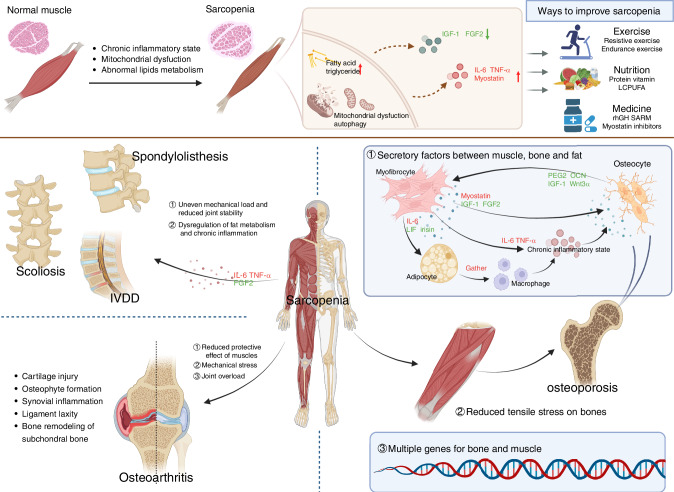
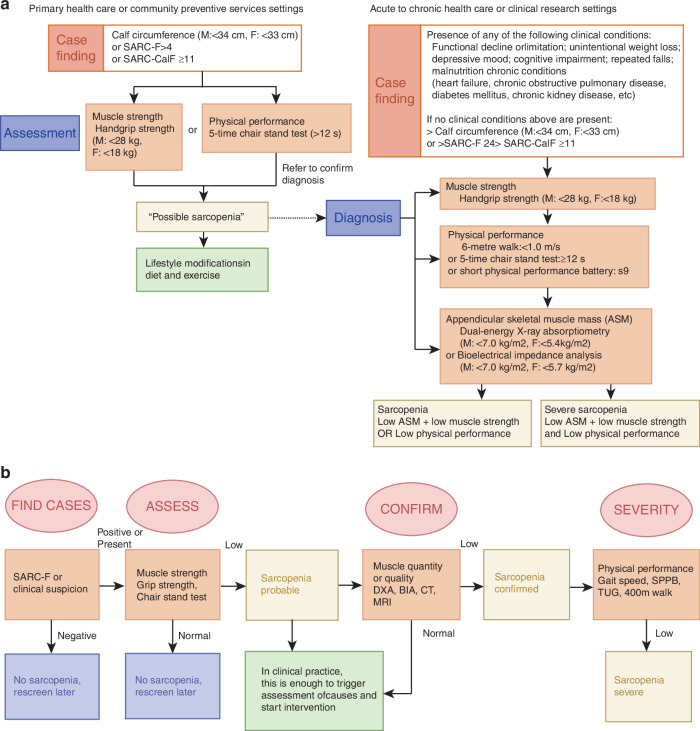
Sarcopenia, a progressive and systemic skeletal muscle disorder marked by the accelerated deterioration of both muscle function and mass, is highly prevalent among the elderly population, significantly contributing to an elevated risk of adverse outcomes, including falls, fractures, and muscle weakness. Clinical investigations have identified a strong correlation between sarcopenia and several prevalent degenerative skeletal muscle disorders. This correlation is attributed to imbalances in joint mechanics resulting from localized muscle atrophy and the influence of musculoskeletal secretory factors. In this review, we discuss the broader implications of sarcopenia and critically evaluate the currently established assessment methods. Furthermore, the clinical significance of prevalent musculoskeletal disorders (including osteoporosis, osteoarthritis, and spinal pathologies) in relation to sarcopenia, alongside the underlying mechanisms influencing this relationship, is summarized. Additionally, the effects of sarcopenia on the therapeutic efficacy of medications and surgical interventions for musculoskeletal conditions are reviewed. Sarcopenia is intricately linked to the onset, progression, and prognosis of musculoskeletal disorders. Future research should prioritize elucidating the potential mechanisms that connect muscle loss with skeletal muscle diseases, and investigating whether mitigating sarcopenia symptoms could decelerate the progression of these disorders, thereby paving new pathways for therapeutic interventions.
Overview
The claims and statistics of this paper haven’t been checked yet.
Free: it reads the open-access text and checks the first 5 claims that cite a source we can check. Create a free account to check every claim.
Integrity signals
Registry
Cites
Statistics
Figures
Verification
Claims the paper makes
The claims and statistics of this paper haven’t been checked yet.
Free: it reads the open-access text and checks the first 5 claims that cite a source we can check. Create a free account to check every claim.
Claims other papers make about this one
Each is checked against this paper’s own text: does it say what the citing paper says it does?
The check wasn’t confident either way, so it gives no verdict — never disputed.
In the citing paper
“Studies utilizing dual-energy X-ray absorptiometry (DEXA) and physical performance tests—such as the Short Physical Performance Battery (SPPB) and handgrip strength assessments—have documented declines in functional status in a subset of patients receiving GLP-1 RAs, particularly in those who do not engage in concurrent physical activity interventions [57].”
From A Narrative Review on GLP-1 Receptor Agonists for Obesity in Older Women: Maximizing Weight Loss While Preserving Lean Mass (2026) · cites this paper as [57]
Experimental — accuracy not yet measuredThe check wasn’t confident either way, so it gives no verdict — never disputed.
In the citing paper
“These effects appear to be mediated, at least in part, by reductions in systemic and local low-grade inflammation and improvements in metabolic and mitochondrial efficiency [56,57,58].”
From A Narrative Review on GLP-1 Receptor Agonists for Obesity in Older Women: Maximizing Weight Loss While Preserving Lean Mass (2026) · cites this paper as [57]
Experimental — accuracy not yet measured
Self-check
Percentages, sums and reported differences re-computed from the paper’s own numbers.
The self-check needs the paper’s full text.
Citations
Cites
The Timed “Up & Go”: A Test of Basic Functional Mobility for Frail Elderly Persons
Podsiadlo, D., & Richardson, S. (1991) · Journal of the American Geriatrics Society · doi:10.1111/j.1532-5415.1991.tb01616.x · Cited by 14,418 · cited 2×
“75 Screening methods for sarcopenia within community settings must be simple, rapid, and user-friendly.”
James, S. L., Abate, D., Abate, K. H., Abay, S. M., Abbafati, C., Abbasi, N., Abbastabar, H., Abd-Allah, F., Abdela, J., Abdelalim, A., et al. (2018) · The Lancet · doi:10.1016/s0140-6736(18)32279-7 · Cited by 13,867 · cited 2×
“185 Emerging evidence suggests that select anabolic agents, including myostatin inhibitors, can simultaneously enhance muscle and bone mass. 186 Notably, the soluble activin type IIB receptor (ActRIIB-Fc) demonstrated signi fi cant ef fi cacy in a murine muscular atrophy model, increasing both…”
Sarcopenia: revised European consensus on definition and diagnosis
Cruz-Jentoft, A. J., Bahat, G., Bauer, J., Boirie, Y., Bruyère, O., Cederholm, T., Cooper, C., Landi, F., Rolland, Y., Sayer, A. A., et al. (2019) · Age and Ageing · doi:10.1093/ageing/afy169 · Cited by 13,818
Asian Working Group for Sarcopenia: 2019 Consensus Update on Sarcopenia Diagnosis and Treatment
Chen, L.-K., Woo, J., Assantachai, P., Auyeung, T.-W., Chou, M.-Y., Iijima, K., Jang, H. C., Kang, L., Kim, M., Kim, S., et al. (2020) · Journal of the American Medical Directors Association · doi:10.1016/j.jamda.2019.12.012 · Cited by 7,070 · cited 4×
“1,20 – 22 Additionally, we evaluated the strengths and limitations of these commonly used methods (Table 1).”
InfluentialSarcopenia in Asia: Consensus Report of the Asian Working Group for Sarcopenia
Chen, L.-K., Liu, L.-K., Woo, J., Assantachai, P., Auyeung, T.-W., Bahyah, K. S., Chou, M.-Y., Chen, L.-Y., Hsu, P.-S., Krairit, O., et al. (2014) · Journal of the American Medical Directors Association · doi:10.1016/j.jamda.2013.11.025 · Cited by 4,051 · cited 1×
“1,57 Due to these advantages, BIA is increasingly being considered a practical alternative to dual-energy X-ray absorptiometry (DEXA).”
Cruz-Jentoft, A. J., & Sayer, A. A. (2019) · The Lancet · doi:10.1016/s0140-6736(19)31138-9 · Cited by 3,905 · cited 1×
“10 In addition, Insulin resistance secondary to metabolic dysregulation (e.g., diabetes and dyslipidemia) compromises skeletal muscle glucose metabolism while enhancing ectopic lipid deposition through increased cellular uptake of triglycerides and free fatty acids.”
Sarcopenia: revised European consensus on definition and diagnosis
Cruz-Jentoft, A. J., Bahat, G., Bauer, J., Boirie, Y., Bruyère, O., Cederholm, T., Cooper, C., Landi, F., Rolland, Y., Sayer, A. A., et al. (2019) · Age and Ageing · doi:10.1093/ageing/afz046 · Cited by 3,803
Fielding, R. A., Vellas, B., Evans, W. J., Bhasin, S., Morley, J. E., Newman, A. B., Abellan van Kan, G., Andrieu, S., Bauer, J., Breuille, D., et al. (2011) · Journal of the American Medical Directors Association · doi:10.1016/j.jamda.2011.01.003 · Cited by 3,256
Roberts, H. C., Denison, H. J., Martin, H. J., Patel, H. P., Syddall, H., Cooper, C., & Sayer, A. A. (2011) · Age and Ageing · doi:10.1093/ageing/afr051 · Cited by 3,001 · cited 1×
“23 This evaluation requires participants to rise from a seated position in a chair and return to a seated posture without using their arms to assist.”
A 30-s chair-stand test as a measure of lower body strength in community-residing older adults.
Jones, C. J., Rikli, R. E., & Beam, W. C. (1999) · Research Quarterly for Exercise and Sport · doi:10.1080/02701367.1999.10608028 · Cited by 2,921
Research works printed but not linked: 1
- Binotto, M. A., Lenardt, M. H. & Rodríguez-Martínez, M. D. C. Physical frailty and gait speed in community elderly: a systematic review. Rev. da Esc. de. Enferm. da U S P 52, e03392 (2018). 30570081
Cited by
Araújo, L. P., Godoy, A. C. F., Frota, F. F., Lamas, C. B., Quesada, K. R., Detregiachi, C. R. P., Araújo, A. C., Miglino, M. A., Guiguer, É. L., Haber, R. S. D. A., et al. (2025) · International Journal of Molecular Sciences · doi:10.3390/ijms262412147 · Cited by 41
“…Working Group on Sarcopenia in Older People 2 (EWGSOP2) study, as a muscle disorder characterized by progressive and generalized loss of the quality and quantity of skeletal muscle structure [1], resulting in adverse events such as difficulty in locomotion [2] and, in extreme cases, mortality [3].”
Moscucci, F., Baratta, F., Pastori, D., Menichelli, D., Mattioli, A. V., Gallina, S., Lospinuso, I., Sciomer, S., Piccirillo, G., & Desideri, G. (2026) · Nutrients · doi:10.3390/nu18040632 · Cited by 11
“…physical performance tests—such as the Short Physical Performance Battery (SPPB) and handgrip strength assessments—have documented declines in functional status in a subset of patients receiving GLP-1 RAs, particularly in those who do not engage in concurrent physical activity interventions [57].”
Zhang, X., Wang, Z., Wang, J., Wu, F., Xia, L., Shi, S., Zhu, M., & Zhuang, J. (2025) · Journal of Multidisciplinary Healthcare · doi:10.2147/jmdh.s560139 · Cited by 6
“46 However, due to various limitations, they are not typically used as routine bedside tools.”
Skeletal Fiber Type in Muscle Pain and Dysfunction
Cardia, M. L., Carneiro, B. D., Tavares, I., & Pozza, D. H. (2026) · Biomedicines · doi:10.3390/biomedicines14040794 · Cited by 2
“…in Type II fibers, associated satellite cell pools, and progressive intramuscular fat infiltration, changes that are further exacerbated by systemic metabolic dysregulation, particularly insulin resistance, which promotes ectopic lipid accumulation and impaired muscle glucose metabolism [72–74].”
Azim, M. M. N., Lee, Y. K., Alam, M. J., Kim, J., & Park, J. H. (2026) · Biomedicine & Pharmacotherapy · doi:10.1016/j.biopha.2026.119441 · Cited by 7
PDMD: A Comprehensive Repository of Plants Reported for Skeletal Muscle-related Ailments
Gupta, A., & Chawla, S. (2026) · Current Drug Targets · doi:10.2174/0113894501435270251129220150 · Cited by 1
Yan, Y., Zhang, J., Li, N., Li, J., Wen, Y., Wang, Y., & Huang, Y. (2026) · Frontiers in Immunology · doi:10.3389/fimmu.2026.1782149 · Cited by 2
“In the study of diseases such as osteoporosis (OP) (14), osteoarthritis (OA) (15), and lumbar disc herniation (LDH) (16), the bone and muscle crosstalk is increasingly being recognized as a novel systemic health model (17, 18).”
Dai, D., Xie, F., Cui, J., Wang, S., Cai, J., Wang, G. Q., & Yao, F. (2026) · Journal of Global Health · doi:10.7189/jogh.16.04095 · Cited by 1
“The condition significantly increases the risk of falls, fractures, physical disability, and death, placing a huge economic burden on healthcare systems [ 4 ].”
Hathaway, Q. A., Ghotbi, E., Pan, T., Momtazmanesh, S., Klein, J. G., Allison, M., Barbosa, E. J. M., Barr, R. G., Bluemke, D. A., Lima, J. A. C., et al. (2026) · Radiology · doi:10.1148/radiol.260238 · Cited by 2
Identifying and managing sarcopenia in older people in nursing and residential care
Palmer, S. J. (2025) · Nursing and Residential Care · doi:10.12968/nrec.2025.0045
Exercise in a Pill: Emerging Therapeutics for Age-Related Orthopedic Diseases
Luo, J., Meng, X., Han, J., Kong, H., Wang, X., & Zhang, X. (2026) · Antioxidants and Redox Signaling · doi:10.1177/15230864251411560
“…BMMSCs (Behera et al., 2022) and ferroptosis of osteoblasts (Tao et al., 2024), activation of the p38 mitogen-activated protein kinase (MAPK) and JNK signaling pathways related to osteogenesis (Mao et al., 2025a), and alleviation of the inhibitory effect of IL-6 on osteogenesis (Zhang et al., FIG.”
ATF4 Coordinates Transcriptomic and Structural Adaptations in Aging MusclePreprint
Crabtree, A., Khan, M. M., Scudese, E., Perez, C. P. H., Venkhatesh, P., Marshall, A. G., Rodriguez, B., Lopez, E. G., Ochayi, O. M., Dantas, E. H. M., et al. (2026) · bioRxiv (Cold Spring Harbor Laboratory) · doi:10.64898/2026.03.27.711928
Associations between outdoor light exposure and low muscle mass: An NHANES 2011 to 2014 analysis
Xue, Z., Sun, D., Wang, Z., Yan, D., Deng, F., Yu, Z., & Liu, P. (2026) · Medicine · doi:10.1097/md.0000000000048257
“[1,3,7] Therefore, early detection of sarcopenia is important for effective treatment and preventing disease progression.”
Zhu, C., Xu, J., Gong, Y., Wang, C., Xu, W., & Chen, L. (2026) · Frontiers in Aging Neuroscience · doi:10.3389/fnagi.2026.1806386
Zhang, S., Wang, L., He, C.-Y., Chen, Y.-B., Wang, Y., Li, Y., He, R., Ding, Y., Wang, X.-L., Zhou, Q.-H., et al. (2026) · Journal of the American Chemical Society · doi:10.1021/jacs.6c01000
Automated Sarcopenia Risk Stratification from POCUS Using Vision Transformers and Radiomics
Ribeiro, R. T., Coutaudier, T., & D’Amelio, P. (2026) · IEEE International Symposium on Biomedical Imaging (ISBI) · doi:10.1109/isbi61048.2026.11515432 · Cited by 1
Grabovoy, A. N., & Raskaliei, T. Y. (2026) · Ukrainian Scientific Medical Youth Journal · doi:10.32345/supplement.1.2026.210-216
Qui, C., Yu, D., Li, Y., & Wang, D. (2026) · Archives of Gerontology and Geriatrics · doi:10.1016/j.archger.2026.106337
Self-citationLin, W., Sui, W., Deng, Y. X., Chen, J. K., Shao, X., HUANG, Z., Wei, W., Liang, C. M., Zhang, X., Hu, R., et al. (2026) · Journal of Translational Medicine · doi:10.1186/s12967-026-08475-6
Hong, J., Zhang, X., Kong, G., Chen, B., & Zhao, S. (2026) · International Journal of Molecular Sciences · doi:10.3390/ijms27146340
“The coexistence of sarcopenia and osteoporosis is clinically relevant, because patients with osteosarcopenia often exhibit a higher risk of falls, fractures, functional impairment, and mortality than those with either condition alone [5].”
Arekemase, S. O., Abdulwaliyu, I., Mustapha, R. A., Hassan, U., Olusina, O. S., Udom, I. E., Sunday, A. A., & Bala, S. (2026) · Journal of Mind and Medical Sciences · doi:10.3390/jmms13030016
“Sarcopenia is a progressive and systemic skeletal muscle disorder characterized by low muscle strength [196,197].”
Kim, D. H., Choi, Y.-H., & Lee, S. Y. (2026) · Journal of the American Medical Directors Association · doi:10.1016/j.jamda.2026.106382
Salud Bucodental y Sarcopenia. Un Vínculo Fisiopatológico Ignorado
Hernández-Monjaraz, B. (2026) · Casos y Revisiones de Salud · doi:10.22201/fesz.26831422e.2026.8.1s.3
Chang, T., Qin, Z., Zhao, F., Han, K., Cui, Y., Duan, L., & Hao, J. (2026) · Frontiers in Public Health · doi:10.3389/fpubh.2026.1873124
Zhang, Y., Lin, L., Zheng, L., Lin, X., Xu, Z., Shen, X., Huang, L., Zhao, F., & Yan, S. (2026) · Journal of Cachexia Sarcopenia and Muscle · doi:10.1002/jcsm.70336
“Sarcopenia, characterised by progressive loss of skeletal muscle mass and function, is associated with markedly elevated fall, disability and mortality risks [5].”
Gao, H., Wu, H., Guo, L., Zhang, Z., Chen, J., Chen, H., Zhao, Y., & Wang, Z. (2026) · Frontiers in Endocrinology · doi:10.3389/fendo.2026.1865132
“Instead, these two tissues are tightly inter-connected through various molecular signaling pathways and local cytokine crosstalk (15).”
Que, P., Gan, W., Xu, C., Cui, G., & Zhan, K. (2026) · Indian Journal of Orthopaedics · doi:10.1007/s43465-026-01889-w
Prevalence and diagnostic variability of sarcopenia in India: A systematic review and meta-analysis
Kaviprawin, M., Gurusamy, G., George, C. E., Thomas, A., Saminathan, M., Kathiresan, L., Deepa, C., Aswathy, P., Gandhi, A. P., & Rajasekaran, S. (2026) · The Indian Journal of Medical Research · doi:10.25259/ijmr_881_2026
Krombholz-Reindl, P., Winkler, A., Dinges, C., Linni, K., Pilz, M., Rassam, S., Hammerer, M., Clodi, N., Gottardi, R., Hecht, S., et al. (2026) · Medical Sciences · doi:10.3390/medsci14050569
“While prior research has predominantly focused on abdominal muscles, particularly the psoas and paraspinal regions at the lumbar level [12,13], such measurements are rarely available in preoperative cardiac imaging.”
The Gut Microbiota–Muscle Axis: Lactobacillus as a Potential Modulator of Skeletal Muscle Health
Janet, B., Jena, R., Rao, B. S. S., & Dehury, B. (2026) · BioMed Research International · doi:10.1155/bmri/7133290
Ta, G., Li, L., Jing, C., Chen, X., Jeong, S.-J., Ryu, D., & Wei, S. (2026) · Frontiers in Endocrinology · doi:10.3389/fendo.2026.1935289
Are we at risk of increasing sarcopenia? Implications for osteoarthritis and osteoporosis
Pan, F., & Cicuttini, F. (2026) · Best Practice & Research Clinical Rheumatology · doi:10.1016/j.berh.2026.102204
Cha, Y., Kim, J.-T., Kim, J., Kim, H., & Yoo, J. (2026) · PLoS ONE · doi:10.1371/journal.pone.0359317
“Historically, most investigations into sarcopenia and hip fracture risk have relied on single-slice or few-slice cross-sectional area (CSA) measurements, typically at the mid-thigh or L3 vertebral level [23].”
Wang, Z., Zhang, H., 田佩洲, Li, S., Li, L., Tian, K., Shi, X., Wu, C., Fan, Y., & Lv, Y. (2026) · Pharmacological Research · doi:10.1016/j.phrs.2026.109667
Mu, B., Fan, Z., Chen, Y., & Wu, J. (2026) · European Spine Journal · doi:10.1007/s00586-026-10383-8
Zeng, Y., & Wang, P. (2026) · Discover Nano · doi:10.1186/s11671-026-05041-3
Li, X., Yuan, Z., Ma, N., Huang, B., Tao, H., & Chen, S. (2026) · Journal of Cachexia Sarcopenia and Muscle · doi:10.1002/jcsm.70406
“This interpretation is also aligned with newer reviews of sarcopenia within the musculoskeletal system and meta-analytic evidence showing strong epidemiologic coupling be-tween sarcopenia and osteoporosis [37, 38].”
Zeng, D., He, M., Lin, B., Liu, Y., Wang, X., & Lu, J. (2026) · Insights into Imaging · doi:10.1186/s13244-026-02443-w
Metadata
- Authors
- Mao, X., Lv, K., Qi, W., Cheng, W., Li, T., Sun, Y., Jin, H., Pan, H., & Wang, D.
- Affiliations
- Zhejiang Chinese Medical University (CN)
- Corresponding author
- Jin, Hongting
- Pan, Hao
- Wang, Dong
- Venue
- Bone Research
- Published
- 2025-09-23
- Volume
- 13
- Issue
- 1
- Pages
- 78-78
- ISSN
- 2095-4700 (ISSN-L)
- 2095-6231
- PMC
- PMC12457612
- OpenAlex
- W4414418007
- Cited by
- 37
- References
- 244
- Citations by year
- 2026: 34 · 2025: 3
- FWCI
- 4.80
- Type
- journal article
- Language
- en
- Open access
- gold
- doi.org
- Licence
- cc-by
- creativecommons.org/licenses/by/4.0 (tdm)
- creativecommons.org/licenses/by/4.0 (vor)
- Locations
- Bone Research (publishedVersion, cc-by)
- Europe PMC (PubMed Central) (publishedVersion, cc-by)
- PubMed (publishedVersion)
- PubMed Central (publishedVersion, cc-by)
- DOAJ (DOAJ: Directory of Open Access Journals) (submittedVersion, cc-by-sa)
- Funders
- National Natural Science Foundation of China (82405429)
- Topics
- Health Sciences › Medicine › Physiology (medical) › Nutrition and Health in Aging
- Life Sciences › Biochemistry, Genetics and Molecular Biology › Molecular Biology › Muscle Physiology and Disorders
- Health Sciences › Medicine › Geriatrics and Gerontology › Frailty in Older Adults
- Keywords
- sarcopenia, skeletal muscle atrophy, musculoskeletal disorders, osteoporosis, osteoarthritis, spinal pathology, falls and fractures, muscle weakness, joint mechanics, sarcopenia assessment
- MeSH terms
- Humans, Musculoskeletal Diseases, Musculoskeletal System, Muscle, Skeletal, Sarcopenia
About these checks
Registry, retraction, Cites and statistics results are computed, not judged, with one exception: a printed reference that no index lists is read once by a model before it counts as a citation error. Claims are extracted by a model and kept only when their quote appears verbatim in the text; each cited source is then checked, with a model’s help, for whether it says what the claim relies on. Those verdicts can be wrong — read the claim’s quote and the cited source before relying on one.
Statistics and arithmetic are recomputed, not judged.
Confidence bands are shown only for fields calibrated on our annotated test set. None is calibrated yet, so no band is shown.
What counts as a claim ›How we measure confidence ›How we check this ›
Are you an author, or do you see a problem with this page? Request a review
Data sources
Bibliographic data: Semantic Scholar, OpenAlex, Crossref.
Contains information from the Semantic Scholar Academic Graph Datasets, made available under the ODC Attribution License (ODC-BY 1.0).
Semantic Scholar’s data is described in: Kinney, R., et al. (2023). The Semantic Scholar Open Data Platform. arXiv:2301.10140.
