

The DOI matches its Crossref record; 14 of the 14 references it cites were found in a registry or an index.
Artificial intelligence in oncology: current applications and future perspectives
Open accessAbstract
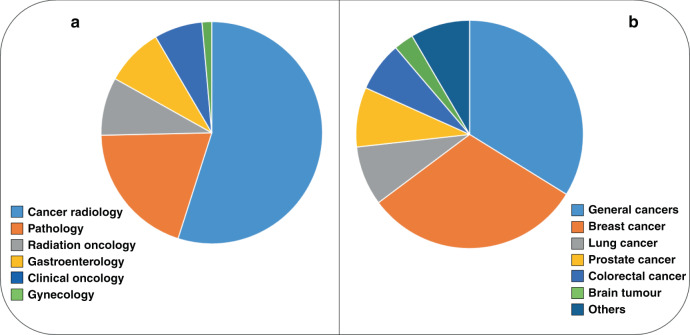
Artificial intelligence (AI) is concretely reshaping the landscape and horizons of oncology, opening new important opportunities for improving the management of cancer patients. Analysing the AI-based devices that have already obtained the official approval by the Federal Drug Administration (FDA), here we show that cancer diagnostics is the oncology-related area in which AI is already entered with the largest impact into clinical practice. Furthermore, breast, lung and prostate cancers represent the specific cancer types that now are experiencing more advantages from AI-based devices. The future perspectives of AI in oncology are discussed: the creation of multidisciplinary platforms, the comprehension of the importance of all neoplasms, including rare tumours and the continuous support for guaranteeing its growth represent in this time the most important challenges for finalising the 'AI-revolution' in oncology.
Overview
The claims and statistics of this paper haven’t been checked yet.
Run the check — free, no account needed. It reads the open-access text and checks the sources it cites.
Integrity signals
Registry
Cites
Statistics
Figures
Verification
Claims the paper makes
The claims and statistics of this paper haven’t been checked yet.
Run the check — free, no account needed. It reads the open-access text and checks the sources it cites.
Claims other papers make about this one
Each is checked against this paper’s own text: does it say what the citing paper says it does?
In the citing paper
“For example, Luchini and colleagues (194) summarized 71 FDA-cleared devices in oncology (up to 2021) and found that radiology accounted for the majority of approved devices (54.9%), followed by pathology (19.7%).”
From Artificial Intelligence in Oncology: Current Landscape, Challenges, and Future Directions (2024) · cites this paper as [194]
In the citing paper
“The same study also found that breast cancer was the most commonly cited cancer type (31%), most commonly associated with radiology, providing further evidence of the advancing maturity of AI in mammography.”
From Artificial Intelligence in Oncology: Current Landscape, Challenges, and Future Directions (2024) · cites this paper as [194]
Self-check
Percentages, sums and reported differences re-computed from the paper’s own numbers.
The self-check needs the paper’s full text.
Citations
Cites
Richards, S., Aziz, N., Bale, S., Bick, D., Das, S., Gastier-Foster, J., Grody, W. W., Hegde, M., Lyon, E., Spector, E., et al. (2015) · Genetics in Medicine · doi:10.1038/gim.2015.30 · Cited by 32,594
Liberati, A., Altman, D. G., Tetzlaff, J., Mulrow, C., Gøtzsche, P. C., Ioannidis, J. P. A., Clarke, M., Devereaux, P. J., Kleijnen, J., & Moher, D. (2009) · PLoS Medicine · doi:10.1371/journal.pmed.1000100 · Cited by 28,164
Liberati, A., Altman, D. G., Tetzlaff, J., Mulrow, C., Gotzsche, P. C., Ioannidis, J. P. A., Clarke, M., Devereaux, P. J., Kleijnen, J., & Moher, D. (2009) · BMJ · doi:10.1136/bmj.b2700 · Cited by 17,648
Liberati, A., Altman, D. G., Tetzlaff, J., Mulrow, C., Gøtzsche, P. C., Ioannidis, J. P. A., Clarke, M., Devereaux, P. J., Kleijnen, J., & Moher, D. (2009) · Annals of Internal Medicine · doi:10.7326/0003-4819-151-4-200908180-00136 · Cited by 10,349
Benjamens, S., Dhunnoo, P., & Meskó, B. (2020) · npj Digital Medicine · doi:10.1038/s41746-020-00324-0 · Cited by 1,215
History of artificial intelligence in medicine
Kaul, V., Enslin, S., & Gross, S. A. (2020) · Gastrointestinal Endoscopy · doi:10.1016/j.gie.2020.06.040 · Cited by 1,184
Artificial Intelligence in Cancer Research and Precision Medicine
Bhinder, B., Gilvary, C., Madhukar, N. S., & Elemento, O. (2021) · Cancer Discovery · doi:10.1158/2159-8290.cd-21-0090 · Cited by 781
Muehlematter, U. J., Daniore, P., & Vokinger, K. N. (2021) · The Lancet Digital Health · doi:10.1016/s2589-7500(20)30292-2 · Cited by 665
Wu, E., Wu, K., Daneshjou, R., Ouyang, D., Ho, D. E., & Zou, J. (2021) · Nature Medicine · doi:10.1038/s41591-021-01312-x · Cited by 494
Artificial intelligence in radiation oncology
Huynh, E., Hosny, A., Guthier, C. V., Bitterman, D. S., Petit, S., Haas-Kogan, D. A., Kann, B. H., Aerts, H. J. W. L., & Mak, R. H. (2020) · Nature Reviews Clinical Oncology · doi:10.1038/s41571-020-0417-8 · Cited by 454
Artificial intelligence for clinical oncology
Kann, B. H., Hosny, A., & Aerts, H. J. W. L. (2021) · Cancer Cell · doi:10.1016/j.ccell.2021.04.002 · Cited by 404
Hamamoto, R., Suvarna, K., Yamada, M., Kobayashi, K., Shinkai, N., Miyake, M., Takahashi, M., Jinnai, S., Shimoyama, R., Sakai, A., et al. (2020) · Cancers · doi:10.3390/cancers12123532 · Cited by 207
Molecular Tumor Boards in Clinical Practice
Luchini, C., Lawlor, R. T., Milella, M., & Scarpa, A. (2020) · Trends in cancer · doi:10.1016/j.trecan.2020.05.008 · Cited by 175
Artificial Intelligence and Mechanistic Modeling for Clinical Decision Making in Oncology
Benzekry, S. (2020) · Clinical Pharmacology & Therapeutics · doi:10.1002/cpt.1951 · Cited by 96
Cited by
Sorted by citations
Redefining Radiology: A Review of Artificial Intelligence Integration in Medical Imaging
Najjar, R. (2023) · Diagnostics · doi:10.3390/diagnostics13172760 · Cited by 1,025
The Promise of Digital Health: Then, Now, and the Future
Verily, Abernethy, A., Adams, L., National Academy of Medicine, Barrett, M., ResMed, Bechtel, C., Health, X., Brennan, P., Medicine, N. L. O., et al. (2022) · NAM Perspectives · doi:10.31478/202206e · Cited by 477
Artificial intelligence-based multi-omics analysis fuels cancer precision medicine
He, X., Liu, X., Zuo, F., Shi, H., & Jing, J. (2022) · Seminars in Cancer Biology · doi:10.1016/j.semcancer.2022.12.009 · Cited by 494
Eng, C., Yoshino, T., Ruíz‐García, E., Mostafa, N., Cann, C., O’Brian, B., Benny, A., Perez, R. O., & Cremolini, C. (2024) · The Lancet · doi:10.1016/s0140-6736(24)00360-x · Cited by 508
Machine Learning for Lung Cancer Diagnosis, Treatment, and Prognosis
Li, Y., Xin, W., Yang, P., Jiang, G., & Luo, Y. (2022) · Genomics Proteomics & Bioinformatics · doi:10.1016/j.gpb.2022.11.003 · Cited by 287
Metadata
- Authors
- Luchini, C., Pea, A., & Scarpa, A.
- Affiliations
- University of Verona (IT)
- Corresponding author
- Luchini, Claudio
- Scarpa, Aldo
- Venue
- British Journal of Cancer
- Published
- 2021-11-26
- Volume
- 126
- Issue
- 1
- Pages
- 4-9
- ISSN
- 0007-0920 (ISSN-L)
- 1532-1827
- PMC
- PMC8727615
- OpenAlex
- W3215393627
- Cited by
- 281
- References
- 14
- Citations by year
- 2026: 56 · 2025: 83 · 2024: 71 · 2023: 43 · 2022: 28
- FWCI
- 12.50
- Type
- journal article
- Language
- en
- Open access
- hybrid
- doi.org
- Locations
- British Journal of Cancer (publishedVersion, cc-by)
- PubMed Central (publishedVersion, cc-by)
- PubMed (publishedVersion)
- Funders
- Associazione Italiana per la Ricerca sul Cancro (12182)
- Fondazione Cassa di Risparmio di Verona Vicenza Belluno e Ancona (203885/2017)
- Topics
- Physical Sciences › Computer Science › Artificial Intelligence › AI in cancer detection
- Health Sciences › Medicine › Health Informatics › Artificial Intelligence in Healthcare and Education
- Health Sciences › Medicine › Radiology, Nuclear Medicine and Imaging › Radiomics and Machine Learning in Medical Imaging
- Keywords
- artificial intelligence in oncology, AI-based medical devices, cancer diagnosis, breast cancer, lung cancer, prostate cancer, rare tumor, clinical implementation of AI
- MeSH terms
- Artificial Intelligence, Forecasting, Humans, Medical Oncology, Neoplasms
About these checks
Registry, retraction, Cites and statistics results are computed, not judged, with one exception: a printed reference that no index lists is read once by a model before it counts as a citation error. Claims are extracted by a model and kept only when their quote appears verbatim in the text; each cited source is then checked, with a model’s help, for whether it says what the claim relies on. Those verdicts can be wrong — read the claim’s quote and the cited source before relying on one.
Statistics and arithmetic are recomputed, not judged.
Confidence bands are shown only for fields calibrated on our annotated test set. None is calibrated yet, so no band is shown.
What counts as a claim ›How we measure confidence ›How we check this ›
Are you an author, or do you see a problem with this page? Request a review
