

Matrix stiffness modulates hepatic stellate cell activation into tumor-promoting myofibroblasts via E2F3-dependent signaling and regulates malignant progression
Open accessThe DOI matches its Crossref record; 27 of the 27 references it cites were found in a registry or an index; 2 of the 2 sources its claims cite were checked for support.
Abstract
The hepatic stellate cells (HSCs) activation by myofibroblastic differentiation is critical for liver fibrosis. Crosstalk between stromal cells and tumor cells in the microenvironment alters the properties and facilitates the growth and metastasis of tumor cells. How mechanical stimuli originally stiffness of extracellular matrix (ECM) contribute to tumor development remains poorly understood. Here, we demonstrated that stiffness contributes to mechanosignal transduction in HSCs, which promotes hepatocellular carcinoma (HCC) cells growth and metastasis through secretion of FGF2. On stiffness matrix, HSCs activation was confirmed by immunofluorescence (IF) and Western blot (WB) for α-smooth muscle actin (SMA). Increasing matrix stiffness promoted HSCs activation by CD36-AKT-E2F3 mechanosignaling through shRNA-mediated E2F3 knockdown, AKT inhibitors, and CD36 shRNA. Moreover, ChIP-qPCR. Confirmed that E2F3 combined the promoter of FGF2, and stiffness promoted FGF2 expression. On a stiff matrix, HCC cells cultured with conditioned media (CM) from HSCs increased HCC cells growth and metastasis by binding FGFR1 to activate PI3K/AKT and MEK/ERK signaling pathways. Moreover, conditional E2F3 knockout mice were subjected to CCl4 treatment to assess the role of E2F3 in HSC activation. Additionally, the DEN-induced HCC model was also used to evaluate the role of E2F3 in liver fibrosis and HCC growth. In conclusion, we demonstrated that stiffness-induced HSC activation by E2F3 dependent. Stiffness activated CD36-AKT-E2F3 signaling and targeted FGF2 transcription, subsequently, activated HCC growth and metastasis by FGFR1-mediated PI3K/AKT and MEK/ERK signaling.
Overview
CoChat Summary
TL;DR
This study argues that a stiff extracellular matrix drives hepatic stellate cell (HSC) activation into tumor-promoting myofibroblasts through a CD36-AKT-E2F3 pathway. Activated HSCs then secrete FGF2, which promotes hepatocellular carcinoma (HCC) growth and metastasis in vitro and in mice.
Key findings
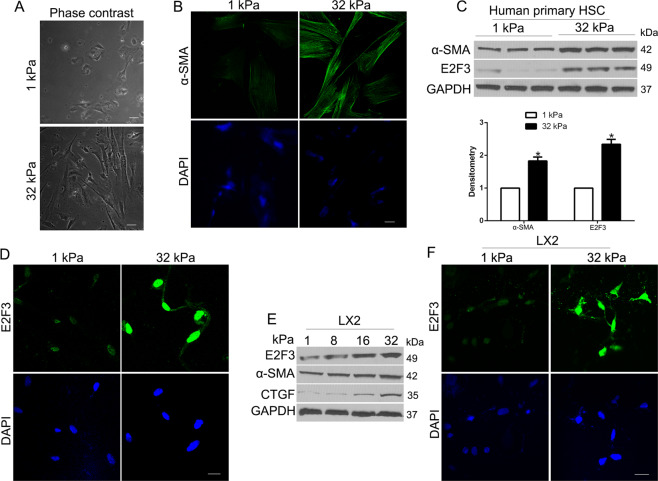
- On 32 kPa hydrogels, HSCs showed activated/myofibroblastic features, including elongated morphology and increased α-SMA; E2F3 and CTGF also increased, while 1 kPa soft gels showed a round morphology.
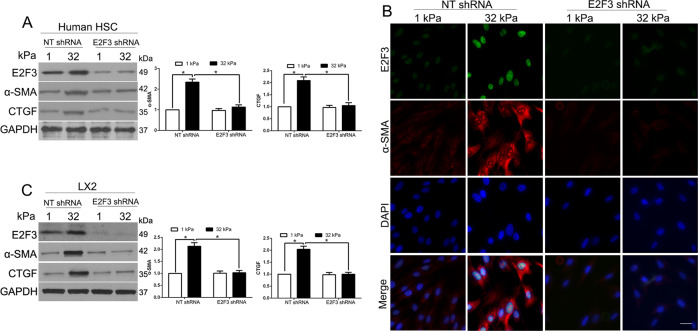
- E2F3 knockdown abolished stiffness-induced HSC activation: stiffness-induced increases in α-SMA and CTGF were suppressed in human HSCs and LX2 cells, with effects reported as significant at P < 0.05.
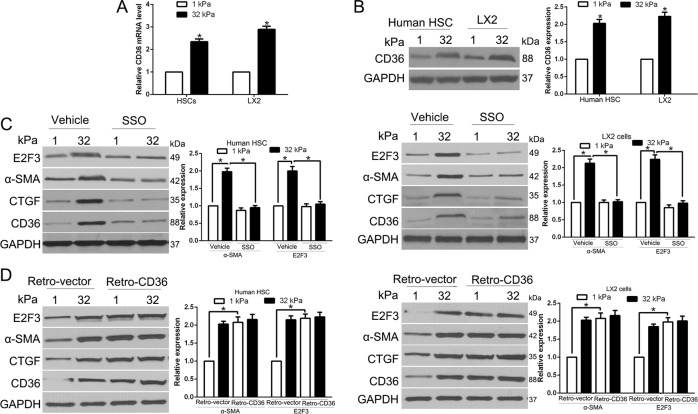
- CD36 was required for the stiffness response: the CD36 inhibitor SSO blocked stiffness-induced α-SMA and E2F3 upregulation, and CD36 overexpression on 1 kPa mimicked 32 kPa stiffness.
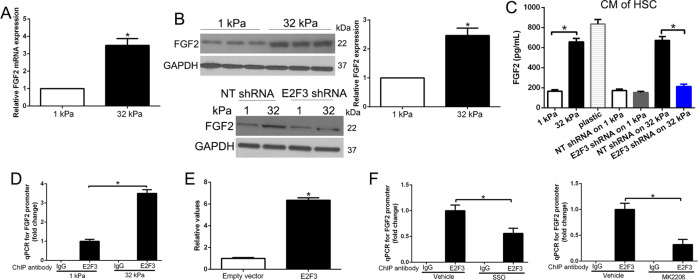
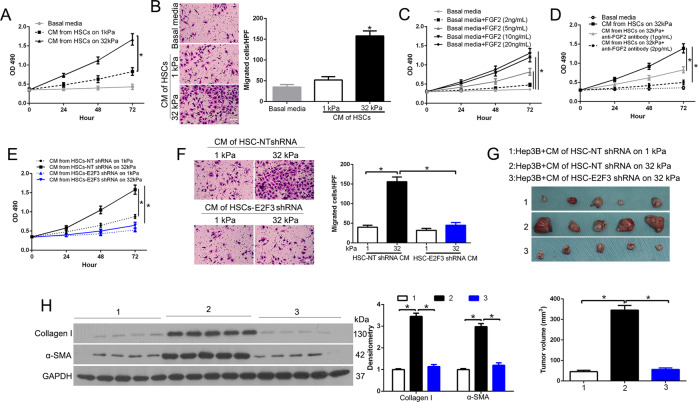
- Stiffness induced E2F3-dependent FGF2 transcription and secretion: E2F3 increased FGF2 promoter activity sixfold, and CM from 32 kPa HSCs promoted Hep3B proliferation and migration; in the mouse co-injection model, 32 kPa CM increased tumor growth by day 10, while E2F3 knockdown in HSCs abolished this effect.
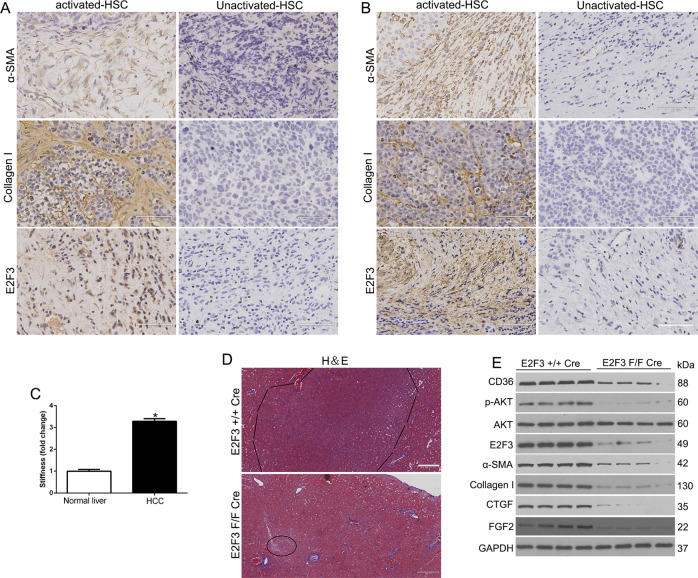
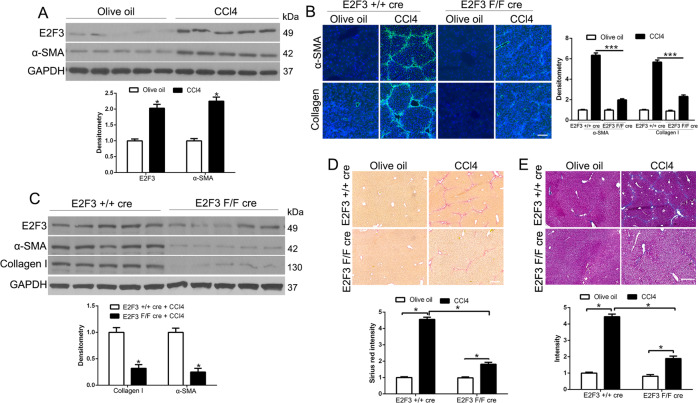
- In vivo, conditional E2F3 knockout reduced CCl4-induced HSC activation/liver fibrosis, and E2F3 +/+ cre mice developed macroscopic tumors compared with E2F3 F/F cre mice in the DEN model.
Methods
- In vitro design: primary human HSCs, LX2 cells, and Hep3B cells were cultured on polyacrylamide hydrogels of different stiffness, especially 1 kPa and 32 kPa.
- Mechanistic assays included Western blotting, immunofluorescence/confocal microscopy, qRT-PCR, ELISA for FGF2, ChIP-qPCR, reporter assays, co-IP, CCK8 proliferation, and Transwell migration.
- In vivo studies included subcutaneous co-injection of Hep3B cells with HSC conditioned media into SCID mice, plus CCl4-induced fibrosis in mice and a DEN-based HCC/fibrosis model with conditional E2F3 knockout.
Limitations
- The paper does not state explicit limitations.
- Evident from the text: several key claims rely on cell-line and mouse-model systems, so direct human causal evidence is limited in the provided text.
Model-written summary. Check it against the paper before relying on it.
Integrity signals
Registry
Cites
Statistics
Figures
Verification
Claims the paper makes
2 Valid · 0 Not valid · 0 Not checked · 55 Own results and interpretations
The cited sources support only part of this claim — read each source’s verdict below.
In the paper
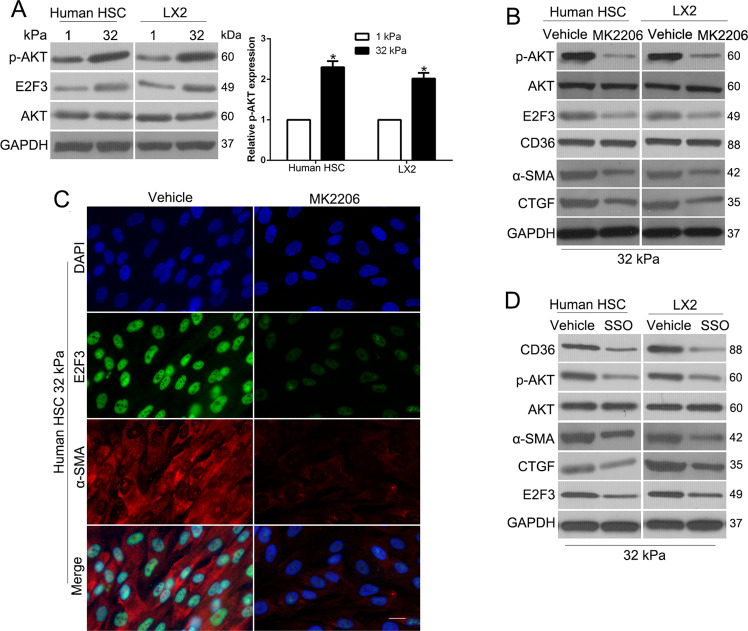
“we performed WB to confirm that AKT phosphorylation was intermediate according to previous studies (P < 0.05 by t-test, Fig. 4A) [19].”
§ Matrix stiffness modulates hepatic stellate cell activation into tumor-promoting myofibroblasts via E2F3-dependent signaling and regulates malignant progression > Results > Stiffness promoted E2F3 expression by activating a CD36-AKT pathway
What the sources say
- Partly supportedcites [19] Rios FJ Koga MM Ferracini M Jancar S Co-stimulation of PAFR and CD36 is required for oxLDL-induced human macrophages activation PLoS ONE 2012 7 e36632 10.1371/journal.pone.0036632 22570732 PMC3343035 sourceExperimental — accuracy not yet measured
The Results section (page unavailable) reports that oxLDL induces Akt phosphorylation in human macrophages, and the Discussion places PI3K/Akt upstream of p38 and JNK activation. That supports Akt phosphorylation as part of an intermediate signaling pathway, but the paper studies oxLDL stimulation, not stiffness-induced signaling. (LLM, conf=0.85)
plainstates a cause- Asserted: passes — The authors put it forward as true.
- Checkable: passes — It can be checked against evidence.
- Load-bearing: passes — The paper’s conclusions depend on it.
- Based: passes — The paper gives a reason why it holds.
- Rests on an assumption not shown here.
- Partly supported
Every source the paper cites for this claim was checked and supports it.
In the paper
“Stiffness promoted transcription of more than 20 tumor-promoting factors, including FGF, CTGF, and IL6 [12].”
§ Matrix stiffness modulates hepatic stellate cell activation into tumor-promoting myofibroblasts via E2F3-dependent signaling and regulates malignant progression > Results > Stiffness-E2F3 axis promotes transcription of tumor-promoting factors of HSCs
What the sources say
- Supportedcites [12] Dou C Liu Z Tu K Zhang H Chen C Yaqoob U P300 acetyltransferase mediates stiffness-induced activation of hepatic stellate cells into tumor-promoting myofibroblasts Gastroenterology 2018 154 2209 21 10.1053/j.gastro.2018.02.015 29454793 PMC6039101 source
The Results section (“Stiffness-p300 axis epigenetically turns on transcription of tumor-promoting factors of HSCs,” Fig. 5C) states that stiffness promoted transcription of more than 20 tumor-promoting factors and explicitly includes FGF, CTGF, and IL6. (LLM, conf=0.95)
plainstates a cause- Asserted: passes — The authors put it forward as true.
- Checkable: passes — It can be checked against evidence.
- Load-bearing: passes — The paper’s conclusions depend on it.
- Based: passes — The paper gives a reason why it holds.
- Rests on an assumption not shown here.
- Supported
A result the paper reports from its own data — it cites no other source for it, so there is none to check. The quote shows it is in the paper.
In the paper
“In addition, we used CCl4 to induce liver fibrosis and found that E2F3 was increased in CCl4-induced liver, moreover, CCl4-mediated HSC activation was reduced in E2F3 F/F cre livers (P < 0.05 by t-test, Fig. 8).”
- Also stated in: § E2F3 is overexpressed in the HSCs/MF murine and the patient’s HCC and CCl4-induced fibrosis was reversed in conditional E2F3 knockout mice · plain
“moreover, CCl4-mediated HSC activation was reduced in E2F3 F/F cre livers (P < 0.05 by t-test, Fig. 8).”
§ Matrix stiffness modulates hepatic stellate cell activation into tumor-promoting myofibroblasts via E2F3-dependent signaling and regulates malignant progression > Results > E2F3 is overexpressed in the HSCs/MF murine and the patient’s HCC and CCl4-induced fibrosis was reversed in conditional E2F3 knockout mice
plainstates a cause- Asserted: passes — The authors put it forward as true.
- Checkable: passes — It can be checked against evidence.
- Load-bearing: passes — The paper’s conclusions depend on it.
- Based: passes — The paper gives a reason why it holds.
- Rests on an assumption not shown here.
- Also stated in: § E2F3 is overexpressed in the HSCs/MF murine and the patient’s HCC and CCl4-induced fibrosis was reversed in conditional E2F3 knockout mice · plain
A result the paper reports from its own data — it cites no other source for it, so there is none to check. The quote shows it is in the paper.
In the paper
“We performed qRT-PCR and WB and found that CD36 mRNA and protein level all increased in primary human HSCs and LX2 cells (P < 0.05 by t-test, Fig. 3A, B).”
§ Matrix stiffness modulates hepatic stellate cell activation into tumor-promoting myofibroblasts via E2F3-dependent signaling and regulates malignant progression > Results > Stiffness promoted E2F3 expression is mediated by CD36
plainstates a cause- Asserted: passes — The authors put it forward as true.
- Checkable: passes — It can be checked against evidence.
- Load-bearing: passes — The paper’s conclusions depend on it.
- Based: passes — The paper gives a reason why it holds.
- Rests on an assumption not shown here.
A result the paper reports from its own data — it cites no other source for it, so there is none to check. The quote shows it is in the paper.
In the paper
“WB confirmed that stiffness-mediated HSC activation was inhibited in E2F3 knockdown LX2 cells (P < 0.05 by ANOVA Fig. 2C).”
§ Matrix stiffness modulates hepatic stellate cell activation into tumor-promoting myofibroblasts via E2F3-dependent signaling and regulates malignant progression > Results > E2F3 knockdown abolished the matrix stiffness-induced HSCs activation
plainstates a cause- Asserted: passes — The authors put it forward as true.
- Checkable: passes — It can be checked against evidence.
- Load-bearing: passes — The paper’s conclusions depend on it.
- Based: passes — The paper gives a reason why it holds.
- Rests on an assumption not shown here.
41 more claims
Create a free account to see all 57 claims and every source verdict.
- It may state two separate claims as one. 11
Self-check
Percentages, sums and reported differences re-computed from the paper’s own numbers.
Self-check results appear here once an independent check has confirmed them.
Cited works that were retracted
Works this paper cites that were later retracted, from the retraction notices publishers deposit. Major when the notice came out before this paper was published.
A note, not an issue: for example, a cited work that was retracted only after this paper was published, which its authors could not have known.
In the paper
“Liu Z, Wang Y, Wang L, Yao B, Sun L, Liu R, et al. Long non-coding RNA AGAP2-AS1, functioning as a competitive endogenous RNA, upregulates ANXA11 expression by sponging miR-16-5p and promotes proliferation and metastasis in hepatocellular carcinoma. J Exp Clin cancer Res: CR. 2019;38:194.”
Cited work 10.1186/s13046-019-1188-x · retracted 2022-11-02 · notice 10.1186/s13046-022-02521-z · this paper published 2021-12-06
A note, not an issue: for example, a cited work that was retracted only after this paper was published, which its authors could not have known.
In the paper
“Liu Z, Dou C, Yao B, Xu M, Ding L, Wang Y, et al. Ftx non coding RNA-derived miR-545 promotes cell proliferation by targeting RIG-I in hepatocellular carcinoma. Oncotarget 2016;7:25350–65.”
Cited work 10.18632/oncotarget.8129 · retracted 2025-02-18 · notice 10.18632/oncotarget.28695 · this paper published 2021-12-06
Citations
Cites
2 retracted
Liu, Z., Wang, Y., Wang, L., Yao, B., Sun, L., Liu, R., Chen, T., Niu, Y., Tu, K., & Liu, Q. (2019) · Journal of Experimental & Clinical Cancer Research · doi:10.1186/s13046-019-1188-x · Cited by 136
Self-citationRetractedLiu, Z., Dou, C., Yao, B., Xu, M. M., Ding, L., Wang, Y., Jia, Y., Li, Q., Zhang, H., Tu, K., et al. (2016) · Oncotarget · doi:10.18632/oncotarget.8129 · Cited by 124
Self-citationRetractedSiegel, R., Naishadham, D., & Jemal, A. (2012) · CA: A Cancer Journal for Clinicians · doi:10.3322/caac.20138 · Cited by 10,679
Accessories to the Crime: Functions of Cells Recruited to the Tumor Microenvironment
Hanahan, D., & Coussens, L. M. (2012) · Cancer Cell · doi:10.1016/j.ccr.2012.02.022 · Cited by 4,632 · cited 1×
“RESULTS Increasing matrix stiffness-induced MF activation of HSCs and promoted the expression of E2F3 in human HSCs and LX2 cells Pathological fibrosis is driven by a feedback loop in which the fibrotic extracellular matrix is both cause and consequence of fibroblast activation [17].”
BackgroundEffects of substrate stiffness on cell morphology, cytoskeletal structure, and adhesion
Yeung, T., Georges, P. C., Flanagan, L. A., Marg, B., Ortiz, M., Funaki, M., Zahir, N., Ming, W., Weaver, V., & Janmey, P. A. (2005) · Cell Motility and the Cytoskeleton · doi:10.1002/cm.20041 · Cited by 2,325 · cited 3×
“The cancerassociated fibroblasts (CAFs) are responsible for the remodeling of ECM and subsequent growth and dissemination of tumor cells [24].”
BackgroundFibroblast Adaptation and Stiffness Matching to Soft Elastic Substrates
Solon, J., Levental, I., Sengupta, K., Georges, P. C., & Janmey, P. A. (2007) · Biophysical Journal · doi:10.1529/biophysj.106.101386 · Cited by 1,027 · cited 8×
“On the contrary, ECM-mediated stiffness promotes malignancies by modulating cell growth, motility, proliferation, metabolism, and metastasis, such as clustering of integrin-based adhesion proteins into focal adhesions, Rho-ROCK activation, and nuclear localization of transcriptional regulators YAP and SNAIL1 [5].”
BackgroundInfluentialSchrader, J., Gordon-Walker, T. T., Aucott, R. L., van Deemter, M., Quaas, A., Walsh, S., Benten, D., Forbes, S. J., Wells, R. G., & Iredale, J. P. (2011) · Hepatology · doi:10.1002/hep.24108 · Cited by 720 · cited 1×
“Activated HSCs in the liver microenvironment regulate HCC growth by paracrine mechanisms, including secreting growth factors, ECM, cytokines [6, 7].”
BackgroundThe E2F transcriptional network: old acquaintances with new faces
Dimova, D. K., & Dyson, N. J. (2005) · Oncogene · doi:10.1038/sj.onc.1208612 · Cited by 715 · cited 1×
“E2F3, as a member of the E2F family, was originally identified as an E2F1 paralog through low-stringency hybridization experiments [11].”
BackgroundThe E2F family: specific functions and overlapping interests
Attwooll, C., Denchi, E. L., & Helin, K. (2004) · The EMBO Journal · doi:10.1038/sj.emboj.7600481 · Cited by 573
Fibrosis-dependent mechanisms of hepatocarcinogenesis
Zhang, D. Y., & Friedman, S. L. (2012) · Hepatology · doi:10.1002/hep.25670 · Cited by 444 · cited 1×
“Activated HSCs in the liver microenvironment regulate HCC growth by paracrine mechanisms, including secreting growth factors, ECM, cytokines [6, 7].”
Background
Cited by
Sleeboom, J. J. F., van Tienderen, G. S., Schenke-Layland, K., van der Laan, L. J. W., Khalil, A. A., & Verstegen, M. M. A. (2024) · Science Translational Medicine · doi:10.1126/scitranslmed.adg3840 · Cited by 375
“Furthermore, in HCC, CAFs originating from hepatic stellate cells are activated by stiffened ECM and promote invasion by secreting fibroblast growth factor 2 ( 51 ).”
BackgroundImmune microenvironment in hepatocellular carcinoma: from pathogenesis to immunotherapy
Seyhan, D., Allaire, M., Fu, Y., Conti, F., Wang, X. W., Gao, B., & Lafdil, F. (2025) · Cellular and Molecular Immunology · doi:10.1038/s41423-025-01308-4 · Cited by 165
“To further under-score this confounding effect, another study revealed that this stiffness phenotype also activated HSCs and led to HCC progression [61].”
Advances of cancer-associated fibroblasts in liver cancer
Peng, H., Zhu, E., & Zhang, Y. (2022) · Biomarker Research · doi:10.1186/s40364-022-00406-z · Cited by 86
“A recent study showed that stiffness induced HSCs activation through the CD36AKT-E2F3 mechano-signaling pathway, which in turn promoted FGF2 transcription and secretion to promote HCC growth and distant metastasis [121].”
BackgroundExosomes-regulated lipid metabolism in tumorigenesis and cancer progression
Ye, L., Li, Y., Zhang, S., Wang, J., & Lei, B. (2023) · Cytokine & Growth Factor Reviews · doi:10.1016/j.cytogfr.2023.05.002 · Cited by 58
Cellular mechanosignaling for sensing and transducing matrix rigidity
Young, K. M., & Reinhart-King, C. A. (2023) · Current Opinion in Cell Biology · doi:10.1016/j.ceb.2023.102208 · Cited by 50
The Material World of 3D‐Bioprinted and Microfluidic‐Chip Models of Human Liver Fibrosis
Carvalho, A. M., Bansal, R., Barrias, C. C., & Sarmento, B. F. C. C. (2023) · Advanced Materials · doi:10.1002/adma.202307673 · Cited by 38
A synergistic regulation works in matrix stiffness-driven invadopodia formation in HCC
Zhang, X., Zhao, Y., Li, M., Wang, M., Qian, J., Wang, Z., Wang, Y., Wang, F., Guo, K., Gao, D., et al. (2024) · Cancer Letters · doi:10.1016/j.canlet.2023.216597 · Cited by 35
Regulators, functions, and mechanotransduction pathways of matrix stiffness in hepatic disease
Guo, T., Wantono, C., Tan, Y., Deng, F., Duan, T., & Liu, D. (2023) · Frontiers in Physiology · doi:10.3389/fphys.2023.1098129 · Cited by 45
“The nuclear translocation of YAP/TAZ promotes expression of α-SMA, AREG, and CTGF.”
BackgroundInfluentialMolecular mechanisms of TACE refractoriness: Directions for improvement of the TACE procedure
Li, J., Liu, Y., Zheng, R., Qu, C., & Li, J. (2024) · Life Sciences · doi:10.1016/j.lfs.2024.122540 · Cited by 38
Chen, Y., Li, P., Chen, X., Yan, R., Zhang, Y., Wang, M., Qin, X., Li, S., Zheng, C., You, F., et al. (2023) · Acta Biomaterialia · doi:10.1016/j.actbio.2023.07.060 · Cited by 37
Xia, L., Zhou, Z., Chen, X., Luo, W., Ding, L., Xie, H., Zhuang, W., Ni, K., & Li, G. (2023) · Biomedicine & Pharmacotherapy · doi:10.1016/j.biopha.2023.115834 · Cited by 42
Reyes-Avendaño, I., Reyes-Jiménez, E., González-García, K., Pérez-Figueroa, D. C., Baltiérrez‐Hoyos, R., Tapia-Pastrana, G., Sánchez-Chino, X. M., Villa‐Treviño, S., Arellanes‐Robledo, J., & Vásquez-Garzón, V. R. (2022) · Antioxidants · doi:10.3390/antiox11020358 · Cited by 37
“Deposition of ECM in TME is a histopathological characteristic of HCC and constitutes a powerful stimulus for both its establishment and progression [11,12].”
BackgroundAtorvastatin favorably modulates a clinical hepatocellular carcinoma risk gene signature
Kim, M., Kim, M., Salloum, S., Qian, T., Wong, L. P., Xu, M., Lee, Y., Shroff, S. G., Sadreyev, R. I., Corey, K. E., et al. (2022) · Hepatology Communications · doi:10.1002/hep4.1991 · Cited by 31
“(A) Spheroids consisting of Huh7 cells and human primary hepatic stellate cells (pHSCs) were treated with free fatty acids (FFAs) and statins for 2 days and analyzed by PLS score.”
ResultInfluentialA key driver to promote HCC: Cellular crosstalk in tumor microenvironment
Liu, P., Lingyu, K., Liu, Y., Li, G., Xie, J., & Lu, X. (2023) · Frontiers in Oncology · doi:10.3389/fonc.2023.1135122 · Cited by 30
“Moreover, HSCs-derived FGF2 promoted HCC cells proliferation and metastasis through binding to FGFR1 on HCC cells to stimulate PI3K/AKT and MEK/ERK signaling pathways (100).”
BackgroundSinusoidal communication in chronic liver disease
Gibert-Ramos, A., Andrés-Rozas, M., Pastó, R., Alfaro-Retamero, P., Guixé-Muntet, S., & Gracia-Sancho, J. (2025) · Clinical and Molecular Hepatology · doi:10.3350/cmh.2024.0734 · Cited by 20
“Interestingly, E2F3 knockdown mice subjected to CCl 4 treatment showed a reduction of expression in HSC activation markers, α -SMA, collagen type I alpha 1 ( Col1α1 ) and FGF2, in comparation to wildtype mice, emerging as a potential target for HCC treatment(130).”
BackgroundRedox signaling-mediated tumor extracellular matrix remodeling: pleiotropic regulatory mechanisms
Liu, G., Li, B., Qin, S., Nice, E. C., Yang, J., Li, Y., & Huang, C. (2023) · Cellular Oncology · doi:10.1007/s13402-023-00884-9 · Cited by 21
Ezhilarasan, D., & Najimi, M. (2023) · Critical Reviews in Oncology/Hematology · doi:10.1016/j.critrevonc.2022.103902 · Cited by 20
Liver Microenvironment Response to Prostate Cancer Metastasis and Hormonal Therapy
Buxton, A. K., Abbasova, S., Bevan, C. L., & Leach, D. A. (2022) · Cancers · doi:10.3390/cancers14246189 · Cited by 17
Yu, H., Wang, C., Ke, S., Bai, M., Xu, Y., Lu, S., Feng, Z., Qian, B., Xu, Y. M., Zhou, M., et al. (2022) · Frontiers in Immunology · doi:10.3389/fimmu.2022.892750 · Cited by 19
“Using GSEA, we also revealed that low CFHR4 expression was significantly associated with FCGR-activated reactions, the PLK1 pathway, reactant FCERI- June 2022 | Volume 13 | Article 892750 mediated MAPK activation, the ATR pathway, the MCM pathway, the cascade reactions of PI3K and FGFR1, reactantmediated MAPK activati…”
BackgroundInfluentialInfluence of PHA Substrate Surface Characteristics on the Functional State of Endothelial Cells
Ryltseva, G. A., Dudaev, A. E., Menzyanova, N. G., Volova, T. G., Alexandrushkina, N. A., Efimenko, A. Y., & Shishatskaya, E. I. (2023) · Journal of Functional Biomaterials · doi:10.3390/jfb14020085 · Cited by 15
New insights into fibrotic signaling in hepatocellular carcinoma
Liang, S., Wang, F., Xue, W., Zhai, D., Liu, J., & Lv, X. (2023) · Frontiers in Oncology · doi:10.3389/fonc.2023.1196298 · Cited by 15
Mechanical stiffness promotes skin fibrosis through FAPα-AKT signaling pathway
He, J., Fang, B., Shan, S., & Li, Q. (2023) · Journal of Dermatological Science · doi:10.1016/j.jdermsci.2023.12.004 · Cited by 14
Bioelectricity in dental medicine: a narrative review
Min, Q., Gao, Y., & Wang, Y. (2024) · BioMedical Engineering OnLine · doi:10.1186/s12938-023-01189-6 · Cited by 14
“Abundance studies demonstrated that mechanical stimulation plays an essential role in wide biological processes [107–111].”
BackgroundNokkeaw, A., Thamjamrassri, P., Tangkijvanich, P., & Ariyachet, C. (2023) · Cells · doi:10.3390/cells12030378 · Cited by 16
“This mechanical tension in turn leads to YAP activation in the Hippo signaling pathway and Akt activation in the PI3K/Akt signaling pathway [198,199].”
BackgroundSong, Y., Kim, N., Heo, J., Shum, D., Heo, T., & Seo, H. R. (2024) · Scientific Reports · doi:10.1038/s41598-023-50680-6 · Cited by 12
“Therefore, it is imperative to study the control mechanism of activated HSCs to develop new drugs for more effective treatment of HCC and to augment current therapies and increase their success 14,33,34 .”
BackgroundZhang, M., Jing, Y., Xu, W., Shi, X., Zhang, W., Chen, P., Cao, X., Han, X., Duan, X., & Ren, J. (2023) · Cell Death and Disease · doi:10.1038/s41419-023-06324-8 · Cited by 13
Targeting AKT to treat liver disease: Opportunities and challenges
Wang, Z., Dou, X., Shan, Q., Ning, Y., Wang, J., Wang, T., Cheng, T., Shi, K., Li, S., Han, X., et al. (2025) · Biochemical Pharmacology · doi:10.1016/j.bcp.2025.117208 · Cited by 15
A simple and effective scaffold for mouse hepatic stellate cell primary culture
Le, T. V., Diep, T. T. N., Nhan, V. T., Uyen, N. L. T., Dang, T. M., & Truong, N. H. (2023) · American Journal of Physiology-Cell Physiology · doi:10.1152/ajpcell.00001.2023 · Cited by 10
Wang, Y., Yin, Z., Gao, L., Ma, B., Shi, J., & Chen, H. (2023) · International Journal of Nanomedicine · doi:10.2147/ijn.s402821 · Cited by 9
“In CRLM and intrahepatic metastasis of hepatocellular carcinoma, HSCs would promote the growth of liver metastasis by the action of the SDF-1/CXCR4 axis and PI3K-AKT-ERK pathway, respectively.(89,90) Therefore, HSC was a pivotal modulator in the pathogenesis of liver metastasis.”
BackgroundAbe, H., Shibutani, K., Yamazaki, S., Kanda, T., Moriyama, M., Okada, M., Sugitani, M., Tsuji, S., Takayama, T., & Okamura, Y. (2022) · Surgery · doi:10.1016/j.surg.2022.11.001 · Cited by 9
Ryoo, H., Giovanni, R., Kimmel, H., Jain, I., & Underhill, G. H. (2024) · Advanced Science · doi:10.1002/advs.202303128 · Cited by 10
Wang, X., Guo, T., Li, X., Tian, Z., Fu, L., & Sun, Z. (2025) · Chinese Medical Journal · doi:10.1097/cm9.0000000000003409 · Cited by 11
“[22] 29–32] However, the association between fibroblast-to-myofibroblast differentiation and matrix stiffness has been extensively discussed and reported in other tissues, while whether there is a relationship between matrix stiffness and myofibroblast differentiation and to what extent in vaginal…”
Hong-liang, O., Qian, Y.-S., & Ma, L. (2023) · Aging · doi:10.18632/aging.204795 · Cited by 7
Challenges of in vitro modelling of liver fibrosis
Ros-Tárraga, P., Villanueva-Bádenas, E., Sanchez-Gonzalez, E., Ferrer, G. G., Donato, M. T., & Tolosa, L. (2025) · Frontiers in Cell and Developmental Biology · doi:10.3389/fcell.2025.1567916 · Cited by 13
Liver microenvironment and therapy resistance in hepatocellular carcinoma
Rahi, K., Hedayati, M., Hendi, Z., Najimi, M., & Vosough, M. (2025) · Critical Reviews in Oncology/Hematology · doi:10.1016/j.critrevonc.2025.104997 · Cited by 9
Hepatic Fibrosis and Liver Cancer
Anton, A., Friedman, S. L., & Cogliati, B. (2025) · Seminars in Liver Disease · doi:10.1055/a-2779-4937 · Cited by 11
Deng, B., Huang, R., Liang, R., Fei, Y., Luo, Q., & Song, G. (2024) · International Journal of Biological Macromolecules · doi:10.1016/j.ijbiomac.2024.138311 · Cited by 7
Zhao, Z., Han, W., Huang, G., He, Y., Zuo, X., Ning, M., Jiang, N., & Hong, H. (2024) · Experimental Cell Research · doi:10.1016/j.yexcr.2024.113974 · Cited by 7
Wang, M., Xu, Y., Meng, Y., Xie, W., Chen, J., & Du, J. (2025) · JHEP Reports · doi:10.1016/j.jhepr.2025.101484 · Cited by 10
“These CAFs share the contractility and migratory capacity of MFs. 5 Some clinical research has demonstrated that CAFs correlate to poor outcomes in patients with HCC, 6–8 but their exact role in HCC progression is not fully understood.”
InfluentialHaaker, M. W., Goossens, V., Hoogland, N. A. N., van Doorne, H., Wang, Z., Jansen, J. W. A., Kaloyanova, D. V., van de Lest, C. H. A., Houweling, M., Vaandrager, A. B., et al. (2024) · Biochimica et Biophysica Acta (BBA) - Molecular and Cell Biology of Lipids · doi:10.1016/j.bbalip.2024.159540 · Cited by 9
Li, Y., Qin, S., Dong, L., Xiao, Y., Zhang, Y., Hou, Y., Qiao, S., Zhang, R., Li, Y., Bao, Y., et al. (2024) · EBioMedicine · doi:10.1016/j.ebiom.2024.105428 · Cited by 8
Walker, M., Gourdon, D., & Cantini, M. (2024) · Current Opinion in Biomedical Engineering · doi:10.1016/j.cobme.2024.100570 · Cited by 7
Huang, P., Xu, J., Jiang, S., Zhang, Y., Wang, X., Xiong, C., & Xia, C.-M. (2024) · Parasites & Vectors · doi:10.1186/s13071-024-06399-y · Cited by 5
“However, when it fails to recover from various stressors, extracellular stimuli, inflammation, or injuries, it can progress to liver fibrosis [19–21].”
BackgroundJin, B., Zhang, Y.-Y., & Pan, J. (2023) · PubMed Central · doi:10.12182/20230560301 · Cited by 6
Wang, J., Li, P., Li, Y., Wang, C., Kulaixi, X., & Ye, J. (2025) · Acta Tropica · doi:10.1016/j.actatropica.2025.107532 · Cited by 5
Zhou, Z., & Xu, X. (2026) · Frontiers in Immunology · doi:10.3389/fimmu.2026.1773909 · Cited by 5
“On the other hand, matrix stiffness activates CAFs induced by CD36-AKT-E2F3 signalling, enhancing HCC growth and metastasis (73).”
Miniaturized Liver Disease Mimics to Gain Insights into MMP Expression during Disease Progression
Rainu, S. K., & Singh, N. (2024) · ACS Biomaterials Science & Engineering · doi:10.1021/acsbiomaterials.4c01449 · Cited by 3
Hong, H., Tu, T., Alhousari, D., He, L., Aggarwal, R., Debebe, A., Chen, C.-Y., Ashouri, K., Martynova, A., Nakhoul, C., et al. (2025) · American Journal Of Pathology · doi:10.1016/j.ajpath.2025.06.003 · Cited by 6
“Treatment with inhibitor for CD36, SMS121, however, was not able to reverse this effect of LMacs (Figure 5E), likely because of the low level of CD36 expression on NKTs ( https://www.livercellatlas.org , last accessed May 2, 2025).”
InfluentialPrunella vulgaris: A potential molecule for the treatment of hepatocellular carcinoma
Lin, J., Zhou, J., Ye, K., & Xie, F. (2025) · Medicine · doi:10.1097/md.0000000000042267 · Cited by 3
“Some studies have found that TFs, such as E2F3 and EP300, are linked to the progression of HCC. [41,42]”
Li, Y., Cao, Z.-M., Lu, Y. E., Lei, C., & Lyu, W. (2025) · Frontiers in Pharmacology · doi:10.3389/fphar.2025.1571879 · Cited by 1
Zhang, X., Gong, Y., Wang, Y., Su, H.-W., Tan, R., Fan, J., & Li, W. (2025) · Renal Failure · doi:10.1080/0886022x.2025.2539948 · Cited by 1
“It also regulates autophagy to counteract pulmonary fibrosis [40]. activation of the PI3K/aKt pathway enhances hepatic stellate cell activation,inflammatory responses, and ECM accumulation, promoting liver fibrosis [41].”
Yan, X., Dong, X., Yao, L., Guo, M., & Wang, N. (2026) · Pathology - Research and Practice · doi:10.1016/j.prp.2026.156425 · Cited by 1
Susanto, H., Taufiq, A., Malek, N. A. N. N., & Putra, W. E. (2022) · Biogenesis Jurnal Ilmiah Biologi · doi:10.24252/bio.v10i1.27464 · Cited by 1
Yang, T., Wang, L., Ma, H., Li, K., Wang, Y., Tang, W., Wang, Z., An, M., Gao, X., Xu, L., et al. (2024) · Acta Biochimica et Biophysica Sinica · doi:10.3724/abbs.2024094 · Cited by 1
Chand, V. (2023) · Queensland University of Technology · doi:10.5204/thesis.eprints.249238 · Cited by 1
Cheng, J. (2026) · Frontiers in Cell and Developmental Biology · doi:10.3389/fcell.2026.1842681
“Compared to cells on soft matrices, HSCs on stiff matrices show higher levels of α -SMA and collagen I (Liu et al., 2021; Jia et al., 2026).”
Siddique, J. F., Sajitha Lulu, S., & Vaithilingam, M. (2023) · Biomedical & Pharmacology Journal · doi:10.13005/bpj/2798
Du, X., Wei, N., Wang, A., & Sun, G. (2025) · BMC Medical Genomics · doi:10.1186/s12920-025-02142-3
“Previous studies have highlighted that alterations in the rigidity of the ECM influence tumor development, particularly in liver and breast cancers [16, 17].”
Mechanical microenvironment and its role in hepatocellular carcinoma oncogenesis and progression
Guo, X., Xie, Y., Qian, R., Li, J., Shi, J., Huang, Q., & Shao, D. (2025) · Critical Reviews in Oncology/Hematology · doi:10.1016/j.critrevonc.2025.105099
Piezo1 signaling facilitates capillarization of LSECs and contributes to liver fibrosis progressionPreprint
Xiang, Y., Gao, L., Han, Y., Zhang, Y., Chang, X., Zhu, L., Meng, Y., Ju, Y., Zheng, Y., Yang, T., et al. (2026) · Research Square · doi:10.21203/rs.3.rs-8630916/v1
Wei, C., Sun, H., Long, J., Liu, X., Li, Q., & Cao, B. (2026) · International Immunopharmacology · doi:10.1016/j.intimp.2026.117308 · Cited by 1
jin, Q., Liu, Y., & Jin, P. (2026) · Cancer Treatment and Research Communications · doi:10.1016/j.ctarc.2026.101337
Metadata
- Authors
- Liu, Z., Mo, H., Liu, R., Niu, Y., Chen, T., Xu, Q., Tu, K., & Yang, N.
- Affiliations
- First Affiliated Hospital of Xi'an Jiaotong University (CN)
- Zhejiang Provincial People's Hospital (CN)
- Corresponding author
- Tu, Kangsheng
- Yang, Nan
- Venue
- Cell Death & Disease
- Published
- 2021-12-06
- Volume
- 12
- Issue
- 12
- Pages
- 1134-1134
- ISSN
- 2041-4889 (ISSN-L)
- PMC
- PMC8648844
- OpenAlex
- W4200090961
- Cited by
- 67
- References
- 27
- Citations by year
- 2026: 7 · 2025: 14 · 2024: 18 · 2023: 21 · 2022: 7
- FWCI
- 6.39
- Type
- journal article
- Language
- en
- Update notices
- correction (2022-01-28)
- Open access
- gold
- doi.org
- Licence
- cc-by
- creativecommons.org/licenses/by/4.0 (tdm)
- creativecommons.org/licenses/by/4.0 (vor)
- Locations
- Cell Death and Disease (publishedVersion, cc-by)
- PubMed Central (publishedVersion, cc-by)
- PubMed (publishedVersion)
- DOAJ (DOAJ: Directory of Open Access Journals) (submittedVersion, cc-by-sa)
- Funders
- Fundamental Research Funds for the Central Universities
- Topics
- Health Sciences › Medicine › Hepatology › Liver physiology and pathology
- Life Sciences › Biochemistry, Genetics and Molecular Biology › Cell Biology › Cellular Mechanics and Interactions
- Life Sciences › Biochemistry, Genetics and Molecular Biology › Molecular Biology › TGF-β signaling in diseases
- Keywords
- hepatic stellate cell activation, extracellular matrix stiffness, mechanotransduction, E2F3, CD36, Akt signaling, FGF2, FGFR1, hepatocellular carcinoma, metastasis, liver fibrosis, PI3K/Akt signaling, MEK/ERK signaling, tumor microenvironment
- MeSH terms
- Animals, Carcinoma, Hepatocellular, Liver Cirrhosis, Liver Neoplasms, Fibroblast Growth Factor 2, Phosphatidylinositol 3-Kinases, Mitogen-Activated Protein Kinase Kinases, RNA, Small Interfering, Cell Proliferation, E2F3 Transcription Factor, Proto-Oncogene Proteins c-akt, Mice, Hepatic Stellate Cells, Myofibroblasts, Tumor Microenvironment
About these checks
Registry, retraction, Cites and statistics results are computed, not judged, with one exception: a printed reference that no index lists is read once by a model before it counts as a citation error. Claims are extracted by a model and kept only when their quote appears verbatim in the text; each cited source is then checked, with a model’s help, for whether it says what the claim relies on. Those verdicts can be wrong — read the claim’s quote and the cited source before relying on one.
The claim verdicts this report counts are experimental: their accuracy is not yet measured.
A language model drew the claims from the paper on 2026-10-10, under version 3 of the claim definition (model deepseek-v4.1-flash, prompt extract-v3).
A second model labelled each claim on 2026-10-10 (model jev-1.13-20260917, definition revision gold-guideline-v0.2).
Cited sources are checked with a language model’s help (gpt-6-sol).
Statistics and arithmetic are recomputed, not judged.
Confidence bands are shown only for fields calibrated on our annotated test set. None is calibrated yet, so no band is shown.
What counts as a claim ›How we measure confidence ›How we check this ›
Are you an author, or do you see a problem with this page? Request a review
Data sources
Bibliographic data: Semantic Scholar, OpenAlex, Crossref.
Contains information from the Semantic Scholar Academic Graph Datasets, made available under the ODC Attribution License (ODC-BY 1.0).
Semantic Scholar’s data is described in: Kinney, R., et al. (2023). The Semantic Scholar Open Data Platform. arXiv:2301.10140.
