

The DOI matches its Crossref record; 12 of the 12 references it cites were found in a registry or an index.
Ancestral genetic components are consistently associated with the complex trait landscape in European biobanks
Published version of a preprint
Abstract
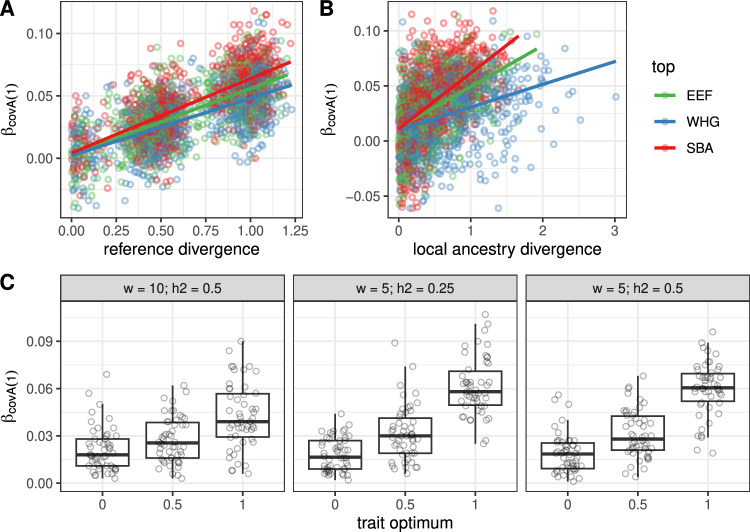
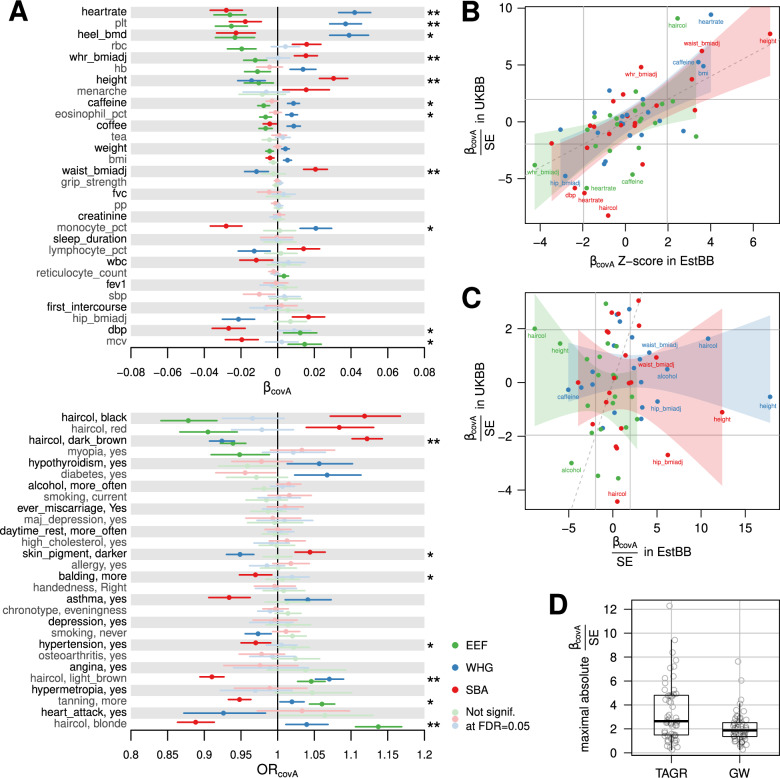
The genetic structure in Europe was mostly shaped by admixture between the Western Hunter-Gatherers, Early European Farmers and Steppe Bronze Age ancestral components. Such structure is regarded as a confounder in GWAS and follow-up studies, and gold-standard methods exist to correct for it. However, it is still poorly understood to which extent these ancestral components contribute to complex trait variation in present-day Europe. In this work we harness the UK Biobank to address this question. By extensive demographic simulations, exploiting data on siblings and incorporating previous results we obtained from the Estonian Biobank, we carefully evaluate the significance and scope of our findings. Heart rate, platelet count, bone mineral density and many other traits show stratification similar to height and pigmentation traits, likely targets of selection and divergence across ancestral groups. We show that the reported ancestry-trait associations are not driven by environmental confounders by confirming our results when using between-sibling differences in ancestry. The consistency of our results across biobanks further supports this and indicates that these genetic predispositions that derive from post-Neolithic admixture events act as a source of variability and as potential confounders in Europe as a whole.
Overview
The claims and statistics of this paper haven’t been checked yet.
Run the check — free, no account needed. It reads the open-access text and checks the sources it cites.
Integrity signals
Registry
Cites
Statistics
Figures
Verification
Claims the paper makes
The claims and statistics of this paper haven’t been checked yet.
Run the check — free, no account needed. It reads the open-access text and checks the sources it cites.
Claims other papers make about this one
Each is checked against this paper’s own text: does it say what the citing paper says it does?
The source backs part of the claim, not all of it — or backs it for a different population, condition or comparison.
In the citing paper
“We note, however, that this interpretation reflects only two axes of a potentially broader selective landscape that probably also involves other fitness-relevant phenotypes, including immunity58,59.”
From Genetic trade-offs in fertility and longevity explain the maintenance of disease-associated alleles in humans (2026) · cites this paper as [59]
Experimental — accuracy not yet measured
Self-check
Percentages, sums and reported differences re-computed from the paper’s own numbers.
The self-check needs the paper’s full text.
Citations
Cites
FinnGen provides genetic insights from a well-phenotyped isolated population
Kurki, M. I., Karjalainen, J., Palta, P., Sipilä, T. P., Kristiansson, K., Donner, K. M., Reeve, M. P., Laivuori, H., Aavikko, M., Kaunisto, M. A., et al. (2023) · Nature · doi:10.1038/s41586-022-05473-8 · Cited by 4,233
Clinical use of current polygenic risk scores may exacerbate health disparities
Martin, A. R., Kanai, M., Kamatani, Y., Okada, Y., Neale, B. M., & Daly, M. J. (2019) · Nature Genetics · doi:10.1038/s41588-019-0379-x · Cited by 2,821
Massive migration from the steppe was a source for Indo-European languages in Europe
Haak, W., Lazaridis, I., Patterson, N., Rohland, N., Mallick, S., Llamas, B., Brandt, G., Nordenfelt, S., Harney, E., Stewardson, K., et al. (2015) · Nature · doi:10.1038/nature14317 · Cited by 1,940
Genomics is failing on diversity
Popejoy, A. B., & Fullerton, S. M. (2016) · Nature · doi:10.1038/538161a · Cited by 1,924
Genome-wide association studies
Uffelmann, E., Huang, Q. Q., Munung, N. S., de Vries, J., Okada, Y., Martin, A. R., Martin, H. C., Lappalainen, T., & Posthuma, D. (2021) · Nature Reviews Methods Primers · doi:10.1038/s43586-021-00056-9 · Cited by 1,849
Khalifa, A. A. Z., Ichikawa, M., Dai, D., Kubo, S., Black, C. S., Peri, K., McAlear, T. S., Veyron, S., Yang, S. K., Vargas, J., et al. (2020) · eLife · doi:10.7554/elife.52760 · Cited by 1,676
Population genomics of Bronze Age Eurasia
Allentoft, M. E., Sikora, M., Sjögren, K.-G., Rasmussen, S., Rasmussen, M., Stenderup, J., Damgaard, P. B., Schroeder, H., Ahlström, T., Vinner, L., et al. (2015) · Nature · doi:10.1038/nature14507 · Cited by 1,550
Self-citationGenome-wide patterns of selection in 230 ancient Eurasians
Mathieson, I., Lazaridis, I., Rohland, N., Mallick, S., Patterson, N., Roodenberg, S. A., Harney, E., Stewardson, K., Fernandes, D., Novak, M., et al. (2015) · Nature · doi:10.1038/nature16152 · Cited by 1,515
Ancient human genomes suggest three ancestral populations for present-day Europeans
Lazaridis, I., Patterson, N., Mittnik, A., Renaud, G., Mallick, S., Kirsanow, K., Sudmant, P. H., Schraiber, J. G., Castellano, S., Lipson, M., et al. (2014) · Nature · doi:10.1038/nature13673 · Cited by 1,357
Self-citationRevising the human mutation rate: implications for understanding human evolution
Scally, A., & Durbin, R. (2012) · Nature Reviews Genetics · doi:10.1038/nrg3295 · Cited by 610
Research works printed but not linked: 40
- Abdellaoui A, Yengo L, Verweij KJH, Visscher PM. 15 years of GWAS discovery: realizing the promise. Am J Hum Genet. 2023;110:179–94. S0002929722005456. · DOI
- Bycroft C, Freeman C, Petkova D, Band G, Elliott LT, Sharp K, et al. The UK Biobank resource with deep phenotyping and genomic data. Nature 2018;562:203–9. · DOI · Paper page
- Leitsalu L, Haller T, Esko T, Tammesoo ML, Alavere H, Snieder H, et al. Cohort profile: Estonian biobank of the Estonian Genome Center, University of Tartu. Int J Epidemiol. 2015;44:1137–47. · DOI
- Sijtsma A, Rienks J, Van Der Harst P, Navis G, Rosmalen JGM, Dotinga A. Cohort profile update: lifelines, a three-generation cohort study and biobank. Int J Epidemiol. 2022;51:e295–302. · DOI
- Kachuri L, Chatterjee N, Hirbo J, Schaid DJ, Martin I, Kullo IJ, et al. Principles and methods for transferring polygenic risk scores across global populations. Nat Rev Genet. 2024;25:8–25. · DOI
- Price AL, Patterson NJ, Plenge RM, Weinblatt ME, Shadick NA, Reich D. Principal components analysis corrects for stratification in genome-wide association studies. Nat Genet. 2006;38:904–9. · DOI · Paper page
- Loh PR, Tucker G, Bulik-Sullivan BK, Vilhjálmsson BJ, Finucane HK, Salem RM, et al. Efficient Bayesian mixed-model analysis increases association power in large cohorts. Nat Genet. 2015;47:284–90. · DOI · Paper page
- Zhou W, Nielsen JB, Fritsche LG, Dey R, Gabrielsen ME, Wolford BN, et al. Efficiently controlling for case-control imbalance and sample relatedness in large-scale genetic association studies. Nat Genet. 2018;50:1335–41. · DOI · Paper page
- Kerminen S, Martin AR, Koskela J, Ruotsalainen SE, Havulinna AS, Surakka I, et al. Geographic variation and bias in the polygenic scores of complex diseases and traits in Finland. Am J Hum Genet. 2019;104:1169–81. · DOI
- Pankratov V, Montinaro F, Kushniarevich A, Hudjashov G, Jay F, Saag L, et al. Differences in local population history at the finest level: the case of the Estonian population. Eur J Hum Genet. 2020;28:1580–91. · DOI
- Helgason A, Yngvadóttir B, Hrafnkelsson B, Gulcher J, Stefánsson K. An Icelandic example of the impact of population structure on association studies. Nat Genet. 2005;37:90–5. · DOI
- Zaidi AA, Mathieson I. Demographic history mediates the effect of stratification on polygenic scores. eLife 2020;9:1–30. · DOI · Paper page
- Pärna K, Nolte IM, Snieder H, Fischer K, Estonian Biobank Research Team, Marnetto D, et al. A principal component informed approach to address polygenic risk score transferability across European cohorts. Front Genet. 2022;13:899523. · DOI
- Mostafavi H, Harpak A, Agarwal I, Conley D, Pritchard JK, Przeworski M. Variable prediction accuracy of polygenic scores within an ancestry group. eLife 2020;9:e48376. · DOI · Paper page
- Barton N, Hermisson J, Nordborg M. Why structure matters. eLife 2019;8:e45380. · DOI
- Berg JJ, Harpak A, Sinnott-Armstrong N, Joergensen AM, Mostafavi H, Field Y, et al. Reduced signal for polygenic adaptation of height in UK Biobank. eLife 2019;8:1–47. · DOI · Paper page
- Sohail M, Maier RM, Ganna A, Bloemendal A, Martin AR, Turchin MC, et al. Polygenic adaptation on height is overestimated due to uncorrected stratification in genome-wide association studies. eLife 2019;8:1–17. · DOI · Paper page
- Marchi N, Winkelbach L, Schulz I, Brami M, Hofmanová Z, Blöcher J, et al. The genomic origins of the world’s first farmers. Cell 2022;185:1842–59.e18. · DOI
- Cox SL, Ruff CB, Maier RM, Mathieson I. Genetic contributions to variation in human stature in prehistoric Europe. Proc Natl Acad Sci USA. 2019;116:21484–92. · DOI
- Ju D, Mathieson I. The evolution of skin pigmentation-associated variation in West Eurasia. Proc Natl Acad Sci. 2021;118:e2009227118. · DOI
- Berens AJ, Cooper TL, Lachance J. The genomic health of ancient hominins. Hum Biol. 2017;89:7. · DOI
- Irving-Pease EK, Refoyo-Martínez A, Ingason A, Pearson A, Fischer A, Barrie W, et al. The selection landscape and genetic legacy of ancient Eurasians. Evol Biol; 2022. Available from: https://doi.org/10.1101/2022.09.22.509027. · DOI
- Saag L, Vasilyev SV, Varul L, Kosorukova NV, Gerasimov DV, Oshibkina SV, et al. Genetic ancestry changes in Stone to Bronze age transition in the East European plain. Sci Adv. 2021;7:eabd6535. · DOI
- Marnetto D, Pankratov V, Mondal M, Montinaro F, Pärna K, Vallini L, et al. Ancestral genomic contributions to complex traits in contemporary Europeans. Curr Biol. 2022;32:1412–9.e3. · DOI
- Haller BC, Messer PW. SLiM 4: multispecies eco-evolutionary modeling. Am Nat. 2023;201:E127–39. · DOI
- Ding Y, Hou K, Xu Z, Pimplaskar A, Petter E, Boulier K, et al. Polygenic scoring accuracy varies across the genetic ancestry continuum. Nature 2023;618:774–81. · DOI
- Sakaue S, Hirata J, Kanai M, Suzuki K, Akiyama M, Lai Too C, et al. Dimensionality reduction reveals fine-scale structure in the Japanese population with consequences for polygenic risk prediction. Nat Commun. 2020;11:1569. · DOI
- Baumdicker F, Bisschop G, Goldstein D, Gower G, Ragsdale AP, Tsambos G, et al. Efficient ancestry and mutation simulation with msprime 1.0. Browning S, editor. Genetics. 2022;220:iyab229. · DOI
- Yair S, Coop G. Population differentiation of polygenic score predictions under stabilizing selection. Philos Trans R Soc B Biol Sci. 2022;377:20200416. · DOI
- Mallick S, Micco A, Mah M, Ringbauer H, Lazaridis I, Olalde I, et al. The Allen Ancient DNA Resource (AADR): a curated compendium of ancient human genomes. Genomics; 2023. Available from: https://doi.org/10.1101/2023.04.06.535797. · DOI
- Sollis E, Mosaku A, Abid A, Buniello A, Cerezo M, Gil L, et al. The NHGRI-EBI GWAS Catalog: knowledgebase and deposition resource. Nucleic Acids Res. 2023;51:D977–85. · DOI · Paper page
- The 1000 Genomes Project Consortium, Auton A, Abecasis GR, Altshuler DM, Durbin RM, Bentley DR, et al. A global reference for human genetic variation. Nature 2015;526:68–74. · DOI · Paper page
- The International HapMap 3 Consortium. Integrating common and rare genetic variation in diverse human populations. Nature. 2010;467:52–8. · DOI · Paper page
- Finucane HK, Bulik-Sullivan B, Gusev A, Trynka G, Reshef Y, Loh PR, et al. Partitioning heritability by functional annotation using genome-wide association summary statistics. Nat Genet. 2015;47:1228–35. · DOI · Paper page
- De Lorenzo F. Cold adaptation and the seasonal distribution of acute myocardial infarction. QJM 1999;92:747–51. · DOI
- Mourot L, Bouhaddi M, Regnard J. Effects of the cold pressor test on cardiac autonomic control in normal subjects. Physiol Res. 2009;58:83–91. · DOI
- LeBlanc J, Dulac S, Cote J, Girard B. Autonomic nervous system and adaptation to cold in man. J Appl Physiol. 1975;39:181–6. · DOI
- Bortolini E, Pagani L, Oxilia G, Posth C, Fontana F, Badino F, et al. Early Alpine occupation backdates westward human migration in Late Glacial Europe. Curr Biol. 2021;31:2484–93.e7. · DOI
- Le MK, Smith OS, Akbari A, Harpak A, Reich D, Narasimhan VM. 1000 ancient genomes uncover 10,000 years of natural selection in Europe. Genomics; 2022. Available from: https://doi.org/10.1101/2022.08.24.505188. · DOI
- Kerner G, Neehus AL, Philippot Q, Bohlen J, Rinchai D, Kerrouche N, et al. Genetic adaptation to pathogens and increased risk of inflammatory disorders in post-Neolithic Europe. Cell Genom. 2023;3:100248. · DOI
Cited by
Sorted by citations
Brigos-Barril, E., Vasallo, C., Farré, X., Morcillo-Suárez, C., Polo-Alonso, S., Rodríguez-Fernández, B., Valenzuela, A., Sarabia, C., Bosch, E., Laayouni, H., et al. (2026) · Nature Ecology & Evolution · doi:10.1038/s41559-026-03140-z · Cited by 6
Effects of introgressed Neanderthal alleles on present-day brain morphology
Zeloni, R., Amaolo, A., Morez Jacobs, A., Zapparoli, E., Akl, Y., Shafie, M., Huerta-Sanchez, E., Pizzagalli, F., Provero, P., Pagani, L., et al. (2026) · bioRxiv · doi:10.64898/2026.04.14.718380
“As in other analyses 54,55 , we therefore resorted to limiting the burden calculation to a set of trait-associated genomic regions, selecting 200kb windows centered on loci suggestively associated to at least one BIDP (P ACAT 10 -5 ).”
Self-citation
Metadata
- Authors
- Pankratov, V., Mezzavilla, M., Aneli, S., Kuznetsov, I. A., Fusco, D., Wilson, J. F., Metspalu, M., Provero, P., Pagani, L., & Marnetto, D.
- Venue
- European Journal of Human Genetics
- Published
- 2024-08-10
- Volume
- 32
- Issue
- 11
- Pages
- 1492-1499
- ISSN
- 1018-4813
- 1476-5438
- PMC
- PMC11576899
- Cited by
- 10
- References
- 12
- Language
- en
- Funders
- Università degli Studi di Torino (Grant For Internationalization 2022)
- EC | Horizon 2020 Framework Programme (810645)
- EC | European Regional Development Fund (MOBEC008)
- Eesti Teadusagentuur (PRG1899)
About these checks
Registry, retraction, Cites and statistics results are computed, not judged, with one exception: a printed reference that no index lists is read once by a model before it counts as a citation error. Claims are extracted by a model and kept only when their quote appears verbatim in the text; each cited source is then checked, with a model’s help, for whether it says what the claim relies on. Those verdicts can be wrong — read the claim’s quote and the cited source before relying on one.
Statistics and arithmetic are recomputed, not judged.
Confidence bands are shown only for fields calibrated on our annotated test set. None is calibrated yet, so no band is shown.
What counts as a claim ›How we measure confidence ›How we check this ›
Are you an author, or do you see a problem with this page? Request a review
