

Stem cell senescence drives age-attenuated induction of pituitary tumours in mouse models of paediatric craniopharyngioma
Open accessThe DOI matches its Crossref record; 70 of the 70 references it cites were found in a registry or an index.
Abstract
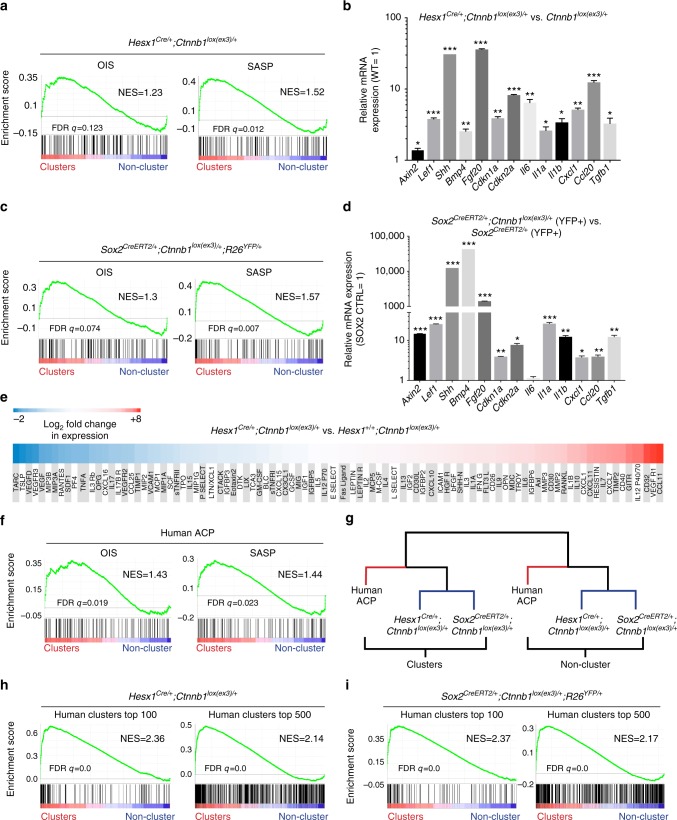
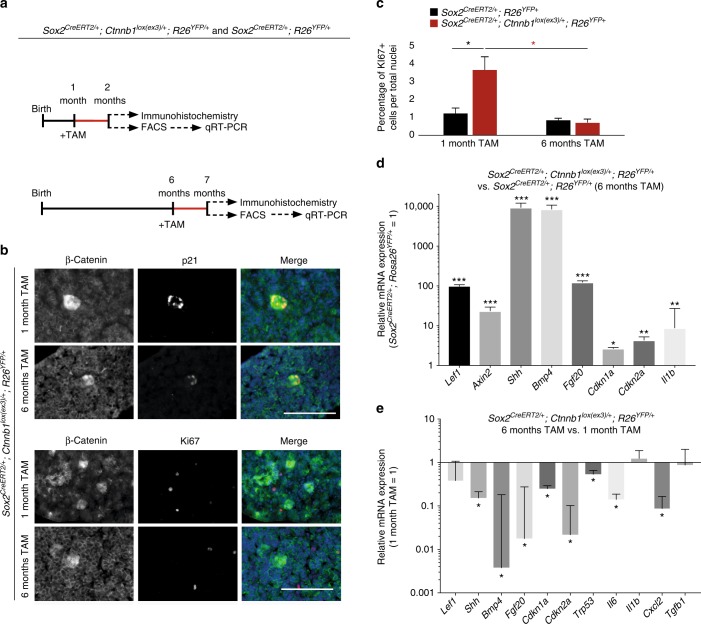
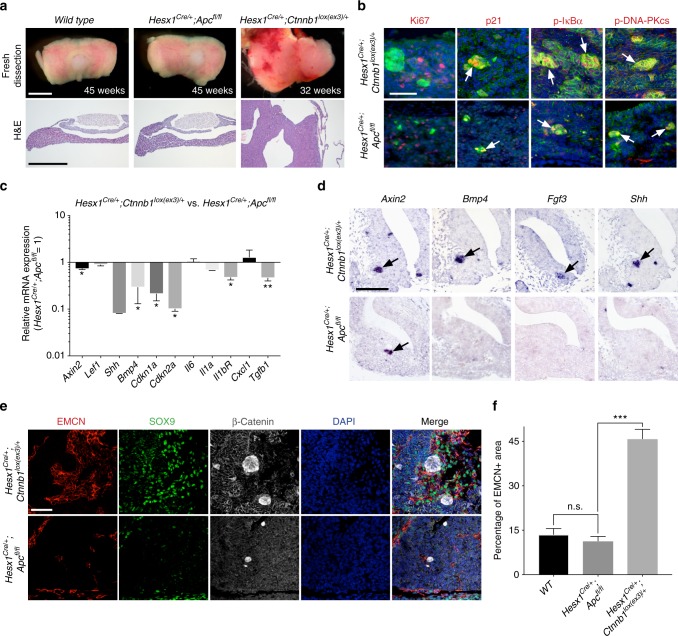
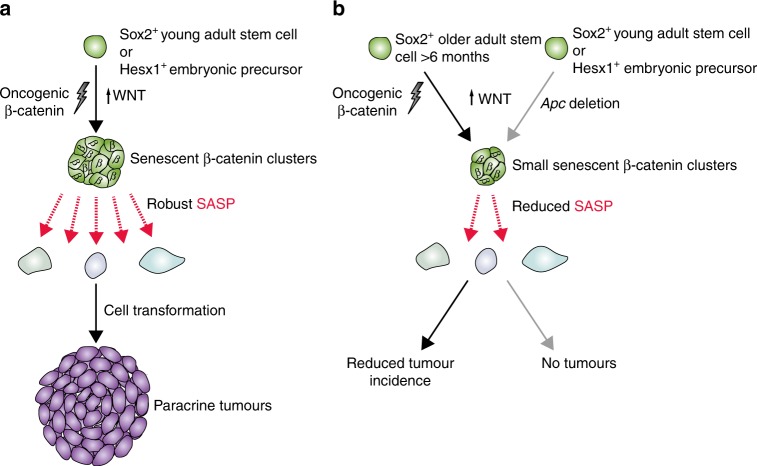
Senescent cells may promote tumour progression through the activation of a senescence-associated secretory phenotype (SASP), whether these cells are capable of initiating tumourigenesis in vivo is not known. Expression of oncogenic β-catenin in Sox2+ young adult pituitary stem cells leads to formation of clusters of stem cells and induction of tumours resembling human adamantinomatous craniopharyngioma (ACP), derived from Sox2− cells in a paracrine manner. Here, we uncover the mechanisms underlying this paracrine tumourigenesis. We show that expression of oncogenic β-catenin in Hesx1+ embryonic precursors also results in stem cell clusters and paracrine tumours. We reveal that human and mouse clusters are analogous and share a common signature of senescence and SASP. Finally, we show that mice with reduced senescence and SASP responses exhibit decreased tumour-inducing potential. Together, we provide evidence that senescence and a stem cell-associated SASP drive cell transformation and tumour initiation in vivo in an age-dependent fashion.
Overview
The claims and statistics of this paper haven’t been checked yet.
Free: it reads the open-access text and checks the first 5 claims that cite a source we can check. Create a free account to check every claim.
Integrity signals
Registry
Cites
Statistics
Figures
Verification
Claims the paper makes
The claims and statistics of this paper haven’t been checked yet.
Free: it reads the open-access text and checks the first 5 claims that cite a source we can check. Create a free account to check every claim.
Claims other papers make about this one
Each is checked against this paper’s own text: does it say what the citing paper says it does?
The source backs part of the claim, not all of it — or backs it for a different population, condition or comparison.
In the citing paper
“Similarly, pediatric craniopharyngiomas depend on the SASP of a cluster of senescent stem cells expressing oncogenic β-catenin (González-Meljem et al. 2017).”
From Senescence and the SASP: many therapeutic avenues (2020) · cites this paper as González-Meljem et al. 2017
Experimental — accuracy not yet measuredThe cited source says what the claim attributes to it.
In the citing paper
“In addition, through SASP, senescent cells contribute to cancer development162,163 and metastasis164, treatment failure and increased risk of recurrence165.”
From Cellular senescence in ageing: from mechanisms to therapeutic opportunities (2021) · cites this paper as [163]
In the citing paper
“confirmed, as previously shown 38, that preneoplastic clusters of β-catenin positive cells were senescent: they were arrested (ki67 -) and enriched for markers of senescent such as p21CIP1 or Glb1”
From Cardiac glycosides are broad-spectrum senolytics (2019) · cites this paper as [38]
Self-check
Percentages, sums and reported differences re-computed from the paper’s own numbers.
The self-check needs the paper’s full text.
Citations
Cites
Moderated estimation of fold change and dispersion for RNA-seq data with DESeq2
Love, M. I., Huber, W., & Anders, S. (2014) · Genome Biology · doi:10.1186/s13059-014-0550-8 · Cited by 95,106
Subramanian, A., Tamayo, P., Mootha, V. K., Mukherjee, S., Ebert, B. L., Gillette, M. A., Paulovich, A., Pomeroy, S. L., Golub, T. R., Lander, E. S., et al. (2005) · Proceedings of the National Academy of Sciences · doi:10.1073/pnas.0506580102 · Cited by 53,625
Oncogenic ras provokes premature cell senescence associated with accumulation of p53 and p16INK4a
Serrano, M., Lin, A. W., McCurrach, M. E., Beach, D., & Lowe, S. W. (1997) · Cell · doi:10.1016/s0092-8674(00)81902-9 · Cited by 5,218 · cited 1×
“Prominent or persistent SASP activation has been shown to: (1) disrupt cell–cell adhesion and induce epithelial-tomesenchymal transition and invasiveness14, 15; (2) cause local inflammation12, 16; (3) modify tissue architecture17, 18; (4) facilitate development of hepatic cancer after carcinogen exposure19, 20; (5) st…”
BackgroundThe senescence-associated secretory phenotype: the dark side of tumor suppression
Coppé, J.-P., Desprez, P.-Y., Krtolica, A., & Campisi, J. (2010) · Annual Review of Pathology: Mechanisms of Disease · doi:10.1146/annurev-pathol-121808-102144 · Cited by 5,206
A global double-fluorescent Cre reporter mouse
Muzumdar, M. D., Tasic, B., Miyamichi, K., Li, L., & Luo, L. (2007) · genesis · doi:10.1002/dvg.20335 · Cited by 3,491
Aging, Cellular Senescence, and Cancer
Campisi, J. (2013) · Annual Review of Physiology · doi:10.1146/annurev-physiol-030212-183653 · Cited by 2,954 · cited 1×
“Prominent or persistent SASP activation has been shown to: (1) disrupt cell–cell adhesion and induce epithelial-tomesenchymal transition and invasiveness14, 15; (2) cause local inflammation12, 16; (3) modify tissue architecture17, 18; (4) facilitate development of hepatic cancer after carcinogen exposure19, 20; (5) st…”
BackgroundNaturally occurring p16Ink4a-positive cells shorten healthy lifespan
Baker, D. J., Childs, B. G., Durik, M., Wijers, M. E., Sieben, C. J., Zhong, J., A. Saltness, R., Jeganathan, K. B., Verzosa, G. C., Pezeshki, A., et al. (2016) · Nature · doi:10.1038/nature16932 · Cited by 2,876
A complex secretory program orchestrated by the inflammasome controls paracrine senescence
Acosta, J. C., Banito, A., Wuestefeld, T., Georgilis, A., Janich, P., Morton, J. P., Athineos, D., Kang, T.-W., Lasitschka, F., Andrulis, M., et al. (2013) · Nature Cell Biology · doi:10.1038/ncb2784 · Cited by 2,278
Self-citationPersistent DNA damage signalling triggers senescence-associated inflammatory cytokine secretion
Rodier, F., Coppé, J.-P., Patil, C. K., Hoeijmakers, W. A. M., Muñoz, D. P., Raza, S. R., Freund, A., Campeau, E., Davalos, A. R., & Campisi, J. (2009) · Nature Cell Biology · doi:10.1038/ncb1909 · Cited by 2,232
Obesity-induced gut microbial metabolite promotes liver cancer through senescence secretome
Yoshimoto, S., Loo, T. M., Atarashi, K., Kanda, H., Sato, S., Oyadomari, S., Iwakura, Y., Oshima, K., Morita, H., Hattori, M., et al. (2013) · Nature · doi:10.1038/nature12347 · Cited by 2,219
Cited by
Items 101–138 of 138
Epigenetic dynamics of cellular senescence: From mechanistic insights to precision senotherapy
Hu, X., Lai, W., Liu, M., & Wang, B. (2026) · Chinese Medical Journal · doi:10.1097/cm9.0000000000004042 · Cited by 2
“[60] Therefore, senescence functions as a critical determinant of cellular outcome rather than a static terminal endpoint.”
Kövér, B., Willis, T. L., Sherwin, O., Kaufman-Cook, J., Kemkem, Y., Segoviano, M. V., Lodge, E. J., Zamojski, M., Mendelev, N., Zhang, Z., et al. (2026) · Yearbook of pediatric endocrinology · doi:10.1016/j.celrep.2026.117407 · Cited by 4
Self-citationMolecular Developments in Parasellar Tumors and Potential Therapeutic Implications
Xekouki, P., Venetsanaki, V., Kyriakopoulos, G., Alexandraki, K., Angelousi, A. G., & Kaltsas, G. (2024) · Endocrine Reviews · doi:10.1210/endrev/bnae020 · Cited by 1
Balancing senescence and apoptosis: therapeutic insights into aging and cancer
Jan, N., Sofi, S., Mir, A. A., Masoodi, G., & Mir, M. A. (2025) · Molecular and Cellular Biochemistry · doi:10.1007/s11010-025-05355-3 · Cited by 4
“Studies conducted in this regard have demonstrated that stem cell senescence and a stem cell-associated SASP have been shown to initiate cell transformation and induce pituitary tumors in mice [169, 170].”
Zhang, H., Wang, C., Fan, J., Chen, Z., Yu, H., Bai, Y., Zhang, T., Zhu, Q., Feng, Y., Niu, P., et al. (2025) · Advanced Science · doi:10.1002/advs.202503924 · Cited by 2
Cellular senescence in gastric cancer: a novel prognostic stratification and immune predictor
Wei, C.-Z., Li, Y., Lin, Z.-H., Lin, F.-Z., Chen, X.-J., Nie, R., Chen, G., Xue, Z., & Zheng, Z. (2026) · BMC Medical Genomics · doi:10.1186/s12920-026-02346-1 · Cited by 1
Mouse Models of Craniopharyngioma
Apps, J. R., & Martínez-Barberá, J. P. (2020) · Springer eBooks · doi:10.1007/978-3-030-41176-3_2 · Cited by 1
Self-citationBaykal, D., Sönmez, Ö., & Sav, A. (2023) · Acta Scientific Neurology · doi:10.31080/asne.2023.06.0601 · Cited by 1
Biology of Pituitary Stem Cells
Millan, M. I. P., Cheung, L., & Camper, S. A. (2021) · Elsevier eBooks · doi:10.1016/b978-0-12-819801-8.00003-x
The Immunology and Biology of Brain Tumors
Graner, M. W. (2021) · MDPI eBooks · doi:10.3390/books978-3-0365-0103-1
An Overview of the Role of Senescence in Cancer
Al-Janabi, I. I. (2022) · Al-Rafidain Journal of Medical Sciences · doi:10.54133/ajms.v3i.77
“A recent study was able to show that SASP components were able to not only increase the progression of existing tumors but also aid in the initiation of cancer [135].”
BackgroundDe novo adamantinomatous craniopharyngioma with long-term pre-diagnostic imaging
Nassif, R. B., Ahmadieh, T. Y. E., Abou-Mrad, Z., Rosenblum, M. K., Cohen, M., & Tabar, V. S. (2023) · Neurochirurgie · doi:10.1016/j.neuchi.2023.101404
Study of the role of the cyclin-dependent kinase inhibitor p21Waf1/Cip1 in cellular senescence
Zapata-Bodalo, I. (2022) · theses.fr (ABES) · doi:10.70675/db01e49aza2daz4404za0f1za3db90231ce9
The interconnections between gerontogen, aging, and senotherapy
Rahma, R., & Barinda, A. J. (2024) · Journal of Applied Pharmaceutical Science · doi:10.7324/japs.2024.184140
“At the end of the DDR signaling pathway, ATM activates p53, triggering the expression of CDKI p21, resulting in cell cycle termination [21].”
BackgroundTena‐Suck, M. L., Villanueva-Castro, E., Muñuzuri-Camacho, M. A., Apo, E. G., Salinas-Lara, C., Sánchez-Garibay, C., Fernández‐Valverde, F., Sánchez-García, A. D. C., & Ortíz-Plata, A. (2024) · Preprints.org · doi:10.20944/preprints202410.2229.v1
Vardon, A., Haston, S., Guiho, R., Carvahlo, D., Carter, R., Boult, J. K. R., Gharai, D., Santhakumar, D., Cloete, I., Gray, J., et al. (2024) · bioRxiv (Cold Spring Harbor Laboratory) · doi:10.1101/2024.12.20.629607 · Cited by 1
Self-citationTransfer of Aging: Implications for Pediatric Solid Organ Transplantation
Gudenberg, R. W. V., Eckholt, L. S. J., Moosburner, S., Greve, D., Boerger, L., Walter, K. A., Wert, L., Geiger, D., Penkalla, A., Schmitto, J. D., et al. (2025) · Pediatric Transplantation · doi:10.1111/petr.70226
“These SASP-secreting cells act as signaling hubs, reshaping the tumor micro-environment and promoting disease progression [42].”
InfluentialApps, J. R., González-Meljem, J. M., Guiho, R., Pickles, J. C., Prince, E. W., Schwalbe, E., Joshi, N., Stone, T. J., Ogunbiyi, O. K., Chalker, J., et al. (2024) · Figshare · doi:10.6084/m9.figshare.26759138
Self-citationApps, J. R., González-Meljem, J. M., Guiho, R., Pickles, J. C., Prince, E. W., Schwalbe, E., Joshi, N., Stone, T. J., Ogunbiyi, O. K., Chalker, J., et al. (2024) · Figshare · doi:10.6084/m9.figshare.26759141
Self-citationApps, J. R., González-Meljem, J. M., Guiho, R., Pickles, J. C., Prince, E. W., Schwalbe, E., Joshi, N., Stone, T. J., Ogunbiyi, O. K., Chalker, J., et al. (2024) · Figshare · doi:10.6084/m9.figshare.26759144
Self-citationApps, J. R., González-Meljem, J. M., Guiho, R., Pickles, J. C., Prince, E. W., Schwalbe, E., Joshi, N., Stone, T. J., Ogunbiyi, O. K., Chalker, J., et al. (2024) · Figshare · doi:10.6084/m9.figshare.26759129
Self-citationApps, J. R., González-Meljem, J. M., Guiho, R., Pickles, J. C., Prince, E. W., Schwalbe, E., Joshi, N., Stone, T. J., Ogunbiyi, O. K., Chalker, J., et al. (2024) · Figshare · doi:10.6084/m9.figshare.26759132
Self-citationApps, J. R., González-Meljem, J. M., Guiho, R., Pickles, J. C., Prince, E. W., Schwalbe, E., Joshi, N., Stone, T. J., Ogunbiyi, O. K., Chalker, J., et al. (2024) · Figshare · doi:10.6084/m9.figshare.26759135
Self-citationApps, J. R., González-Meljem, J. M., Guiho, R., Pickles, J. C., Prince, E. W., Schwalbe, E., Joshi, N., Stone, T. J., Ogunbiyi, O. K., Chalker, J., et al. (2024) · Figshare · doi:10.6084/m9.figshare.26759120
Self-citationApps, J. R., González-Meljem, J. M., Guiho, R., Pickles, J. C., Prince, E. W., Schwalbe, E., Joshi, N., Stone, T. J., Ogunbiyi, O. K., Chalker, J., et al. (2024) · Figshare · doi:10.6084/m9.figshare.26759117
Self-citationApps, J. R., González-Meljem, J. M., Guiho, R., Pickles, J. C., Prince, E. W., Schwalbe, E., Joshi, N., Stone, T. J., Ogunbiyi, O. K., Chalker, J., et al. (2024) · Figshare · doi:10.6084/m9.figshare.26759123
Self-citationApps, J. R., González-Meljem, J. M., Guiho, R., Pickles, J. C., Prince, E. W., Schwalbe, E., Joshi, N., Stone, T. J., Ogunbiyi, O. K., Chalker, J., et al. (2024) · Figshare · doi:10.6084/m9.figshare.26759126
Self-citationOnderzoek van de biologie van stamcellen in hypofysetumoren en afgeleide organoïden
Nys, C. (2022) · Lirias
Vennekens, A. (2022) · Lirias
Vardon, A., Haston, S., Hamdi, H., Cooksley, G., Guiho, R., Carvalho, D., Carter, R., Rowena Boult, J. K., Gharai, D., Cloete, I., et al. (2025) · UCL Discovery (University College London) · Cited by 1
Self-citationYang, S., Dai, Z., Yang, B., Wang, J., Li, S., Liu, Y., & Chen, Q. (2026) · Ecotoxicology and Environmental Safety · doi:10.1016/j.ecoenv.2026.120288
Dong, X., Sun, Q., Tu, M., Wei, Q., Liu, X., & Su, B. (2026) · Journal of Cell Science · doi:10.1242/jcs.264763
Stem cells of the hypothalamic-pituitary-adrenal axis
Sherwin, O., Basham, K. J., & Andoniadou, C. L. (2026) · Endocrine Reviews · doi:10.1210/endrev/bnag024
Self-citationAdult neural stem cell pools in homeostasis and pathogenesis
Li, S., Shi, X., Sun, X., & Wu, Q. (2026) · Seminars in Cell and Developmental Biology · doi:10.1016/j.semcdb.2026.103685
Hou, K., Wang, Y., Guo, T., Song, J., Li, Q., & Pan, Y. (2026) · Neurosurgical Review · doi:10.1007/s10143-026-04483-8
“Studies have shown that in ACP, the senescence-associated secretory phenotype (SASP) acts on surrounding epithelial tumor cells, promoting tumor proliferation and invasion while also fostering the development of the tumor microenvironment [32–34].”
Blackburn, J., Nicholson, J., Gomez-Corral, L., Xue, J., Rai, A., Finn, B. P., Tan, R. J. L., Chakravarthi, K. C., Gualtieri, A., Hall, C. L., et al. (2026) · EMBO Molecular Medicine · doi:10.1038/s44321-026-00525-2
Xiao, R., Hong, J. H., Wang, P., Zhong, Y., Ye, Z., Hao, Z., Gao, J., Yu, J., Peng, Y., Chen, S., et al. (2026) · Cancer Letters · doi:10.1016/j.canlet.2026.218902
Metadata
- Authors
- Gonzalez-Meljem, J. M., Haston, S., Carreno, G., Apps, J. R., Pozzi, S., Stache, C., Kaushal, G., Virasami, A., Panousopoulos, L., Mousavy-Gharavy, S. N., Guerrero, A., Rashid, M., Jani, N., Goding, C. R., Jacques, T. S., Adams, D. J., Gil, J., Andoniadou, C. L., & Martinez-Barbera, J. P.
- Affiliations
- University College London (GB)
- Great Ormond Street Hospital (GB)
- Imperial College London (GB)
- Wellcome Sanger Institute (GB)
- University of Oxford (GB)
- Guy's Hospital (GB)
- ORCID
- Venue
- Nature Communications
- Published
- 2017-11-28
- Volume
- 8
- Issue
- 1
- Pages
- 1819-1819
- ISSN
- 2041-1723 (ISSN-L)
- PMC
- PMC5703905
- OpenAlex
- W2768478289
- Cited by
- 130
- References
- 70
- Citations by year
- 2026: 9 · 2025: 17 · 2024: 26 · 2023: 16 · 2022: 16 · 2021: 11 · 2020: 17 · 2019: 9 · 2018: 9
- FWCI
- 7.08
- Type
- journal article
- Language
- en
- Open access
- gold
- doi.org
- Licence
- cc-by
- creativecommons.org/licenses/by/4.0 (tdm)
- creativecommons.org/licenses/by/4.0 (vor)
- Locations
- Nature Communications (publishedVersion, cc-by)
- Europe PMC (PubMed Central) (publishedVersion, cc-by)
- PubMed Central (publishedVersion, cc-by)
- PubMed (publishedVersion)
- Research Portal (King's College London) (submittedVersion, cc-by)
- RePEc: Research Papers in Economics (submittedVersion)
- DOAJ (DOAJ: Directory of Open Access Journals) (submittedVersion, cc-by-sa)
- DOAJ (DOAJ: Directory of Open Access Journals) (submittedVersion)
- UCL Discovery (University College London) (submittedVersion)
- Spiral (Imperial College London) (submittedVersion, cc-by)
- Funders
- Wellcome Trust
- NIHR Biomedical Research Centre, Royal Marsden NHS Foundation Trust/Institute of Cancer Research
- Cancer Research UK (13031, S_1731)
- National Institute for Health and Care Research
- University College London
- CHILDREN with CANCER UK (15/190, W1055)
- Consejo Nacional de Ciencia y Tecnología
- Great Ormond Street Hospital for Children
- University of California, Los Angeles
- Medical Research Council (MR/M000125/1, MR/L016729/1)
- National Cancer Institute (P01CA128814)
- Topics
- Life Sciences › Biochemistry, Genetics and Molecular Biology › Cell Biology › Telomeres, Telomerase, and Senescence
- Health Sciences › Medicine › Endocrinology, Diabetes and Metabolism › Pituitary Gland Disorders and Treatments
- Life Sciences › Biochemistry, Genetics and Molecular Biology › Aging › Genetics, Aging, and Longevity in Model Organisms
- Keywords
- stem cell senescence, senescence-associated secretory phenotype, pituitary tumors, adamantinomatous craniopharyngioma, β-catenin, HESX1, cell transformation
- MeSH terms
- Exome Sequencing, Aniline Compounds, Animals, Biphenyl Compounds, Cell Transformation, Neoplastic, Child, Craniopharyngioma, Disease Models, Animal, Humans, Nitrophenols, Oncogenes, Piperazines, Pituitary Gland, Pituitary Neoplasms, Repressor Proteins, Sulfonamides, Neoplastic Stem Cells, Cellular Senescence, Homeodomain Proteins, beta Catenin, Mice, SOXB1 Transcription Factors, Young Adult
About these checks
Registry, retraction, Cites and statistics results are computed, not judged, with one exception: a printed reference that no index lists is read once by a model before it counts as a citation error. Claims are extracted by a model and kept only when their quote appears verbatim in the text; each cited source is then checked, with a model’s help, for whether it says what the claim relies on. Those verdicts can be wrong — read the claim’s quote and the cited source before relying on one.
Statistics and arithmetic are recomputed, not judged.
Confidence bands are shown only for fields calibrated on our annotated test set. None is calibrated yet, so no band is shown.
What counts as a claim ›How we measure confidence ›How we check this ›
Are you an author, or do you see a problem with this page? Request a review
Data sources
Bibliographic data: Semantic Scholar, OpenAlex, Crossref.
Contains information from the Semantic Scholar Academic Graph Datasets, made available under the ODC Attribution License (ODC-BY 1.0).
Semantic Scholar’s data is described in: Kinney, R., et al. (2023). The Semantic Scholar Open Data Platform. arXiv:2301.10140.
