

The DOI matches its Crossref record; 37 of the 37 references it cites were found in a registry or an index.
Super-radiance reveals infinite-range dipole interactions through a nanofiber
Open accessAbstract
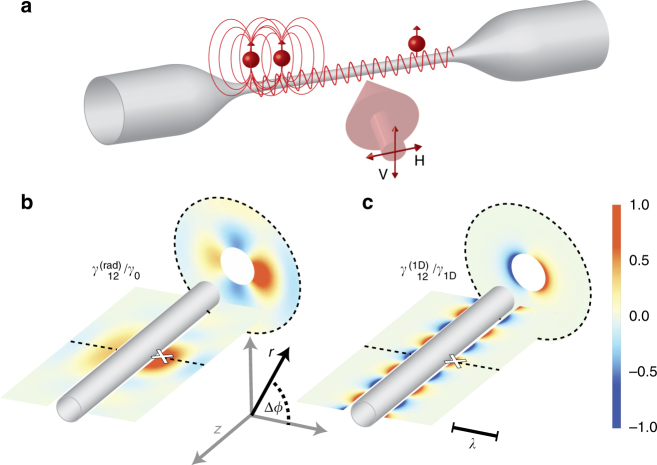
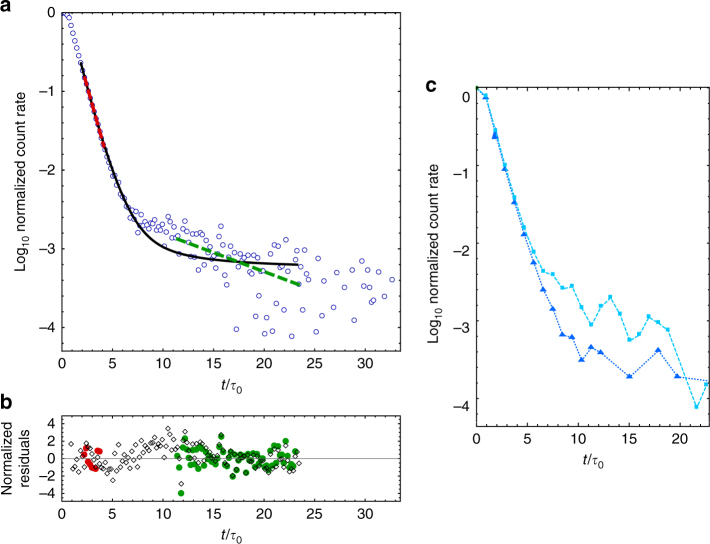
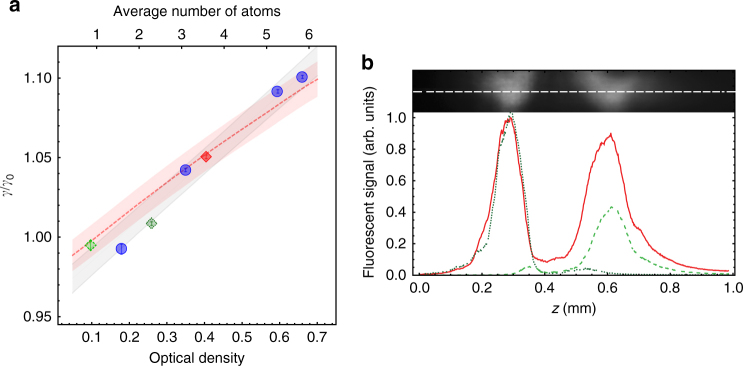
Abstract Atoms interact with each other through the electromagnetic field, creating collective states that can radiate faster or slower than a single atom, i.e., super- and sub-radiance. When the field is confined to one dimension it enables infinite-range atom–atom interactions. Here we present the first report of infinite-range interactions between macroscopically separated atomic dipoles mediated by an optical waveguide. We use cold 87 Rb atoms in the vicinity of a single-mode optical nanofiber (ONF) that coherently exchange evanescently coupled photons through the ONF mode. In particular, we observe super-radiance of a few atoms separated by hundreds of resonant wavelengths. The same platform allows us to measure sub-radiance, a rarely observed effect, presenting a unique tool for quantum optics. This result constitutes a proof of principle for collective behavior of macroscopically delocalized atomic states, a crucial element for new proposals in quantum information and many-body physics.
Overview
The claims and statistics of this paper haven’t been checked yet.
Run the check — free, no account needed. It reads the open-access text and checks the sources it cites.
Integrity signals
Registry
Cites
Statistics
Figures
Verification
Claims the paper makes
The claims and statistics of this paper haven’t been checked yet.
Run the check — free, no account needed. It reads the open-access text and checks the sources it cites.
Claims other papers make about this one
Each is checked against this paper’s own text: does it say what the citing paper says it does?
In the citing paper
“Those authors cited theoretical work (Solano et al., 2017) in support of the “tantalizing possibility” that the physiological arrangement of MTs in axons could magnify the collective interaction “to an extremely long range.””
From Microtubule-stabilizer epothilone B delays anesthetic-induced unconsciousness in rats (2024) · cites this paper as Solano et al., 2017
Self-check
Percentages, sums and reported differences re-computed from the paper’s own numbers.
The self-check needs the paper’s full text.
Citations
Cites
Coherence in Spontaneous Radiation Processes
Dicke, R. H. (1954) · Physical Review · doi:10.1103/physrev.93.99 · Cited by 7,445
Kimble, H. J. (2008) · Nature · doi:10.1038/nature07127 · Cited by 6,023
Lodahl, P., Mahmoodian, S., Stobbe, S., Rauschenbeutel, A., Schneeweiß, P., Volz, J., Pichler, H., & Zoller, P. (2017) · Nature · doi:10.1038/nature21037 · Cited by 1,643
Dicke quantum phase transition with a superfluid gas in an optical cavity
Baumann, K., Guerlin, C., Brennecke, F., & Esslinger, T. (2010) · Nature · doi:10.1038/nature09009 · Cited by 1,530
Non-local propagation of correlations in quantum systems with long-range interactions
Richerme, P., Gong, Z., Lee, A., Senko, C., Smith, J., Foss‐Feig, M., Michalakis, S., Gorshkov, A. V., & Monroe, C. R. (2014) · Nature · doi:10.1038/nature13450 · Cited by 764
Nanophotonic quantum phase switch with a single atom
Tiecke, T. G., Thompson, J. D., de Leon, N. P., Liu, L. R., Vuletić, V., & Lukin, M. D. (2014) · Nature · doi:10.1038/nature13188 · Cited by 562
Quantum spin dynamics and entanglement generation with hundreds of trapped ions
Bohnet, J. G., Sawyer, B. C., Britton, J. W., Wall, M. L., Rey, A. M., Foss-Feig, M., & Bollinger, J. J. (2016) · Science · doi:10.1126/science.aad9958 · Cited by 546
Superradiance for Atoms Trapped along a Photonic Crystal Waveguide
Goban, A., Hung, C.-L., Hood, J. D., Yu, S., Muniz, J. A., Painter, O. J., & Kimble, H. J. (2015) · Physical Review Letters · doi:10.1103/physrevlett.115.063601 · Cited by 540
Photon-Mediated Interactions Between Distant Artificial Atoms
van Loo, A. F., Fedorov, A., Lalumière, K., Sanders, B. C., Blais, A., & Wallraff, A. J. (2013) · Science · doi:10.1126/science.1244324 · Cited by 536
A steady-state superradiant laser with less than one intracavity photon
Bohnet, J., Chen, Z., Weiner, J. M., Meiser, D., Holland, M., & Thompson, J. K. (2012) · Nature · doi:10.1038/nature10920 · Cited by 530
Research works printed but not linked: 3
- Solano, P. et al. in Advances In Atomic, Molecular, and Optical Physics Vol. 66 (eds Arimondo, E., Lin, C. C. & Yelin, S. F.) 439–505 (Academic Press, New York, 2017).
- Asenjo-Garcia, A., Moreno-Cardoner, M., Albrecht, A., Kimble, H. J. & Chang, D. E. Exponential improvement in photon storage fidelities using subradiance and selective radiance in atomic arrays. Phys. Rev. X 7, 031024 (2017).
- O’Connor, D. & Phillips, D. Time-Correlated Single Photon Counting (Academic Press, London, 1984).
Cited by
Sorted by citations
Waveguide quantum electrodynamics: Collective radiance and photon-photon correlations
Sheremet, A. S., Petrov, M. I., Iorsh, I. V., Poshakinskiy, A. V., & Poddubny, A. N. (2023) · Reviews of Modern Physics · doi:10.1103/revmodphys.95.015002 · Cited by 395
A subradiant optical mirror formed by a single structured atomic layer
Rui, J., Wei, D., Rubio-Abadal, A., Hollerith, S., Zeiher, J., Stamper-Kurn, D., Gross, C., & Bloch, I. (2020) · Nature · doi:10.1038/s41586-020-2463-x · Cited by 307
Hybrid integration methods for on-chip quantum photonics
Kim, J.-H., Aghaeimeibodi, S., Carolan, J., Englund, D., & Waks, E. (2020) · Optica · doi:10.1364/optica.384118 · Cited by 272
“In particular, integrating the emitters into a one‐dimensional waveguide can realize long‐range interactions between the emitters [146].”
BackgroundWaveguide-coupled single collective excitation of atomic arrays
Corzo, N., Raskop, J., Chandra, A., Sheremet, A. S., Gouraud, B., & Laurat, J. (2019) · Nature · doi:10.1038/s41586-019-0902-3 · Cited by 221
Theory of Subradiant States of a One-Dimensional Two-Level Atom Chain
Zhang, Y.-X., & Mølmer, K. (2019) · Physical Review Letters · doi:10.1103/physrevlett.122.203605 · Cited by 169
Metadata
- Authors
- Solano, P., Barberis-Blostein, P., Fatemi, F. K., Orozco, L. A., & Rolston, S. L.
- Affiliations
- National Institute of Standards and Technology (US)
- Joint Quantum Institute (US)
- DEVCOM Army Research Laboratory (US)
- Corresponding author
- Solano, P.
- ORCID
- Solano, P.
- Venue
- Nature Communications
- Published
- 2017-11-30
- Volume
- 8
- Issue
- 1
- Pages
- 1857-1857
- ISSN
- 2041-1723 (ISSN-L)
- PMC
- PMC5707363
- OpenAlex
- W2729354929
- Cited by
- 247
- References
- 37
- Citations by year
- 2026: 17 · 2025: 36 · 2024: 32 · 2023: 27 · 2022: 30 · 2021: 26 · 2020: 33 · 2019: 26 · 2018: 19 · 2017: 1
- FWCI
- 10.60
- Type
- journal article
- Language
- en
- Open access
- gold
- doi.org
- Locations
- Nature Communications (publishedVersion, cc-by)
- PubMed Central (publishedVersion, cc-by)
- PubMed (publishedVersion)
- arXiv (Cornell University) (submittedVersion)
- DOAJ (DOAJ: Directory of Open Access Journals) (submittedVersion, cc-by-sa)
- arXiv (Cornell University)
- Funders
- National Science Foundation (1430094, 1307416)
- U.S. Department of Commerce
- Joint Quantum Institute (PHY-1430094, 70NANB16H168)
- National Institute of Standards and Technology (PHY-1430094, 70NANB16H168)
- Office of the Secretary of Defense
- Topics
- Physical Sciences › Physics and Astronomy › Atomic and Molecular Physics, and Optics › Quantum optics and atomic interactions
- Physical Sciences › Physics and Astronomy › Atomic and Molecular Physics, and Optics › Cold Atom Physics and Bose-Einstein Condensates
- Physical Sciences › Physics and Astronomy › Atomic and Molecular Physics, and Optics › Strong Light-Matter Interactions
- Keywords
- superradiance, optical nanofibers, optical waveguides, cold rubidium atoms, evanescent coupling, collective atomic states, quantum information
About these checks
Registry, retraction, Cites and statistics results are computed, not judged, with one exception: a printed reference that no index lists is read once by a model before it counts as a citation error. Claims are extracted by a model and kept only when their quote appears verbatim in the text; each cited source is then checked, with a model’s help, for whether it says what the claim relies on. Those verdicts can be wrong — read the claim’s quote and the cited source before relying on one.
Statistics and arithmetic are recomputed, not judged.
Confidence bands are shown only for fields calibrated on our annotated test set. None is calibrated yet, so no band is shown.
What counts as a claim ›How we measure confidence ›How we check this ›
Are you an author, or do you see a problem with this page? Request a review
