

Metasurface-assisted phase-matching-free second harmonic generation in lithium niobate waveguides
Open accessThe DOI matches its Crossref record; 39 of the 39 references it cites were found in a registry or an index.
Abstract
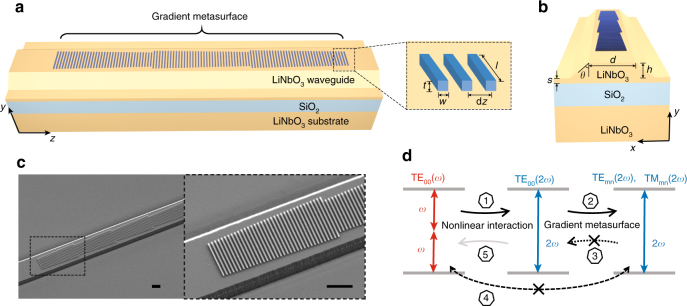
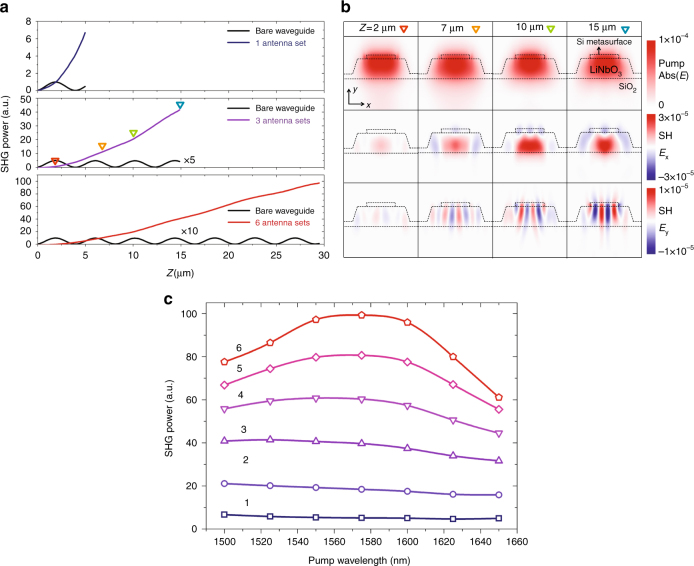
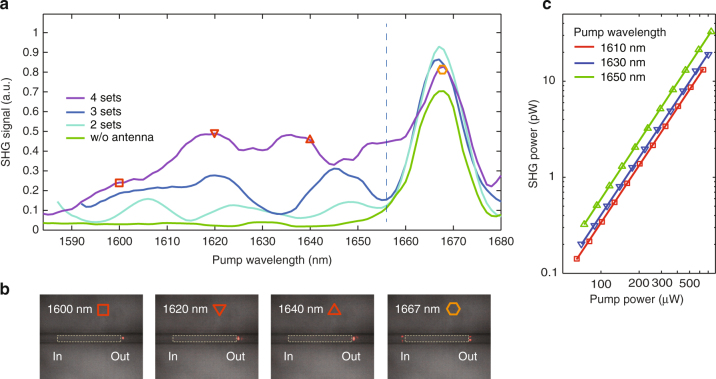
The phase-matching condition is a key aspect in nonlinear wavelength conversion processes, which requires the momenta of the photons involved in the processes to be conserved. Conventionally, nonlinear phase matching is achieved using either birefringent or periodically poled nonlinear crystals, which requires careful dispersion engineering and is usually narrowband. In recent years, metasurfaces consisting of densely packed arrays of optical antennas have been demonstrated to provide an effective optical momentum to bend light in arbitrary ways. Here, we demonstrate that gradient metasurface structures consisting of phased array antennas are able to circumvent the phase-matching requirement in on-chip nonlinear wavelength conversion. We experimentally demonstrate phase-matching-free second harmonic generation over many coherent lengths in thin film lithium niobate waveguides patterned with the gradient metasurfaces. Efficient second harmonic generation in the metasurface-based devices is observed over a wide range of pump wavelengths ( λ = 1580–1650 nm).
Overview
The claims and statistics of this paper haven’t been checked yet.
Free: it reads the open-access text and checks the first 5 claims that cite a source we can check. Create a free account to check every claim.
Integrity signals
Registry
Cites
Statistics
Figures
Verification
Claims the paper makes
The claims and statistics of this paper haven’t been checked yet.
Free: it reads the open-access text and checks the first 5 claims that cite a source we can check. Create a free account to check every claim.
Claims other papers make about this one
Each is checked against this paper’s own text: does it say what the citing paper says it does?
The check wasn’t confident either way, so it gives no verdict — never disputed.
In the citing paper
“In a type-I second harmonic generation (SHG) process, there are four positions along the ring which the phase matching can be achieved.”
From Integrated photonics on thin-film lithium niobate (2021) · cites this paper as [318]
Experimental — accuracy not yet measuredThe check wasn’t confident either way, so it gives no verdict — never disputed.
In the citing paper
“When the crystallographic axis is not the symmetry axis, for example, on a X/Y-cut LN thin film, the effective nonlinearity and the refractive index of in-plane polarized light is changing as light propagates in the microring resonator ([317-319]).”
From Integrated photonics on thin-film lithium niobate (2021) · cites this paper as [318]
Experimental — accuracy not yet measuredIn the citing paper
“As compared to the type-I SHG when the caxis is the symmetry axis, CPM can enable a much broader phase matching bandwidth (only certain discrete wavelengths would satisfy phase matching within this bandwidth) but at a sacrifice of conversion efficiency.”
From Integrated photonics on thin-film lithium niobate (2021) · cites this paper as [318]
Self-check
Percentages, sums and reported differences re-computed from the paper’s own numbers.
The self-check needs the paper’s full text.
Citations
Cites
Kauranen, M., & Zayats, A. V. (2012) · Nature Photonics · doi:10.1038/nphoton.2012.244 · Cited by 2,530
Optical frequency comb generation from a monolithic microresonator
Del’Haye, P., Schliesser, A., Arcizet, O., Wilken, T., Holzwarth, R., & Kippenberg, T. J. (2007) · Nature · doi:10.1038/nature06401 · Cited by 2,290
Microresonator-Based Optical Frequency Combs
Kippenberg, T. J., Holzwarth, R., & Diddams, S. A. (2011) · Science · doi:10.1126/science.1193968 · Cited by 2,192
All-optical control of light on a silicon chip
Almeida, V. R., Barrios, C. A., Panepucci, R. R., & Lipson, M. (2004) · Nature · doi:10.1038/nature02921 · Cited by 1,517
Nonlinear Optical Crystals: A Complete Survey
(2005) · Springer eBooks · doi:10.1007/b138685 · Cited by 1,018
Nanophotonic lithium niobate electro-optic modulators
Wang, C., Zhang, M., Stern, B., Lipson, M., & Lončar, M. (2018) · Optics Express · doi:10.1364/oe.26.001547 · Cited by 652
Self-citationLithium niobate on insulator (LNOI) for micro‐photonic devices
Poberaj, G., Hu, H., Sohler, W., & Günter, P. (2012) · Laser & Photonics Reviews · doi:10.1002/lpor.201100035 · Cited by 631
Enhanced Third-Harmonic Generation in Silicon Nanoparticles Driven by Magnetic Response
Shcherbakov, M. R., Neshev, D. N., Hopkins, B., Shorokhov, A. S., Staude, I., Melik-Gaykazyan, E. V., Decker, M., Ezhov, A. A., Miroshnichenko, A. E., Brener, I., et al. (2014) · Nano Letters · doi:10.1021/nl503029j · Cited by 629
Corcoran, B., Monat, C., Grillet, C., Moss, D. J., Eggleton, B. J., White, T. P., O'Faolain, L., & Krauss, T. F. (2009) · Nature Photonics · doi:10.1038/nphoton.2009.28 · Cited by 624
Nonlinear Fano-Resonant Dielectric Metasurfaces
Yang, Y., Wang, W., Boulesbaa, A., Kravchenko, I. I., Briggs, D. P., Puretzky, A., Geohegan, D., & Valentine, J. (2015) · Nano Letters · doi:10.1021/acs.nanolett.5b02802 · Cited by 611
Research works printed but not linked: 1
- Boyd, R. W. Nonlinear Optics. (Academic Press, MA, USA, 2003).
Cited by
Integrated photonics on thin-film lithium niobate
Zhu, D., Shao, L., Yu, M., Cheng, R., Desiatov, B., Xin, C. J., Hu, Y., Holzgrafe, J., Ghosh, S., Shams-Ansari, A., et al. (2021) · Advances in Optics and Photonics · doi:10.1364/aop.411024 · Cited by 1,516
Self-citationSpatiotemporal light control with active metasurfaces
Shaltout, A. M., Shalaev, V. M., & Brongersma, M. L. (2019) · Science · doi:10.1126/science.aat3100 · Cited by 1,020
“silicon metasurface has been used on top of a nonlinear lithium niobate layer and experimentally demonstrated a broadbandphasematching– free second harmonic generation inside lithium niobate (94).”
MethodWang, C., Langrock, C., Marandi, A., Jankowski, M., Zhang, M., Desiatov, B., Fejer, M. M., & Lončar, M. (2018) · Optica · doi:10.1364/optica.5.001438 · Cited by 673
Self-citationOptical meta-waveguides for integrated photonics and beyond
Meng, Y., Chen, Y., Lu, L., Ding, Y., Cusano, A., Fan, J. A., Hu, Q., Wang, K., Xie, Z., Liu, Z., et al. (2021) · Light: Science & Applications · doi:10.1038/s41377-021-00655-x · Cited by 464
Integrated lithium niobate photonics
Qi, Y., & Li, Y. (2020) · Nanophotonics · doi:10.1515/nanoph-2020-0013 · Cited by 422
Metadata
- Authors
- Wang, C., Li, Z., Kim, M.-H., Xiong, X., Ren, X.-F., Guo, G.-C., Yu, N., & Lončar, M.
- Affiliations
- Harvard University (US)
- Columbia University (US)
- The University of Texas Rio Grande Valley (US)
- University of Science and Technology of China (CN)
- Corresponding author
- Yu, Nanfang
- Lončar, Marko
- ORCID
- Venue
- Nature Communications
- Published
- 2017-12-13
- Volume
- 8
- Issue
- 1
- Pages
- 2098-2098
- ISSN
- 2041-1723 (ISSN-L)
- PMC
- PMC5727391
- OpenAlex
- W2742644198
- Cited by
- 208
- References
- 39
- Citations by year
- 2026: 10 · 2025: 24 · 2024: 31 · 2023: 22 · 2022: 23 · 2021: 27 · 2020: 28 · 2019: 23 · 2018: 18
- FWCI
- 6.42
- Type
- journal article
- Language
- en
- Open access
- gold
- doi.org
- Licence
- cc-by
- creativecommons.org/licenses/by/4.0 (tdm)
- creativecommons.org/licenses/by/4.0 (vor)
- Locations
- Nature Communications (publishedVersion, cc-by)
- PubMed Central (publishedVersion, cc-by)
- PubMed (publishedVersion)
- arXiv (Cornell University) (submittedVersion)
- ScholarWorks @ UTRGV (The University of Texas Rio Grande Valley) (submittedVersion)
- OSTI OAI (U.S. Department of Energy Office of Scientific and Technical Information) (submittedVersion)
- Digital Access to Scholarship at Harvard (DASH) (Harvard University) (submittedVersion, cc-by)
- RePEc: Research Papers in Economics (submittedVersion)
- DOAJ (DOAJ: Directory of Open Access Journals) (submittedVersion)
- DOAJ (DOAJ: Directory of Open Access Journals) (submittedVersion, cc-by-sa)
- arXiv (Cornell University)
- Funders
- National Science Foundation (1609549, 1307948, DE-SC0012704)
- U.S. Department of Energy (DE‐SC0012704, SC0012704.)
- Harvard University
- National Natural Science Foundation of China (DE-SC0012704, No. 61590932, 61590932)
- Advanced Research Projects Agency
- Multidisciplinary University Research Initiative (FA9550-14-1-0389)
- State Key Laboratory on Integrated Optoelectronics
- Division of Electrical, Communications and Cyber Systems (1307948, ECCS-1307948)
- Basic Energy Sciences (DE- SC0012704, SC0012704)
- Air Force Office of Scientific Research (FA9550-, FA9550-14-10389)
- Brookhaven National Laboratory (SC0012704, DE- SC0012704)
- Topics
- Physical Sciences › Materials Science › Electronic, Optical and Magnetic Materials › Metamaterials and Metasurfaces Applications
- Physical Sciences › Physics and Astronomy › Atomic and Molecular Physics, and Optics › Photorefractive and Nonlinear Optics
- Physical Sciences › Physics and Astronomy › Statistical and Nonlinear Physics › Nonlinear Photonic Systems
- Keywords
- second harmonic generation, phase matching, metasurfaces, gradient metasurfaces, phased array antenna, lithium niobate waveguides, nonlinear frequency conversion, optical momentum, on-chip nonlinear optics, thin-film lithium niobate
About these checks
Registry, retraction, Cites and statistics results are computed, not judged, with one exception: a printed reference that no index lists is read once by a model before it counts as a citation error. Claims are extracted by a model and kept only when their quote appears verbatim in the text; each cited source is then checked, with a model’s help, for whether it says what the claim relies on. Those verdicts can be wrong — read the claim’s quote and the cited source before relying on one.
Statistics and arithmetic are recomputed, not judged.
Confidence bands are shown only for fields calibrated on our annotated test set. None is calibrated yet, so no band is shown.
What counts as a claim ›How we measure confidence ›How we check this ›
Are you an author, or do you see a problem with this page? Request a review
How to cite
Cite CoChat for the checks on this page, and the paper for its own findings.
- This page
- CoChat. (2026). Citation check: Metasurface-assisted phase-matching-free second harmonic generation in lithium niobate waveguides. https://app.cochat.ai/papers/10.1038/s41467-017-02189-6
- The paper
- Wang, C., Li, Z., Kim, M.-H., Xiong, X., Ren, X.-F., Guo, G.-C., Yu, N., & Lončar, M. (2017). Metasurface-assisted phase-matching-free second harmonic generation in lithium niobate waveguides. Nature Communications. https://doi.org/10.1038/s41467-017-02189-6
Data sources
Bibliographic data: Semantic Scholar, OpenAlex, Crossref.
Contains information from the Semantic Scholar Academic Graph Datasets, made available under the ODC Attribution License (ODC-BY 1.0).
Semantic Scholar’s data is described in: Kinney, R., et al. (2023). The Semantic Scholar Open Data Platform. arXiv:2301.10140.
