

Linked cycles of oxidative decarboxylation of glyoxylate as protometabolic analogs of the citric acid cycle
Open accessThe DOI matches its Crossref record; 40 of the 40 references it cites were found in a registry or an index.
Abstract
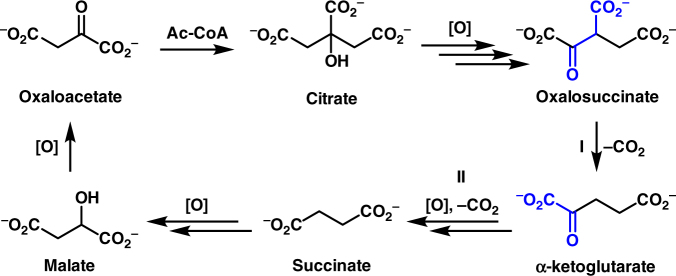
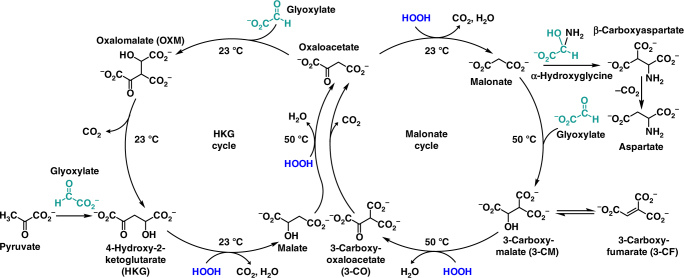
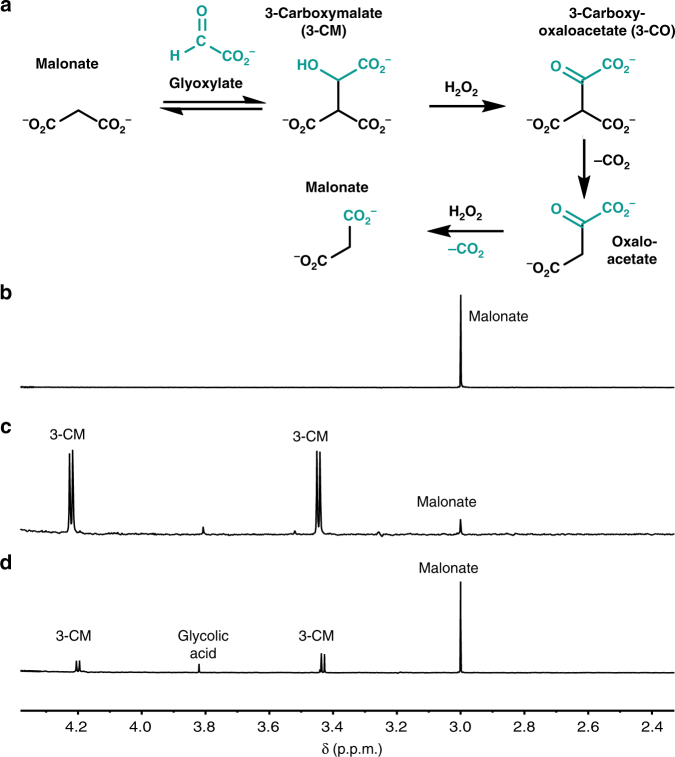
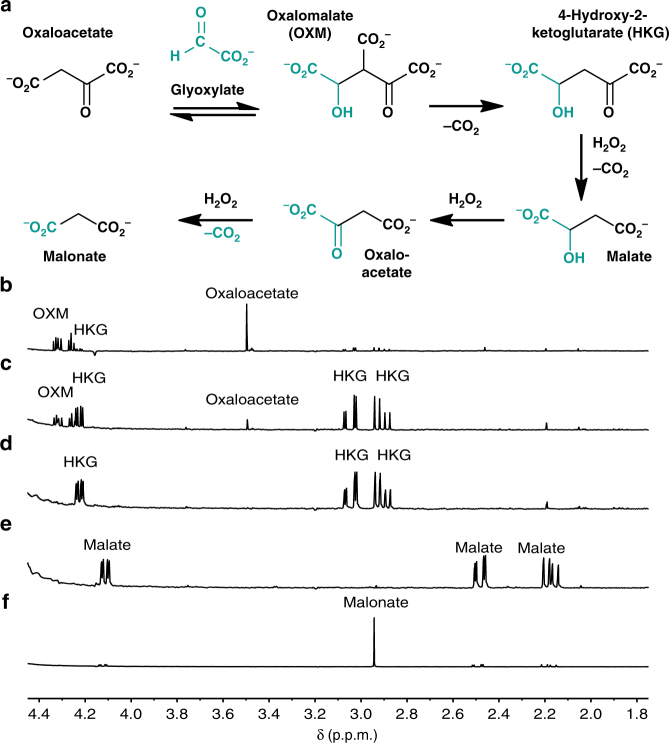
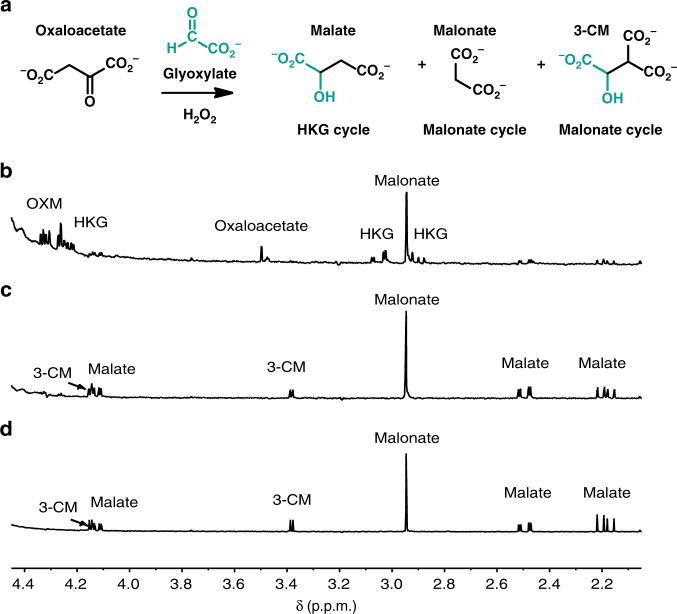
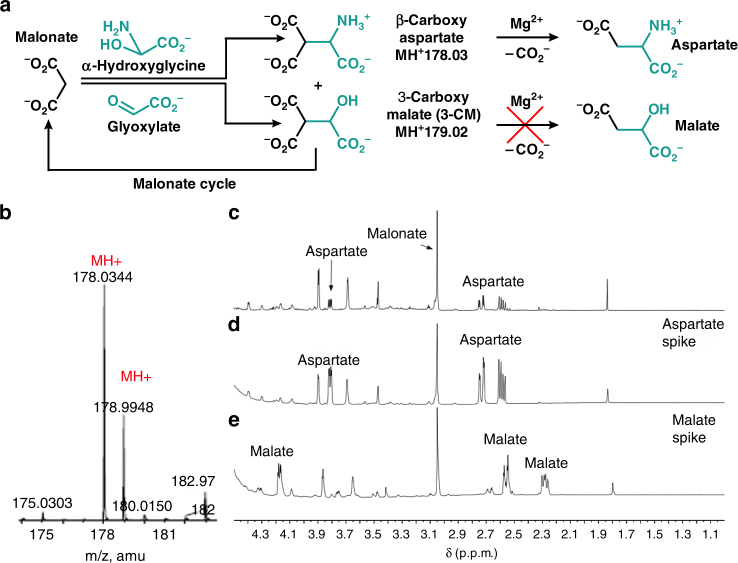
The development of metabolic approaches towards understanding the origins of life, which have focused mainly on the citric acid (TCA) cycle, have languished—primarily due to a lack of experimentally demonstrable and sustainable cycle(s) of reactions. We show here the existence of a protometabolic analog of the TCA involving two linked cycles, which convert glyoxylate into CO 2 and produce aspartic acid in the presence of ammonia. The reactions proceed from either pyruvate, oxaloacetate or malonate in the presence of glyoxylate as the carbon source and hydrogen peroxide as the oxidant under neutral aqueous conditions and at mild temperatures. The reaction pathway demonstrates turnover under controlled conditions. These results indicate that simpler versions of metabolic cycles could have emerged under potential prebiotic conditions, laying the foundation for the appearance of more sophisticated metabolic pathways once control by (polymeric) catalysts became available.
Overview
The claims and statistics of this paper haven’t been checked yet.
Free: it reads the open-access text and checks the first 5 claims that cite a source we can check. Create a free account to check every claim.
Integrity signals
Registry
Cites
Statistics
Figures
Verification
Claims the paper makes
The claims and statistics of this paper haven’t been checked yet.
Free: it reads the open-access text and checks the first 5 claims that cite a source we can check. Create a free account to check every claim.
Claims other papers make about this one
Each is checked against this paper’s own text: does it say what the citing paper says it does?
The cited source says what the claim attributes to it.
In the citing paper
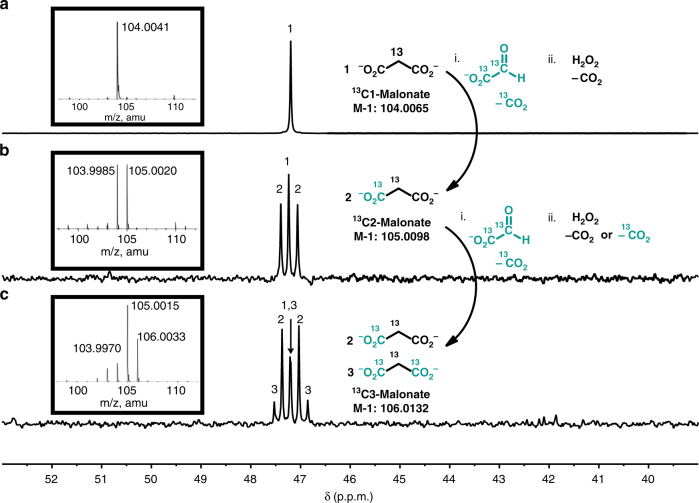
“Using isotopically labelled substrates, the authors demonstrated the high turnover potential of the malonate cycle”
From Prebiotic Reaction Networks in Water (2020) · cites this paper as [22]
The cited source says what the claim attributes to it.
In the citing paper
“Another important feature for protometabolic reaction networks is their ability for sustained cycle turnover [22].”
From Prebiotic Reaction Networks in Water (2020) · cites this paper as [22]
The cited source says what the claim attributes to it.
In the citing paper
“The bicyclic reaction network, linked by their common intermediate oxaloacetate 49, can be initiated via the aldol addition of glyoxylate 38 with oxaloacetate, malonate 52 or pyruvate 39.”
From Prebiotic Reaction Networks in Water (2020) · cites this paper as [22]
The cited source says what the claim attributes to it.
In the citing paper
“In addition to the above approaches, there is an important body of work that proposes synthetic routes towards di- and tricarboxylic acids, which constitute core metabolites of the tricarboxylic acids (TCA/rTCA) cycle, also called the (reductive) Krebs cycle (e in Scheme 1).49,50”
From The protometabolic nature of prebiotic chemistry (2023) · cites this paper as [50]
The cited source says what the claim attributes to it.
In the citing paper
“The group of Krishnamurthy has reported, in turn, on two similar abiotic cycles, the HKG and malonate cycles, which are connected through a common intermediate, oxaloacetate, and together constitute the glyoxylate scenario.50”
From The protometabolic nature of prebiotic chemistry (2023) · cites this paper as [50]
5 more claims about this paper
Create a free account to see every claim other papers make about this one.
Self-check
Percentages, sums and reported differences re-computed from the paper’s own numbers.
The self-check needs the paper’s full text.
Citations
Cites
Before enzymes and templates: theory of surface metabolism
Wächtershäuser, G. (1988) · Microbiological Reviews · doi:10.1128/mmbr.52.4.452-484.1988 · Cited by 1,242
Primordial Carbonylated Iron-Sulfur Compounds and the Synthesis of Pyruvate
Cody, G. D., Boctor, N. Z., Filley, T. R., Hazen, R. M., Scott, J. H., Sharma, A., & Yoder, H. S. (2000) · Science · doi:10.1126/science.289.5483.1337 · Cited by 441
The origin of intermediary metabolism
Morowitz, H. J., Kostelnik, J. D., Yang, J., & Cody, G. D. (2000) · Proceedings of the National Academy of Sciences · doi:10.1073/pnas.110153997 · Cited by 339
Hydrogen Peroxide on the Surface of Europa
Carlson, R. W., Anderson, M. S., Johnson, R. E., Smythe, W. D., Hendrix, A. R., Barth, C. A., Soderblom, L. A., Hansen, G. B., McCord, T. B., Dalton, J. B., et al. (1999) · Science · doi:10.1126/science.283.5410.2062 · Cited by 316
The search for the chemistry of life's origin
Eschenmoser, A. (2007) · Tetrahedron · doi:10.1016/j.tet.2007.10.012 · Cited by 292
The Implausibility of Metabolic Cycles on the Prebiotic Earth
Orgel, L. E. (2008) · PLoS Biology · doi:10.1371/journal.pbio.0060018 · Cited by 271
Non-Enzymatic Glycolysis and Pentose Phosphate Pathway-Like Reactions in a Plausible Archean Ocean
Keller, M. A., Turchyn, A. V., & Ralser, M. (2014) · Molecular Systems Biology · doi:10.1002/msb.20145228 · Cited by 242
Self-organizing biochemical cycles
Orgel, L. E. (2000) · Proceedings of the National Academy of Sciences · doi:10.1073/pnas.220406697 · Cited by 236
Metals promote sequences of the reverse Krebs cycle
Muchowska, K. B., Varma, S. J., Chevallot-Beroux, E., Lethuillier-Karl, L., Li, G., & Moran, J. (2017) · Nature Ecology & Evolution · doi:10.1038/s41559-017-0311-7 · Cited by 228
Dyson, F. (1999) · doi:10.1017/cbo9780511546303 · Cited by 219
Formation of Oxaloacetate from Pyruvate and CO2
Utter, M. F., & Keech, D. B. (1960) · Journal of Biological Chemistry · doi:10.1016/s0021-9258(18)69442-6 · Cited by 212
Borda, M. J., Elsetinow, A. R., Schoonen, M. A., & Strongin, D. R. (2001) · Astrobiology · doi:10.1089/15311070152757474 · Cited by 173
The Organic Chemistry of Biological Pathways
McMurry, J. E., & Begley, T. P. (2005) · Cited by 156
Cooper, G., Reed, C., Nguyen, D., Carter, M., & Wang, Y. (2011) · Proceedings of the National Academy of Sciences · doi:10.1073/pnas.1105715108 · Cited by 131
The place of metabolism in the origin of life
Anet, F. A. L. (2004) · Current Opinion in Chemical Biology · doi:10.1016/j.cbpa.2004.10.005 · Cited by 124
Sulfate radicals enable a non-enzymatic Krebs cycle precursor
Keller, M. A., Kampjut, D., Harrison, S. A., & Ralser, M. (2017) · Nature Ecology & Evolution · doi:10.1038/s41559-017-0083 · Cited by 121
Liang, M.-C., Hartman, H., Kopp, R. E., Kirschvink, J. L., & Yung, Y. L. (2006) · Proceedings of the National Academy of Sciences · doi:10.1073/pnas.0608839103 · Cited by 120
Driving Parts of Krebs Cycle in Reverse through Mineral Photochemistry
Zhang, X. V., & Martin, S. T. (2006) · Journal of the American Chemical Society · doi:10.1021/ja066103k · Cited by 106
Lactate oxidation in pyrite suspension: A Fenton-like process in situ generating H2O2
Wang, W., Qu, Y., Yang, B., Liu, X., & Wenhui, S. (2011) · Chemosphere · doi:10.1016/j.chemosphere.2011.10.026 · Cited by 104
Multi-Phase Chemistry of C2 and C3 Organic Compounds in the Marine Atmosphere
Warneck, P. (2005) · Journal of Atmospheric Chemistry · doi:10.1007/s10874-005-5984-7 · Cited by 99
Guzman, M. I., & Martin, S. T. (2009) · Astrobiology · doi:10.1089/ast.2009.0356 · Cited by 89
The Thermodynamics of the Krebs Cycle and Related Compounds
Miller, S. L., & Smith-Magowan, D. (1990) · Journal of Physical and Chemical Reference Data · doi:10.1063/1.555878 · Cited by 87
Hydrogen peroxide on Mars: Observations, interpretation and future plans
Encrenaz, T. A., Greathouse, T. K., Lefèvre, F., & Atreya, S. K. (2011) · Planetary and Space Science · doi:10.1016/j.pss.2011.03.019 · Cited by 80
Reactivity landscape of pyruvate under simulated hydrothermal vent conditions
Novikov, Y., & Copley, S. D. (2013) · Proceedings of the National Academy of Sciences · doi:10.1073/pnas.1304923110 · Cited by 71
Photocatalytic Reduction of Fumarate to Succinate on ZnS Mineral Surfaces
Zhou, R., & Guzmán, M. I. (2016) · The Journal of Physical Chemistry C · doi:10.1021/acs.jpcc.5b12380 · Cited by 61
Formation of oxaloacetate from pyruvate and carbon dioxide.
Mf, U., & KEECH, D. B. (1960) · PubMed · Cited by 59
Guzman, M. I., & Martin, S. T. (2010) · Chemical Communications · doi:10.1039/b924179e · Cited by 56
Analysis of the Intermediary Metabolism of a Reductive Chemoautotroph
Srinivasan, V., & Morowitz, H. J. (2009) · The Biological Bulletin · doi:10.1086/bblv217n3p222 · Cited by 45
The reaction of glyoxylic acid with ammonia revisited
Hoefnagel, A. J., van Bekkum, H., & Peters, J. A. (1992) · The Journal of Organic Chemistry · doi:10.1021/jo00040a035 · Cited by 44
Guzmán, M. I., & Martin, S. T. (2008) · International Journal of Astrobiology · doi:10.1017/s1473550408004291 · Cited by 36
The RNA world and the origin of metabolic enzymes
Ralser, M. (2014) · Biochemical Society Transactions · doi:10.1042/bst20140132 · Cited by 34
Über die Bildung von Citronensäure.
Knoop, F., & Martius, C. A. (1936) · Hoppe-Seyler´s Zeitschrift für physiologische Chemie · doi:10.1515/bchm2.1936.242.3-4.i · Cited by 34
Prebiotic synthesis of orotic acid parallel to the biosynthetic pathway
Yamagata, Y., Sasaki, K., Takaoka, O., Sano, S., INOMATA, K., KANEMITSU, K., Inoue, Y., & Matsumoto, I. (1990) · Origins of Life and Evolution of Biospheres · doi:10.1007/bf01808133 · Cited by 23
The Viability of a Nonenzymatic Reductive Citric Acid Cycle – Kinetics and Thermochemistry
Ross, D. S. (2006) · Origins of Life and Evolution of Biospheres · doi:10.1007/s11084-006-9017-6 · Cited by 22
Krishnamurthy, R., Liotta, C., Mohammed, F., Chen, K., Mojica, M., Conley, M., Napoline, J., Butch, C., & Pollet, P. (2016) · Synlett · doi:10.1055/s-0036-1588657 · Cited by 22
Self-citationPREBIOTIC FORMATION OF HIGHER MOLECULAR WEIGHT COMPOUNDS FROM THE PHOTOLYSIS OF AQUEOUS ACETIC ACID
Mendoza, A. N., & Ponnamperuma, C. (1982) · Photochemistry and Photobiology · doi:10.1111/j.1751-1097.1982.tb04421.x · Cited by 17
Oxidative decarboxylation of isocitric acid in the presence of montmorillonite
Naidja, A., & Siffert, B. (1990) · Clay Minerals · doi:10.1180/claymin.1990.025.1.04 · Cited by 16
Wiley, R. H., & Kim, K. S. (1973) · The Journal of Organic Chemistry · doi:10.1021/jo00960a030 · Cited by 14
Complexity, self-organization and the origin of life: The happy liaison?
Lazcano, A. (2009) · doi:10.1051/orvie/2009002 · Cited by 13
The Abiotic Oxidation of Organic Acids to Malonate
Springsteen, G., Rice, G., Yerabolu, J., & Krishnamurthy, R. (2016) · Synlett · doi:10.1055/s-0036-1588649 · Cited by 5
Self-citation
Research works printed but not linked: 2
- Copley SD Smith E Morowitz HJ How life began: the emergence of sparse metabolic networks J. Cosmol. 2010 10 3345 3361
- Zubay G The glyoxylate cycle, a possible evolutionary precursor of the TCA cycle Chemtracts 2003 16 783 788
Cited by
Regulation and function of the mammalian tricarboxylic acid cycle
Arnold, P. K., & Finley, L. W. S. (2023) · Journal of Biological Chemistry · doi:10.1016/j.jbc.2022.102838 · Cited by 535
Synthesis and breakdown of universal metabolic precursors promoted by iron
Muchowska, K. B., Varma, S. J., & Moran, J. (2019) · Nature · doi:10.1038/s41586-019-1151-1 · Cited by 365
A short peptide synthon for liquid–liquid phase separation
Abbas, M., Lipiński, W. P., Nakashima, K. K., Huck, W. T. S., & Spruijt, E. (2021) · Nature Chemistry · doi:10.1038/s41557-021-00788-x · Cited by 355
Nonenzymatic Metabolic Reactions and Life’s Origins
Muchowska, K. B., Varma, S. J., & Moran, J. (2020) · Chemical Reviews · doi:10.1021/acs.chemrev.0c00191 · Cited by 317
“Based on this study and the one from Springsteen and Krishnamurthy, 156 it seems plausible that both the (r)TCA and glyoxylate cycles may have had a common precursor that originated as prebiotic chemistry.”
Evolutionary History of Plant Metabolism
Maeda, H. A., & Fernie, A. R. (2021) · Annual Review of Plant Biology · doi:10.1146/annurev-arplant-080620-031054 · Cited by 156
Metadata
- Authors
- Springsteen, G., Yerabolu, J. R., Nelson, J., Rhea, C. J., & Krishnamurthy, R.
- Affiliations
- Furman University (US)
- Scripps Research Institute (US)
- Corresponding author
- Krishnamurthy, Ramanarayanan
- Venue
- Nature Communications
- Published
- 2018-01-08
- Volume
- 9
- Issue
- 1
- Pages
- 91-91
- ISSN
- 2041-1723 (ISSN-L)
- PMC
- PMC5758577
- OpenAlex
- W2782125837
- Cited by
- 132
- References
- 40
- Citations by year
- 2026: 9 · 2025: 19 · 2024: 15 · 2023: 17 · 2022: 20 · 2021: 12 · 2020: 14 · 2019: 18 · 2018: 7
- FWCI
- 6.86
- Type
- journal article
- Language
- en
- Open access
- gold
- doi.org
- Licence
- cc-by
- creativecommons.org/licenses/by/4.0 (tdm)
- creativecommons.org/licenses/by/4.0 (vor)
- Locations
- Nature Communications (publishedVersion, cc-by)
- Europe PMC (PubMed Central) (publishedVersion, cc-by)
- PubMed Central (publishedVersion, cc-by)
- PubMed (publishedVersion)
- RePEc: Research Papers in Economics (submittedVersion)
- DOAJ (DOAJ: Directory of Open Access Journals) (submittedVersion, cc-by-sa)
- DOAJ (DOAJ: Directory of Open Access Journals) (submittedVersion)
- Furman University Scholar Exchange (Furman University) (submittedVersion)
- Furman University Scholar Exchange (Furman University) (submittedVersion, cc-by)
- Funders
- National Science Foundation (1504217)
- National Aeronautics and Space Administration (CHE-1504217)
- Division of Chemistry (CHE-1504217, 1504217)
- Topics
- Physical Sciences › Physics and Astronomy › Astronomy and Astrophysics › Origins and Evolution of Life
- Physical Sciences › Chemistry › Organic Chemistry › Physical Organic Chemistry and Reaction Kinetics
- Life Sciences › Biochemistry, Genetics and Molecular Biology › Molecular Biology › Enzyme Catalysis and Immobilization
- Keywords
- glyoxylic acid, oxidative decarboxylation, protometabolism, origin of life, hydrogen peroxide oxidation, prebiotic metabolism, pyruvate, oxaloacetate, malonate, ammonia, metabolic cycles
- MeSH terms
- Origin of Life, Ammonia, Aspartic Acid, Carbon Dioxide, Decarboxylation, Glyoxylates, Hydrogen Peroxide, Hydrogen-Ion Concentration, Kinetics, Malonates, Models, Chemical, Oxidation-Reduction, Pyruvic Acid, Metabolic Networks and Pathways, Oxaloacetic Acid
About these checks
Registry, retraction, Cites and statistics results are computed, not judged, with one exception: a printed reference that no index lists is read once by a model before it counts as a citation error. Claims are extracted by a model and kept only when their quote appears verbatim in the text; each cited source is then checked, with a model’s help, for whether it says what the claim relies on. Those verdicts can be wrong — read the claim’s quote and the cited source before relying on one.
Statistics and arithmetic are recomputed, not judged.
Confidence bands are shown only for fields calibrated on our annotated test set. None is calibrated yet, so no band is shown.
What counts as a claim ›How we measure confidence ›How we check this ›
Are you an author, or do you see a problem with this page? Request a review
Data sources
Bibliographic data: Semantic Scholar, OpenAlex, Crossref.
Contains information from the Semantic Scholar Academic Graph Datasets, made available under the ODC Attribution License (ODC-BY 1.0).
Semantic Scholar’s data is described in: Kinney, R., et al. (2023). The Semantic Scholar Open Data Platform. arXiv:2301.10140.
