

Interneuron-specific signaling evokes distinctive somatostatin-mediated responses in adult cortical astrocytes
Open accessThe DOI matches its Crossref record; 69 of the 69 references it cites were found in a registry or an index.
Abstract
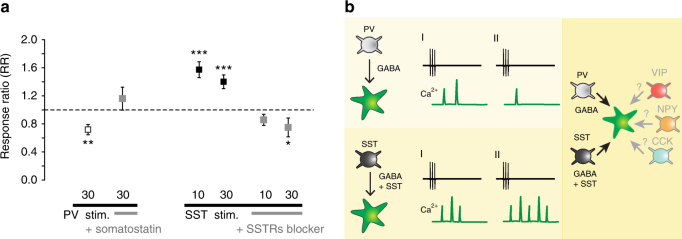
The signaling diversity of GABAergic interneurons to post-synaptic neurons is crucial to generate the functional heterogeneity that characterizes brain circuits. Whether this diversity applies to other brain cells, such as the glial cells astrocytes, remains unexplored. Using optogenetics and two-photon functional imaging in the adult mouse neocortex, we here reveal that parvalbumin- and somatostatin-expressing interneurons, two key interneuron classes in the brain, differentially signal to astrocytes inducing weak and robust GABA B receptor-mediated Ca 2+ elevations, respectively. Furthermore, the astrocyte response depresses upon parvalbumin interneuron repetitive stimulations and potentiates upon somatostatin interneuron repetitive stimulations, revealing a distinguished astrocyte plasticity. Remarkably, the potentiated response crucially depends on the neuropeptide somatostatin, released by somatostatin interneurons, which activates somatostatin receptors at astrocytic processes. Our study unveils, in the living brain, a hitherto unidentified signaling specificity between interneuron subtypes and astrocytes opening a new perspective into the role of astrocytes as non-neuronal components of inhibitory circuits.
Overview
The claims and statistics of this paper haven’t been checked yet.
Free: it reads the open-access text and checks the first 5 claims that cite a source we can check. Create a free account to check every claim.
Integrity signals
Registry
Cites
Statistics
Figures
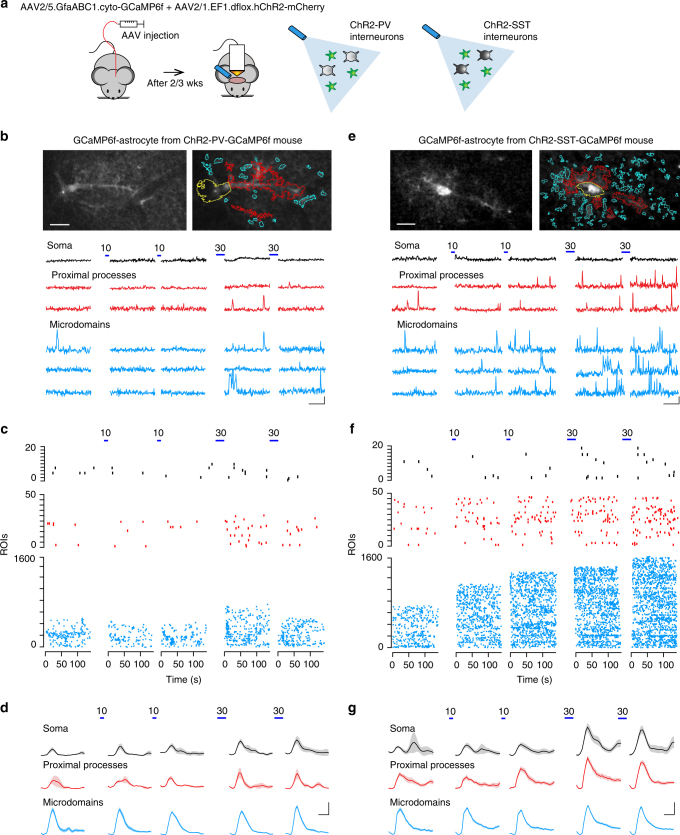
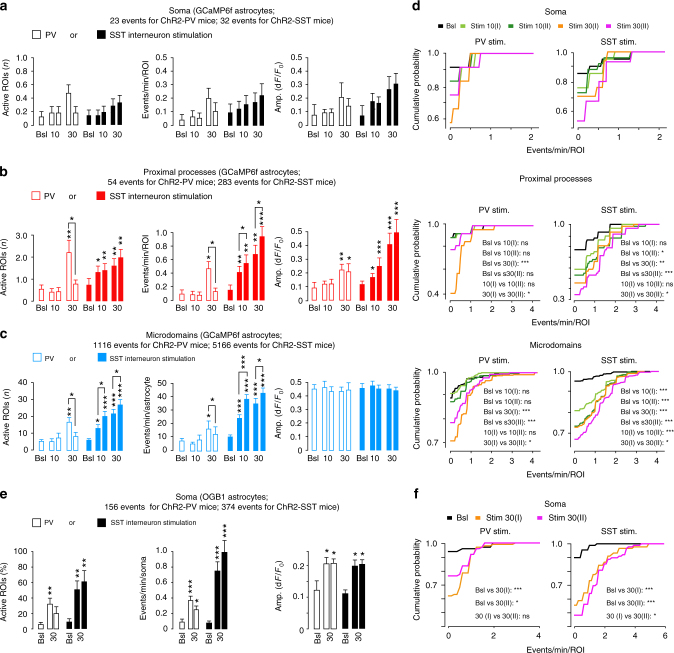
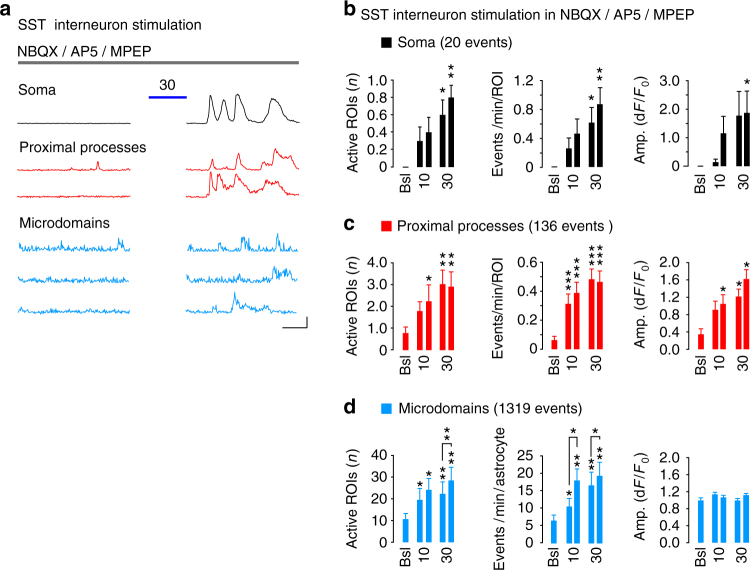
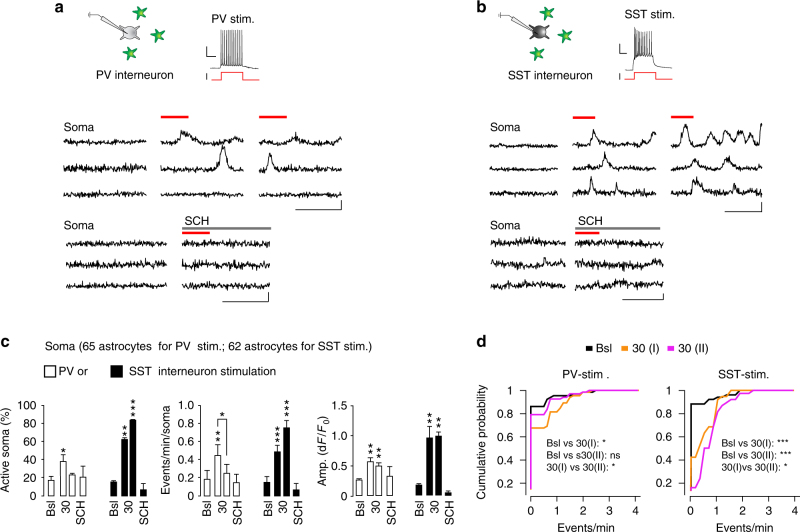
Verification
Claims the paper makes
The claims and statistics of this paper haven’t been checked yet.
Free: it reads the open-access text and checks the first 5 claims that cite a source we can check. Create a free account to check every claim.
Claims other papers make about this one
Each is checked against this paper’s own text: does it say what the citing paper says it does?
In the citing paper
“The astrocytic contributions appear to be circuit-specific 9 , stimulus-specific 10 , and their outputs in register with the modalities of their activation 11 .”
From Astrocyte function from information processing to cognition and cognitive impairment (2019) · cites this paper as [10]
Self-check
Percentages, sums and reported differences re-computed from the paper’s own numbers.
The self-check needs the paper’s full text.
Citations
Cites
Ultrasensitive fluorescent proteins for imaging neuronal activity
Chen, T.-W., Wardill, T. J., Sun, Y., Pulver, S. R., Renninger, S. L., Baohan, A., Schreiter, E. R., Kerr, R. A., Orger, M. B., Jayaraman, V., et al. (2013) · Nature · doi:10.1038/nature12354 · Cited by 6,474
Interneurons of the neocortical inhibitory system
Markram, H., Toledo-Rodriguez, M., Wang, Y., Gupta, A., Silberberg, G., & Wu, C. (2004) · Nature Reviews Neuroscience · doi:10.1038/nrn1519 · Cited by 2,954
Petilla terminology: nomenclature of features of GABAergic interneurons of the cerebral cortex
The Petilla Interneuron Nomenclature Group (PING) (2008) · Nature Reviews Neuroscience · doi:10.1038/nrn2402 · Cited by 1,491
Pfeffer, C. K., Xue, M., He, M., Huang, Z. J., & Scanziani, M. (2013) · Nature Neuroscience · doi:10.1038/nn.3446 · Cited by 1,353
Astrocyte Control of Synaptic Transmission and Neurovascular Coupling
Haydon, P. G., & Carmignoto, G. (2006) · Physiological Reviews · doi:10.1152/physrev.00049.2005 · Cited by 1,323
Self-citationGliotransmitters Travel in Time and Space
Araque, A., Carmignoto, G., Haydon, P. G., Oliet, S. H. R., Robitaille, R., & Volterra, A. (2014) · Neuron · doi:10.1016/j.neuron.2014.02.007 · Cited by 1,308
Self-citationFast-spiking, parvalbumin + GABAergic interneurons: From cellular design to microcircuit function
Hu, H., Gan, J., & Jonas, P. (2014) · Science · doi:10.1126/science.1255263 · Cited by 1,197
Astrocyte calcium signaling: the third wave
Bazargani, N., & Attwell, D. (2016) · Nature Neuroscience · doi:10.1038/nn.4201 · Cited by 944
Rocheville, M., Lange, D. C., Kumar, U., Patel, S. C., Patel, R. C., & Patel, Y. C. (2000) · Science · doi:10.1126/science.288.5463.154 · Cited by 888
Astrocyte-mediated potentiation of inhibitory synaptic transmission
Kang, J., Jiang, L., Goldman, S. A., & Nedergaard, M. (1998) · Nature Neuroscience · doi:10.1038/3684 · Cited by 842
Research works printed but not linked: 1
- Peters, A., Palay, S. L. & Webster, H. D. F. in The Fine Structure of the Central Nervous System: Neurons and Their Supportive Cells (ed. Press, O. U.) 276–295 (Oxford University Press, New York, 1991).
Cited by
Items 101–139 of 139
Tauriala, N. L., & Kellner, V. (2025) · Journal of Neurochemistry · doi:10.1111/jnc.70266 · Cited by 2
Neuropeptidergic systems in psychiatric disorders
Hodzic, S., & Riedemann, T. (2026) · Frontiers in Endocrinology · doi:10.3389/fendo.2025.1654292 · Cited by 2
GABAB receptors in glial cells: from physiological regulation to pathological implications
Wang, J., Xu, L., Shen, Q., & Tang, Y. (2026) · Brain · doi:10.1093/brain/awag141 · Cited by 2
An unsuspected physiological role for mGluRIII glutamate receptors in hippocampal area CA1
Petroccione, M. A., Melone, M., Rathwell, T. J., Dwivedi, N., Grienberger, C., Conti, F., & Scimemi, A. (2026) · Cell Reports · doi:10.1016/j.celrep.2026.117388 · Cited by 1
Self-citationDynamic and Homeostatic Neuron–Astrocyte Interactions at GABAergic Synapses
Clarke, D., Lacaille, J., & Robitaille, R. (2025) · Neurochemical Research · doi:10.1007/s11064-025-04554-0 · Cited by 1
“…sensitive GABA B Ca 2+ activation to cortical somatostatin interneuron activity than parvalbumin interneuron firing, which was potentiated by prolonged somatostatin interneuron activity and depressed by prolonged parval-bumin interneuron activity, independent of the amount of released GABA [68 ].”
Driscoll, N. (2001) · ScholarlyCommons (University of Pennsylvania) · Cited by 1
Anaya, F. J., Kim, J., Ross, S. E., & Vazquez, A. L. (2026) · Science Advances · doi:10.1126/sciadv.adx5109 · Cited by 1
Astrocytes: The Rising Stars that Regulate Synaptic Plasticity and Long-Term Memory Formation
Li, Q. (2024) · Springer eBooks · doi:10.1007/978-3-031-54864-2_16 · Cited by 1
G Protein Signaling In Astrocytes Regulates Neuronal Excitability And Synaptic Plasticity
Durkee, C. A. (2019) · University of Minnesota Digital Conservancy (University of Minnesota) · Cited by 1
Astrocytic Regulation of Basal Ganglia Dopamine/D2-Dependent BehaviorsPreprint
Mastrogiacomo, R., Trigilio, G., Dautan, D., Devroye, C., Ferretti, V., Vitali, E., Orso, G., Marotta, R., Maltese, F., Piras, G., et al. (2021) · bioRxiv (Cold Spring Harbor Laboratory) · doi:10.1101/2021.05.11.443394 · Cited by 1
Rózsa, M. (2018) · SZTE Repository of Dissertations (University of Szeged) · doi:10.14232/phd.9755
P.116 Interneuron-astrocyte interactions in neurovascular coupling
Majnaric, M., Zonta, M., Lia, A., & Carmignoto, G. (2020) · European Neuropsychopharmacology · doi:10.1016/j.euroneuro.2019.12.017
Self-citationComunicación astrocito-interneurona y el procesamiento de la información en las redes neuronales
Mederos, S. (2019) · LA Referencia (Red Federada de Repositorios Institucionales de Publicaciones Científicas)
Murai, K. K. (2019) · Faculty Opinions – Post-Publication Peer Review of the Biomedical Literature · doi:10.3410/f.734222060.793563292
(outdated draft) Somatostatin and the pathophysiology of Alzheimer’s diseasePreprint
Almeida, V. N. (2024) · Qeios · doi:10.32388/goy6dk.2
Bidirectional control of neurovascular coupling by cortical somatostatin interneuronsPreprint
Mohamed, B., O’Reilly, J., Picaud, S., Gac, B. L., Belzic, E., Castro, L. R., Soula, H. A., Dusart, I., Li, D., & Cauli, B. (2024) · bioRxiv (Cold Spring Harbor Laboratory) · doi:10.1101/2024.11.06.622247
Perea, G., Sánchez-Ruiz, A., González-Arias, C., Arancibia, L., & Mederos, S. (2025) · Research Square · doi:10.21203/rs.3.rs-7038027/v1
A Journey between Neurons and Astrocytes: A Tribute to Giorgio Carmignoto
Zonta, M., Vicini, S., Berardi, N., Maffei, L., Ratto, G. M., Magalhães, P. J., Fellin, T., Losi, G., Gómez‐Gonzalo, M., & Verkhratsky, A. (2025) · Neurochemical Research · doi:10.1007/s11064-025-04527-3
“In collabo - ration with Tommaso Fellin, Fiorenzo Conti and Marcello Melone we revealed that astrocytic response to SOM-INs is stronger and potentiating upon successive synaptic inputs, while response to PV-INs repeated activation is depressing [46].”
Self-citationShao, F.-B., Fang, J.-F., Wang, S.-S., Qiu, M., Danning, X., Jin, X., Liu, J., Shao, X., Shen, Z., Liang, Y., et al. (2021) · Figshare · doi:10.6084/m9.figshare.16607063
Shao, F.-B., Fang, J.-F., Wang, S.-S., Qiu, M., Danning, X., Jin, X., Liu, J., Shao, X., Shen, Z., Liang, Y., et al. (2021) · Figshare · doi:10.6084/m9.figshare.16607057
Shao, F.-B., Fang, J.-F., Wang, S.-S., Qiu, M., Danning, X., Jin, X., Liu, J., Shao, X., Shen, Z., Liang, Y., et al. (2021) · Figshare · doi:10.6084/m9.figshare.16607060
Shao, F.-B., Fang, J.-F., Wang, S.-S., Qiu, M., Danning, X., Jin, X., Liu, J., Shao, X., Shen, Z., Liang, Y., et al. (2021) · Figshare · doi:10.6084/m9.figshare.16607066
Courtney, C. D. (2021) · Illinois Digital Environment for Access to Learning and Scholarship (University of Illinois at Urbana-Champaign)
Ahmadpour, N. (2022) · Mspace (University of Manitoba)
Beyond excitatory neurons: How inhibitory neurons and astrocytes shape fMRI spatiotemporal dynamics
Vo, T. T., & Kim, S. (2026) · Journal of Cerebral Blood Flow & Metabolism · doi:10.1177/0271678x261417892
Cellular Interrogation of Neurovascular Coupling: The Role of Cortical Inhibitory Interneurons
Lee, L. (2025) · White Rose eTheses Online (University of Leeds, The University of Sheffield, University of York)
Watanabe, R., Hori, K., Kira, Y., Tsujikawa, S., Hino, H., MATSUURA, T., & Mori, T. (2026) · British Journal of Pharmacology · doi:10.1111/bph.70438
“Although the distinct pathways in the crosstalk between neurons and glia remain to be elucidated, recent studies have shown that both excitatory and inhibitory neurons play a significant role in modulating glial cells (Mariotti et al., 2018; Tian et al., 2012).”
Study of the Neuron-Astrocyte Relationship in a Rodent Model of Tauopathy
de Gérando, A. M. (2019) · theses.fr (ABES) · doi:10.70675/04658671zaca3z4fefza24dz2f5a011bebfe
Role of astrocytic signaling in synapse function : implications for neurodevelopmental disorders
Rubino, B. (2020) · theses.fr (ABES) · doi:10.70675/f0a8ded0z4cc7z44b7za0c0z641f71405c00
Contrôle bidirectionnel du couplage neurovasculaire par les interneurones à somatostatine
Mohamed, B. (2024) · theses.fr (ABES) · doi:10.70675/fcace520z6c3bz4c9dz806dzf67da9eb0747
Astrocyte subtype dynamics in mood disorders: Current insights and future directions
Chen, D., Wang, J., Zhu, G., & Yang, S. (2026) · Brain Network Disorders · doi:10.1016/j.bnd.2026.04.003
The 3-Body Problem: How Astrocytes May Govern Plasticity
Watanabe, A., Guo, C., & Sjöström, P. J. (2026) · The Neuroscientist · doi:10.1177/10738584261445371
“Consistent with this view, astrocytes exhibit selective responses to specific cell and synapse types (Mariotti et al 2018; Matos et al 2018), with functional heterogeneity emerging among local astrocyte populations (Martin et al 2015).”
Organization of Astrocytic GLT‐1 at Cortical Inhibitory Synapses
Melone, M., Palma, M. D., Scimemi, A., & Conti, F. (2026) · Glia · doi:10.1002/glia.70180
“…referred to as closely spaced couples), a criterion used in previous studies as indicative of close molecular proximity (Storey et al. 2012; Amiry-Moghaddam and Ottersen 2013; Mariotti et al. 2018; Melone et al. 2019), were sublocalized in relation to symmetric and asymmetric synaptic contacts.”
InfluentialSelf-citationKim, Y., & Woo, D. H. (2026) · bioRxiv (Cold Spring Harbor Laboratory) · doi:10.64898/2026.06.12.731805
Somatostatin regulation of the stress response
Guo, H., Ali, T., & Li, S. (2026) · Brain medicine : · doi:10.61373/bm026i.0042
The emerging role of astrocytes in spatial cognition, action and Alzheimer’s disease
Gaborit, M., Arabi, A., & Mariotti, L. (2026) · Frontiers in Cellular Neuroscience · doi:10.3389/fncel.2026.1811370
“…express a complement of proteins involved in synaptic transmission (Chai et al., 2017; Aboufares El Alaoui et al., 2021), enabling astrocytes to sense different neurotransmitters released from both pre-and post-synaptic elements (Fellin et al., 2004; Panatier et al., 2011; Mariotti et al., 2018).”
Self-citationPérez-Rodríguez, M. (2022) · RIO (Universidad Pablo de Olavide)
Liao, Y., Zhang, J., Zhao, X., Zhang, G., & Yang, Z. (2026) · Nonlinear Dynamics · doi:10.1007/s11071-026-12939-1
Curreli, S., Bonato, J., Romanzi, S., Panzeri, S., & Fellin, T. (2022) · doi:10.1371/journal.pbio.3001530.r006
Self-citation
Metadata
- Authors
- Mariotti, L., Losi, G., Lia, A., Melone, M., Chiavegato, A., Gómez-Gonzalo, M., Sessolo, M., Bovetti, S., Forli, A., Zonta, M., Requie, L. M., Marcon, I., Pugliese, A., Viollet, C., Bettler, B., Fellin, T., Conti, F., & Carmignoto, G.
- Affiliations
- University of Padua (IT)
- Marche Polytechnic University (IT)
- Italian Institute of Technology (IT)
- Inserm (FR)
- University of Basel (CH)
- Corresponding author
- Carmignoto, Giorgio
- ORCID
- Venue
- Nature Communications
- Published
- 2018-01-08
- Volume
- 9
- Issue
- 1
- Pages
- 82-82
- ISSN
- 2041-1723 (ISSN-L)
- PMC
- PMC5758790
- OpenAlex
- W2782315930
- Semantic Scholar
- 19e2d12c96e6cb0db4f370680ea78f42a885bf30
- Cited by
- 131
- References
- 69
- Citations by year
- 2026: 13 · 2025: 12 · 2024: 12 · 2023: 19 · 2022: 21 · 2021: 20 · 2020: 8 · 2019: 19 · 2018: 7
- FWCI
- 6.15
- Type
- journal article
- Language
- en
- Open access
- gold
- doi.org
- Licence
- cc-by
- creativecommons.org/licenses/by/4.0 (tdm)
- creativecommons.org/licenses/by/4.0 (vor)
- Locations
- Nature Communications (publishedVersion, cc-by)
- Europe PMC (PubMed Central) (publishedVersion, cc-by)
- PubMed Central (publishedVersion, cc-by)
- PubMed (publishedVersion)
- Institutional Research Information System University of Turin (University of Turin) (submittedVersion, other-oa)
- RePEc: Research Papers in Economics (submittedVersion)
- DOAJ (DOAJ: Directory of Open Access Journals) (submittedVersion)
- DOAJ (DOAJ: Directory of Open Access Journals) (submittedVersion, cc-by-sa)
- Università Politecnica delle Marche (Università Politecnica delle Marche) (submittedVersion)
- Padua Research Archive (University of Padova) (submittedVersion, cc-by)
- Funders
- Ministero dell’Istruzione, dell’Università e della Ricerca (PRIN 2015, GGP12265, 2010JFYFY2)
- Università Politecnica delle Marche
- Istituto Italiano di Tecnologia
- Topics
- Life Sciences › Neuroscience › Cellular and Molecular Neuroscience › Neuroscience and Neuropharmacology Research
- Life Sciences › Neuroscience › Cognitive Neuroscience › Neural dynamics and brain function
- Life Sciences › Neuroscience › Neurology › Neuroinflammation and Neurodegeneration Mechanisms
- Keywords
- astrocytes, GABAergic interneurons, parvalbumin interneurons, somatostatin interneurons, GABAB receptors, calcium signaling, somatostatin receptors, neuropeptide signaling, astrocyte plasticity, inhibitory circuits, neocortex, optogenetics, two-photon imaging
- MeSH terms
- Animals, Astrocytes, Calcium, Interneurons, Mice, Inbred C57BL, Mice, Transgenic, Neuronal Plasticity, Parvalbumins, Somatosensory Cortex, Somatostatin, Signal Transduction, Receptors, GABA-B, Patch-Clamp Techniques, Neocortex, Mice, Optogenetics
About these checks
Registry, retraction, Cites and statistics results are computed, not judged, with one exception: a printed reference that no index lists is read once by a model before it counts as a citation error. Claims are extracted by a model and kept only when their quote appears verbatim in the text; each cited source is then checked, with a model’s help, for whether it says what the claim relies on. Those verdicts can be wrong — read the claim’s quote and the cited source before relying on one.
Statistics and arithmetic are recomputed, not judged.
Confidence bands are shown only for fields calibrated on our annotated test set. None is calibrated yet, so no band is shown.
What counts as a claim ›How we measure confidence ›How we check this ›
Are you an author, or do you see a problem with this page? Request a review
Data sources
Bibliographic data: Semantic Scholar, OpenAlex, Crossref.
Contains information from the Semantic Scholar Academic Graph Datasets, made available under the ODC Attribution License (ODC-BY 1.0).
Semantic Scholar’s data is described in: Kinney, R., et al. (2023). The Semantic Scholar Open Data Platform. arXiv:2301.10140.
