

Wing bone geometry reveals active flight in Archaeopteryx
Open accessThe DOI matches its Crossref record; 79 of the 79 references it cites were found in a registry or an index; 23 of the 77 sources its claims cite were checked for support.
Abstract
Archaeopteryx is an iconic fossil taxon with feathered wings from the Late Jurassic of Germany that occupies a crucial position for understanding the early evolution of avian flight. After over 150 years of study, its mosaic anatomy unifying characters of both non-flying dinosaurs and flying birds has remained challenging to interpret in a locomotory context. Here, we compare new data from three Archaeopteryx specimens obtained through phase-contrast synchrotron microtomography to a representative sample of archosaurs employing a diverse array of locomotory strategies. Our analyses reveal that the architecture of Archaeopteryx's wing bones consistently exhibits a combination of cross-sectional geometric properties uniquely shared with volant birds, particularly those occasionally utilising short-distance flapping. We therefore interpret that Archaeopteryx actively employed wing flapping to take to the air through a more anterodorsally posteroventrally oriented flight stroke than used by modern birds. This unexpected outcome implies that avian powered flight must have originated before the latest Jurassic.
Overview
CoChat Summary
TL;DR
The paper argues that Archaeopteryx was capable of active, powered flight based on wing-bone cross-sectional geometry from three specimens compared with a large archosaur reference sample. The authors infer that its flight stroke differed from that of modern birds and that avian powered flight originated before the latest Jurassic.
Key findings
- Cortical vascular density in Archaeopteryx was reported at about 69 canals/mm² in the ninth specimen and about 116 canals/mm² in the fifth specimen, which the authors interpret as consistent with substantial bone growth and higher resting metabolic rate.
- Average relative cortical thickness of Archaeopteryx wing bones was thinner than any element in the non-volant sample and aligned it with volant birds; the paper also notes a 0.60 average relative cortical thickness threshold that separated volant from non-volant archosaurs in their data set.
- In phylogenetic PCA / PAM classification, Archaeopteryx fell in a domain shared almost exclusively with modern volant birds, and PAM resolved volancy with a 95.52% success rate; k-means gave the same assignment.
- Discriminant classification grouped all three Archaeopteryx specimens with short-flight or burst-flight birds, and the authors conclude this supports habitual flapping and an anterodorsally–posteroventrally oriented flight stroke unlike that of modern birds.
Methods
- The study used propagation phase-contrast synchrotron X-ray microtomography (PPC-SRµCT) on the humeral and ulnar cross sections of three Archaeopteryx specimens, plus comparative data from 28 species of neornithine birds and additional archosaurs including Compsognathus, Rhamphorhynchus, Brasileodactylus, and Crocodylus.
- They reconstructed and measured mid-diaphyseal cross-sectional geometry, quantifying relative cortical thickness (CA/TA) and mass-normalised torsional resistance (J/M), and qualitatively assessed cortical vascular density in a subset.
- Main analyses included phylogenetic ANCOVA, phylogenetic PCA, Partitioning Around Medoids, LDA, and one-way MANOVA, with body mass incorporated as a covariate or for normalization.
Limitations
- The authors note that flight-mode classification is qualitative and non-discrete, and that group overlap in volant birds leads to uncertainty in classifying extinct taxa; they also report relatively low correct-classification rates of 53.62% and 56.52% for the two flight-mode divisions.
- The paper states that the study’s avian and pterosaur comparisons are based on single taxa for basal and derived pterosaurs, which the text itself implies limits inference across those lineages.
- Evident from the text: some Archaeopteryx specimens were brittle-deformed or splintered, so cross-sectional reconstructions required restoration; this introduces reconstruction uncertainty.
Model-written summary. Check it against the paper before relying on it.
Integrity signals
Registry
Cites
Statistics
Figures
Verification
Claims the paper makes
19 Valid · 4 Not valid · 22 Not checked · 47 Own results and interpretations
Every source the paper cites for this claim was checked and supports it.
In the paper
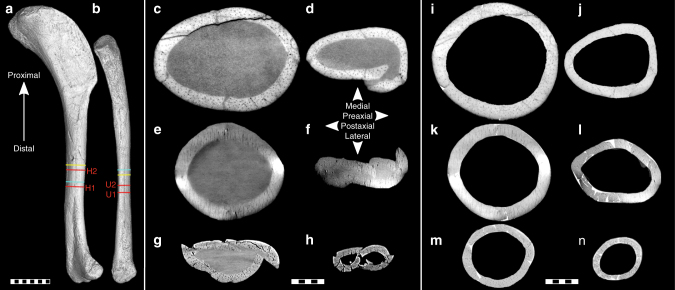
“Contrary to previously reported data13, the bone cortex of Archaeopteryx is well vascularised (Fig. 1c–h, Supplementary Data 1).”
§ Wing bone geometry reveals active flight in Archaeopteryx > Results > Cortical vascularisation
What the sources say
- Supportedcites [13] Erickson GM Was dinosaurian physiology inherited by birds? Reconciling slow growth in Archaeopteryx PLoS ONE 2009 4 e7390 10.1371/journal.pone.0007390 19816582 PMC2756958 source
Citation 13 is attached to “previously reported data,” not to the citing authors’ finding that the cortex is well vascularised. The source’s Introduction reports exceptionally sparse vascularization in Archaeopteryx, and its Results give a femoral porosity of 0.68%, supporting the characterization of the earlier data as contrary to that finding. (LLM, conf=0.94)
boosted- Asserted: passes — The authors put it forward as true.
- Checkable: passes — It can be checked against evidence.
- Load-bearing: passes — The paper’s conclusions depend on it.
- Based: passes — The paper gives a reason why it holds.
- Supported
The sources with a verdict support this claim; the rest weren’t checked yet, have no full text we could read, or their verdicts aren’t rated yet.
In the paper
“This is consistent with a higher bone growth rate14 and associated higher resting metabolic rate15 than inferred from nearly avascular bone chips of the seventh specimen13.”
§ Wing bone geometry reveals active flight in Archaeopteryx > Results > Cortical vascularisation
What the sources say
- Not checked — no full text of the sourcecites [14] Cubo J Le Roy N Martinez-Maza C Montes L Paleohistological estimation of bone growth rate in extinct archosaurs Paleobiology 2012 38 335 349 10.1666/08093.1 source
- Not checked — no full text of the sourcecites [15] Montes L Relationships between bone growth rate, body mass and resting metabolic rate in growing amniotes: a phylogenetic approach Biol. J. Linn. Soc. 2007 92 63 76 10.1111/j.1095-8312.2007.00881.x source
- Supportedcites [13] Erickson GM Was dinosaurian physiology inherited by birds? Reconciling slow growth in Archaeopteryx PLoS ONE 2009 4 e7390 10.1371/journal.pone.0007390 19816582 PMC2756958 source
The citation is attached to the comparison with nearly avascular bone chips, not to the higher growth or metabolic-rate inferences, which have separate citations. Materials and Methods describes cortical chips taken from the Munich Archaeopteryx specimen; Results reports that its vascular canals were sparsely distributed (0.68% porosity). Our copy does not call the Munich specimen the “seventh specimen.” (LLM, conf=0.88)
plainstates an association- Asserted: passes — The authors put it forward as true.
- Checkable: passes — It can be checked against evidence.
- Load-bearing: passes — The paper’s conclusions depend on it.
- Based: passes — The paper gives a reason why it holds.
The cited sources support only part of this claim — read each source’s verdict below.
In the paper
“This sequence starts at the bottom of DA 2 with short21 or burst20 flight and intermittent bounding20.”
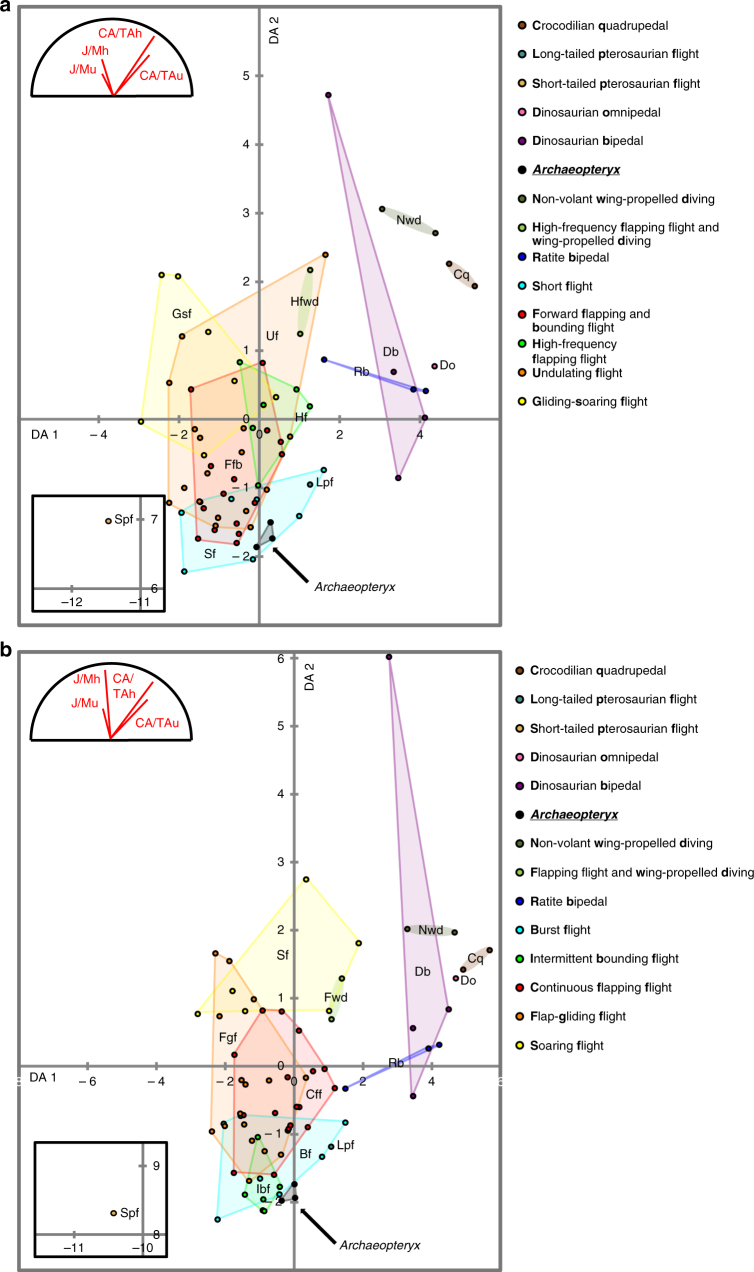
§ Wing bone geometry reveals active flight in Archaeopteryx > Results > Locomotor mode Phylogenetic autocorrelation was found to be insignificant towards Phylogenetically Informed Discriminant Analysis (Supplementary Fig. 8), thus rendering Linear Discriminant Analysis (LDA) appropriate for resolving the locomotory affinity of Archaeopteryx. Linear discriminant analysis (LDA) principally separates volant and non-volant archosaurs along discriminant axis (DA) 1 (Fig. 2 and Supplementary Fig. 9) through predominantly humeral and ulnar relative cortical thickness. DA 2 is loaded more equally on all parameters than DA 1, but slightly stronger on relative cortical thickness for the classification expanded from Viscor et al.21, and slightly stronger on mass-normalised torsional resistance for the classification expanded from Close et al.20. Within modern volant birds, an overlapping succession of avian flight modes extends upwards along DA 2 (Fig. 2). This sequence starts at the bottom of DA 2 with short21 or burst20 flight and intermittent bounding20. These flight modes share a strong climbing component during powered flight phases, where intermittent bounding remains restricted to species with an adult body mass typically below 200 g21. Forward flapping21, high-frequency flapping21, or continuous flapping20 flight is observed in birds that maintain level flapping flight after take-off. The avian sequence terminates in undulating21 or flap-gliding20 fliers that structurally alternate between flapping and gliding during flight, and aerial specialists in the gliding–soaring21 and soaring20 flight categories that harvest atmospheric movements to gain altitude and engage in sustained gliding. Across avian flight strategies and relative to mass-specific effects, relative torsional resistance of wing bones appears to scale inversely with a reliance on flapping during flight. This may reflect either a multidirectional stress regime or elevated torsional loading experienced during gliding and soaring as opposed to the directionally confined stresses associated with flapping12. A coupled decrease in relative cortical thickness and torsional resistance of anterior limb bones accompanied the transition from non-avian dinosaurs to birds (Fig. 2). A subsequent increase in relative torsional resistance at rather constant relative cortical thickness within volant birds accompanies the establishment of distinct avian flight modes (Fig. 2). Although basal and derived pterosaurs are represented by only one taxon each, their reciprocal relationship in pPCA and LDA morphospace qualitatively agrees with those between (occasionally) flapping birds and avian hyperaerial soarers, respectively. From a biomechanical point of view, this lends some support for an analogous evolutionary trajectory leading from flapping volancy in Rhamphorhynchus to an affinity with prolonged soaring in Brasileodactylus. Discriminant classification unanimously groups the specimens of Archaeopteryx with short21 or burst20 flyers in our set (Supplementary Data 2). Substantial group overlap within the volant avian cluster in discriminant morphospace results in relatively low percentages of correctly classified training species (53.62% and 56.52% for the Viscor et al.21 and Close et al.20 divisions, respectively), and this uncertainty undoubtedly carries over to the characterisation of extinct taxa with unknown locomotory strategies. Nevertheless, the position of Archaeopteryx is chiefly shared with short21/burst20 flyers (Fig. 2 and Supplementary Fig. 9), which supports the resolved affinity with these near-synonymous flight groups. Although Archaeopteryx plots close to intermittent bounding20 birds as well, its reconstructed adult body mass13 vastly exceeds the mass threshold to which modern bounding birds adhere21. Finally, short21 and burst20 flyers exhibit significantly deviating means from respectively gliding–soaring21, and flap-gliding20 and soaring20 birds (Supplementary Tables 1 and 2), thereby underlining an affinity to habitual flapping for Archaeopteryx.
What the sources say
- Not checked — no full text of the sourcecites [21] Viscor G Fuster JF Relationships between morphological parameters in birds with different flying habits Comp. Biochem. Physiol. 1987 87A 231 249 10.1016/0300-9629(87)90118-6 2886265 source
- Partly supportedcites [20] Close RA Rayfield EJ Functional morphometric analysis of the furcula in Mesozoic birds PloS ONE 2012 7 e36664 10.1371/journal.pone.0036664 22666324 PMC3364262 sourceExperimental — accuracy not yet measured
The Results (Extant-only Dataset; page unavailable) place intermittent bounders at low ES2 values, and the Methods identify burst-adapted fliers as a flight-mode category. But ES2 is an eigenshape axis, not discriminant axis 2 (DA 2), and our copy does not place both burst flight and intermittent bounding at the bottom of DA 2. (LLM, conf=0.83)
plain- Asserted: passes — The authors put it forward as true.
- Checkable: passes — It can be checked against evidence.
- Load-bearing: passes — The paper’s conclusions depend on it.
- Based: passes — The paper gives a reason why it holds.
The cited sources that could be checked couldn’t confirm or dispute this claim.
In the paper
“Burst-flying20 birds (incidental explosive take off and brief horizontal flight followed by a running escape) exhibit humeral and ulnar relative torsional resistance values overlapping with those of intermittent bounding20 flyers (flapping phases aimed at gaining altitude and speed, alternated with passive phases with folded wings).”
§ Wing bone geometry reveals active flight in Archaeopteryx > Results > Mass-normalised torsional resistance
What the sources say
- Could not verifycites [20] Close RA Rayfield EJ Functional morphometric analysis of the furcula in Mesozoic birds PloS ONE 2012 7 e36664 10.1371/journal.pone.0036664 22666324 PMC3364262 sourceExperimental — accuracy not yet measured
The Methods section (‘Flight mode categories’; page unavailable) defines burst-adapted and intermittent-bounding flight, while the Discussion compares their furcular shapes. Searches for humeral and ulnar torsional resistance found no passage reporting those values or their overlap; the cited paper’s discussion of furcular morphology does not verify the claim. (LLM, conf=0.76)
plainstates an association- Asserted: passes — The authors put it forward as true.
- Checkable: passes — It can be checked against evidence.
- Load-bearing: unclear — It is unclear whether the paper’s conclusions depend on it.
- Based: passes — The paper gives a reason why it holds.
- Could not verify
The sources with a verdict support this claim; the rest weren’t checked yet, have no full text we could read, or their verdicts aren’t rated yet.
In the paper
“Discriminant classification unanimously groups the specimens of Archaeopteryx with short21 or burst20 flyers in our set (Supplementary Data 2).”
§ Wing bone geometry reveals active flight in Archaeopteryx > Results > Locomotor mode Phylogenetic autocorrelation was found to be insignificant towards Phylogenetically Informed Discriminant Analysis (Supplementary Fig. 8), thus rendering Linear Discriminant Analysis (LDA) appropriate for resolving the locomotory affinity of Archaeopteryx. Linear discriminant analysis (LDA) principally separates volant and non-volant archosaurs along discriminant axis (DA) 1 (Fig. 2 and Supplementary Fig. 9) through predominantly humeral and ulnar relative cortical thickness. DA 2 is loaded more equally on all parameters than DA 1, but slightly stronger on relative cortical thickness for the classification expanded from Viscor et al.21, and slightly stronger on mass-normalised torsional resistance for the classification expanded from Close et al.20. Within modern volant birds, an overlapping succession of avian flight modes extends upwards along DA 2 (Fig. 2). This sequence starts at the bottom of DA 2 with short21 or burst20 flight and intermittent bounding20. These flight modes share a strong climbing component during powered flight phases, where intermittent bounding remains restricted to species with an adult body mass typically below 200 g21. Forward flapping21, high-frequency flapping21, or continuous flapping20 flight is observed in birds that maintain level flapping flight after take-off. The avian sequence terminates in undulating21 or flap-gliding20 fliers that structurally alternate between flapping and gliding during flight, and aerial specialists in the gliding–soaring21 and soaring20 flight categories that harvest atmospheric movements to gain altitude and engage in sustained gliding. Across avian flight strategies and relative to mass-specific effects, relative torsional resistance of wing bones appears to scale inversely with a reliance on flapping during flight. This may reflect either a multidirectional stress regime or elevated torsional loading experienced during gliding and soaring as opposed to the directionally confined stresses associated with flapping12. A coupled decrease in relative cortical thickness and torsional resistance of anterior limb bones accompanied the transition from non-avian dinosaurs to birds (Fig. 2). A subsequent increase in relative torsional resistance at rather constant relative cortical thickness within volant birds accompanies the establishment of distinct avian flight modes (Fig. 2). Although basal and derived pterosaurs are represented by only one taxon each, their reciprocal relationship in pPCA and LDA morphospace qualitatively agrees with those between (occasionally) flapping birds and avian hyperaerial soarers, respectively. From a biomechanical point of view, this lends some support for an analogous evolutionary trajectory leading from flapping volancy in Rhamphorhynchus to an affinity with prolonged soaring in Brasileodactylus. Discriminant classification unanimously groups the specimens of Archaeopteryx with short21 or burst20 flyers in our set (Supplementary Data 2). Substantial group overlap within the volant avian cluster in discriminant morphospace results in relatively low percentages of correctly classified training species (53.62% and 56.52% for the Viscor et al.21 and Close et al.20 divisions, respectively), and this uncertainty undoubtedly carries over to the characterisation of extinct taxa with unknown locomotory strategies. Nevertheless, the position of Archaeopteryx is chiefly shared with short21/burst20 flyers (Fig. 2 and Supplementary Fig. 9), which supports the resolved affinity with these near-synonymous flight groups. Although Archaeopteryx plots close to intermittent bounding20 birds as well, its reconstructed adult body mass13 vastly exceeds the mass threshold to which modern bounding birds adhere21. Finally, short21 and burst20 flyers exhibit significantly deviating means from respectively gliding–soaring21, and flap-gliding20 and soaring20 birds (Supplementary Tables 1 and 2), thereby underlining an affinity to habitual flapping for Archaeopteryx.
What the sources say
- Not checked — no full text of the sourcecites [21] Viscor G Fuster JF Relationships between morphological parameters in birds with different flying habits Comp. Biochem. Physiol. 1987 87A 231 249 10.1016/0300-9629(87)90118-6 2886265 source
- Supportedcites [20] Close RA Rayfield EJ Functional morphometric analysis of the furcula in Mesozoic birds PloS ONE 2012 7 e36664 10.1371/journal.pone.0036664 22666324 PMC3364262 source
Citation 20 is attached to “burst,” not to the citing authors’ own discriminant classification of Archaeopteryx. In Materials and Methods (Flight mode categories; page unavailable), the source defines “burst-adapted” fliers as birds capable of only very short-range flights. (LLM, conf=0.91)
plainstates an association- Asserted: passes — The authors put it forward as true.
- Checkable: passes — It can be checked against evidence.
- Load-bearing: passes — The paper’s conclusions depend on it.
- Based: passes — The paper gives a reason why it holds.
43 more claims · 2 with their cited sources checked
Create a free account to see all 92 claims and to verify the 1 reference still open.
- It may state two separate claims as one. 31
- Probably not a substantial claim. 20
Claims other papers make about this one
Each is checked against this paper’s own text: does it say what the citing paper says it does?
The source backs part of the claim, not all of it — or backs it for a different population, condition or comparison.
In the citing paper
“The cross-sectional geometry of the humerus and bone density values observed in Archaeopteryx are within the values observed in extant volant birds [22].”
From The ecology of Archaeopteryx (2026) · cites this paper as [22]
Experimental — accuracy not yet measuredThe cited source says what the claim attributes to it.
In the citing paper
“The reported cross-sectional geometry most closely resembles birds that utilize short-distance flapping flight.”
From The ecology of Archaeopteryx (2026) · cites this paper as [22]
The cited source says what the claim attributes to it.
In the citing paper
“Earlier hypotheses that Archaeopteryx was only capable of gliding flight [38], a locomotor strategy not present in living birds, have lost support and a gliding-only phase for the evolution of avian flight is considered unlikely [2, 22, 78].”
From The ecology of Archaeopteryx (2026) · cites this paper as [22]
The check wasn’t confident either way, so it gives no verdict — never disputed.
In the citing paper
“The overall shape of the feathered wing is short and broad [21] but the proportions of the body suggest relatively high wing loading.”
From The ecology of Archaeopteryx (2026) · cites this paper as [21]
Experimental — accuracy not yet measuredThe check wasn’t confident either way, so it gives no verdict — never disputed.
In the citing paper
“The shape of the wing is broad [21], most closely resembling the elliptical wings of neornithines.”
From The ecology of Archaeopteryx (2026) · cites this paper as [21]
Experimental — accuracy not yet measured
1 more claim about this paper
Create a free account to see every claim other papers make about this one.
Citations
Cites
PAST: PALEONTOLOGICAL STATISTICAL SOFTWARE PACKAGE FOR EDUCATION AND DATA ANALYSIS
Hammer, Ø., Harper, D. A. T., & Ryan, P. D. (2001) · Palaeontologia Electronica · Cited by 17,871
phytools: an R package for phylogenetic comparative biology (and other things)
Revell, L. J. (2012) · Methods in Ecology and Evolution · doi:10.1111/j.2041-210x.2011.00169.x · Cited by 9,277
Inferring the historical patterns of biological evolution
Pagel, M. (1999) · Nature · doi:10.1038/44766 · Cited by 5,200
Simultaneous phase and amplitude extraction from a single defocused image of a homogeneous object
Paganin, D., Mayo, S. C., Gureyev, T. E., Miller, P. R., & Wilkins, S. W. (2002) · Journal of Microscopy · doi:10.1046/j.1365-2818.2002.01010.x · Cited by 2,062
Whole-genome analyses resolve early branches in the tree of life of modern birds
Jarvis, E. D., Mirarab, S., Aberer, A. J., Li, B., Houde, P., Li, C., Ho, S. Y. W., Faircloth, B. C., Nabholz, B., Howard, J. T., et al. (2014) · Science · doi:10.1126/science.1253451 · Cited by 1,901
A comprehensive phylogeny of birds (Aves) using targeted next-generation DNA sequencing
Prum, R. O., Berv, J. S., Dornburg, A., Field, D. J., Townsend, J. P., Lemmon, E. M., & Lemmon, A. R. (2015) · Nature · doi:10.1038/nature15697 · Cited by 1,668
Phylogenetic Analysis of Covariance by Computer Simulation
Garland, T., Dickerman, A. W., Janis, C. M., & Jones, J. A. (1993) · Systematic Biology · doi:10.1093/sysbio/42.3.265 · Cited by 1,238
A comprehensive phylogeny of birds (Aves) using targeted next-generation DNA sequencing
Prum, R. O., Berv, J. S., Dornburg, A., Field, D. J., Townsend, J. P., Lemmon, E. M., & Lemmon, A. R. (2016) · Nature · doi:10.1038/nature19417 · Cited by 928
SIZE-CORRECTION AND PRINCIPAL COMPONENTS FOR INTERSPECIFIC COMPARATIVE STUDIES
Revell, L. J. (2009) · Evolution · doi:10.1111/j.1558-5646.2009.00804.x · Cited by 838
A database of vertebrate longevity records and their relation to other life‐history traits
DE MAGALHÃES, J. P., & COSTA, J. (2009) · Journal of Evolutionary Biology · doi:10.1111/j.1420-9101.2009.01783.x · Cited by 543
Research works printed but not linked: 3
- Parsons WL Parsons KM Further descriptions of the osteology of Deinonychus antirrhopus (Saurischia, Theropoda) Bull. Buffalo Soc. Nat. Sci. 2009 38 43 54
- Barthel, K. W., Swinburne, N. H. M., Conway Morris, S. Solnhofen. A study in Mesozoic palaeontology (Cambridge University Press, Cambridge, 1990).
- Masser MP Alligator production: grow-out and harvest SRAC Publ. 1993 232 1 4
Cited by
Walsh, C. L., Tafforeau, P., Wagner, W. L., Jafree, D. J., Bellier, A., Werlein, C., Kühnel, M. P., Boller, E., Walker-Samuel, S., Robertus, J. L., et al. (2021) · Nature Methods · doi:10.1038/s41592-021-01317-x · Cited by 321
Self-citationFeather function and the evolution of birds
Terrill, R. S., & Shultz, A. J. (2023) · Biological Reviews · doi:10.1111/brv.12918 · Cited by 147
Potential for Powered Flight Neared by Most Close Avialan Relatives, but Few Crossed Its Thresholds
Pei, R., Pittman, M., Goloboff, P. A., Dececchi, T. A., Habib, M. B., Kaye, T. G., Larsson, H. C. E., Norell, M. A., Brusatte, S. L., & Xu, X. (2020) · Current Biology · doi:10.1016/j.cub.2020.06.105 · Cited by 137
“The long bone cross-sections in the forelimbs of early birds and microraptorine dromaeosaurids have similar shapes and comparable bending strengths to those of living birds [60].”
Subaqueous foraging among carnivorous dinosaurs
Fabbri, M., Navalón, G., Benson, R., Pol, D., O'Connor, J. K., Bhullar, B.-A. S., Erickson, G. M., Norell, M. A., Orkney, A., Lamanna, M. C., et al. (2022) · Nature · doi:10.1038/s41586-022-04528-0 · Cited by 75
Paravian Phylogeny and the Dinosaur-Bird Transition: An Overview
Agnolin, F. L., Motta, M. J., Brissón Egli, F., Lo Coco, G., & Novas, F. E. (2019) · Frontiers in Earth Science · doi:10.3389/feart.2018.00252 · Cited by 48
“This is in agreement with other lines of evidence, including feather morphology and bone geometry (Feo et al., 2015; Voeten et al., 2018), that suggest flight capability was low or absent in basal avialans.”
BackgroundResultAvian Emotions: Comparative Perspectives on Fear and Frustration
Papini, M. R., Penagos-Corzo, J. C., & Pérez-Acosta, A. M. (2019) · Frontiers in Psychology · doi:10.3389/fpsyg.2018.02707 · Cited by 65
Miedema, F., Spiekman, S. N. F., Fernández, V., Reumer, J. W. F., & Scheyer, T. M. (2020) · Scientific Reports · doi:10.1038/s41598-020-68912-4 · Cited by 60
The early origin of a birdlike inner ear and the evolution of dinosaurian movement and vocalization
Hanson, M., Hoffman, E. A., Norell, M. A., & Bhullar, B.-A. S. (2021) · Science · doi:10.1126/science.abb4305 · Cited by 53
The relationship between sternum variation and mode of locomotion in birds
Lowi‐Merri, T. M., Benson, R., Claramunt, S., & Evans, D. C. (2021) · BMC Biology · doi:10.1186/s12915-021-01105-1 · Cited by 56
Multiphase progenetic development shaped the brain of flying archosaurs
Beyrand, V., Voeten, D. F. A. E., Bureš, S., Fernández, V., Janáček, J., Jirák, D., Rauhut, O. W. M., & Tafforeau, P. (2019) · Scientific Reports · doi:10.1038/s41598-019-46959-2 · Cited by 47
Self-citationThe evolution of flight in bats: a novel hypothesis
Anderson, S., & Ruxton, G. D. (2020) · Mammal Review · doi:10.1111/mam.12211 · Cited by 56
Differing effects of size and lifestyle on bone structure in mammals
Amson, E., & Bibi, F. (2021) · BMC Biology · doi:10.1186/s12915-021-01016-1 · Cited by 42
A non-archaeopterygid avialan theropod from the Late Jurassic of southern Germany
Rauhut, O. W. M., Tischlinger, H., & Foth, C. (2019) · eLife · doi:10.7554/elife.43789 · Cited by 35
Lowi‐Merri, T. M., Demuth, O. E., Benito, J., Field, D. J., Benson, R., Claramunt, S., & Evans, D. C. (2023) · Proceedings of the Royal Society B Biological Sciences · doi:10.1098/rspb.2022.2020 · Cited by 22
Novas, F. E., Motta, M. J., Agnolín, F. L., Rozadilla, S., Coco, G. E. L., & Egli, F. B. (2021) · Frontiers in Earth Science · doi:10.3389/feart.2021.662167 · Cited by 23
“As suggested by comparisons between Rhea and early paravians, the basal bird Archaeopteryx had a wing posture different from neognaths, with an arc of movement from anterodorsal to posteroventral, and a main wing surface that was posteroventrally oriented in maximum abduction (Voeten et al., 2018; Novas et al., 2020).”
ResultPittman, M., Kaye, T. G., Wang, X., Zheng, X., Dececchi, T. A., & Hartman, S. A. (2022) · Proceedings of the National Academy of Sciences · doi:10.1073/pnas.2205476119 · Cited by 22
Chicago Archaeopteryx informs on the early evolution of the avian bauplan
O’Connor, J., Clark, A., Kuo, P.-C., Kiat, Y., Fabbri, M., Shinya, A., Van Beek, C., Lu, J., Wang, M., & Hu, H. (2025) · Nature · doi:10.1038/s41586-025-08912-4 · Cited by 21
The earliest evidence of deep-sea vertebrates
Baucon, A., Ferretti, A., Fioroni, C., Pandolfi, L., Serpagli, E., Piccinini, A., de Carvalho, C. N., Cachão, M., Linley, T. D., Muñiz, F., et al. (2023) · Proceedings of the National Academy of Sciences · doi:10.1073/pnas.2306164120 · Cited by 20
“Body fossils of sarcopterygians ( Tiktaalik ), basal pterosaurs ( Preondactylus ), and winged dinosaurs ( Archaeopteryx ) have provided crucial insights into the Devonian transition from water to land (3) and the Triassic–Jurassic colonization of the air (4, 5).”
Complex macroevolution of pterosaurs
Yu, Y., Zhang, C., & Xu, X. (2023) · Current Biology · doi:10.1016/j.cub.2023.01.007 · Cited by 19
A histological survey of avian post-natal skeletal ontogeny
Atterholt, J., & Woodward, H. N. (2021) · PeerJ · doi:10.7717/peerj.12160 · Cited by 25
Halszkaraptor escuilliei and the evolution of the paravian bauplan
Brownstein, C. D. (2019) · Scientific Reports · doi:10.1038/s41598-019-52867-2 · Cited by 17
Complex vocal learning and three-dimensional mating environments
Verpooten, J. (2021) · Biology & Philosophy · doi:10.1007/s10539-021-09786-2 · Cited by 19
“Flight is ancestral in birds (Voeten et al. 2018) and thus the three complex vocal learning bird groups (parrots, oscine songbirds and hummingbirds) have been competing for mates in three-dimensional, aerial environments.”
BackgroundVariation in cross‐sectional shape and biomechanical properties of the bat humerus under Wolff's law
López‐Aguirre, C., Wilson, L. A. B., Koyabu, D. B., Tú, V. T., & Hand, S. J. (2021) · The Anatomical Record · doi:10.1002/ar.24620 · Cited by 14
Frongia, G. N., Naitana, S., Farina, V., Gadau, S. D., Stefano, M. D., Muzzeddu, M., Leoni, G. G., & Zedda, M. (2021) · Journal of Anatomy · doi:10.1111/joa.13411 · Cited by 11
Coracoid strength as an indicator of wing‐beat propulsion in birds
Akeda, T., & Fujiwara, S. (2022) · Journal of Anatomy · doi:10.1111/joa.13788 · Cited by 9
The Feathers of the Jurassic Urvogel Archaeopteryx
Longrich, N. R., Tischlinger, H., & Foth, C. (2020) · Fascinating life sciences · doi:10.1007/978-3-030-27223-4_8 · Cited by 12
Novas, F. E., Agnolín, F. L., Egli, F. B., & Coco, G. E. L. (2020) · LA Referencia (Red Federada de Repositorios Institucionales de Publicaciones Científicas) · Cited by 13
Canoville, A., Robin, J., & de Buffrénil, V. (2024) · Zoological Journal of the Linnean Society · doi:10.1093/zoolinnean/zlae002 · Cited by 8
Chen, A., Steell, E. M., Benson, R., & Field, D. J. (2025) · Integrative Organismal Biology · doi:10.1093/iob/obaf029 · Cited by 13
Enhanced flight performance and adaptive evolution of Mesozoic giant cicadas
Xu, C., Chen, J., Muijres, F. T., Yu, Y., Jarzembowski, E. A., Zhang, H., & Wáng, B. (2024) · Science Advances · doi:10.1126/sciadv.adr2201 · Cited by 9
“Although the origin and early evolution of birds have been in the spotlight since the finding of the classic “missing link” Archaeopteryx ( 25 , 26 , 28 , 29 ), little is known about the ecological influence of these early birds via predator-prey interactions.”
Enlargement of sternum traits facilitated the evolution of powered flight in birds
Lowi‐Merri, T. M., Benson, R., Hu, H., O'Connor, J. K., Claramunt, S., & Evans, D. C. (2025) · Nature Ecology & Evolution · doi:10.1038/s41559-025-02795-4 · Cited by 9
A new Archaeopteryx from the lower Tithonian Mörnsheim Formation at Mühlheim (Late Jurassic)
Foth, C., van de Kamp, T., Tischlinger, H., Kantelis, T., Carney, R. M., Zubér, M. S., Hamann, E., Wallaard, J. J. W., Lenz, N., Rauhut, O. W. M., et al. (2025) · Fossil record · doi:10.3897/fr.28.e131671 · Cited by 7
The effect of long-term atmospheric changes on the macroevolution of birds
Serrano, F. J., Chiappe, L. M., Palmqvist, P., Figueirido, B., Long, J. A., & Sanz, J. L. (2018) · Gondwana Research · doi:10.1016/j.gr.2018.09.002 · Cited by 7
Imai, T., Hattori, S., Uesugi, K., & Hoshino, M. (2023) · Journal of Synchrotron Radiation · doi:10.1107/s1600577523001790 · Cited by 6
Powered flight potential approached by wide range of close avian relatives but achieved selectivelyPreprint
Pei, R., Pittman, M., Goloboff, P. A., Dececchi, T. A., Habib, M., Kaye, T. G., Larsson, H. C. E., Norell, M. A., Brusatte, S. L., & Xu, X. (2020) · bioRxiv (Cold Spring Harbor Laboratory) · doi:10.1101/2020.04.17.046169 · Cited by 5
Inferring aerial behavior in Mesozoic dinosaurs: Implications and uncertainties
Xu, X. (2024) · Proceedings of the National Academy of Sciences · doi:10.1073/pnas.2401482121 · Cited by 4
Forelimb feathering, soft tissues, and skeleton of the flying dromaeosaurid Microraptor
Grosmougin, M., Wang, X., Zheng, X., Kaye, T. G., Chotard, M., Barlow, L. A., Dececchi, T., Habib, M., Zariwala, J., Hartman, S. A., et al. (2025) · BMC Ecology and Evolution · doi:10.1186/s12862-025-02397-5 · Cited by 5
Perspectives on low-Reynolds-number aerodynamics: shape, motion and structure
Chen, D., Fu, L., Hefler, C., Ji, T., Noda, R., Pittman, M., Qiu, H., Shyy, W., & Zhang, Q. (2025) · Acta Mechanica Sinica · doi:10.1007/s10409-025-25312-x · Cited by 7
Terol, J. C., Pérez‐Ramos, A., O'Connor, J. K., Sanz, J. L., & Serrano, F. J. (2025) · Geobios · doi:10.1016/j.geobios.2024.11.006 · Cited by 4
Wilkin, J. T. R. (2020) · Geology Today · doi:10.1111/gto.12288 · Cited by 3
Monfroy, Q. T., Kundrát, M., O'Connor, J. K., You, H., Marone, F., Stampanoni, M., & Šmajda, B. (2021) · Acta Zoologica · doi:10.1111/azo.12402 · Cited by 3
Anatomy and Evolution of Avian Brain and Senses: What Endocasts Can Tell Us
Degrange, F. J., Carril, J., Mendoza, R. S. D., Ferreira, M. M. D., & Tambussi, C. P. (2022) · Springer eBooks · doi:10.1007/978-3-031-13983-3_9 · Cited by 5
Erten, E. Y., Tollis, M., & Kokko, H. (2020) · bioRxiv (Cold Spring Harbor Laboratory) · doi:10.1101/2020.10.22.345439 · Cited by 3
“(2014) dates the bird node to ∼163 Mya and recent studies suggest powered flight potential in Archaeopteryx (Voeten et al., 2018; Pei et al., 2020), as well as other forms of wing-assisted movement in various early ancestors of birds (Pei et al.”
BackgroundThe lost long tail of early bird evolution
Brusatte, S. L. (2025) · Nature · doi:10.1038/d41586-024-04212-5 · Cited by 2
Sena, M. V. D. A., Voeten, D. F. A. E., de Araújo, E. V., & Cubo, J. (2025) · PeerJ · doi:10.7717/peerj.19806 · Cited by 2
Self-citationErten, E. Y., Tollis, M., & Kokko, H. (2025) · PLoS Computational Biology · doi:10.1371/journal.pcbi.1013432 · Cited by 6
“[ 54] dates the bird node to ∼ 163 Mya and recent studies suggest powered flight potential in Archaeopteryx [63,64], as well as other forms of wing-assisted movement in various early ancestors of birds [64].”
Coco, G. E. L., Motta, M. J., Agnolín, F. L., & Novas, F. E. (2025) · BMC Ecology and Evolution · doi:10.1186/s12862-025-02454-z · Cited by 2
“…allow us to assume that basal birds with a considerable wing area (e.g., Archaeopteryx , Confuciusornis ), would have been able to achieve passive flight (see [1, 98]) as long as they extended the wings with its ventral surface oriented subparallel to the ground (see [9, 54, 87, 101]).”
Neuroanatomical convergence between pterosaurs and non-avian paravians in the evolution of flight
Bronzati, M., Watanabe, A., Benson, R., Müller, R. T., Witmer, L. M., Ezcurra, M. D., Montefeltro, F. C., von Baczko, M. B., Bhullar, B.-A. S., Desojo, J. B., et al. (2025) · Current Biology · doi:10.1016/j.cub.2025.10.086 · Cited by 6
SERIO, M., Heers, A. M., Varricchio, D. J., & Hu, H. (2026) · PeerJ · doi:10.7717/peerj.20987 · Cited by 2
“This contrasts sharply with related paravian species like Deinonychus, Archaeopteryx, Gobivenator and Mei , which all have a DPC roughly a quarter the length of the humeral shaft ( Ostrom, 1969 ; Gao et al., 2012 ; Tsuihiji et al., 2014 ; Voeten et al., 2018 ).”
Hop, hop and away: On the take-off of Archaeopteryx using a multiple leaping mechanism
Meilak, E. A., Gostling, N. J., Palmer, C., Provini, P., & Heller, M. O. (2026) · Developmental Biology · doi:10.1016/j.ydbio.2026.07.018 · Cited by 2
Allemand, R., Moon, B. C., & Voeten, D. F. A. E. (2022) · Springer eBooks · doi:10.1007/978-3-031-13983-3_3 · Cited by 2
Self-citationKsepka, D. T. (2021) · Elsevier eBooks · doi:10.1016/b978-0-12-819770-7.00009-8 · Cited by 3
Avian Locomotion: Flying, Running, Walking, Climbing, Swimming, and Diving
Ritchison, G. (2023) · Fascinating life sciences · doi:10.1007/978-3-031-14852-1_11 · Cited by 2
Soja, C. M. (2018) · Journal of Geoscience Education · doi:10.1080/10899995.2018.1485003 · Cited by 2
Análise do uso de elementos da paleontologia em livros didáticos de biologia no ensino médio
Alves, E. F., & Lippi, M. D. S. S. P. (2021) · ACTIO Docência em Ciências · doi:10.3895/actio.v6n2.14360 · Cited by 5
González, J. J., & Uliarte, I. M. (1996) · Harvard-Deusto business review · Cited by 2
O’Connor, J. K., & Clark, A. D. (2026) · Discover Ecology · doi:10.1007/s44396-026-00026-z
Knoepfler, P. S., & Knoepfler, J. (2021) · Springer eBooks · doi:10.1007/978-3-662-62526-2_2
Breed, M. D., & Moore, J. (2021) · Elsevier eBooks · doi:10.1016/b978-0-12-819558-1.00008-7
Complex vocal learning and three-dimensional mating environmentsPreprint
Verpooten, J. (2019) · doi:10.31219/osf.io/hkzru
Fascinating Natural and Biological Traits of Birds
Maina, J. N. (2023) · Zoological monographs · doi:10.1007/978-3-031-35180-8_1
The Tyrant King of the Auction House: The Disastrous “Fine Artification” of the Dinosaur
Kolstad, A. (2025) · Anthós · doi:10.15760/anthos.2025.14.1.5
How did birds evolve? The answer is wilder than anyone thought
Marshall, M. (2026) · Nature · doi:10.1038/d41586-026-00076-z · Cited by 1
Microraptor reveals specialized gliding capabilities in multiwinged early paravians
Hefler, C., Wang, Y., Wang, X., Zheng, X., Kaye, T. G., Grosmougin, M., Chotard, M., Barlow, L. A., Qiu, H., Dececchi, T. A., et al. (2026) · Proceedings of the National Academy of Sciences · doi:10.1073/pnas.2518106123
“…Archaeopteryx , Anchiornis, and Sapeornis had large forewings and smaller hindwings (15) and are usually hypothesized as powered flyers (27 , 28), although soaring abilities have been suggested for Sapeornis (29 , 30 ) and Anchiornis has been proposed as a “borderline” powered flyer (27 ,…”
Flight behaviours in birds : studying aerial insectivores at a local scale using 3D trajectometry
Ruaux, G. (2022) · theses.fr (ABES) · doi:10.70675/d7d580a8z0809z4a0dz8211zd4361520653d
Progress and future directions in dinosaur palaeontology
Xu, X., Upchurch, P., Zanno, L. E., McNamara, M. E., Qin, Z., & Benton, M. (2026) · Nature Reviews Biodiversity · doi:10.1038/s44358-026-00191-9
“Further changes included extension and honing of wing shape for flight and then for controlled flight 199,200 , strengthening of the hindlimbs for take-off and landing, and modification of the tail as part of the wing module for flight control 201,202 .”
Metadata
- Authors
- Voeten, D. F. A. E., Cubo, J., de Margerie, E., Röper, M., Beyrand, V., Bureš, S., Tafforeau, P., & Sanchez, S.
- Affiliations
- European Synchrotron Radiation Facility (FR)
- Centre National de la Recherche Scientifique (FR)
- Bayerische Staatssammlung für Paläontologie und Geologie (DE)
- Palacký University Olomouc (CZ)
- Uppsala University (SE)
- Venue
- Nature Communications
- Published
- 2018-03-13
- Volume
- 9
- Issue
- 1
- Pages
- 923-923
- ISSN
- 2041-1723 (ISSN-L)
- PMC
- PMC5849612
- OpenAlex
- W2791698505
- Cited by
- 77
- References
- 79
- Citations by year
- 2026: 6 · 2025: 14 · 2024: 3 · 2023: 6 · 2022: 7 · 2021: 21 · 2020: 8 · 2019: 6 · 2018: 2
- FWCI
- 12.43
- Type
- journal article
- Language
- en
- Open access
- gold
- doi.org
- Licence
- cc-by
- creativecommons.org/licenses/by/4.0 (tdm)
- creativecommons.org/licenses/by/4.0 (vor)
- Locations
- Nature Communications (publishedVersion, cc-by)
- PubMed (publishedVersion)
- PubMed Central (submittedVersion, cc-by)
- Uppsala University Publications (Uppsala University) (submittedVersion, other-oa)
- HAL (Le Centre pour la Communication Scientifique Directe) (submittedVersion)
- RePEc: Research Papers in Economics (submittedVersion)
- DOAJ (DOAJ: Directory of Open Access Journals) (submittedVersion)
- DOAJ (DOAJ: Directory of Open Access Journals) (submittedVersion, cc-by-sa)
- Topics
- Physical Sciences › Earth and Planetary Sciences › Paleontology › Paleontology and Evolutionary Biology
- Physical Sciences › Earth and Planetary Sciences › Paleontology › Evolution and Paleontology Studies
- Life Sciences › Agricultural and Biological Sciences › Ecology, Evolution, Behavior and Systematics › Amphibian and Reptile Biology
- Keywords
- Archaeopteryx, avian flight evolution, flapping flight, archosaurs, synchrotron microtomography, Late Jurassic, locomotion
- MeSH terms
- Animals, Birds, Bone and Bones, Biological Evolution, Flight, Animal, Fossils, Wings, Animal
About these checks
Registry, retraction, Cites and statistics results are computed, not judged, with one exception: a printed reference that no index lists is read once by a model before it counts as a citation error. Claims are extracted by a model and kept only when their quote appears verbatim in the text; each cited source is then checked, with a model’s help, for whether it says what the claim relies on. Those verdicts can be wrong — read the claim’s quote and the cited source before relying on one.
The claim verdicts this report counts are experimental: their accuracy is not yet measured.
A language model drew the claims from the paper on 2026-10-10, under version 3 of the claim definition (model deepseek-v4.1-flash, prompt extract-v3).
A second model labelled each claim on 2026-10-10 (model jev-1.13-20260917, definition revision gold-guideline-v0.2).
Cited sources are checked with a language model’s help (gpt-6-sol).
Statistics and arithmetic are recomputed, not judged.
Confidence bands are shown only for fields calibrated on our annotated test set. None is calibrated yet, so no band is shown.
What counts as a claim ›How we measure confidence ›How we check this ›
Are you an author, or do you see a problem with this page? Request a review
Data sources
Bibliographic data: Semantic Scholar, OpenAlex, Crossref.
Contains information from the Semantic Scholar Academic Graph Datasets, made available under the ODC Attribution License (ODC-BY 1.0).
Semantic Scholar’s data is described in: Kinney, R., et al. (2023). The Semantic Scholar Open Data Platform. arXiv:2301.10140.
