

Wing bone geometry reveals active flight in Archaeopteryx
Open accessThe DOI matches its Crossref record; 79 of the 79 references it cites were found in a registry or an index; 23 of the 77 sources its claims cite were checked for support.
Abstract
Archaeopteryx is an iconic fossil taxon with feathered wings from the Late Jurassic of Germany that occupies a crucial position for understanding the early evolution of avian flight. After over 150 years of study, its mosaic anatomy unifying characters of both non-flying dinosaurs and flying birds has remained challenging to interpret in a locomotory context. Here, we compare new data from three Archaeopteryx specimens obtained through phase-contrast synchrotron microtomography to a representative sample of archosaurs employing a diverse array of locomotory strategies. Our analyses reveal that the architecture of Archaeopteryx's wing bones consistently exhibits a combination of cross-sectional geometric properties uniquely shared with volant birds, particularly those occasionally utilising short-distance flapping. We therefore interpret that Archaeopteryx actively employed wing flapping to take to the air through a more anterodorsally posteroventrally oriented flight stroke than used by modern birds. This unexpected outcome implies that avian powered flight must have originated before the latest Jurassic.
Overview
CoChat Summary
TL;DR
The paper argues that Archaeopteryx was capable of active, powered flight based on wing-bone cross-sectional geometry from three specimens compared with a large archosaur reference sample. The authors infer that its flight stroke differed from that of modern birds and that avian powered flight originated before the latest Jurassic.
Key findings
- Cortical vascular density in Archaeopteryx was reported at about 69 canals/mm² in the ninth specimen and about 116 canals/mm² in the fifth specimen, which the authors interpret as consistent with substantial bone growth and higher resting metabolic rate.
- Average relative cortical thickness of Archaeopteryx wing bones was thinner than any element in the non-volant sample and aligned it with volant birds; the paper also notes a 0.60 average relative cortical thickness threshold that separated volant from non-volant archosaurs in their data set.
- In phylogenetic PCA / PAM classification, Archaeopteryx fell in a domain shared almost exclusively with modern volant birds, and PAM resolved volancy with a 95.52% success rate; k-means gave the same assignment.
- Discriminant classification grouped all three Archaeopteryx specimens with short-flight or burst-flight birds, and the authors conclude this supports habitual flapping and an anterodorsally–posteroventrally oriented flight stroke unlike that of modern birds.
Methods
- The study used propagation phase-contrast synchrotron X-ray microtomography (PPC-SRµCT) on the humeral and ulnar cross sections of three Archaeopteryx specimens, plus comparative data from 28 species of neornithine birds and additional archosaurs including Compsognathus, Rhamphorhynchus, Brasileodactylus, and Crocodylus.
- They reconstructed and measured mid-diaphyseal cross-sectional geometry, quantifying relative cortical thickness (CA/TA) and mass-normalised torsional resistance (J/M), and qualitatively assessed cortical vascular density in a subset.
- Main analyses included phylogenetic ANCOVA, phylogenetic PCA, Partitioning Around Medoids, LDA, and one-way MANOVA, with body mass incorporated as a covariate or for normalization.
Limitations
- The authors note that flight-mode classification is qualitative and non-discrete, and that group overlap in volant birds leads to uncertainty in classifying extinct taxa; they also report relatively low correct-classification rates of 53.62% and 56.52% for the two flight-mode divisions.
- The paper states that the study’s avian and pterosaur comparisons are based on single taxa for basal and derived pterosaurs, which the text itself implies limits inference across those lineages.
- Evident from the text: some Archaeopteryx specimens were brittle-deformed or splintered, so cross-sectional reconstructions required restoration; this introduces reconstruction uncertainty.
Model-written summary. Check it against the paper before relying on it.
Integrity signals
Registry
Cites
Statistics
Figures
Verification
Claims the paper makes
19 Valid · 4 Not valid · 22 Not checked · 47 Own results and interpretations
Every source the paper cites for this claim was checked and supports it.
In the paper
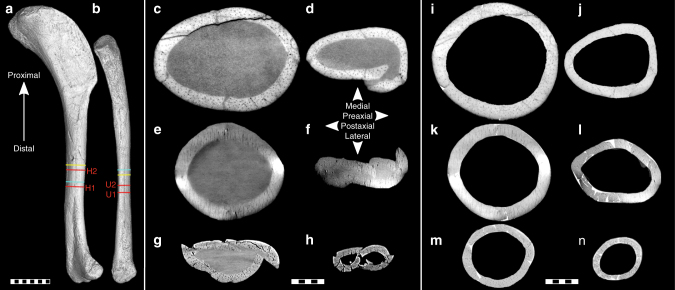
“Contrary to previously reported data13, the bone cortex of Archaeopteryx is well vascularised (Fig. 1c–h, Supplementary Data 1).”
§ Wing bone geometry reveals active flight in Archaeopteryx > Results > Cortical vascularisation
What the sources say
- Supportedcites [13] Erickson GM Was dinosaurian physiology inherited by birds? Reconciling slow growth in Archaeopteryx PLoS ONE 2009 4 e7390 10.1371/journal.pone.0007390 19816582 PMC2756958 source
Citation 13 is attached to “previously reported data,” not to the citing authors’ finding that the cortex is well vascularised. The source’s Introduction reports exceptionally sparse vascularization in Archaeopteryx, and its Results give a femoral porosity of 0.68%, supporting the characterization of the earlier data as contrary to that finding. (LLM, conf=0.94)
boosted- Asserted: passes — The authors put it forward as true.
- Checkable: passes — It can be checked against evidence.
- Load-bearing: passes — The paper’s conclusions depend on it.
- Based: passes — The paper gives a reason why it holds.
- Supported
The sources with a verdict support this claim; the rest weren’t checked yet, have no full text we could read, or their verdicts aren’t rated yet.
In the paper
“This is consistent with a higher bone growth rate14 and associated higher resting metabolic rate15 than inferred from nearly avascular bone chips of the seventh specimen13.”
§ Wing bone geometry reveals active flight in Archaeopteryx > Results > Cortical vascularisation
What the sources say
- Not checked — no full text of the sourcecites [14] Cubo J Le Roy N Martinez-Maza C Montes L Paleohistological estimation of bone growth rate in extinct archosaurs Paleobiology 2012 38 335 349 10.1666/08093.1 source
- Not checked — no full text of the sourcecites [15] Montes L Relationships between bone growth rate, body mass and resting metabolic rate in growing amniotes: a phylogenetic approach Biol. J. Linn. Soc. 2007 92 63 76 10.1111/j.1095-8312.2007.00881.x source
- Supportedcites [13] Erickson GM Was dinosaurian physiology inherited by birds? Reconciling slow growth in Archaeopteryx PLoS ONE 2009 4 e7390 10.1371/journal.pone.0007390 19816582 PMC2756958 source
The citation is attached to the comparison with nearly avascular bone chips, not to the higher growth or metabolic-rate inferences, which have separate citations. Materials and Methods describes cortical chips taken from the Munich Archaeopteryx specimen; Results reports that its vascular canals were sparsely distributed (0.68% porosity). Our copy does not call the Munich specimen the “seventh specimen.” (LLM, conf=0.88)
plainstates an association- Asserted: passes — The authors put it forward as true.
- Checkable: passes — It can be checked against evidence.
- Load-bearing: passes — The paper’s conclusions depend on it.
- Based: passes — The paper gives a reason why it holds.
The cited sources support only part of this claim — read each source’s verdict below.
In the paper
“This sequence starts at the bottom of DA 2 with short21 or burst20 flight and intermittent bounding20.”
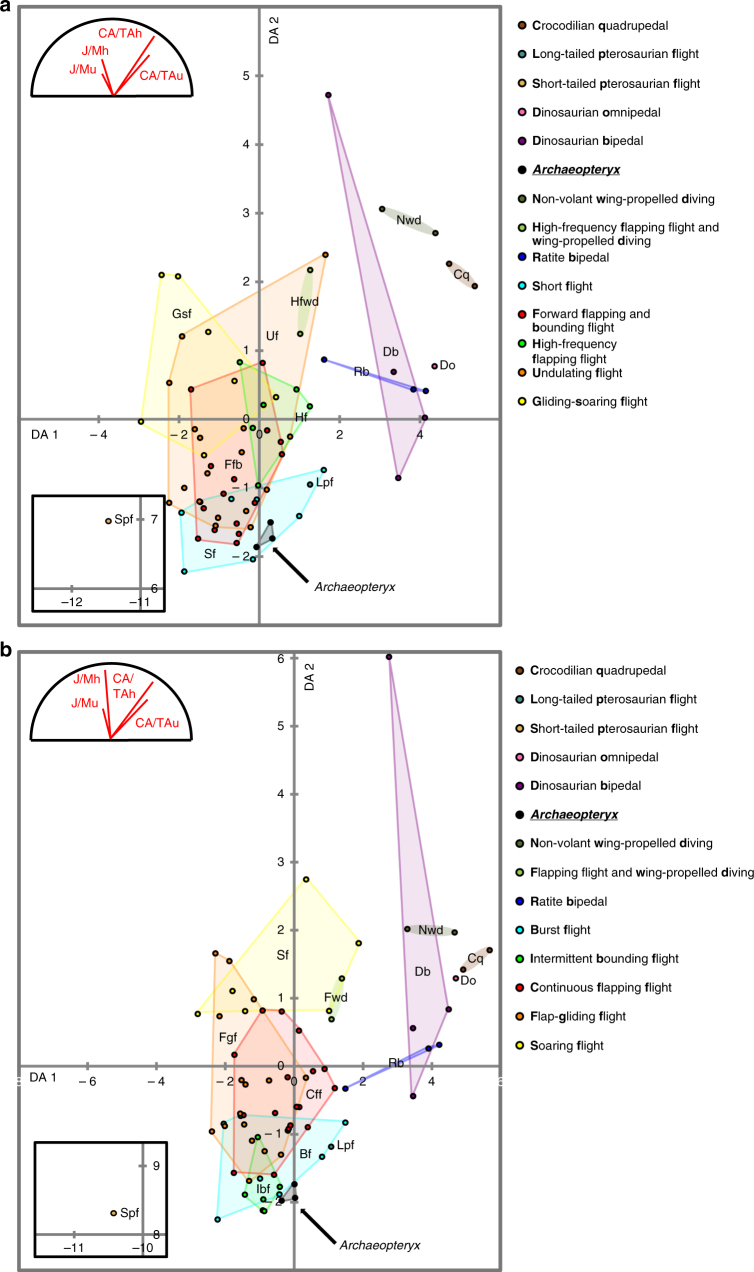
§ Wing bone geometry reveals active flight in Archaeopteryx > Results > Locomotor mode Phylogenetic autocorrelation was found to be insignificant towards Phylogenetically Informed Discriminant Analysis (Supplementary Fig. 8), thus rendering Linear Discriminant Analysis (LDA) appropriate for resolving the locomotory affinity of Archaeopteryx. Linear discriminant analysis (LDA) principally separates volant and non-volant archosaurs along discriminant axis (DA) 1 (Fig. 2 and Supplementary Fig. 9) through predominantly humeral and ulnar relative cortical thickness. DA 2 is loaded more equally on all parameters than DA 1, but slightly stronger on relative cortical thickness for the classification expanded from Viscor et al.21, and slightly stronger on mass-normalised torsional resistance for the classification expanded from Close et al.20. Within modern volant birds, an overlapping succession of avian flight modes extends upwards along DA 2 (Fig. 2). This sequence starts at the bottom of DA 2 with short21 or burst20 flight and intermittent bounding20. These flight modes share a strong climbing component during powered flight phases, where intermittent bounding remains restricted to species with an adult body mass typically below 200 g21. Forward flapping21, high-frequency flapping21, or continuous flapping20 flight is observed in birds that maintain level flapping flight after take-off. The avian sequence terminates in undulating21 or flap-gliding20 fliers that structurally alternate between flapping and gliding during flight, and aerial specialists in the gliding–soaring21 and soaring20 flight categories that harvest atmospheric movements to gain altitude and engage in sustained gliding. Across avian flight strategies and relative to mass-specific effects, relative torsional resistance of wing bones appears to scale inversely with a reliance on flapping during flight. This may reflect either a multidirectional stress regime or elevated torsional loading experienced during gliding and soaring as opposed to the directionally confined stresses associated with flapping12. A coupled decrease in relative cortical thickness and torsional resistance of anterior limb bones accompanied the transition from non-avian dinosaurs to birds (Fig. 2). A subsequent increase in relative torsional resistance at rather constant relative cortical thickness within volant birds accompanies the establishment of distinct avian flight modes (Fig. 2). Although basal and derived pterosaurs are represented by only one taxon each, their reciprocal relationship in pPCA and LDA morphospace qualitatively agrees with those between (occasionally) flapping birds and avian hyperaerial soarers, respectively. From a biomechanical point of view, this lends some support for an analogous evolutionary trajectory leading from flapping volancy in Rhamphorhynchus to an affinity with prolonged soaring in Brasileodactylus. Discriminant classification unanimously groups the specimens of Archaeopteryx with short21 or burst20 flyers in our set (Supplementary Data 2). Substantial group overlap within the volant avian cluster in discriminant morphospace results in relatively low percentages of correctly classified training species (53.62% and 56.52% for the Viscor et al.21 and Close et al.20 divisions, respectively), and this uncertainty undoubtedly carries over to the characterisation of extinct taxa with unknown locomotory strategies. Nevertheless, the position of Archaeopteryx is chiefly shared with short21/burst20 flyers (Fig. 2 and Supplementary Fig. 9), which supports the resolved affinity with these near-synonymous flight groups. Although Archaeopteryx plots close to intermittent bounding20 birds as well, its reconstructed adult body mass13 vastly exceeds the mass threshold to which modern bounding birds adhere21. Finally, short21 and burst20 flyers exhibit significantly deviating means from respectively gliding–soaring21, and flap-gliding20 and soaring20 birds (Supplementary Tables 1 and 2), thereby underlining an affinity to habitual flapping for Archaeopteryx.
What the sources say
- Not checked — no full text of the sourcecites [21] Viscor G Fuster JF Relationships between morphological parameters in birds with different flying habits Comp. Biochem. Physiol. 1987 87A 231 249 10.1016/0300-9629(87)90118-6 2886265 source
- Partly supportedcites [20] Close RA Rayfield EJ Functional morphometric analysis of the furcula in Mesozoic birds PloS ONE 2012 7 e36664 10.1371/journal.pone.0036664 22666324 PMC3364262 sourceExperimental — accuracy not yet measured
The Results (Extant-only Dataset; page unavailable) place intermittent bounders at low ES2 values, and the Methods identify burst-adapted fliers as a flight-mode category. But ES2 is an eigenshape axis, not discriminant axis 2 (DA 2), and our copy does not place both burst flight and intermittent bounding at the bottom of DA 2. (LLM, conf=0.83)
plain- Asserted: passes — The authors put it forward as true.
- Checkable: passes — It can be checked against evidence.
- Load-bearing: passes — The paper’s conclusions depend on it.
- Based: passes — The paper gives a reason why it holds.
The cited sources that could be checked couldn’t confirm or dispute this claim.
In the paper
“Burst-flying20 birds (incidental explosive take off and brief horizontal flight followed by a running escape) exhibit humeral and ulnar relative torsional resistance values overlapping with those of intermittent bounding20 flyers (flapping phases aimed at gaining altitude and speed, alternated with passive phases with folded wings).”
§ Wing bone geometry reveals active flight in Archaeopteryx > Results > Mass-normalised torsional resistance
What the sources say
- Could not verifycites [20] Close RA Rayfield EJ Functional morphometric analysis of the furcula in Mesozoic birds PloS ONE 2012 7 e36664 10.1371/journal.pone.0036664 22666324 PMC3364262 sourceExperimental — accuracy not yet measured
The Methods section (‘Flight mode categories’; page unavailable) defines burst-adapted and intermittent-bounding flight, while the Discussion compares their furcular shapes. Searches for humeral and ulnar torsional resistance found no passage reporting those values or their overlap; the cited paper’s discussion of furcular morphology does not verify the claim. (LLM, conf=0.76)
plainstates an association- Asserted: passes — The authors put it forward as true.
- Checkable: passes — It can be checked against evidence.
- Load-bearing: unclear — It is unclear whether the paper’s conclusions depend on it.
- Based: passes — The paper gives a reason why it holds.
- Could not verify
The sources with a verdict support this claim; the rest weren’t checked yet, have no full text we could read, or their verdicts aren’t rated yet.
In the paper
“Discriminant classification unanimously groups the specimens of Archaeopteryx with short21 or burst20 flyers in our set (Supplementary Data 2).”
§ Wing bone geometry reveals active flight in Archaeopteryx > Results > Locomotor mode Phylogenetic autocorrelation was found to be insignificant towards Phylogenetically Informed Discriminant Analysis (Supplementary Fig. 8), thus rendering Linear Discriminant Analysis (LDA) appropriate for resolving the locomotory affinity of Archaeopteryx. Linear discriminant analysis (LDA) principally separates volant and non-volant archosaurs along discriminant axis (DA) 1 (Fig. 2 and Supplementary Fig. 9) through predominantly humeral and ulnar relative cortical thickness. DA 2 is loaded more equally on all parameters than DA 1, but slightly stronger on relative cortical thickness for the classification expanded from Viscor et al.21, and slightly stronger on mass-normalised torsional resistance for the classification expanded from Close et al.20. Within modern volant birds, an overlapping succession of avian flight modes extends upwards along DA 2 (Fig. 2). This sequence starts at the bottom of DA 2 with short21 or burst20 flight and intermittent bounding20. These flight modes share a strong climbing component during powered flight phases, where intermittent bounding remains restricted to species with an adult body mass typically below 200 g21. Forward flapping21, high-frequency flapping21, or continuous flapping20 flight is observed in birds that maintain level flapping flight after take-off. The avian sequence terminates in undulating21 or flap-gliding20 fliers that structurally alternate between flapping and gliding during flight, and aerial specialists in the gliding–soaring21 and soaring20 flight categories that harvest atmospheric movements to gain altitude and engage in sustained gliding. Across avian flight strategies and relative to mass-specific effects, relative torsional resistance of wing bones appears to scale inversely with a reliance on flapping during flight. This may reflect either a multidirectional stress regime or elevated torsional loading experienced during gliding and soaring as opposed to the directionally confined stresses associated with flapping12. A coupled decrease in relative cortical thickness and torsional resistance of anterior limb bones accompanied the transition from non-avian dinosaurs to birds (Fig. 2). A subsequent increase in relative torsional resistance at rather constant relative cortical thickness within volant birds accompanies the establishment of distinct avian flight modes (Fig. 2). Although basal and derived pterosaurs are represented by only one taxon each, their reciprocal relationship in pPCA and LDA morphospace qualitatively agrees with those between (occasionally) flapping birds and avian hyperaerial soarers, respectively. From a biomechanical point of view, this lends some support for an analogous evolutionary trajectory leading from flapping volancy in Rhamphorhynchus to an affinity with prolonged soaring in Brasileodactylus. Discriminant classification unanimously groups the specimens of Archaeopteryx with short21 or burst20 flyers in our set (Supplementary Data 2). Substantial group overlap within the volant avian cluster in discriminant morphospace results in relatively low percentages of correctly classified training species (53.62% and 56.52% for the Viscor et al.21 and Close et al.20 divisions, respectively), and this uncertainty undoubtedly carries over to the characterisation of extinct taxa with unknown locomotory strategies. Nevertheless, the position of Archaeopteryx is chiefly shared with short21/burst20 flyers (Fig. 2 and Supplementary Fig. 9), which supports the resolved affinity with these near-synonymous flight groups. Although Archaeopteryx plots close to intermittent bounding20 birds as well, its reconstructed adult body mass13 vastly exceeds the mass threshold to which modern bounding birds adhere21. Finally, short21 and burst20 flyers exhibit significantly deviating means from respectively gliding–soaring21, and flap-gliding20 and soaring20 birds (Supplementary Tables 1 and 2), thereby underlining an affinity to habitual flapping for Archaeopteryx.
What the sources say
- Not checked — no full text of the sourcecites [21] Viscor G Fuster JF Relationships between morphological parameters in birds with different flying habits Comp. Biochem. Physiol. 1987 87A 231 249 10.1016/0300-9629(87)90118-6 2886265 source
- Supportedcites [20] Close RA Rayfield EJ Functional morphometric analysis of the furcula in Mesozoic birds PloS ONE 2012 7 e36664 10.1371/journal.pone.0036664 22666324 PMC3364262 source
Citation 20 is attached to “burst,” not to the citing authors’ own discriminant classification of Archaeopteryx. In Materials and Methods (Flight mode categories; page unavailable), the source defines “burst-adapted” fliers as birds capable of only very short-range flights. (LLM, conf=0.91)
plainstates an association- Asserted: passes — The authors put it forward as true.
- Checkable: passes — It can be checked against evidence.
- Load-bearing: passes — The paper’s conclusions depend on it.
- Based: passes — The paper gives a reason why it holds.
43 more claims · 2 with their cited sources checked
Create a free account to see all 92 claims and to verify the 1 reference still open.
- It may state two separate claims as one. 31
- Probably not a substantial claim. 20
Claims other papers make about this one
Each is checked against this paper’s own text: does it say what the citing paper says it does?
The source backs part of the claim, not all of it — or backs it for a different population, condition or comparison.
In the citing paper
“The cross-sectional geometry of the humerus and bone density values observed in Archaeopteryx are within the values observed in extant volant birds [22].”
From The ecology of Archaeopteryx (2026) · cites this paper as [22]
Experimental — accuracy not yet measuredThe cited source says what the claim attributes to it.
In the citing paper
“The reported cross-sectional geometry most closely resembles birds that utilize short-distance flapping flight.”
From The ecology of Archaeopteryx (2026) · cites this paper as [22]
The cited source says what the claim attributes to it.
In the citing paper
“Earlier hypotheses that Archaeopteryx was only capable of gliding flight [38], a locomotor strategy not present in living birds, have lost support and a gliding-only phase for the evolution of avian flight is considered unlikely [2, 22, 78].”
From The ecology of Archaeopteryx (2026) · cites this paper as [22]
The check wasn’t confident either way, so it gives no verdict — never disputed.
In the citing paper
“The overall shape of the feathered wing is short and broad [21] but the proportions of the body suggest relatively high wing loading.”
From The ecology of Archaeopteryx (2026) · cites this paper as [21]
Experimental — accuracy not yet measuredThe check wasn’t confident either way, so it gives no verdict — never disputed.
In the citing paper
“The shape of the wing is broad [21], most closely resembling the elliptical wings of neornithines.”
From The ecology of Archaeopteryx (2026) · cites this paper as [21]
Experimental — accuracy not yet measured
1 more claim about this paper
Create a free account to see every claim other papers make about this one.
Citations
Cites
PAST: PALEONTOLOGICAL STATISTICAL SOFTWARE PACKAGE FOR EDUCATION AND DATA ANALYSIS
Hammer, Ø., Harper, D. A. T., & Ryan, P. D. (2001) · Palaeontologia Electronica · Cited by 17,871
phytools: an R package for phylogenetic comparative biology (and other things)
Revell, L. J. (2012) · Methods in Ecology and Evolution · doi:10.1111/j.2041-210x.2011.00169.x · Cited by 9,277
Inferring the historical patterns of biological evolution
Pagel, M. (1999) · Nature · doi:10.1038/44766 · Cited by 5,200
Simultaneous phase and amplitude extraction from a single defocused image of a homogeneous object
Paganin, D., Mayo, S. C., Gureyev, T. E., Miller, P. R., & Wilkins, S. W. (2002) · Journal of Microscopy · doi:10.1046/j.1365-2818.2002.01010.x · Cited by 2,062
Whole-genome analyses resolve early branches in the tree of life of modern birds
Jarvis, E. D., Mirarab, S., Aberer, A. J., Li, B., Houde, P., Li, C., Ho, S. Y. W., Faircloth, B. C., Nabholz, B., Howard, J. T., et al. (2014) · Science · doi:10.1126/science.1253451 · Cited by 1,901
A comprehensive phylogeny of birds (Aves) using targeted next-generation DNA sequencing
Prum, R. O., Berv, J. S., Dornburg, A., Field, D. J., Townsend, J. P., Lemmon, E. M., & Lemmon, A. R. (2015) · Nature · doi:10.1038/nature15697 · Cited by 1,668
Phylogenetic Analysis of Covariance by Computer Simulation
Garland, T., Dickerman, A. W., Janis, C. M., & Jones, J. A. (1993) · Systematic Biology · doi:10.1093/sysbio/42.3.265 · Cited by 1,238
A comprehensive phylogeny of birds (Aves) using targeted next-generation DNA sequencing
Prum, R. O., Berv, J. S., Dornburg, A., Field, D. J., Townsend, J. P., Lemmon, E. M., & Lemmon, A. R. (2016) · Nature · doi:10.1038/nature19417 · Cited by 928
SIZE-CORRECTION AND PRINCIPAL COMPONENTS FOR INTERSPECIFIC COMPARATIVE STUDIES
Revell, L. J. (2009) · Evolution · doi:10.1111/j.1558-5646.2009.00804.x · Cited by 838
A database of vertebrate longevity records and their relation to other life‐history traits
DE MAGALHÃES, J. P., & COSTA, J. (2009) · Journal of Evolutionary Biology · doi:10.1111/j.1420-9101.2009.01783.x · Cited by 543
From Wolff's law to the Utah paradigm: Insights about bone physiology and its clinical applications
Frost, H. M. (2001) · The Anatomical Record · doi:10.1002/ar.1049 · Cited by 457
Tafforeau, P., Boistel, R., Boller, E., Bravin, A., Brunet, M., Chaimanee, Y., Cloetens, P., Feist, M., Hoszowska, J., Jaeger, J.-J., et al. (2006) · Applied Physics A · doi:10.1007/s00339-006-3507-2 · Cited by 456
Self-citation(2008) · Theoretical Ecology Series · doi:10.1016/s1875-306x(08)x0002-4 · Cited by 356
The Microstructure of Dinosaur Bone
Chinsamy-Turan, A. (2005) · doi:10.56021/9780801881206 · Cited by 342
The thickness of the walls of tubular bones
Currey, J. D., & Alexander, R. M. (1985) · Journal of Zoology · doi:10.1111/j.1469-7998.1985.tb03551.x · Cited by 287 · cited 1×
“Both referred avian flight classifications were complemented with the following locomotor categories: (6) long-tailed pterosaurian flight, (7) short-tailed pterosaurian flight, (8) (avian) non-volant wing-propelled diving, (9) ratite bipedal, (10) (non-avian) dinosaurian bipedal, (11) (non-avian) dinosaurian omnipedal…”
BackgroundAlexander, W. A. K., & Tomida, Y. (2000) · National Science Museum monographs · Cited by 257
Bone curvature: Sacrificing strength for load predictability?
Bertram, J. E. A., & Biewener, A. A. (1988) · Journal of Theoretical Biology · doi:10.1016/s0022-5193(88)80122-x · Cited by 252
Crocodiles: biology, husbandry and diseases
(2003) · doi:10.1079/9780851996561.0000 · Cited by 242
The Microstructure of Dinosaur Bone: Deciphering Biology with Fine-Scale Techniques.
(2005) · Choice Reviews Online · doi:10.5860/choice.43-2219 · Cited by 204
Was Dinosaurian Physiology Inherited by Birds? Reconciling Slow Growth in Archaeopteryx
Erickson, G. M., Rauhut, O. W. M., Zhou, Z., Turner, A. H., Inouye, B. D., Hu, D., & Norell, M. A. (2009) · PLoS ONE · doi:10.1371/journal.pone.0007390 · Cited by 195
Nocturnality in Dinosaurs Inferred from Scleral Ring and Orbit Morphology
Schmitz, L., & Motani, R. (2011) · Science · doi:10.1126/science.1200043 · Cited by 173
Gastrointestinal Microbiology: Volume 1 Gastrointestinal Ecosystems and Fermentations
(1997) · Springer eBooks · doi:10.1007/978-1-4615-4111-0 · Cited by 167
Sanchez, S., Ahlberg, P. E., Trinajstic, K. M., Mirone, A., & Tafforeau, P. (2012) · Microscopy and Microanalysis · doi:10.1017/s1431927612001079 · Cited by 163
Self-citationThe effects of locomotion on the structural characteristics of avian limb bones
HABIB, M. B., & RUFF, C. B. (2008) · Zoological Journal of the Linnean Society · doi:10.1111/j.1096-3642.2008.00402.x · Cited by 146
De Margerie, E., Sanchez, S., Cubo, J., & Castanet, J. (2005) · The Anatomical Record Part A: Discoveries in Molecular, Cellular, and Evolutionary Biology · doi:10.1002/ar.a.20141 · Cited by 146
Self-citationWoodward, H. N., Horner, J. R., & Farlow, J. O. (2014) · PeerJ · doi:10.7717/peerj.422 · Cited by 144
Bennett, S. C. (1995) · Journal of Paleontology · doi:10.1017/s0022336000034946 · Cited by 139
Weitere Pterosaurierfunde aus der Santana-Formation (Apt) der Chapada do Araripe, Brasilien
Wellnhofer, P. (1991) · Palaeontographica Abteilung A · Cited by 138
Bybee, P. J., Lee, A. H., & Lamm, E. (2006) · Journal of Morphology · doi:10.1002/jmor.10406 · Cited by 128
Paleohistological estimation of bone growth rate in extinct archosaurs
Cubo, J., Le Roy, N., Martinez-Maza, C., & Montes, L. (2012) · Paleobiology · doi:10.1666/08093.1 · Cited by 123
Self-citationThe wing of Archaeopteryx as a primary thrust generator
Burgers, P., & Chiappe, L. M. (1999) · Nature · doi:10.1038/19967 · Cited by 121 · cited 2×
“20 separates (1) burst flight, (2) intermittent bounding flight, (3) continuous flapping flight, (4) flap-gliding flight and (5) soaring flight, and was applied through description.”
BackgroundAvian Evolution: The Fossil Record of Birds and its Paleobiological Significance
Mayr, G. (2016) · Cited by 114
Carlson, K. J. (2005) · American Journal of Physical Anthropology · doi:10.1002/ajpa.20124 · Cited by 112
Wing upstroke and the evolution of flapping flight
Poore, S. O., Sánchez-Haiman, A., & Goslow, G. E. (1997) · Nature · doi:10.1038/42930 · Cited by 104
The Princeton Field Guide to Dinosaurs
Paul, G. S. (2016) · Princeton University Press eBooks · doi:10.1515/9781400883141 · Cited by 103
Avian Evolution: The Fossil Record of Birds and Its Paleobiological Significance
Mayr, G. (2016) · doi:10.1002/9781119020677 · Cited by 102
Morphometrics of flightlessness in the Alcidae
Livezey, B. C. (1988) · The Auk · doi:10.1093/auk/105.4.681 · Cited by 99
Zheng, X., O’Connor, J., Wang, X., Wang, M., Zhang, X., & Zhou, Z. (2014) · Proceedings of the National Academy of Sciences · doi:10.1073/pnas.1411070111 · Cited by 96
The Ontogenetic Osteohistology of Tenontosaurus tilletti
Werning, S. (2012) · PLoS ONE · doi:10.1371/journal.pone.0033539 · Cited by 96
Chiappe, L. (2016) · doi:10.1353/book.48019 · Cited by 92
MONTES, L., LE ROY, N., PERRET, M., DE BUFFRENIL, V., CASTANET, J., & CUBO, J. (2007) · Biological Journal of the Linnean Society · doi:10.1111/j.1095-8312.2007.00881.x · Cited by 91
Self-citation(2009) · Oxford University Press eBooks · doi:10.1093/acprof:oso/9780199535095.001.0001 · Cited by 90
Ruff, C. B., Burgess, M. L., Bromage, T. G., Mudakikwa, A., & McFarlin, S. C. (2013) · Journal of Human Evolution · doi:10.1016/j.jhevol.2013.06.008 · Cited by 88
Predatory Dinosaurs of the World, a Complete Illustrated Guide
Prothero, D. R., & Paul, G. S. (1989) · Palaios · doi:10.2307/3514595 · Cited by 87
Incidence and mechanical significance of pneumatization in the long bones of birds
CUBO, J. (2000) · Zoological Journal of the Linnean Society · doi:10.1006/zjls.2000.0238 · Cited by 84
Self-citationPterosaur body mass estimates from three-dimensional mathematical slicing
Henderson, D. M. (2010) · Journal of Vertebrate Paleontology · doi:10.1080/02724631003758334 · Cited by 84
Bengtson, S.-A. (1984) · The Auk · doi:10.1093/auk/101.1.1 · Cited by 82
Flight capability and the pectoral girdle of Archaeopteryx
OLSON, S. L., & FEDUCCIA, A. (1979) · Nature · doi:10.1038/278247a0 · Cited by 74
Castanet, J., Grandin, A., Abourachid, A., de Ricqlès, A., & Grandin, S. (1996) · Cited by 73
Scapular orientation in theropods and basal birds, and the origin of flapping flight
Senter, P. (2006) · Zenodo · doi:10.5281/zenodo.13644023 · Cited by 72
de Buffrénil, V., Houssaye, A., & Böhme, W. (2007) · Journal of Morphology · doi:10.1002/jmor.10604 · Cited by 70
How animals glide: from trajectory to morphology
Socha, J. J., Jafari, F., Munk, Y., & Byrnes, G. (2015) · Canadian Journal of Zoology · doi:10.1139/cjz-2014-0013 · Cited by 65
Biomechanical Significance of Cross-Sectional Geometry of Avian Long Bones
Cubo, J., & Casinos, A. (1998) · European Journal of Morphology · doi:10.1076/ejom.36.1.0019 · Cited by 65 · cited 1×
“Both referred avian flight classifications were complemented with the following locomotor categories: (6) long-tailed pterosaurian flight, (7) short-tailed pterosaurian flight, (8) (avian) non-volant wing-propelled diving, (9) ratite bipedal, (10) (non-avian) dinosaurian bipedal, (11) (non-avian) dinosaurian omnipedal…”
BackgroundSelf-citationStructure and function of hindlimb feathers in Archaeopteryx lithographica
Longrich, N. (2006) · Paleobiology · doi:10.1666/04014.1 · Cited by 63
Estimation of torsional rigidity in primate long bones
Daegling, D. J. (2002) · Journal of Human Evolution · doi:10.1006/jhev.2002.0574 · Cited by 61
Relationships between morphological parameters in birds with different flying habits
Viscor, G., & Fuster, J. F. (1987) · Comparative Biochemistry and Physiology Part A: Physiology · doi:10.1016/0300-9629(87)90118-6 · Cited by 60
The Princeton Field Guide to Dinosaurs
Paul, G. S. (2011) · Princeton University Press eBooks · doi:10.1515/9781400836154 · Cited by 56
Cross sectional geometry of the forelimb skeleton and flight mode in pelecaniform birds
Simons, E. L. R., Hieronymus, T. L., & O'Connor, P. M. (2011) · Journal of Morphology · doi:10.1002/jmor.10963 · Cited by 55 · cited 1×
“Both referred avian flight classifications were complemented with the following locomotor categories: (6) long-tailed pterosaurian flight, (7) short-tailed pterosaurian flight, (8) (avian) non-volant wing-propelled diving, (9) ratite bipedal, (10) (non-avian) dinosaurian bipedal, (11) (non-avian) dinosaurian omnipedal…”
BackgroundHumeral Cross‐Sectional Shape in Suspensory Primates and Sloths
Patel, B. A., Ruff, C. B., Simons, E. L. R., & Organ, J. M. (2013) · The Anatomical Record · doi:10.1002/ar.22669 · Cited by 54
White, M. A., Cook, A. G., Hocknull, S. A., Sloan, T., Sinapius, G. H. K., & Elliott, D. A. (2012) · PLoS ONE · doi:10.1371/journal.pone.0039364 · Cited by 52
(2016) · Cited by 49
[Expression of growth dynamic in the structure of periosteal bone in Anas platyrhynchos].
Castanet, J., Grandin, A., Abourachid, A., & de Ricqlès, A. J. (1996) · PubMed · Cited by 47
Pectoral girdle morphology of Mesozoic birds and the evolution of the avian supracoracoideus muscle
Mayr, G. (2017) · Journal of Ornithology · doi:10.1007/s10336-017-1451-x · Cited by 47
Functional Morphometric Analysis of the Furcula in Mesozoic Birds
Close, R. A., & Rayfield, E. J. (2012) · PLoS ONE · doi:10.1371/journal.pone.0036664 · Cited by 44
Wilson, L. E., & Chin, K. (2014) · Royal Society Open Science · doi:10.1098/rsos.140245 · Cited by 43
Tiny dinosaurs: are they fully grown?
Callison, G., & Quimby, H. M. (1984) · Journal of Vertebrate Paleontology · doi:10.1080/02724634.1984.10011975 · Cited by 43
Smith, N. A., & Clarke, J. A. (2014) · The Anatomical Record · doi:10.1002/ar.22841 · Cited by 41
Wing bone laminarity is not an adaptation for torsional resistance in bats
Lee, A. H., & Simons, E. L. R. (2015) · PeerJ · doi:10.7717/peerj.823 · Cited by 37
Hone, D., Henderson, D. M., Therrien, F., & Habib, M. B. (2015) · PeerJ · doi:10.7717/peerj.1191 · Cited by 34
Phylogenetic signal in bone histology of amniotes revisited
Legendre, L. J., Roy, N. L., Martínez-Maza, C., Montes, L., Laurin, M., & Cubo, J. (2012) · Zoologica Scripta · doi:10.1111/j.1463-6409.2012.00564.x · Cited by 33
Self-citationXXVI.—On some Fossil Remains of Carinate Birds from Central Madagascar
Andrews, C. W. (1897) · Ibis · doi:10.1111/j.1474-919x.1897.tb03281.x · Cited by 20
Pterosaurs from the Lower Cretaceous of Brazil in the Stuttgart Collection
Veldmeijer, A. J. (1998) · reroDoc Digital Library · Cited by 15
Geometric and metabolic constraints on bone vascular supply in diapsids
Cubo, J., Baudin, J., Legendre, L. J., Quilhac, A., & de Buffrénil, V. (2014) · Biological Journal of the Linnean Society · doi:10.1111/bij.12331 · Cited by 14
Self-citationOn the origin of flight in Archaeopteryx and in pterosaurs
Ebel, K. (1996) · Neues Jahrbuch für Geologie und Paläontologie - Abhandlungen · doi:10.1127/njgpa/202/1996/269 · Cited by 5
Evolution: A Rapid Flight towards Birds
Ksepka, D. T. (2014) · Current Biology · doi:10.1016/j.cub.2014.09.018 · Cited by 4 · cited 2×
“20 separates (1) burst flight, (2) intermittent bounding flight, (3) continuous flapping flight, (4) flap-gliding flight and (5) soaring flight, and was applied through description.”
BackgroundWind-assisted flight of Archaeopteryx
Thulborn, R. A. (2003) · Neues Jahrbuch für Geologie und Paläontologie - Abhandlungen · doi:10.1127/njgpa/229/2003/61 · Cited by 3
Humeral Cross‐Sectional Shape in Suspensory Primates and Sloths
Patel, B. A., Ruff, C. B., Simons, E. L. R., & Organ, J. M. (2013) · The Anatomical Record · doi:10.1002/ar.22560 · Cited by 2
Kale, H. W., Horsfall, J. A., & Lohrer, F. E. (1984) · The Auk · doi:10.2307/4086356 · Cited by 2
Crocodiles – Biology, husbandry and diseases
Huchzermeyer, F., & Wyk, W. V. (2003) · Journal of the South African Veterinary Association · doi:10.4102/jsava.v74i4.529
Research works printed but not linked: 3
- Parsons WL Parsons KM Further descriptions of the osteology of Deinonychus antirrhopus (Saurischia, Theropoda) Bull. Buffalo Soc. Nat. Sci. 2009 38 43 54
- Barthel, K. W., Swinburne, N. H. M., Conway Morris, S. Solnhofen. A study in Mesozoic palaeontology (Cambridge University Press, Cambridge, 1990).
- Masser MP Alligator production: grow-out and harvest SRAC Publ. 1993 232 1 4
Cited by
Walsh, C. L., Tafforeau, P., Wagner, W. L., Jafree, D. J., Bellier, A., Werlein, C., Kühnel, M. P., Boller, E., Walker-Samuel, S., Robertus, J. L., et al. (2021) · Nature Methods · doi:10.1038/s41592-021-01317-x · Cited by 321
Self-citationFeather function and the evolution of birds
Terrill, R. S., & Shultz, A. J. (2023) · Biological Reviews · doi:10.1111/brv.12918 · Cited by 147
Potential for Powered Flight Neared by Most Close Avialan Relatives, but Few Crossed Its Thresholds
Pei, R., Pittman, M., Goloboff, P. A., Dececchi, T. A., Habib, M. B., Kaye, T. G., Larsson, H. C. E., Norell, M. A., Brusatte, S. L., & Xu, X. (2020) · Current Biology · doi:10.1016/j.cub.2020.06.105 · Cited by 137
“The long bone cross-sections in the forelimbs of early birds and microraptorine dromaeosaurids have similar shapes and comparable bending strengths to those of living birds [60].”
Subaqueous foraging among carnivorous dinosaurs
Fabbri, M., Navalón, G., Benson, R., Pol, D., O'Connor, J. K., Bhullar, B.-A. S., Erickson, G. M., Norell, M. A., Orkney, A., Lamanna, M. C., et al. (2022) · Nature · doi:10.1038/s41586-022-04528-0 · Cited by 75
Paravian Phylogeny and the Dinosaur-Bird Transition: An Overview
Agnolin, F. L., Motta, M. J., Brissón Egli, F., Lo Coco, G., & Novas, F. E. (2019) · Frontiers in Earth Science · doi:10.3389/feart.2018.00252 · Cited by 48
“This is in agreement with other lines of evidence, including feather morphology and bone geometry (Feo et al., 2015; Voeten et al., 2018), that suggest flight capability was low or absent in basal avialans.”
BackgroundResult
Metadata
- Authors
- Voeten, D. F. A. E., Cubo, J., de Margerie, E., Röper, M., Beyrand, V., Bureš, S., Tafforeau, P., & Sanchez, S.
- Affiliations
- European Synchrotron Radiation Facility (FR)
- Centre National de la Recherche Scientifique (FR)
- Bayerische Staatssammlung für Paläontologie und Geologie (DE)
- Palacký University Olomouc (CZ)
- Uppsala University (SE)
- Venue
- Nature Communications
- Published
- 2018-03-13
- Volume
- 9
- Issue
- 1
- Pages
- 923-923
- ISSN
- 2041-1723 (ISSN-L)
- PMC
- PMC5849612
- OpenAlex
- W2791698505
- Cited by
- 77
- References
- 79
- Citations by year
- 2026: 6 · 2025: 14 · 2024: 3 · 2023: 6 · 2022: 7 · 2021: 21 · 2020: 8 · 2019: 6 · 2018: 2
- FWCI
- 12.43
- Type
- journal article
- Language
- en
- Open access
- gold
- doi.org
- Licence
- cc-by
- creativecommons.org/licenses/by/4.0 (tdm)
- creativecommons.org/licenses/by/4.0 (vor)
- Locations
- Nature Communications (publishedVersion, cc-by)
- PubMed (publishedVersion)
- PubMed Central (submittedVersion, cc-by)
- Uppsala University Publications (Uppsala University) (submittedVersion, other-oa)
- HAL (Le Centre pour la Communication Scientifique Directe) (submittedVersion)
- RePEc: Research Papers in Economics (submittedVersion)
- DOAJ (DOAJ: Directory of Open Access Journals) (submittedVersion)
- DOAJ (DOAJ: Directory of Open Access Journals) (submittedVersion, cc-by-sa)
- Topics
- Physical Sciences › Earth and Planetary Sciences › Paleontology › Paleontology and Evolutionary Biology
- Physical Sciences › Earth and Planetary Sciences › Paleontology › Evolution and Paleontology Studies
- Life Sciences › Agricultural and Biological Sciences › Ecology, Evolution, Behavior and Systematics › Amphibian and Reptile Biology
- Keywords
- Archaeopteryx, avian flight evolution, flapping flight, archosaurs, synchrotron microtomography, Late Jurassic, locomotion
- MeSH terms
- Animals, Birds, Bone and Bones, Biological Evolution, Flight, Animal, Fossils, Wings, Animal
About these checks
Registry, retraction, Cites and statistics results are computed, not judged, with one exception: a printed reference that no index lists is read once by a model before it counts as a citation error. Claims are extracted by a model and kept only when their quote appears verbatim in the text; each cited source is then checked, with a model’s help, for whether it says what the claim relies on. Those verdicts can be wrong — read the claim’s quote and the cited source before relying on one.
The claim verdicts this report counts are experimental: their accuracy is not yet measured.
A language model drew the claims from the paper on 2026-10-10, under version 3 of the claim definition (model deepseek-v4.1-flash, prompt extract-v3).
A second model labelled each claim on 2026-10-10 (model jev-1.13-20260917, definition revision gold-guideline-v0.2).
Cited sources are checked with a language model’s help (gpt-6-sol).
Statistics and arithmetic are recomputed, not judged.
Confidence bands are shown only for fields calibrated on our annotated test set. None is calibrated yet, so no band is shown.
What counts as a claim ›How we measure confidence ›How we check this ›
Are you an author, or do you see a problem with this page? Request a review
Data sources
Bibliographic data: Semantic Scholar, OpenAlex, Crossref.
Contains information from the Semantic Scholar Academic Graph Datasets, made available under the ODC Attribution License (ODC-BY 1.0).
Semantic Scholar’s data is described in: Kinney, R., et al. (2023). The Semantic Scholar Open Data Platform. arXiv:2301.10140.
