

The DOI matches its Crossref record; 83 of the 83 references it cites were found in a registry or an index.
Assembly of 913 microbial genomes from metagenomic sequencing of the cow rumen
Open accessAbstract
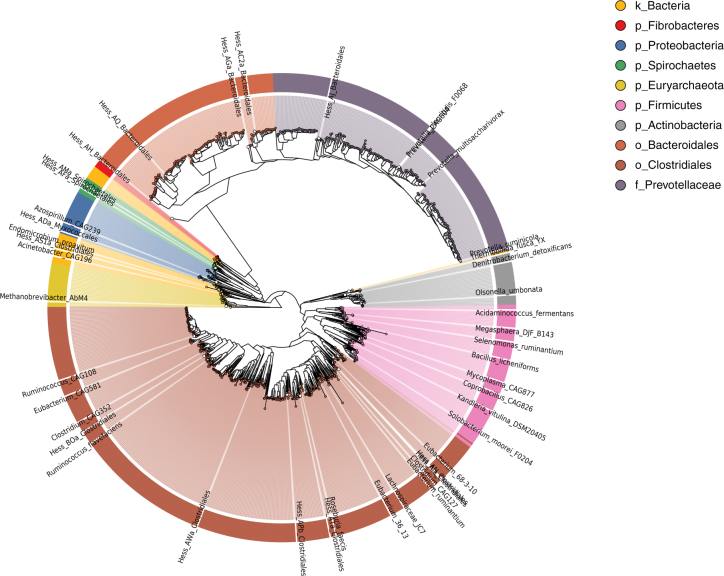
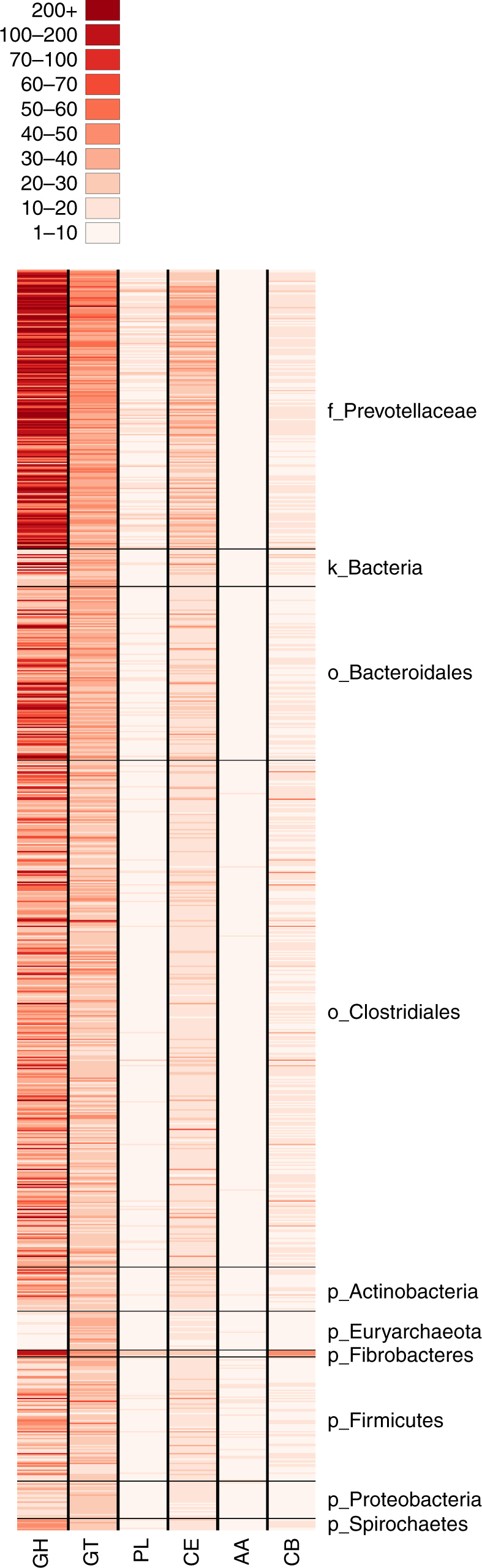
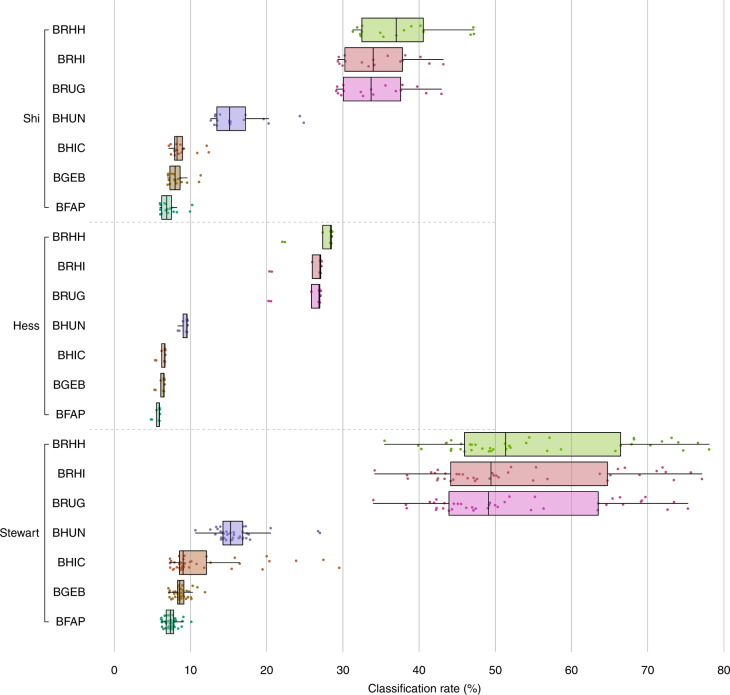
The cow rumen is adapted for the breakdown of plant material into energy and nutrients, a task largely performed by enzymes encoded by the rumen microbiome. Here we present 913 draft bacterial and archaeal genomes assembled from over 800 Gb of rumen metagenomic sequence data derived from 43 Scottish cattle, using both metagenomic binning and Hi-C-based proximity-guided assembly. Most of these genomes represent previously unsequenced strains and species. The draft genomes contain over 69,000 proteins predicted to be involved in carbohydrate metabolism, over 90% of which do not have a good match in public databases. Inclusion of the 913 genomes presented here improves metagenomic read classification by sevenfold against our own data, and by fivefold against other publicly available rumen datasets. Thus, our dataset substantially improves the coverage of rumen microbial genomes in the public databases and represents a valuable resource for biomass-degrading enzyme discovery and studies of the rumen microbiome.
Overview
The claims and statistics of this paper haven’t been checked yet.
Run the check — free, no account needed. It reads the open-access text and checks the sources it cites.
Integrity signals
Registry
Cites
Statistics
Figures
Verification
Claims the paper makes
The claims and statistics of this paper haven’t been checked yet.
Run the check — free, no account needed. It reads the open-access text and checks the sources it cites.
Claims other papers make about this one
Each is checked against this paper’s own text: does it say what the citing paper says it does?
In the citing paper
“Subsequently, Svartstrom et al. (2017) assembled 99 microbial genomes from the moose rumen, Stewart et al. (2018) assembled 913 microbial genomes from the rumen of cattle, and Parks et al. (2017) assembled over 8,000 novel microbial genomes from 1,500 public datasets, some of which originated from the rumen.”
From Addressing global ruminant agricultural challenges through understanding the rumen microbiome: past, present, and future (2018) · cites this paper as Stewart et al., 2018
In the citing paper
“Hi-C binning has been used effectively on human feces (Press et al., 2017) as well as in ruminants (Stewart et al., 2018).”
From Addressing global ruminant agricultural challenges through understanding the rumen microbiome: past, present, and future (2018) · cites this paper as Stewart et al., 2018
Self-check
Percentages, sums and reported differences re-computed from the paper’s own numbers.
The self-check needs the paper’s full text.
Citations
Cites
Trimmomatic: a flexible trimmer for Illumina sequence data
Bolger, A. M., Lohse, M., & Usadel, B. (2014) · Bioinformatics · doi:10.1093/bioinformatics/btu170 · Cited by 65,548
The Sequence Alignment/Map format and SAMtools
Li, H., Handsaker, B., Wysoker, A., Fennell, T., Ruan, J., Homer, N., Marth, G., Abecasis, G., Durbin, R., & 1000 Genome Project Data Processing Subgroup (2009) · Bioinformatics · doi:10.1093/bioinformatics/btp352 · Cited by 62,041
Fast and accurate short read alignment with Burrows-Wheeler transform
Li, H., & Durbin, R. (2009) · Bioinformatics · doi:10.1093/bioinformatics/btp324 · Cited by 58,607
BLAST+: architecture and applications
Camacho, C., Coulouris, G., Avagyan, V., Ma, N., Papadopoulos, J., Bealer, K., & Madden, T. L. (2009) · BMC Bioinformatics · doi:10.1186/1471-2105-10-421 · Cited by 22,074
Fast and sensitive protein alignment using DIAMOND
Buchfink, B., Xie, C., & Huson, D. H. (2015) · Nature Methods · doi:10.1038/nmeth.3176 · Cited by 14,201
Aligning sequence reads, clone sequences and assembly contigs with BWA-MEMPreprint
Li, H. (2013) · arXiv (Cornell University) · doi:10.48550/arxiv.1303.3997 · Cited by 10,846
Li, D., Liu, C.-M., Luo, R., Sadakane, K., & Lam, T. (2015) · Bioinformatics · doi:10.1093/bioinformatics/btv033 · Cited by 10,133
UniProt: the Universal Protein knowledgebase
Apweiler, R. (2003) · Nucleic Acids Research · doi:10.1093/nar/gkh131 · Cited by 7,593
The carbohydrate-active enzymes database (CAZy) in 2013
Lombard, V., Ramulu, H. G., Drula, É., Coutinho, P. M., & Henrissat, B. (2013) · Nucleic Acids Research · doi:10.1093/nar/gkt1178 · Cited by 6,452
O'Leary, N. A., Wright, M. W., Brister, J. R., Ciufo, S., Haddad, D., McVeigh, R., Rajput, B., Robbertse, B., Smith-White, B., Ako-Adjei, D., et al. (2016) · Nucleic Acids Research · doi:10.1093/nar/gkv1189 · Cited by 6,357
Cited by
Sorted by citations
Improved metagenomic analysis with Kraken 2
Wood, D. E., Lu, J., & Langmead, B. (2019) · Genome biology · doi:10.1186/s13059-019-1891-0 · Cited by 7,173
“As databases of assembled genomes continue to grow, databases of reference sequences used for metagenomics studies will also grow [21,23].”
BackgroundA new genomic blueprint of the human gut microbiota
Almeida, A., Mitchell, A. L., Boland, M., Forster, S. C., Gloor, G. B., Tarkowska, A., Lawley, T. D., & Finn, R. D. (2019) · Nature · doi:10.1038/s41586-019-0965-1 · Cited by 1,314
A genomic catalog of Earth’s microbiomes
Nayfach, S., Roux, S., Seshadri, R., Udwary, D., Varghese, N. J., Schulz, F., Wu, D., Páez-Espino, D., Chen, I.-M. A., Huntemann, M., et al. (2020) · Nature Biotechnology · doi:10.1038/s41587-020-0718-6 · Cited by 890
“We performed metagenomic assembly and binning on 10,450 globally distributed metagenomes from diverse habitats, including ocean and other aquatic environments (3,345), human and animal host-associated environments (3,536), as well as soils and other terrestrial environments (1,919), to recover 52,515 MAGs (Fig.”
BackgroundA practical guide to amplicon and metagenomic analysis of microbiome data
Liu, Y., Qin, Y., Chen, T., Lu, M., Qian, X., Guo, X., & Bai, Y. (2020) · Protein & Cell · doi:10.1007/s13238-020-00724-8 · Cited by 931
“…from the human gut (Li et al., 2014; Pasolli et al., 2019; Tierney et al., 2019), the mouse gut (Xiao et al., 2015), the chicken gut (Huang et al., 2018), the cow rumen (Stewart et al., 2018; Stewart et al., 2019), the ocean (Salazar et al., 2019), and the citrus rhizosphere (Xu et al., 2018).”
BackgroundNew insights from uncultivated genomes of the global human gut microbiome
Nayfach, S., Shi, Z. J., Seshadri, R., Pollard, K. S., & Kyrpides, N. C. (2019) · Nature · doi:10.1038/s41586-019-1058-x · Cited by 737
Metadata
- Authors
- Stewart, R. D., Auffret, M. D., Warr, A., Wiser, A. H., Press, M. O., Langford, K. W., Liachko, I., Snelling, T. J., Dewhurst, R. J., Walker, A. W., Roehe, R., & Watson, M.
- Affiliations
- Roslin Institute (GB)
- Scotland's Rural College (GB)
- University of Aberdeen (GB)
- Corresponding author
- Watson, Mick
- ORCID
- Venue
- Nature Communications
- Published
- 2018-02-28
- Volume
- 9
- Issue
- 1
- Pages
- 870-870
- ISSN
- 2041-1723 (ISSN-L)
- PMC
- PMC5830445
- OpenAlex
- W2786358949
- Cited by
- 559
- References
- 83
- Citations by year
- 2026: 39 · 2025: 48 · 2024: 77 · 2023: 69 · 2022: 64 · 2021: 73 · 2020: 89 · 2019: 73 · 2018: 27
- FWCI
- 24.09
- Type
- journal article
- Language
- en
- Open access
- gold
- doi.org
- Locations
- Nature Communications (publishedVersion, cc-by)
- Europe PMC (PubMed Central) (publishedVersion, cc-by)
- PubMed Central (publishedVersion, cc-by)
- PubMed (publishedVersion)
- Edinburgh Research Explorer (University of Edinburgh) (publishedVersion, cc-by)
- RePEc: Research Papers in Economics (submittedVersion)
- Aberdeen University Research Archive (Aberdeen University) (submittedVersion)
- DOAJ (DOAJ: Directory of Open Access Journals) (submittedVersion)
- DOAJ (DOAJ: Directory of Open Access Journals) (submittedVersion, cc-by-sa)
- Funders
- Rural and Environment Science and Analytical Services Division
- Scottish Government
- Scotland’s Rural College
- Directorate for Biological Sciences
- Biotechnology and Biological Sciences Research Council (BBS/E/D/30002276, BB/M01844X/1, BB/J004235/1, BB/R015023/1, BB/P013732/1, BB/J004235, BB/N016742/1, BB/ J004243/1, BB/N01720X/1, P013759, BBP013759/1, BBS/E/D/20310000)
- National Institute of Allergy and Infectious Diseases (R43AI122654, R44AI122654)
- Topics
- Life Sciences › Biochemistry, Genetics and Molecular Biology › Molecular Biology › Genomics and Phylogenetic Studies
- Life Sciences › Agricultural and Biological Sciences › Animal Science and Zoology › Ruminant Nutrition and Digestive Physiology
- Physical Sciences › Energy › Renewable Energy, Sustainability and the Environment › Anaerobic Digestion and Biogas Production
- Keywords
- rumen microbiome, draft genome sequence, metagenome binning, Hi-C, cattle, rumen bacteria, rumen archaea, carbohydrate metabolism, biomass-degrading enzymes, metagenome-assembled genomes, read classification
- MeSH terms
- Animals, Bacteria, Bacterial Proteins, Cattle, Phylogeny, Rumen, Genome, Bacterial, Metagenome, Metagenomics
About these checks
Registry, retraction, Cites and statistics results are computed, not judged, with one exception: a printed reference that no index lists is read once by a model before it counts as a citation error. Claims are extracted by a model and kept only when their quote appears verbatim in the text; each cited source is then checked, with a model’s help, for whether it says what the claim relies on. Those verdicts can be wrong — read the claim’s quote and the cited source before relying on one.
Statistics and arithmetic are recomputed, not judged.
Confidence bands are shown only for fields calibrated on our annotated test set. None is calibrated yet, so no band is shown.
What counts as a claim ›How we measure confidence ›How we check this ›
Are you an author, or do you see a problem with this page? Request a review
