

High-capacity optical long data memory based on enhanced Young’s modulus in nanoplasmonic hybrid glass composites
Open accessThe DOI matches its Crossref record; 27 of the 27 references it cites were found in a registry or an index.
Abstract
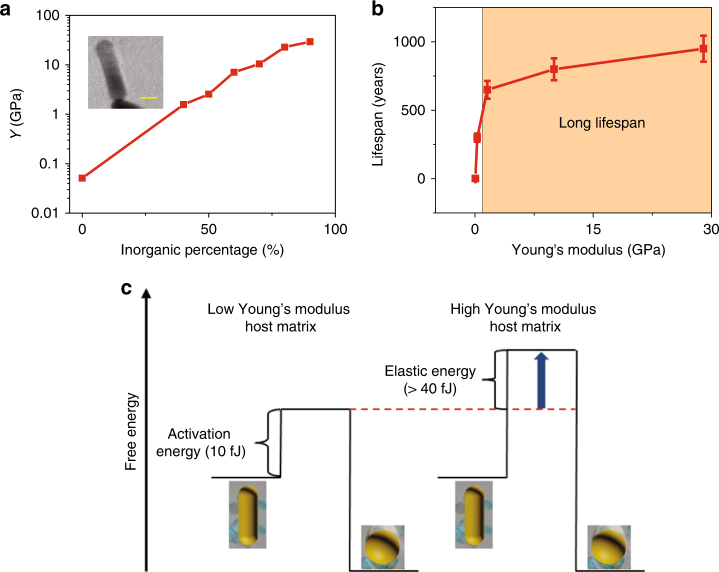
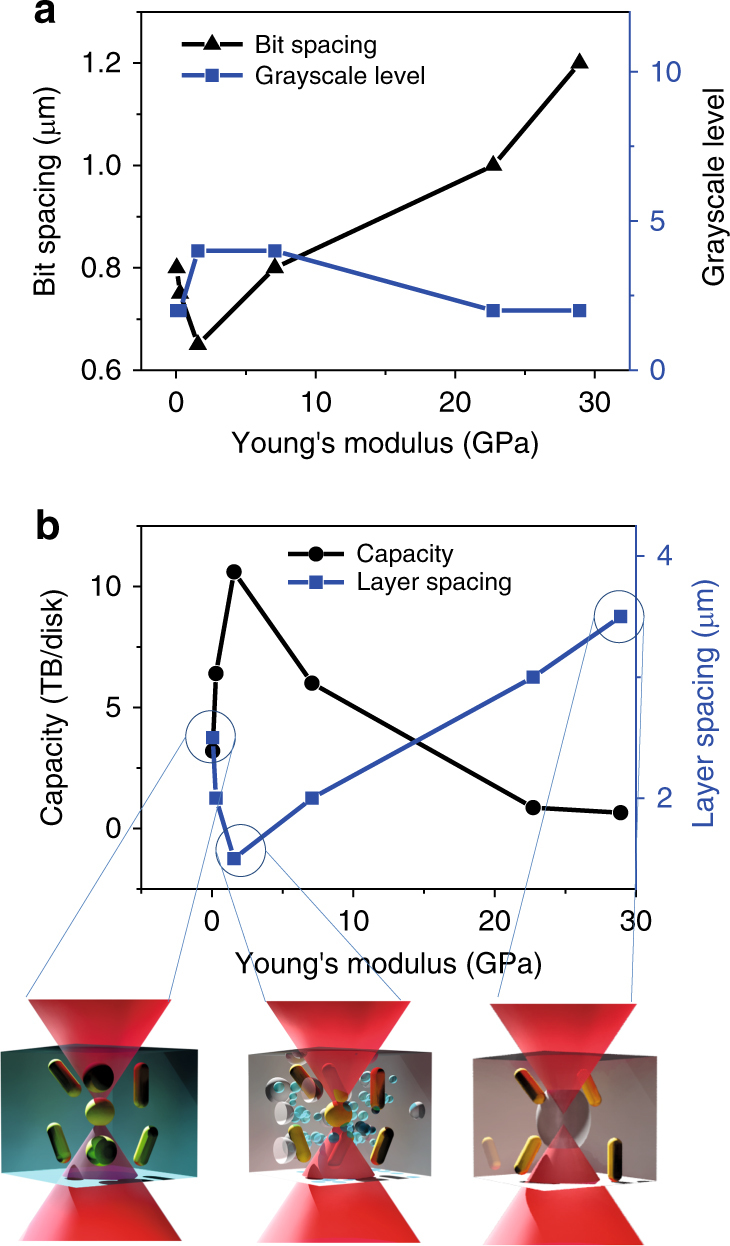
Emerging as an inevitable outcome of the big data era, long data are the massive amount of data that captures changes in the real world over a long period of time. In this context, recording and reading the data of a few terabytes in a single storage device repeatedly with a century-long unchanged baseline is in high demand. Here, we demonstrate the concept of optical long data memory with nanoplasmonic hybrid glass composites. Through the sintering-free incorporation of nanorods into the earth abundant hybrid glass composite, Young’s modulus is enhanced by one to two orders of magnitude. This discovery, enabling reshaping control of plasmonic nanoparticles of multiple-length allows for continuous multi-level recording and reading with a capacity over 10 terabytes with no appreciable change of the baseline over 600 years, which opens new opportunities for long data memory that affects the past and future.
Overview
The claims and statistics of this paper haven’t been checked yet.
Free: it reads the open-access text and checks the first 5 claims that cite a source we can check. Create a free account to check every claim.
Integrity signals
Registry
Cites
Statistics
Figures


Verification
Claims the paper makes
The claims and statistics of this paper haven’t been checked yet.
Free: it reads the open-access text and checks the first 5 claims that cite a source we can check. Create a free account to check every claim.
Claims other papers make about this one
Each is checked against this paper’s own text: does it say what the citing paper says it does?
The cited source doesn’t support the claim as written.
In the citing paper
“Previous work4–16 has predominantly optimized individual aspects such as data density but has not demonstrated an end-to-end system, including writing, storing and retrieving information.”
From Laser writing in glass for dense, fast and efficient archival data storage (2026) · cites this paper as [8]
Checked by a reasoning model — may be wrong.
Experimental — accuracy not yet measuredThe cited source says what the claim attributes to it.
In the citing paper
“Our comparison with known previous work4–16,22 (Supplementary Information) shows that, to our knowledge, Silica is the first published storage technology using glass that performs across all these key storage metrics and is the first to demonstrate reliable operation across writing, reading and decoding.”
From Laser writing in glass for dense, fast and efficient archival data storage (2026) · cites this paper as [8]
Self-check
Percentages, sums and reported differences re-computed from the paper’s own numbers.
The self-check needs the paper’s full text.
Citations
Cites
Climate and atmospheric history of the past 420,000 years from the Vostok ice core, Antarctica
Petit, J. R., Jouzel, J., Raynaud, D., Barkov, N. I., Barnola, J.-M., Basile, I., Bender, M., Chappellaz, J., Davis, M., Delaygue, G., et al. (1999) · Nature · doi:10.1038/20859 · Cited by 6,508
Preparation and Growth Mechanism of Gold Nanorods (NRs) Using Seed-Mediated Growth Method
Nikoobakht, B., & El-Sayed, M. A. (2003) · Chemistry of Materials · doi:10.1021/cm020732l · Cited by 5,069
Finishing the euchromatic sequence of the human genome
International Human Genome Sequencing Consortium (2004) · Nature · doi:10.1038/nature03001 · Cited by 4,971
Mitchell, T. D., & Jones, P. D. (2005) · International Journal of Climatology · doi:10.1002/joc.1181 · Cited by 3,822
A Semi-Empirical Approach to Projecting Future Sea-Level Rise
Rahmstorf, S. (2007) · Science · doi:10.1126/science.1135456 · Cited by 1,644
種結晶を媒介とした成長法を用いた金ナノロッド(NR)の調製と成長メカニズム
Nikoobakht, B., & El-Sayed, M. A. (2003) · Chemistry of Materials · Cited by 1,419
Five-dimensional optical recording mediated by surface plasmons in gold nanorods
Zijlstra, P., Chon, J. W. M., & Gu, M. (2009) · Nature · doi:10.1038/nature08053 · Cited by 1,234
Self-citationEvolution of high mutation rates in experimental populations of E. coli
Sniegowski, P. D., Gerrish, P. J., & Lenski, R. E. (1997) · Nature · doi:10.1038/42701 · Cited by 879
Structure and Properties of Poly(vinyl alcohol)/Na+ Montmorillonite Nanocomposites
Strawhecker, K. E., & Manias, E. (2000) · Chemistry of Materials · doi:10.1021/cm000506g · Cited by 790
Optical storage arrays: a perspective for future big data storage
Gu, M., Li, X., & Cao, Y. (2014) · Light: Science & Applications · doi:10.1038/lsa.2014.58 · Cited by 542
Self-citation
Research works printed but not linked: 1
- Böhlen, M. in 26th International Conference on Scientific and Statistical Database Management. (Aalborg, Denmark, 2014).
Cited by
Plasmonic polymer nanocomposites
Pastoriza-Santos, I., Kinnear, C., Pérez-Juste, J., Mulvaney, P., & Liz-Marzán, L. M. (2018) · Nature Reviews Materials · doi:10.1038/s41578-018-0050-7 · Cited by 256
Gao, L., Zhang, Q., Evans, R. A., & Gu, M. (2021) · Advanced Optical Materials · doi:10.1002/adom.202100487 · Cited by 28
Self-citationLaser writing in glass for dense, fast and efficient archival data storage
Microsoft Research Project Silica Team, Allison, J., Anderson, P., Aranas, E., Assaf, Y., Black, R., Caballero, M., Canakci, B., Chattaway, J. A., Chatzieleftheriou, A., et al. (2026) · Nature · doi:10.1038/s41586-025-10042-w · Cited by 25
Metadata
- Authors
- Zhang, Q., Xia, Z., Cheng, Y.-B., & Gu, M.
- Affiliations
- Centre for Ultrahigh Bandwidth Devices for Optical Systems (AU)
- Wuhan University of Technology (CN)
- Venue
- Nature Communications
- Published
- 2018-03-22
- Volume
- 9
- Issue
- 1
- Pages
- 1183-1183
- ISSN
- 2041-1723 (ISSN-L)
- PMC
- PMC5864957
- OpenAlex
- W2791846971
- Cited by
- 87
- References
- 27
- Citations by year
- 2026: 7 · 2025: 6 · 2024: 14 · 2023: 12 · 2022: 10 · 2021: 14 · 2020: 11 · 2019: 8 · 2018: 5
- FWCI
- 3.55
- Type
- journal article
- Language
- en
- Open access
- gold
- doi.org
- Licence
- cc-by
- creativecommons.org/licenses/by/4.0 (tdm)
- creativecommons.org/licenses/by/4.0 (vor)
- Locations
- Nature Communications (publishedVersion, cc-by)
- PubMed Central (publishedVersion, cc-by)
- PubMed (publishedVersion)
- Monash University Research Portal (Monash University) (submittedVersion, other-oa)
- RePEc: Research Papers in Economics (submittedVersion)
- DOAJ (DOAJ: Directory of Open Access Journals) (submittedVersion)
- DOAJ (DOAJ: Directory of Open Access Journals) (submittedVersion, cc-by-sa)
- Figshare (submittedVersion, cc-by)
- Swinburne figshare (Swinburne University of Technology) (submittedVersion, cc-by)
- Swinburne figshare (Swinburne University of Technology) (cc-by)
- Funders
- Swinburne University of Technology
- Australian Research Council (FL100100099, DP170101775, CE 110001018)
- Topics
- Physical Sciences › Materials Science › Materials Chemistry › Phase-change materials and chalcogenides
- Physical Sciences › Materials Science › Ceramics and Composites › Glass properties and applications
- Physical Sciences › Engineering › Industrial and Manufacturing Engineering › Laser Material Processing Techniques
- Keywords
- Young's modulus enhancement, plasmonic nanorods, long-term data storage, plasmonic nanoparticles
About these checks
Registry, retraction, Cites and statistics results are computed, not judged, with one exception: a printed reference that no index lists is read once by a model before it counts as a citation error. Claims are extracted by a model and kept only when their quote appears verbatim in the text; each cited source is then checked, with a model’s help, for whether it says what the claim relies on. Those verdicts can be wrong — read the claim’s quote and the cited source before relying on one.
Statistics and arithmetic are recomputed, not judged.
Confidence bands are shown only for fields calibrated on our annotated test set. None is calibrated yet, so no band is shown.
What counts as a claim ›How we measure confidence ›How we check this ›
Are you an author, or do you see a problem with this page? Request a review
How to cite
Cite CoChat for the checks on this page, and the paper for its own findings.
- This page
- CoChat. (2026). Citation check: High-capacity optical long data memory based on enhanced Young’s modulus in nanoplasmonic hybrid glass composites. https://app.cochat.ai/papers/10.1038/s41467-018-03589-y
- The paper
- Zhang, Q., Xia, Z., Cheng, Y.-B., & Gu, M. (2018). High-capacity optical long data memory based on enhanced Young’s modulus in nanoplasmonic hybrid glass composites. Nature Communications. https://doi.org/10.1038/s41467-018-03589-y
Data sources
Bibliographic data: Semantic Scholar, OpenAlex, Crossref.
Contains information from the Semantic Scholar Academic Graph Datasets, made available under the ODC Attribution License (ODC-BY 1.0).
Semantic Scholar’s data is described in: Kinney, R., et al. (2023). The Semantic Scholar Open Data Platform. arXiv:2301.10140.
