

The DOI matches its Crossref record; 69 of the 69 references it cites were found in a registry or an index.
Towards a new approach to reveal dynamical organization of the brain using topological data analysis
Open accessAbstract
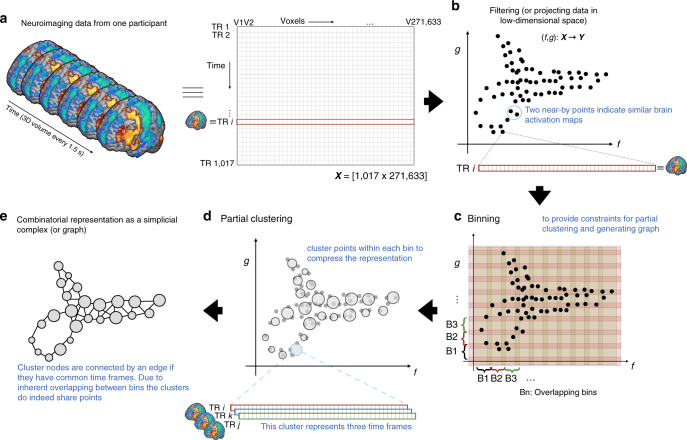
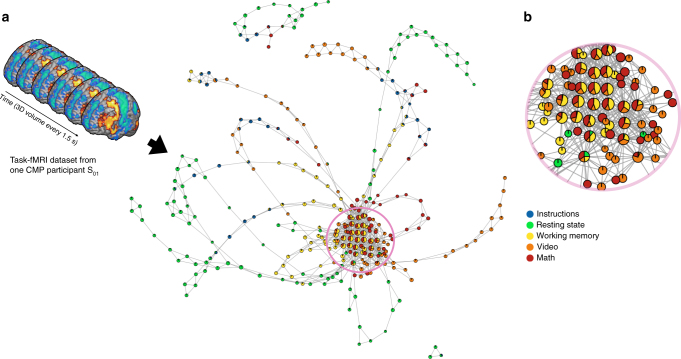
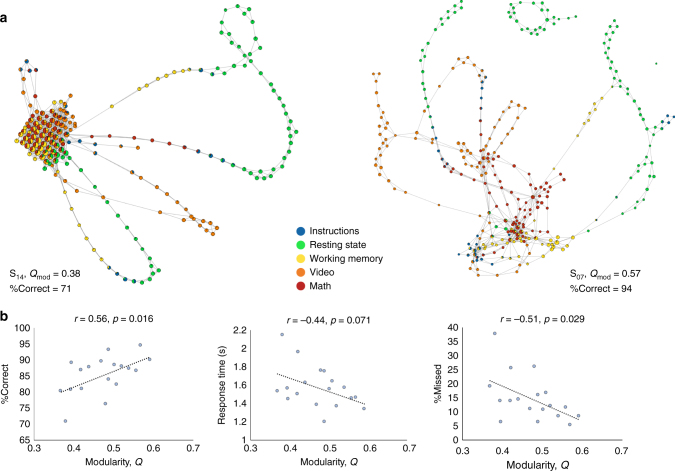
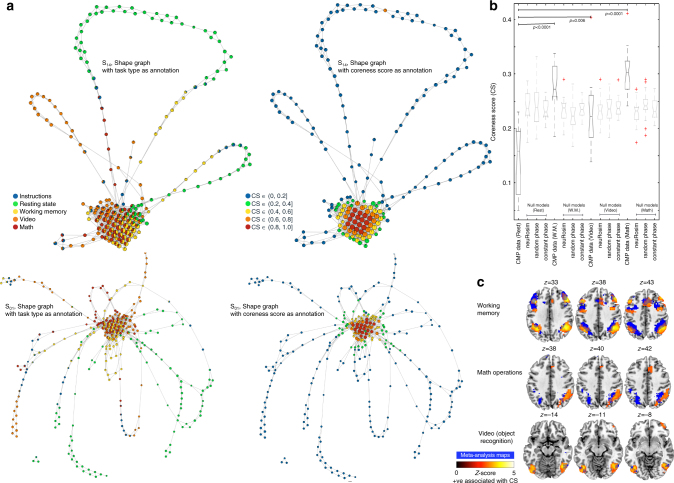
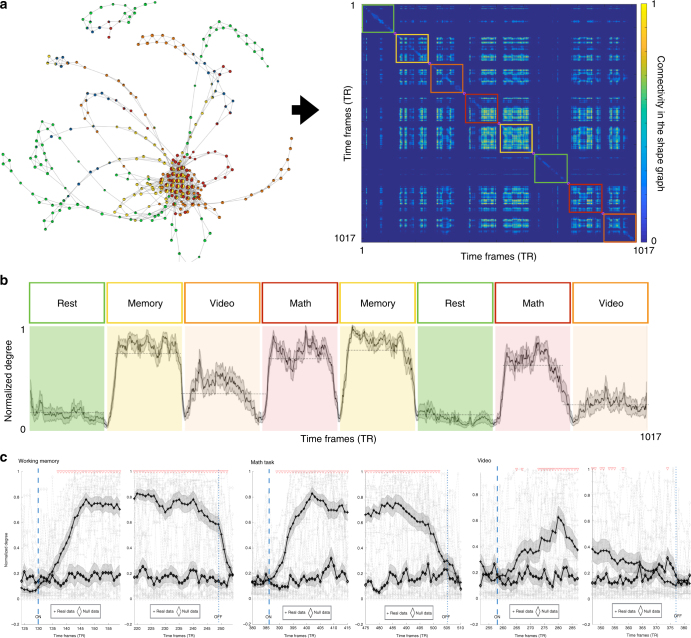
Little is known about how our brains dynamically adapt for efficient functioning. Most previous work has focused on analyzing changes in co-fluctuations between a set of brain regions over several temporal segments of the data. We argue that by collapsing data in space or time, we stand to lose useful information about the brain’s dynamical organization. Here we use Topological Data Analysis to reveal the overall organization of whole-brain activity maps at a single-participant level—as an interactive representation—without arbitrarily collapsing data in space or time. Using existing multitask fMRI datasets, with the known ground truth about the timing of transitions from one task-block to next, our approach tracks both within- and between-task transitions at a much faster time scale (~4–9 s) than before. The individual differences in the revealed dynamical organization predict task performance. In summary, our approach distills complex brain dynamics into interactive and behaviorally relevant representations.
Overview
The claims and statistics of this paper haven’t been checked yet.
Run the check — free, no account needed. It reads the open-access text and checks the sources it cites.
Integrity signals
Registry
Cites
Statistics
Figures
Verification
Claims the paper makes
The claims and statistics of this paper haven’t been checked yet.
Run the check — free, no account needed. It reads the open-access text and checks the sources it cites.
Claims other papers make about this one
Each is checked against this paper’s own text: does it say what the citing paper says it does?
In the citing paper
“Several recent studies have further shown how individual differences in task performance are related to patterns of dynamic brain organization54,55.”
From Cognitive and behavioural flexibility: Neural mechanisms and clinical considerations (2021) · cites this paper as [55]
Self-check
Percentages, sums and reported differences re-computed from the paper’s own numbers.
The self-check needs the paper’s full text.
Citations
Cites
(2008) · Journal of Machine Learning Research · Cited by 33,051
A Global Geometric Framework for Nonlinear Dimensionality Reduction
Tenenbaum, J. B., Silva, V. D., & Langford, J. C. (2000) · Science · doi:10.1126/science.290.5500.2319 · Cited by 13,585
Complex brain networks: graph theoretical analysis of structural and functional systems
Bullmore, E., & Sporns, O. (2009) · Nature Reviews Neuroscience · doi:10.1038/nrn2575 · Cited by 11,820
Self-citationFortunato, S. (2010) · Physics Reports · doi:10.1016/j.physrep.2009.11.002 · Cited by 11,293
Fast algorithm for detecting community structure in networks
Newman, M. E. J. (2004) · Physical Review E · doi:10.1103/physreve.69.066133 · Cited by 5,415
The minimal preprocessing pipelines for the Human Connectome Project
Glasser, M. F., Sotiropoulos, S. N., Wilson, J. A., Coalson, T. S., Fischl, B., Andersson, J. L., Xu, J., Jbabdi, S., Webster, M., Polimeni, J. R., et al. (2013) · NeuroImage · doi:10.1016/j.neuroimage.2013.04.127 · Cited by 5,253
Correspondence of the brain's functional architecture during activation and rest
Smith, S. M., Fox, P. T., Miller, K. L., Glahn, D. C., Fox, P. M., Mackay, C. E., Filippini, N., Watkins, K. E., Toro, R., Laird, A. R., et al. (2009) · Proceedings of the National Academy of Sciences · doi:10.1073/pnas.0905267106 · Cited by 5,150
A component based noise correction method (CompCor) for BOLD and perfusion based fMRI
Behzadi, Y., Restom, K., Liau, J., & Liu, T. T. (2007) · NeuroImage · doi:10.1016/j.neuroimage.2007.04.042 · Cited by 4,502
Consistent resting-state networks across healthy subjects
Damoiseaux, J. S., Rombouts, S. A. R. B., Barkhof, F., Scheltens, P., Stam, C. J., Smith, S. M., & Beckmann, C. F. (2006) · Proceedings of the National Academy of Sciences · doi:10.1073/pnas.0601417103 · Cited by 4,326
Functional Network Organization of the Human Brain
Power, J. D., Cohen, A. L., Nelson, S. M., Wig, G. S., Barnes, K. A., Church, J. A., Vogel, A. C., Laumann, T. O., Miezin, F. M., Schlaggar, B. L., et al. (2011) · Neuron · doi:10.1016/j.neuron.2011.09.006 · Cited by 4,124
Cited by
Sorted by citations
Networks beyond pairwise interactions: Structure and dynamics
Battiston, F., Cencetti, G., Iacopini, I., Latora, V., Lucas, M., Patania, A., Young, J.-G., & Petri, G. (2020) · Physics Reports · doi:10.1016/j.physrep.2020.05.004 · Cited by 1,879
Networks beyond pairwise interactions: Structure and dynamics
Battiston, F., Cencetti, G., Iacopini, I., Latora, V., Lucas, M., Patania, A., Young, J., & Petri, G. (2020) · UCL Discovery (University College London) · Cited by 1,179
Cognitive and behavioural flexibility: Neural mechanisms and clinical considerations
Uddin, L. Q. (2021) · Nature Reviews Neuroscience · doi:10.1038/s41583-021-00428-w · Cited by 698
Graph theory methods: applications in brain networks
Sporns, O. (2018) · Dialogues in Clinical Neuroscience · doi:10.31887/dcns.2018.20.2/osporns · Cited by 671
Self-citationIdiosynchrony: From shared responses to individual differences during naturalistic neuroimaging
Finn, E. S., Glerean, E., Khojandi, A., Nielson, D. M., Molfese, P. J., Handwerker, D. A., & Bandettini, P. A. (2020) · NeuroImage · doi:10.1016/j.neuroimage.2020.116828 · Cited by 277
Self-citation
Metadata
- Authors
- Saggar, M., Sporns, O., Gonzalez-Castillo, J., Bandettini, P. A., Carlsson, G., Glover, G., & Reiss, A. L.
- Affiliations
- Stanford Medicine (US)
- Indiana University Bloomington (US)
- National Institutes of Health (US)
- Ayasdi (United States) (US)
- Stanford University (US)
- Corresponding author
- Saggar, Manish
- Venue
- Nature Communications
- Published
- 2018-04-11
- Volume
- 9
- Issue
- 1
- Pages
- 1399-1399
- ISSN
- 2041-1723 (ISSN-L)
- PMC
- PMC5895632
- OpenAlex
- W2797507693
- Cited by
- 253
- References
- 69
- Citations by year
- 2026: 29 · 2025: 32 · 2024: 19 · 2023: 40 · 2022: 24 · 2021: 40 · 2020: 27 · 2019: 32 · 2018: 10
- FWCI
- 16.23
- Type
- journal article
- Language
- en
- Open access
- gold
- doi.org
- Locations
- Nature Communications (publishedVersion, cc-by)
- Europe PMC (PubMed Central) (publishedVersion, other-oa)
- PubMed Central (publishedVersion, cc-by)
- PubMed (publishedVersion)
- RePEc: Research Papers in Economics (submittedVersion)
- DOAJ (DOAJ: Directory of Open Access Journals) (submittedVersion)
- DOAJ (DOAJ: Directory of Open Access Journals) (submittedVersion, cc-by-sa)
- IUScholarWorks Open (Indiana University) (submittedVersion)
- Funders
- National Alliance for Research on Schizophrenia and Depression
- National Institutes of Health (93-M-0170, NCT00001360, 5u54mh091657-05, 1U54‐MH‐091657)
- McDonnell Center for Systems Neuroscience (ZIAMH002783, 1U54MH091657)
- National Institute of Mental Health (K99MH104605, 1U54 MH091657, U54-MH091657, 93- M-0170, NCT00001360, R00MH104605, ZIAMH002783)
- Topics
- Life Sciences › Neuroscience › Cognitive Neuroscience › Functional Brain Connectivity Studies
- Physical Sciences › Computer Science › Computational Theory and Mathematics › Topological and Geometric Data Analysis
- Life Sciences › Neuroscience › Cognitive Neuroscience › Neural dynamics and brain function
- Keywords
- brain dynamics, topological data analysis, task transitions, interactive visualization, individual differences, task performance prediction
- MeSH terms
- Adult, Brain, Female, Humans, Magnetic Resonance Imaging, Male, Memory, Short-Term, Nerve Net, Rest, Task Performance and Analysis, Connectome, Datasets as Topic
About these checks
Registry, retraction, Cites and statistics results are computed, not judged, with one exception: a printed reference that no index lists is read once by a model before it counts as a citation error. Claims are extracted by a model and kept only when their quote appears verbatim in the text; each cited source is then checked, with a model’s help, for whether it says what the claim relies on. Those verdicts can be wrong — read the claim’s quote and the cited source before relying on one.
Statistics and arithmetic are recomputed, not judged.
Confidence bands are shown only for fields calibrated on our annotated test set. None is calibrated yet, so no band is shown.
What counts as a claim ›How we measure confidence ›How we check this ›
Are you an author, or do you see a problem with this page? Request a review
