

The DOI matches its Crossref record; 69 of the 69 references it cites were found in a registry or an index.
Towards a new approach to reveal dynamical organization of the brain using topological data analysis
Open accessAbstract
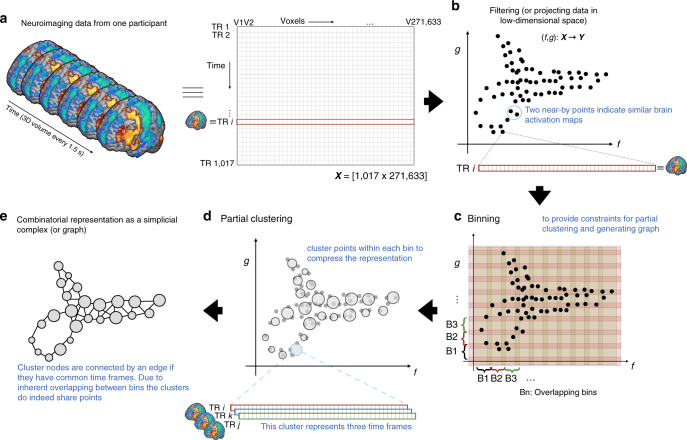
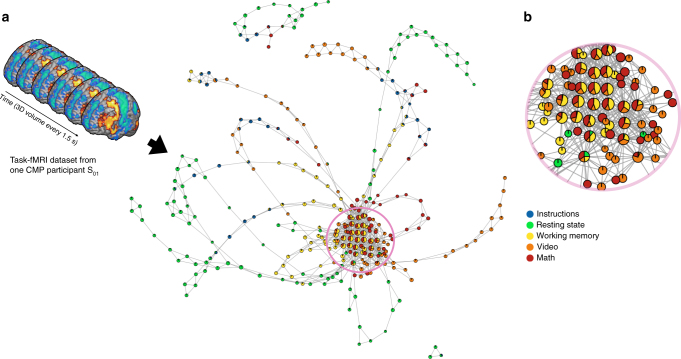
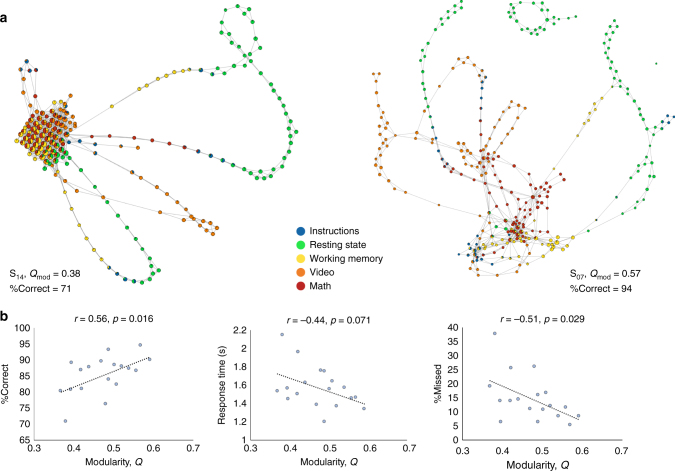
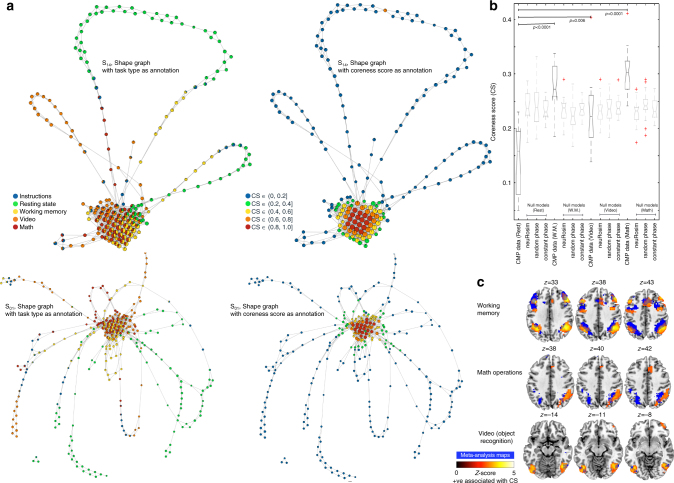
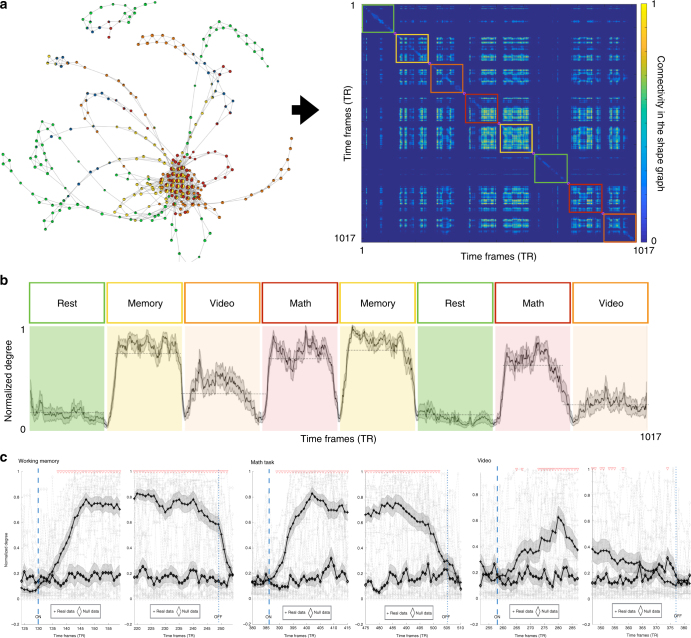
Little is known about how our brains dynamically adapt for efficient functioning. Most previous work has focused on analyzing changes in co-fluctuations between a set of brain regions over several temporal segments of the data. We argue that by collapsing data in space or time, we stand to lose useful information about the brain’s dynamical organization. Here we use Topological Data Analysis to reveal the overall organization of whole-brain activity maps at a single-participant level—as an interactive representation—without arbitrarily collapsing data in space or time. Using existing multitask fMRI datasets, with the known ground truth about the timing of transitions from one task-block to next, our approach tracks both within- and between-task transitions at a much faster time scale (~4–9 s) than before. The individual differences in the revealed dynamical organization predict task performance. In summary, our approach distills complex brain dynamics into interactive and behaviorally relevant representations.
Overview
The claims and statistics of this paper haven’t been checked yet.
Run the check — free, no account needed. It reads the open-access text and checks the sources it cites.
Integrity signals
Registry
Cites
Statistics
Figures
Verification
Claims the paper makes
The claims and statistics of this paper haven’t been checked yet.
Run the check — free, no account needed. It reads the open-access text and checks the sources it cites.
Claims other papers make about this one
Each is checked against this paper’s own text: does it say what the citing paper says it does?
In the citing paper
“Several recent studies have further shown how individual differences in task performance are related to patterns of dynamic brain organization54,55.”
From Cognitive and behavioural flexibility: Neural mechanisms and clinical considerations (2021) · cites this paper as [55]
Self-check
Percentages, sums and reported differences re-computed from the paper’s own numbers.
The self-check needs the paper’s full text.
Citations
Cites
(2008) · Journal of Machine Learning Research · Cited by 33,051
A Global Geometric Framework for Nonlinear Dimensionality Reduction
Tenenbaum, J. B., Silva, V. D., & Langford, J. C. (2000) · Science · doi:10.1126/science.290.5500.2319 · Cited by 13,585
Complex brain networks: graph theoretical analysis of structural and functional systems
Bullmore, E., & Sporns, O. (2009) · Nature Reviews Neuroscience · doi:10.1038/nrn2575 · Cited by 11,820
Self-citationFortunato, S. (2010) · Physics Reports · doi:10.1016/j.physrep.2009.11.002 · Cited by 11,293
Fast algorithm for detecting community structure in networks
Newman, M. E. J. (2004) · Physical Review E · doi:10.1103/physreve.69.066133 · Cited by 5,415
The minimal preprocessing pipelines for the Human Connectome Project
Glasser, M. F., Sotiropoulos, S. N., Wilson, J. A., Coalson, T. S., Fischl, B., Andersson, J. L., Xu, J., Jbabdi, S., Webster, M., Polimeni, J. R., et al. (2013) · NeuroImage · doi:10.1016/j.neuroimage.2013.04.127 · Cited by 5,253
Correspondence of the brain's functional architecture during activation and rest
Smith, S. M., Fox, P. T., Miller, K. L., Glahn, D. C., Fox, P. M., Mackay, C. E., Filippini, N., Watkins, K. E., Toro, R., Laird, A. R., et al. (2009) · Proceedings of the National Academy of Sciences · doi:10.1073/pnas.0905267106 · Cited by 5,150
A component based noise correction method (CompCor) for BOLD and perfusion based fMRI
Behzadi, Y., Restom, K., Liau, J., & Liu, T. T. (2007) · NeuroImage · doi:10.1016/j.neuroimage.2007.04.042 · Cited by 4,502
Consistent resting-state networks across healthy subjects
Damoiseaux, J. S., Rombouts, S. A. R. B., Barkhof, F., Scheltens, P., Stam, C. J., Smith, S. M., & Beckmann, C. F. (2006) · Proceedings of the National Academy of Sciences · doi:10.1073/pnas.0601417103 · Cited by 4,326
Functional Network Organization of the Human Brain
Power, J. D., Cohen, A. L., Nelson, S. M., Wig, G. S., Barnes, K. A., Church, J. A., Vogel, A. C., Laumann, T. O., Miezin, F. M., Schlaggar, B. L., et al. (2011) · Neuron · doi:10.1016/j.neuron.2011.09.006 · Cited by 4,124
Cited by
Sorted by citations
Networks beyond pairwise interactions: Structure and dynamics
Battiston, F., Cencetti, G., Iacopini, I., Latora, V., Lucas, M., Patania, A., Young, J.-G., & Petri, G. (2020) · Physics Reports · doi:10.1016/j.physrep.2020.05.004 · Cited by 1,879
Networks beyond pairwise interactions: Structure and dynamics
Battiston, F., Cencetti, G., Iacopini, I., Latora, V., Lucas, M., Patania, A., Young, J., & Petri, G. (2020) · UCL Discovery (University College London) · Cited by 1,179
Cognitive and behavioural flexibility: Neural mechanisms and clinical considerations
Uddin, L. Q. (2021) · Nature Reviews Neuroscience · doi:10.1038/s41583-021-00428-w · Cited by 698
Graph theory methods: applications in brain networks
Sporns, O. (2018) · Dialogues in Clinical Neuroscience · doi:10.31887/dcns.2018.20.2/osporns · Cited by 671
Self-citationIdiosynchrony: From shared responses to individual differences during naturalistic neuroimaging
Finn, E. S., Glerean, E., Khojandi, A., Nielson, D. M., Molfese, P. J., Handwerker, D. A., & Bandettini, P. A. (2020) · NeuroImage · doi:10.1016/j.neuroimage.2020.116828 · Cited by 277
Self-citationThe importance of the whole: Topological data analysis for the network neuroscientist
Sizemore, A. E., Phillips‐Cremins, J. E., Ghrist, R., & Bassett, D. S. (2018) · Network Neuroscience · doi:10.1162/netn_a_00073 · Cited by 215
Bianconi, G. (2021) · doi:10.1017/9781108770996 · Cited by 223
Metrics for graph comparison: A practitioner’s guide
Wills, P., & Meyer, F. G. (2020) · PLoS ONE · doi:10.1371/journal.pone.0228728 · Cited by 222
Simplicial complexes and complex systems
Salnikov, V., Cassese, D., & Lambiotte, R. (2018) · European Journal of Physics · doi:10.1088/1361-6404/aae790 · Cited by 164
Cornblath, E. J., Ashourvan, A., Kim, J. Z., Betzel, R. F., Ćirić, R., Adebimpe, A., Baum, G. L., He, X., Ruparel, K., Moore, T. M., et al. (2020) · Communications Biology · doi:10.1038/s42003-020-0961-x · Cited by 142
Interpreting Deep Learning Features for Myoelectric Control: A Comparison With Handcrafted Features
Côté-Allard, U., Campbell, E., Phinyomark, A., Laviolette, F., Gosselin, B. J., & Scheme, E. (2020) · Frontiers in Bioengineering and Biotechnology · doi:10.3389/fbioe.2020.00158 · Cited by 139
Higher-order simplicial synchronization of coupled topological signals
Ghorbanchian, R., Restrepo, J. G., Torres, J. J., & Bianconi, G. (2021) · Communications Physics · doi:10.1038/s42005-021-00605-4 · Cited by 121
Topological Data Analysis with Applications
Carlsson, G., & Vejdemo‐Johansson, M. (2021) · Cambridge University Press eBooks · doi:10.1017/9781108975704 · Cited by 122
Self-citationMultivariate information theory uncovers synergistic subsystems of the human cerebral cortex
Varley, T. F., Pope, M., Faskowitz, J., & Sporns, O. (2023) · Communications Biology · doi:10.1038/s42003-023-04843-w · Cited by 112
Self-citationHigher-order organization of multivariate time series
Santoro, A., Battiston, F., Petri, G., & Amico, E. (2023) · Nature Physics · doi:10.1038/s41567-022-01852-0 · Cited by 106
Network Tomography for Understanding Phenotypic Presentations in Aortic Stenosis
Casaclang‐Verzosa, G., Shrestha, S., Khalil, M. J., Cho, J. S., Tokodi, M., Balla, S., Alkhouli, M. A., Badhwar, V., Narula, J., Miller, J. D., et al. (2019) · JACC. Cardiovascular imaging · doi:10.1016/j.jcmg.2018.11.025 · Cited by 90
Tapping into Multi-Faceted Human Behavior and Psychopathology Using fMRI Brain Dynamics
Bolton, T. A. W., Morgenroth, E., Preti, M. G., & Ville, D. V. D. (2020) · Trends in Neurosciences · doi:10.1016/j.tins.2020.06.005 · Cited by 94
Topological phase transitions in functional brain networks
Santos, F. A. N., Raposo, E. P., Coutinho-Filho, M. D., Copelli, M., Stam, C. J., & Douw, L. (2019) · Physical review. E · doi:10.1103/physreve.100.032414 · Cited by 85
Beyond the clustering coefficient: A topological analysis of node neighbourhoods in complex networks
Kartun-Giles, A. P., & Ginestra Bianconi, A. (2019) · Chaos Solitons & Fractals X · doi:10.1016/j.csfx.2019.100004 · Cited by 81
Yan, L., Masood, T. B., Sridharamurthy, R., Rasheed, F., Natarajan, V., Hotz, I., & Wang, B. (2021) · Computer Graphics Forum · doi:10.1111/cgf.14331 · Cited by 101
Topological methods for data modelling
Carlsson, G. (2020) · Nature Reviews Physics · doi:10.1038/s42254-020-00249-3 · Cited by 85
Self-citationSimplicial complexes and complex systems
Salnikov, V., Cassese, D., & Lambiotte, R. (2019) · Apollo (University of Cambridge) · doi:10.17863/cam.56775 · Cited by 63
Gao, S., Mishne, G., & Scheinost, D. (2021) · Human Brain Mapping · doi:10.1002/hbm.25561 · Cited by 58
Neurogenetic profiles delineate large-scale connectivity dynamics of the human brain
Diez, I. P., & Sepulcre, J. (2018) · Nature Communications · doi:10.1038/s41467-018-06346-3 · Cited by 59
The hidden repertoire of brain dynamics and dysfunction
McIntosh, A. R., & Jirsa, V. (2019) · Network Neuroscience · doi:10.1162/netn_a_00107 · Cited by 61
SFCM: A Fuzzy Clustering Algorithm of Extracting the Shape Information of Data
Bui, Q., Vo, B., Snåšel, V., Pedrycz, W., Hong, T., Nguyên, N. T., & Chen, M. (2020) · IEEE Transactions on Fuzzy Systems · doi:10.1109/tfuzz.2020.3014662 · Cited by 60
Brain mitochondrial diversity and network organization predict anxiety-like behavior in male mice
Rosenberg, A. M., Saggar, M., Monzel, A. S., Devine, J., Rogu, P., Limoges, A., Junker, A., Sandi, C., Mosharov, E. V., Dumitriu, D., et al. (2023) · Nature Communications · doi:10.1038/s41467-023-39941-0 · Cited by 65
Self-citationSaggar, M., Shine, J. M., Liégeois, R., Dosenbach, N. U. F., & Fair, D. A. (2022) · Nature Communications · doi:10.1038/s41467-022-32381-2 · Cited by 65
Self-citationGeniesse, C., Sporns, O., Petri, G., & Saggar, M. (2019) · Network Neuroscience · doi:10.1162/netn_a_00093 · Cited by 57
Self-citationFeature Extraction and Selection for Pain Recognition Using Peripheral Physiological Signals
Campbell, E., Phinyomark, A., & Scheme, E. (2019) · Frontiers in Neuroscience · doi:10.3389/fnins.2019.00437 · Cited by 64
González-Castillo, J., Caballero‐Gaudes, C., Topolski, N., Handwerker, D. A., Pereira, F., & Bandettini, P. A. (2019) · NeuroImage · doi:10.1016/j.neuroimage.2019.116129 · Cited by 54
Self-citationA hands-on tutorial on network and topological neuroscience
Centeno, E. G. Z., Moreni, G., Vriend, C., Douw, L., & Santos, F. A. N. (2022) · Brain Structure and Function · doi:10.1007/s00429-021-02435-0 · Cited by 55
Topological portraits of multiscale coordination dynamics
Zhang, M., Kalies, W. D., Kelso, J. A. S., & Tognoli, E. (2020) · Journal of Neuroscience Methods · doi:10.1016/j.jneumeth.2020.108672 · Cited by 49
Organizing principles of whole-brain functional connectivity in zebrafish larvae
Betzel, R. F. (2020) · Network Neuroscience · doi:10.1162/netn_a_00121 · Cited by 52
Xie, H., Zheng, C. Y., Handwerker, D. A., Bandettini, P. A., Calhoun, V. D., Mitra, S. D., & González-Castillo, J. (2018) · NeuroImage · doi:10.1016/j.neuroimage.2018.12.037 · Cited by 44
Self-citationF-Mapper: A Fuzzy Mapper clustering algorithm
Bui, Q., Vo, B., Nguyen, H.-A. T., Nguyen, Q. V. H., & Snåšel, V. (2019) · Knowledge-Based Systems · doi:10.1016/j.knosys.2019.105107 · Cited by 44
Pushing the Boundaries of Psychiatric Neuroimaging to Ground Diagnosis in Biology
Saggar, M., & Uddin, L. Q. (2019) · eneuro · doi:10.1523/eneuro.0384-19.2019 · Cited by 38
Self-citationThe topology of data: opportunities for cancer research
Loughrey, C. F., Fitzpatrick, P., Orr, N., & Jurek, A. (2021) · Bioinformatics · doi:10.1093/bioinformatics/btab553 · Cited by 44
Tang, E., Mattar, M. G., Giusti, C., Lydon‐Staley, D. M., Thompson‐Schill, S. L., & Bassett, D. S. (2019) · Nature Neuroscience · doi:10.1038/s41593-019-0400-9 · Cited by 46
Topological Data Analysis of Functional MRI Connectivity in Time and Space Domains
Anderson, K. L., Anderson, J. S., Palande, S., & Wang, B. (2018) · Lecture notes in computer science · doi:10.1007/978-3-030-00755-3_8 · Cited by 40
Topological gene expression networks recapitulate brain anatomy and function
Patania, A., Selvaggi, P., Veronese, M., Dipasquale, O., Expert, P., & Petri, G. (2019) · Network Neuroscience · doi:10.1162/netn_a_00094 · Cited by 40
Simplicial and topological descriptions of human brain dynamics
Billings, J., Saggar, M., Hlinka, J., Keilholz, S. D., & Petri, G. (2021) · Network Neuroscience · doi:10.1162/netn_a_00190 · Cited by 42
Self-citationA dynamic gradient architecture generates brain activity states
Brown, J. A., Lee, A. J., Pasquini, L., & Seeley, W. W. (2022) · NeuroImage · doi:10.1016/j.neuroimage.2022.119526 · Cited by 38
The expanding horizons of network neuroscience: From description to prediction and control
Srivastava, P., Fotiadis, P., Parkes, L., & Bassett, D. S. (2022) · NeuroImage · doi:10.1016/j.neuroimage.2022.119250 · Cited by 38
Network Analysis of Time Series: Novel Approaches to Network Neuroscience
Varley, T. F., & Sporns, O. (2022) · Frontiers in Neuroscience · doi:10.3389/fnins.2021.787068 · Cited by 36
Self-citationXie, H., Beaty, R. E., Jahanikia, S., Geniesse, C., Sonalkar, N., & Saggar, M. (2021) · NeuroImage · doi:10.1016/j.neuroimage.2021.118531 · Cited by 33
Self-citationComplex networks of marine heatwaves reveal abrupt transitions in the global ocean
Benedetti‐Cecchi, L. (2021) · Scientific Reports · doi:10.1038/s41598-021-81369-3 · Cited by 33
Persistent homology and applied homotopy theory
Carlsson, G. (2020) · Chapman & Hall/CRC eBooks · doi:10.1201/9781351251624-8 · Cited by 30
Self-citationImaging the temporal dynamics of brain states with highly sampled fMRI
Yang, Z., & Lewis, L. D. (2021) · Current Opinion in Behavioral Sciences · doi:10.1016/j.cobeha.2021.02.005 · Cited by 33
Editorial: Topological Neuroscience
Expert, P., Lord, L.-D., Kringelbach, M. L., & Petri, G. (2019) · Network Neuroscience · doi:10.1162/netn_e_00096 · Cited by 28
Why topological data analysis detects financial bubbles?
Akingbade, S. W., Gidea, M., Manzi, M., & Nateghi, V. (2023) · Communications in Nonlinear Science and Numerical Simulation · doi:10.1016/j.cnsns.2023.107665 · Cited by 27
TopoAct: Visually Exploring the Shape of Activations in Deep Learning
Rathore, A., Chalapathi, N., Palande, S., & Wang, B. (2021) · Computer Graphics Forum · doi:10.1111/cgf.14195 · Cited by 37
Parameter investigation of topological data analysis for EEG signals
Altindış, F., Yılmaz, B., Borisenok, S., & İçöz, K. (2020) · Biomedical Signal Processing and Control · doi:10.1016/j.bspc.2020.102196 · Cited by 25
Atypical core-periphery brain dynamics in autism
Roy, D., & Uddin, L. Q. (2021) · Network Neuroscience · doi:10.1162/netn_a_00181 · Cited by 23
Salch, A., Regalski, A., Abdallah, H., Suryadevara, R., Catanzaro, M. J., & Diwadkar, V. A. (2021) · PLoS ONE · doi:10.1371/journal.pone.0255859 · Cited by 30
Yang, W., & Wang, Y. (2024) · EPJ Data Science · doi:10.1140/epjds/s13688-024-00453-6 · Cited by 26
Temporal Mapper: Transition networks in simulated and real neural dynamics
Zhang, M., Chowdhury, S., & Saggar, M. (2022) · Network Neuroscience · doi:10.1162/netn_a_00301 · Cited by 22
Self-citationWhy Topology for Machine Learning and Knowledge Extraction?
Ferri, M. (2018) · Machine Learning and Knowledge Extraction · doi:10.3390/make1010006 · Cited by 23
Feasibility of topological data analysis for event-related fMRI
Ellis, C. T., Lesnick, M., Henselman‐Petrusek, G., Keller, B., & Cohen, J. D. (2019) · Network Neuroscience · doi:10.1162/netn_a_00095 · Cited by 23
The connectome spectrum as a canonical basis for a sparse representation of fast brain activity
Rué‐Queralt, J., Glomb, K., Pascucci, D., Tourbier, S., Carboni, M., Vulliémoz, S., Plomp, G., & Hagmann, P. (2021) · NeuroImage · doi:10.1016/j.neuroimage.2021.118611 · Cited by 25
Singh, Y., Jons, W. A., Eaton, J. E., Vesterhus, M. N., Karlsen, T. H., Bjoerk, I., Abildgaard, A., Jørgensen, K. K., Folseraas, T., Little, D. H. W., et al. (2022) · European Radiology Experimental · doi:10.1186/s41747-022-00312-x · Cited by 22
Raman spectroscopy and topological machine learning for cancer grading
Conti, F., D’Acunto, M., Caudai, C., Colantonio, S., Gaeta, R., Moroni, D., & Pascali, M. A. (2023) · Scientific Reports · doi:10.1038/s41598-023-34457-5 · Cited by 24
The complexity of the stream of consciousness
Coppola, P., Allanson, J. E., Naçi, L., Adapa, R., Finoia, P., Williams, G. B., Pickard, J. D., Owen, A. M., Menon, D. K., & Stamatakis, E. A. (2022) · Communications Biology · doi:10.1038/s42003-022-04109-x · Cited by 22
State and trait characteristics of anterior insula time-varying functional connectivity
Pasquini, L., Toller, G., Staffaroni, A. M., Brown, J. A., Deng, J., Lee, A. J., Kurcyus, K., Shdo, S. M., Allen, I. E., Sturm, V. E., et al. (2019) · NeuroImage · doi:10.1016/j.neuroimage.2019.116425 · Cited by 20
Model-based plant phenomics on morphological traits using morphometric descriptors
Noshita, K., Murata, H., & Kirié, S. (2022) · Ikushugaku zasshi · doi:10.1270/jsbbs.21078 · Cited by 20
Characterizing EEG signals of meditative states using persistent homology and Hodge spectral entropy
Gupta, K. V., Beuria, J., & Behera, L. (2023) · Biomedical Signal Processing and Control · doi:10.1016/j.bspc.2023.105779 · Cited by 20
Geniesse, C., Chowdhury, S., & Saggar, M. (2022) · Network Neuroscience · doi:10.1162/netn_a_00229 · Cited by 17
Self-citationEspinoza, F. A., Vergara, V. M., Damaraju, E., Henke, K., Faghiri, A., Turner, J. A., Belger, A., Ford, J. M., McEwen, S. C., Mathalon, D. H., et al. (2019) · Frontiers in Neuroscience · doi:10.3389/fnins.2019.00634 · Cited by 19
Mapping firms’ locations in technological space: A topological analysis of patent statistics
Escolar, E. G., Hiraoka, Y., Igami, M., & Ozcan, Y. (2023) · Research Policy · doi:10.1016/j.respol.2023.104821 · Cited by 18
Computing Wasserstein Distance for Persistence Diagrams on a Quantum ComputerPreprint
Berwald, J., Gottlieb, J. M., & Munch, E. (2018) · arXiv (Cornell University) · doi:10.48550/arxiv.1809.06433 · Cited by 28
Allocentric representation in the human amygdala and ventral visual stream
Evensmoen, H. R., Rimol, L. M., Winkler, A. M., Betzel, R. F., Hansen, T. I., Nili, H., & Haberg, A. K. (2021) · Cell Reports · doi:10.1016/j.celrep.2020.108658 · Cited by 17
STruD: Truss Decomposition of Simplicial Complexes
Preti, G., Morales, G. D. F., & Bonchi, F. (2021) · International World Wide Web Conference (WWW) · doi:10.1145/3442381.3450073 · Cited by 17
Dizaji, A. S., Vieira, B. H., Khodaei, M. R., Ashrafi, M., Parham, E., Hossein‐Zadeh, G., Salmón, C. E. G., & Hamid Soltanian-zadeh, A. (2021) · Basic and Clinical Neuroscience Journal · doi:10.32598/bcn.12.1.574.1 · Cited by 17
A topological approach for cancer subtyping from gene expression data
Rafique, O., & Mir, A. H. (2019) · Journal of Biomedical Informatics · doi:10.1016/j.jbi.2019.103357 · Cited by 16
Functional network collapse in neurodegenerative disease
Brown, J. A., Lee, A. J., Fernhoff, K., Pistone, T., Pasquini, L., Wise, A. B., Staffaroni, A. M., Mandelli, M. L., Lee, S. E., Boxer, A. L., et al. (2025) · Nature Communications · doi:10.1038/s41467-025-65156-6 · Cited by 22
Singer, B., Meling, D., Hirsch‐Hoffmann, M., Michels, L., Kometer, M., Smigielski, L., Dornbierer, D., Seifritz, E., Vollenweider, F. X., & Scheidegger, M. (2024) · Scientific Reports · doi:10.1038/s41598-024-55726-x · Cited by 20
Wang, T., Johnson, T. S., Zhang, J., & Huang, K. (2018) · Pacific Symposium on Biocomputing (PSB) · doi:10.1142/9789813279827_0032 · Cited by 15
Predictive modeling of neurobehavioral state and trait variation across development
Sanchez–Alonso, S., & Aslin, R. Ν. (2020) · Developmental Cognitive Neuroscience · doi:10.1016/j.dcn.2020.100855 · Cited by 13
Ensemble forecasting of the Zika space‐time spread with topological data analysis
Soliman, M., Lyubchich, V., & Gel, Y. R. (2020) · Environmetrics · doi:10.1002/env.2629 · Cited by 14
Using discrete Ricci curvatures to infer COVID-19 epidemic network fragility and systemic risk
de Souza, D. B., da Cunha, J. T. S., dos Santos, E. F., Correia, J. B., da Silva, H. P., Filho, J. L. D. L., Albuquerque, J. D. O., & Santos, F. A. N. (2021) · Journal of Statistical Mechanics Theory and Experiment · doi:10.1088/1742-5468/abed4e · Cited by 14
Liu, S., Yang, Y., Yang, Q., Chang, G., Zhao, X., Tang, Q., Hu, A., & Chen, X. (2022) · ChemElectroChem · doi:10.1002/celc.202101561 · Cited by 13
Manifold learning for fMRI time-varying functional connectivity
González-Castillo, J., Fernandez, I. S., Lam, K. C., Handwerker, D. A., Pereira, F., & Bandettini, P. A. (2023) · Frontiers in Human Neuroscience · doi:10.3389/fnhum.2023.1134012 · Cited by 11
Self-citationGaurav, K., Landge, J., & Reddy, T. K. (2024) · IEEE Sensors Letters · doi:10.1109/lsens.2024.3488331 · Cited by 12
Duman, A. N., Tatar, A. E., & Pirim, H. (2019) · Brain Sciences · doi:10.3390/brainsci9060144 · Cited by 12
Embedding Functional Brain Networks in Low Dimensional Spaces Using Manifold Learning Techniques
Casanova, R., Lyday, R. G., Bahrami, M., Burdette, J. H., Simpson, S. L., & Laurienti, P. J. (2021) · Frontiers in Neuroinformatics · doi:10.3389/fninf.2021.740143 · Cited by 12
From calcium imaging to graph topology
Blevins, A. S., Bassett, D. S., Scott, E. K., & Vanwalleghem, G. C. (2022) · Network Neuroscience · doi:10.1162/netn_a_00262 · Cited by 11
Ciocanel, M.-V., Juenemann, R., Dawes, A. T., & McKinley, S. A. (2021) · Bulletin of Mathematical Biology · doi:10.1007/s11538-020-00847-3 · Cited by 13
Topological Data Analysis of Vascular Disease: A Theoretical Framework
Nicponski, J., & Jung, J.-H. (2020) · Frontiers in Applied Mathematics and Statistics · doi:10.3389/fams.2020.00034 · Cited by 12
Haşegan, D., Geniesse, C., Chowdhury, S., & Saggar, M. (2024) · Network Neuroscience · doi:10.1162/netn_a_00403 · Cited by 11
Self-citationData analysis of intellectual property policy system based on Internet of Things
Wang, W. (2020) · Enterprise Information Systems · doi:10.1080/17517575.2020.1712744 · Cited by 11
Chung, M. K., Garcia‐Ramos, C., de Paiva, F. B., Mathis, J. R., Prabhakaran, V., Nair, V. A., Meyerand, M. E., Hermann, B. P., Binder, J. R., & Struck, A. F. (2023) · NeuroImage · doi:10.1016/j.neuroimage.2023.120436 · Cited by 15
Nakajima, R., Laskaris, N., Rhee, J. K., Baker, B. J., & Kosmidis, E. K. (2021) · European Journal of Neuroscience · doi:10.1111/ejn.15177 · Cited by 11
Saggar, M., Bruno, J. L., Gaillard, C., Claudino, L., & Ernst, M. (2022) · NeuroImage · doi:10.1016/j.neuroimage.2022.119686 · Cited by 10
Self-citation31st Annual Computational Neuroscience Meeting: CNS*2022
Corsi, M., Sorrentino, P., Schwartz, D., George, N., Hugueville, L., Kahn, A. E., Dupont, S., Bassett, D. S., Jirsa, V., & Fallani, F. D. V. (2023) · Journal of Computational Neuroscience · doi:10.1007/s10827-022-00841-9 · Cited by 11
Ryu, H. M., Habeck, C. G., Stern, Y., & Lee, S. (2023) · Human Brain Mapping · doi:10.1002/hbm.26304 · Cited by 13
TDAview: an online visualization tool for topological data analysis
Walsh, K., Voineagu, M., Vafaee, F., & Voineagu, I. (2020) · Bioinformatics · doi:10.1093/bioinformatics/btaa600 · Cited by 10
Persistent homology of fractional Gaussian noise
Masoomy, H., Askari, B., Najafi, M. N., & Movahed, M. S. (2021) · Physical review. E · doi:10.1103/physreve.104.034116 · Cited by 10
Madukpe, V. N., Ugoala, B. C., & Zulkepli, N. F. S. (2025) · International Journal of Data Science and Analytics · doi:10.1007/s41060-025-00971-0 · Cited by 9
Lee, Y., Yoo, K., Roh, J. H., Moon, W., & Jeong, Y. (2019) · Brain Topography · doi:10.1007/s10548-019-00719-7 · Cited by 9
Jiang, S., Bao, N., Smith, A. D. S., Byndoor, S., Lehn, R. C. V., Mavrikakis, M., Abbott, N. L., & Zavala, V. M. (2023) · The Journal of Physical Chemistry C · doi:10.1021/acs.jpcc.3c03076 · Cited by 8
Metadata
- Authors
- Saggar, M., Sporns, O., Gonzalez-Castillo, J., Bandettini, P. A., Carlsson, G., Glover, G., & Reiss, A. L.
- Affiliations
- Stanford Medicine (US)
- Indiana University Bloomington (US)
- National Institutes of Health (US)
- Ayasdi (United States) (US)
- Stanford University (US)
- Corresponding author
- Saggar, Manish
- Venue
- Nature Communications
- Published
- 2018-04-11
- Volume
- 9
- Issue
- 1
- Pages
- 1399-1399
- ISSN
- 2041-1723 (ISSN-L)
- PMC
- PMC5895632
- OpenAlex
- W2797507693
- Cited by
- 253
- References
- 69
- Citations by year
- 2026: 29 · 2025: 32 · 2024: 19 · 2023: 40 · 2022: 24 · 2021: 40 · 2020: 27 · 2019: 32 · 2018: 10
- FWCI
- 16.23
- Type
- journal article
- Language
- en
- Open access
- gold
- doi.org
- Locations
- Nature Communications (publishedVersion, cc-by)
- Europe PMC (PubMed Central) (publishedVersion, other-oa)
- PubMed Central (publishedVersion, cc-by)
- PubMed (publishedVersion)
- RePEc: Research Papers in Economics (submittedVersion)
- DOAJ (DOAJ: Directory of Open Access Journals) (submittedVersion)
- DOAJ (DOAJ: Directory of Open Access Journals) (submittedVersion, cc-by-sa)
- IUScholarWorks Open (Indiana University) (submittedVersion)
- Funders
- National Alliance for Research on Schizophrenia and Depression
- National Institutes of Health (93-M-0170, NCT00001360, 5u54mh091657-05, 1U54‐MH‐091657)
- McDonnell Center for Systems Neuroscience (ZIAMH002783, 1U54MH091657)
- National Institute of Mental Health (K99MH104605, 1U54 MH091657, U54-MH091657, 93- M-0170, NCT00001360, R00MH104605, ZIAMH002783)
- Topics
- Life Sciences › Neuroscience › Cognitive Neuroscience › Functional Brain Connectivity Studies
- Physical Sciences › Computer Science › Computational Theory and Mathematics › Topological and Geometric Data Analysis
- Life Sciences › Neuroscience › Cognitive Neuroscience › Neural dynamics and brain function
- Keywords
- brain dynamics, topological data analysis, task transitions, interactive visualization, individual differences, task performance prediction
- MeSH terms
- Adult, Brain, Female, Humans, Magnetic Resonance Imaging, Male, Memory, Short-Term, Nerve Net, Rest, Task Performance and Analysis, Connectome, Datasets as Topic
About these checks
Registry, retraction, Cites and statistics results are computed, not judged, with one exception: a printed reference that no index lists is read once by a model before it counts as a citation error. Claims are extracted by a model and kept only when their quote appears verbatim in the text; each cited source is then checked, with a model’s help, for whether it says what the claim relies on. Those verdicts can be wrong — read the claim’s quote and the cited source before relying on one.
Statistics and arithmetic are recomputed, not judged.
Confidence bands are shown only for fields calibrated on our annotated test set. None is calibrated yet, so no band is shown.
What counts as a claim ›How we measure confidence ›How we check this ›
Are you an author, or do you see a problem with this page? Request a review
