

Human single neuron activity precedes emergence of conscious perception
Open accessThe DOI matches its Crossref record; 82 of the 82 references it cites were found in a registry or an index.
Abstract
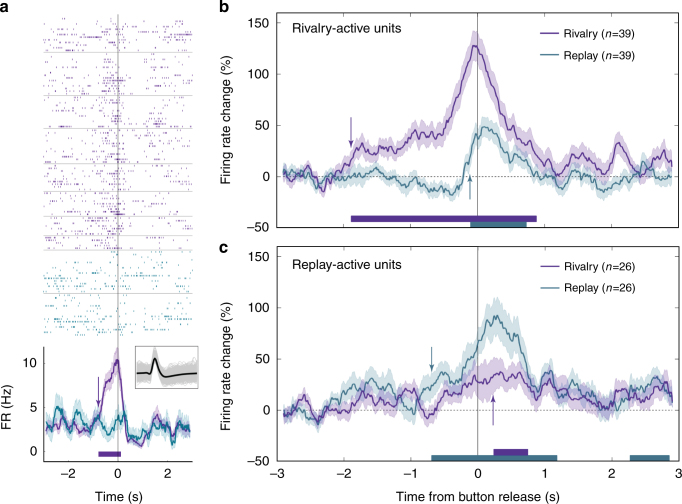
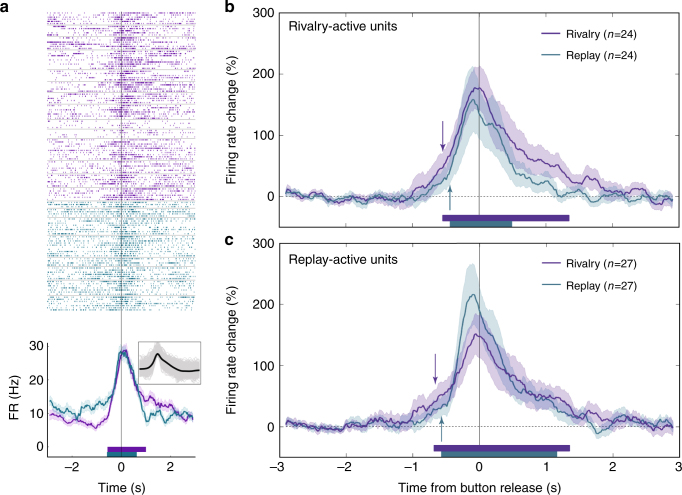
Identifying the neuronal basis of spontaneous changes in conscious experience in the absence of changes in the external environment is a major challenge. Binocular rivalry, in which two stationary monocular images lead to continuously changing perception, provides a unique opportunity to address this issue. We studied the activity of human single neurons in the medial temporal and frontal lobes while patients were engaged in binocular rivalry. Here we report that internal changes in the content of perception are signaled by very early (~-2000 ms) nonselective medial frontal activity, followed by selective activity of medial temporal lobe neurons that precedes the perceptual change by ~1000 ms. Such early activations are not found for externally driven perceptual changes. These results suggest that a medial fronto-temporal network may be involved in the preconscious internal generation of perceptual transitions.
Overview
The claims and statistics of this paper haven’t been checked yet.
Free: it reads the open-access text and checks the first 5 claims that cite a source we can check. Create a free account to check every claim.
Integrity signals
Registry
Cites
Statistics
Figures
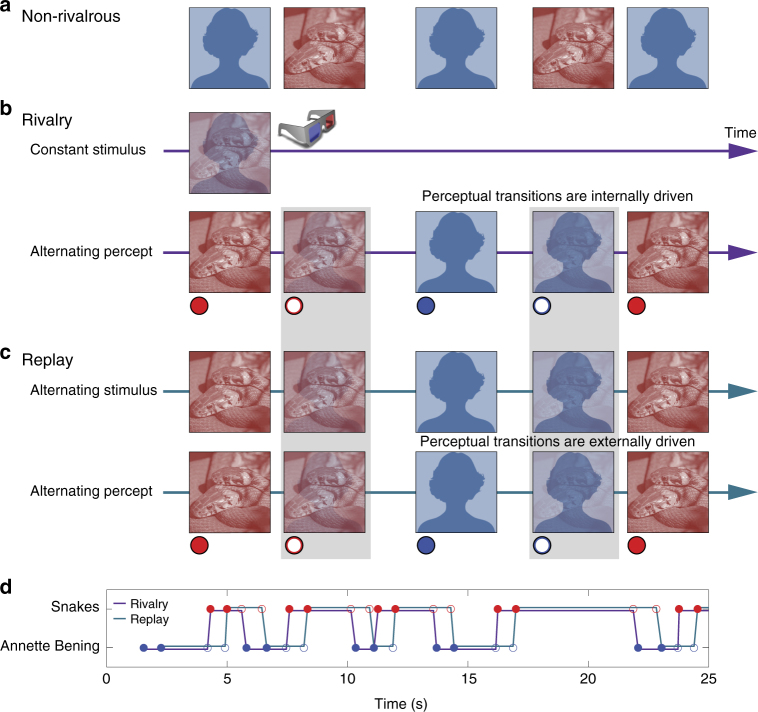
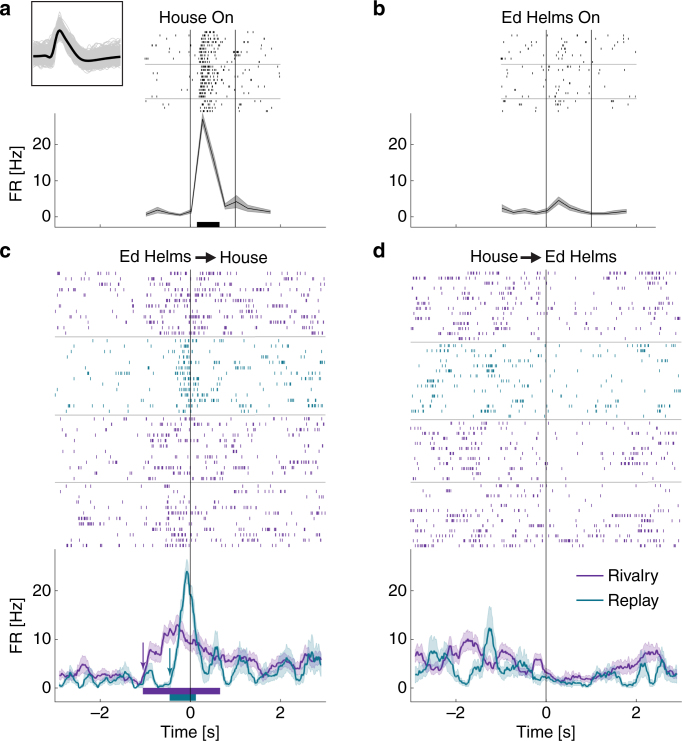
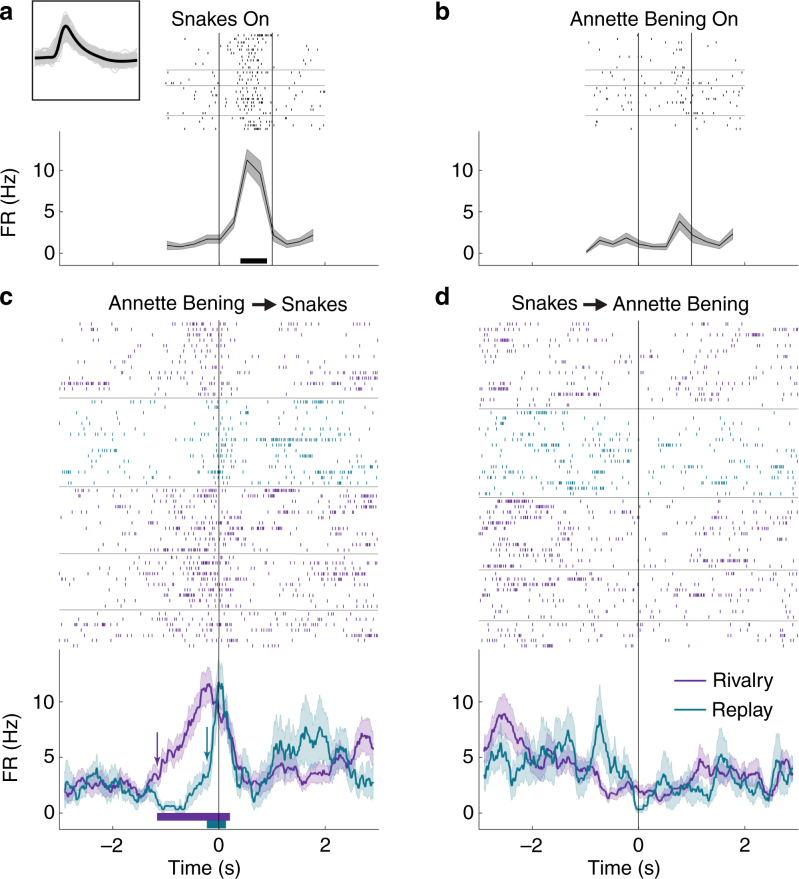
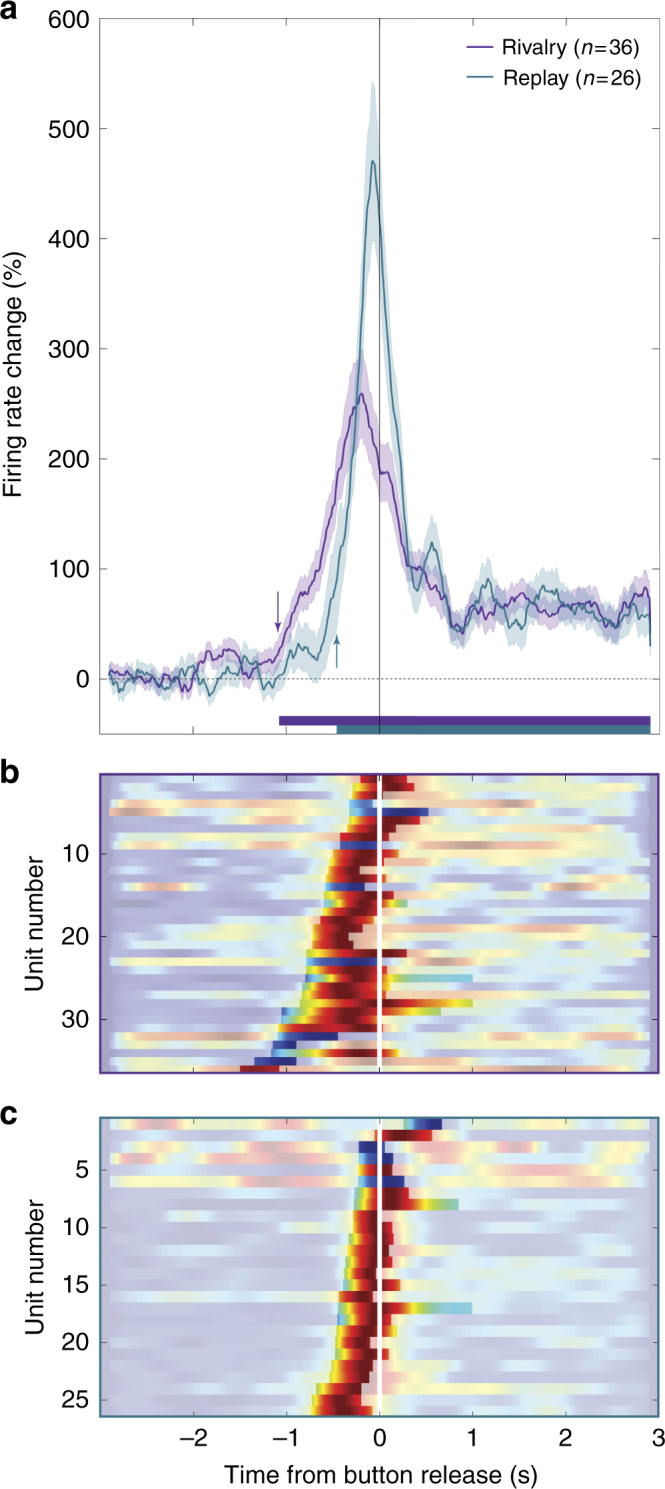
Verification
Claims the paper makes
The claims and statistics of this paper haven’t been checked yet.
Free: it reads the open-access text and checks the first 5 claims that cite a source we can check. Create a free account to check every claim.
Claims other papers make about this one
Each is checked against this paper’s own text: does it say what the citing paper says it does?
The cited source doesn’t support the claim as written.
In the citing paper
“In humans, the so-called concept cells in the anterior temporal lobe, which fire after 300 to 400 ms to specific pictures and words such as “Bill Clinton” or “the World Trade Center,” do so with stronger and longer-lasting firing rates when the corresponding stimulus is consciously perceived”
From Conscious Processing and the Global Neuronal Workspace Hypothesis (2020) · cites this paper as Gelbard-Sagiv et al., 2018
Checked by a reasoning model — may be wrong.
Experimental — accuracy not yet measured
Self-check
Percentages, sums and reported differences re-computed from the paper’s own numbers.
The self-check needs the paper’s full text.
Citations
Cites
Brainard, D. H. (1997) · Spatial Vision · doi:10.1163/156856897x00357 · Cited by 19,702
Nonparametric statistical testing of EEG- and MEG-data
Maris, E., & Oostenveld, R. (2007) · Journal of Neuroscience Methods · doi:10.1016/j.jneumeth.2007.03.024 · Cited by 8,496
Conflict monitoring and anterior cingulate cortex: an update
Botvinick, M. M., Cohen, J. D., & Carter, C. S. (2004) · Trends in Cognitive Sciences · doi:10.1016/j.tics.2004.10.003 · Cited by 3,623
Structure and function of the brain serotonin system
Jacobs, B. L., & Azmitia, E. C. (1992) · Physiological Reviews · doi:10.1152/physrev.1992.72.1.165 · Cited by 2,576
Experimental and theoretical approaches to conscious processing
Dehaene, S., & Changeux, J.-P. (2011) · Neuron · doi:10.1016/j.neuron.2011.03.018 · Cited by 2,573
The distinct modes of vision offered by feedforward and recurrent processing
Lamme, V. A. F., & Roelfsema, P. R. (2000) · Trends in Neurosciences · doi:10.1016/s0166-2236(00)01657-x · Cited by 2,338
Temporary suppression of visual processing in an RSVP task: An attentional blink?
Raymond, J. E., Shapiro, K. L., & Arnell, K. M. (1992) · Journal of Experimental Psychology: Human Perception and Performance · doi:10.1037//0096-1523.18.3.849 · Cited by 2,260
Unsupervised spike detection and sorting with wavelets and superparamagnetic clustering
Quiroga, R. Q., Nadasdy, Z., & Ben-Shaul, Y. (2004) · Neural Computation · doi:10.1162/089976604774201631 · Cited by 2,119
Invariant visual representation by single neurons in the human brain
Quiroga, R. Q., Reddy, L., Kreiman, G., Koch, C., & Fried, I. (2005) · Nature · doi:10.1038/nature03687 · Cited by 1,988
Self-citationNucleus locus ceruleus: new evidence of anatomical and physiological specificity
Foote, S. L., Bloom, F. E., & Aston-Jones, G. (1983) · Physiological Reviews · doi:10.1152/physrev.1983.63.3.844 · Cited by 1,901
Research works printed but not linked: 2
- Logothetis, N. K. & Leopold, D. A. On the Physiology of Bistable Percepts 1–18 (MIT Press, Cambridge, MA, 1995).
- Hanes DP Thompson KG Schall JD Nonparametric statistical testing of EEG- and MEG-data J. Neurosci. Methods 2007 164 177 190 10.1016/j.jneumeth.2007.03.024 17517438 · DOI · Paper page
Cited by
Conscious Processing and the Global Neuronal Workspace Hypothesis
Mashour, G. A., Roelfsema, P., Changeux, J.-P., & Dehaene, S. (2020) · Neuron · doi:10.1016/j.neuron.2020.01.026 · Cited by 1,164
“780 Neuron 105, March 4, 2020 so with stronger and longer-lasting firing rates when the corresponding stimulus is consciously perceived (Gelbard-Sagiv et al., 2018; Kreiman et al., 2002; Quiroga et al., 2008; Reber et al., 2017) or recalled (Gelbard-Sagiv et al.”
BackgroundHeart–brain interactions shape somatosensory perception and evoked potentials
Al, E., Iliopoulos, F., Forschack, N., Nierhaus, T., Grund, M., Motyka, P., Gaebler, M., Nikulin, V. V., & Villringer, A. (2020) · Proceedings of the National Academy of Sciences · doi:10.1073/pnas.1915629117 · Cited by 276
Neurons detect cognitive boundaries to structure episodic memories in humans
Zheng, J., Schjetnan, A. G. P., Yebra, M., Gomes, B. A., Mosher, C. P., Kalia, S. K., Valiante, T. A., Mamelak, A. N., Kreiman, G., & Rutishauser, U. (2022) · Nature Neuroscience · doi:10.1038/s41593-022-01020-w · Cited by 129
Kapoor, V., Dwarakanath, A., Safavi, S., Werner, J., Besserve, M., Panagiotaropoulos, T. I., & Logothetis, N. K. (2022) · Nature Communications · doi:10.1038/s41467-022-28897-2 · Cited by 111
Hesse, J. K., & Tsao, D. Y. (2020) · eLife · doi:10.7554/elife.58360 · Cited by 78
Bellet, J., Gay, M., Dwarakanath, A., Jarraya, B., van Kerkoerle, T., Dehaene, S., & Panagiotaropoulos, T. I. (2022) · Neuroscience of Consciousness · doi:10.1093/nc/niac005 · Cited by 55
Bistability of prefrontal states gates access to consciousness
Dwarakanath, A., Kapoor, V., Werner, J., Safavi, S., Fedorov, L., Logothetis, N. K., & Panagiotaropoulos, T. I. (2023) · Neuron · doi:10.1016/j.neuron.2023.02.027 · Cited by 67
Decoding the contents of consciousness from prefrontal ensembles
Kapoor, V., Dwarakanath, A., Safavi, S., Werner, J., Besserve, M., Panagiotaropoulos, T. I., & Logothetis, N. K. (2020) · bioRxiv (Cold Spring Harbor Laboratory) · doi:10.1101/2020.01.28.921841 · Cited by 47
“reflect the prerequisites of conscious perception than conscious content per se (22).”
BackgroundMultisensory Neurons in the Primate Amygdala
Morrow, J. K., Mosher, C. P., & Gothard, K. M. (2019) · Journal of Neuroscience · doi:10.1523/jneurosci.2903-18.2019 · Cited by 51
“To further validate our findings, we calculated the false discovery rate using a Wilcoxon rank-sum based cluster mass test described by Maris and Oostenveld (2007) and applied to single-unit data by numerous groups (Kaminski et al., 2017; Gelbard-Sagiv et al., 2018; Intveld et al., 2018).”
MethodNieder, A. (2021) · Current Opinion in Neurobiology · doi:10.1016/j.conb.2021.09.010 · Cited by 51
“Such techniques have been explored in humans [2 e 5], as well as our closest relatives in the animal kingdom, nonhuman primates [6 e 10].”
BackgroundMethodInfluentialA leaky evidence accumulation process for perceptual experience
Pereira, M., Perrin, D., & Faivre, N. (2022) · Trends in Cognitive Sciences · doi:10.1016/j.tics.2022.03.003 · Cited by 57
How do the blind ‘see’? The role of spontaneous brain activity in self-generated perception
Hahamy, A., Wilf, M., Rosin, B., Behrmann, M., & Malach, R. (2021) · Brain · doi:10.1093/brain/awaa384 · Cited by 41
Early brain activity: Translations between bedside and laboratory
Luhmann, H. J., Kanold, P. O., Molnár, Z., & Vanhatalo, S. (2022) · Progress in Neurobiology · doi:10.1016/j.pneurobio.2022.102268 · Cited by 35
Canales‐Johnson, A., Beerendonk, L., Chennu, S., Davidson, M., Ince, R. A. A., & van Gaal, S. (2023) · PLoS Biology · doi:10.1371/journal.pbio.3002120 · Cited by 44
Pronouns reactivate conceptual representations in human hippocampal neurons
Dijksterhuis, D. E., Self, M. W., Possel, J. K., Peters, J. C., van Straaten, E. C. W., Idema, S., Baayen, J. C., van der Salm, S. M. A., Aarnoutse, E. J., van Klink, N. E. C., et al. (2024) · Science · doi:10.1126/science.adr2813 · Cited by 46
Perceptual stability reflected in neuronal pattern similarities in human visual cortex
Broday-Dvir, R., Norman, Y., Harel, M., Mehta, A. D., & Malach, R. (2023) · Cell Reports · doi:10.1016/j.celrep.2023.112614 · Cited by 28
Be still my heart: Cardiac regulation as a mode of uncertainty reduction
Corcoran, A. W., Macefield, V. G., & Hohwy, J. (2021) · Psychonomic Bulletin & Review · doi:10.3758/s13423-021-01888-y · Cited by 34
Neurons as will and representation
Fried, I. (2021) · Nature reviews. Neuroscience · doi:10.1038/s41583-021-00543-8 · Cited by 35
Self-citationMultistability, perceptual value, and internal foraging
Safavi, S., & Dayan, P. (2022) · Neuron · doi:10.1016/j.neuron.2022.07.024 · Cited by 36
Whyte, C. J., Hohwy, J., & Smith, R. (2022) · Current Research in Neurobiology · doi:10.1016/j.crneur.2022.100036 · Cited by 24
de Jong, M. C., Vansteensel, M. J., van Ee, R., Leijten, F. S. S., Ramsey, N. F., Dijkerman, H. C., Dumoulin, S. O., & Knapen, T. H. J. (2020) · Current Biology · doi:10.1016/j.cub.2020.05.082 · Cited by 26
“Although previous investigations relied on averaged epochs that are influenced by reaction times [13, 46] (which may result in exaggerated differences; Figures S1B, S1C, and S3B), we here eliminated any influence of reaction times by analyzing single-epoch responses, irrespective of their delay to the report.”
BackgroundResultReconciling Current Theories of Consciousness
Maillé, S., & Lynn, M. B. (2020) · Journal of Neuroscience · doi:10.1523/jneurosci.2740-19.2020 · Cited by 24
“Proponents of IIT point to its explanatory power: for instance, it can explain why the cortex is capable of producing conscious experience while the cerebellum is not (Lemon and Edgley, 2010; Yu et al., 2015), even though the cerebellum possesses up to four times more neurons. While the IIT has not received unambiguou…”
BackgroundZaretskaya, N. (2021) · Progress in Neurobiology · doi:10.1016/j.pneurobio.2021.101998 · Cited by 22
Kapoor, V., Besserve, M., Logothetis, N. K., & Panagiotaropoulos, T. I. (2018) · Communications Biology · doi:10.1038/s42003-018-0225-1 · Cited by 21
Resting-State Fluctuations Underlie Free and Creative Verbal Behaviors in the Human Brain
Broday-Dvir, R., & Malach, R. (2020) · Cerebral Cortex · doi:10.1093/cercor/bhaa221 · Cited by 23
Neuronal correlates of full and partial visual conscious perception
Haque, H., Lobier, M., Palva, J. M., & Palva, S. (2019) · Consciousness and Cognition · doi:10.1016/j.concog.2019.102863 · Cited by 19
Bi-Stable Perception: Self-Coordinating Brain Regions to Make-Up the Mind
Devia, C., Concha‐Miranda, M., & Rodríguez, E. (2022) · Frontiers in Neuroscience · doi:10.3389/fnins.2021.805690 · Cited by 18
Slow ramping emerges from spontaneous fluctuations in spiking neural networks
Gavenas, J., Rutishauser, U., Schurger, A., & Maoz, U. (2024) · Nature Communications · doi:10.1038/s41467-024-51401-x · Cited by 18
Marly, A., Yazdjian, A., & Soto‐Faraco, S. (2023) · Philosophical Transactions of the Royal Society B Biological Sciences · doi:10.1098/rstb.2022.0346 · Cited by 17
Frequency-specific neural signatures of perceptual content and perceptual stability
Hardstone, R., Flounders, M. W., Zhu, M., & He, B. J. (2022) · eLife · doi:10.7554/elife.78108 · Cited by 12
Switch rates for orthogonally oriented kinetic-depth displays are correlated across observers
Pastukhov, A., Kastrup, P., Abs, I. F., & Carbon, C. (2019) · Journal of Vision · doi:10.1167/19.6.1 · Cited by 11
Representation of conscious percept without report in the macaque face patch networkPreprint
Hesse, J. K., & Tsao, D. Y. (2020) · bioRxiv (Cold Spring Harbor Laboratory) · doi:10.1101/2020.04.22.047522 · Cited by 8
“The reported percept also modulates activity of single units in the human medial temporal lobe and frontal cortex (Gelbard-Sagiv et al., 2018).”
BackgroundSubcortical correlates of consciousness with human single neuron recordings
Pereira, M., Faivre, N., Bernasconi, F., Brandmeir, N. J., Suffridge, J., Tran, K., Wang, S., Finomore, V. S., Konrad, P. E., Rezai, A. R., et al. (2025) · eLife · doi:10.1101/2023.01.27.525684 · Cited by 8
Neural signals-based respiratory motion tracking: a proof-of-concept study
Zhang, X., Liu, W., Xu, F., He, W., Song, Y., Li, G., Zhang, Y., Dai, G., Xiao, Q., Meng, Q., et al. (2023) · Physics in Medicine and Biology · doi:10.1088/1361-6560/acf819 · Cited by 7
Araya, J. M. (2023) · Phenomenology and the Cognitive Sciences · doi:10.1007/s11097-023-09945-8 · Cited by 8
“In fact, perceptual transitions during binocular rivalry involve activation of the anterior cingulate cortex (ACC) (Drew et al., 2022; Gelbard-Sagiv et al., 2018; Knapen et al., 2011).”
Wagener, L., & Nieder, A. (2024) · Journal of Cognitive Neuroscience · doi:10.1162/jocn_a_02101 · Cited by 9
What Can iEEG Inform Us About Mechanisms of Spontaneous Behavior?
Norman, Y., & Malach, R. (2023) · Studies in neuroscience, psychology and behavioral economics · doi:10.1007/978-3-031-20910-9_21 · Cited by 4
Single-neuron correlates of visual consciousness in human lateral occipital complex
Vanhoyland, M., Janssen, P., & Theys, T. (2025) · Nature Communications · doi:10.1038/s41467-025-67077-w · Cited by 8
“In humans, however,single-unit recordings are mostly restricted to areas accessible via depth electrodes, typically involving deep and medial structures such as the medial temporal lobe (MTL) and medial frontal lobe 3,9 .”
InfluentialEmotion against reason? Self-control conflict as self-modelling rivalry
Araya, J. M. (2024) · Synthese · doi:10.1007/s11229-024-04672-2 · Cited by 5
“Infact Infact,justlikeself-controlconflict,perceptualtransitionsduringbinocular rivalry involve the activation of the anterior cingulate cortex (ACC) (Drew et al., 2022; Gelbard-Sagiv et al., 2018; Knapen et al., 2011).”
Stockart, F., Robin, A., Blumenfeld, H., Brázdil, M., Kahane, P., Mudrik, L., Thum, J. A., Pereira, M., & Faivre, N. (2026) · eLife · doi:10.7554/elife.109604.4 · Cited by 5
Self-citation20 years of concept cells: From invariant responses to a unique coding of human memory
Quiroga, R. Q. (2026) · Neuron · doi:10.1016/j.neuron.2026.01.026 · Cited by 4
Subcortical correlates of consciousness with human single neuron recordingsPreprint
Pereira, M., Faivre, N., Bernasconi, F., Brandmeir, N. J., Suffridge, J., Tran, K., Wang, S., Finomore, V. S., Konrad, P. E., Rezai, A. R., et al. (2025) · eLife · doi:10.7554/elife.95272 · Cited by 10
The complexity of human subjective experience during binocular rivalry
Yılmaz, C., Pabel, L., Kerschenbauer, E., Ischebeck, A. K., Sipatchin, A., Bartels, A., & Zaretskaya, N. (2025) · Neuroscience of Consciousness · doi:10.1093/nc/niaf004 · Cited by 3
Consciousness: a neurosurgical perspective
Andelman‐Gur, M. M., & Fried, I. (2023) · Acta Neurochirurgica · doi:10.1007/s00701-023-05738-9 · Cited by 3
Self-citationKingir, E., Segawa, R., Hesse, J. K., Kagan, I., & Wilke, M. (2025) · Consciousness and Cognition · doi:10.1016/j.concog.2025.103891 · Cited by 1
Neural signals-based respiratory motion tracking: a prospective review
Zhang, X., Yan, D., Li, G., & Zhong, R. (2026) · Physics in Medicine and Biology · doi:10.1088/1361-6560/ae2db5 · Cited by 1
“Several studies have demonstrated that conscious perception and human self-initiated action are modulated by neural signals (Fried et al 2011, Gelbard-Sagiv et al 2018), which can be detected via neuroimaging systems.”
Bhatla, N., Cheong, K. C. T., Takahashi, S., Lay, C., Fiedeldey, M., Liang, K., Mao, M., Wu, Y.-F., Lu, S., Yun, K., et al. (2026) · Current Biology · doi:10.1016/j.cub.2026.03.031 · Cited by 3
Pronouns reactivate conceptual representations in human hippocampal neuronsPreprint
Dijksterhuis, D. E., Self, M. W., Possel, J. K., Peters, J. C., van Straaten, E. C. W., Idema, S., Baaijen, J. C., van der Salm, S. M. A., Aarnoutse, E. J., van Klink, N. E. C., et al. (2024) · bioRxiv (Cold Spring Harbor Laboratory) · doi:10.1101/2024.06.23.600044 · Cited by 1
A decision-theoretic model of multistability: perceptual switches as internal actionsPreprint
Safavi, S., & Dayan, P. (2024) · bioRxiv (Cold Spring Harbor Laboratory) · doi:10.1101/2024.12.06.627286 · Cited by 5
Multisensory Processing in the Primate Amygdala
Morrow, J. K. (2019) · UA Campus Repository (The University of Arizona)
The gradedness and richness of consciousness: Two pathways toward decoding consciousness
Cao, J., Qiu, S., Xianfeng, D. I. N. G., Cheng, X., & Fan, Z. (2023) · Advances in Psychological Science · doi:10.3724/sp.j.1042.2023.01172
Quettier, T., Lello, N. D., Tsuchiya, N., & Sessa, P. (2023) · Frontiers in Human Neuroscience · doi:10.3389/fnhum.2023.1145653
The Achilles Heel of Artificial Intelligence
Premaratne, U. K., & Halgamuge, S. K. (2023) · Communications in computer and information science · doi:10.1007/978-3-031-42430-4_32
The properties of mental experience evince its communicative functionPreprint
Kaifosh, P. (2024) · PsyArXiv (OSF Preprints) · doi:10.31234/osf.io/sbz8u
Subcortical correlates of consciousness with human single neuron recordingsPreprint
Pereira, M., Faivre, N., Bernasconi, F., Brandmeir, N. J., Suffridge, J., Tran, K., Wang, S., Finomore, V. S., Konrad, P. E., Rezai, A. R., et al. (2024) · eLife · doi:10.7554/elife.95272.1 · Cited by 2
Hand reaching: From motor control to intention and awareness
Bardi, L., Coudé, G., & Desmurget, M. (2024) · Elsevier eBooks · doi:10.1016/b978-0-12-820480-1.00108-x
Subcortical correlates of consciousness with human single neuron recordingsPreprint
Pereira, M., Faivre, N., Bernasconi, F., Brandmeir, N. J., Suffridge, J., Tran, K., Wang, S., Finomore, V. S., Konrad, P. E., Rezai, A. R., et al. (2025) · eLife · doi:10.7554/elife.95272.2 · Cited by 4
The properties of mental experience evince its communicative functionPreprint
Kaifosh, P. (2025) · PsyArXiv (OSF Preprints) · doi:10.31234/osf.io/sbz8u_v2
Stetza, L., & Kayser, C. (2026) · Scientific Reports · doi:10.1038/s41598-026-53388-5 · Cited by 1
Stockart, F., Robin, A., Blumenfeld, H., Brázdil, M., Kahane, P., Mudrik, L., Thum, J., Pereira, M., & Faivre, N. (2026) · eLife · doi:10.7554/elife.109604 · Cited by 1
Self-citationDifferential effects of attention and contrast on transition appearance during binocular rivalry
Yilmaz, C., Maitz, K., Gerschütz, M., Grassegger, W., Ischebeck, A. K., Bartels, A., & Zaretskaya, N. (2026) · Journal of Vision · doi:10.1167/jov.26.1.14 · Cited by 1
Ischemic lesions to the inferior frontal cortex slow perceptual switching
Fritsch, M., Michely, J., Jaeckel, L., Rangus, I., Riegler, C., Scheitz, J. F., Nolte, C. H., Sterzer, P., & Weilnhammer, V. A. (2026) · iScience · doi:10.1016/j.isci.2026.114943
“8,24 In both discussions, IFC’s involvement is considered primarily important for more general perceptual or motor mechanisms in perception.”
Stockart, F. (2024) · theses.fr (ABES) · doi:10.70675/c4f62883zfadez4797z9c4ezc049226f96a4 · Cited by 1
Perceptual multistability: a multifaceted window into brain dysfunctions
Safavi, S., Rolland, D., Sterzer, P., Jardri, R., & Leptourgos, P. (2026) · Trends in Cognitive Sciences · doi:10.1016/j.tics.2026.02.008 · Cited by 1
Wang, Y., Meng, N., Xing, H., Kou, Y., Zheng, R., Wu, Y., Feng, S., Luo, Y., & Zhang, M. (2026) · Physiology & Behavior · doi:10.1016/j.physbeh.2026.115359
Affective Modelling and Valenced Mixtures Within a Hierarchical Bayesian Architecture
Araya, J. M. (2026) · Topoi · doi:10.1007/s11245-026-10465-8
Metadata
- Authors
- Gelbard-Sagiv, H., Mudrik, L., Hill, M. R., Koch, C., & Fried, I.
- Affiliations
- California Institute of Technology (US)
- University of California, Los Angeles (US)
- Corresponding author
- Gelbard-Sagiv, Hagar
- Venue
- Nature Communications
- Published
- 2018-05-25
- Volume
- 9
- Issue
- 1
- Pages
- 2057-2057
- ISSN
- 2041-1723 (ISSN-L)
- PMC
- PMC5970215
- OpenAlex
- W2804389235
- Cited by
- 66
- References
- 82
- Citations by year
- 2026: 10 · 2025: 7 · 2024: 11 · 2023: 11 · 2022: 9 · 2021: 4 · 2020: 9 · 2019: 4 · 2018: 1
- FWCI
- 2.68
- Type
- journal article
- Language
- en
- Open access
- gold
- doi.org
- Licence
- cc-by
- creativecommons.org/licenses/by/4.0 (tdm)
- creativecommons.org/licenses/by/4.0 (vor)
- Locations
- Nature Communications (publishedVersion, cc-by)
- Europe PMC (PubMed Central) (publishedVersion, cc-by)
- PubMed Central (publishedVersion, cc-by)
- PubMed (publishedVersion)
- CaltechAUTHORS (California Institute of Technology) (submittedVersion, cc-by)
- RePEc: Research Papers in Economics (submittedVersion)
- DOAJ (DOAJ: Directory of Open Access Journals) (submittedVersion, cc-by-sa)
- DOAJ (DOAJ: Directory of Open Access Journals) (submittedVersion)
- Funders
- European Molecular Biology Organization
- L'Oreal USA
- European Commission (HORIZON2020, 659765, 659759)
- National Institute of Neurological Disorders and Stroke (R01NS033221, R01NS084017)
- H2020 Marie Skłodowska-Curie Actions (659759, 659765, HORIZON2020)
- Topics
- Life Sciences › Neuroscience › Cognitive Neuroscience › Visual perception and processing mechanisms
- Social Sciences › Arts and Humanities › Philosophy › Philosophy and Theoretical Science
- Life Sciences › Neuroscience › Cognitive Neuroscience › Neural dynamics and brain function
- Keywords
- binocular rivalry, conscious perception, single-unit activity, medial temporal lobe, medial frontal lobe, preconscious processing, perceptual transitions, fronto-temporal network, visual perception
- MeSH terms
- Drug Resistant Epilepsy, Adult, Consciousness, Electrodes, Implanted, Female, Frontal Lobe, Humans, Male, Middle Aged, Nerve Net, Neurons, Temporal Lobe, Visual Perception, Vision, Binocular, Young Adult, Single-Cell Analysis
About these checks
Registry, retraction, Cites and statistics results are computed, not judged, with one exception: a printed reference that no index lists is read once by a model before it counts as a citation error. Claims are extracted by a model and kept only when their quote appears verbatim in the text; each cited source is then checked, with a model’s help, for whether it says what the claim relies on. Those verdicts can be wrong — read the claim’s quote and the cited source before relying on one.
Statistics and arithmetic are recomputed, not judged.
Confidence bands are shown only for fields calibrated on our annotated test set. None is calibrated yet, so no band is shown.
What counts as a claim ›How we measure confidence ›How we check this ›
Are you an author, or do you see a problem with this page? Request a review
Data sources
Bibliographic data: Semantic Scholar, OpenAlex, Crossref.
Contains information from the Semantic Scholar Academic Graph Datasets, made available under the ODC Attribution License (ODC-BY 1.0).
Semantic Scholar’s data is described in: Kinney, R., et al. (2023). The Semantic Scholar Open Data Platform. arXiv:2301.10140.
