

A switch point in the molecular chaperone Hsp90 responding to client interaction
Open accessThe DOI matches its Crossref record; 66 of the 66 references it cites were found in a registry or an index.
Abstract
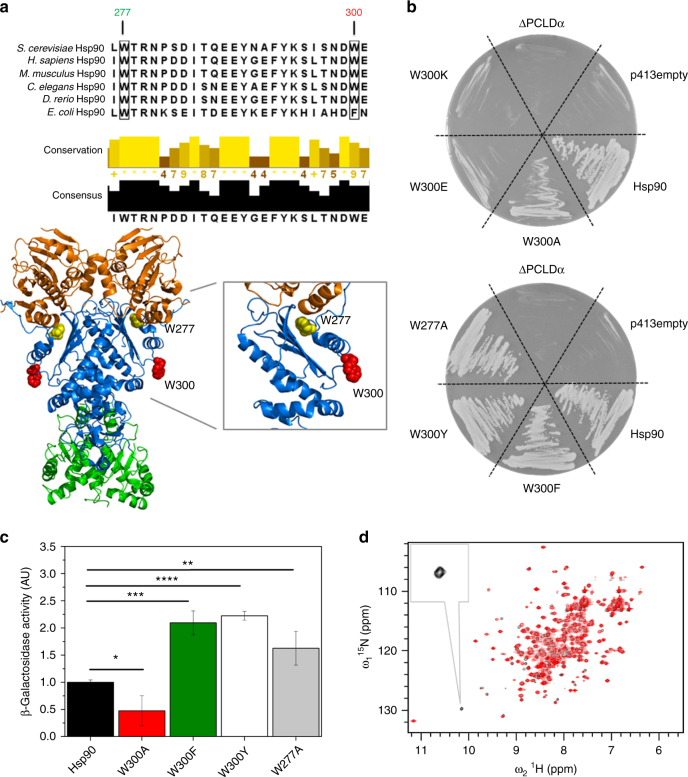
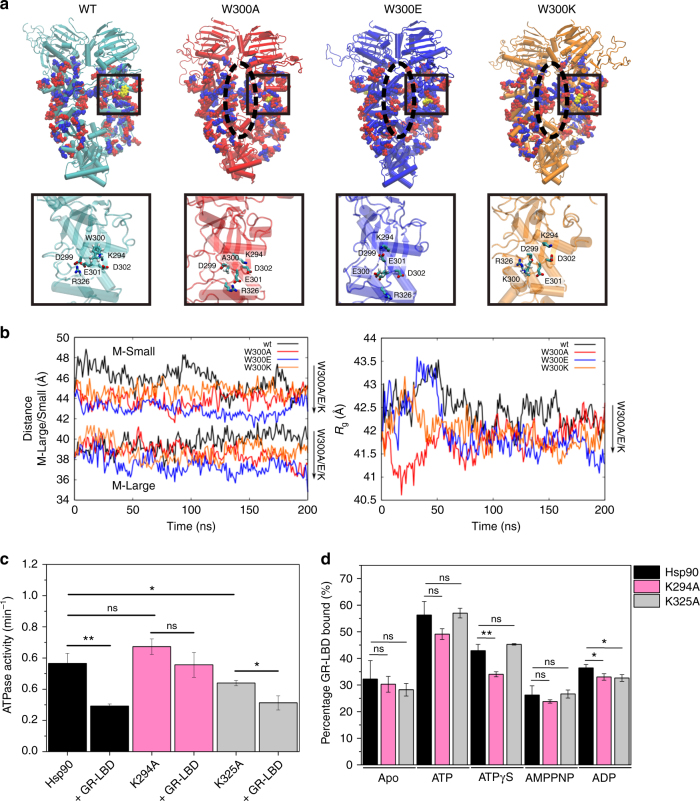
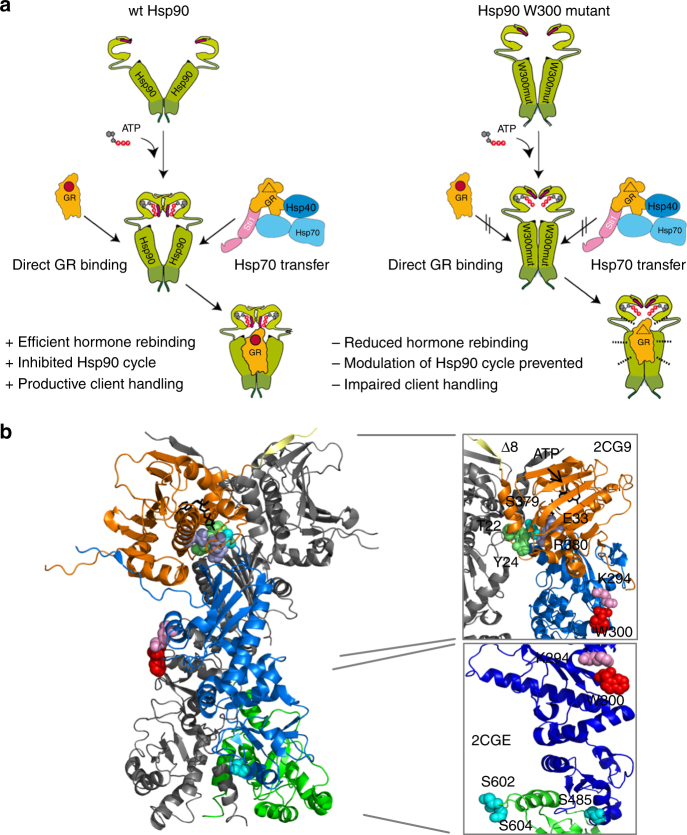
Heat shock protein 90 (Hsp90) is a dimeric molecular chaperone that undergoes large conformational changes during its functional cycle. It has been established that conformational switch points exist in the N-terminal (Hsp90-N) and C-terminal (Hsp90-C) domains of Hsp90, however information for switch points in the large middle-domain (Hsp90-M) is scarce. Here we report on a tryptophan residue in Hsp90-M as a new type of switch point. Our study shows that this conserved tryptophan senses the interaction of Hsp90 with a stringent client protein and transfers this information via a cation–π interaction with a neighboring lysine. Mutations at this position hamper the communication between domains and the ability of a client protein to affect the Hsp90 cycle. The residue thus allows Hsp90 to transmit information on the binding of a client from Hsp90-M to Hsp90-N which is important for progression of the conformational cycle and the efficient processing of client proteins.
Overview
The claims and statistics of this paper haven’t been checked yet.
Free: it reads the open-access text and checks the first 5 claims that cite a source we can check. Create a free account to check every claim.
Integrity signals
Registry
Cites
Statistics
Figures
Verification
Claims the paper makes
The claims and statistics of this paper haven’t been checked yet.
Free: it reads the open-access text and checks the first 5 claims that cite a source we can check. Create a free account to check every claim.
Claims other papers make about this one
Each is checked against this paper’s own text: does it say what the citing paper says it does?
The source backs part of the claim, not all of it — or backs it for a different population, condition or comparison.
In the citing paper
“Notably, Hsp90W320,F349 also make contact with GR in the loading complex12 and Hsp90W320 is critical for client activation in vivo20-22.”
From Structure of Hsp90–p23–GR reveals the Hsp90 client-remodelling mechanism (2022) · cites this paper as [21]
Experimental — accuracy not yet measuredThe source backs part of the claim, not all of it — or backs it for a different population, condition or comparison.
In the citing paper
“Supporting its broad functional importance, numerous studies have reported deleterious effects of Hsp90 W320 mutations on GR activation40,43 and yeast growth26.”
From Structure of Hsp90–Hsp70–Hop–GR reveals the Hsp90 client-loading mechanism (2022) · cites this paper as [43]
Experimental — accuracy not yet measuredThe cited source says what the claim attributes to it.
In the citing paper
“In addition, clients bind to the MD in close proximity of W300, another allosteric regulation point sensitive to client binding that modulates long-range conformational transitions involved in client maturation (63).”
From Client binding shifts the populations of dynamic Hsp90 conformations through an allosteric network (2021) · cites this paper as [63]
Self-check
Percentages, sums and reported differences re-computed from the paper’s own numbers.
The self-check needs the paper’s full text.
Citations
Cites
VMD: visual molecular dynamics
Humphrey, W., Dalke, A., & Schulten, K. (1996) · Journal of Molecular Graphics · doi:10.1016/0263-7855(96)00018-5 · Cited by 66,952
Scalable molecular dynamics with NAMD
Phillips, J. C., Braun, R., Wang, W., Gumbart, J., Tajkhorshid, E., Villa, E., Chipot, C., Skeel, R. D., Kalé, L., & Schulten, K. (2005) · Journal of Computational Chemistry · doi:10.1002/jcc.20289 · Cited by 16,914
CHARMM: A program for macromolecular energy, minimization, and dynamics calculations
Brooks, B. R., Bruccoleri, R. E., Olafson, B. D., States, D. J., Swaminathan, S., & Karplus, M. (1983) · Journal of Computational Chemistry · doi:10.1002/jcc.540040211 · Cited by 14,944
Comparative Protein Modelling by Satisfaction of Spatial Restraints
Šali, A., & Blundell, T. L. (1993) · Journal of Molecular Biology · doi:10.1006/jmbi.1993.1626 · Cited by 12,977
Schuck, P. (2000) · Biophysical Journal · doi:10.1016/s0006-3495(00)76713-0 · Cited by 3,868
Svergun, D. I. (1992) · Journal of Applied Crystallography · doi:10.1107/s0021889892001663 · Cited by 3,759
Svergun, D., Barberato, C., & Koch, M. H. J. (1995) · Journal of Applied Crystallography · doi:10.1107/s0021889895007047 · Cited by 3,434
Cation-π interactions in structural biology
Gallivan, J. P., & Dougherty, D. A. (1999) · Proceedings of the National Academy of Sciences · doi:10.1073/pnas.96.17.9459 · Cited by 1,997
HSP90 at the hub of protein homeostasis: emerging mechanistic insights
Taipale, M., Jarosz, D. F., & Lindquist, S. (2010) · Nature Reviews Molecular Cell Biology · doi:10.1038/nrm2918 · Cited by 1,818
Crystal structure of an Hsp90–nucleotide–p23/Sba1 closed chaperone complex
Ali, M. M. U., Roe, S. M., Vaughan, C. K., Meyer, P., Panaretou, B., Piper, P. W., Prodromou, C., & Pearl, L. H. (2006) · Nature · doi:10.1038/nature04716 · Cited by 962
Cited by
Structure, Function, and Regulation of the Hsp90 Machinery
Biebl, M. M., & Buchner, J. (2019) · Cold Spring Harbor Perspectives in Biology · doi:10.1101/cshperspect.a034017 · Cited by 304
Structure of Hsp90–Hsp70–Hop–GR reveals the Hsp90 client-loading mechanism
Wang, R. Y.-R., Noddings, C. M., Kirschke, E., Myasnikov, A. G., Johnson, J. L., & Agard, D. A. (2022) · Nature · doi:10.1038/s41586-021-04252-1 · Cited by 220
Noddings, C. M., Wang, R. Y.-R., & Agard, D. A. (2020) · doi:10.1101/2020.09.12.294975 · Cited by 166
Structure of Hsp90–p23–GR reveals the Hsp90 client-remodelling mechanism
Noddings, C. M., Wang, R. Y.-R., Johnson, J. L., & Agard, D. A. (2022) · Nature · doi:10.1038/s41586-021-04236-1 · Cited by 164
Functional principles and regulation of molecular chaperones
Dahiya, V., & Buchner, J. (2019) · Advances in Protein Chemistry and Structural Biology · doi:10.1016/bs.apcsb.2018.10.001 · Cited by 76
Inhibitors of HSP90 in melanoma
Mielczarek-Lewandowska, A., Hartman, M. L., & Czyż, M. (2019) · APOPTOSIS · doi:10.1007/s10495-019-01577-1 · Cited by 78
Involvement of molecular chaperone in protein-misfolding brain diseases
Wankhede, N. L., Kale, M. B., Upaganlawar, A. B., Taksande, B. G., Umekar, M. J., Behl, T., Abdellatif, A. A. H., Bhaskaran, P. M., Dachani, S. R., Sehgal, A., et al. (2022) · Biomedicine & Pharmacotherapy · doi:10.1016/j.biopha.2022.112647 · Cited by 77
Client binding shifts the populations of dynamic Hsp90 conformations through an allosteric network
Lopez, A., Dahiya, V., Delhommel, F., Freiburger, L., Stehle, R., Asami, S., Rutz, D., Blair, L., Buchner, J., & Sattler, M. (2021) · Science Advances · doi:10.1126/sciadv.abl7295 · Cited by 59
Self-citationNudC guides client transfer between the Hsp40/70 and Hsp90 chaperone systems
Biebl, M. M., Delhommel, F., Faust, O., Zak, K. M., Agam, G., Guo, X., Mühlhofer, M., Dahiya, V., Hillebrand, D., Popowicz, G. M., et al. (2022) · Molecular Cell · doi:10.1016/j.molcel.2021.12.031 · Cited by 48
Self-citationCryo-EM structures reveal a multistep mechanism of Hsp90 activation by co-chaperone Aha1
Liu, Y., Sun, M., Myasnikov, A. G., Elnatan, D., Delaeter, N., Nguyenquang, M., & Agard, D. A. (2020) · doi:10.1101/2020.06.30.180695 · Cited by 37
A methylated lysine is a switch point for conformational communication in the chaperone Hsp90
Rehn, A., Lawatscheck, J., Jokisch, M.-L., Mader, S. L., Luo, Q., Tippel, F., Blank, B., Richter, K., Lang, K., Kaila, V. R. I., et al. (2020) · Nature Communications · doi:10.1038/s41467-020-15048-8 · Cited by 38
Self-citationManagement of Hsp90-Dependent Protein Folding by Small Molecules Targeting the Aha1 Co-Chaperone
Singh, J. K., Hutt, D. M., Tait, B. D., Guy, N. C., Sivils, J. C., Ortiz, N. R., Payan, A. N., Komaragiri, S. K., Owens, J. J., Culbertson, D. S., et al. (2020) · Cell chemical biology · doi:10.1016/j.chembiol.2020.01.008 · Cited by 33
Glucocorticoid receptor complexes form cooperatively with the Hsp90 co-chaperones Pp5 and FKBPs
Kaziales, A., Barkovits, K., Marcus, K., & Richter, K. (2020) · Scientific Reports · doi:10.1038/s41598-020-67645-8 · Cited by 24
Dual Roles for Yeast Sti1/Hop in Regulating the Hsp90 Chaperone Cycle
Reidy, M., Kumar, S., Anderson, D. E., & Masison, D. C. (2018) · Genetics · doi:10.1534/genetics.118.301178 · Cited by 22
“The NTD-proximal residue W300 of Hsp82 was recently identified as a switch point linked to transmitting information between domains in response to client interaction (Rutz et al. 2018).”
BackgroundSmall molecule inhibitors targeting heat shock protein 90: An updated review
Li, Y., Dong, J., & Qin, J. (2024) · European Journal of Medicinal Chemistry · doi:10.1016/j.ejmech.2024.116562 · Cited by 25
Solution structure of Plasmodium falciparum Hsp90 indicates a high flexible dimer
da Silva, N. S. M., Torricillas, M. D. S., Minari, K., Barbosa, L. R. S., Seraphim, T. V., & Borges, J. C. (2020) · Archives of Biochemistry and Biophysics · doi:10.1016/j.abb.2020.108468 · Cited by 17
Rogala-Koziarska, K., Samluk, Ł., & Nałęcz, K. A. (2019) · Biochimica et Biophysica Acta (BBA) - Molecular Cell Research · doi:10.1016/j.bbamcr.2019.07.009 · Cited by 18
Verkhivker, G. M. (2022) · Journal of Molecular Biology · doi:10.1016/j.jmb.2022.167506 · Cited by 16
Stetz, G., Astl, L., & Verkhivker, G. M. (2020) · Journal of Chemical Theory and Computation · doi:10.1021/acs.jctc.0c00280 · Cited by 12
Hohrman, K., Gonçalves, D. L., Morano, K. A., & Johnson, J. L. (2021) · Genetics · doi:10.1093/genetics/iyab009 · Cited by 12
Verkhivker, G. M. (2022) · The Journal of Physical Chemistry B · doi:10.1021/acs.jpcb.2c03464 · Cited by 13
Mercier, R., Yama, D., LaPointe, P., & Johnson, J. L. (2023) · PLoS Genetics · doi:10.1371/journal.pgen.1010772 · Cited by 11
Wang, R. Y.-R., Noddings, C. M., Kirschke, E., Myasnikov, A. G., Johnson, J. L., & Agard, D. A. (2020) · doi:10.1101/2020.11.05.370247 · Cited by 10
p23 and Aha1: Distinct Functions Promote Client Maturation
Biebl, M. M., & Büchner, J. (2022) · Sub-cellular biochemistry/Subcellular biochemistry · doi:10.1007/978-3-031-14740-1_6 · Cited by 10
Astl, L., Stetz, G., & Verkhivker, G. M. (2020) · Journal of Chemical Information and Modeling · doi:10.1021/acs.jcim.0c00380 · Cited by 9
Yang, T., Wei, L., Ma, X., & Ke, H. (2020) · Journal of Receptors and Signal Transduction · doi:10.1080/10799893.2020.1794003 · Cited by 8
Identification of a chaperone-code responsible for Rad51-mediated genome repair
Rani, K., Gotmare, A., Maier, A., Menghal, R., Akhtar, N., Fangaria, N., Büchner, J., & Bhattacharyya, S. (2024) · Journal of Biological Chemistry · doi:10.1016/j.jbc.2024.107342 · Cited by 8
Advances in NMR Spectroscopy for biological systems: Principles, techniques, and their growing scope
Aboalroub, A. A. (2026) · Biotechnology Advances · doi:10.1016/j.biotechadv.2026.108809 · Cited by 7
Quantitative proteomic analysis reveals unique Hsp90 cycle-dependent client interactions
Rios, E. I., Gonçalves, D. L., Morano, K. A., & Johnson, J. L. (2024) · Genetics · doi:10.1093/genetics/iyae057 · Cited by 5
Astl, L., Stetz, G., & Verkhivker, G. M. (2020) · Journal of Chemical Theory and Computation · doi:10.1021/acs.jctc.0c00503 · Cited by 5
Nitration-driven structural changes in Hsp90 linked to gain of pathological functions
Chatterjee, T., Taboada, A., Logan, I. E., Paul, P. N., Huerta, M., Reardon, P. N., Radí, R., Zeida, A., & Franco, M. C. (2025) · Biochemical Journal · doi:10.1042/bcj20253230 · Cited by 5
Quintana‐Gallardo, L., Maestro-López, M., Martín‐Benito, J., Marcilla, M., Rutz, D. A., Büchner, J., Valpuesta, J., & Cuéllar, J. (2021) · Methods in molecular biology · doi:10.1007/978-1-0716-1936-0_17 · Cited by 4
Self-citationStructural basis of the key residue W320 responsible for Hsp90 conformational change
Peng, S., Matts, R. L., & Deng, J. (2022) · Journal of Biomolecular Structure and Dynamics · doi:10.1080/07391102.2022.2146197 · Cited by 3
The essential co-chaperone Sgt1 regulates client dwell time in the Hsp90 chaperone cycle
Engler, S., Delhommel, F., Dodt, C., López, A., Faust, O., Elimelech, A. R., Napolitano, V., Popowicz, G. M., Rosenzweig, R., Sattler, M., et al. (2025) · Molecular Cell · doi:10.1016/j.molcel.2025.12.002 · Cited by 6
Self-citationRefolding activity of bacterial Hsp90 in vivo reveals ancient chaperoning functionPreprint
Luengo, T. M., Ahlnäs, T., Hoekstra, A. T., Berkers, C. R., Mayer, M. P., & Rüdiger, S. (2018) · bioRxiv (Cold Spring Harbor Laboratory) · doi:10.1101/462549 · Cited by 1
Mollapour, M. (2020) · Faculty Opinions – Post-Publication Peer Review of the Biomedical Literature · doi:10.3410/f.737482045.793572272
Cytosolic heat shock protein 90 is required for photoreceptor outer segment development and vision
Aliff, H. L., Crockett, A. B., Munezero, D., Reid, C., Bockius, H. G., Kuzak, S. G., Rhodes, S., Saravanan, T., & Ramamurthy, V. (2026) · Journal of Biological Chemistry · doi:10.1016/j.jbc.2026.113192
Nair, A. M., Tullo, L., Espinosa, K. A., Tong, S. L. T., & Zhao, R. (2026) · Biomolecules · doi:10.3390/biom16060903
Metadata
- Authors
- Rutz, D. A., Luo, Q., Freiburger, L., Madl, T., Kaila, V. R. I., Sattler, M., & Buchner, J.
- Affiliations
- Center for Integrated Protein Science Munich (DE)
- Medical University of Graz (AT)
- Venue
- Nature Communications
- Published
- 2018-04-16
- Volume
- 9
- Issue
- 1
- Pages
- 1472-1472
- ISSN
- 2041-1723 (ISSN-L)
- PMC
- PMC5902578
- OpenAlex
- W2798201889
- Cited by
- 37
- References
- 66
- Citations by year
- 2026: 3 · 2025: 2 · 2024: 3 · 2023: 1 · 2022: 6 · 2021: 5 · 2020: 11 · 2019: 3 · 2018: 3
- FWCI
- 1.96
- Type
- journal article
- Language
- en
- Open access
- gold
- doi.org
- Licence
- cc-by
- creativecommons.org/licenses/by/4.0 (tdm)
- creativecommons.org/licenses/by/4.0 (vor)
- Locations
- Nature Communications (publishedVersion, cc-by)
- Europe PMC (PubMed Central) (publishedVersion, other-oa)
- PubMed Central (publishedVersion, cc-by)
- PubMed (publishedVersion)
- RePEc: Research Papers in Economics (submittedVersion)
- DOAJ (DOAJ: Directory of Open Access Journals) (submittedVersion)
- DOAJ (DOAJ: Directory of Open Access Journals) (submittedVersion, cc-by-sa)
- mediaTUM (Technical University of Munich) (submittedVersion, other-oa)
- PuSH - Publication Server of Helmholtz Zentrum München (submittedVersion)
- Funders
- Deutsche Forschungsgemeinschaft (SFB 1035, SFB 1035 A3)
- National Natural Science Foundation of China (31450110423)
- Austrian Science Fund (FWF: P28854, P28854, W 1226, W1226-B18)
- Gauss Centre for Supercomputing
- Leibniz-Gemeinschaft
- Leibniz-Rechenzentrum
- Topics
- Life Sciences › Biochemistry, Genetics and Molecular Biology › Molecular Biology › Heat shock proteins research
- Life Sciences › Biochemistry, Genetics and Molecular Biology › Molecular Biology › Protein Structure and Dynamics
- Life Sciences › Biochemistry, Genetics and Molecular Biology › Molecular Biology › Ubiquitin and proteasome pathways
- Keywords
- HSP90, molecular chaperones, tryptophan, cation-π interactions, middle domain, N-terminal domain, C-terminal domain, chaperone cycle, lysine
- MeSH terms
- Protein Conformation, alpha-Helical, Protein Conformation, beta-Strand, Adenosine Triphosphatases, Amino Acid Sequence, Animals, Binding Sites, Cloning, Molecular, Escherichia coli, Genetic Vectors, Humans, Ligands, Lysine, Mutation, Protein Binding, Recombinant Proteins, Saccharomyces cerevisiae, Tryptophan, Zebrafish, Gene Expression, Sequence Alignment, Caenorhabditis elegans, Crystallography, X-Ray, HSP90 Heat-Shock Proteins, Amino Acid Substitution, Structural Homology, Protein, Mice, Protein Interaction Domains and Motifs, Molecular Dynamics Simulation
About these checks
Registry, retraction, Cites and statistics results are computed, not judged, with one exception: a printed reference that no index lists is read once by a model before it counts as a citation error. Claims are extracted by a model and kept only when their quote appears verbatim in the text; each cited source is then checked, with a model’s help, for whether it says what the claim relies on. Those verdicts can be wrong — read the claim’s quote and the cited source before relying on one.
Statistics and arithmetic are recomputed, not judged.
Confidence bands are shown only for fields calibrated on our annotated test set. None is calibrated yet, so no band is shown.
What counts as a claim ›How we measure confidence ›How we check this ›
Are you an author, or do you see a problem with this page? Request a review
Data sources
Bibliographic data: Semantic Scholar, OpenAlex, Crossref.
Contains information from the Semantic Scholar Academic Graph Datasets, made available under the ODC Attribution License (ODC-BY 1.0).
Semantic Scholar’s data is described in: Kinney, R., et al. (2023). The Semantic Scholar Open Data Platform. arXiv:2301.10140.
