

A switch point in the molecular chaperone Hsp90 responding to client interaction
Open accessThe DOI matches its Crossref record; 66 of the 66 references it cites were found in a registry or an index.
Abstract
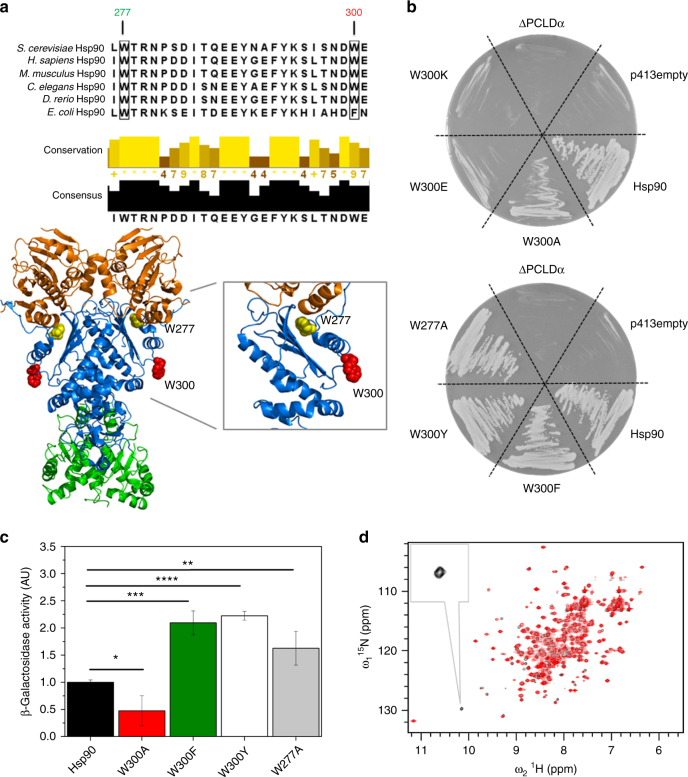
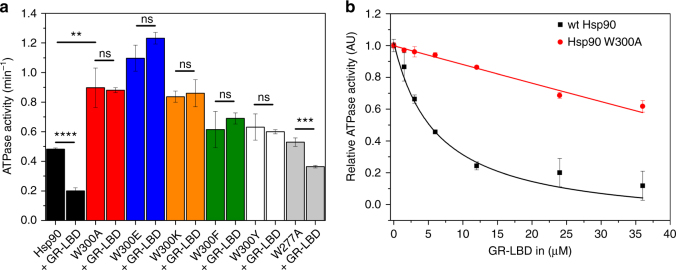
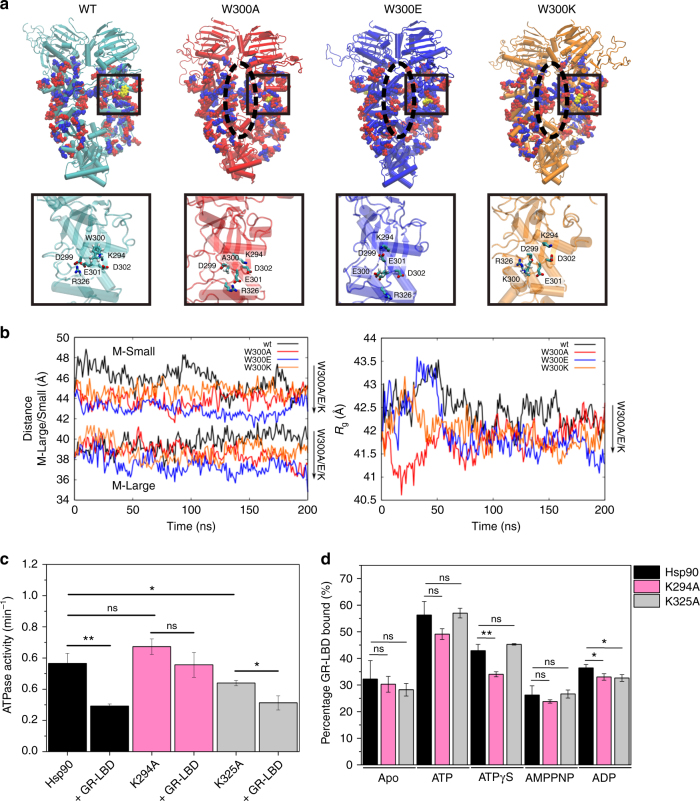
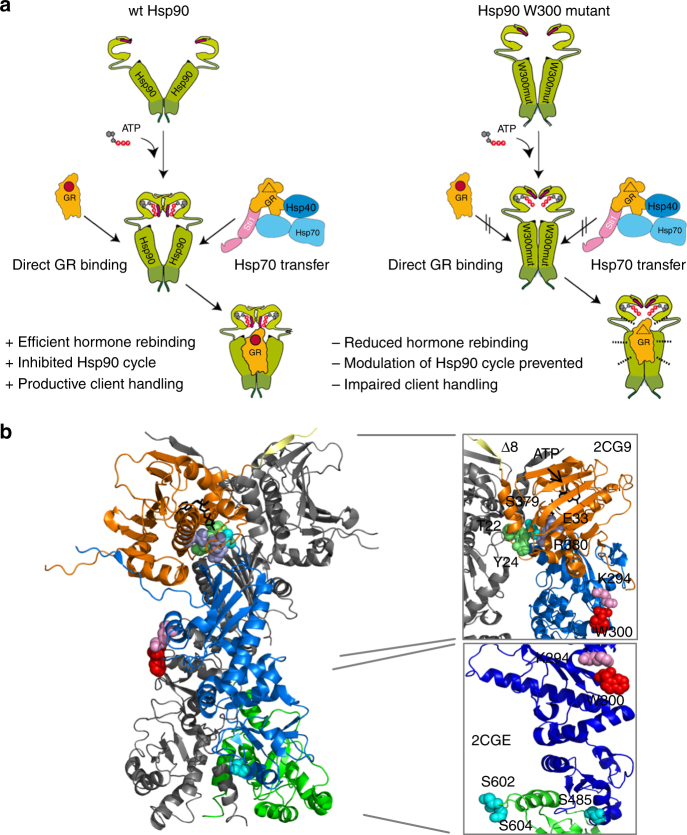
Heat shock protein 90 (Hsp90) is a dimeric molecular chaperone that undergoes large conformational changes during its functional cycle. It has been established that conformational switch points exist in the N-terminal (Hsp90-N) and C-terminal (Hsp90-C) domains of Hsp90, however information for switch points in the large middle-domain (Hsp90-M) is scarce. Here we report on a tryptophan residue in Hsp90-M as a new type of switch point. Our study shows that this conserved tryptophan senses the interaction of Hsp90 with a stringent client protein and transfers this information via a cation–π interaction with a neighboring lysine. Mutations at this position hamper the communication between domains and the ability of a client protein to affect the Hsp90 cycle. The residue thus allows Hsp90 to transmit information on the binding of a client from Hsp90-M to Hsp90-N which is important for progression of the conformational cycle and the efficient processing of client proteins.
Overview
The claims and statistics of this paper haven’t been checked yet.
Free: it reads the open-access text and checks the first 5 claims that cite a source we can check. Create a free account to check every claim.
Integrity signals
Registry
Cites
Statistics
Figures
Verification
Claims the paper makes
The claims and statistics of this paper haven’t been checked yet.
Free: it reads the open-access text and checks the first 5 claims that cite a source we can check. Create a free account to check every claim.
Claims other papers make about this one
Each is checked against this paper’s own text: does it say what the citing paper says it does?
The source backs part of the claim, not all of it — or backs it for a different population, condition or comparison.
In the citing paper
“Notably, Hsp90W320,F349 also make contact with GR in the loading complex12 and Hsp90W320 is critical for client activation in vivo20-22.”
From Structure of Hsp90–p23–GR reveals the Hsp90 client-remodelling mechanism (2022) · cites this paper as [21]
Experimental — accuracy not yet measuredThe source backs part of the claim, not all of it — or backs it for a different population, condition or comparison.
In the citing paper
“Supporting its broad functional importance, numerous studies have reported deleterious effects of Hsp90 W320 mutations on GR activation40,43 and yeast growth26.”
From Structure of Hsp90–Hsp70–Hop–GR reveals the Hsp90 client-loading mechanism (2022) · cites this paper as [43]
Experimental — accuracy not yet measuredThe cited source says what the claim attributes to it.
In the citing paper
“In addition, clients bind to the MD in close proximity of W300, another allosteric regulation point sensitive to client binding that modulates long-range conformational transitions involved in client maturation (63).”
From Client binding shifts the populations of dynamic Hsp90 conformations through an allosteric network (2021) · cites this paper as [63]
Self-check
Percentages, sums and reported differences re-computed from the paper’s own numbers.
The self-check needs the paper’s full text.
Citations
Cites
VMD: visual molecular dynamics
Humphrey, W., Dalke, A., & Schulten, K. (1996) · Journal of Molecular Graphics · doi:10.1016/0263-7855(96)00018-5 · Cited by 66,952
Scalable molecular dynamics with NAMD
Phillips, J. C., Braun, R., Wang, W., Gumbart, J., Tajkhorshid, E., Villa, E., Chipot, C., Skeel, R. D., Kalé, L., & Schulten, K. (2005) · Journal of Computational Chemistry · doi:10.1002/jcc.20289 · Cited by 16,914
CHARMM: A program for macromolecular energy, minimization, and dynamics calculations
Brooks, B. R., Bruccoleri, R. E., Olafson, B. D., States, D. J., Swaminathan, S., & Karplus, M. (1983) · Journal of Computational Chemistry · doi:10.1002/jcc.540040211 · Cited by 14,944
Comparative Protein Modelling by Satisfaction of Spatial Restraints
Šali, A., & Blundell, T. L. (1993) · Journal of Molecular Biology · doi:10.1006/jmbi.1993.1626 · Cited by 12,977
Schuck, P. (2000) · Biophysical Journal · doi:10.1016/s0006-3495(00)76713-0 · Cited by 3,868
Svergun, D. I. (1992) · Journal of Applied Crystallography · doi:10.1107/s0021889892001663 · Cited by 3,759
Svergun, D., Barberato, C., & Koch, M. H. J. (1995) · Journal of Applied Crystallography · doi:10.1107/s0021889895007047 · Cited by 3,434
Cation-π interactions in structural biology
Gallivan, J. P., & Dougherty, D. A. (1999) · Proceedings of the National Academy of Sciences · doi:10.1073/pnas.96.17.9459 · Cited by 1,997
HSP90 at the hub of protein homeostasis: emerging mechanistic insights
Taipale, M., Jarosz, D. F., & Lindquist, S. (2010) · Nature Reviews Molecular Cell Biology · doi:10.1038/nrm2918 · Cited by 1,818
Crystal structure of an Hsp90–nucleotide–p23/Sba1 closed chaperone complex
Ali, M. M. U., Roe, S. M., Vaughan, C. K., Meyer, P., Panaretou, B., Piper, P. W., Prodromou, C., & Pearl, L. H. (2006) · Nature · doi:10.1038/nature04716 · Cited by 962
Quantitative Analysis of Hsp90-Client Interactions Reveals Principles of Substrate Recognition
Taipale, M., Krykbaeva, I., Koeva, M., Kayatekin, C., Westover, K. D., Karras, G. I., & Lindquist, S. (2012) · Cell · doi:10.1016/j.cell.2012.06.047 · Cited by 879
Heat-shock protein 90, a chaperone for folding and regulation
Picard, D. (2002) · Cellular and Molecular Life Sciences · doi:10.1007/pl00012491 · Cited by 796
Evaluation of fluorescence-based thermal shift assays for hit identification in drug discovery
Lo, M.-C., Aulabaugh, A., Jin, G., Cowling, R., Bard, J., Malamas, M., & Ellestad, G. (2004) · Analytical Biochemistry · doi:10.1016/j.ab.2004.04.031 · Cited by 684
Electrostatic calculations of the pKa values of ionizable groups in bacteriorhodopsin
Bashford, D., & Gerwert, K. (1992) · Journal of Molecular Biology · doi:10.1016/0022-2836(92)91009-e · Cited by 548
The Hsp90 chaperone machinery: Conformational dynamics and regulation by co-chaperones
Li, J., Soroka, J., & Buchner, J. (2012) · Biochimica et Biophysica Acta (BBA) - Molecular Cell Research · doi:10.1016/j.bbamcr.2011.09.003 · Cited by 498
Meyer, P., Prodromou, C., Hu, B., Vaughan, C., Roe, S. M., Panaretou, B., Piper, P. W., & Pearl, L. H. (2003) · Molecular Cell · doi:10.1016/s1097-2765(03)00065-0 · Cited by 491
Shiau, A. K., Harris, S. F., Southworth, D. R., & Agard, D. A. (2006) · Cell · doi:10.1016/j.cell.2006.09.027 · Cited by 455
Atomic structure of Hsp90-Cdc37-Cdk4 reveals that Hsp90 traps and stabilizes an unfolded kinase
Verba, K. A., Wang, R. Y.-R., Arakawa, A., Liu, Y., Shirouzu, M., Yokoyama, S., & Agard, D. A. (2016) · Science · doi:10.1126/science.aaf5023 · Cited by 424
Mutational Analysis of Hsp90 Function: Interactions with a Steroid Receptor and a Protein Kinase
Nathan, D. F., & Lindquist, S. (1995) · Molecular and Cellular Biology · doi:10.1128/mcb.15.7.3917 · Cited by 423
Kirschke, E., Goswami, D., Southworth, D., Griffin, P. R., & Agard, D. A. (2014) · Cell · doi:10.1016/j.cell.2014.04.038 · Cited by 399
Dissection of the ATP-induced conformational cycle of the molecular chaperone Hsp90
Hessling, M., Richter, K., & Buchner, J. (2009) · Nature Structural & Molecular Biology · doi:10.1038/nsmb.1565 · Cited by 349
Ali, J. A., Jackson, A. P., Howells, A. J., & Maxwell, A. (1993) · Biochemistry · doi:10.1021/bi00061a033 · Cited by 303
Structure of an Hsp90-Cdc37-Cdk4 Complex
Vaughan, C. K., Gohlke, U., Sobott, F., Good, V. M., Ali, M. M. U., Prodromou, C., Robinson, C. V., Saibil, H. R., & Pearl, L. H. (2006) · Molecular Cell · doi:10.1016/j.molcel.2006.07.016 · Cited by 293
Structural basis for recruitment of the ATPase activator Aha1 to the Hsp90 chaperone machinery
Meyer, P. (2004) · The EMBO Journal · doi:10.1038/sj.emboj.7600141 · Cited by 291
Post-translational modifications of Hsp90 and their contributions to chaperone regulation
Mollapour, M., & Neckers, L. (2012) · Biochimica et Biophysica Acta (BBA) - Molecular Cell Research · doi:10.1016/j.bbamcr.2011.07.018 · Cited by 288
Structures of GRP94-Nucleotide Complexes Reveal Mechanistic Differences between the hsp90 Chaperones
Dollins, D. E., Warren, J. J., Immormino, R. M., & Gewirth, D. T. (2007) · Molecular Cell · doi:10.1016/j.molcel.2007.08.024 · Cited by 281
The chaperone Hsp90: changing partners for demanding clients
Röhl, A., Rohrberg, J., & Buchner, J. (2013) · Trends in Biochemical Sciences · doi:10.1016/j.tibs.2013.02.003 · Cited by 269
Folding and Quality Control of the VHL Tumor Suppressor Proceed through Distinct Chaperone Pathways
McClellan, A. J., Scott, M. D., & Frydman, J. (2005) · Cell · doi:10.1016/j.cell.2005.03.024 · Cited by 259
Hsp90 and co‐chaperones twist the functions of diverse client proteins
Zuehlke, A., & Johnson, J. L. (2010) · Biopolymers · doi:10.1002/bip.21292 · Cited by 251
Asymmetric Activation of the Hsp90 Dimer by Its Cochaperone Aha1
Retzlaff, M., Hagn, F., Mitschke, L., Hessling, M., Gugel, F., Kessler, H., Richter, K., & Buchner, J. (2010) · Molecular Cell · doi:10.1016/j.molcel.2010.01.006 · Cited by 244
The architecture of functional modules in the Hsp90 co‐chaperone Sti1/Hop
Schmid, A. B., Lagleder, S., Gräwert, M. A., Röhl, A., Hagn, F., Wandinger, S. K., Cox, M. B., Demmer, O., Richter, K., Groll, M., et al. (2012) · The EMBO Journal · doi:10.1038/emboj.2011.472 · Cited by 229
Swe1Wee1-Dependent Tyrosine Phosphorylation of Hsp90 Regulates Distinct Facets of Chaperone Function
Mollapour, M., Tsutsumi, S., Donnelly, A. C., Beebe, K., Tokita, M. J., Lee, M.-J., Lee, S., Morra, G., Bourboulia, D., Scroggins, B. T., et al. (2010) · Molecular Cell · doi:10.1016/j.molcel.2010.01.005 · Cited by 196
Mayer, M. P., & Le Breton, L. (2015) · Molecular Cell · doi:10.1016/j.molcel.2015.02.022 · Cited by 174
Smith, D. F., & Toft, D. O. (2008) · Molecular Endocrinology · doi:10.1210/me.2008-0089 · Cited by 173
Minami, Y., Kimura, Y., Kawasaki, H., Suzuki, K., & Yahara, I. (1994) · Molecular and Cellular Biology · doi:10.1128/mcb.14.2.1459 · Cited by 172
Hsp90 is regulated by a switch point in the C‐terminal domain
Retzlaff, M., Stahl, M., Eberl, H. C., Lagleder, S., Beck, J., Kessler, H., & Buchner, J. (2009) · EMBO reports · doi:10.1038/embor.2009.153 · Cited by 171
Structural basis for recruitment of the ATPase activator Aha1 to the Hsp90 chaperone machinery
Meyer, P., Prodromou, C., Liao, C., Hu, B., Mark Roe, S., Vaughan, C. K., Vlasic, I., Panaretou, B., Piper, P. W., & Pearl, L. H. (2004) · The EMBO Journal · doi:10.1038/sj.emboj.7600060 · Cited by 166
Mollapour, M., Tsutsumi, S., Truman, A. W., Xu, W., Vaughan, C. K., Beebe, K., Konstantinova, A., Vourganti, S., Panaretou, B., Piper, P. W., et al. (2011) · Molecular Cell · doi:10.1016/j.molcel.2011.02.011 · Cited by 165
Krukenberg, K. A., Förster, F., Rice, L. M., Sali, A., & Agard, D. A. (2008) · Structure · doi:10.1016/j.str.2008.01.021 · Cited by 160
Modulation of the Hsp90 Chaperone Cycle by a Stringent Client Protein
Lorenz, O. R., Freiburger, L., Rutz, D. A., Krause, M., Zierer, B. K., Alvira, S., Cuéllar, J., Valpuesta, J. M., Madl, T., Sattler, M., et al. (2014) · Molecular Cell · doi:10.1016/j.molcel.2014.02.003 · Cited by 151 · cited 1×
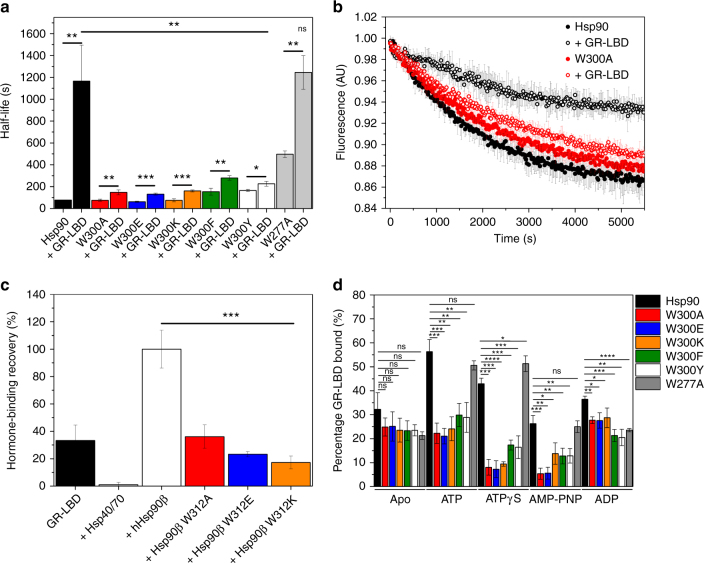
“We find that the presence of the GR-LBD almost doubles the half-life of the wt hetero-oligomer, consistent with the notion that this client induces a semi-closed conformation in Hsp90 and crosslinks the protomers[27].”
BackgroundSelf-citationThe Hsp90 Chaperone Machinery Regulates Signaling by Modulating Ligand Binding Clefts
Pratt, W. B., Morishima, Y., & Osawa, Y. (2008) · Journal of Biological Chemistry · doi:10.1074/jbc.r800023200 · Cited by 151
Morra, G., Verkhivker, G., & Colombo, G. (2009) · PLoS Computational Biology · doi:10.1371/journal.pcbi.1000323 · Cited by 148
Conformational Switching of the Molecular Chaperone Hsp90 via Regulated Phosphorylation
Soroka, J., Wandinger, S. K., Mäusbacher, N., Schreiber, T., Richter, K., Daub, H., & Buchner, J. (2012) · Molecular Cell · doi:10.1016/j.molcel.2011.12.031 · Cited by 139
Dynamic Tyrosine Phosphorylation Modulates Cycling of the HSP90-P50CDC37-AHA1 Chaperone Machine
Xu, W., Mollapour, M., Prodromou, C., Wang, S., Scroggins, B. T., Palchick, Z., Beebe, K., Siderius, M., Lee, M.-J., Couvillon, A., et al. (2012) · Molecular Cell · doi:10.1016/j.molcel.2012.05.015 · Cited by 133
CARMA: Software for Continuous Affect Rating and Media Annotation
Girard, J. M. (2014) · Journal of Open Research Software · doi:10.5334/jors.ar · Cited by 133
Asymmetric Hsp90 N Domain SUMOylation Recruits Aha1 and ATP-Competitive Inhibitors
Mollapour, M., Bourboulia, D., Beebe, K., Woodford, M. R., Polier, S., Hoang, A., Chelluri, R., Li, Y., Guo, A., Lee, M.-J., et al. (2014) · Molecular Cell · doi:10.1016/j.molcel.2013.12.007 · Cited by 129
The Middle Domain of Hsp90 Acts as a Discriminator between Different Types of Client Proteins
Hawle, P., Siepmann, M., Harst, A., Siderius, M., Reusch, H. P., & Obermann, W. M. J. (2006) · Molecular and Cellular Biology · doi:10.1128/mcb.02188-05 · Cited by 127
Symmetry-related proton transfer pathways in respiratory complex I
Luca, A. D., Gámiz‐Hernández, A. P., & Kaila, V. R. I. (2017) · Proceedings of the National Academy of Sciences · doi:10.1073/pnas.1706278114 · Cited by 123
Self-citationGenest, O., Reidy, M., Street, T. O., Hoskins, J. R., Camberg, J. L., Agard, D. A., Masison, D. C., & Wickner, S. (2013) · Molecular Cell · doi:10.1016/j.molcel.2012.11.017 · Cited by 118
Importance of cycle timing for the function of the molecular chaperone Hsp90
Zierer, B. K., Rübbelke, M., Tippel, F., Madl, T., Schopf, F. H., Rutz, D. A., Richter, K., Sattler, M., & Buchner, J. (2016) · Nature Structural & Molecular Biology · doi:10.1038/nsmb.3305 · Cited by 99
Self-citationHuai, Q., Wang, H., Liu, Y., Kim, H.-Y., Toft, D. O., & Ke, H. (2005) · Structure · doi:10.1016/j.str.2004.12.018 · Cited by 96
Vettoretti, G., Moroni, E., Sattin, S., Tao, J., Agard, D. A., Bernardi, A., & Colombo, G. (2016) · Scientific Reports · doi:10.1038/srep23830 · Cited by 83
Dehner, A., Furrer, J., Richter, K., Schuster, I., Buchner, J., & Kessler, H. (2003) · ChemBioChem · doi:10.1002/cbic.200300658 · Cited by 75
Johnson, J. L., Halas, A., & Flom, G. (2007) · Molecular and Cellular Biology · doi:10.1128/mcb.01034-06 · Cited by 72
Cunningham, C. N., Southworth, D. R., Krukenberg, K. A., & Agard, D. A. (2012) · Protein Science · doi:10.1002/pro.2103 · Cited by 66
Allosteric Regulation Points Control the Conformational Dynamics of the Molecular Chaperone Hsp90
Rehn, A., Moroni, E., Zierer, B. K., Tippel, F., Morra, G., John, C., Richter, K., Colombo, G., & Büchner, J. (2016) · Journal of Molecular Biology · doi:10.1016/j.jmb.2016.09.014 · Cited by 65
Seitz, T., Thoma, R., Schoch, G., Stihle, M., Benz, J., D’Arcy, B., Wiget, A., Ruf, A., Hennig, M., & Sterner, R. (2010) · Journal of Molecular Biology · doi:10.1016/j.jmb.2010.08.048 · Cited by 54
Wider, D., Gulli, M., Briand, P.-A., Tatu, U. S., & Picard, D. (2009) · Molecular and Biochemical Parasitology · doi:10.1016/j.molbiopara.2008.12.011 · Cited by 48
Echtenkamp, F. J., Gvozdenov, Z., Adkins, N. L., Zhang, Y., Lynch-Day, M., Watanabe, S., Peterson, C. L., & Freeman, B. C. (2016) · Molecular Cell · doi:10.1016/j.molcel.2016.09.040 · Cited by 47
Protein unfolding as a switch from self-recognition to high-affinity client binding
Groitl, B., Horowitz, S. A., Makepeace, K. A. T., Petrotchenko, E. V., Borchers, C. H., Reichmann, D., Bardwell, J. C. A., & Jakob, U. (2016) · Nature Communications · doi:10.1038/ncomms10357 · Cited by 44
Enforced N-domain Proximity Stimulates Hsp90 ATPase Activity and Is Compatible with Function in Vivo
Pullen, L., & Bolon, D. N. (2011) · Journal of Biological Chemistry · doi:10.1074/jbc.m111.223131 · Cited by 33
Nguyễn, M. T., Knieß, R. A., Daturpalli, S., Breton, L. L., Ke, X., Chen, X., & Mayer, M. P. (2017) · Journal of Molecular Biology · doi:10.1016/j.jmb.2017.01.011 · Cited by 32
Interheme electron tunneling in cytochrome c oxidase
Kaila, V. R. I., Johansson, M. P., Sundholm, D., & Wikström, M. K. F. (2010) · Proceedings of the National Academy of Sciences · doi:10.1073/pnas.1005889107 · Cited by 29
Self-citationSEDVIEW, Real‐time Sedimentation Analysis
Hayes, D. B., & Stafford, W. F. (2010) · Macromolecular Bioscience · doi:10.1002/mabi.201000075 · Cited by 25
Salek, R. M., Williams, M. A., Prodromou, C., Pearl, L. H., & Ladbury, J. E. (2002) · Journal of Biomolecular NMR · doi:10.1023/a:1020268712347 · Cited by 24
Flom, G. A., Langner, E., & Johnson, J. L. (2012) · Current Genetics · doi:10.1007/s00294-012-0373-7 · Cited by 22
Cited by
Structure, Function, and Regulation of the Hsp90 Machinery
Biebl, M. M., & Buchner, J. (2019) · Cold Spring Harbor Perspectives in Biology · doi:10.1101/cshperspect.a034017 · Cited by 304
Structure of Hsp90–Hsp70–Hop–GR reveals the Hsp90 client-loading mechanism
Wang, R. Y.-R., Noddings, C. M., Kirschke, E., Myasnikov, A. G., Johnson, J. L., & Agard, D. A. (2022) · Nature · doi:10.1038/s41586-021-04252-1 · Cited by 220
Noddings, C. M., Wang, R. Y.-R., & Agard, D. A. (2020) · doi:10.1101/2020.09.12.294975 · Cited by 166
Structure of Hsp90–p23–GR reveals the Hsp90 client-remodelling mechanism
Noddings, C. M., Wang, R. Y.-R., Johnson, J. L., & Agard, D. A. (2022) · Nature · doi:10.1038/s41586-021-04236-1 · Cited by 164
Functional principles and regulation of molecular chaperones
Dahiya, V., & Buchner, J. (2019) · Advances in Protein Chemistry and Structural Biology · doi:10.1016/bs.apcsb.2018.10.001 · Cited by 76
Metadata
- Authors
- Rutz, D. A., Luo, Q., Freiburger, L., Madl, T., Kaila, V. R. I., Sattler, M., & Buchner, J.
- Affiliations
- Center for Integrated Protein Science Munich (DE)
- Medical University of Graz (AT)
- Venue
- Nature Communications
- Published
- 2018-04-16
- Volume
- 9
- Issue
- 1
- Pages
- 1472-1472
- ISSN
- 2041-1723 (ISSN-L)
- PMC
- PMC5902578
- OpenAlex
- W2798201889
- Cited by
- 37
- References
- 66
- Citations by year
- 2026: 3 · 2025: 2 · 2024: 3 · 2023: 1 · 2022: 6 · 2021: 5 · 2020: 11 · 2019: 3 · 2018: 3
- FWCI
- 1.96
- Type
- journal article
- Language
- en
- Open access
- gold
- doi.org
- Licence
- cc-by
- creativecommons.org/licenses/by/4.0 (tdm)
- creativecommons.org/licenses/by/4.0 (vor)
- Locations
- Nature Communications (publishedVersion, cc-by)
- Europe PMC (PubMed Central) (publishedVersion, other-oa)
- PubMed Central (publishedVersion, cc-by)
- PubMed (publishedVersion)
- RePEc: Research Papers in Economics (submittedVersion)
- DOAJ (DOAJ: Directory of Open Access Journals) (submittedVersion)
- DOAJ (DOAJ: Directory of Open Access Journals) (submittedVersion, cc-by-sa)
- mediaTUM (Technical University of Munich) (submittedVersion, other-oa)
- PuSH - Publication Server of Helmholtz Zentrum München (submittedVersion)
- Funders
- Deutsche Forschungsgemeinschaft (SFB 1035, SFB 1035 A3)
- National Natural Science Foundation of China (31450110423)
- Austrian Science Fund (FWF: P28854, P28854, W 1226, W1226-B18)
- Gauss Centre for Supercomputing
- Leibniz-Gemeinschaft
- Leibniz-Rechenzentrum
- Topics
- Life Sciences › Biochemistry, Genetics and Molecular Biology › Molecular Biology › Heat shock proteins research
- Life Sciences › Biochemistry, Genetics and Molecular Biology › Molecular Biology › Protein Structure and Dynamics
- Life Sciences › Biochemistry, Genetics and Molecular Biology › Molecular Biology › Ubiquitin and proteasome pathways
- Keywords
- HSP90, molecular chaperones, tryptophan, cation-π interactions, middle domain, N-terminal domain, C-terminal domain, chaperone cycle, lysine
- MeSH terms
- Protein Conformation, alpha-Helical, Protein Conformation, beta-Strand, Adenosine Triphosphatases, Amino Acid Sequence, Animals, Binding Sites, Cloning, Molecular, Escherichia coli, Genetic Vectors, Humans, Ligands, Lysine, Mutation, Protein Binding, Recombinant Proteins, Saccharomyces cerevisiae, Tryptophan, Zebrafish, Gene Expression, Sequence Alignment, Caenorhabditis elegans, Crystallography, X-Ray, HSP90 Heat-Shock Proteins, Amino Acid Substitution, Structural Homology, Protein, Mice, Protein Interaction Domains and Motifs, Molecular Dynamics Simulation
About these checks
Registry, retraction, Cites and statistics results are computed, not judged, with one exception: a printed reference that no index lists is read once by a model before it counts as a citation error. Claims are extracted by a model and kept only when their quote appears verbatim in the text; each cited source is then checked, with a model’s help, for whether it says what the claim relies on. Those verdicts can be wrong — read the claim’s quote and the cited source before relying on one.
Statistics and arithmetic are recomputed, not judged.
Confidence bands are shown only for fields calibrated on our annotated test set. None is calibrated yet, so no band is shown.
What counts as a claim ›How we measure confidence ›How we check this ›
Are you an author, or do you see a problem with this page? Request a review
Data sources
Bibliographic data: Semantic Scholar, OpenAlex, Crossref.
Contains information from the Semantic Scholar Academic Graph Datasets, made available under the ODC Attribution License (ODC-BY 1.0).
Semantic Scholar’s data is described in: Kinney, R., et al. (2023). The Semantic Scholar Open Data Platform. arXiv:2301.10140.
