

Diffusion markers of dendritic density and arborization in gray matter predict differences in intelligence
Open accessThe DOI matches its Crossref record; 67 of the 67 references it cites were found in a registry or an index.
Abstract
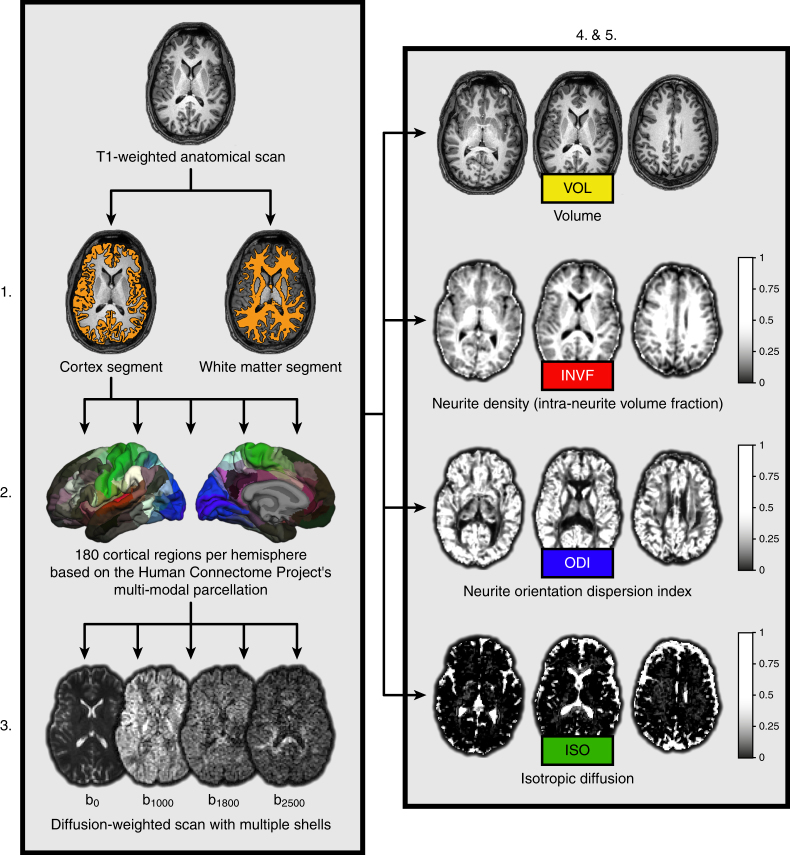
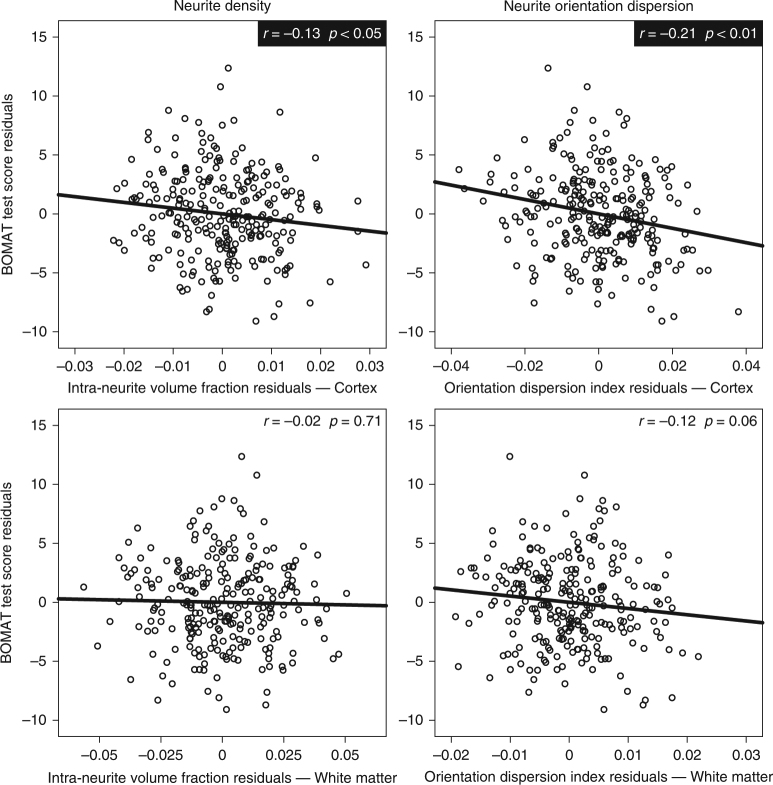
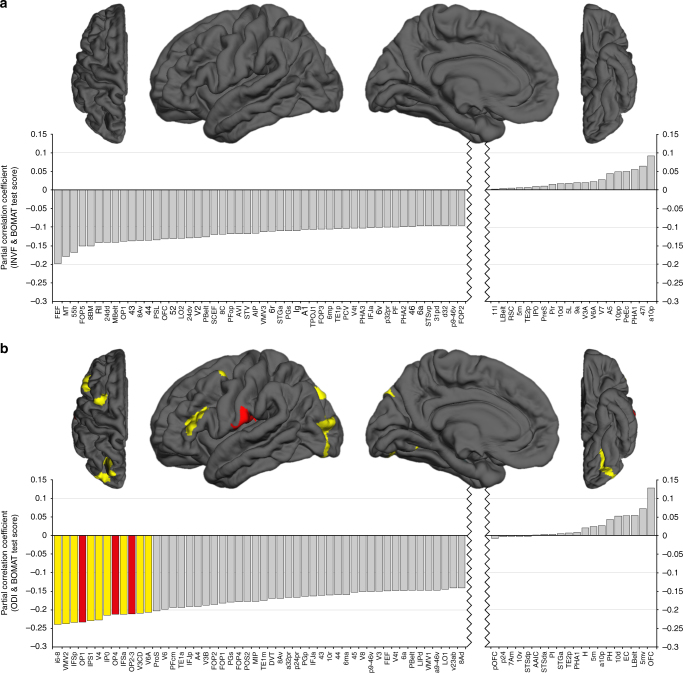
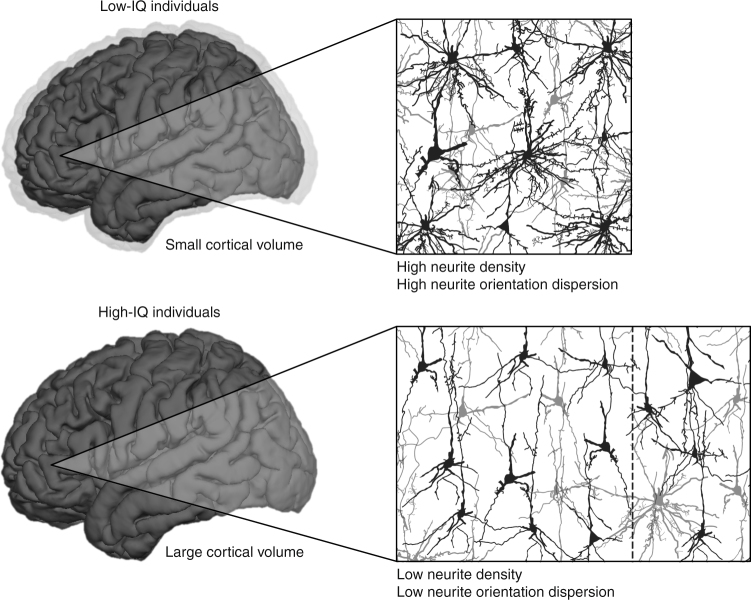
Previous research has demonstrated that individuals with higher intelligence are more likely to have larger gray matter volume in brain areas predominantly located in parieto-frontal regions. These findings were usually interpreted to mean that individuals with more cortical brain volume possess more neurons and thus exhibit more computational capacity during reasoning. In addition, neuroimaging studies have shown that intelligent individuals, despite their larger brains, tend to exhibit lower rates of brain activity during reasoning. However, the microstructural architecture underlying both observations remains unclear. By combining advanced multi-shell diffusion tensor imaging with a culture-fair matrix-reasoning test, we found that higher intelligence in healthy individuals is related to lower values of dendritic density and arborization. These results suggest that the neuronal circuitry associated with higher intelligence is organized in a sparse and efficient manner, fostering more directed information processing and less cortical activity during reasoning.
Overview
The claims and statistics of this paper haven’t been checked yet.
Free: it reads the open-access text and checks the first 5 claims that cite a source we can check. Create a free account to check every claim.
Integrity signals
Registry
Cites
Statistics
Figures
Verification
Claims the paper makes
The claims and statistics of this paper haven’t been checked yet.
Free: it reads the open-access text and checks the first 5 claims that cite a source we can check. Create a free account to check every claim.
Claims other papers make about this one
Each is checked against this paper’s own text: does it say what the citing paper says it does?
The source backs part of the claim, not all of it — or backs it for a different population, condition or comparison.
In the citing paper
“Several studies (Fukutomi et al., 2018;Genç et al., 2018) found optimizing d i, based on the fitting residual is helpful for re- vealing cortical cytoarchitecture with NODDI, though their method is still dependent on the assumption of equal diffusivities ( = d d i, e, ).”
From NODDI in clinical research (2020) · cites this paper as Genç et al., 2018
Experimental — accuracy not yet measuredThe cited source says what the claim attributes to it.
In the citing paper
“However, (Genç et al., 2018) have reported that higher intelligence in healthy young to middle-aged individuals was associated with lower cortical ODI”
From NODDI in clinical research (2020) · cites this paper as Genç et al., 2018
Self-check
Percentages, sums and reported differences re-computed from the paper’s own numbers.
The self-check needs the paper’s full text.
Citations
Cites
Controlling the False Discovery Rate: A Practical and Powerful Approach to Multiple Testing
Benjamini, Y., & Hochberg, Y. (1995) · Journal of the Royal Statistical Society Series B: Statistical Methodology · doi:10.1111/j.2517-6161.1995.tb02031.x · Cited by 109,482
Statistical power analyses using G∗Power 3.1: tests for correlation and regression analyses
Faul, F., Erdfelder, E., Buchner, A., & Lang, A.-G. (2009) · Behavior Research Methods · doi:10.3758/brm.41.4.1149 · Cited by 37,615
The assessment and analysis of handedness: The Edinburgh inventory
Oldfield, R. C. (1971) · Neuropsychologia · doi:10.1016/0028-3932(71)90067-4 · Cited by 35,900
Cortical Surface-Based Analysis
Dale, A. M., Fischl, B., & Sereno, M. I. (1999) · NeuroImage · doi:10.1006/nimg.1998.0395 · Cited by 10,910
Cortical Surface-Based Analysis
Fischl, B., Sereno, M. I., & Dale, A. M. (1999) · NeuroImage · doi:10.1006/nimg.1998.0396 · Cited by 6,147
The WU-Minn Human Connectome Project: An overview
Van Essen, D. C., Smith, S. M., Barch, D. M., Behrens, T. E. J., Yacoub, E., & Ugurbil, K. (2013) · NeuroImage · doi:10.1016/j.neuroimage.2013.05.041 · Cited by 5,651
The minimal preprocessing pipelines for the Human Connectome Project
Glasser, M. F., Sotiropoulos, S. N., Wilson, J. A., Coalson, T. S., Fischl, B., Andersson, J. L., Xu, J., Jbabdi, S., Webster, M., Polimeni, J. R., et al. (2013) · NeuroImage · doi:10.1016/j.neuroimage.2013.04.127 · Cited by 5,253
A multi-modal parcellation of human cerebral cortex
Glasser, M. F., Coalson, T. S., Robinson, E. C., Hacker, C. D., Harwell, J., Yacoub, E., Ugurbil, K., Andersson, J., Beckmann, C. F., Jenkinson, M., et al. (2016) · Nature · doi:10.1038/nature18933 · Cited by 5,111
(1998) · Cited by 4,172
A million spiking-neuron integrated circuit with a scalable communication network and interface
Merolla, P. A., Arthur, J. V., Alvarez-Icaza, R., Cassidy, A. S., Sawada, J., Akopyan, F., Jackson, B. L., Imam, N., Guo, C., Nakamura, Y., et al. (2014) · Science · doi:10.1126/science.1254642 · Cited by 4,147
Research works printed but not linked: 2
- Neubauer, A. C. & Fink, A. in Cognition and Intelligence: Identifying the Mechanisms of the Mind(eds Sternberg, R. J. & Pretz, J. E.) 68–87 (Cambridge University Press, Cambridge, 2005).
- Tukey, J. W. Exploratory Data Analysis (Addison-Wesley, Boston, 1977).
Cited by
Kamiya, K., Hori, M., & Aoki, S. (2020) · Journal of Neuroscience Methods · doi:10.1016/j.jneumeth.2020.108908 · Cited by 321
“However, (Genç et al., 2018) have reported that higher intelligence in healthy young to middle-aged individuals was associated with lower cortical ODI, suggesting that the relationship between cortical ODI and neurocognitive decline with age is likely not straightforward.”
BackgroundMethodStructural brain imaging correlates of general intelligence in UK Biobank
Cox, S. R., Ritchie, S. J., Fawns-Ritchie, C., Tucker-Drob, E. M., & Deary, I. J. (2019) · Intelligence · doi:10.1016/j.intell.2019.101376 · Cited by 164
Large and fast human pyramidal neurons associate with intelligence
Goriounova, N. A., Heyer, D. B., Wilbers, R., Verhoog, M. B., Giugliano, M., Verbist, C., Obermayer, J., Kerkhofs, A., Smeding, H., Verberne, M., et al. (2018) · eLife · doi:10.7554/elife.41714 · Cited by 162
Genetic variation, brain, and intelligence differences
Deary, I. J., Cox, S. R., & Hill, W. D. (2022) · Molecular Psychiatry · doi:10.1038/s41380-021-01027-y · Cited by 137
Genes, Cells and Brain Areas of Intelligence
Goriounova, N. A., & Mansvelder, H. D. (2019) · Frontiers in Human Neuroscience · doi:10.3389/fnhum.2019.00044 · Cited by 168
Metadata
- Authors
- Genç, E., Fraenz, C., Schlüter, C., Friedrich, P., Hossiep, R., Voelkle, M. C., Ling, J. M., Güntürkün, O., & Jung, R. E.
- Affiliations
- Ruhr University Bochum (DE)
- Humboldt-Universität zu Berlin (DE)
- Mind Research Network (US)
- Stellenbosch University (ZA)
- University of New Mexico (US)
- Corresponding author
- Genç, Erhan
- ORCID
- Venue
- Nature Communications
- Published
- 2018-05-15
- Volume
- 9
- Issue
- 1
- Pages
- 1905-1905
- ISSN
- 2041-1723 (ISSN-L)
- PMC
- PMC5954098
- OpenAlex
- W2803816323
- Cited by
- 167
- References
- 67
- Citations by year
- 2026: 8 · 2025: 20 · 2024: 14 · 2023: 25 · 2022: 23 · 2021: 38 · 2020: 16 · 2019: 17 · 2018: 6
- FWCI
- 13.30
- Type
- journal article
- Language
- en
- Open access
- gold
- doi.org
- Licence
- cc-by
- creativecommons.org/licenses/by/4.0 (tdm)
- creativecommons.org/licenses/by/4.0 (vor)
- Locations
- Nature Communications (publishedVersion, cc-by)
- Europe PMC (PubMed Central) (publishedVersion, cc-by)
- PubMed Central (publishedVersion, cc-by)
- PubMed (publishedVersion)
- RePEc: Research Papers in Economics (submittedVersion)
- Universitätsbibliographie, Universität Duisburg-Essen (submittedVersion)
- DOAJ (DOAJ: Directory of Open Access Journals) (submittedVersion, cc-by-sa)
- FreiDok plus (Universitätsbibliothek Freiburg) (submittedVersion)
- SUNScholar (Stellenbosch University) (submittedVersion)
- Funders
- Deutsche Forschungsgemeinschaft (Gu227/16, Project A03, Gu227/16‐1, GE2777/2-1, SFB 1280 project A03, SFB 1280, 1U54MH091657)
- Mercator Research Center Ruhr (1U54MH091657, AN-2015-0044)
- National Institutes of Health (5u54mh091657-05, 1U54‐MH‐091657)
- McDonnell Center for Systems Neuroscience (1U54MH091657)
- National Institute of Mental Health (U54-MH091657)
- NIH Blueprint for Neuroscience Research (1U54-MH-091657)
- Topics
- Health Sciences › Medicine › Radiology, Nuclear Medicine and Imaging › Advanced Neuroimaging Techniques and Applications
- Social Sciences › Psychology › Experimental and Cognitive Psychology › Cognitive Abilities and Testing
- Life Sciences › Neuroscience › Cognitive Neuroscience › Neural and Behavioral Psychology Studies
- Keywords
- intelligence, gray matter, dendritic density, dendritic branching, matrix reasoning, brain efficiency, Culture Fair Intelligence Test
- MeSH terms
- Adolescent, Adult, Brain Mapping, Dendrites, Female, Humans, Intelligence, Intelligence Tests, Male, Young Adult, Gray Matter
About these checks
Registry, retraction, Cites and statistics results are computed, not judged, with one exception: a printed reference that no index lists is read once by a model before it counts as a citation error. Claims are extracted by a model and kept only when their quote appears verbatim in the text; each cited source is then checked, with a model’s help, for whether it says what the claim relies on. Those verdicts can be wrong — read the claim’s quote and the cited source before relying on one.
Statistics and arithmetic are recomputed, not judged.
Confidence bands are shown only for fields calibrated on our annotated test set. None is calibrated yet, so no band is shown.
What counts as a claim ›How we measure confidence ›How we check this ›
Are you an author, or do you see a problem with this page? Request a review
How to cite
Cite CoChat for the checks on this page, and the paper for its own findings.
- This page
- CoChat. (2026). Citation check: Diffusion markers of dendritic density and arborization in gray matter predict differences in intelligence. https://app.cochat.ai/papers/10.1038/s41467-018-04268-8
- The paper
- Genç, E., Fraenz, C., Schlüter, C., Friedrich, P., Hossiep, R., Voelkle, M. C., Ling, J. M., Güntürkün, O., & Jung, R. E. (2018). Diffusion markers of dendritic density and arborization in gray matter predict differences in intelligence. Nature Communications. https://doi.org/10.1038/s41467-018-04268-8
Data sources
Bibliographic data: Semantic Scholar, OpenAlex, Crossref.
Contains information from the Semantic Scholar Academic Graph Datasets, made available under the ODC Attribution License (ODC-BY 1.0).
Semantic Scholar’s data is described in: Kinney, R., et al. (2023). The Semantic Scholar Open Data Platform. arXiv:2301.10140.
