

Estimating geological CO2 storage security to deliver on climate mitigation
Open accessPublished version of a preprint
The DOI matches its Crossref record; 53 of the 53 references it cites were found in a registry or an index.
Abstract
Carbon capture and storage (CCS) can help nations meet their Paris CO 2 reduction commitments cost-effectively. However, lack of confidence in geologic CO 2 storage security remains a barrier to CCS implementation. Here we present a numerical program that calculates CO 2 storage security and leakage to the atmosphere over 10,000 years. This combines quantitative estimates of geological subsurface CO 2 retention, and of surface CO 2 leakage. We calculate that realistically well-regulated storage in regions with moderate well densities has a 50% probability that leakage remains below 0.0008% per year, with over 98% of the injected CO 2 retained in the subsurface over 10,000 years. An unrealistic scenario, where CO 2 storage is inadequately regulated, estimates that more than 78% will be retained over 10,000 years. Our modelling results suggest that geological storage of CO 2 can be a secure climate change mitigation option, but we note that long-term behaviour of CO 2 in the subsurface remains a key uncertainty.
Overview
The claims and statistics of this paper haven’t been checked yet.
Free: it reads the open-access text and checks the first 5 claims that cite a source we can check. Create a free account to check every claim.
Integrity signals
Registry
Cites
Statistics
Figures
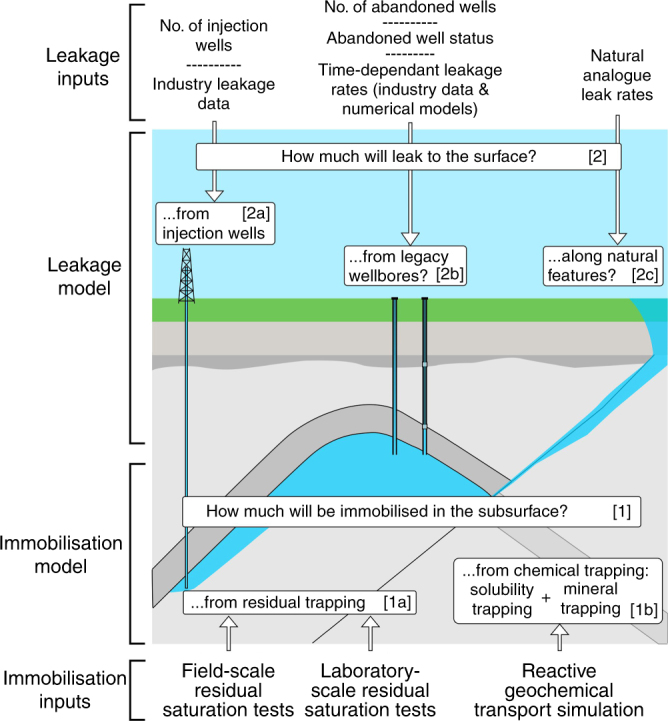
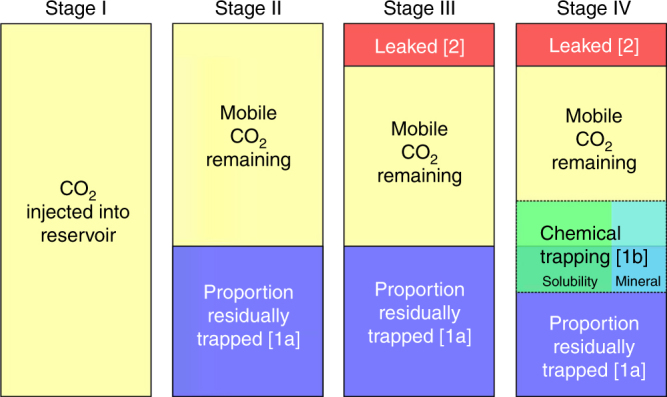
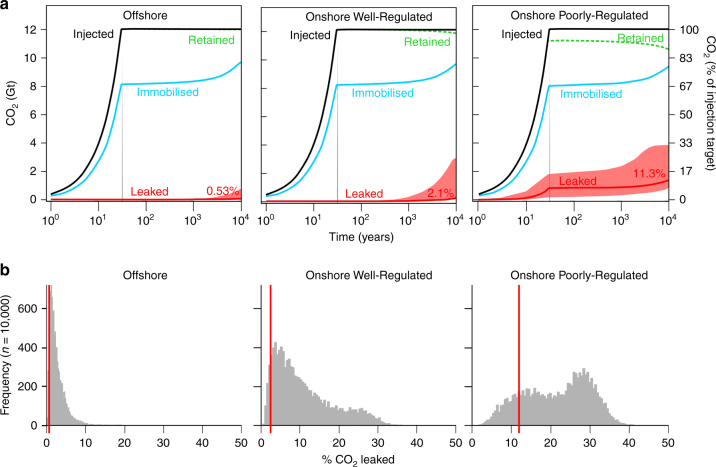
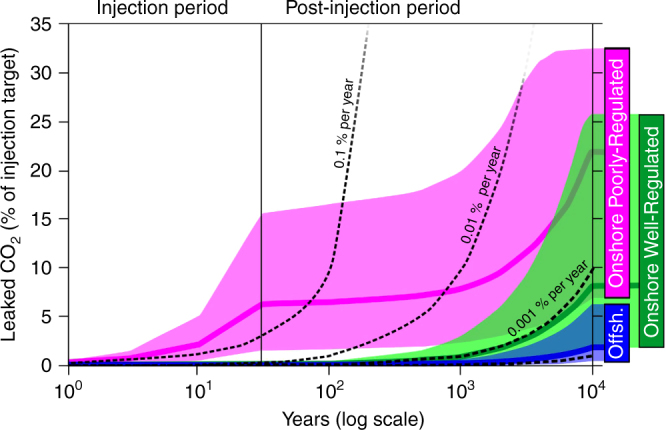
Verification
Claims the paper makes
The claims and statistics of this paper haven’t been checked yet.
Free: it reads the open-access text and checks the first 5 claims that cite a source we can check. Create a free account to check every claim.
Claims other papers make about this one
Each is checked against this paper’s own text: does it say what the citing paper says it does?
The source backs part of the claim, not all of it — or backs it for a different population, condition or comparison.
In the citing paper
“Probabilistic modeling of risks associated with leakage suggest that 98% of the CO 2 will be retained in 10,000 years”
From An Overview of the Status and Challenges of CO2 Storage in Minerals and Geological Formations (2019) · cites this paper as Alcalde et al., 2018
Experimental — accuracy not yet measuredThe cited source says what the claim attributes to it.
In the citing paper
“Geological storage, when executed correctly, is considered to be more permanent 22 than storage in the biosphere, which is shorter and subject to human and natural disturbances 23 such as wildfires and pests, as well as changes in climate 24 .”
From The technological and economic prospects for CO2 utilization and removal (2019) · cites this paper as [22]
Self-check
Percentages, sums and reported differences re-computed from the paper’s own numbers.
The self-check needs the paper’s full text.
Citations
Cites
Michael, K., Golab, A., Shulakova, V., Ennis-King, J., Allinson, G., Sharma, S., & Aiken, T. (2010) · International Journal of Greenhouse Gas Control · doi:10.1016/j.ijggc.2009.12.011 · Cited by 727
Nordbotten, J. M., Celia, M. A., & Bachu, S. (2005) · Transport in Porous Media · doi:10.1007/s11242-004-0670-9 · Cited by 671
Relative permeability and trapping of CO2 and water in sandstone rocks at reservoir conditions
Krevor, S. C. M., Pini, R., Zuo, L., & Benson, S. M. (2012) · Water Resources Research · doi:10.1029/2011wr010859 · Cited by 646
Fate of fossil fuel CO2 in geologic time
Archer, D. (2005) · Journal of Geophysical Research: Oceans · doi:10.1029/2004jc002625 · Cited by 620
Monitoring of CO2 injected at Sleipner using time-lapse seismic data
Arts, R., Eiken, O., Chadwick, A., Zweigel, P., van der Meer, L., & Zinszner, B. (2004) · Energy · doi:10.1016/j.energy.2004.03.072 · Cited by 507
Carey, J. W., Wigand, M., Chipera, S. J., WoldeGabriel, G., Pawar, R., Lichtner, P. C., Wehner, S. C., Raines, M. A., & Guthrie, G. D. (2007) · International Journal of Greenhouse Gas Control · doi:10.1016/s1750-5836(06)00004-1 · Cited by 503
Davies, R. J., Almond, S., Ward, R. S., Jackson, R. B., Adams, C., Worrall, F., Herringshaw, L. G., Gluyas, J. G., & Whitehead, M. A. (2014) · Marine and Petroleum Geology · doi:10.1016/j.marpetgeo.2014.03.001 · Cited by 476
Last chance for carbon capture and storage
Scott, V., Gilfillan, S., Markusson, N., Chalmers, H., & Haszeldine, R. S. (2013) · Nature Climate Change · doi:10.1038/nclimate1695 · Cited by 376
Self-citationConvective dissolution of CO2 in saline aquifers: Progress in modeling and experiments
Emami-Meybodi, H., Hassanzadeh, H., Green, C. P., & Ennis-King, J. (2015) · International Journal of Greenhouse Gas Control · doi:10.1016/j.ijggc.2015.04.003 · Cited by 372
Xu, T., Apps, J. A., & Pruess, K. (2003) · Journal of Geophysical Research: Solid Earth · doi:10.1029/2002jb001979 · Cited by 363
Monitoring of CO2 Injected at Sleipner Using Time Lapse Seismic Data
ARTS, R., EIKEN, O., CHADWICK, A., ZWEIGEL, P., VANDERMEER, L., & ZINSZNER, B. (2003) · Greenhouse Gas Control Technologies - 6th International Conference · doi:10.1016/b978-008044276-1/50056-8 · Cited by 270
Chadwick, A., Arts, R. J., Bernstone, C., May, F., Thibeau, S., & Zweigel, P. (2008) · Cited by 258
Review: Role of chemistry, mechanics, and transport on well integrity in CO2 storage environments
Carroll, S., Carey, J. W., Dzombak, D., Huerta, N. J., Li, L., Richard, T., Um, W., Walsh, S. D. C., & Zhang, L. (2016) · International Journal of Greenhouse Gas Control · doi:10.1016/j.ijggc.2016.01.010 · Cited by 255
Gunter, W. D., Bachu, S., & Benson, S. (2004) · Geological Society, London, Special Publications · doi:10.1144/gsl.sp.2004.233.01.09 · Cited by 251
Review and implications of relative permeability of CO2/brine systems and residual trapping of CO2
Burnside, N. M., & Naylor, M. (2014) · International Journal of Greenhouse Gas Control · doi:10.1016/j.ijggc.2014.01.013 · Cited by 249
Damen, K., Faaij, A., & Turkenburg, W. (2006) · Climatic Change · doi:10.1007/s10584-005-0425-9 · Cited by 234
EOR: Current Status and Opportunities
Manrique, E., Thomas, C., Ravikiran, R., Izadi, M., Lantz, M., Romero, J., & Alvarado, V. (2010) · SPE Improved Oil Recovery Symposium · doi:10.2118/130113-ms · Cited by 230
Analytical solutions for leakage rates through abandoned wells
Nordbotten, J. M., Celia, M. A., & Bachu, S. (2004) · Water Resources Research · doi:10.1029/2003wr002997 · Cited by 215
Identification and characterization of high methane-emitting abandoned oil and gas wells
Kang, M., Christian, S., Celia, M. A., Mauzerall, D. L., Bill, M., Miller, A. R., Chen, Y., Conrad, M. E., Darrah, T. H., & Jackson, R. B. (2016) · Proceedings of the National Academy of Sciences · doi:10.1073/pnas.1605913113 · Cited by 209
Hepple, R. P., & Benson, S. M. (2005) · Environmental Geology · doi:10.1007/s00254-004-1181-2 · Cited by 204
Koornneef, J., Ramírez, A., Turkenburg, W., & Faaij, A. (2012) · Progress in Energy and Combustion Science · doi:10.1016/j.pecs.2011.05.002 · Cited by 193
Würdemann, H., Möller, F., Kühn, M., Heidug, W., Christensen, N. P., Borm, G., & Schilling, F. R. (2010) · International Journal of Greenhouse Gas Control · doi:10.1016/j.ijggc.2010.08.010 · Cited by 181
Long-term effectiveness and consequences of carbon dioxide sequestration
Shaffer, G. (2010) · Nature Geoscience · doi:10.1038/ngeo896 · Cited by 181
CELIA, M., BACHU, S., NORDBOTTEN, J., GASDA, S., & DAHLE, H. (2005) · Greenhouse Gas Control Technologies 7 · doi:10.1016/b978-008044704-9/50067-7 · Cited by 178
The Ketzin Group, Martens, S., Kempka, T., Liebscher, A., Lüth, S., Möller, F., Myrttinen, A., Norden, B., Schmidt-Hattenberger, C., Zimmer, M., et al. (2012) · Environmental Earth Sciences · doi:10.1007/s12665-012-1672-5 · Cited by 171
Celia, M. A., Nordbotten, J. M., Court, B., Dobossy, M., & Bachu, S. (2011) · International Journal of Greenhouse Gas Control · doi:10.1016/j.ijggc.2010.10.005 · Cited by 165
(2013) · Environmental Earth Sciences · doi:10.1007/12665.1866-6299 · Cited by 151
Miocic, J. M., Gilfillan, S., Roberts, J. J., Edlmann, K., McDermott, C. I., & Haszeldine, R. S. (2016) · International journal of greenhouse gas control · doi:10.1016/j.ijggc.2016.05.019 · Cited by 126
Self-citationFossil fuels in a trillion tonne world
Scott, V., Haszeldine, R. S., Tett, S. F. B., & Oschlies, A. (2015) · Nature Climate Change · doi:10.1038/nclimate2578 · Cited by 124
Self-citationSurface CO2 leakage during two shallow subsurface CO2 releases
Lewicki, J. L., Oldenburg, C. M., Dobeck, L., & Spangler, L. (2007) · Geophysical Research Letters · doi:10.1029/2007gl032047 · Cited by 108
Pawar, R. J., Bromhal, G. S., Chu, S. P., Dilmore, R. M., Oldenburg, C. M., Stauffer, P. H., Zhang, Y., & Guthrie, G. D. (2016) · International journal of greenhouse gas control · doi:10.1016/j.ijggc.2016.06.015 · Cited by 108
Mabon, L., Shackley, S. J., & Bower-Bir, N. (2013) · Marine Policy · doi:10.1016/j.marpol.2013.11.011 · Cited by 69
Overview of the CO2CRC Otway Residual Saturation And Dissolution Test
Paterson, L., Boreham, C. J., Bunch, M., Dance, T., Ennis‐King, J., Freifeld, B., Haese, R. R., Jenkins, C., LaForce, T. C., Raab, M., et al. (2013) · Energy Procedia · doi:10.1016/j.egypro.2013.06.543 · Cited by 60
Jordan, P. D., & Benson, S. M. (2008) · Environmental Geology · doi:10.1007/s00254-008-1403-0 · Cited by 58
Nicot, J. (2008) · Environmental Geology · doi:10.1007/s00254-008-1444-4 · Cited by 56
LaForce, T. C., Ennis‐King, J., Boreham, C. J., & Paterson, L. (2014) · International journal of greenhouse gas control · doi:10.1016/j.ijggc.2014.04.009 · Cited by 51
Prinet, C., Thibeau, S., Lescanne, M., & Monne, J. (2013) · Energy Procedia · doi:10.1016/j.egypro.2013.06.254 · Cited by 37
Public Preferences to CCS: How does it Change Across Countries?
Ashworth, P., Einsiedel, E. F., Howell, R., Brunsting, S., Boughen, N., Boyd, A. D., Shackley, S. J., van Bree, B., Jeanneret, T., Stenner, K., et al. (2013) · Energy Procedia · doi:10.1016/j.egypro.2013.06.683 · Cited by 34
Seabed scars raise questions over carbon-storage plan
Monastersky, R. (2013) · Nature · doi:10.1038/504339a · Cited by 33
What can we expect from Europe's carbon capture and storage demonstrations?
Scott, V. (2012) · Energy Policy · doi:10.1016/j.enpol.2012.11.026 · Cited by 33
Self-citationIndustry Experience With CO2-Enhanced Oil Recovery Technology
Sweatman, R. E., Parker, M. E., & Crookshank, S. (2009) · SPE International Conference on CO2 Capture, Storage, and Utilization · doi:10.2118/126446-ms · Cited by 30
The Role of Geological Barriers in Achieving Robust Well Integrity
Loizzo, M., Lecampion, B., & Mogilevskaya, S. G. (2017) · Energy Procedia · doi:10.1016/j.egypro.2017.03.1673 · Cited by 29
Edlmann, K., Bensabat, J., Niemi, A., Haszeldine, R. S., & McDermott, C. I. (2016) · International journal of greenhouse gas control · doi:10.1016/j.ijggc.2016.02.018 · Cited by 28
Self-citationEvaluation of hydraulic controls for leakage intervention in carbon storage reservoirs
Zahasky, C., & Benson, S. M. (2016) · International journal of greenhouse gas control · doi:10.1016/j.ijggc.2016.01.035 · Cited by 26
An improved model to forecast CO2 leakage rates along a wellbore
Tao, Q., Checkai, D. A., Huerta, N. J., & Bryant, S. L. (2011) · Energy Procedia · doi:10.1016/j.egypro.2011.02.522 · Cited by 24
Serno, S., Johnson, G., LaForce, T. C., Ennis‐King, J., Haese, R. R., Boreham, C. J., Paterson, L., Freifeld, B., Cook, P. J., Kirste, D. M., et al. (2016) · International journal of greenhouse gas control · doi:10.1016/j.ijggc.2016.06.019 · Cited by 22
Self-citationHydrodynamics in subsurface CO 2 storage: Tilted contacts and increased storage security
Heinemann, N., Stewart, R., Wilkinson, M. E., Pickup, G. E., & Haszeldine, R. S. (2016) · International journal of greenhouse gas control · doi:10.1016/j.ijggc.2016.10.003 · Cited by 22
Self-citationHeinemann, N., Haszeldine, R. S., Shu, Y., Stewart, R., Scott, V., & Wilkinson, M. E. (2017) · International journal of greenhouse gas control · doi:10.1016/j.ijggc.2017.11.009 · Cited by 19
Self-citationLindeberg, E., Bergmo, P. E. S., Torsæter, M., & Grimstad, A.-A. (2017) · Energy Procedia · doi:10.1016/j.egypro.2017.03.1914 · Cited by 13
Baseline integrity property measurement of legacy oil and gas wells for carbon storage projects
Duguid, A., Butsch, R., Carey, J. W., Celia, M. A., Chugunov, N., Gasda, S. E., Ramakrishnan, T. S. S., Stamp, V. W., & Wang, J. (2017) · Greenhouse Gases Science and Technology · doi:10.1002/ghg.1669 · Cited by 11
Jordan, P. D., & Carey, J. W. (2016) · International journal of greenhouse gas control · doi:10.1016/j.ijggc.2016.04.026 · Cited by 7
Heinemann, N., Haszeldine, R. S., Shu, Y., & Wilkinson, M. E. (2017) · Energy Procedia · doi:10.1016/j.egypro.2017.03.1602 · Cited by 6
Self-citationRitter, K., Siveter, R., Lev-On, M., Shires, T. M., & Kheshgi, H. S. (2009) · Energy Procedia · doi:10.1016/j.egypro.2009.02.261 · Cited by 1
Research works printed but not linked: 1
- Metz, B., Davidson, O., de Coninck, H., Loos, M. & Meyer, L. Special Report on Carbon Dioxide Capture and Storage (Cambridge University Press, New York, 2005).
Cited by
The technological and economic prospects for CO2 utilization and removal
Hepburn, C., Adlen, E., Beddington, J., Carter, E. A., Fuss, S., Mac Dowell, N., Minx, J. C., Smith, P., & Williams, C. K. (2019) · Nature · doi:10.1038/s41586-019-1681-6 · Cited by 2,523
Enabling large-scale hydrogen storage in porous media – the scientific challenges
Heinemann, N., Alcalde, J., Miocic, J. M., Hangx, S. J. T., Kallmeyer, J., Ostertag-Henning, C., Hassanpouryouzband, A., Thaysen, E. M., Strobel, G. J., Schmidt-Hattenberger, C., et al. (2021) · Energy & Environmental Science · doi:10.1039/d0ee03536j · Cited by 1,083
Self-citationRissman, J., Bataille, C., Masanet, E., Aden, N., Morrow, W. R., Zhou, N., Elliott, N., Dell, R., Heeren, N., Huckestein, B., et al. (2020) · Applied Energy · doi:10.1016/j.apenergy.2020.114848 · Cited by 1,040
Carbon dioxide storage through mineral carbonation
Snæbjörnsdóttir, S. Ó., Sigfússon, B., Marieni, C., Goldberg, D., Gislason, S. R., & Oelkers, E. H. (2020) · Nature Reviews Earth & Environment · doi:10.1038/s43017-019-0011-8 · Cited by 977
Recent advances in carbon dioxide utilization
Zhang, Z., Pan, S.-Y., Li, H., Cai, J., Olabi, A. G., Anthony, E. J., & Manovic, V. (2020) · Renewable and Sustainable Energy Reviews · doi:10.1016/j.rser.2020.109799 · Cited by 732
Metadata
- Authors
- Alcalde, J., Flude, S., Wilkinson, M., Johnson, G., Edlmann, K., Bond, C. E., Scott, V., Gilfillan, S. M. V., Ogaya, X., & Haszeldine, R. S.
- Affiliations
- University of Aberdeen (GB)
- University of Edinburgh (GB)
- Universitat de Barcelona (ES)
- Corresponding author
- Alcalde, Juan
- ORCID
- Venue
- Nature Communications
- Published
- 2018-06-12
- Volume
- 9
- Issue
- 1
- Pages
- 2201-2201
- ISSN
- 2041-1723 (ISSN-L)
- PMC
- PMC5997736
- OpenAlex
- W2797035059
- Semantic Scholar
- 8fa7cd77c0529f59a8bd5cc831b96407cc2cd893
- Cited by
- 442
- References
- 53
- Citations by year
- 2026: 74 · 2025: 97 · 2024: 65 · 2023: 52 · 2022: 47 · 2021: 51 · 2020: 34 · 2019: 17 · 2018: 5
- FWCI
- 13.44
- Type
- journal article
- Language
- en
- Open access
- gold
- doi.org
- Licence
- cc-by
- creativecommons.org/licenses/by/4.0 (tdm)
- creativecommons.org/licenses/by/4.0 (vor)
- Locations
- Nature Communications (publishedVersion, cc-by)
- Europe PMC (PubMed Central) (publishedVersion, cc-by)
- PubMed Central (publishedVersion, cc-by)
- PubMed (publishedVersion)
- Strathprints: The University of Strathclyde institutional repository (University of Strathclyde) (acceptedVersion)
- Aberdeen University Research Archive (Aberdeen University) (submittedVersion)
- EarthArXiv (California Digital Library) (submittedVersion, cc-by)
- RePEc: Research Papers in Economics (submittedVersion)
- DIGITAL.CSIC (Spanish National Research Council (CSIC)) (submittedVersion, cc-by)
- DOAJ (DOAJ: Directory of Open Access Journals) (submittedVersion)
- DOAJ (DOAJ: Directory of Open Access Journals) (submittedVersion, cc-by-sa)
- Edinburgh Research Explorer (University of Edinburgh) (submittedVersion, other-oa)
- EarthArXiv (OSF Preprints) (submittedVersion, cc-by)
- EarthArXiv (OSF Preprints) (submittedVersion)
- Funders
- Scottish Funding Council (EP/P026214/1)
- Horizon 2020 Framework Programme (636811)
- Engineering and Physical Sciences Research Council (EP/K036033/1, EP/P026214/1, H2020, EP/K000446/2)
- Natural Environment Research Council (EP/P026214/1, NE/G015163/1, NE/P019749/1, NE/M007251/1, NE/L008475/1)
- Topics
- Physical Sciences › Environmental Science › Environmental Engineering › CO2 Sequestration and Geologic Interactions
- Physical Sciences › Chemical Engineering › Filtration and Separation › Carbon Dioxide Capture Technologies
- Physical Sciences › Environmental Science › Global and Planetary Change › Climate Change and Geoengineering
- Keywords
- CO2 geological storage, carbon capture and storage, CO2 leakage, storage security, storage regulations, well density, climate change mitigation, Paris Agreement commitments, numerical modeling
About these checks
Registry, retraction, Cites and statistics results are computed, not judged, with one exception: a printed reference that no index lists is read once by a model before it counts as a citation error. Claims are extracted by a model and kept only when their quote appears verbatim in the text; each cited source is then checked, with a model’s help, for whether it says what the claim relies on. Those verdicts can be wrong — read the claim’s quote and the cited source before relying on one.
Statistics and arithmetic are recomputed, not judged.
Confidence bands are shown only for fields calibrated on our annotated test set. None is calibrated yet, so no band is shown.
What counts as a claim ›How we measure confidence ›How we check this ›
Are you an author, or do you see a problem with this page? Request a review
Data sources
Bibliographic data: Semantic Scholar, OpenAlex, Crossref.
Contains information from the Semantic Scholar Academic Graph Datasets, made available under the ODC Attribution License (ODC-BY 1.0).
Semantic Scholar’s data is described in: Kinney, R., et al. (2023). The Semantic Scholar Open Data Platform. arXiv:2301.10140.
