

Estimating geological CO2 storage security to deliver on climate mitigation
Open accessPublished version of a preprint
The DOI matches its Crossref record; 53 of the 53 references it cites were found in a registry or an index.
Abstract
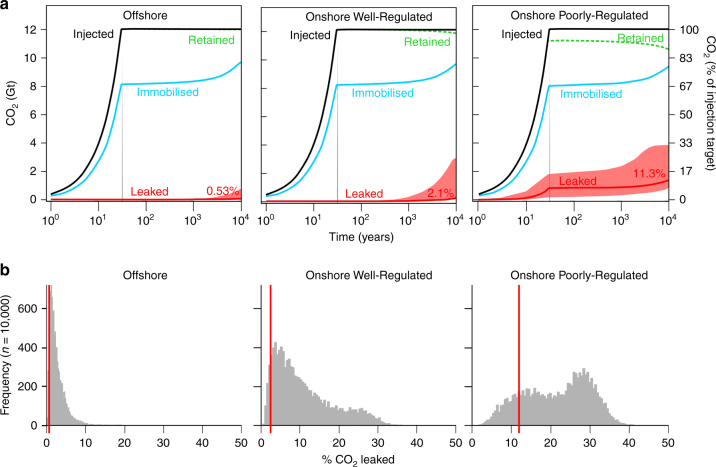
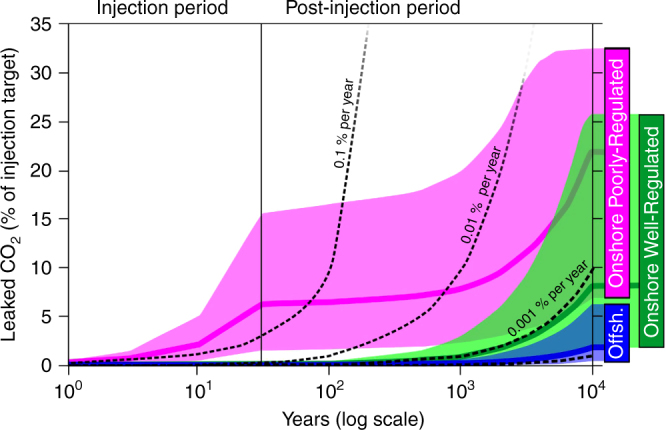
Carbon capture and storage (CCS) can help nations meet their Paris CO 2 reduction commitments cost-effectively. However, lack of confidence in geologic CO 2 storage security remains a barrier to CCS implementation. Here we present a numerical program that calculates CO 2 storage security and leakage to the atmosphere over 10,000 years. This combines quantitative estimates of geological subsurface CO 2 retention, and of surface CO 2 leakage. We calculate that realistically well-regulated storage in regions with moderate well densities has a 50% probability that leakage remains below 0.0008% per year, with over 98% of the injected CO 2 retained in the subsurface over 10,000 years. An unrealistic scenario, where CO 2 storage is inadequately regulated, estimates that more than 78% will be retained over 10,000 years. Our modelling results suggest that geological storage of CO 2 can be a secure climate change mitigation option, but we note that long-term behaviour of CO 2 in the subsurface remains a key uncertainty.
Overview
The claims and statistics of this paper haven’t been checked yet.
Free: it reads the open-access text and checks the first 5 claims that cite a source we can check. Create a free account to check every claim.
Integrity signals
Registry
Cites
Statistics
Figures
Verification
Claims the paper makes
The claims and statistics of this paper haven’t been checked yet.
Free: it reads the open-access text and checks the first 5 claims that cite a source we can check. Create a free account to check every claim.
Claims other papers make about this one
Each is checked against this paper’s own text: does it say what the citing paper says it does?
The source backs part of the claim, not all of it — or backs it for a different population, condition or comparison.
In the citing paper
“Probabilistic modeling of risks associated with leakage suggest that 98% of the CO 2 will be retained in 10,000 years”
From An Overview of the Status and Challenges of CO2 Storage in Minerals and Geological Formations (2019) · cites this paper as Alcalde et al., 2018
Experimental — accuracy not yet measuredThe cited source says what the claim attributes to it.
In the citing paper
“Geological storage, when executed correctly, is considered to be more permanent 22 than storage in the biosphere, which is shorter and subject to human and natural disturbances 23 such as wildfires and pests, as well as changes in climate 24 .”
From The technological and economic prospects for CO2 utilization and removal (2019) · cites this paper as [22]
Self-check
Percentages, sums and reported differences re-computed from the paper’s own numbers.
The self-check needs the paper’s full text.
Citations
Cites
Michael, K., Golab, A., Shulakova, V., Ennis-King, J., Allinson, G., Sharma, S., & Aiken, T. (2010) · International Journal of Greenhouse Gas Control · doi:10.1016/j.ijggc.2009.12.011 · Cited by 727
Nordbotten, J. M., Celia, M. A., & Bachu, S. (2005) · Transport in Porous Media · doi:10.1007/s11242-004-0670-9 · Cited by 671
Relative permeability and trapping of CO2 and water in sandstone rocks at reservoir conditions
Krevor, S. C. M., Pini, R., Zuo, L., & Benson, S. M. (2012) · Water Resources Research · doi:10.1029/2011wr010859 · Cited by 646
Fate of fossil fuel CO2 in geologic time
Archer, D. (2005) · Journal of Geophysical Research: Oceans · doi:10.1029/2004jc002625 · Cited by 620
Monitoring of CO2 injected at Sleipner using time-lapse seismic data
Arts, R., Eiken, O., Chadwick, A., Zweigel, P., van der Meer, L., & Zinszner, B. (2004) · Energy · doi:10.1016/j.energy.2004.03.072 · Cited by 507
Carey, J. W., Wigand, M., Chipera, S. J., WoldeGabriel, G., Pawar, R., Lichtner, P. C., Wehner, S. C., Raines, M. A., & Guthrie, G. D. (2007) · International Journal of Greenhouse Gas Control · doi:10.1016/s1750-5836(06)00004-1 · Cited by 503
Davies, R. J., Almond, S., Ward, R. S., Jackson, R. B., Adams, C., Worrall, F., Herringshaw, L. G., Gluyas, J. G., & Whitehead, M. A. (2014) · Marine and Petroleum Geology · doi:10.1016/j.marpetgeo.2014.03.001 · Cited by 476
Last chance for carbon capture and storage
Scott, V., Gilfillan, S., Markusson, N., Chalmers, H., & Haszeldine, R. S. (2013) · Nature Climate Change · doi:10.1038/nclimate1695 · Cited by 376
Self-citationConvective dissolution of CO2 in saline aquifers: Progress in modeling and experiments
Emami-Meybodi, H., Hassanzadeh, H., Green, C. P., & Ennis-King, J. (2015) · International Journal of Greenhouse Gas Control · doi:10.1016/j.ijggc.2015.04.003 · Cited by 372
Xu, T., Apps, J. A., & Pruess, K. (2003) · Journal of Geophysical Research: Solid Earth · doi:10.1029/2002jb001979 · Cited by 363
Research works printed but not linked: 1
- Metz, B., Davidson, O., de Coninck, H., Loos, M. & Meyer, L. Special Report on Carbon Dioxide Capture and Storage (Cambridge University Press, New York, 2005).
Cited by
The technological and economic prospects for CO2 utilization and removal
Hepburn, C., Adlen, E., Beddington, J., Carter, E. A., Fuss, S., Mac Dowell, N., Minx, J. C., Smith, P., & Williams, C. K. (2019) · Nature · doi:10.1038/s41586-019-1681-6 · Cited by 2,523
Enabling large-scale hydrogen storage in porous media – the scientific challenges
Heinemann, N., Alcalde, J., Miocic, J. M., Hangx, S. J. T., Kallmeyer, J., Ostertag-Henning, C., Hassanpouryouzband, A., Thaysen, E. M., Strobel, G. J., Schmidt-Hattenberger, C., et al. (2021) · Energy & Environmental Science · doi:10.1039/d0ee03536j · Cited by 1,083
Self-citationRissman, J., Bataille, C., Masanet, E., Aden, N., Morrow, W. R., Zhou, N., Elliott, N., Dell, R., Heeren, N., Huckestein, B., et al. (2020) · Applied Energy · doi:10.1016/j.apenergy.2020.114848 · Cited by 1,040
Carbon dioxide storage through mineral carbonation
Snæbjörnsdóttir, S. Ó., Sigfússon, B., Marieni, C., Goldberg, D., Gislason, S. R., & Oelkers, E. H. (2020) · Nature Reviews Earth & Environment · doi:10.1038/s43017-019-0011-8 · Cited by 977
Recent advances in carbon dioxide utilization
Zhang, Z., Pan, S.-Y., Li, H., Cai, J., Olabi, A. G., Anthony, E. J., & Manovic, V. (2020) · Renewable and Sustainable Energy Reviews · doi:10.1016/j.rser.2020.109799 · Cited by 732
An Overview of the Status and Challenges of CO2 Storage in Minerals and Geological Formations
Kelemen, P., Benson, S. M., Pilorgé, H., Psarras, P., & Wilcox, J. (2019) · Frontiers in Climate · doi:10.3389/fclim.2019.00009 · Cited by 587
“Probabilistic modeling of risks associated with leakage suggest that 98% of the CO2 will be retained in 10,000 years (Choi et al., 2013; Alcalde et al., 2018; Rogelj et al., 2018).”
BackgroundSubsurface carbon dioxide and hydrogen storage for a sustainable energy future
Krevor, S., de Coninck, H., Gasda, S. E., Ghaleigh, N. S., de Gooyert, V., Hajibeygi, H., Juanes, R., Neufeld, J., Roberts, J. J., & Swennenhuis, F. (2023) · Nature Reviews Earth & Environment · doi:10.1038/s43017-022-00376-8 · Cited by 481
Leakage risk assessment of a CO2 storage site: A review
Gholami, R., Raza, A., & Iglauer, S. (2021) · Earth-Science Reviews · doi:10.1016/j.earscirev.2021.103849 · Cited by 364
Electrolytic cell design for electrochemical CO2 reduction
Liang, S., Altaf, N., Huang, L., Gao, Y., & Wang, Q. (2020) · Journal of CO2 Utilization · doi:10.1016/j.jcou.2019.09.007 · Cited by 362
Strengthening and Implementing the Global Response
(2022) · Global Warming of 1.5°C · doi:10.1017/9781009157940.006 · Cited by 352
Carbon capture and storage at the end of a lost decade
Martin-Roberts, E., Scott, V., Flude, S., Johnson, G., Haszeldine, R. S., & Gilfillan, S. (2021) · One Earth · doi:10.1016/j.oneear.2021.10.002 · Cited by 312
Self-citationHanson, E., Nwakile, C., & Hammed, V. O. (2025) · Results in Surfaces and Interfaces · doi:10.1016/j.rsurfi.2024.100381 · Cited by 308
Recent advances of single-atom catalysts in CO2 conversion
Wang, S., Wang, L., Wang, D., & Li, Y. (2023) · Energy & Environmental Science · doi:10.1039/d3ee00037k · Cited by 297
Evaluating climate geoengineering proposals in the context of the Paris Agreement temperature goals
Lawrence, M. G., Schäfer, S., Muri, H., Scott, V., Oschlies, A., Vaughan, N. E., Boucher, O., Schmidt, H., Haywood, J., & Scheffran, J. (2018) · Nature Communications · doi:10.1038/s41467-018-05938-3 · Cited by 305
Self-citationHydrogen storage in saline aquifers: The role of cushion gas for injection and production
Heinemann, N., Scafidi, J., Pickup, G., Thaysen, E. M., Hassanpouryouzband, A., Wilkinson, M., Satterley, A. K., Booth, M. G., Edlmann, K., & Haszeldine, R. S. (2021) · International Journal of Hydrogen Energy · doi:10.1016/j.ijhydene.2021.09.174 · Cited by 291
Self-citationFuture environmental impacts of global hydrogen production
Wei, S., Sacchi, R., Tukker, A., Suh, S., & Steubing, B. (2024) · Energy & Environmental Science · doi:10.1039/d3ee03875k · Cited by 250
Uncertain storage prospects create a conundrum for carbon capture and storage ambitions
Lane, J., Greig, C., & Garnett, A. (2021) · Nature Climate Change · doi:10.1038/s41558-021-01175-7 · Cited by 199
A comprehensive review of value-added CO2 sequestration in subsurface saline aquifers
Kumar, S., Foroozesh, J., Edlmann, K., Rezk, M. G., & Lim, C. Y. (2020) · Journal of Natural Gas Science and Engineering · doi:10.1016/j.jngse.2020.103437 · Cited by 202
Self-citationRecent advances in CCUS: A critical review on technologies, regulatory aspects and economics
Nath, F., Mahmood, M. N., & Yousuf, N. (2024) · Geoenergy Science and Engineering · doi:10.1016/j.geoen.2024.212726 · Cited by 194
Mitigation Pathways Compatible with 1.5°C in the Context of Sustainable Development
(2022) · Global Warming of 1.5°C · doi:10.1017/9781009157940.004 · Cited by 154
Thermodynamic and transport properties of hydrogen containing streams
Hassanpouryouzband, A., Joonaki, E., Edlmann, K., Heinemann, N., & Yang, J. (2020) · Scientific Data · doi:10.1038/s41597-020-0568-6 · Cited by 178
Self-citationMapping geological hydrogen storage capacity and regional heating demands: An applied UK case study
Mouli-Castillo, J., Heinemann, N., & Edlmann, K. (2021) · Applied Energy · doi:10.1016/j.apenergy.2020.116348 · Cited by 172
Self-citation(IPCC), I. P. O. C. C. (2023) · Cambridge University Press eBooks · doi:10.1017/9781009157926.008 · Cited by 244
Ringrose, P. S., & Meckel, T. A. (2019) · Scientific Reports · doi:10.1038/s41598-019-54363-z · Cited by 161
Application of red mud in carbon capture, utilization and storage (CCUS) technology
Liu, X., Liu, X., & Zhang, Z. (2024) · Renewable and Sustainable Energy Reviews · doi:10.1016/j.rser.2024.114683 · Cited by 162
Li, L., Liu, Q., Huang, T., & Peng, W. (2022) · Separation and Purification Technology · doi:10.1016/j.seppur.2022.121512 · Cited by 154
Integrating Carbon Dioxide Removal Into European Emissions Trading
Rickels, W., Proelß, A., Geden, O., Burhenne, J., & Fridahl, M. (2021) · Frontiers in Climate · doi:10.3389/fclim.2021.690023 · Cited by 148
Trends in Research and Development for CO 2 Capture and Sequestration
Yu, X., Catanescu, C. O., Bird, R. E., Satagopan, S., Baum, Z. J., Diaz, L. M. L., & Zhou, Q. A. (2023) · ACS Omega · doi:10.1021/acsomega.2c05070 · Cited by 138
Sorbents for the Capture of CO 2 and Other Acid Gases: A Review
Halliday, C., & Hatton, T. A. (2021) · Industrial & Engineering Chemistry Research · doi:10.1021/acs.iecr.1c00597 · Cited by 125
Khandoozi, S., Hazlett, R. D., & Fustic, M. (2023) · Earth-Science Reviews · doi:10.1016/j.earscirev.2023.104515 · Cited by 125
Sovacool, B. K., Rio, D. D. F. D., Herman, K. S., Iskandarova, M., Uratani, J. M., & Griffiths, S. (2024) · Energy & Environmental Science · doi:10.1039/d3ee03270a · Cited by 125
Application of machine learning to predict CO2 trapping performance in deep saline aquifers
Thanh, H. V., & Lee, K. (2021) · Energy · doi:10.1016/j.energy.2021.122457 · Cited by 122
Understanding initial opportunities and key challenges for CCUS deployment in India at scale
Vishal, V., Chandra, D., Singh, U., & Verma, Y. (2021) · Resources Conservation and Recycling · doi:10.1016/j.resconrec.2021.105829 · Cited by 122
Current state of industrial heating and opportunities for decarbonization
Pisciotta, M., Pilorgé, H., Feldmann, J., Jacobson, R., Davids, J., Swett, S., Sasso, Z., & Wilcox, J. L. (2022) · Progress in Energy and Combustion Science · doi:10.1016/j.pecs.2021.100982 · Cited by 118
A review of risk and uncertainty assessment for geologic carbon storage
Xiao, T., Chen, T., Ma, Z., Tian, H., Meguerdijian, S., Chen, B., Pawar, R. J., Huang, L., Xu, T., Cather, M., et al. (2023) · Renewable and Sustainable Energy Reviews · doi:10.1016/j.rser.2023.113945 · Cited by 116
A comparative analysis of the efficiency, timing, and permanence of CO 2 removal pathways
Chiquier, S., Patrizio, P., Bui, M., Sunny, N., & Dowell, N. M. (2022) · Energy & Environmental Science · doi:10.1039/d2ee01021f · Cited by 114
Criteria and workflow for selecting depleted hydrocarbon reservoirs for carbon storage
Callas, C., Saltzer, S. D., Davis, J. S., Hashemi, S. S., Kovscek, A. R., Okoroafor, E. R., Wen, G., Zoback, M. D., & Benson, S. M. (2022) · Applied Energy · doi:10.1016/j.apenergy.2022.119668 · Cited by 117
Carbon accounting for negative emissions technologies
Brander, M., Ascui, F., Scott, V., & Tett, S. F. B. (2021) · Climate Policy · doi:10.1080/14693062.2021.1878009 · Cited by 125
Self-citationSun, X., Alcalde, J., Bakhtbidar, M., Elío, J., Vilarrasa, V., Canal‐Vila, J., Ballesteros, J., Heinemann, N., Haszeldine, S., Cavanagh, A., et al. (2021) · Applied Energy · doi:10.1016/j.apenergy.2021.117418 · Cited by 110
Self-citationRosa, L., Becattini, V., Gabrielli, P., Andreotti, A., & Mazzotti, M. (2022) · Resources Conservation and Recycling · doi:10.1016/j.resconrec.2022.106436 · Cited by 111
Kumar, N., Verma, A. K., Ahmad, T., Sahu, R. K., Mandal, A., Mubashir, M., Ali, M., & Pal, N. (2023) · Geoenergy Science and Engineering · doi:10.1016/j.geoen.2023.212619 · Cited by 109
Olabi, A. G., Alami, A. H., Ayoub, M., Aljaghoub, H., Alasad, S., Inayat, A., Abdelkareem, M. A., Chae, K., & Sayed, E. T. (2023) · Chemosphere · doi:10.1016/j.chemosphere.2023.137996 · Cited by 104
Net-zero approaches must consider Earth system impacts to achieve climate goals
Zickfeld, K., MacIsaac, A., Canadell, J. G., Fuss, S., Jackson, R. B., JONES, C. D., Lohila, A., Matthews, H. D., Peters, G. P., Rogelj, J., et al. (2023) · Nature Climate Change · doi:10.1038/s41558-023-01862-7 · Cited by 111
Alcalde, J., Heinemann, N., Mabon, L., Worden, R. H., de Coninck, H., Robertson, H., Maver, M., Ghanbari, S., Swennenhuis, F., Mann, I., et al. (2019) · Journal of Cleaner Production · doi:10.1016/j.jclepro.2019.06.087 · Cited by 96
Self-citationThe current scope and stand of carbon capture storage and utilization ∼ A comprehensive review
Bhavsar, A., Hingar, D., Ostwal, S., Thakkar, I., Jadeja, S., & Shah, M. (2023) · Case Studies in Chemical and Environmental Engineering · doi:10.1016/j.cscee.2023.100368 · Cited by 98
Durability of carbon dioxide removal is critical for Paris climate goals
Brunner, C., Hausfather, Z., & Knutti, R. (2024) · Communications Earth & Environment · doi:10.1038/s43247-024-01808-7 · Cited by 101
Global Carbon Dioxide Removal Potential of Waste Materials From Metal and Diamond Mining
Bullock, L. A., James, R. H., Matter, J., Renforth, P., & Teagle, D. A. H. (2021) · Frontiers in Climate · doi:10.3389/fclim.2021.694175 · Cited by 88
Omrani, S., Ghasemi, M., Mahmoodpour, S., Shafiei, A., & Rostami, B. (2021) · Journal of Molecular Liquids · doi:10.1016/j.molliq.2021.117868 · Cited by 80
Sustainable aspects behind the application of nanotechnology in CO2 sequestration
Youns, Y. T., Manshad, A. K., & Ali, J. A. (2023) · Fuel · doi:10.1016/j.fuel.2023.128680 · Cited by 79
Pore-scale mechanisms of CO2 storage in oilfields
Alhosani, A., Scanziani, A., Lin, Q., Raeini, A. Q., Bijeljic, B., & Blunt, M. J. (2020) · Scientific Reports · doi:10.1038/s41598-020-65416-z · Cited by 76
420,000 year assessment of fault leakage rates shows geological carbon storage is secure
Miocic, J. M., Gilfillan, S., Frank, N., Schröder‐Ritzrau, A., Burnside, N. M., & Haszeldine, R. S. (2019) · Scientific Reports · doi:10.1038/s41598-018-36974-0 · Cited by 76
Self-citationUnderground Gas Storage in Saline Aquifers: Geological Aspects
Uliasz‐Misiak, B., & Misiak, J. (2024) · Energies · doi:10.3390/en17071666 · Cited by 71
Leveraging the bioeconomy for carbon drawdown
Dees, J., Sagues, W. J., Woods, E., Goldstein, H. M., Simon, A. J., & Sanchez, D. L. (2023) · Green Chemistry · doi:10.1039/d2gc02483g · Cited by 73
Sun, L., Liu, Y., Cheng, Z., Jiang, L., Lv, P., & Song, Y. (2023) · Energy & Fuels · doi:10.1021/acs.energyfuels.3c01830 · Cited by 73
Ying, T., Tan, X., Su, Q., Cheng, W., Dong, L., & Zhang, S. (2019) · Green Chemistry · doi:10.1039/c9gc00010k · Cited by 65
Extension of CO2 storage life in the Sleipner CCS project by reservoir pressure management
Zhang, K., Lau, H. C., & Chen, Z. (2022) · Journal of Natural Gas Science and Engineering · doi:10.1016/j.jngse.2022.104814 · Cited by 64
Mullen, D., Herraiz, L., Gibbins, J., & Lucquiaud, M. (2023) · International journal of greenhouse gas control · doi:10.1016/j.ijggc.2023.103904 · Cited by 64
Physics-Based Proxy Modeling of CO2 Sequestration in Deep Saline Aquifers
Khanal, A., & Shahriar, M. F. (2022) · Energies · doi:10.3390/en15124350 · Cited by 65
Kirmani, F. U. D., Raza, A., Ahmad, S., Arif, M., & Mahmoud, M. (2024) · The Science of The Total Environment · doi:10.1016/j.scitotenv.2024.173836 · Cited by 66
Alcalde, J., Heinemann, N., James, A., Bond, C. E., Ghanbari, S., Mackay, E. J., Haszeldine, R. S., Faulkner, D. R., Worden, R. H., & Allen, M. J. (2021) · Marine and Petroleum Geology · doi:10.1016/j.marpetgeo.2021.105309 · Cited by 70
Self-citationRoberts, J. J., & Stalker, L. (2020) · Earth-Science Reviews · doi:10.1016/j.earscirev.2019.102939 · Cited by 60
Liu, Y., & Liu, Q. (2022) · Journal of Petroleum Science and Engineering · doi:10.1016/j.petrol.2022.111110 · Cited by 63
A Hierarchical Framework for CO2 Storage Capacity in Deep Saline Aquifer Formations
Wei, N., Li, X., Jiao, Z., Stauffer, P. H., Liu, S., Ellett, K., & Middleton, R. S. (2022) · Frontiers in Earth Science · doi:10.3389/feart.2021.777323 · Cited by 64
Climate neutrality strategies for energy-intensive industries: An Austrian case study
Mobarakeh, M. R., & Kienberger, T. (2022) · Cleaner Engineering and Technology · doi:10.1016/j.clet.2022.100545 · Cited by 67
Zhang, X., Ranjith, P. G., Lu, Y., & Ranathunga, A. S. (2019) · International Journal of Coal Geology · doi:10.1016/j.coal.2019.04.004 · Cited by 58
Breakthrough innovations in carbon dioxide mineralization for a sustainable future
Kumar, R., Chung, W. J., Khan, M. A., Son, M., Park, Y., Lee, S. S., & Jeon, B. (2024) · Reviews in Environmental Science and Bio/Technology · doi:10.1007/s11157-024-09695-2 · Cited by 60
Edlmann, K., Hinchliffe, S., Heinemann, N., Johnson, G., Ennis‐King, J., & McDermott, C. I. (2018) · International journal of greenhouse gas control · doi:10.1016/j.ijggc.2018.11.009 · Cited by 56
Self-citationMelara, A. J., Singh, U., & Colosi, L. M. (2020) · Energy Conversion and Management · doi:10.1016/j.enconman.2020.113300 · Cited by 55
Broecks, K. P. F., Jack, C., ter Mors, E., Boomsma, C., & Shackley, S. J. (2021) · Energy Research & Social Science · doi:10.1016/j.erss.2021.102236 · Cited by 61
The potential for implementation of Negative Emission Technologies in Scotland
Alcalde, J., Smith, P., Haszeldine, R. S., & Bond, C. E. (2018) · International Journal of Greenhouse Gas Control · doi:10.1016/j.ijggc.2018.06.021 · Cited by 53
Self-citationThe cost of permanent carbon dioxide removal
Prado, A., & Dowell, N. M. (2023) · Joule · doi:10.1016/j.joule.2023.03.006 · Cited by 60
The UK net-zero target: Insights into procedural justice for greenhouse gas removal
O’Beirne, P., Battersby, F., Mallett, A., Aczel, M. R., Makuch, Z., Workman, M. H. W., & Heap, R. (2020) · Environmental Science & Policy · doi:10.1016/j.envsci.2020.06.013 · Cited by 55
Biochar is a long-lived form of carbon removal, making evidence-based CDR projects possible
Chiaramonti, D., Lehmann, J. C., Berruti, F., Giudicianni, P., Sanei, H., & Mašek, O. (2024) · Biochar · doi:10.1007/s42773-024-00366-7 · Cited by 57
A review of commercialisation mechanisms for carbon dioxide removal
Hickey, C., Fankhauser, S., Smith, S. M., & Allen, M. R. (2023) · Frontiers in Climate · doi:10.3389/fclim.2022.1101525 · Cited by 57
Opportunities for cement decarbonization
Pisciotta, M., Pilorgé, H., Davids, J., & Psarras, P. C. (2023) · Cleaner Engineering and Technology · doi:10.1016/j.clet.2023.100667 · Cited by 63
Kolawole, O., Millikan, C. V., Kumar, M., Ispas, I., Schwartz, B. A., Weber, J., Badurina, L., & Šegvić, B. (2022) · International journal of greenhouse gas control · doi:10.1016/j.ijggc.2022.103755 · Cited by 50
Predicting CO2 trapping in deep saline aquifers using optimized long short-term memory
Al‐qaness, M. A. A., Ewees, A. A., Thanh, H. V., AlRassas, A. M., Dahou, A., & Elaziz, M. A. (2022) · Environmental Science and Pollution Research · doi:10.1007/s11356-022-24326-5 · Cited by 49
Dynamics of dissolution trapping in geological carbon storage
Bakhshian, S. (2021) · International journal of greenhouse gas control · doi:10.1016/j.ijggc.2021.103520 · Cited by 46
Energy modelling challenges for the full decarbonisation of hard-to-abate sectors
Groppi, D., Pastore, L. M., Nastasi, B., Prina, M. G., Garcia, D. A., & de Santoli, L. (2024) · Renewable and Sustainable Energy Reviews · doi:10.1016/j.rser.2024.115103 · Cited by 47
Chai, R., Liu, Y., Wang, J., Liu, Q., & Rui, Z. (2022) · Applied Energy · doi:10.1016/j.apenergy.2022.119584 · Cited by 48
Multi‐Layered Systems for Permanent Geologic Storage of CO2 at the Gigatonne Scale
Kivi, I. R., Makhnenko, R. Y., Oldenburg, C. M., Rutqvist, J., & Vilarrasa, V. (2022) · Geophysical Research Letters · doi:10.1029/2022gl100443 · Cited by 43
Carbon dioxide emission, mitigation and storage technologies pathways
Oyewole, K. A., Okedere, O. B., Rabiu, K. O., Alawode, K. O., & Oyelami, S. (2023) · Sustainable Environment · doi:10.1080/27658511.2023.2188760 · Cited by 43
Verma, Y., Vishal, V., & Ranjith, P. G. (2021) · Frontiers in Climate · doi:10.3389/fclim.2021.720959 · Cited by 44
Jing, J., Yang, Y., & Tang, Z. (2020) · Energy · doi:10.1016/j.energy.2020.119097 · Cited by 41
The energy and carbon inequality corridor for a 1.5 °C compatible and just Europe
Jaccard, I. S., Pichler, P., Többen, J., & Weisz, H. (2021) · Environmental Research Letters · doi:10.1088/1748-9326/abfb2f · Cited by 46
Micromechanical property evolution and damage mechanism of coal subjected to ScCO2 treatment
He, H., Liu, P., Nie, B., Zhao, Y., Wang, L., Liu, X., Deng, B., Zhao, Z., Zhang, H., Zhao, D., et al. (2024) · Energy · doi:10.1016/j.energy.2024.132087 · Cited by 40
Tasleem, S., & Alsharaeh, E. H. (2025) · Energy Conversion and Management · doi:10.1016/j.enconman.2025.119500 · Cited by 46
Gutsch, M., & Leker, J. (2024) · Communications Engineering · doi:10.1038/s44172-023-00152-6 · Cited by 42
Neil, C. W., Yang, Y., Nisbet, H., Iyare, U. C., Boampong, L. O., Li, W., Kang, Q., Hyman, J. D., & Viswanathan, H. (2024) · PNAS Nexus · doi:10.1093/pnasnexus/pgae388 · Cited by 43
Li, D., & Jiang, X. (2020) · International journal of greenhouse gas control · doi:10.1016/j.ijggc.2020.103015 · Cited by 39
Evaluation of nutrient bioextraction by seaweed and shellfish aquaculture in Korea
Park, J., Shin, S. K., Wu, H., Yarish, C., Yoo, H. I., & Kim, J. K. (2021) · Journal of the World Aquaculture Society · doi:10.1111/jwas.12786 · Cited by 40
Global biomethane and carbon dioxide removal potential through anaerobic digestion of waste biomass
Feng, Y., & Rosa, L. (2024) · Environmental Research Letters · doi:10.1088/1748-9326/ad1e81 · Cited by 42
Assessment of technologies and economics for carbon dioxide removal from a portfolio perspective
Mühlbauer, A., Keiner, D., Gerhards, C., Caldera, U., Sterner, M., & Breyer, C. (2025) · International journal of greenhouse gas control · doi:10.1016/j.ijggc.2024.104297 · Cited by 39
Zhang, S., Abdallah, K. B., Li, L., Hamdi, E., & Liu, J. (2025) · Fuel · doi:10.1016/j.fuel.2025.135591 · Cited by 38
Vallejo, V., Nguyen, Q. P., & Ravikumar, A. P. (2024) · Nature Energy · doi:10.1038/s41560-024-01653-0 · Cited by 41
d’Amore, F., Sunny, N., Iruretagoyena, D., Bezzo, F., & Shah, N. (2019) · Computers & Chemical Engineering · doi:10.1016/j.compchemeng.2019.106521 · Cited by 37
Stalker, L., Roberts, J. J., Mabon, L., & Hartley, P. G. (2022) · Frontiers in Energy Research · doi:10.3389/fenrg.2022.869264 · Cited by 39
Toward Commercial Carbon Dioxide Electrolysis
Ganji, P., Borse, R. A., Xie, J., Mohamed, A. G. A., & Wang, Y. (2020) · Advanced Sustainable Systems · doi:10.1002/adsu.202000096 · Cited by 39
Clean energy futures: An Australian based foresight study
Gilmore, N., Koskinen, I., van Gennip, D., Paget, G., Burr, P. A., Obbard, E. G., Daiyan, R., Sproul, A. B., Kay, M. J., Lennon, A. J., et al. (2022) · Energy · doi:10.1016/j.energy.2022.125089 · Cited by 41
Hydro-thermo-chemo-mechanical modeling of carbon dioxide injection in fluvial heterogeneous aquifers
Ershadnia, R., Wallace, C. D., Hajirezaie, S., Hosseini, S. A., Nguyen, T. N., Sturmer, D. M., Dai, Z., & Soltanian, M. R. (2021) · Chemical Engineering Journal · doi:10.1016/j.cej.2021.133451 · Cited by 37
Metadata
- Authors
- Alcalde, J., Flude, S., Wilkinson, M., Johnson, G., Edlmann, K., Bond, C. E., Scott, V., Gilfillan, S. M. V., Ogaya, X., & Haszeldine, R. S.
- Affiliations
- University of Aberdeen (GB)
- University of Edinburgh (GB)
- Universitat de Barcelona (ES)
- Corresponding author
- Alcalde, Juan
- ORCID
- Venue
- Nature Communications
- Published
- 2018-06-12
- Volume
- 9
- Issue
- 1
- Pages
- 2201-2201
- ISSN
- 2041-1723 (ISSN-L)
- PMC
- PMC5997736
- OpenAlex
- W2797035059
- Semantic Scholar
- 8fa7cd77c0529f59a8bd5cc831b96407cc2cd893
- Cited by
- 442
- References
- 53
- Citations by year
- 2026: 74 · 2025: 97 · 2024: 65 · 2023: 52 · 2022: 47 · 2021: 51 · 2020: 34 · 2019: 17 · 2018: 5
- FWCI
- 13.44
- Type
- journal article
- Language
- en
- Open access
- gold
- doi.org
- Licence
- cc-by
- creativecommons.org/licenses/by/4.0 (tdm)
- creativecommons.org/licenses/by/4.0 (vor)
- Locations
- Nature Communications (publishedVersion, cc-by)
- Europe PMC (PubMed Central) (publishedVersion, cc-by)
- PubMed Central (publishedVersion, cc-by)
- PubMed (publishedVersion)
- Strathprints: The University of Strathclyde institutional repository (University of Strathclyde) (acceptedVersion)
- Aberdeen University Research Archive (Aberdeen University) (submittedVersion)
- EarthArXiv (California Digital Library) (submittedVersion, cc-by)
- RePEc: Research Papers in Economics (submittedVersion)
- DIGITAL.CSIC (Spanish National Research Council (CSIC)) (submittedVersion, cc-by)
- DOAJ (DOAJ: Directory of Open Access Journals) (submittedVersion)
- DOAJ (DOAJ: Directory of Open Access Journals) (submittedVersion, cc-by-sa)
- Edinburgh Research Explorer (University of Edinburgh) (submittedVersion, other-oa)
- EarthArXiv (OSF Preprints) (submittedVersion, cc-by)
- EarthArXiv (OSF Preprints) (submittedVersion)
- Funders
- Scottish Funding Council (EP/P026214/1)
- Horizon 2020 Framework Programme (636811)
- Engineering and Physical Sciences Research Council (EP/K036033/1, EP/P026214/1, H2020, EP/K000446/2)
- Natural Environment Research Council (EP/P026214/1, NE/G015163/1, NE/P019749/1, NE/M007251/1, NE/L008475/1)
- Topics
- Physical Sciences › Environmental Science › Environmental Engineering › CO2 Sequestration and Geologic Interactions
- Physical Sciences › Chemical Engineering › Filtration and Separation › Carbon Dioxide Capture Technologies
- Physical Sciences › Environmental Science › Global and Planetary Change › Climate Change and Geoengineering
- Keywords
- CO2 geological storage, carbon capture and storage, CO2 leakage, storage security, storage regulations, well density, climate change mitigation, Paris Agreement commitments, numerical modeling
About these checks
Registry, retraction, Cites and statistics results are computed, not judged, with one exception: a printed reference that no index lists is read once by a model before it counts as a citation error. Claims are extracted by a model and kept only when their quote appears verbatim in the text; each cited source is then checked, with a model’s help, for whether it says what the claim relies on. Those verdicts can be wrong — read the claim’s quote and the cited source before relying on one.
Statistics and arithmetic are recomputed, not judged.
Confidence bands are shown only for fields calibrated on our annotated test set. None is calibrated yet, so no band is shown.
What counts as a claim ›How we measure confidence ›How we check this ›
Are you an author, or do you see a problem with this page? Request a review
Data sources
Bibliographic data: Semantic Scholar, OpenAlex, Crossref.
Contains information from the Semantic Scholar Academic Graph Datasets, made available under the ODC Attribution License (ODC-BY 1.0).
Semantic Scholar’s data is described in: Kinney, R., et al. (2023). The Semantic Scholar Open Data Platform. arXiv:2301.10140.
