

The DOI matches its Crossref record; 14 of the 14 references it cites were found in a registry or an index.
Genetic inactivation of ANGPTL4 improves glucose homeostasis and is associated with reduced risk of diabetes
Abstract
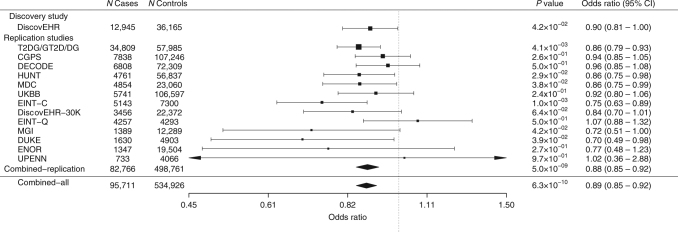
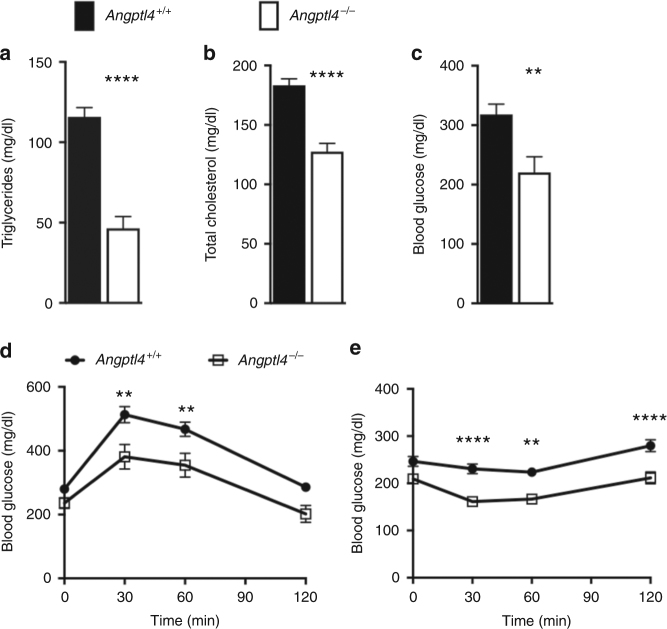
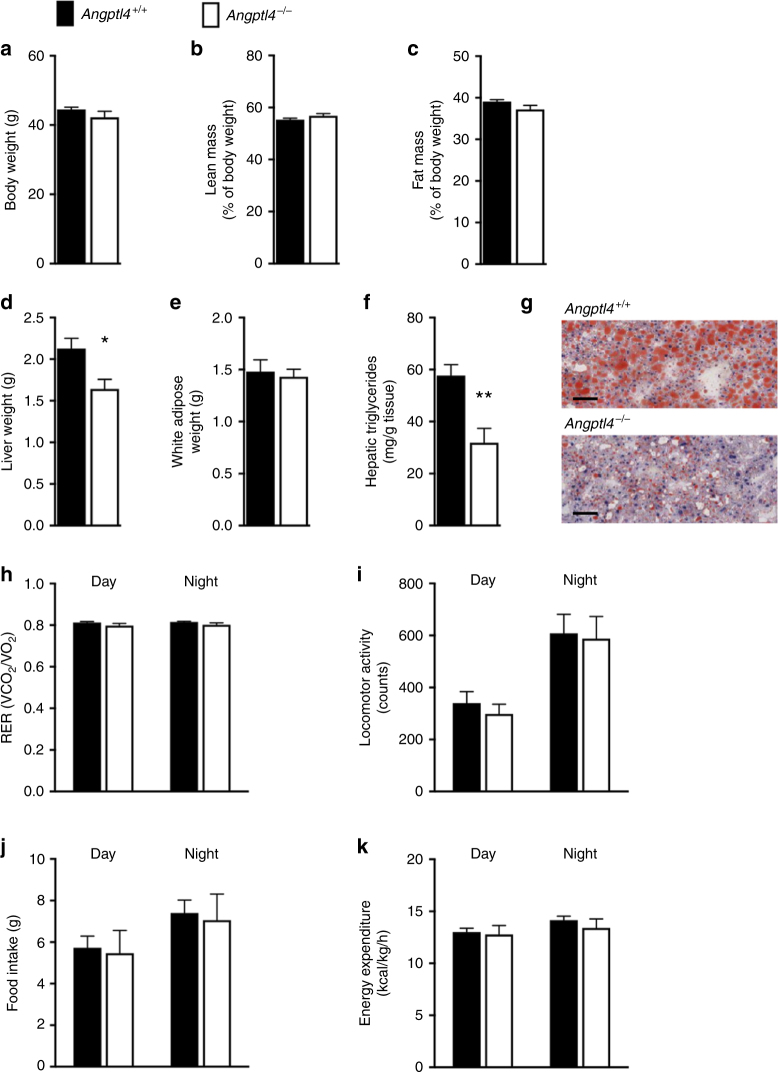
Angiopoietin-like 4 (ANGPTL4) is an endogenous inhibitor of lipoprotein lipase that modulates lipid levels, coronary atherosclerosis risk, and nutrient partitioning. We hypothesize that loss of ANGPTL4 function might improve glucose homeostasis and decrease risk of type 2 diabetes (T2D). We investigate protein-altering variants in ANGPTL4 among 58,124 participants in the DiscovEHR human genetics study, with follow-up studies in 82,766 T2D cases and 498,761 controls. Carriers of p.E40K, a variant that abolishes ANGPTL4 ability to inhibit lipoprotein lipase, have lower odds of T2D (odds ratio 0.89, 95% confidence interval 0.85–0.92, p = 6.3 × 10⁻¹⁰), lower fasting glucose, and greater insulin sensitivity. Predicted loss-of-function variants are associated with lower odds of T2D among 32,015 cases and 84,006 controls (odds ratio 0.71, 95% confidence interval 0.49–0.99, p = 0.041). Functional studies in Angptl4-deficient mice confirm improved insulin sensitivity and glucose homeostasis. In conclusion, genetic inactivation of ANGPTL4 is associated with improved glucose homeostasis and reduced risk of T2D.
Overview
The claims and statistics of this paper haven’t been checked yet.
Run the check — free, no account needed. It reads the open-access text and checks the sources it cites.
Integrity signals
Registry
Cites
Statistics
Figures
Verification
Claims the paper makes
The claims and statistics of this paper haven’t been checked yet.
Run the check — free, no account needed. It reads the open-access text and checks the sources it cites.
Claims other papers make about this one
Each is checked against this paper’s own text: does it say what the citing paper says it does?
The cited source says what the claim attributes to it.
In the citing paper
“Interestingly, there is evidence that loss of ANGPTL function can also improve glucose homeostasis (110, 163, 167).”
From Regulation of lipoprotein metabolism by ANGPTL3, ANGPTL4, and ANGPTL8 (2021) · cites this paper as [167]
Self-check
Percentages, sums and reported differences re-computed from the paper’s own numbers.
The self-check needs the paper’s full text.
Citations
Cites
LD Score regression distinguishes confounding from polygenicity in genome-wide association studies
Schizophrenia Working Group of the Psychiatric Genomics Consortium, Bulik-Sullivan, B. K., Loh, P.-R., Finucane, H. K., Ripke, S., Yang, J., Patterson, N., Daly, M. J., Price, A. L., & Neale, B. M. (2015) · Nature Genetics · doi:10.1038/ng.3211 · Cited by 5,559
METAL: fast and efficient meta-analysis of genomewide association scans
Willer, C. J., Li, Y., & Abecasis, G. R. (2010) · Bioinformatics · doi:10.1093/bioinformatics/btq340 · Cited by 5,205
Self-citationA solution to the problem of separation in logistic regression
Heinze, G., & Schemper, M. (2002) · Statistics in Medicine · doi:10.1002/sim.1047 · Cited by 2,711
Riboli, E., Hunt, K., Slimani, N., Ferrari, P., Norat, T., Fahey, M., Charrondière, U., Hémon, B., Casagrande, C., Vignat, J., et al. (2002) · Public Health Nutrition · doi:10.1079/phn2002394 · Cited by 1,866
PheWAS: demonstrating the feasibility of a phenome-wide scan to discover gene–disease associations
Denny, J. C., Ritchie, M. D., Basford, M. A., Pulley, J. M., Bastarache, L., Brown-Gentry, K., Wang, D., Masys, D. R., Roden, D. M., & Crawford, D. C. (2010) · Bioinformatics · doi:10.1093/bioinformatics/btq126 · Cited by 1,219
Self-citationCohort Profile: The HUNT Study, Norway
Krokstad, S., Langhammer, A., Hveem, K., Holmen, T., Midthjell, K., Stene, T., Bratberg, G., Heggland, J., & Holmen, J. (2013) · International Journal of Epidemiology · doi:10.1093/ije/dys095 · Cited by 1,127
Self-citationThe genetic architecture of type 2 diabetes
Fuchsberger, C., Flannick, J., Teslovich, T. M., Mahajan, A., Agarwala, V., Gaulton, K. J., Ma, C., Fontanillas, P., Moutsianas, L., McCarthy, D. J., et al. (2016) · Nature · doi:10.1038/nature18642 · Cited by 1,051
Self-citationInactivating Variants in ANGPTL4 and Risk of Coronary Artery Disease
Dewey, F. E., Gusarova, V., O’Dushlaine, C., Gottesman, O., Trejos, J., Hunt, C., Van Hout, C. V., Habegger, L., Buckler, D., Lai, K.-M. V., et al. (2016) · New England Journal of Medicine · doi:10.1056/nejmoa1510926 · Cited by 497
Self-citationCoding Variation in ANGPTL4, LPL, and SVEP1 and the Risk of Coronary Disease
Myocardial Infarction Genetics and CARDIoGRAM Exome Consortia Investigators (2016) · New England Journal of Medicine · doi:10.1056/nejmoa1507652 · Cited by 493
Loss-of-function mutations in SLC30A8 protect against type 2 diabetes
Go-T2D Consortium, Flannick, J., T2D-GENES Consortium, Thorleifsson, G., Beer, N. L., Jacobs, S. B. R., Grarup, N., Burtt, N. P., Mahajan, A., Fuchsberger, C., et al. (2014) · Nature Genetics · doi:10.1038/ng.2915 · Cited by 492
Self-citationKöster, A., Chao, Y. B., Mosior, M., Ford, A., Gonzalez-DeWhitt, P. A., Hale, J. E., Li, D., Qiu, Y., Fraser, C. C., Yang, D. D., et al. (2005) · Endocrinology · doi:10.1210/en.2005-0476 · Cited by 427
UK biobank data: come and get it
Allen, N. E., Sudlow, C., Peakman, T., Collins, R., & Biobank, O. B. O. U. (2014) · Science Translational Medicine · doi:10.1126/scitranslmed.3008601 · Cited by 399
The InterAct Consortium (2011) · Diabetologia · doi:10.1007/s00125-011-2182-9 · Cited by 208
ANGPTL8/Betatrophin Does Not Control Pancreatic Beta Cell Expansion
Gusarova, V., Alexa, C. A., Na, E., Stevis, P. E., Xin, Y., Bonner-Weir, S., Cohen, J. C., Hobbs, H. H., Murphy, A. J., Yancopoulos, G. D., et al. (2014) · Cell · doi:10.1016/j.cell.2014.09.027 · Cited by 202
Self-citation
Research works printed but not linked: 44
- Yoshida, K., Shimizugawa, T., Ono, M. & Furukawa, H. Angiopoietin-like protein 4 is a potent hyperlipidemia-inducing factor in mice and inhibitor of lipoprotein lipase. J. Lipid Res. 43, 1770–1772 (2002). · DOI · Paper page
- Yau, M. H. et al. A highly conserved motif within the NH2-terminal coiled-coil domain of angiopoietin-like protein 4 confers its inhibitory effects on lipoprotein lipase by disrupting the enzyme dimerization. J. Biol. Chem. 284, 11942–11952 (2009). · DOI · Paper page
- Sukonina, V., Lookene, A., Olivecrona, T. & Olivecrona, G. Angiopoietin-like protein 4 converts lipoprotein lipase to inactive monomers and modulates lipase activity in adipose tissue. Proc. Natl. Acad. Sci. USA 103, 17450–17455 (2006). · DOI · Paper page
- Romeo, S. et al. Population-based resequencing of ANGPTL4 uncovers variations that reduce triglycerides and increase HDL. Nat. Genet. 39, 513–516 (2007). · DOI · Paper page
- Romeo, S. et al. Rare loss-of-function mutations in ANGPTL family members contribute to plasma triglyceride levels in humans. J. Clin. Invest. 119, 70–79 (2009).
- Desai, U. et al. Lipid-lowering effects of anti-angiopoietin-like 4 antibody recapitulate the lipid phenotype found in angiopoietin-like 4 knockout mice. Proc. Natl. Acad. Sci. USA 104, 11766–11771 (2007). · DOI · Paper page
- Wang, Y. et al. Hepatic ANGPTL3 regulates adipose tissue energy homeostasis. Proc. Natl. Acad. Sci. USA 112, 11630–11635 (2015). · DOI · Paper page
- Zhang, R. The ANGPTL3-4-8 model, a molecular mechanism for triglyceride trafficking. Open Biol. 6, 150272 (2016). · DOI
- Kersten, S. Physiological regulation of lipoprotein lipase. Biochim. Biophys. Acta 1841, 919–933 (2014). · DOI
- Dijk, W. & Kersten, S. Regulation of lipid metabolism by angiopoietin-like proteins. Curr. Opin. Lipidol. 27, 249–256 (2016). · DOI
- Liu, D. J. et al. Exome-wide association study of plasma lipids in 300,000 individuals. Nat. Genet. 49, 1758–1766 (2017). · DOI · Paper page
- Yin, W. et al. Genetic variation in ANGPTL4 provides insights into protein processing and function. J. Biol. Chem. 284, 13213–13222 (2009). · DOI · Paper page
- Okamoto, H. et al. Angptl4 does not control hyperglucagonemia or alpha-cell hyperplasia following glucagon receptor inhibition. Proc. Natl. Acad. Sci. USA 114, 2747–2752 (2017). · DOI
- Xu, A. et al. Angiopoietin-like protein 4 decreases blood glucose and improves glucose tolerance but induces hyperlipidemia and hepatic steatosis in mice. Proc. Natl. Acad. Sci. USA 102, 6086–6091 (2005). · DOI · Paper page
- Wang, Y. et al. Angiopoietin-like protein 4 improves glucose tolerance and insulin resistance but induces liver steatosis in high-fat-diet mice. Mol. Med. Rep. 14, 3293–3300 (2016). · DOI
- Mandard, S. et al. The fasting-induced adipose factor/angiopoietin-like protein 4 is physically associated with lipoproteins and governs plasma lipid levels and adiposity. J. Biol. Chem. 281, 934–944 (2006). · DOI · Paper page
- Groop, L. et al. Metabolic consequences of a family history of NIDDM (the Botnia study): evidence for sex-specific parental effects. Diabetes 45, 1585–1593 (1996). · DOI
- Isomaa, B. et al. A family history of diabetes is associated with reduced physical fitness in the Prevalence, Prediction and Prevention of Diabetes (PPP)-Botnia study. Diabetologia 53, 1709–1713 (2010). · DOI
- Lichtenstein, L. et al. Angptl4 protects against severe proinflammatory effects of saturated fat by inhibiting fatty acid uptake into mesenteric lymph node macrophages. Cell Metab. 12, 580–592 (2010). · DOI · Paper page
- Smart-Halajko, M. C. et al. The relationship between plasma angiopoietin-like protein 4 levels, angiopoietin-like protein 4 genotype, and coronary heart disease risk. Arterioscler. Thromb. Vasc. Biol. 30, 2277–2282 (2010). · DOI
- Lotta, L. A. et al. Integrative genomic analysis implicates limited peripheral adipose storage capacity in the pathogenesis of human insulin resistance. Nat. Genet. 49, 17–26 (2017). · DOI
- Aryal, B. et al. Absence of ANGPTL4 in adipose tissue improves glucose tolerance and attenuates atherogenesis. JCI Insight 3, pii: 97918 (2018). · DOI · Paper page
- Lovshin, J. A. & Drucker, D. J. Incretin-based therapies for type 2 diabetes mellitus. Nat. Rev. Endocrinol. 5, 262–269 (2009). · DOI
- Scott, R. A. et al. A genomic approach to therapeutic target validation identifies a glucose-lowering GLP1R variant protective for coronary heart disease. Sci. Transl. Med. 8, 341ra76 (2016). · DOI
- Dewey, F. E. et al. Distribution and clinical impact of functional variants in 50,726 whole-exome sequences from the DiscovEHR study. Science 354, pii: aaf6814 (2016). · DOI
- McKenna, A. et al. The Genome Analysis Toolkit: a MapReduce framework for analyzing next-generation DNA sequencing data. Genome Res. 20, 1297–1303 (2010). · DOI · Paper page
- Cingolani, P. et al. A program for annotating and predicting the effects of single nucleotide polymorphisms, SnpEff: SNPs in the genome of Drosophila melanogaster strain w1118; iso-2; iso-3. Fly (Austin) 6, 80–92 (2012). · DOI · Paper page
- Kho, A. N. et al. Use of diverse electronic medical record systems to identify genetic risk for type 2 diabetes within a genome-wide association study. J. Am. Med. Inform. Assoc. 19, 212–218 (2012). · DOI
- Berglund, G., Elmstahl, S., Janzon, L. & Larsson, S. A. The Malmo Diet and Cancer Study. Design and feasibility. J. Intern. Med. 233, 45–51 (1993). · DOI
- Enhorning, S., Hedblad, B., Nilsson, P. M., Engstrom, G. & Melander, O. Copeptin is an independent predictor of diabetic heart disease and death. Am. Heart J. 169, 549–56 e1 (2015). · DOI
- Day, N. et al. EPIC-Norfolk: study design and characteristics of the cohort. European Prospective Investigation of Cancer. Br. J. Cancer 80(Suppl 1), 95–103 (1999).
- Jorgensen, A. B. et al. Genetically elevated non-fasting triglycerides and calculated remnant cholesterol as causal risk factors for myocardial infarction. Eur. Heart J. 34, 1826–1833 (2013). · DOI · Paper page
- Varbo, A. et al. Remnant cholesterol as a causal risk factor for ischemic heart disease. J. Am. Coll. Cardiol. 61, 427–436 (2013). · DOI · Paper page
- Steinthorsdottir, V. et al. Identification of low-frequency and rare sequence variants associated with elevated or reduced risk of type 2 diabetes. Nat. Genet. 46, 294–298 (2014). · DOI
- Helgadottir, A. et al. Variants with large effects on blood lipids and the role of cholesterol and triglycerides in coronary disease. Nat. Genet. 48, 634–639 (2016). · DOI
- Kraus, W. E. et al. A Guide for a Cardiovascular Genomics Biorepository: the CATHGEN Experience. J. Cardiovasc Transl. Res. 8, 449–457 (2015). · DOI
- Kuo, J. Z. et al. Trans-ethnic fine mapping identifies a novel independent locus at the 3’ end of CDKAL1 and novel variants of several susceptibility loci for type 2 diabetes in a Han Chinese population. Diabetologia 56, 2619–2628 (2013). · DOI
- Sheu, W. H. et al. Genome-wide association study in a Chinese population with diabetic retinopathy. Hum. Mol. Genet. 22, 3165–3173 (2013). · DOI
- Chang, Y. C. et al. Replication of genome-wide association signals of type 2 diabetes in Han Chinese in a prospective cohort. Clin. Endocrinol. (Oxf.) 76, 365–372 (2012). · DOI
- Victor, R. G. et al. The Dallas Heart Study: a population-based probability sample for the multidisciplinary study of ethnic differences in cardiovascular health. Am. J. Cardiol. 93, 1473–1480 (2004). · DOI
- Denny, J. C. et al. Systematic comparison of phenome-wide association study of electronic medical record data and genome-wide association study data. Nat. Biotechnol. 31, 1102–1110 (2013). · DOI
- Valenzuela, D. M. et al. High-throughput engineering of the mouse genome coupled with high-resolution expression analysis. Nat. Biotechnol. 21, 652–659 (2003). · DOI
- Gusarova, V. et al. ANGPTL3 blockade with a human monoclonal antibody reduces plasma lipids in dyslipidemic mice and monkeys. J. Lipid Res. 56, 1308–1317 (2015). · DOI · Paper page
- Gusarova, V. et al. ANGPTL8 blockade with a monoclonal antibody promotes triglyceride clearance, energy expenditure, and weight loss in mice. Endocrinology 158, 1252–1259 (2017). · DOI
Cited by
Sorted by citations
Heart Disease and Stroke Statistics—2020 Update: A Report From the American Heart Association
Virani, S. S., Alonso, A., Benjamin, E. J., Bittencourt, M. S., Callaway, C. W., Carson, A. P., Chamberlain, A. M., Chang, A. R., Cheng, S., Delling, F. N., et al. (2020) · Circulation · doi:10.1161/cir.0000000000000757 · Cited by 9,175
Self-citationHeart Disease and Stroke Statistics—2019 Update: A Report From the American Heart Association
Benjamin, E. J., Muntner, P., Alonso, A., Bittencourt, M. S., Callaway, C. W., Carson, A. P., Chamberlain, A. M., Chang, A. R., Cheng, S., Das, S. R., et al. (2019) · Circulation · doi:10.1161/cir.0000000000000659 · Cited by 9,036
Self-citationHeart Disease and Stroke Statistics—2022 Update: A Report From the American Heart Association
Tsao, C. W., Aday, A. W., Almarzooq, Z. I., Alonso, A., Beaton, A. Z., Bittencourt, M. S., Boehme, A. K., Buxton, A. E., Carson, A. P., Commodore-Mensah, Y., et al. (2022) · Circulation · doi:10.1161/cir.0000000000001052 · Cited by 5,987
Self-citationHepatokines and metabolism: Deciphering communication from the liver
Jensen-Cody, S. O., & Potthoff, M. J. (2021) · Molecular Metabolism · doi:10.1016/j.molmet.2020.101138 · Cited by 252
Lipid-Lowering Agents: Targets Beyond PCSK9
Hegele, R. A., & Tsimikas, S. (2019) · Circulation Research · doi:10.1161/circresaha.118.313171 · Cited by 171
Metadata
- Authors
- Gusarova, V., O’Dushlaine, C., Teslovich, T. M., Benotti, P. N., Mirshahi, T., Gottesman, O., Van Hout, C. V., Murray, M. F., Mahajan, A., Nielsen, J. B., Fritsche, L., Wulff, A. B., Gudbjartsson, D. F., Sjögren, M., Emdin, C. A., Scott, R. A., Lee, W.-J., Small, A., Kwee, L. C., Dwivedi, O. P., Prasad, R. B., Bruse, S., Lopez, A. E., Penn, J., Marcketta, A., Leader, J. B., Still, C. D., Kirchner, H. L., Mirshahi, U. L., Wardeh, A. H., Hartle, C. M., Habegger, L., Fetterolf, S. N., Tusie-Luna, T., Morris, A. P., Holm, H., Steinthorsdottir, V., Sulem, P., Thorsteinsdottir, U., Rotter, J. I., Chuang, L.-M., Damrauer, S., Birtwell, D., Brummett, C. M., Khera, A. V., Natarajan, P., Orho-Melander, M., Flannick, J., Lotta, L. A., Willer, C. J., Holmen, O. L., Ritchie, M. D., Ledbetter, D. H., Murphy, A. J., Borecki, I. B., Reid, J. G., Overton, J. D., Hansson, O., Groop, L., Shah, S. H., Kraus, W. E., Rader, D. J., Chen, Y.-D. I., Hveem, K., Wareham, N. J., Kathiresan, S., Melander, O., Stefansson, K., Nordestgaard, B. G., Tybjærg-Hansen, A., Abecasis, G. R., Altshuler, D., Florez, J. C., Boehnke, M., McCarthy, M. I., Yancopoulos, G. D., Carey, D. J., Shuldiner, A. R., Baras, A., Dewey, F. E., & Gromada, J.
- ORCID
- Mirshahi, Tooraj
- Mahajan, Anubha
- Nielsen, Jonas B.
- Fritsche, Lars
- Gudbjartsson, Daniel F.
- Emdin, Connor A.
- Prasad, Rashmi B.
- Bruse, Shannon
- Leader, Joseph B.
- Sulem, Patrick
- Willer, Cristen J.
- Ritchie, Marylyn D.
- Ledbetter, David H.
- Murphy, Andrew J.
- Borecki, Ingrid B.
- Reid, Jeffrey G.
- Hansson, Ola
- Groop, Leif
- Kathiresan, Sekar
- Nordestgaard, Børge G.
- McCarthy, Mark I.
- Venue
- Nature Communications
- Published
- 2018-06-13
- Volume
- 9
- Issue
- 1
- ISSN
- 2041-1723
- PMC
- PMC5997992
- Cited by
- 145
- References
- 14
- Language
- en
About these checks
Registry, retraction, Cites and statistics results are computed, not judged, with one exception: a printed reference that no index lists is read once by a model before it counts as a citation error. Claims are extracted by a model and kept only when their quote appears verbatim in the text; each cited source is then checked, with a model’s help, for whether it says what the claim relies on. Those verdicts can be wrong — read the claim’s quote and the cited source before relying on one.
Statistics and arithmetic are recomputed, not judged.
Confidence bands are shown only for fields calibrated on our annotated test set. None is calibrated yet, so no band is shown.
What counts as a claim ›How we measure confidence ›How we check this ›
Are you an author, or do you see a problem with this page? Request a review
