

The DOI matches its Crossref record; 66 of the 67 references it cites were found in a registry or an index; 7 of the 30 sources its claims cite were checked for support.
Neuromorphic computing with multi-memristive synapses
Open accessAbstract
Neuromorphic computing has emerged as a promising avenue towards building the next generation of intelligent computing systems. It has been proposed that memristive devices, which exhibit history-dependent conductivity modulation, could efficiently represent the synaptic weights in artificial neural networks. However, precise modulation of the device conductance over a wide dynamic range, necessary to maintain high network accuracy, is proving to be challenging. To address this, we present a multi-memristive synaptic architecture with an efficient global counter-based arbitration scheme. We focus on phase change memory devices, develop a comprehensive model and demonstrate via simulations the effectiveness of the concept for both spiking and non-spiking neural networks. Moreover, we present experimental results involving over a million phase change memory devices for unsupervised learning of temporal correlations using a spiking neural network. The work presents a significant step towards the realization of large-scale and energy-efficient neuromorphic computing systems.
Overview
CoChat Summary
TL;DR
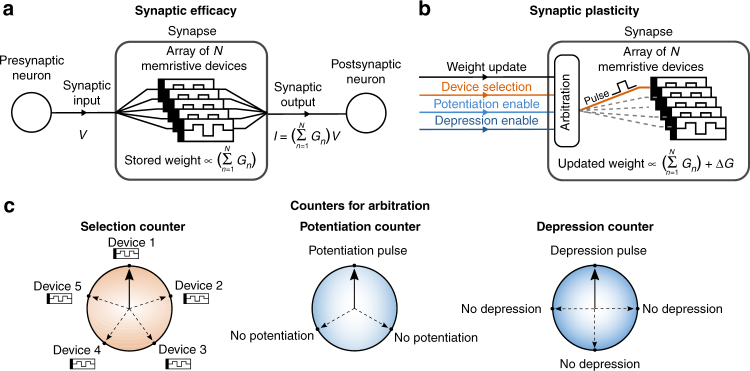
The paper proposes a multi-memristive synapse architecture that uses multiple memristive devices per synapse plus a counter-based arbitration scheme to improve dynamic range, resolution, and robustness for neuromorphic learning. It demonstrates the idea with PCM devices in simulations and in experiments on more than one million devices, including unsupervised temporal-correlation detection.
Key findings
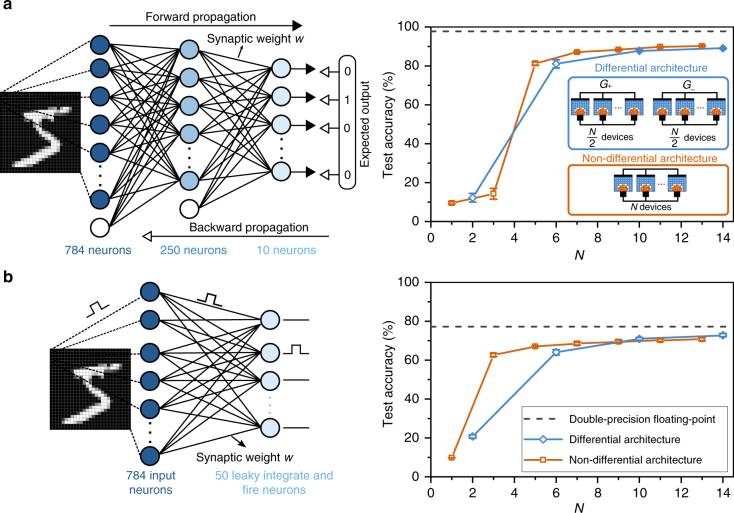
- In MNIST simulations for an ANN, the ideal floating-point classifier achieved 97.8% accuracy, while multi-memristive synapses reached >88.9% in the differential architecture and >90% in the non-differential architecture; the conventional 2-device differential architecture stayed below 15%.
- In MNIST simulations for an SNN with unsupervised learning, the floating-point baseline achieved 77.2% accuracy; the network with multi-memristive synapses achieved >70% correct classification for N > 9, while the conventional 2-device differential architecture was below 21%.
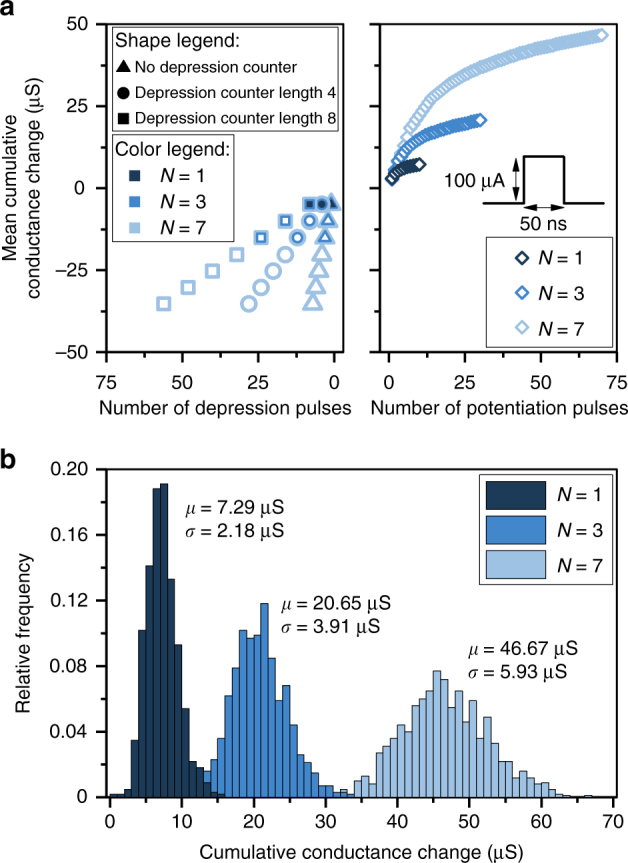
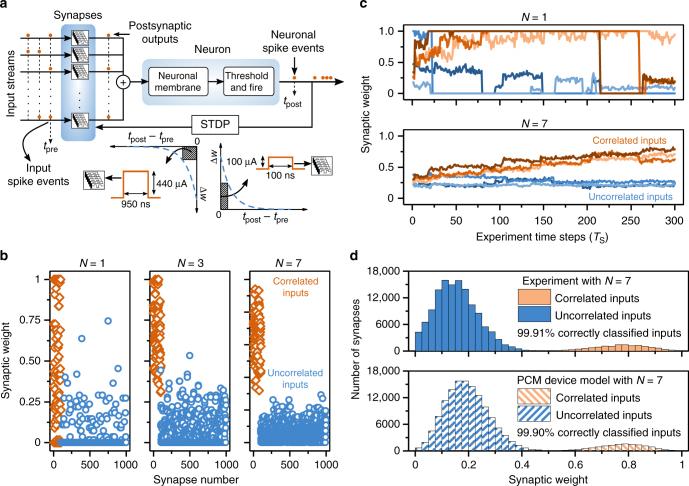
- In the small-scale temporal-correlation experiment, the number of misclassified inputs was 49 for N = 1, 8 for N = 3, and 0 for N = 7.
- In the large-scale temporal-correlation experiment, 144,000 synapses with 7 PCM devices per synapse used 1,008,000 PCM devices total, and the experiment and simulation each reported about 0.1% misclassified inputs after training.
Methods
- The paper combines device characterization, analytical modeling, simulations, and hardware experiments using a prototype PCM chip with 3 million devices in a four-bank inter-leaved architecture fabricated in 90 nm CMOS.
- For simulation, the authors trained an ANN on 60,000 MNIST training images and tested on 10,000 MNIST test images; they also simulated an SNN for MNIST and an SNN for temporal-correlation detection using STDP-based learning rules.
- The hardware correlation-detection experiment trained an SNN on 1000 synapses in the small-scale case and 144,000 synapses in the large-scale case, with some synapses receiving correlated inputs at correlation coefficient 0.75.
Limitations
- The paper states that PCM devices have limiting characteristics including limited conductance range, asymmetric conductance response, nonlinear conductance response, stochasticity, and device-to-device variability.
- The text makes evident that the scheme still relies on counter-based arbitration and may produce weight-dependent plasticity because device selection does not use exact conductance knowledge; the paper notes this could negatively affect ANN accuracy, though it may stabilize some SNNs.
- The paper also states that its experimental data are available upon request only, which may limit immediate reproducibility from the text alone.
Model-written summary. Check it against the paper before relying on it.
Integrity signals
Registry
Cites
Statistics
Figures
Verification
Claims the paper makes
5 Valid · 1 Not valid · 16 Not checked · 68 Own results and interpretations
Every source the paper cites for this claim was checked and supports it.
In the paper
“Such a strongly asymmetric conductance response is undesirable in memristive-device-based implementations of neural networks44”
§ Neuromorphic computing with multi-memristive synapses > Results > Multi-memristive synapses based on PCM devices
What the sources say
- Supportedcites [44] Gokmen, T. & Vlasov, Y. Acceleration of deep neural network training with resistive cross-point devices: design considerations. Front. Neurosci. 10, 333 (2016). source
The Introduction identifies asymmetrical set and reset operations as a limitation for accelerating neural-network training. The Results (“Derivation of RPU device specifications”) find that upward and downward conductance changes must be closely balanced to keep the training error penalty acceptable. The paper notes that global asymmetry can be compensated by adjusting pulses. (LLM, conf=0.90)
boosted- Asserted: passes — The authors put it forward as true.
- Checkable: passes — It can be checked against evidence.
- Load-bearing: passes — The paper’s conclusions depend on it.
- Based: passes — The paper gives a reason why it holds.
- Supported
Every source the paper cites for this claim was checked and supports it.
In the paper
“Memristive crossbars can also be fabricated with very small areal footprint27,29,60.”
§ Neuromorphic computing with multi-memristive synapses > Discussion
What the sources say
- Supportedcites [27] Alibart, F., Zamanidoost, E. & Strukov, D. B. Pattern classification by memristive crossbar circuits using ex situ and in situ training. Nat. Commun. 4, 2072 (2013). source
The Abstract says memristors’ simple structure allows crossbar integration and aggressive size scaling. It also reports sub-10-nm devices, supporting the claim that memristive crossbars can have a very small areal footprint. Page numbers are not provided in our copy. (LLM, conf=0.91)
- Supportedcites [29] Prezioso, M. et al. Training and operation of an integrated neuromorphic network based on metal-oxide memristors. Nature 521, 61–64 (2015). source
The paper reports fabricating an integrated 12×12 memristive crossbar (Memristor Fabrication, Forming and Characterization, p. 3). It also describes the crossbar topology as capable of extremely high areal density and gives a 30-nm-pitch example (main text, p. 2), supporting the general claim of a small areal footprint. (LLM, conf=0.87)
- Supportedcites [60] Eryilmaz, S. B. et al. Brain-like associative learning using a nanoscale non-volatile phase change synaptic device array. Front. Neurosci. 8, 205 (2014). source
The Introduction says nanoscale non-volatile memory devices can be scaled to nanometer dimensions, enabling dense synaptic arrays because of their small feature sizes. The paper also describes its PCM cells as connected in a crossbar fashion (Phase change memory cell array for synaptic operation). Together, these passages support the general claim that such crossbar arrays can have a small areal footprint; the paper does not quantify the footprint of its array. (LLM, conf=0.86)
plain- Asserted: passes — The authors put it forward as true.
- Checkable: passes — It can be checked against evidence.
- Load-bearing: unclear — It is unclear whether the paper’s conclusions depend on it.
- Based: passes — The paper gives a reason why it holds.
- Supported
A result the paper reports from its own data — it cites no other source for it, so there is none to check. The quote shows it is in the paper.
In the paper
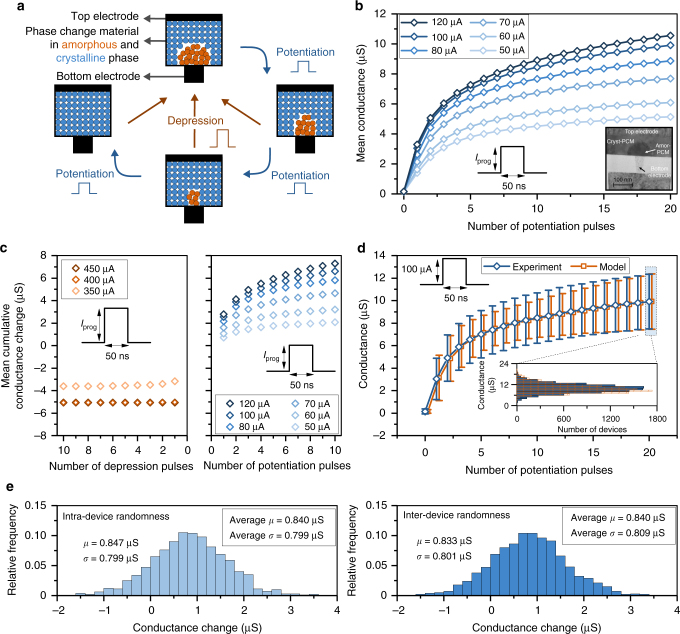
“These experiments show that the standard deviation of the conductance change due to intra-device variability is almost as large as that due to the inter-device variability.”
§ Neuromorphic computing with multi-memristive synapses > Results > Multi-memristive synapses based on PCM devices
plain- Asserted: passes — The authors put it forward as true.
- Checkable: passes — It can be checked against evidence.
- Load-bearing: passes — The paper’s conclusions depend on it.
- Based: passes — The paper gives a reason why it holds.
A result the paper reports from its own data — it cites no other source for it, so there is none to check. The quote shows it is in the paper.
In the paper
“Moreover, the fact that the non-differential architecture achieves a comparable performance to that of the differential architecture is promising for synaptic realizations using highly asymmetric devices.”
§ Neuromorphic computing with multi-memristive synapses > Results > Simulation results on handwritten digit classification
plain- Asserted: passes — The authors put it forward as true.
- Checkable: passes — It can be checked against evidence.
- Load-bearing: passes — The paper’s conclusions depend on it.
- Based: passes — The paper gives a reason why it holds.
- Rests on an assumption not shown here.
A result the paper reports from its own data — it cites no other source for it, so there is none to check. The quote shows it is in the paper.
In the paper
“There are also significant intra-device and inter-device variabilities associated with the conductance response in PCM devices as evidenced by the distribution of conductance values upon application of successive potentiation pulses”
§ Neuromorphic computing with multi-memristive synapses > Results > Multi-memristive synapses based on PCM devices
plainstates an association- Asserted: passes — The authors put it forward as true.
- Checkable: passes — It can be checked against evidence.
- Load-bearing: passes — The paper’s conclusions depend on it.
- Based: passes — The paper gives a reason why it holds.
55 more claims
Create a free account to see all 90 claims and to verify the 3 references still open.
- It may state two separate claims as one. 18
- Borderline: one of the tests for a substantial claim is unclear. 1
- The quote only partly states this claim. 1
- Probably not a substantial claim. 13
Claims other papers make about this one
Each is checked against this paper’s own text: does it say what the citing paper says it does?
The cited source says what the claim attributes to it.
In the citing paper
“Multibit weights are composed of low-bit weights 33 through the cooperation of peripheral circuits.”
From A computing-in-memory macro based on three-dimensional resistive random-access memory (2022) · cites this paper as [33]
Citations
Cites
LeCun, Y., Bengio, Y., & Hinton, G. (2015) · Nature · doi:10.1038/nature14539 · Cited by 84,126
Gradient-based learning applied to document recognition
Lecun, Y., Bottou, L., Bengio, Y., & Haffner, P. (1998) · Proceedings of the IEEE · doi:10.1109/5.726791 · Cited by 58,805
Learning representations by back-propagating errors
Rumelhart, D. E., Hinton, G. E., & Williams, R. J. (1986) · Nature · doi:10.1038/323533a0 · Cited by 31,892
Parallel Distributed Processing: Explorations in the Microstructure of Cognition: Foundations
Rumelhart, D. E., McClelland, J. L., & AU (1986) · doi:10.7551/mitpress/5236.001.0001 · Cited by 15,686
Strukov, D. B., Snider, G. S., Stewart, D. R., & Williams, R. S. (2008) · Nature · doi:10.1038/nature06932 · Cited by 11,828
A million spiking-neuron integrated circuit with a scalable communication network and interface
Merolla, P. A., Arthur, J. V., Alvarez-Icaza, R., Cassidy, A. S., Sawada, J., Akopyan, F., Jackson, B. L., Imam, N., Guo, C., Nakamura, Y., et al. (2014) · Science · doi:10.1126/science.1254642 · Cited by 4,147
Malenka, R. C., & Bear, M. F. (2004) · Neuron · doi:10.1016/j.neuron.2004.09.012 · Cited by 3,968
Regulation of Synaptic Efficacy by Coincidence of Postsynaptic APs and EPSPs
Markram, H., Lübke, J., Frotscher, M., & Sakmann, B. (1997) · Science · doi:10.1126/science.275.5297.213 · Cited by 3,832
Training and operation of an integrated neuromorphic network based on metal-oxide memristors
Prezioso, M., Merrikh-Bayat, F., Hoskins, B. D., Adam, G. C., Likharev, K. K., & Strukov, D. B. (2015) · Nature · doi:10.1038/nature14441 · Cited by 3,001
Competitive Hebbian learning through spike-timing-dependent synaptic plasticity
Song, S., Miller, K. D., & Abbott, L. F. (2000) · Nature Neuroscience · doi:10.1038/78829 · Cited by 2,729
Research works printed but not linked: 1
- Burr, G. W. et al. Integration of nanoscale memristor synapses in neuromorphic computing architectures. Adv. Phys. X 2, 89–124 (2016).
Cited by
Memory devices and applications for in-memory computing
Sebastian, A., Le Gallo, M., Khaddam-Aljameh, R., & Eleftheriou, E. (2020) · Nature Nanotechnology · doi:10.1038/s41565-020-0655-z · Cited by 2,289
Self-citationParallel convolutional processing using an integrated photonic tensor core
Feldmann, J., Youngblood, N., Karpov, M., Gehring, H., Li, X., Stappers, M., Le Gallo, M., Fu, X., Lukashchuk, A., Raja, A. S., et al. (2021) · Nature · doi:10.1038/s41586-020-03070-1 · Cited by 1,900
Self-citationResistive switching materials for information processing
Wang, Z., Wu, H., Burr, G. W., Hwang, C. S., Wang, K. L., Xia, Q., & Yang, J. J. (2020) · Nature Reviews Materials · doi:10.1038/s41578-019-0159-3 · Cited by 1,214
Physics for neuromorphic computing
Marković, D., Mizrahi, A., Querlioz, D., & Grollier, J. (2020) · Nature Reviews Physics · doi:10.1038/s42254-020-0208-2 · Cited by 1,176
Efficient and self-adaptive in-situ learning in multilayer memristor neural networks
Li, C., Belkin, D., Li, Y., Yan, P., Hu, M., Ge, N., Jiang, H., Montgomery, E., Lin, P., Wang, Z., et al. (2018) · Nature Communications · doi:10.1038/s41467-018-04484-2 · Cited by 931
“…for other applications, by device engineering for better IV linearity 37,38 , or using pulse width instead of amplitude to represent analog input (with increased time overhead) 27,28,37 , or employing multiple memristors to represent one synaptic weight (at the expense of chip area) 52 , etc.”
Method
Metadata
- Authors
- Boybat, I., Le Gallo, M., Nandakumar, S. R., Moraitis, T., Parnell, T., Tuma, T., Rajendran, B., Leblebici, Y., Sebastian, A., & Eleftheriou, E.
- Affiliations
- IBM Research - Zurich (CH)
- New Jersey Institute of Technology (US)
- École Polytechnique Fédérale de Lausanne (CH)
- Corresponding author
- Boybat, Irem
- Sebastian, Abu
- ORCID
- Venue
- Nature Communications
- Published
- 2018-06-28
- Volume
- 9
- Issue
- 1
- Pages
- 2514-2514
- ISSN
- 2041-1723 (ISSN-L)
- PMC
- PMC6023896
- OpenAlex
- W2769049661
- Cited by
- 899
- References
- 67
- Citations by year
- 2026: 95 · 2025: 107 · 2024: 99 · 2023: 128 · 2022: 127 · 2021: 140 · 2020: 122 · 2019: 63 · 2018: 18
- FWCI
- 32.77
- Type
- journal article
- Language
- en
- Open access
- gold
- doi.org
- Licence
- cc-by
- creativecommons.org/licenses/by/4.0 (tdm)
- creativecommons.org/licenses/by/4.0 (vor)
- Locations
- Nature Communications (publishedVersion, cc-by)
- Europe PMC (PubMed Central) (publishedVersion, cc-by)
- PubMed Central (publishedVersion, cc-by)
- PubMed (publishedVersion)
- arXiv (Cornell University) (submittedVersion)
- Research Portal (King's College London) (submittedVersion, cc-by)
- RePEc: Research Papers in Economics (submittedVersion)
- DOAJ (DOAJ: Directory of Open Access Journals) (submittedVersion)
- DOAJ (DOAJ: Directory of Open Access Journals) (submittedVersion, cc-by-sa)
- Infoscience (Ecole Polytechnique Fédérale de Lausanne) (submittedVersion, cc-by-nc-nd)
- arXiv (Cornell University)
- Funders
- National Science Foundation
- European Commission (HORIZON2020, 682675)
- Schweizerischer Nationalfonds zur Förderung der Wissenschaftlichen Forschung
- Topics
- Physical Sciences › Engineering › Electrical and Electronic Engineering › Advanced Memory and Neural Computing
- Physical Sciences › Computer Science › Artificial Intelligence › Neural Networks and Reservoir Computing
- Physical Sciences › Mathematics › Theoretical Computer Science › DNA and Biological Computing
- Keywords
- neuromorphic computing, memristors, phase-change memory, spiking neural networks, unsupervised learning, energy-efficient hardware, artificial neural networks
- MeSH terms
- Unsupervised Machine Learning, Action Potentials, Animals, Electric Conductivity, Electronics, Humans, Models, Neurological, Synapses, Neural Networks, Computer, Biomimetic Materials
About these checks
Registry, retraction, Cites and statistics results are computed, not judged, with one exception: a printed reference that no index lists is read once by a model before it counts as a citation error. Claims are extracted by a model and kept only when their quote appears verbatim in the text; each cited source is then checked, with a model’s help, for whether it says what the claim relies on. Those verdicts can be wrong — read the claim’s quote and the cited source before relying on one.
The claim verdicts this report counts are experimental: their accuracy is not yet measured.
A language model drew the claims from the paper on 2026-10-10, under version 3 of the claim definition (model deepseek-v4.1-flash, prompt extract-v3).
A second model labelled each claim on 2026-10-10 (model jev-1.13-20260917, definition revision gold-guideline-v0.2).
Cited sources are checked with a language model’s help (gpt-6-sol).
Statistics and arithmetic are recomputed, not judged.
Confidence bands are shown only for fields calibrated on our annotated test set. None is calibrated yet, so no band is shown.
What counts as a claim ›How we measure confidence ›How we check this ›
Are you an author, or do you see a problem with this page? Request a review
How to cite
Cite CoChat for the checks on this page, and the paper for its own findings.
- This page
- CoChat. (2026). Citation check: Neuromorphic computing with multi-memristive synapses. https://app.cochat.ai/papers/10.1038/s41467-018-04933-y
- The paper
- Boybat, I., Le Gallo, M., Nandakumar, S. R., Moraitis, T., Parnell, T., Tuma, T., Rajendran, B., Leblebici, Y., Sebastian, A., & Eleftheriou, E. (2018). Neuromorphic computing with multi-memristive synapses. Nature Communications. https://doi.org/10.1038/s41467-018-04933-y
Data sources
Bibliographic data: Semantic Scholar, OpenAlex, Crossref.
Contains information from the Semantic Scholar Academic Graph Datasets, made available under the ODC Attribution License (ODC-BY 1.0).
Semantic Scholar’s data is described in: Kinney, R., et al. (2023). The Semantic Scholar Open Data Platform. arXiv:2301.10140.
