

Neuromorphic computing with multi-memristive synapses
Open accessThe DOI matches its Crossref record; 66 of the 67 references it cites were found in a registry or an index; 8 of the 30 sources its claims cite were checked for support.
Abstract
Neuromorphic computing has emerged as a promising avenue towards building the next generation of intelligent computing systems. It has been proposed that memristive devices, which exhibit history-dependent conductivity modulation, could efficiently represent the synaptic weights in artificial neural networks. However, precise modulation of the device conductance over a wide dynamic range, necessary to maintain high network accuracy, is proving to be challenging. To address this, we present a multi-memristive synaptic architecture with an efficient global counter-based arbitration scheme. We focus on phase change memory devices, develop a comprehensive model and demonstrate via simulations the effectiveness of the concept for both spiking and non-spiking neural networks. Moreover, we present experimental results involving over a million phase change memory devices for unsupervised learning of temporal correlations using a spiking neural network. The work presents a significant step towards the realization of large-scale and energy-efficient neuromorphic computing systems.
Overview
CoChat Summary
TL;DR
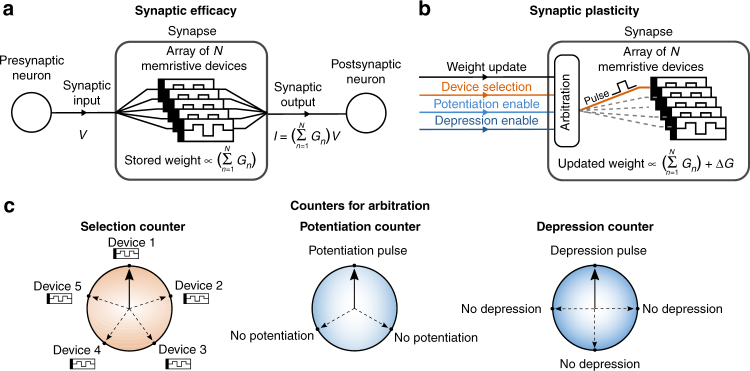
The paper proposes a multi-memristive synapse architecture that uses multiple memristive devices per synapse plus a counter-based arbitration scheme to improve dynamic range, resolution, and robustness for neuromorphic learning. It demonstrates the idea with PCM devices in simulations and in experiments on more than one million devices, including unsupervised temporal-correlation detection.
Key findings
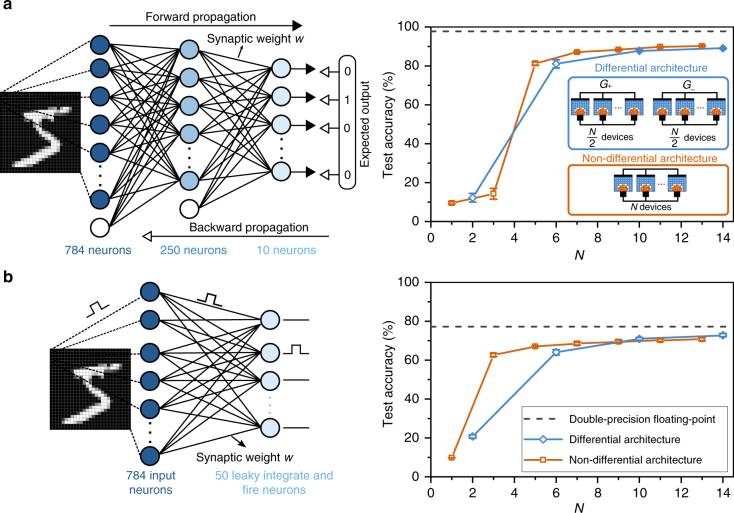
- In MNIST simulations for an ANN, the ideal floating-point classifier achieved 97.8% accuracy, while multi-memristive synapses reached >88.9% in the differential architecture and >90% in the non-differential architecture; the conventional 2-device differential architecture stayed below 15%.
- In MNIST simulations for an SNN with unsupervised learning, the floating-point baseline achieved 77.2% accuracy; the network with multi-memristive synapses achieved >70% correct classification for N > 9, while the conventional 2-device differential architecture was below 21%.
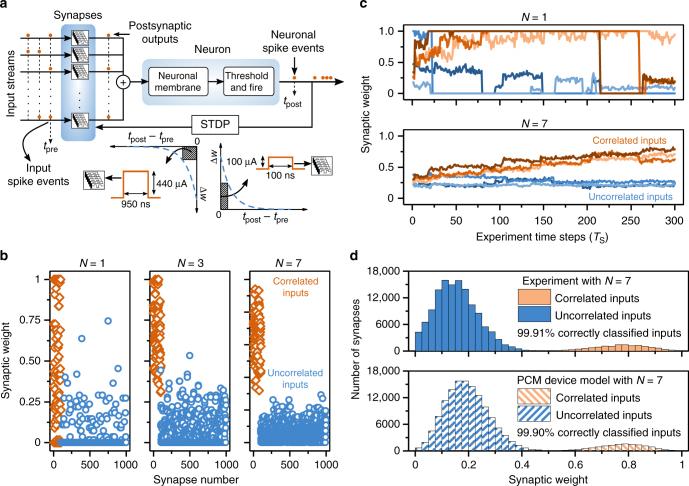
- In the small-scale temporal-correlation experiment, the number of misclassified inputs was 49 for N = 1, 8 for N = 3, and 0 for N = 7.
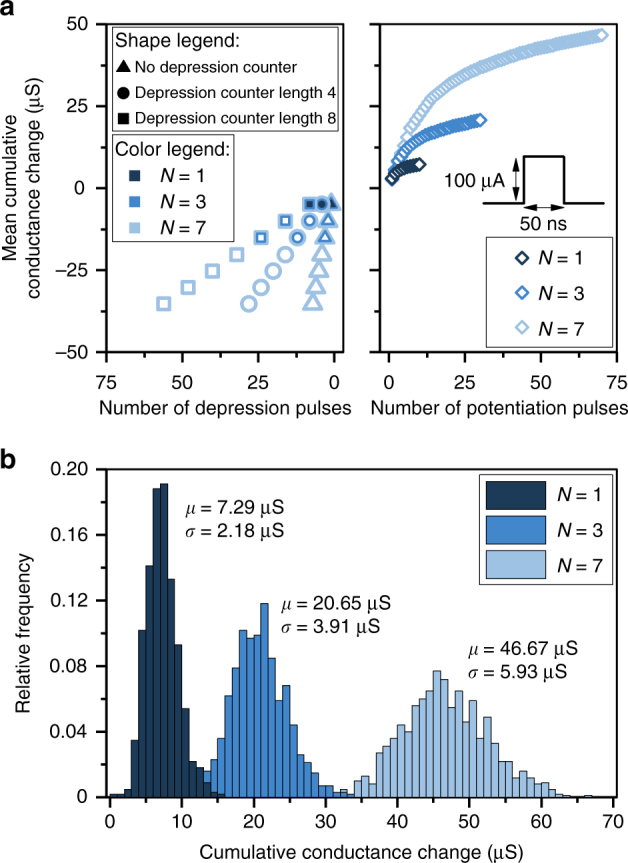
- In the large-scale temporal-correlation experiment, 144,000 synapses with 7 PCM devices per synapse used 1,008,000 PCM devices total, and the experiment and simulation each reported about 0.1% misclassified inputs after training.
Methods
- The paper combines device characterization, analytical modeling, simulations, and hardware experiments using a prototype PCM chip with 3 million devices in a four-bank inter-leaved architecture fabricated in 90 nm CMOS.
- For simulation, the authors trained an ANN on 60,000 MNIST training images and tested on 10,000 MNIST test images; they also simulated an SNN for MNIST and an SNN for temporal-correlation detection using STDP-based learning rules.
- The hardware correlation-detection experiment trained an SNN on 1000 synapses in the small-scale case and 144,000 synapses in the large-scale case, with some synapses receiving correlated inputs at correlation coefficient 0.75.
Limitations
- The paper states that PCM devices have limiting characteristics including limited conductance range, asymmetric conductance response, nonlinear conductance response, stochasticity, and device-to-device variability.
- The text makes evident that the scheme still relies on counter-based arbitration and may produce weight-dependent plasticity because device selection does not use exact conductance knowledge; the paper notes this could negatively affect ANN accuracy, though it may stabilize some SNNs.
- The paper also states that its experimental data are available upon request only, which may limit immediate reproducibility from the text alone.
Model-written summary. Check it against the paper before relying on it.
Integrity signals
Registry
Cites
Statistics
Figures
Verification
Claims the paper makes
6 Valid · 1 Not valid · 15 Not checked · 68 Own results and interpretations
Every source the paper cites for this claim was checked and supports it.
In the paper
“Such a strongly asymmetric conductance response is undesirable in memristive-device-based implementations of neural networks44”
§ Neuromorphic computing with multi-memristive synapses > Results > Multi-memristive synapses based on PCM devices
What the sources say
- Supportedcites [44] Gokmen, T. & Vlasov, Y. Acceleration of deep neural network training with resistive cross-point devices: design considerations. Front. Neurosci. 10, 333 (2016). source
The Introduction identifies asymmetrical set and reset operations as a limitation for accelerating neural-network training. The Results (“Derivation of RPU device specifications”) find that upward and downward conductance changes must be closely balanced to keep the training error penalty acceptable. The paper notes that global asymmetry can be compensated by adjusting pulses. (LLM, conf=0.90)
boosted- Asserted: passes — The authors put it forward as true.
- Checkable: passes — It can be checked against evidence.
- Load-bearing: passes — The paper’s conclusions depend on it.
- Based: passes — The paper gives a reason why it holds.
- Supported
The cited sources support only part of this claim — read each source’s verdict below.
In the paper
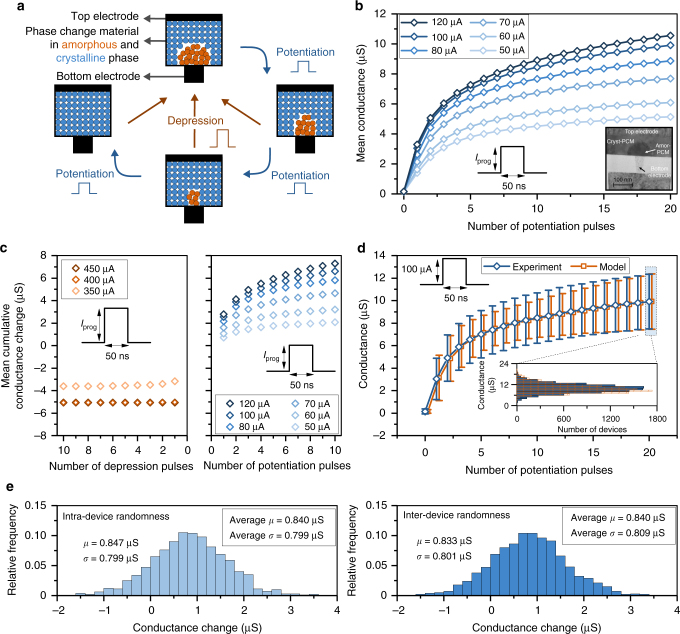
“Large conductance change granularities, as well as nonlinear conductance responses, both observed in the PCM characterization performed here, have been shown to degrade the performance of neural networks trained with memristive synapses34,43.”
§ Neuromorphic computing with multi-memristive synapses > Results > Multi-memristive synapses based on PCM devices
What the sources say
- Not checked — no full text of the sourcecites [34] Burr, G. W. et al. Experimental demonstration and tolerancing of a large-scale neural network (165 000 synapses) using phase-change memory as the synaptic weight element. IEEE Trans. Electron Dev. 62, 3498–3507 (2015). source
- Partly supportedcites [43] Boybat, I. et al. Stochastic weight updates in phase-change memory-based synapses and their influence on artificial neural networks. In Proc. Ph.D. Research in Microelectronics and Electronics (PRIME), 13–16 (IEEE, Giardini Naxos, Italy, 2017). sourceExperimental — accuracy not yet measured
Our copy supports the granularity half: Section II.C states that 'the minimal mean conductance change that can be induced can be quite large especially for low values of device conductance... implies a granularity of possible weight updates in a PCM synapse', and the abstract/introduction (Section I) frame the paper as quantifying the effect of experimentally observed conductance-change granularity (and stochasticity) on classification accuracies, noting that 'non-ideal device characteristics pose challenges to reach competitive classification accuracies'. The nonlinear-conductance-response half is not in this paper at all: our copy's stated scope is explicitly limited to 'two aspects: the granularity of weight updates and the update randomness', and searches for nonlinearity, asymmetry or potentiation/depression returned no passage. The attributed claim that nonlinear responses degrade network performance therefore rests on the other citation(s), not on Boybat et al. (2017). (LLM, conf=0.75)
boostedstates a cause- Asserted: passes — The authors put it forward as true.
- Checkable: passes — It can be checked against evidence.
- Load-bearing: passes — The paper’s conclusions depend on it.
- Based: passes — The paper gives a reason why it holds.
Every source the paper cites for this claim was checked and supports it.
In the paper
“Memristive crossbars can also be fabricated with very small areal footprint27,29,60.”
§ Neuromorphic computing with multi-memristive synapses > Discussion
What the sources say
- Supportedcites [27] Alibart, F., Zamanidoost, E. & Strukov, D. B. Pattern classification by memristive crossbar circuits using ex situ and in situ training. Nat. Commun. 4, 2072 (2013). source
The Abstract says memristors’ simple structure allows crossbar integration and aggressive size scaling. It also reports sub-10-nm devices, supporting the claim that memristive crossbars can have a very small areal footprint. Page numbers are not provided in our copy. (LLM, conf=0.91)
- Supportedcites [29] Prezioso, M. et al. Training and operation of an integrated neuromorphic network based on metal-oxide memristors. Nature 521, 61–64 (2015). source
The paper reports fabricating an integrated 12×12 memristive crossbar (Memristor Fabrication, Forming and Characterization, p. 3). It also describes the crossbar topology as capable of extremely high areal density and gives a 30-nm-pitch example (main text, p. 2), supporting the general claim of a small areal footprint. (LLM, conf=0.87)
- Supportedcites [60] Eryilmaz, S. B. et al. Brain-like associative learning using a nanoscale non-volatile phase change synaptic device array. Front. Neurosci. 8, 205 (2014). source
The Introduction says nanoscale non-volatile memory devices can be scaled to nanometer dimensions, enabling dense synaptic arrays because of their small feature sizes. The paper also describes its PCM cells as connected in a crossbar fashion (Phase change memory cell array for synaptic operation). Together, these passages support the general claim that such crossbar arrays can have a small areal footprint; the paper does not quantify the footprint of its array. (LLM, conf=0.86)
plain- Asserted: passes — The authors put it forward as true.
- Checkable: passes — It can be checked against evidence.
- Load-bearing: unclear — It is unclear whether the paper’s conclusions depend on it.
- Based: passes — The paper gives a reason why it holds.
- Supported
A result the paper reports from its own data — it cites no other source for it, so there is none to check. The quote shows it is in the paper.
In the paper
“These experiments show that the standard deviation of the conductance change due to intra-device variability is almost as large as that due to the inter-device variability.”
§ Neuromorphic computing with multi-memristive synapses > Results > Multi-memristive synapses based on PCM devices
plain- Asserted: passes — The authors put it forward as true.
- Checkable: passes — It can be checked against evidence.
- Load-bearing: passes — The paper’s conclusions depend on it.
- Based: passes — The paper gives a reason why it holds.
A result the paper reports from its own data — it cites no other source for it, so there is none to check. The quote shows it is in the paper.
In the paper
“Moreover, the fact that the non-differential architecture achieves a comparable performance to that of the differential architecture is promising for synaptic realizations using highly asymmetric devices.”
§ Neuromorphic computing with multi-memristive synapses > Results > Simulation results on handwritten digit classification
plain- Asserted: passes — The authors put it forward as true.
- Checkable: passes — It can be checked against evidence.
- Load-bearing: passes — The paper’s conclusions depend on it.
- Based: passes — The paper gives a reason why it holds.
- Rests on an assumption not shown here.
55 more claims
Create a free account to see all 90 claims and to verify the 2 references still open.
- It may state two separate claims as one. 18
- Borderline: one of the tests for a substantial claim is unclear. 1
- The quote only partly states this claim. 1
- Probably not a substantial claim. 13
Claims other papers make about this one
Each is checked against this paper’s own text: does it say what the citing paper says it does?
The cited source says what the claim attributes to it.
In the citing paper
“Multibit weights are composed of low-bit weights 33 through the cooperation of peripheral circuits.”
From A computing-in-memory macro based on three-dimensional resistive random-access memory (2022) · cites this paper as [33]
Citations
Cites
LeCun, Y., Bengio, Y., & Hinton, G. (2015) · Nature · doi:10.1038/nature14539 · Cited by 84,126
Gradient-based learning applied to document recognition
Lecun, Y., Bottou, L., Bengio, Y., & Haffner, P. (1998) · Proceedings of the IEEE · doi:10.1109/5.726791 · Cited by 58,805
Learning representations by back-propagating errors
Rumelhart, D. E., Hinton, G. E., & Williams, R. J. (1986) · Nature · doi:10.1038/323533a0 · Cited by 31,892
Parallel Distributed Processing: Explorations in the Microstructure of Cognition: Foundations
Rumelhart, D. E., McClelland, J. L., & AU (1986) · doi:10.7551/mitpress/5236.001.0001 · Cited by 15,686
Strukov, D. B., Snider, G. S., Stewart, D. R., & Williams, R. S. (2008) · Nature · doi:10.1038/nature06932 · Cited by 11,828
A million spiking-neuron integrated circuit with a scalable communication network and interface
Merolla, P. A., Arthur, J. V., Alvarez-Icaza, R., Cassidy, A. S., Sawada, J., Akopyan, F., Jackson, B. L., Imam, N., Guo, C., Nakamura, Y., et al. (2014) · Science · doi:10.1126/science.1254642 · Cited by 4,147
Malenka, R. C., & Bear, M. F. (2004) · Neuron · doi:10.1016/j.neuron.2004.09.012 · Cited by 3,968
Regulation of Synaptic Efficacy by Coincidence of Postsynaptic APs and EPSPs
Markram, H., Lübke, J., Frotscher, M., & Sakmann, B. (1997) · Science · doi:10.1126/science.275.5297.213 · Cited by 3,832
Training and operation of an integrated neuromorphic network based on metal-oxide memristors
Prezioso, M., Merrikh-Bayat, F., Hoskins, B. D., Adam, G. C., Likharev, K. K., & Strukov, D. B. (2015) · Nature · doi:10.1038/nature14441 · Cited by 3,001
Competitive Hebbian learning through spike-timing-dependent synaptic plasticity
Song, S., Miller, K. D., & Abbott, L. F. (2000) · Nature Neuroscience · doi:10.1038/78829 · Cited by 2,729
Research works printed but not linked: 1
- Burr, G. W. et al. Integration of nanoscale memristor synapses in neuromorphic computing architectures. Adv. Phys. X 2, 89–124 (2016).
Cited by
Memory devices and applications for in-memory computing
Sebastian, A., Le Gallo, M., Khaddam-Aljameh, R., & Eleftheriou, E. (2020) · Nature Nanotechnology · doi:10.1038/s41565-020-0655-z · Cited by 2,289
Self-citationParallel convolutional processing using an integrated photonic tensor core
Feldmann, J., Youngblood, N., Karpov, M., Gehring, H., Li, X., Stappers, M., Le Gallo, M., Fu, X., Lukashchuk, A., Raja, A. S., et al. (2021) · Nature · doi:10.1038/s41586-020-03070-1 · Cited by 1,900
Self-citationResistive switching materials for information processing
Wang, Z., Wu, H., Burr, G. W., Hwang, C. S., Wang, K. L., Xia, Q., & Yang, J. J. (2020) · Nature Reviews Materials · doi:10.1038/s41578-019-0159-3 · Cited by 1,214
Physics for neuromorphic computing
Marković, D., Mizrahi, A., Querlioz, D., & Grollier, J. (2020) · Nature Reviews Physics · doi:10.1038/s42254-020-0208-2 · Cited by 1,176
Efficient and self-adaptive in-situ learning in multilayer memristor neural networks
Li, C., Belkin, D., Li, Y., Yan, P., Hu, M., Ge, N., Jiang, H., Montgomery, E., Lin, P., Wang, Z., et al. (2018) · Nature Communications · doi:10.1038/s41467-018-04484-2 · Cited by 931
“…for other applications, by device engineering for better IV linearity 37,38 , or using pulse width instead of amplitude to represent analog input (with increased time overhead) 27,28,37 , or employing multiple memristors to represent one synaptic weight (at the expense of chip area) 52 , etc.”
MethodNeuro-inspired computing chips
Zhang, W., Gao, B., Tang, J., Yao, P., Yu, S., Chang, M.-F., Yoo, H.-J., Qian, H., & Wu, H. (2020) · Nature Electronics · doi:10.1038/s41928-020-0435-7 · Cited by 892
“To overcome the limited precision of NVM devices, a general approach is using multiple devices with proportional significance to represent a multi-bit number 60,61 .”
MethodZhang, W., Mazzarello, R., Wuttig, M., & Ma, E. (2019) · Nature Reviews Materials · doi:10.1038/s41578-018-0076-x · Cited by 885
Tang, J., Yuan, F., Shen, X., Wang, Z., Rao, M., He, Y., Sun, Y., Li, X., Zhang, W., Li, Y., et al. (2019) · Advanced Materials · doi:10.1002/adma.201902761 · Cited by 834
A fully integrated reprogrammable memristor–CMOS system for efficient multiply–accumulate operations
Cai, F., Correll, J. M., Lee, S. H., Lim, Y., Bothra, V., Zhang, Z., Flynn, M. P., & Lu, W. D. (2019) · Nature Electronics · doi:10.1038/s41928-019-0270-x · Cited by 728
Embedded Devices for Neuromorphic Time-Series Assessment
Mazumder, A. N., Hosseini, M., & Mohsenin, T. (2022) · Research Explorer (The University of Manchester) · doi:10.13016/m2ksy0-wxr3 · Cited by 652
The rise of intelligent matter
Kaspar, C., Ravoo, B. J., van der Wiel, W. G., Wegner, S. V., & Pernice, W. H. P. (2021) · Nature · doi:10.1038/s41586-021-03453-y · Cited by 526
Accurate deep neural network inference using computational phase-change memory
Joshi, V., Le Gallo, M., Haefeli, S., Boybat, I., Nandakumar, S. R., Piveteau, C., Dazzi, M., Rajendran, B., Sebastian, A., & Eleftheriou, E. (2020) · Nature Communications · doi:10.1038/s41467-020-16108-9 · Cited by 490
Self-citationAn overview of phase-change memory device physics
Le Gallo, M., & Sebastian, A. (2020) · Journal of Physics D: Applied Physics · doi:10.1088/1361-6463/ab7794 · Cited by 460
Self-citationAll‐Optically Controlled Memristor for Optoelectronic Neuromorphic Computing
Hu, L., Yang, J., Wang, J., Cheng, P., Chua, L. O., & Zhuge, F. (2021) · Advanced Functional Materials · doi:10.1002/adfm.202005582 · Cited by 457
Wang, M., Luo, Y., Wang, T., Wan, C., Pan, L., Pan, S., He, K., Neo, A., & Chen, X. (2021) · Advanced Materials · doi:10.1002/adma.202003014 · Cited by 451
Emerging Memristive Artificial Synapses and Neurons for Energy‐Efficient Neuromorphic Computing
Choi, S., Yang, J., & Wang, G. (2020) · Advanced Materials · doi:10.1002/adma.202004659 · Cited by 424
Phase-change heterostructure enables ultralow noise and drift for memory operation
Ding, K., Wang, J., Zhou, Y., Tian, H., Lu, L., Mazzarello, R., Jia, C., Zhang, W., Rao, F., & Ma, E. (2019) · Science · doi:10.1126/science.aay0291 · Cited by 415
Accurate deep neural network inference using computational phase-change memory
Joshi, V., Gallo, M. L., Haefeli, S., Boybat, I., Nandakumar, S. R., Piveteau, C., Dazzi, M., Rajendran, B., Sebastian, A., & Eleftheriou, E. S. (2020) · RePEc: Research Papers in Economics · doi:10.3929/ethz-b-000416797 · Cited by 379
Self-citationReinforcement learning with analogue memristor arrays
Wang, Z., Li, C., Song, W., Rao, M., Belkin, D., Li, Y., Yan, P., Jiang, H., Lin, P., Hu, M., et al. (2019) · Nature Electronics · doi:10.1038/s41928-019-0221-6 · Cited by 370
Semiconductor Quantum Dots for Memories and Neuromorphic Computing Systems
Lv, Z., Wang, Y., Chen, J., Wang, J., Zhou, Y., & Han, S.-T. (2020) · Chemical Reviews · doi:10.1021/acs.chemrev.9b00730 · Cited by 364
Neuromorphic Engineering: From Biological to Spike‐Based Hardware Nervous Systems
Yang, J., Wang, R., Ren, Y., Mao, J., Wang, Z., Zhou, Y., & Han, S. (2020) · Advanced Materials · doi:10.1002/adma.202003610 · Cited by 350
Wan, C., Cai, P., Wang, M., Qian, Y., Huang, W., & Chen, X. (2020) · Advanced Materials · doi:10.1002/adma.201902434 · Cited by 343
Mehonic, A., Sebastian, A., Rajendran, B., Simeone, O., Vasilaki, E., & Kenyon, A. J. (2020) · Advanced Intelligent Systems · doi:10.1002/aisy.202000085 · Cited by 331
Self-citationIelmini, D., & Ambrogio, S. (2020) · Nanotechnology · doi:10.1088/1361-6528/ab554b · Cited by 321
Stretchable elastic synaptic transistors for neurologically integrated soft engineering systems
Shim, H., Sim, K., Ershad, F., Yang, P., Thukral, A., Rao, Z., Kim, H.-J., Liu, Y., Wang, X., Gu, G., et al. (2019) · Science Advances · doi:10.1126/sciadv.aax4961 · Cited by 310
In situ training of feed-forward and recurrent convolutional memristor networks
Wang, Z., Li, C., Lin, P., Rao, M., Nie, Y., Song, W., Qiu, Q., Li, Y., Yan, P., Strachan, J. P., et al. (2019) · Nature Machine Intelligence · doi:10.1038/s42256-019-0089-1 · Cited by 307
Tutorial: Brain-inspired computing using phase-change memory devices
Sebastian, A., Le Gallo, M., Burr, G. W., Kim, S., BrightSky, M., & Eleftheriou, E. (2018) · Journal of Applied Physics · doi:10.1063/1.5042413 · Cited by 303
Self-citationLe Gallo, M., Khaddam-Aljameh, R., Stanisavljevic, M., Vasilopoulos, A., Kersting, B., Dazzi, M., Karunaratne, G., Brändli, M., Singh, A., Müller, S. M., et al. (2023) · Nature Electronics · doi:10.1038/s41928-023-01010-1 · Cited by 310
Self-citationEmerging Artificial Synaptic Devices for Neuromorphic Computing
Wan, Q., Sharbati, M. T., Erickson, J. R., Du, Y., & Xiong, F. (2019) · Advanced Materials Technologies · doi:10.1002/admt.201900037 · Cited by 303
Recent Advances and Future Prospects for Memristive Materials, Devices, and Systems
Song, M.-K., Kang, J.-H., Zhang, X., Ji, W., Ascoli, A., Messaris, I., Demirkol, A. S., Dong, B., Aggarwal, S., Wan, W., et al. (2023) · ACS Nano · doi:10.1021/acsnano.3c03505 · Cited by 300
Self-citationReconfigurable halide perovskite nanocrystal memristors for neuromorphic computing
John, R. A., Demirağ, Y., Shynkarenko, Y., Berezovska, Y., Ohannessian, N., Payvand, M., Zeng, P., Bodnarchuk, M. I., Krumeich, F., Kara, G., et al. (2022) · Nature Communications · doi:10.1038/s41467-022-29727-1 · Cited by 292
In-memory hyperdimensional computing
Karunaratne, G., Le Gallo, M., Cherubini, G., Benini, L., Rahimi, A., & Sebastian, A. (2020) · Nature Electronics · doi:10.1038/s41928-020-0410-3 · Cited by 293
Self-citationRecent Advances on Neuromorphic Devices Based on Chalcogenide Phase‐Change Materials
Xu, M., Mai, X., Lin, J., Zhang, W., Li, Y., He, Y., Tong, H., Hou, X., Zhou, P., & Miao, X. (2020) · Advanced Functional Materials · doi:10.1002/adfm.202003419 · Cited by 273
Exploring Neuromorphic Computing Based on Spiking Neural Networks: Algorithms to Hardware
Rathi, N., Chakraborty, I., Kosta, A., Sengupta, A., Ankit, A., Panda, P., & Roy, K. (2023) · ACM Computing Surveys · doi:10.1145/3571155 · Cited by 267
“Such devices can emulate neuronal [172, 206, 234] and synaptic functionalities [28, 84, 97, 111, 185, 224, 226] at a one-to-one level while simultaneously enabling a novel paradigm of “In-Memoryž computing, i.”
Background4K-memristor analog-grade passive crossbar circuit
Kim, H., Mahmoodi, M. R., Nili, H., & Strukov, D. B. (2021) · Nature Communications · doi:10.1038/s41467-021-25455-0 · Cited by 265
“Analog-grade nonvoltaile memories, such as those based on floating-gate transistor [13], and phase-change [4-6], ferroelectric [7, 8], magnetic [9], solid-state electrolyte [10, 11], organic [12], and metal-oxide [13-21] materials, are enabling components for mixed-signal circuits implementing vector-by-martix multipl…”
BackgroundVertical organic synapse expandable to 3D crossbar array
Choi, Y., Oh, S., Qian, C., Park, J.-H., & Cho, J. H. (2020) · Nature Communications · doi:10.1038/s41467-020-17850-w · Cited by 248
Yuan, R., Duan, Q., Tiw, P. J., Li, G., Xiao, Z., Jing, Z., Yang, K., Liu, C., Ge, C., Huang, R., et al. (2022) · Nature Communications · doi:10.1038/s41467-022-31747-w · Cited by 242
Energy‐Efficient Organic Ferroelectric Tunnel Junction Memristors for Neuromorphic Computing
Majumdar, S., Tan, H., Qin, Q. H., & van Dijken, S. (2019) · Advanced Electronic Materials · doi:10.1002/aelm.201800795 · Cited by 224
Embodied neuromorphic intelligence
Bartolozzi, C., Indiveri, G., & Donati, E. (2022) · Nature Communications · doi:10.1038/s41467-022-28487-2 · Cited by 218
Perspective: A review on memristive hardware for neuromorphic computation
Sung, C., Hwang, H., & Yoo, I. K. (2018) · Journal of Applied Physics · doi:10.1063/1.5037835 · Cited by 217
Machine Learning‐Enabled Smart Sensor Systems
Ha, N., Xu, K., Ren, G., Mitchell, A., & Ou, J. Z. (2020) · Advanced Intelligent Systems · doi:10.1002/aisy.202000063 · Cited by 207
Ryu, H., Wu, H., Rao, F., & Zhu, W. (2019) · Scientific Reports · doi:10.1038/s41598-019-56816-x · Cited by 205
In-memory Learning with Analog Resistive Switching Memory: A Review and Perspective
Xi, Y., Gao, B., Tang, J., Chen, A., Chang, M.-F., Hu, X. S., Spiegel, J. V. D., Qian, H., & Wu, H. (2021) · Proceedings of the IEEE · doi:10.1109/jproc.2020.3004543 · Cited by 196
“A succinct definition as well as the relationships between some device characteristics and synaptic weights of the neural network are summarized in Table 3 [78], [88], [90].”
BackgroundMethodAnalog architectures for neural network acceleration based on non-volatile memory
Xiao, T. P., Bennett, C. H., Feinberg, B., Agarwal, S., & Marinella, M. J. (2020) · Applied Physics Reviews · doi:10.1063/1.5143815 · Cited by 193
Scalable Deep Learning on Distributed Infrastructures: Challenges, Techniques, and Tools
Mayer, R., & Jacobsen, H.-A. (2021) · ACM Computing Surveys · doi:10.1145/3363554 · Cited by 192
“3.1.1 Hardware Components for DL. novel in-memory computing architectures (also called neuromorphic hardware [20]).”
BackgroundInfluentialProgramming memristor arrays with arbitrarily high precision for analog computing
Song, W., Rao, M., Li, Y., Li, C., Zhuo, Y., Cai, F., Wu, M., Yin, W., Li, Z., Wei, Q., et al. (2024) · Science · doi:10.1126/science.adi9405 · Cited by 193
Ultralow Power Wearable Heterosynapse with Photoelectric Synergistic Modulation
Wang, T., Meng, J., He, Z., Chen, L., Zhu, H., Sun, Q., Ding, S., Zhou, P., & Zhang, D. W. (2020) · Advanced Science · doi:10.1002/advs.201903480 · Cited by 190
Unveiling the structural origin to control resistance drift in phase-change memory materials
Zhang, W., & Ma, E. (2020) · Materials Today · doi:10.1016/j.mattod.2020.07.016 · Cited by 186
Reconfigurable optoelectronic memristor for in-sensor computing applications
Wang, T.-Y., Meng, J.-L., Li, Q.-X., He, Z.-Y., Zhu, H., Ji, L., Sun, Q.-Q., Chen, L., & Zhang, D. W. (2021) · Nano Energy · doi:10.1016/j.nanoen.2021.106291 · Cited by 188
Kwon, K. C., Baek, J. H., Hong, K., Kim, S. Y., & Jang, H. W. (2022) · Nano-Micro Letters · doi:10.1007/s40820-021-00784-3 · Cited by 187
In situ learning using intrinsic memristor variability via Markov chain Monte Carlo sampling
Dalgaty, T., Castellani, N., Turck, C., Harabi, K.-E., Querlioz, D., & Vianello, E. (2021) · Nature Electronics · doi:10.1038/s41928-020-00523-3 · Cited by 180
Rajendran, B., Sebastian, A., Schmuker, M., Srinivasa, N., & Eleftheriou, E. (2019) · IEEE Signal Processing Magazine · doi:10.1109/msp.2019.2933719 · Cited by 177
“Recent breakthroughs, such as multicell architectures, hold great promise to address these issues [21].”
BackgroundMethodInfluentialSelf-citationStimuli‐Responsive Memristive Materials for Artificial Synapses and Neuromorphic Computing
Bian, H., Goh, Y. Y., Liu, Y., Ling, H., Xie, L., & Liu, X. (2021) · Advanced Materials · doi:10.1002/adma.202006469 · Cited by 182
A phase-change memory model for neuromorphic computing
Nandakumar, S. R., Le Gallo, M., Boybat, I., Rajendran, B., Sebastian, A., & Eleftheriou, E. (2018) · Journal of Applied Physics · doi:10.1063/1.5042408 · Cited by 178
Self-citationA biomimetic neural encoder for spiking neural network
Subbulakshmi Radhakrishnan, S., Sebastian, A., Oberoi, A., Das, S., & Das, S. (2021) · Nature Communications · doi:10.1038/s41467-021-22332-8 · Cited by 174
Self-citationAhl, A., Yarime, M., Goto, M., Chopra, S. S., Kumar, N. M., Tanaka, K., & Sagawa, D. (2020) · Renewable and Sustainable Energy Reviews · doi:10.1016/j.rser.2019.109488 · Cited by 172
The promise of spintronics for unconventional computing
Finocchio, G., Di Ventra, M., Camsari, K. Y., Everschor-Sitte, K., Khalili Amiri, P., & Zeng, Z. (2021) · Journal of Magnetism and Magnetic Materials · doi:10.1016/j.jmmm.2020.167506 · Cited by 173
Device and Circuit Architectures for In‐Memory Computing
Ielmini, D., & Pedretti, G. (2020) · Advanced Intelligent Systems · doi:10.1002/aisy.202000040 · Cited by 170
Zero-power optoelectronic synaptic devices
Huang, W., Hang, P., Wang, Y., Wang, K., Han, S., Chen, Z., Peng, W., Zhu, Y., Xu, M., Zhang, Y., et al. (2020) · Nano Energy · doi:10.1016/j.nanoen.2020.104790 · Cited by 166
Pathways to efficient neuromorphic computing with non-volatile memory technologies
Chakraborty, I., Jaiswal, A., Saha, A. K., Gupta, S. K., & Roy, K. (2020) · Applied Physics Reviews · doi:10.1063/1.5113536 · Cited by 168
Biomemristors as the next generation bioelectronics
Sun, B., Zhou, G., Guo, T., Zhou, Y. N., & Wu, Y. A. (2020) · Nano Energy · doi:10.1016/j.nanoen.2020.104938 · Cited by 165
Comprehensive Model of Electron Conduction in Oxide-Based Memristive Devices
Funck, C., & Menzel, S. (2021) · ACS Applied Electronic Materials · doi:10.1021/acsaelm.1c00398 · Cited by 158
Reconfigurable Logic‐in‐Memory and Multilingual Artificial Synapses Based on 2D Heterostructures
Xiong, X., Kang, J., Hu, Q., Gu, C., Gao, T., Li, X., & Wu, Y. (2020) · Advanced Functional Materials · doi:10.1002/adfm.201909645 · Cited by 158
Computational phase-change memory: beyond von Neumann computing
Sebastian, A., Gallo, M. L., & Eleftheriou, E. S. (2019) · Journal of Physics D Applied Physics · doi:10.1088/1361-6463/ab37b6 · Cited by 166
Self-citationMax, B., Hoffmann, M., Mulaosmanovic, H., Slesazeck, S., & Mikolajick, T. (2020) · ACS Applied Electronic Materials · doi:10.1021/acsaelm.0c00832 · Cited by 165
A computing-in-memory macro based on three-dimensional resistive random-access memory
Huo, Q., Yang, Y., Wang, Y., Lei, D., Fu, X., Ren, Q., Xu, X., Luo, Q., Xing, G., Chen, C., et al. (2022) · Nature Electronics · doi:10.1038/s41928-022-00795-x · Cited by 159
“Multibit weights are composed of low-bit weights 33 through the cooperation of peripheral circuits.”
BackgroundABO 3 multiferroic perovskite materials for memristive memory and neuromorphic computing
Sun, B. T., Zhou, G., Sun, L., Zhao, H., Chen, Y., Yang, F., Zhao, Y. X., & Song, Q. (2021) · Nanoscale Horizons · doi:10.1039/d1nh00292a · Cited by 161
A Habituation Sensory Nervous System with Memristors
Wu, Z., Lu, J., Shi, T., Zhao, X., Zhang, X., Yang, Y., Wu, F., Li, Y., Liu, Q., & Liu, M. (2020) · Advanced Materials · doi:10.1002/adma.202004398 · Cited by 148
Xiang, S., Zhang, Y., Gong, J., Guo, X., Lin, L., & Hao, Y. (2019) · IEEE Journal of Selected Topics in Quantum Electronics · doi:10.1109/jstqe.2019.2911565 · Cited by 155
“volatile memory technologies [22]–[38] (for more details please refer to Refs.”
BackgroundMemristor-based hardware accelerators for artificial intelligence
Huang, Y., Ando, T., Sebastian, A., Chang, M., Yang, J. J., & Xia, Q. (2024) · Nature Reviews Electrical Engineering · doi:10.1038/s44287-024-00037-6 · Cited by 192
“For example, multiple binary cells can be used as one synapse to achieve multibit weight values for VMM 28,47–49 .”
Self-citationDual‐Gated MoS 2 Memtransistor Crossbar Array
Lee, H., Sangwan, V. K., Rojas, W. A. G., Bergeron, H., Jeong, H. Y., Yuan, J., Su, K., & Hersam, M. C. (2020) · Advanced Functional Materials · doi:10.1002/adfm.202003683 · Cited by 173
Emerging Materials for Neuromorphic Devices and Systems
Kim, M., Park, Y., Kim, I., & Lee, J. (2020) · iScience · doi:10.1016/j.isci.2020.101846 · Cited by 158
Complementary Metal‐Oxide Semiconductor and Memristive Hardware for Neuromorphic Computing
Rahimi Azghadi, M., Chen, Y.-C., Eshraghian, J. K., Chen, J., Lin, C.-Y., Amirsoleimani, A., Mehonic, A., Kenyon, A. J., Fowler, B., Lee, J. C., et al. (2020) · Advanced Intelligent Systems · doi:10.1002/aisy.201900189 · Cited by 140
Evolution of Bio‐Inspired Artificial Synapses: Materials, Structures, and Mechanisms
Yu, H., Wei, H., Gong, J., Han, H., Ma, M., Wang, Y., & Xu, W. (2020) · Small · doi:10.1002/smll.202000041 · Cited by 152
Essential Characteristics of Memristors for Neuromorphic Computing
Chen, W., Song, L., Wang, S., Zhang, Z., Wang, G., Hu, G., & Gao, S. (2022) · Advanced Electronic Materials · doi:10.1002/aelm.202200833 · Cited by 164
Challenges hindering memristive neuromorphic hardware from going mainstream
Adam, G. C., Khiat, A., & Prodromakis, T. (2018) · Nature Communications · doi:10.1038/s41467-018-07565-4 · Cited by 136
Evolution of Phase-Change Memory for the Storage-Class Memory and Beyond
Kim, T., & Lee, S.-Y. (2020) · IEEE Transactions on Electron Devices · doi:10.1109/ted.2020.2964640 · Cited by 150
“The most interesting future application of PCM is probably the synaptic device for neuromorphic computing [69]–[71].”
BackgroundMethodMemristive and CMOS Devices for Neuromorphic Computing
Milo, V., Malavena, G., Compagnoni, C. M., & Ielmini, D. (2020) · Materials · doi:10.3390/ma13010166 · Cited by 158
“Taking inspiration from this approach based on overlapping spikes across memristive device, more recently other significant STDP demonstrations were achieved in individual two-terminal memristive devices, thus enabling unsupervised learning in small-scale memristive SNNs [145-149].”
BackgroundMethodBand‐tailored van der Waals heterostructure for multilevel memory and artificial synapse
Wang, Y., Zheng, Y., Gao, J. L., Jin, T., Li, E., Lian, X., Pan, X., Han, C., Chen, H., & Chen, W. (2021) · InfoMat · doi:10.1002/inf2.12230 · Cited by 139
Roadmap to neuromorphic computing with emerging technologies
Mehonić, A., Ielmini, D., Roy, K., Mutlu, O., Kvatinsky, S., Serrano‐Gotarredona, T., Linares-Barranco, B., Spiga, S., Savel'ev, S. E., Balanov, A. G., et al. (2024) · APL Materials · doi:10.1063/5.0179424 · Cited by 200
Self-citationFusion of memristor and digital compute-in-memory processing for energy-efficient edge computing
Wen, T.-H., Hung, J.-M., Huang, W.-H., Jhang, C.-J., Lo, Y.-C., Hsu, H.-H., Ke, Z.-E., Chen, Y.-C., Chin, Y.-H., Su, C.-I., et al. (2024) · Science · doi:10.1126/science.adf5538 · Cited by 131
Wu, Q., Dang, B., Lu, C., Xu, G., Yang, G., Wang, J., Chuai, X., Lu, N., Geng, D., Wang, H., et al. (2020) · Nano Letters · doi:10.1021/acs.nanolett.0c02892 · Cited by 123
Mixed-Precision Deep Learning Based on Computational Memory
Nandakumar, S. R., Le Gallo, M., Piveteau, C., Joshi, V., Mariani, G., Boybat, I., Karunaratne, G., Khaddam-Aljameh, R., Egger, U., Petropoulos, A., et al. (2020) · Frontiers in Neuroscience · doi:10.3389/fnins.2020.00406 · Cited by 120
“A multi-memristive architecture uses multiple devices per synapse and programs one of them chosen based on a global selector during weight update 21 .”
BackgroundMethodSelf-citationMemristive control of mutual spin Hall nano-oscillator synchronization for neuromorphic computing
Zahedinejad, M., Fulara, H., Khymyn, R., Houshang, A., Dvornik, M., Fukami, S., Kanai, S., Ohno, H., & Åkerman, J. J. (2021) · Nature Materials · doi:10.1038/s41563-021-01153-6 · Cited by 131
Memristor‐Based Intelligent Human‐Like Neural Computing
Wang, S., Song, L., Chen, W., Wang, G., Hao, E., Li, C., Hu, Y., Pan, Y., Nathan, A., Hu, G., et al. (2022) · Advanced Electronic Materials · doi:10.1002/aelm.202200877 · Cited by 133
Nanoscale resistive switching devices for memory and computing applications
Lee, S. H., Zhu, X., & Lu, W. D. (2020) · Nano Research · doi:10.1007/s12274-020-2616-0 · Cited by 125
Li, Z., Li, Z., Tang, W., Yao, J., Dou, Z., Gong, J., Li, Y., Zhang, B., Dong, Y., Xia, J. G., et al. (2024) · Nature Communications · doi:10.1038/s41467-024-51609-x · Cited by 169
“One of the emerging devices in this fi eld is memristor 15,16 , which works more ef fi ciently than CMOS devices such as the synapses 17 – 19 and neurons 20 – 22 , thanks to its simple two-terminal structures and abundant ion dynamics, allowing forin-sensorcomputing.”
Hung, J.-M., Xue, C.-X., Kao, H.-Y., Huang, Y.-H., Chang, F.-C., Huang, S.-P., Liu, T.-W., Jhang, C.-J., Su, C.-I., Khwa, W.-S., et al. (2021) · Nature Electronics · doi:10.1038/s41928-021-00676-9 · Cited by 133
“The latency imposed by the AMIC scheme is far shorter than that of existing input schemes using a fully decoded WL pulse width 42,43 or WL pulse count 41 .”
BackgroundMemristor-Based Artificial Chips
Sun, B. T., Chen, Y., Zhou, G., Cao, Z., Yang, C. S., Du, J., Chen, X., & Shao, J. (2023) · ACS Nano · doi:10.1021/acsnano.3c07384 · Cited by 123
Bian, J., Cao, Z., & Zhou, P. (2021) · Applied Physics Reviews · doi:10.1063/5.0067352 · Cited by 122
Event-based backpropagation can compute exact gradients for spiking neural networks
Wunderlich, T. C., & Pehle, C. (2021) · Scientific Reports · doi:10.1038/s41598-021-91786-z · Cited by 155
Phase change memory for automotive grade embedded NVM applications
Cappelletti, P., Annunziata, R., Arnaud, F., Disegni, F., Maurelli, A., & Zuliani, P. (2020) · Journal of Physics D Applied Physics · doi:10.1088/1361-6463/ab71aa · Cited by 113
Brain-inspired computing via memory device physics
Ielmini, D., Wang, Z., & Liu, Y. (2021) · APL Materials · doi:10.1063/5.0047641 · Cited by 110
Back-End, CMOS-Compatible Ferroelectric Field-Effect Transistor for Synaptic Weights
Halter, M., Bégon‐Lours, L., Bragaglia, V., Sousa, M., Offrein, B. J., Abel, S., Luisier, M., & Fompeyrine, J. (2020) · ACS Applied Materials & Interfaces · doi:10.1021/acsami.0c00877 · Cited by 116
Emerging synaptic devices: from two-terminal memristors to multiterminal neuromorphic transistors
Jiang, S., Nie, S., He, Y., Liu, R., Chen, C., & Wan, Q. (2019) · Materials Today Nano · doi:10.1016/j.mtnano.2019.100059 · Cited by 129
Neuroinspired unsupervised learning and pruning with subquantum CBRAM arrays
Shi, Y., Nguyen, L., Oh, S., Liu, X., Koushan, F., Jameson, J. R., & Kuzum, D. (2018) · Nature Communications · doi:10.1038/s41467-018-07682-0 · Cited by 106
Mahmoodi, M. R., Prezioso, M., & Strukov, D. B. (2019) · Nature Communications · doi:10.1038/s41467-019-13103-7 · Cited by 104
A recipe for creating ideal hybrid memristive-CMOS neuromorphic processing systems
Chicca, E., & Indiveri, G. (2020) · Applied Physics Letters · doi:10.1063/1.5142089 · Cited by 103
Photonic (computational) memories: tunable nanophotonics for data storage and computing
Lian, C., Vagionas, C., Alexoudi, T., Pleros, N., Youngblood, N., & Ríos, C. (2022) · Nanophotonics · doi:10.1515/nanoph-2022-0089 · Cited by 119
“This pulse accumulation effect has been widely explored in the electrical domain to create 2D arrays of synaptic connections [173, 174] as well as integrate-and-fi re neurons [175].”
Xiang, S., Ren, Z., Song, Z., Zhang, Y., Guo, X., Han, G., & Hao, Y. (2020) · IEEE Transactions on Neural Networks and Learning Systems · doi:10.1109/tnnls.2020.3006263 · Cited by 121
Metadata
- Authors
- Boybat, I., Le Gallo, M., Nandakumar, S. R., Moraitis, T., Parnell, T., Tuma, T., Rajendran, B., Leblebici, Y., Sebastian, A., & Eleftheriou, E.
- Affiliations
- IBM Research - Zurich (CH)
- New Jersey Institute of Technology (US)
- École Polytechnique Fédérale de Lausanne (CH)
- Corresponding author
- Boybat, Irem
- Sebastian, Abu
- ORCID
- Venue
- Nature Communications
- Published
- 2018-06-28
- Volume
- 9
- Issue
- 1
- Pages
- 2514-2514
- ISSN
- 2041-1723 (ISSN-L)
- PMC
- PMC6023896
- OpenAlex
- W2769049661
- Cited by
- 899
- References
- 67
- Citations by year
- 2026: 95 · 2025: 107 · 2024: 99 · 2023: 128 · 2022: 127 · 2021: 140 · 2020: 122 · 2019: 63 · 2018: 18
- FWCI
- 32.77
- Type
- journal article
- Language
- en
- Open access
- gold
- doi.org
- Licence
- cc-by
- creativecommons.org/licenses/by/4.0 (tdm)
- creativecommons.org/licenses/by/4.0 (vor)
- Locations
- Nature Communications (publishedVersion, cc-by)
- Europe PMC (PubMed Central) (publishedVersion, cc-by)
- PubMed Central (publishedVersion, cc-by)
- PubMed (publishedVersion)
- arXiv (Cornell University) (submittedVersion)
- Research Portal (King's College London) (submittedVersion, cc-by)
- RePEc: Research Papers in Economics (submittedVersion)
- DOAJ (DOAJ: Directory of Open Access Journals) (submittedVersion)
- DOAJ (DOAJ: Directory of Open Access Journals) (submittedVersion, cc-by-sa)
- Infoscience (Ecole Polytechnique Fédérale de Lausanne) (submittedVersion, cc-by-nc-nd)
- arXiv (Cornell University)
- Funders
- National Science Foundation
- European Commission (HORIZON2020, 682675)
- Schweizerischer Nationalfonds zur Förderung der Wissenschaftlichen Forschung
- Topics
- Physical Sciences › Engineering › Electrical and Electronic Engineering › Advanced Memory and Neural Computing
- Physical Sciences › Computer Science › Artificial Intelligence › Neural Networks and Reservoir Computing
- Physical Sciences › Mathematics › Theoretical Computer Science › DNA and Biological Computing
- Keywords
- neuromorphic computing, memristors, phase-change memory, spiking neural networks, unsupervised learning, energy-efficient hardware, artificial neural networks
- MeSH terms
- Unsupervised Machine Learning, Action Potentials, Animals, Electric Conductivity, Electronics, Humans, Models, Neurological, Synapses, Neural Networks, Computer, Biomimetic Materials
About these checks
Registry, retraction, Cites and statistics results are computed, not judged, with one exception: a printed reference that no index lists is read once by a model before it counts as a citation error. Claims are extracted by a model and kept only when their quote appears verbatim in the text; each cited source is then checked, with a model’s help, for whether it says what the claim relies on. Those verdicts can be wrong — read the claim’s quote and the cited source before relying on one.
The claim verdicts this report counts are experimental: their accuracy is not yet measured.
A language model drew the claims from the paper on 2026-10-10, under version 3 of the claim definition (model deepseek-v4.1-flash, prompt extract-v3).
A second model labelled each claim on 2026-10-10 (model jev-1.13-20260917, definition revision gold-guideline-v0.2).
Cited sources are checked with a language model’s help (gpt-6-sol and qwen3.8-omni-flash).
Statistics and arithmetic are recomputed, not judged.
Confidence bands are shown only for fields calibrated on our annotated test set. None is calibrated yet, so no band is shown.
What counts as a claim ›How we measure confidence ›How we check this ›
Are you an author, or do you see a problem with this page? Request a review
Data sources
Bibliographic data: Semantic Scholar, OpenAlex, Crossref.
Contains information from the Semantic Scholar Academic Graph Datasets, made available under the ODC Attribution License (ODC-BY 1.0).
Semantic Scholar’s data is described in: Kinney, R., et al. (2023). The Semantic Scholar Open Data Platform. arXiv:2301.10140.
