

The DOI matches its Crossref record; 42 of the 42 references it cites were found in a registry or an index.
Domino-like multi-emissions across red and near infrared from solid-state 2-/2,6-aryl substituted BODIPY dyes
Open accessAbstract
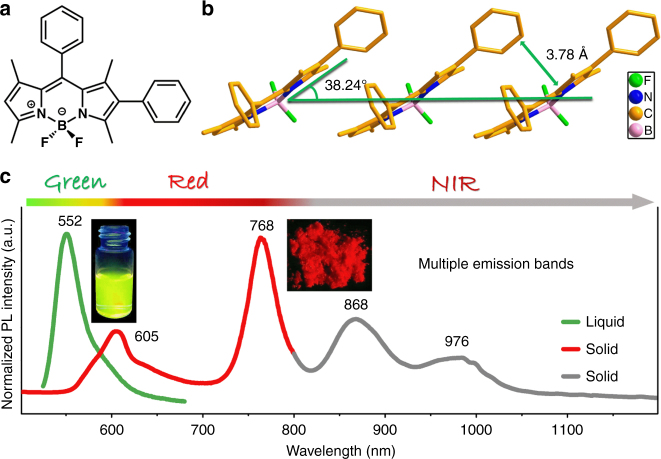
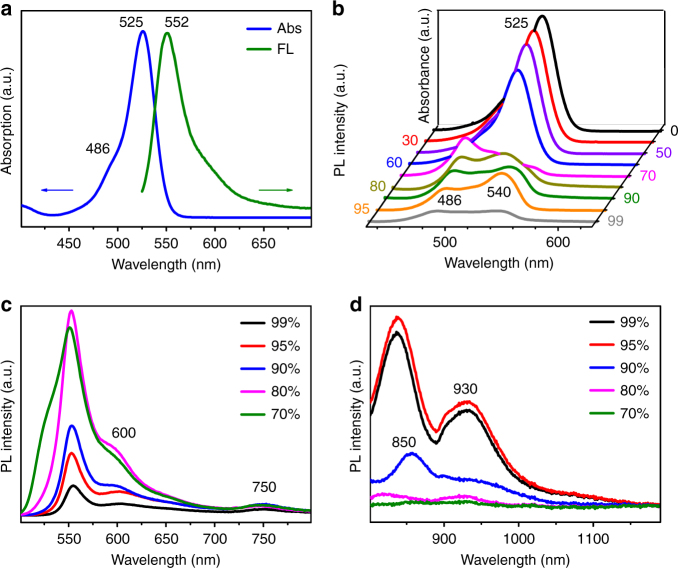
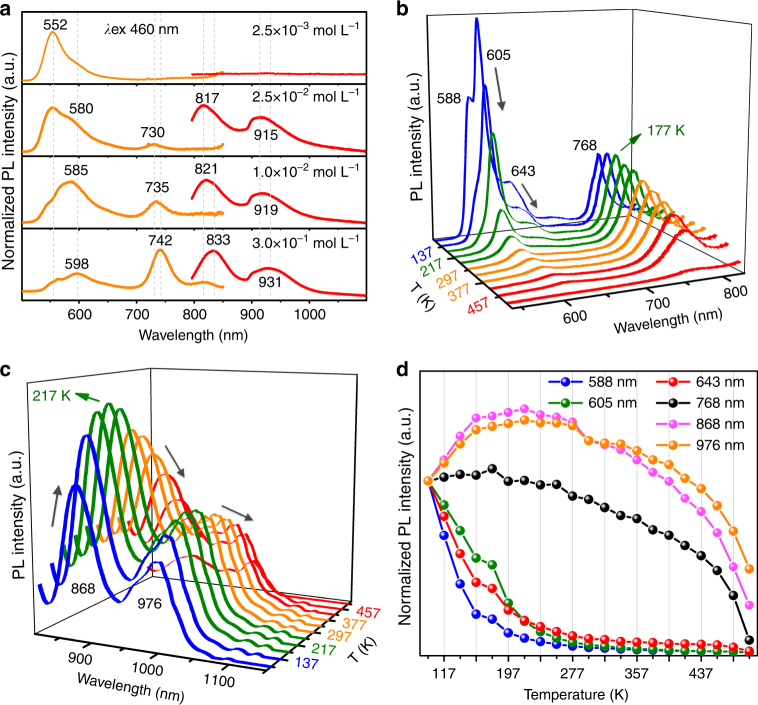
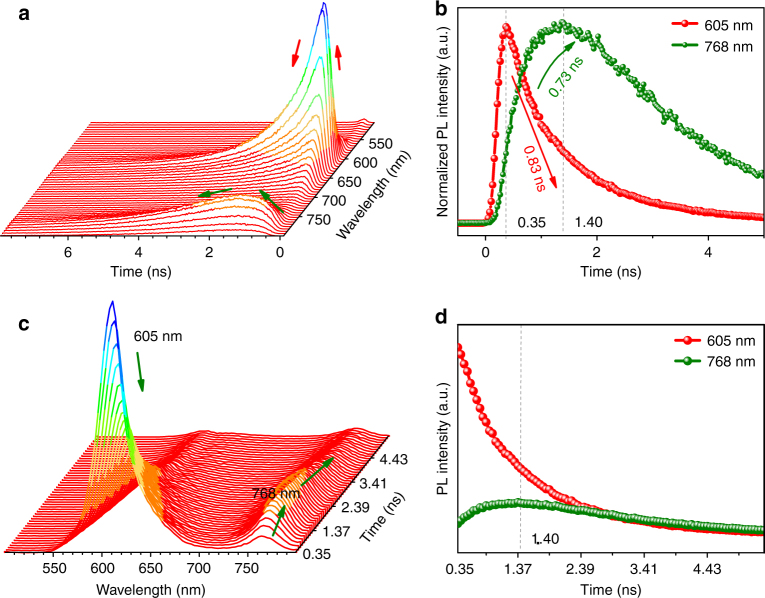
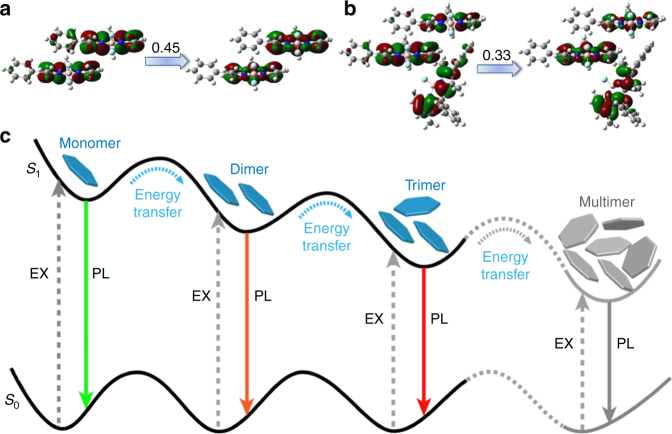
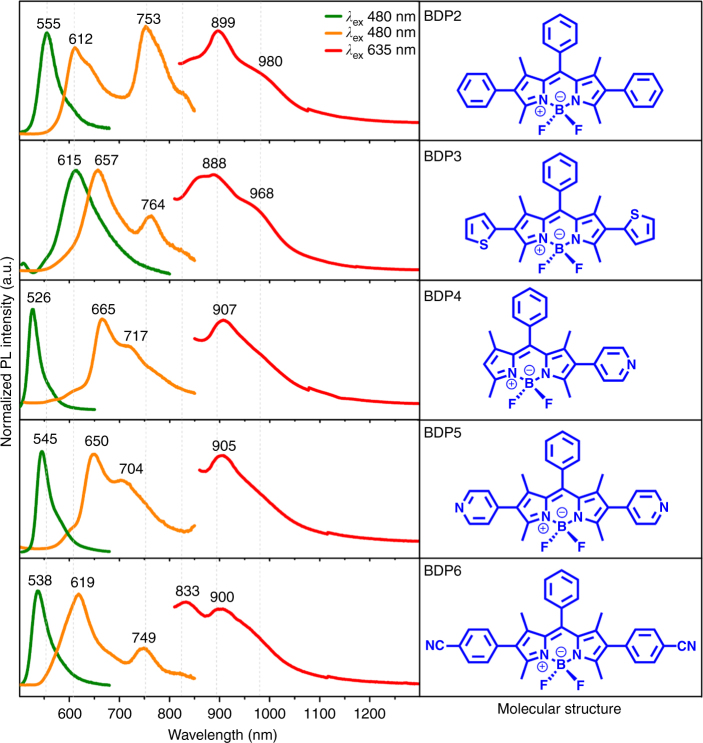
Considerable achievements on multiple emission capabilities and tunable wavelengths have been obtained in inorganic luminescent materials. However, the development of organic counterparts remains a grand challenge. Herein we report a series of 2-/2,6-aryl substituted boron-dipyrromethene dyes with wide-range and multi-fluorescence emissions across red and near infrared in their aggregation states. Experimental data of X-ray diffraction, UV–vis absorption, and room temperature fluorescence spectra have proved the multiple excitation and easy-adjustable emission features in aggregated boron-dipyrromethene dyes. Temperature-dependent and time-resolved fluorescence studies have indicated a successive energy transfer from high to step-wisely lower-located energy levels that correspond to different excitation states of aggregates. Consistent quantum chemical calculation results have proposed possible aggregation modes of boron-dipyrromethene dyes to further support the above-described scenario. Thus, this study greatly enriches the fundamental recognition of conventional boron-dipyrromethene dyes by illustrating the relationships between multiple emission behaviors and the aggregation states of boron-dipyrromethene molecules.
Overview
The claims and statistics of this paper haven’t been checked yet.
Run the check — free, no account needed. It reads the open-access text and checks the sources it cites.
Integrity signals
Registry
Cites
Statistics
Figures
Verification
Claims the paper makes
The claims and statistics of this paper haven’t been checked yet.
Run the check — free, no account needed. It reads the open-access text and checks the sources it cites.
Claims other papers make about this one
Each is checked against this paper’s own text: does it say what the citing paper says it does?
The source backs part of the claim, not all of it — or backs it for a different population, condition or comparison.
In the citing paper
“A spectral shift of the fluorescence emission was observed from 552 nm in tetrahydrofuran (THF) to 605, 768, 868, and 976 nm in the multifluorescence microcrystalline states (formed at varied volumetric factions of water and THF) with a decent Φfl (Φfl = 10%).”
From The Pursuit of Shortwave Infrared-Emitting Nanoparticles with Bright Fluorescence through Molecular Design and Excited-State Engineering of Molecular Aggregates (2022) · cites this paper as [126]
Experimental — accuracy not yet measuredThe source backs part of the claim, not all of it — or backs it for a different population, condition or comparison.
In the citing paper
“Successive domino-like energy transfer in 2-/2,6-aryl substituted BODIPY dyes (BDP1) has been observed from high to step-wisely lower-located energy levels corresponding to different excitation states of aggregates, which leads to multifluorescence emissions across red and NIR-SWIR in their aggregation states (Figure 5b).126”
From The Pursuit of Shortwave Infrared-Emitting Nanoparticles with Bright Fluorescence through Molecular Design and Excited-State Engineering of Molecular Aggregates (2022) · cites this paper as [126]
Experimental — accuracy not yet measured
Self-check
Percentages, sums and reported differences re-computed from the paper’s own numbers.
The self-check needs the paper’s full text.
Citations
Cites
Principles of Fluorescence Spectroscopy
Lakowicz, J. R. (1999) · Springer eBooks · doi:10.1007/978-1-4757-3061-6 · Cited by 26,948
Aggregation-Induced Emission: Together We Shine, United We Soar!
Mei, J., Leung, N. L. C., Kwok, R. T. K., Lam, J. W. Y., & Tang, B. Z. (2015) · Chemical Reviews · doi:10.1021/acs.chemrev.5b00263 · Cited by 8,270
The exciton model in molecular spectroscopy
Kasha, M., Rawls, H. R., & Ashraf El-Bayoumi, M. (1965) · Pure and Applied Chemistry · doi:10.1351/pac196511030371 · Cited by 4,253
Grabowski, Z. R., Rotkiewicz, K., & Rettig, W. (2003) · Chemical Reviews · doi:10.1021/cr940745l · Cited by 3,714
J‐Aggregates: From Serendipitous Discovery to Supramolecular Engineering of Functional Dye Materials
Würthner, F., Kaiser, T. E., & Saha‐Möller, C. R. (2011) · Angewandte Chemie International Edition · doi:10.1002/anie.201002307 · Cited by 2,597
Fluorescent indicators based on BODIPY
Boens, N., Leen, V., & Dehaen, W. (2011) · Chemical Society Reviews · doi:10.1039/c1cs15132k · Cited by 2,271
BODIPY-based probes for the fluorescence imaging of biomolecules in living cells
Kowada, T., Maeda, H., & Kikuchi, K. (2015) · Chemical Society Reviews · doi:10.1039/c5cs00030k · Cited by 1,387
Structural modification strategies for the rational design of red/NIR region BODIPYs
Lü, H., Mack, J. P., Yang, Y., & Shen, Z. (2014) · Chemical Society Reviews · doi:10.1039/c4cs00030g · Cited by 1,343
Self-citationQin, X., Liu, X., Huang, W., Bettinelli, M., & Liu, X. (2017) · Chemical Reviews · doi:10.1021/acs.chemrev.6b00691 · Cited by 1,040
Self-citationLee, C. Y., Farha, O. K., Hong, B. J., Sarjeant, A. A. N., Nguyen, S. T., & Hupp, J. T. (2011) · Journal of the American Chemical Society · doi:10.1021/ja206029a · Cited by 792
Cited by
Sorted by citations
Abdollahi, A., Roghani‐Mamaqani, H., Razavi, B., & Salami‐Kalajahi, M. (2020) · ACS Nano · doi:10.1021/acsnano.0c07289 · Cited by 658
J-aggregates of meso-[2.2]paracyclophanyl-BODIPY dye for NIR-II imaging
Li, K., Duan, X., Jiang, Z., Ding, D., Chen, Y., Zhang, G.-Q., & Liu, Z. (2021) · Nature Communications · doi:10.1038/s41467-021-22686-z · Cited by 301
Self-citationCheng, H., Cao, X., Zhang, S., Zhang, K., Cheng, Y., Wang, J., Zhao, J., Zhou, L., Liang, X., & Yoon, J. (2022) · Advanced Materials · doi:10.1002/adma.202207546 · Cited by 265
Recent Progress of BODIPY Dyes With Aggregation-Induced Emission
Liu, Z., Jiang, Z., Yan, M., & Wang, X. (2019) · Frontiers in Chemistry · doi:10.3389/fchem.2019.00712 · Cited by 191
Self-citationFacile synthesis of AIEgens with wide color tunability for cellular imaging and therapy
Xu, W., Lee, M. M. S., Zhang, Z., Sung, H. H. Y., Williams, I. D., Kwok, R. T. K., Lam, J. W. Y., Wang, D., & Tang, B. Z. (2019) · Chemical Science · doi:10.1039/c8sc05805a · Cited by 148
Metadata
- Authors
- Tian, D., Qi, F., Ma, H., Wang, X., Pan, Y., Chen, R., Shen, Z., Liu, Z., Huang, L., & Huang, W.
- Affiliations
- Nanjing Tech University (CN)
- Nanjing University of Posts and Telecommunications (CN)
- Collaborative Innovation Center of Advanced Microstructures (CN)
- Corresponding author
- Shen, Zhen
- Liu, Zhipeng
- Huang, Ling
- ORCID
- Venue
- Nature Communications
- Published
- 2018-07-12
- Volume
- 9
- Issue
- 1
- Pages
- 2688-2688
- ISSN
- 2041-1723 (ISSN-L)
- PMC
- PMC6043560
- OpenAlex
- W2854672850
- Cited by
- 111
- References
- 42
- Citations by year
- 2026: 7 · 2025: 8 · 2024: 13 · 2023: 17 · 2022: 14 · 2021: 17 · 2020: 18 · 2019: 16 · 2018: 1
- FWCI
- 4.85
- Type
- journal article
- Language
- en
- Open access
- gold
- doi.org
- Locations
- Nature Communications (publishedVersion, cc-by)
- Europe PMC (PubMed Central) (publishedVersion, other-oa)
- PubMed Central (publishedVersion, cc-by)
- PubMed (publishedVersion)
- RePEc: Research Papers in Economics (submittedVersion)
- DOAJ (DOAJ: Directory of Open Access Journals) (submittedVersion)
- DOAJ (DOAJ: Directory of Open Access Journals) (submittedVersion, cc-by-sa)
- Funders
- National Natural Science Foundation of China (21371095)
- Topics
- Physical Sciences › Materials Science › Materials Chemistry › Luminescence and Fluorescent Materials
- Physical Sciences › Chemistry › Spectroscopy › Molecular Sensors and Ion Detection
- Physical Sciences › Chemistry › Physical and Theoretical Chemistry › Photochemistry and Electron Transfer Studies
- Keywords
- BODIPY dyes, boron dipyrromethene, red fluorescence, near-infrared emission, aggregation-induced emission, aggregation state, excitation states, quantum chemical calculations, aggregation modes
About these checks
Registry, retraction, Cites and statistics results are computed, not judged, with one exception: a printed reference that no index lists is read once by a model before it counts as a citation error. Claims are extracted by a model and kept only when their quote appears verbatim in the text; each cited source is then checked, with a model’s help, for whether it says what the claim relies on. Those verdicts can be wrong — read the claim’s quote and the cited source before relying on one.
Statistics and arithmetic are recomputed, not judged.
Confidence bands are shown only for fields calibrated on our annotated test set. None is calibrated yet, so no band is shown.
What counts as a claim ›How we measure confidence ›How we check this ›
Are you an author, or do you see a problem with this page? Request a review
