

Uncovering the heterogeneity and temporal complexity of neurodegenerative diseases with Subtype and Stage Inference
Open accessPublished version of a preprint
The DOI matches its Crossref record; 47 of the 47 references it cites were found in a registry or an index.
Abstract
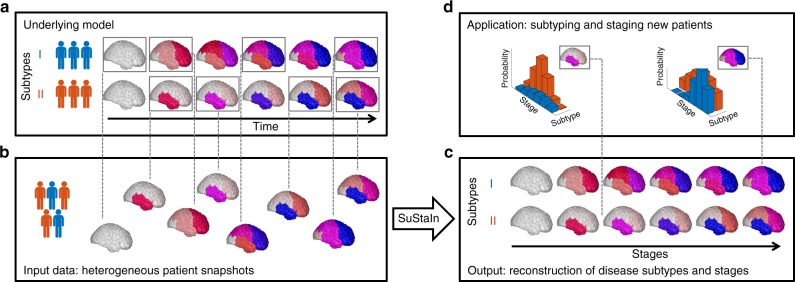
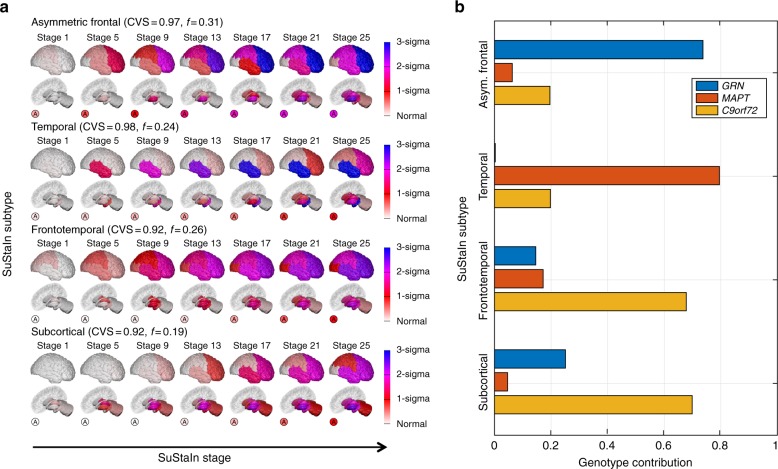
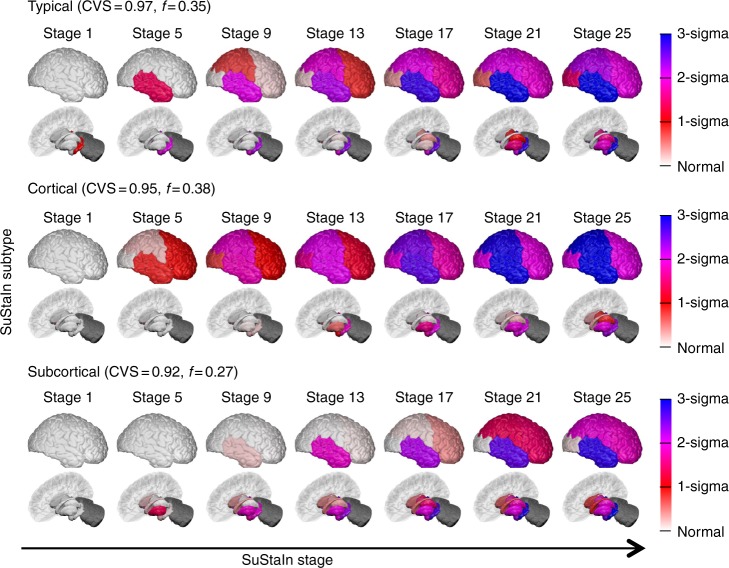
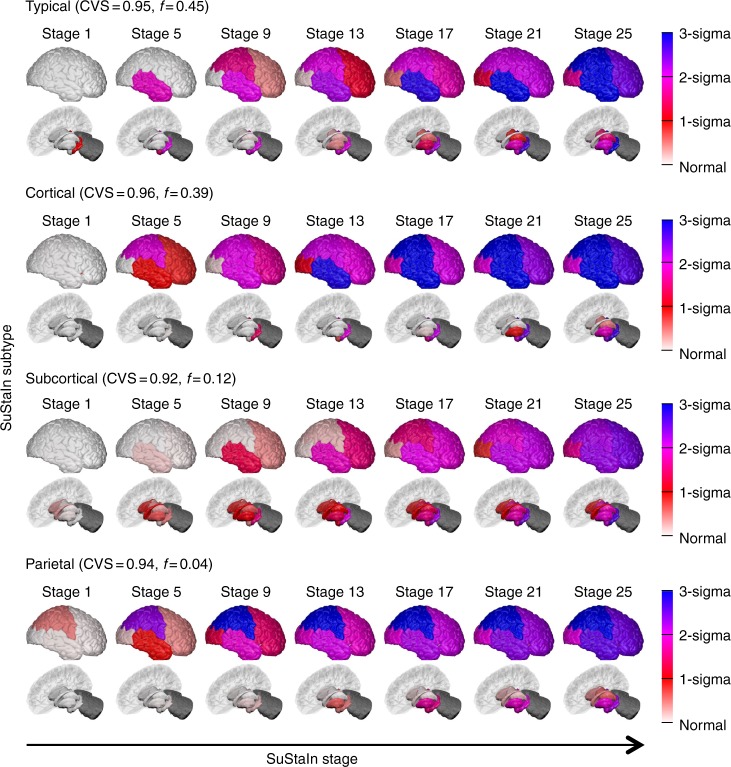
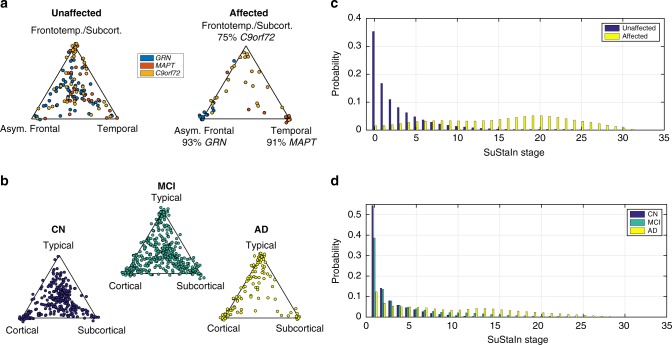
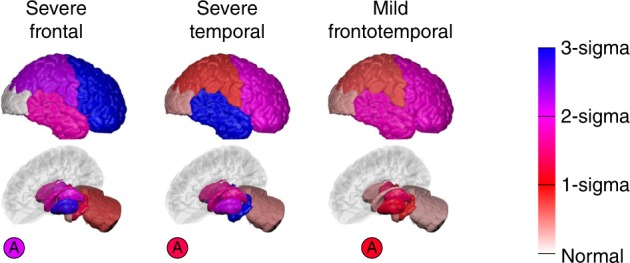
The heterogeneity of neurodegenerative diseases is a key confound to disease understanding and treatment development, as study cohorts typically include multiple phenotypes on distinct disease trajectories. Here we introduce a machine-learning technique—Subtype and Stage Inference (SuStaIn)—able to uncover data-driven disease phenotypes with distinct temporal progression patterns, from widely available cross-sectional patient studies. Results from imaging studies in two neurodegenerative diseases reveal subgroups and their distinct trajectories of regional neurodegeneration. In genetic frontotemporal dementia, SuStaIn identifies genotypes from imaging alone, validating its ability to identify subtypes; further the technique reveals within-genotype heterogeneity. In Alzheimer’s disease, SuStaIn uncovers three subtypes, uniquely characterising their temporal complexity. SuStaIn provides fine-grained patient stratification, which substantially enhances the ability to predict conversion between diagnostic categories over standard models that ignore subtype ( p = 7.18 × 10 −4 ) or temporal stage ( p = 3.96 × 10 −5 ). SuStaIn offers new promise for enabling disease subtype discovery and precision medicine.
Overview
The claims and statistics of this paper haven’t been checked yet.
Free: it reads the open-access text and checks the first 5 claims that cite a source we can check. Create a free account to check every claim.
Integrity signals
Registry
Cites
Statistics
Figures
Verification
Claims the paper makes
The claims and statistics of this paper haven’t been checked yet.
Free: it reads the open-access text and checks the first 5 claims that cite a source we can check. Create a free account to check every claim.
Claims other papers make about this one
Each is checked against this paper’s own text: does it say what the citing paper says it does?
The cited source says what the claim attributes to it.
In the citing paper
“The Subtype and Stage Inference (SuStaIn) algorithm identifies data-driven phenotypes with unique temporal patterns from cross-sectional data”
From Multimodal neuroimaging and AI integration in cognitive disorders: advances, challenges, and future directions for precision medicine (2026) · cites this paper as Young et al., 2018
Experimental — accuracy not yet measuredThe cited source says what the claim attributes to it.
In the citing paper
“In FTD, SuStaIn reveals genetic subtypes and within-genotype heterogeneity from imaging; in AD, it delineates three subtypes with characteristic neuroanatomical sequences.”
From Multimodal neuroimaging and AI integration in cognitive disorders: advances, challenges, and future directions for precision medicine (2026) · cites this paper as Young et al., 2018
The cited source says what the claim attributes to it.
In the citing paper
“The Sustain algorithm can identify phenotypes in genetic FTD from imaging alone while in AD it has uncovered three subtypes opening opportunities for disease subtype phenotyping and better precision medicine [246].”
From The use of neuroimaging techniques in the early and differential diagnosis of dementia (2023) · cites this paper as [246]
The cited source says what the claim attributes to it.
In the citing paper
“Nevertheless, considering the complexity and variability of the different types of dementia along with the presence of mixed pathologies, machine learning algorithms, such as the Subtype and Stage inference (Sustain) have been introduced to discover data-driven disease phenotypes with distinct temporal progression patterns [246].”
From The use of neuroimaging techniques in the early and differential diagnosis of dementia (2023) · cites this paper as [246]
Self-check
Percentages, sums and reported differences re-computed from the paper’s own numbers.
The self-check needs the paper’s full text.
Citations
Cites
Clinical and biomarker changes in dominantly inherited Alzheimer's disease
Bateman, R. J., Xiong, C., Benzinger, T. L. S., Fagan, A. M., Goate, A., Fox, N. C., Marcus, D. S., Cairns, N. J., Xie, X., Blazey, T. M., et al. (2012) · New England Journal of Medicine · doi:10.1056/nejmoa1202753 · Cited by 3,814
Self-citationVillemagne, V. L., Burnham, S., Bourgeat, P., Brown, B., Ellis, K. A., Salvado, O., Szoeke, C., Macaulay, S. L., Martins, R., Maruff, P., et al. (2013) · The Lancet Neurology · doi:10.1016/s1474-4422(13)70044-9 · Cited by 2,279
Understanding predictive information criteria for Bayesian models
Gelman, A., Hwang, J., & Vehtari, A. (2014) · Statistics and Computing · doi:10.1007/s11222-013-9416-2 · Cited by 2,104
Cerebrospinal fluid biomarker signature in Alzheimer's disease neuroimaging initiative subjects
Shaw, L. M., Vanderstichele, H., Knapik‐Czajka, M., Clark, C. M., Aisen, P. S., Petersen, R. C., Blennow, K., Soares, H., Simon, A., Lewczuk, P., et al. (2009) · Annals of Neurology · doi:10.1002/ana.21610 · Cited by 2,065
Self-citationQualitative Assessment of Verbal Fluency Performance in Frontotemporal Dementia
van den Berg, E., Jiskoot, L. C., Grosveld, M. J. H., van Swieten, J. C., & Papma, J. M. (2017) · Dementia and Geriatric Cognitive Disorders · doi:10.1159/000477538 · Cited by 2,046
Self-citationBhattacharyya, A. (1943) · Medical Entomology and Zoology · Cited by 2,002
Iturria-Medina, Y., Sotero, R. C., Toussaint, P. J., Mateos-Pérez, J. M., Evans, A. C., Initiative, T. A. D. N., Weiner, M. W., Aisen, P., Petersen, R., Jack, C. R., et al. (2016) · Nature Communications · doi:10.1038/ncomms11934 · Cited by 1,202
Self-citationReview Article: Genetics of Alzheimer Disease
Bekris, L. M., Yu, C.-E., Bird, T. D., & Tsuang, D. W. (2010) · Journal of Geriatric Psychiatry and Neurology · doi:10.1177/0891988710383571 · Cited by 1,029
Murray, M. E., Graff-Radford, N. R., Ross, O. A., Petersen, R. C., Duara, R., & Dickson, D. W. (2011) · The Lancet Neurology · doi:10.1016/s1474-4422(11)70156-9 · Cited by 972
Self-citationA network diffusion model of disease progression in dementia
Raj, A., Kuceyeski, A., & Weiner, M. (2012) · Neuron · doi:10.1016/j.neuron.2011.12.040 · Cited by 723
Self-citation
Research works printed but not linked: 2
- Huang, J. & Alexander, D. Advances in Neural Information Processing Systems 3104–3112 (The MIT Press, Cambridge, MA, 2012).
- Kass, R. E. & Raftery, A. E. Bayes factors. J. R. Stat. Soc. Ser. B 90, 773–795 (1995).
Cited by
Items 501–600 of 632
Dou, X., Wang, J., Hu, D., Wang, H., Yu, C., Zhou, R., Zhang, X., Yao, Q., Tian, M., Zhang, H., et al. (2025) · European Journal of Nuclear Medicine and Molecular Imaging · doi:10.1007/s00259-025-07509-3
Methods for Measuring Neural Oscillations in Mental Disorders
Atagün, M. İ., Tamura, S., & Hirano, Y. (2025) · Springer eBooks · doi:10.1007/978-3-031-73368-0_105
Sarkar, N. D., Tandon, R., Lah, J. J., & Mitchell, C. S. (2025) · International Journal of Molecular Sciences · doi:10.3390/ijms26188973 · Cited by 1
Self-citationRobust Topographical Representation for Longitudinal Propagation of Tau Pathology
Yue, J., Zhang, J., Wang, X., & Shi, Y. (2025) · Lecture notes in computer science · doi:10.1007/978-3-032-05162-2_56
Reply: Methodological considerations for advancing general paresis research
Fei, C.-J., Chen, K., Wang, R., & Yu, J.-T. (2025) · Brain · doi:10.1093/brain/awaf358
Self-citationSpatiotemporal patterns of amyloid deposition as prognostic markers of Alzheimer’s disease
Amemiya, S., Takao, H., & Abe, O. (2025) · Neuroradiology · doi:10.1007/s00234-025-03781-0
Juxtacortical White Matter Staging as a Correlate of Progression in Alzheimer Disease
Schoonheim, M. M. (2025) · Radiology · doi:10.1148/radiol.252559
Leal, G. C., Konuri, A., Young, A. L., Zebarjadi, N., Samantaray, T., Habich, A., Castellanos-Perilla, N., González, M. C., Taylor, J., Firbank, M., et al. (2025) · medRxiv · doi:10.1101/2025.10.03.25337171
Self-citationDynamic causal discovery in Alzheimer's disease through latent pseudotime modellingPreprint
Glazman, N., Mangal, J., Borges, P., Ourselin, S., & Cardoso, M. J. (2025) · arXiv (Cornell University) · doi:10.48550/arxiv.2511.04619
FastEBM: Robust Disease Progression Inference at Scale
Javid, S., Bhatt, R. R., Zhu, A. H., Aksman, L., Nir, T. M., & Jahanshad, N. (2025) · Lecture notes in computer science · doi:10.1007/978-3-032-07904-6_19
Magnetic Resonance Imaging in Dementia
Anastassiadis, C., Rosen, H. J., & Tartaglia, M. C. (2025) · Cambridge University Press eBooks · doi:10.1017/9781108985055.007
Self-citationRegional brain aging patterns reveal disease-specific pathways of neurodegenerationPreprint
Vakli, P., Weiss, B., Keresztes, A., Hermann, P., Initiative, A. D. N., Cole, J. H., & Vidnyánszky, Z. (2025) · medRxiv · doi:10.1101/2025.11.12.25339989 · Cited by 1
Wang, L., Ambekar, A., & Eloyan, A. (2025) · arXiv (Cornell University) · doi:10.48550/arxiv.2511.01732
An Integrated Data-Driven Model for Clinical Phenotyping of Tuberculosis Disease SeverityPreprint
Malatesta, S., Jacobson, K. R., Horsburgh, C. R., Farhat, M. R., Carney, T., Gile, K. J., Kolaczyk, E. D., & White, L. F. (2025) · medRxiv · doi:10.1101/2025.11.25.25341018
Yu, Y., Ge, R., Hacihaliloglu, I., Rauscher, A., Tam, R. C., & Frangou, S. (2026) · Biological Psychiatry · doi:10.1016/j.biopsych.2026.03.800
Vik, A., Kociński, M., Rye, I., Lundervold, A. J., & Lundervold, A. S. (2024) · Figshare · doi:10.6084/m9.figshare.26579660
Vik, A., Kociński, M., Rye, I., Lundervold, A. J., & Lundervold, A. S. (2024) · Figshare · doi:10.6084/m9.figshare.26579657
Additional file 1 of Novel data-driven subtypes and stages of brain atrophy in the ALS–FTD spectrum
Shen, T., Vogel, J. W., Duda, J., Phillips, J. S., Cook, P. A., Gee, J., Elman, L., Quinn, C. C., Amado, D. A., Baer, M., et al. (2024) · Figshare · doi:10.6084/m9.figshare.26650728
Additional file 1 of Data-driven FDG-PET subtypes of Alzheimer’s disease-related neurodegeneration
Levin, F., Ferreira, D., Lange, C., Dyrba, M., Westman, E., Buchert, R., Teipel, S. J., & Grothe, M. J. (2021) · Figshare · doi:10.6084/m9.figshare.14068058
Golriz Khatami, S., Salimi, Y., Hofmann‐Apitius, M., Oxtoby, N. P., & Birkenbihl, C. (2022) · Figshare · doi:10.6084/m9.figshare.19624375
Self-citationO’Connor, A., Weston, P. S. J., Pavisic, I. M., Ryan, N. S., Collins, J. D., Lu, K., Crutch, S. J., Alexander, D. C., Fox, N. C., & Oxtoby, N. P. (2020) · Figshare · doi:10.6084/m9.figshare.13059304
Self-citationDing, W., Ren, P., Yi, L., Si, Y., Yang, F., Li, Z., Bao, H., Yan, S., Zhang, X., Li, S., et al. (2023) · Figshare · doi:10.6084/m9.figshare.22620649
Nte Pian, M.-E. (2022) · DSpace - NTUA (National Technical University of Athens) · doi:10.26240/heal.ntua.23692
Analyse de la synchronie motrice chez le sujet âgé : étude pilote synchroMCI
Creyssels, S. (2024) · HAL
Improving Wellbeing in At-Risk Frontotemporal Dementia
Greaves, C. V. (2024) · UCL Discovery (University College London)
鈴木, 皓., & スズキ, ア. (2025) · Institutional Repositories DataBase (IRDB)
Huang, X. (2024) · IUScholarWorks (Indiana University) · doi:10.7912/zjrk-jj82
Graphical modeling of cortical tau pathology topography for its subtyping in Alzheimer’s disease
Yue, J., Wang, X., Ringman, J. M., & Shi, Y. (2026) · Imaging Neuroscience · doi:10.1162/imag.a.1110
Comprehensive Review of Neurodegenerative Disorders
Al-Sharafi, N. M. N., & Alaza, Z. (2026) · Kufa Journal For Veterinary Medical Sciences · doi:10.36326/kjvs/2025/v16i218768
Park, C. W., Choi, Y., Sun, Y., Lee, H. S., Lee, P. H., Kim, Y. J., Sohn, Y. H., Lee, J. M., & Chung, S. J. (2026) · Alzheimer s & Dementia · doi:10.1002/alz.71130 · Cited by 1
Alpha-synuclein propagation trajectories in a population-based postmortem cohortPreprint
Khalafi, P., Vogel, J. W., Boghammer, P., Raunio, A., Kivistö, V., Savola, S. E., Kok, E., Mikhailenko, E., Myllykangas, L., & Dagher, A. (2026) · medRxiv · doi:10.64898/2026.01.13.26343943
Chen, X., Zhang, X. R., Xiong, W., Wang, T., Jia, A., Feng, Q., & Huang, M. (2026) · Medical Image Analysis · doi:10.1016/j.media.2026.103952
Time’s up: Using data-driven phenotype-severity metrics not time to map progression in the dementiasPreprint
Smith, V., Schumacher, R., Ramanan, S., Bouzigues, A., Russell, L. L., Foster, P. H., Ferry‐Bolder, E., Swieten, J. C. V., Jiskoot, L. C., Seelaar, H., et al. (2026) · medRxiv · doi:10.64898/2026.01.28.26344700
Self-citationSun, J., Zheng, Y., Yu, Q., Wang, J., Jiang, Z., & Xue, S. (2026) · Journal of Affective Disorders · doi:10.1016/j.jad.2026.121433 · Cited by 1
Song, Y., Zhang, M., & Yang, J. (2025) · International Conference on Computer Science, Electronic Information Engineering and Intelligent Control Technology (CEI) · doi:10.1109/cei66465.2025.11398608
McSweeney, T. P., Akkaya, Z., Zhou, J., Wu, P.-H., Bonnheim, N. B., Link, T. M., Karppinen, J. I., Lotz, J. C., Saarakkala, S. S., Fields, A. J., et al. (2026) · European Spine Journal · doi:10.1007/s00586-026-09840-1
“These include validation using simulated data [14, 16 ], classification tasks [ 14], replication in external data-sets [16], and longitudinal stability of trajectories [29].”
InfluentialTowards unified multimodal cross-scale modelling of neurodegenerative diseases
Leng, F., & Yang, Z. (2026) · Brain Science Advances · doi:10.26599/bsa.2026.905010
Data-driven schizophrenia subtyping via brain atrophy trajectories and functional connectivity
Yoshimaru, D., Ouchi, K., Shibukawa, S., Ozawa, M., Hirabayashi, M., Yuzawa, A., Tsurugizawa, T., Oishi, K., & Okano, H. J. (2026) · Translational Psychiatry · doi:10.1038/s41398-026-03968-w
Distinct Biotypes of Visual Perception in Major Depressive Disorder
Cai, Z., Hu, X., Li, Y., Lin, Z., Li, Y., Cai, Y., Xu, T., Jia, K., Han, J., Tan, Z., et al. (2026) · Advanced Science · doi:10.1002/advs.74882
Hemedan, A. A., Despotović, V., Lukashiv, T., Rian, K., Jónsdóttir, S. R., Pauly, C., Pavelka, L., Béchet, S., Ademola, E., Leonard, M. V., et al. (2026) · medRxiv · doi:10.64898/2026.03.19.26348807
A unified model for staging amyloid and tau pathology in Alzheimer’s diseasePreprint
Earnest, T., Yang, B., Chowdhury, A., Ha, S. M., Bani, A., Kim, S. B., Nazeri, A., Morris, J. C., Benzinger, T. L. S., Gordon, B. A., et al. (2026) · medRxiv · doi:10.64898/2026.03.30.26349752
Self-citationAlzheimer’s Disease Brain Phenotypes are Age-dependentPreprint
Travi, F., Mehta, A., Castro, E., Li, H., Reinen, J., Dhurandhar, A., Meyer, P., Slezak, D. F., Cecchi, G., & Polosecki, P. I. (2026) · bioRxiv (Cold Spring Harbor Laboratory) · doi:10.64898/2026.03.31.715296
“However, an alternative view argues that more effective group identification emerges from disentangling target phenotypes from their degree of progression (Young et al. 2018; Wang et al. 2024).”
Nguyen, D. (2024) · theses.fr (ABES) · doi:10.70675/378a11d7zcd05z4a0az9653z25af633d0bdb · Cited by 1
Self-citationBrain Functional Evolution in ADHD Subtypes Via Contrastive Learning
Gao, Y., Gao, J., Tang, Y., Jiang, A., & Chen, Y. (2026) · IEEE International Conference on Acoustics Speech and Signal Processing · doi:10.1109/icassp55912.2026.11463822
Lebrun‐Frénay, C., Renard, F., Mondot, L., Landes-Château, C., Stewart, A., Cohen, M., Okuda, D. T., & Attyé, A. (2026) · PLOS Digital Health · doi:10.1371/journal.pdig.0001374
Wan, B., Larivière, S., Moreau, C. A., Warrier, V., Bethlehem, R. A. I., Fan, Y., He, Y., Agartz, I., Nerland, S., Jönsson, E. G., et al. (2026) · medRxiv · doi:10.64898/2026.04.25.26351736
Self-citationWang, D., Yan, S., Zhou, R., Li, Y., Liu, L., Wei, Y., Wang, D., Yao, H., Zhou, B., Lu, J., et al. (2026) · Science Advances · doi:10.1126/sciadv.aef3787
Shen, Y., Pang, H., Liu, H., Ma, P., Liu, M. W., Li, Y., Wang, Q., Xie, X., Zhang, X., & Zhao, Y. (2026) · Genes · doi:10.3390/genes17050536
“Recent advances in machine learning, specifically the Subtype and Stage Inference (SuStaIn) algo-rithm, have made it possible to map the most probable sequences of mutation accumulation within “pseudo-time” stages [24–26].”
Alzheimer’s disease subtyping approaches and the role of co-pathologies
Gawor, K., Statz, K., Schaeverbeke, J. M., & Thal, D. R. (2026) · Brain · doi:10.1093/brain/awag157
Kar, P., Roy, D., & Kar, B. R. (2026) · The Neuroscientist · doi:10.1177/10738584261497262
Yang, Y., Wu, T., Fan, X., Yao, Y., Chen, C., Kang, K., Tang, X., Huang, T., Xu, Y., He, Y., et al. (2026) · Advanced Materials · doi:10.1002/adma.202516343 · Cited by 3
Yang, X., Lyu, J., Wang, J., & Quan, Y. (2026) · BMC Neuroscience · doi:10.1186/s12868-026-01035-0
“However, disentangling differences in disease stage from differences in spatial distribution remains essential for improving biological interpretability [30].”
CogBioINet—Cognitive-Biomarker Integration Network for Diagnosis of Neurocognitive Disorders
Jabasheela, L., Kshirsagar, P. R., Tak, T. K., & Sonekar, S. V. (2026) · International journal of Nutrition Pharmacology Neurological Diseases · doi:10.4103/ijnpnd.ijnpnd_110_25
Reframing Alzheimer's disease as a complex adaptive system: More than an amyloid beta–tau connection
Giorelli, M. (2026) · Alzheimer s & Dementia Translational Research & Clinical Interventions · doi:10.1002/trc2.70256 · Cited by 1
“46 Taken together, these theoretical perspectives suggest that CAS phenotypes can be formally represented as stable regions or attractor manifoldswithinamultidimensionalpathologicalstatespacegoverned by non-linear biochemical kinetics, network-constrained propagation, and stochastic biomarker…”
Generative AI for CSF multi-omics: Learning strategies for small-cohort classification
Wuyart, A., & Millot, J. (2026) · Neuroscience Informatics · doi:10.1016/j.neuri.2026.100278
Disease Progression and Subtype Modeling for Combined Discrete and Continuous Input Data
de Jonge, S., Vinke, E. J., Vernooij, M. W., Alexander, D. C., Young, A. L., & Bron, E. E. (2026) · IEEE International Symposium on Biomedical Imaging (ISBI) · doi:10.1109/isbi61048.2026.11515542 · Cited by 1
“Table 1 summarizes the existing models that can be embedded in Subtype and Stage Inference (SuStaIn) [3], illustrating the different suitable input data types corresponding to the underlying biomarker trajectory.”
InfluentialSelf-citationRullmann, M., Henssen, D. J. H. A., Brendel, M., Rumpf, J., Levin, J., Perneczky, R., Tiepolt, S., Patt, M., Schildan, A., Mueller, A., et al. (2026) · The EANM Journal · doi:10.1016/j.eanmj.2026.100226
Geometric brain signatures of Alzheimer’s disease progression and subtypesPreprint
Tong, B., Cao, T., Duong-Tran, D., Davatzikos, C. A., Thompson, P. M., Saykin, A. J., Fornito, A., Shen, L., & Initiative, T. F. L. D. N. (2026) · medRxiv · doi:10.64898/2026.05.14.26353211 · Cited by 1
Self-citationLyu, X., Brown, C., Duong, M. T., Fischer, E. P., McGrew, E., Irwin, D. J., Dickerson, B. C., Nasrallah, I. M., Shinohara, R. T., Young, A. L., et al. (2026) · Alzheimer s & Dementia · doi:10.1002/alz.71474 · Cited by 1
Self-citationBrainBMT: Geometric Deep Learning for Clinical Subtyping Via Multi-batch Brain Network Fusion
Chen, J., Liu, J., Sheng, X., Yao, Z., & Cai, H. (2026) · Fundamental Research · doi:10.1016/j.fmre.2026.05.010
Patterns of Typical and Atypical Age-related Brainstem Volume lossesPreprint
Mueller, S., & Mackin, R. S. (2026) · bioRxiv (Cold Spring Harbor Laboratory) · doi:10.64898/2026.05.21.726989
Multi-Trajectory Pseudotime Inference via Permutation FactorizationsPreprint
Farina, R., Wang, Y., Gabitto, M. I., Agrawal, A., & Mena, G. E. (2026) · bioRxiv (Cold Spring Harbor Laboratory) · doi:10.64898/2026.05.27.728207
“…for neurodegenerative dynamics that assigns each donor a latent pseudotime and models pathology measurements as smooth functions of this latent disease axis, thereby moving from discrete stage labels [Young et al., 2018] toward continuous progression inference in cross-sectional neuropathology.”
Qi, Y., Hsu, E., Lee, S., Luo, S., & Zhu, X. (2026) · bioRxiv (Cold Spring Harbor Laboratory) · doi:10.64898/2026.05.25.727436
“We applied Subtype and Stage Inference (SuStaIn), a data-driven approach, to identify distinct cortical thickness subtypes and infers their progression trajectory from cross-sectional data 24 .”
InfluentialMagomedova, A. M., Magomedova, Z. M., Gamzaeva, Z. M., Cherivova, K. A., Afonina, A. G., Asadova, A. I., Kalandarova, M. K., & Molchanov, N. V. (2026) · Genetics and Molecular Research · doi:10.4238/dp1fw924
Kalkhof, J., & Lorenzi, M. (2026) · Lecture notes in computer science · doi:10.1007/978-3-032-38470-6_60
Two distinct patterns of progression of sporadic cerebral small vessel disease
Chen, Y. T., Hong, H., Tozer, D. J., Sun, Z., Cai, L., Li, H., Tuladhar, A. M., de Leeuw, F., & Markus, H. S. (2026) · International Journal of Stroke · doi:10.1177/17474930261459792
“13,14 In this cohort study, we used SuStaIn to construct a data-driven trajectory of cSVD progression using five MRI markers in two independent longitudinal cohorts of symptomatic cSVD (Figure 1).”
Sun, Y., Choi, Y., Park, C. W., Na, H. K., Lee, H. S., Kim, Y. J., Sohn, Y. H., Lee, P. H., Lee, J., & Chung, S. J. (2026) · Movement Disorders · doi:10.1002/mds.70398
Yu, Q., Guan, X., Wu, J., Sun, X., Chen, Q., Yu, D., Liu, L., Kuang, G., Li, J., Hu, X., et al. (2026) · European Journal of Nuclear Medicine and Molecular Imaging · doi:10.1007/s00259-026-07975-3
“The Subtype and Stage Inference (SuStaIn) model addresses this limitation by jointly modeling spatial and temporal disease processes [25 ].”
Pinnawala, S., Hartanto, A., Jairamani, M., Simpson, I., & Wijeratne, P. A. (2026) · bioRxiv (Cold Spring Harbor Laboratory) · doi:10.64898/2026.06.07.730710
“Subsequent work extended the method to model disease subtypes with distinct progression sequences [20].”
A Quantitative Analysis of Multimodal Biomarkers in Alzheimer’s Disease
Scardace, A., & Ravì, D. (2026) · IEEE Symposium on Computers and Communications (ISCC) · doi:10.1109/iscc70364.2026.11740084 · Cited by 1
“To address this limitation, we applied SuStAIn [12], an unsupervised algorithm that reconstructs disease trajectories from cross-sectional data.”
InfluentialPereira, H. R., Diogo, V. S., Fonseca, J., Ferreira, H. A., & Prata, D. P. (2026) · Clinical Neuroradiology · doi:10.1007/s00062-026-01688-8 · Cited by 2
Predicting pattern and spread of brain atrophy and tau deposition in progressive supranuclear palsy
Ghirelli, A., Ali, F., Stephens, Y. C., Clark, H. M., Stierwalt, J. A. G., Machulda, M. M., Agosta, F., Filippi, M., Dickson, D. W., Lowe, V. J., et al. (2026) · NeuroImage Clinical · doi:10.1016/j.nicl.2026.104031
Subtyping and staging of Alzheimer’s disease from routine structural MRI with PHASE–ADPreprint
Baumeister, H., Lüsebrink, F., Kleineidam, L., Hansen, N., Schmid, M., Moscoso, A., Leuzy, A., Mastenbroek, S. E., Groot, C., Brosseron, F., et al. (2026) · medRxiv · doi:10.64898/2026.06.26.26356678
Senescent cell heterogeneity in brain aging and neurodegenerative disease
Graves, S. I., Vasques, P. D. C., & Baker, D. J. (2026) · Neuron · doi:10.1016/j.neuron.2026.06.020
Hani, M., Betrouni, N., Melonou, J. T., Mahmoudi, S., & Benjelloun, M. (2026) · Electronics · doi:10.3390/electronics15153368
Benbaji, M., Raveh, B., Bassal, L., Elias, U., Gazit, L., Allali, G., Marshall, G. A., & Arzy, S. (2026) · Brain · doi:10.1093/brain/awag248
Self-citationEducational attainment and sex modulate clinical outcomes in genetic frontotemporal dementia
Premi, E., Archetti, D., Redolfi, A., Bracca, V., Cantoni, V., Iraji, A., Calhoun, V. D., Bellini, S., Ghidoni, R., Gasparotti, R., et al. (2026) · Brain Communications · doi:10.1093/braincomms/fcag262
“Future work could investigate the possibility of multiple disease progressions 36,37 that may be associated with specific FTD mutations as well as for sporadic FTD patients.”
Self-citationTotzek, J. F., Heckers, S., Palaniyappan, L. K., Young, A. L., Shah, J. L., Joober, R., MALLA, A. K., Chakravarty, M. M., Lavigne, K. M., & Lepage, M. (2026) · Cortex · doi:10.1016/j.cortex.2026.07.007
Self-citationCryptic disease-prone states in human mesocortical assembloids revealed by multimodal profilingPreprint
Kim, S. J., Kang, R., Lee, T. R., Kim, Y., Kim, C., Koo, K., Na, J., Lee, S., Kim, D., Oh, H., et al. (2026) · bioRxiv (Cold Spring Harbor Laboratory) · doi:10.64898/2026.08.01.742201
Self-citationA literature review of using artificial intelligence to investigate type 2 diabetes and dementia
Nguyen, D., Billion-Polak, P., & Khoshgoftaar, T. M. (2026) · Journal Of Big Data · doi:10.1186/s40537-026-01523-4
Self-citationSex differences in connectivity-based prediction of working memory and its neural organization
Zhuo, L., Xiong, R., Zhang, T., Wei, X., Zhang, J., Jin, Z., & Li, L. (2026) · Cognitive Neurodynamics · doi:10.1007/s11571-026-10525-0
“Many psychiatric and neurological disorders are marked by substantial heterogeneity in symptoms, pathophysiology, and brain organization, which may make models trained directly within patient groups more difficult to stabilize and gener - alize (Young et al. 2018; Wei et al. 2025).”
Houwer, J. F. H. D., Kang, W., van Buuren, R., de Boer, L., Swartenbroekx, T., Rajicic, A., Bouzigues, A., Russell, L. L., Foster, P. H., Ferry‐Bolder, E., et al. (2026) · Alzheimer s Research & Therapy · doi:10.1186/s13195-026-02159-5
Self-citationHuang, C., Watanabe, K., Kosaka, Y., & Nihey, F. (2026) · IEEE International Conference on Healthcare Informatics (ICHI) · doi:10.1109/ichi69079.2026.00225
“Second, we evaluated the SuStaIn output using global diagnosis–stage consistency and subtype-wise stage ordering [7], [8].”
Ma, L., Cao, Y., Liu, N., Sun, Q., Walton, C., & Wang, Y. (2026) · Biological Psychiatry Cognitive Neuroscience and Neuroimaging · doi:10.1016/j.bpsc.2026.07.018 · Cited by 2
Cell Death in Neurodegenerative Diseases: Molecular Mechanisms and Therapeutic Targets
Li, T., Zhang, Q., Wu, Y., & Huang, R. (2026) · MedComm · doi:10.1002/mco2.70915 · Cited by 1
“Human NDs, by contrast, are often diagnosed after substantial neuronal loss and are shaped by broader genetic, inflammatory, vascular, and environmental heterogeneity [ 350 ].”
Binding, L. P., Liu, S., Ansara, A., Miserocchi, A., McEvoy, A. W., Altmann, A., Young, A. L., Duncan, J. S., Baxendale, S., Koepp, M. J., et al. (2026) · medRxiv · doi:10.64898/2026.08.17.26360571
Self-citationvan Haaften, M. F., Koorn, N. J., Vinke, E. J., Vos, F. M., Vrooman, H. A., van Bruchem-Visser, R. L., Seelaar, H., Mattace-Raso, F. U. S., van den Berg, E., Vernooij, M. W., et al. (2026) · Neurology Open Access · doi:10.1212/wn9.0000000000000120
Fotouhi, M., Chui, H. C., Choupan, J., Jahanshad, N., Cen, S., Varghese, B. A., Ringman, J. M., Schneider, L. S. S., & Sheikh‐Bahaei, N. (2026) · Brain Communications · doi:10.1093/braincomms/fcag312
Self-citationSöntgerath, M., Cutini, S., Thöne-Otto, A. I. T., Engel, A., Regenbrecht, F., Polyakova, M., Mueller, K., Scherf, N., Böhm, F., Anderl‐Straub, S., et al. (2026) · Frontiers in Dementia · doi:10.3389/frdem.2026.1757680
“Future studies may therefore benefit from focusing on clearly defined disease stages, whether by stratifying patient groups based on staging instruments such as the FTLD-CDR or by applying ML tools such as subtype and stage inference (SuStaIn) (Young et al., 2018).”
Data‐Driven SuStaIn Model of Disability Progression in Amyotrophic Lateral Sclerosis
Milella, G., Vacchiano, V., Velucci, V., Zoccolella, S., Liguori, R., & Defazio, G. (2026) · Annals of Clinical and Translational Neurology · doi:10.1002/acn3.70519 · Cited by 1
A Subtyping Study of Patients with Alzheimer’s Disease Based on Brain Functional Dynamics
Liang, Y., Wang, K., Ma, Y., Yan, Z., Yan, T., & Liu, T. (2026) · Journal of Physics Conference Series · doi:10.1088/1742-6596/3291/1/012020
Lu, N. (2026) · Drug Discovery Today · doi:10.1016/j.drudis.2026.104795
Vijayakumari, A. A., Sakaie, K., Fernandez, H. H., & Walter, B. L. (2026) · Frontiers in Aging Neuroscience · doi:10.3389/fnagi.2026.1819248
“Hierarchical clustering and k-means identify groups of patients with similar imaging characteristics, whereas HYDRA identifies distinct patterns of patient-control deviation, and SuStaIn simultaneously models disease subtype and disease stage.”
Influentialデータ駆動型病態進行モデリングを用いたパーキンソン病の解析とその機械学習による拡張
神, 亮. (2024) · Institutional Repositories DataBase (IRDB) · doi:10.20776/900122955
Lee, J. H., Na, H. K., Ahn, S. J., Park, M., Joo, B., Lee, J., Ryu, Y. H., Yoo, H. S., & Lyoo, C. H. (2026) · Movement Disorders · doi:10.1002/mds.70498
Le, N. H., Ishrat, S., Yaghooti, B., Murad, T., Sapkota, R., Thakuri, D. S., Wong, D. F., Cruchaga, C., Initiative, A. D. N., & Chand, G. B. (2026) · medRxiv · doi:10.64898/2026.09.02.26361668
Mao, C., Qiu, Y., Li, B., Jiang, Y., Bao, J., You, Y., Wang, T., Li, Y., Chu, S., Jin, W., et al. (2026) · NeuroImage · doi:10.1016/j.neuroimage.2026.122215
Semchin, D., d’Angremont, E., Ding, H., Antar, A., Lorenzi, M., Arfanakis, K., van der Werf, Y. D., Thompson, P. M., & Gutman, B. A. (2026) · arXiv (Cornell University) · doi:10.48550/arxiv.2609.10890
“To contextualize COMIND against a purely data-driven staging model, we fit SuStaIn [15] (pySuStaIn [2]) using the same underlying z-scored data, aggregated to 13 regions and 3 clinical scores for computational tractability, and the same training/validation split as COMIND; cross-validation favored…”
Self-citation
Metadata
- Authors
- Young, A. L., Marinescu, R. V., Oxtoby, N. P., Bocchetta, M., Yong, K., Firth, N. C., Cash, D. M., Thomas, D. L., Dick, K. M., Cardoso, J., van Swieten, J., Borroni, B., Galimberti, D., Masellis, M., Tartaglia, M. C., Rowe, J. B., Graff, C., Tagliavini, F., Frisoni, G. B., Laforce, R., Finger, E., de Mendonça, A., Sorbi, S., Warren, J. D., Crutch, S., Fox, N. C., Ourselin, S., Schott, J. M., Rohrer, J. D., Alexander, D. C., (GENFI), T. G. F. I., Andersson, C., Archetti, S., Arighi, A., Benussi, L., Binetti, G., Black, S., Cosseddu, M., Fallström, M., Ferreira, C., Fenoglio, C., Freedman, M., Fumagalli, G. G., Gazzina, S., Ghidoni, R., Grisoli, M., Jelic, V., Jiskoot, L., Keren, R., Lombardi, G., Maruta, C., Meeter, L., Mead, S., van Minkelen, R., Nacmias, B., Öijerstedt, L., Padovani, A., Panman, J., Pievani, M., Polito, C., Premi, E., Prioni, S., Rademakers, R., Redaelli, V., Rogaeva, E., Rossi, G., Rossor, M., Scarpini, E., Tang-Wai, D., Thonberg, H., Tiraboschi, P., Verdelho, A., (ADNI), T. A. D. N. I., Weiner, M. W., Aisen, P., Petersen, R., Jack, C. R., Jagust, W., Trojanowki, J. Q., Toga, A. W., Beckett, L., Green, R. C., Saykin, A. J., Morris, J., Shaw, L. M., Khachaturian, Z., Sorensen, G., Kuller, L., Raichle, M., Paul, S., Davies, P., Fillit, H., Hefti, F., Holtzman, D., Mesulam, M. M., Potter, W., Snyder, P., Schwartz, A., Montine, T., Thomas, R. G., Donohue, M., Walter, S., Gessert, D., Sather, T., Jiminez, G., Harvey, D., Bernstein, M., Thompson, P., Schuff, N., Borowski, B., Gunter, J., Senjem, M., Vemuri, P., Jones, D., Kantarci, K., Ward, C., Koeppe, R. A., Foster, N., Reiman, E. M., Chen, K., Mathis, C., Landau, S., Cairns, N. J., Householder, E., Taylor-Reinwald, L., Lee, V., Korecka, M., Figurski, M., Crawford, K., Neu, S., Foroud, T. M., Potkin, S., Shen, L., Faber, K., Kim, S., Nho, K., Thal, L., Buckholtz, N., Albert, M., Frank, R., Hsiao, J., Kaye, J., Quinn, J., Lind, B., Carter, R., Dolen, S., Schneider, L. S., Pawluczyk, S., Beccera, M., Teodoro, L., Spann, B. M., Brewer, J., Vanderswag, H., Fleisher, A., Heidebrink, J. L., Lord, J. L., Mason, S. S., Albers, C. S., Knopman, D., Johnson, K., Doody, R. S., Villanueva-Meyer, J., Chowdhury, M., Rountree, S., Dang, M., Stern, Y., Honig, L. S., Bell, K. L., Ances, B., Carroll, M., Leon, S., Mintun, M. A., Schneider, S., Oliver, A., Marson, D., Griffith, R., Clark, D., Geldmacher, D., Brockington, J., Roberson, E., Grossman, H., Mitsis, E., de Toledo-Morrell, L., Shah, R. C., Duara, R., Varon, D., Greig, M. T., Roberts, P., Albert, M., Onyike, C., D’Agostino, D., Kielb, S., Galvin, J. E., Cerbone, B., Michel, C. A., Rusinek, H., de Leon, M. J., Glodzik, L., De Santi, S., Doraiswamy, P. M., Petrella, J. R., Wong, T. Z., Arnold, S. E., Karlawish, J. H., Wolk, D., Smith, C. D., Jicha, G., Hardy, P., Sinha, P., Oates, E., Conrad, G., Lopez, O. L., Oakley, M., Simpson, D. M., Porsteinsson, A. P., Goldstein, B. S., Martin, K., Makino, K. M., Ismail, M. S., Brand, C., Mulnard, R. A., Thai, G., Mc-Adams-Ortiz, C., Womack, K., Mathews, D., Quiceno, M., Diaz-Arrastia, R., King, R., Weiner, M., Martin-Cook, K., DeVous, M., Levey, A. I., Lah, J. J., Cellar, J. S., Burns, J. M., Anderson, H. S., Swerdlow, R. H., Apostolova, L., Tingus, K., Woo, E., Silverman, D. H., Lu, P. H., Bartzokis, G., Graff-Radford, N. R., Parfitt, F., Kendall, T., Johnson, H., Farlow, M. R., Hake, A. M., Matthews, B. R., Herring, S., Hunt, C., van Dyck, C. H., Carson, R. E., MacAvoy, M. G., Chertkow, H., Bergman, H., Hosein, C., Stefanovic, B., Caldwell, C., Hsiung, G.-Y. R., Feldman, H., Mudge, B., Assaly, M., Kertesz, A., Rogers, J., Bernick, C., Munic, D., Kerwin, D., Mesulam, M.-M., Lipowski, K., Wu, C.-K., Johnson, N., Sadowsky, C., Martinez, W., Villena, T., Turner, R. S., Johnson, K., Reynolds, B., Sperling, R. A., Johnson, K. A., Marshall, G., Frey, M., Lane, B., Rosen, A., Tinklenberg, J., Sabbagh, M. N., Belden, C. M., Jacobson, S. A., Sirrel, S. A., Kowall, N., Killiany, R., Budson, A. E., Norbash, A., Johnson, P. L., Allard, J., Lerner, A., Ogrocki, P., Hudson, L., Fletcher, E., Carmichael, O., Olichney, J., DeCarli, C., Kittur, S., Borrie, M., Lee, T.-Y., Bartha, R., Johnson, S., Asthana, S., Carlsson, C. M., Potkin, S. G., Preda, A., Nguyen, D., Tariot, P., Reeder, S., Bates, V., Capote, H., Rainka, M., Scharre, D. W., Kataki, M., Adeli, A., Zimmerman, E. A., Celmins, D., Brown, A. D., Pearlson, G. D., Blank, K., Anderson, K., Santulli, R. B., Kitzmiller, T. J., Schwartz, E. S., Sink, K. M., Williamson, J. D., Garg, P., Watkins, F., Ott, B. R., Querfurth, H., Tremont, G., Salloway, S., Malloy, P., Correia, S., Rosen, H. J., Miller, B. L., Mintzer, J., Spicer, K., Bachman, D., Pasternak, S., Rachinsky, I., Drost, D., Pomara, N., Hernando, R., Sarrael, A., Schultz, S. K., Ponto, L. L. B., Shim, H., Smith, K. E., Relkin, N., Chaing, G., Raudin, L., Smith, A., Fargher, K., Raj, B. A., Neylan, T., Grafman, J., Davis, M., Morrison, R., Hayes, J., Finley, S., Friedl, K., Fleischman, D., Arfanakis, K., James, O., Massoglia, D., Fruehling, J. J., Harding, S., Peskind, E. R., Petrie, E. C., Li, G., Yesavage, J. A., Taylor, J. L., & Furst, A. J.
- Affiliations
- University College London (GB)
- UCL Queen Square Institute of Neurology (GB)
- University of Brescia (IT)
- University of Milan (IT)
- Sunnybrook Health Science Centre (CA)
- University of Toronto (CA)
- University of Cambridge (GB)
- Karolinska Institutet (SE)
- Fondazione IRCCS Istituto Neurologico Carlo Besta (IT)
- University of Geneva (CH)
- Université Laval (CA)
- Western University (CA)
- Don Carlo Gnocchi Foundation (IT)
- Fondazione IRCCS Ca' Granda Ospedale Maggiore Policlinico (IT)
- Centro San Giovanni di Dio Fatebenefratelli (IT)
- Sunnybrook Research Institute (CA)
- Karolinska University Hospital (SE)
- University of Lisbon (PT)
- University Health Network (CA)
- Erasmus MC (NL)
- University of Florence (IT)
- Mayo Clinic in Florida (US)
- University of California San Diego (US)
- Mayo Clinic (US)
- University of Southern California (US)
- University of Pennsylvania (US)
- Indiana University Bloomington (US)
- Brigham and Women's Hospital (US)
- Washington University in St. Louis (US)
- Siemens (Germany) (DE)
- University of Pittsburgh (US)
- Albert Einstein College of Medicine (US)
- Alzheimer's Drug Discovery Foundation (US)
- Northwestern University (US)
- Eli Lilly (United States) (US)
- University of Washington (US)
- University of California, Los Angeles (US)
- University of Michigan (US)
- University of Utah (US)
- Banner Alzheimer’s Institute (US)
- National Institutes of Health (US)
- Johns Hopkins University (US)
- Oregon Health & Science University (US)
- Baylor College of Medicine (US)
- University of Alabama (US)
- Rush University Medical Center (US)
- New York University (US)
- Duke Medical Center (US)
- University of Kentucky (US)
- University of Rochester Medicine (US)
- University of California, Irvine (US)
- The University of Texas Southwestern Medical Center (US)
- University of California, San Francisco (US)
- Emory University (US)
- University of Kansas Medical Center (US)
- Yale University (US)
- Jewish General Hospital (CA)
- University of British Columbia (CA)
- Cleveland Clinic (US)
- St Joseph's Health Care (CA)
- Palm Beach Neurology (US)
- Georgetown University Medical Center (US)
- Banner Sun Health Research Institute (US)
- Boston University (US)
- Howard University (US)
- Case Western Reserve University (US)
- University of California, Davis (US)
- University of Wisconsin–Madison (US)
- Dent Neurologic Institute (US)
- The Ohio State University (US)
- Albany Medical College (US)
- Hartford Hospital (US)
- Dartmouth–Hitchcock Medical Center (US)
- Wake Forest University Health Sciences (US)
- Rhode Island Hospital (US)
- Butler Hospital (US)
- Medical University of South Carolina (US)
- Nathan Kline Institute for Psychiatric Research (US)
- University of Iowa (US)
- Cornell University (US)
- University of South Florida (US)
- United States Department of Defense (US)
- Stanford University (US)
- Corresponding author
- Young, Alexandra L
- ORCID
- Young, Alexandra L
- Marinescu, Razvan V
- Oxtoby, Neil P
- Bocchetta, Martina
- Yong, Keir
- Firth, Nicholas C
- Cash, David M
- Thomas, David L
- Cardoso, Jorge
- Borroni, Barbara
- Galimberti, Daniela
- Masellis, Mario
- Tartaglia, Maria Carmela
- Rowe, James B
- Graff, Caroline
- Tagliavini, Fabrizio
- Frisoni, Giovanni B
- Laforce, Robert
- Finger, Elizabeth
- Sorbi, Sandro
- Warren, Jason D
- Crutch, Sebastian
- Fox, Nick C
- Schott, Jonathan M
- Rohrer, Jonathan D
- Alexander, Daniel C
- Arighi, Andrea
- Benussi, Luisa
- Binetti, Giuliano
- Black, Sandra
- Cosseddu, Maura
- Ferreira, Carlos
- Fenoglio, Chiara
- Freedman, Morris
- Fumagalli, Giorgio G
- Gazzina, Stefano
- Ghidoni, Roberta
- Grisoli, Marina
- Jiskoot, Lize
- Keren, Ron
- Lombardi, Gemma
- Maruta, Carolina
- Meeter, Lieke
- Mead, Simon
- Nacmias, Benedetta
- Öijerstedt, Linn
- Padovani, Alessandro
- Panman, Jessica
- Pievani, Michela
- Polito, Cristina
- Premi, Enrico
- Prioni, Sara
- Rademakers, Rosa
- Redaelli, Veronica
- Rogaeva, Ekaterina
- Rossi, Giacomina
- Rossor, Martin
- Scarpini, Elio
- Tiraboschi, Pietro
- Verdelho, Ana
- Weiner, Michael W
- Petersen, Ronald
- Jack, Clifford R
- Jagust, William
- Toga, Arthur W
- Beckett, Laurel
- Green, Robert C
- Saykin, Andrew J
- Morris, John
- Shaw, Leslie M
- Paul, Steven
- Davies, Peter
- Fillit, Howard
- Hefti, Franz
- Snyder, Peter
- Thomas, Ronald G
- Donohue, Michael
- Walter, Sarah
- Thompson, Paul
- Vemuri, Prashanthi
- Jones, David
- Kantarci, Kejal
- Koeppe, Robert A
- Reiman, Eric M
- Chen, Kewei
- Cairns, Nigel J
- Lee, Virginia
- Korecka, Magdalena
- Crawford, Karen
- Foroud, Tatiana M
- Shen, Li
- Faber, Kelley
- Kim, Sungeun
- Nho, Kwangsik
- Hsiao, John
- Kaye, Jeffrey
- Quinn, Joseph
- Schneider, Lon S
- Fleisher, Adam
- Heidebrink, Judith L
- Lord, Joanne L
- Knopman, David
- Johnson, Kris
- Stern, Yaakov
- Honig, Lawrence S
- Bell, Karen L
- Ances, Beau
- Carroll, Maria
- Oliver, Angela
- Marson, Daniel
- Clark, David
- Geldmacher, David
- Roberson, Erik
- Shah, Raj C
- Duara, Ranjan
- Albert, Marilyn
- Onyike, Chiadi
- D’Agostino, Daniel
- Kielb, Stephanie
- Galvin, James E
- Cerbone, Brittany
- Rusinek, Henry
- Glodzik, Lidia
- Doraiswamy, P Murali
- Petrella, Jeffrey R
- Wong, Terence Z
- Arnold, Steven E
- Karlawish, Jason H
- Wolk, David
- Smith, Charles D
- Hardy, Peter
- Sinha, Partha
- Porsteinsson, Anton P
- Ismail, M Saleem
- Thai, Gaby
- Womack, Kyle
- Quiceno, Mary
- Diaz-Arrastia, Ramon
- Weiner, Myron
- DeVous, Michael
- Levey, Allan I
- Lah, James J
- Burns, Jeffrey M
- Swerdlow, Russell H
- Apostolova, Liana
- Silverman, Daniel Hs
- Lu, Po H
- Johnson, Heather
- Farlow, Martin R
- Hake, Ann Marie
- Carson, Richard E
- Chertkow, Howard
- Bergman, Howard
- Stefanovic, Bojana
- Hsiung, Ging-Yuek Robin
- Feldman, Howard
- Bernick, Charles
- Kerwin, Diana
- Johnson, Nancy
- Turner, Raymond Scott
- Sperling, Reisa A
- Johnson, Keith A
- Marshall, Gad
- Frey, Meghan
- Lane, Barton
- Rosen, Allyson
- Sabbagh, Marwan N
- Belden, Christine M
- Jacobson, Sandra A
- Kowall, Neil
- Killiany, Ronald
- Budson, Andrew E
- Norbash, Alexander
- Lerner, Alan
- Carmichael, Owen
- Olichney, John
- DeCarli, Charles
- Johnson, Sterling
- Asthana, Sanjay
- Carlsson, Cynthia M
- Preda, Adrian
- Nguyen, Dana
- Tariot, Pierre
- Scharre, Douglas W
- Kataki, Maria
- Pearlson, Godfrey D
- Santulli, Robert B
- Sink, Kaycee M
- Williamson, Jeff D
- Garg, Pradeep
- Ott, Brian R
- Tremont, Geoffrey
- Salloway, Stephen
- Correia, Stephen
- Miller, Bruce L
- Mintzer, Jacobo
- Bachman, David
- Pasternak, Stephen
- Pomara, Nunzio
- Schultz, Susan K
- Ponto, Laura L Boles
- Shim, Hyungsub
- Relkin, Norman
- Smith, Amanda
- Neylan, Thomas
- Grafman, Jordan
- Hayes, Jacqueline
- Friedl, Karl
- Fleischman, Debra
- Arfanakis, Konstantinos
- Peskind, Elaine R
- Petrie, Eric C
- Yesavage, Jerome A
- Taylor, Joy L
- Furst, Ansgar J
- Venue
- Nature Communications
- Published
- 2018-10-15
- Volume
- 9
- Issue
- 1
- Pages
- 4273-4273
- ISSN
- 2041-1723 (ISSN-L)
- PMC
- PMC6189176
- OpenAlex
- W2782660935
- Cited by
- 596
- References
- 47
- Citations by year
- 2026: 111 · 2025: 111 · 2024: 91 · 2023: 102 · 2022: 57 · 2021: 59 · 2020: 37 · 2019: 23 · 2018: 4
- FWCI
- 23.81
- Type
- journal article
- Language
- en
- Open access
- gold
- doi.org
- Licence
- cc-by
- creativecommons.org/licenses/by/4.0 (tdm)
- creativecommons.org/licenses/by/4.0 (vor)
- Locations
- Nature Communications (publishedVersion, cc-by)
- bioRxiv (Cold Spring Harbor Laboratory) (acceptedVersion)
- Europe PMC (PubMed Central) (publishedVersion, other-oa)
- PubMed Central (publishedVersion, cc-by)
- PubMed (publishedVersion)
- EUR Research Repository (Erasmus University Rotterdam) (publishedVersion, other-oa)
- Archive ouverte UNIGE (University of Geneva) (publishedVersion, other-oa)
- eScholarship (California Digital Library) (submittedVersion, cc-by)
- Portuguese National Funding Agency for Science, Research and Technology (RCAAP Project by FCT) (submittedVersion, cc-by)
- Institutional Research Information System (Università degli Studi di Trento) (submittedVersion, cc-by)
- EUR Research Repository (Erasmus University Rotterdam) (submittedVersion, other-oa)
- RePub (Erasmus University Rotterdam) (submittedVersion, other-oa)
- RePEc: Research Papers in Economics (submittedVersion)
- Archivio Istituzionale della Ricerca (Universita Degli Studi Di Milano) (submittedVersion, other-oa)
- DOAJ (DOAJ: Directory of Open Access Journals) (submittedVersion)
- DOAJ (DOAJ: Directory of Open Access Journals) (submittedVersion, cc-by-sa)
- UCL Discovery (University College London) (submittedVersion)
- Florence Research (University of Florence) (submittedVersion, other-oa)
- Scholarship@Western (Western University) (submittedVersion)
- Institutional Research Information System (Università degli Studi di Brescia) (submittedVersion)
- Research Portal (King's College London) (submittedVersion, other-oa)
- Archive ouverte UNIGE (University of Geneva) (submittedVersion, cc-by)
- Apollo (University of Cambridge) (submittedVersion, cc-by)
- Apollo (cc-by)
- Funders
- U.S. Department of Defense (U01 AG024904, W81XWH, W81XWH-12-2-, W81XWH-12, W81XWH1220012, AG024904)
- Foundation for the National Institutes of Health (W81XWH-12-2-0012, U01AG024904, Grant U01 AG024904, AG024904)
- Michael J. Fox Foundation for Parkinson's Research
- Alzheimer's Association (U01 AG024904, W81XWH-12-2-0012)
- Bristol-Myers Squibb (U01 AG024904, AG024904, W81XWH-12-2-0012)
- Eli Lilly and Company (U01 AG024904, AG024904, W81XWH-12-2-0012)
- Pfizer (AG024904, W81XWH-12-2-0012, U01 AG024904)
- Biogen (W81XWH-12-2-0012, U01 AG024904, AG024904)
- University of Southern California (W81XWH-12-2-0012, U01 AG024904)
- F. Hoffmann-La Roche (W81XWH-12-2-0012, 666992, AG024904, U01 AG024904)
- Meso Scale Diagnostics (U01 AG024904, AG024904, W81XWH-12-2-0012)
- Alzheimer's Disease Neuroimaging Initiative (W81XWH-12-2–0012, U01AG024904, AG024904, W81XWH-12-2-, Department of Defense award number W81XWH-12-2-0012)
- BioClinica (U01 AG024904, W81XWH-12-2-0012, AG024904)
- Novartis Pharmaceuticals Corporation (W81XWH-12-2-0012, U01 AG024904, AG024904)
- Northern California Institute for Research and Education (U01 AG024904, W81XWH-12-2-0012)
- Wellcome Trust (103838/Z/14/Z, 103838, ARUK-Network 2012-6-ICE, EP/J020990/1, ART-SRF2010-3)
- Weston Brain Institute
- Alzheimer's Society (MR/M008525/1)
- National Institute for Health and Care Research (NF-SI-0512-10033, NF-SI-0513-10134, MR/L023784/1, NF-SI-0617-10175, ES/L001810/1, U01 AG024904, 103838, NF-SI-0508-10123, CL-2012-18-010, EP/J020990/1, EP/M020533/1)
- Brain Research Trust (UCC14191)
- European Commission (U01 AG024904, EP/M020533/1, 666992, HORIZON2020, W81XWH-12-2-0012)
- Rosetrees Trust (M668-CD1)
- Wolfson Foundation (ARUK-PG2017-1946, PR/ylr/18575)
- Eisai (W81XWH-12-2-0012, U01 AG024904, AG024904)
- University College London Hospitals NHS Foundation Trust
- Servier (AG024904, W81XWH-12-2-0012, U01 AG024904)
- H. Lundbeck A/S (U01 AG024904, AG024904, W81XWH-12-2-0012)
- IXICO (AG024904, W81XWH-12-2-0012, U01 AG024904)
- Associazione Italiana Ricerca Alzheimer
- National Institutes of Health (3u01ag024904-10s2, W81XWH, W81XWH-12-2-0012, U01-AG024904, Grant U01 AG024904, AG024904)
- Genentech (W81XWH-12-2-0012, AG024904, U01 AG024904)
- Canadian Institutes of Health Research (U01 AG024904, W81XWH-12-2-0012)
- Medical Research Council (MR/L023784/1, MR/M024873/1, U01 AG024904, MR/M023664/1, MR/M009106/1, MR/J009482/1, MR/M009041/1, MR/M008525/1)
- Engineering and Physical Sciences Research Council (EP/L016478/1, EP/J020990/01, EP/M020533/1, EP/M006093/1, 1219295, MR/L023784/1, EP/J020990/1, M020533/1, ART-SRF2010-3, U01 AG024904, J020990, M006093, 1787142, M020533)
- Economic and Social Research Council (ES/L001810/1)
- National Institute on Aging (U01-AG-024904, P30AG010129, W81XWH-12-2–0012, AG 024904, MR/L023784/1)
- National Institute of Biomedical Imaging and Bioengineering (W81XWH-12-2-0012, U01 AG024904, AG024904)
- EPSRC Centre for Doctoral Training in Medical Imaging (EP/L016478/1)
- Topics
- Health Sciences › Medicine › Psychiatry and Mental health › Dementia and Cognitive Impairment Research
- Life Sciences › Neuroscience › Cellular and Molecular Neuroscience › Alzheimer's disease research and treatments
- Life Sciences › Neuroscience › Cognitive Neuroscience › Functional Brain Connectivity Studies
- Keywords
- neurodegenerative diseases, disease heterogeneity, disease subtypes, disease staging, temporal development, frontotemporal dementia, Alzheimer's disease, patient stratification, conversion prediction, precision medicine, neuroimaging
- MeSH terms
- Alzheimer Disease, Genotype, Humans, Models, Neurological, Phenotype, Time Factors, Reproducibility of Results, Neurodegenerative Diseases, Frontotemporal Dementia
About these checks
Registry, retraction, Cites and statistics results are computed, not judged, with one exception: a printed reference that no index lists is read once by a model before it counts as a citation error. Claims are extracted by a model and kept only when their quote appears verbatim in the text; each cited source is then checked, with a model’s help, for whether it says what the claim relies on. Those verdicts can be wrong — read the claim’s quote and the cited source before relying on one.
Statistics and arithmetic are recomputed, not judged.
Confidence bands are shown only for fields calibrated on our annotated test set. None is calibrated yet, so no band is shown.
What counts as a claim ›How we measure confidence ›How we check this ›
Are you an author, or do you see a problem with this page? Request a review
Data sources
Bibliographic data: Semantic Scholar, OpenAlex, Crossref.
Contains information from the Semantic Scholar Academic Graph Datasets, made available under the ODC Attribution License (ODC-BY 1.0).
Semantic Scholar’s data is described in: Kinney, R., et al. (2023). The Semantic Scholar Open Data Platform. arXiv:2301.10140.
