

Lung colonization by Aspergillus fumigatus is controlled by ZNF77
Open accessThe DOI matches its Crossref record; 60 of the 60 references it cites were found in a registry or an index.
Abstract
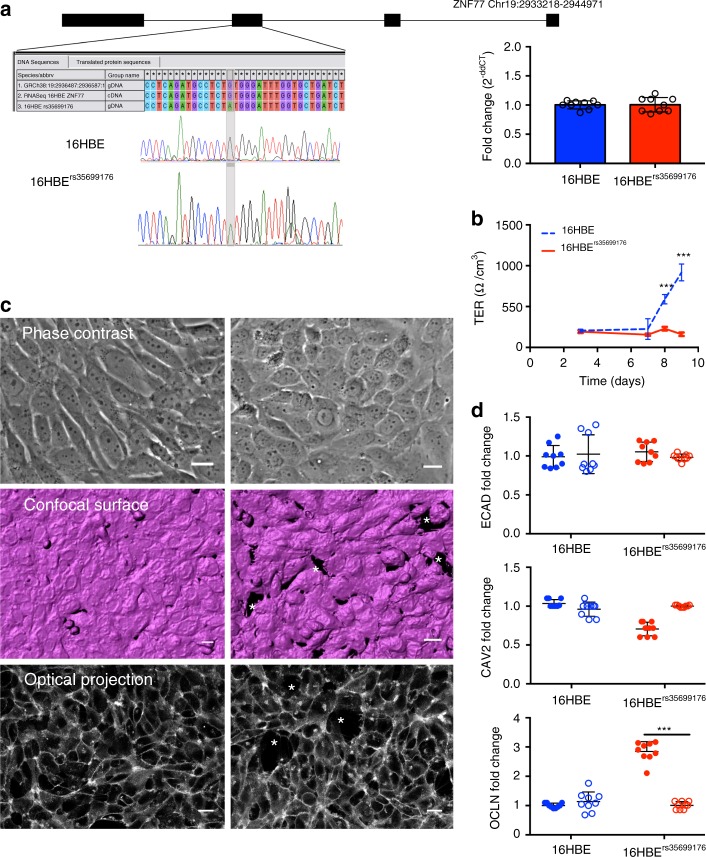
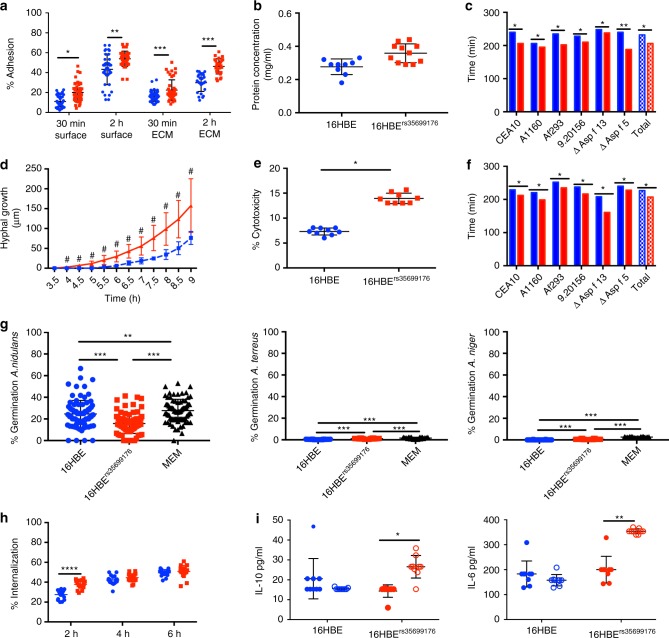
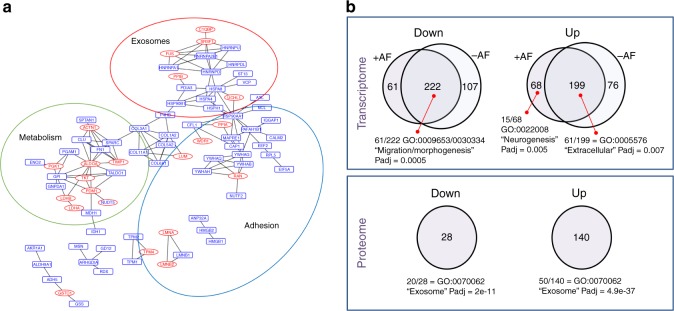
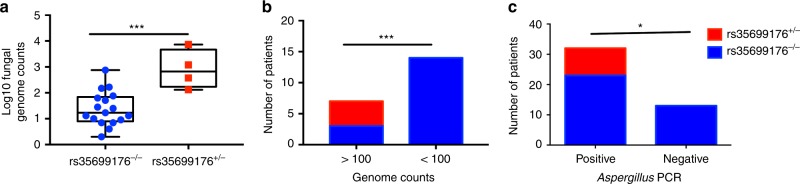
Aspergillus fumigatus is a critical pathogen of humans. Exposure to A. fumigatus conidia occurs frequently but is normally cleared from the respiratory airways. In contrast, individuals with respiratory diseases are often highly colonized by fungi. Here, we use genome-edited epithelial cells to show that the genetic variant rs35699176 in ZNF77 causes loss of integrity of the bronchial epithelium and increases levels of extracellular matrix proteins. These changes promote A. fumigatus conidial adhesion, germination and growth. RNA-seq and LC/MS-MS analysis reveal rs35699176 upregulates vesicle trafficking leading to an increment of adhesion proteins. These changes make cells carrying rs35699176 more receptive to A. fumigatus in the early stages of infection. Moreover, patients with fungal asthma carrying rs35699176+/− have higher A. fumigatus loads in their respiratory airway. Our results indicate ZNF77 as a key controller of Aspergillus colonization and suggest its utility as a risk-marker for patient stratification.
Overview
The claims and statistics of this paper haven’t been checked yet.
Free: it reads the open-access text and checks the first 5 claims that cite a source we can check. Create a free account to check every claim.
Integrity signals
Registry
Cites
Statistics
Figures
Verification
Claims the paper makes
The claims and statistics of this paper haven’t been checked yet.
Free: it reads the open-access text and checks the first 5 claims that cite a source we can check. Create a free account to check every claim.
Claims other papers make about this one
Each is checked against this paper’s own text: does it say what the citing paper says it does?
The source backs part of the claim, not all of it — or backs it for a different population, condition or comparison.
In the citing paper
“It has been found recently that Aspergillus colonization has a strong genetic basis associated with impaired expression of the transcriptional factor ZNF77 in bronchial epithelia, which leads to defective epithelial cell integrity and upregulation of extracellular matrix (ECM) proteins that facilitate conidial adhesion (23).”
From Aspergillus fumigatus and Aspergillosis in 2019 (2019) · cites this paper as [23]
Experimental — accuracy not yet measuredIn the citing paper
“It has been found recently that Aspergillus colonization has a strong genetic basis associated with impaired expression of the transcriptional factor ZNF77 in bronchial epithelia, which leads to defective epithelial cell integrity and upregulation of extracellular matrix (ECM) proteins that facilitate conidial adhesion (23).”
From Aspergillus fumigatus and Aspergillosis in 2019 (2019) · cites this paper as [23]
In the citing paper
“Early studies (23, 561, 562) have shown that A. fumigatus can be isolated from up to 20% of COPD patients.”
From Aspergillus fumigatus and Aspergillosis in 2019 (2019) · cites this paper as [23]
Self-check
Percentages, sums and reported differences re-computed from the paper’s own numbers.
The self-check needs the paper’s full text.
Citations
Cites
Genome engineering using the CRISPR-Cas9 system
Ran, F. A., Hsu, P. D., Wright, J., Agarwala, V., Scott, D. A., & Zhang, F. (2013) · Nature Protocols · doi:10.1038/nprot.2013.143 · Cited by 11,133
Palmer, C. N. A., Irvine, A. D., Terron-Kwiatkowski, A., Zhao, Y., Liao, H., Lee, S. P., Goudie, D. R., Sandilands, A., Campbell, L. E., Smith, F. J. D., et al. (2006) · Nature Genetics · doi:10.1038/ng1767 · Cited by 2,978
Global and Multi-National Prevalence of Fungal Diseases-Estimate Precision
Bongomin, F., Gago, S., Oladele, R., & Denning, D. (2017) · Journal of Fungi · doi:10.3390/jof3040057 · Cited by 2,953
Self-citationCFTR expression and chloride secretion in polarized immortal human bronchial epithelial cells.
Cozens, A. L., Yezzi, M. J., Kunzelmann, K., Ohrui, T., Chin, L., Eng, K., Finkbeiner, W. E., Widdicombe, J. H., & Gruenert, D. C. (1994) · American Journal of Respiratory Cell and Molecular Biology · doi:10.1165/ajrcmb.10.1.7507342 · Cited by 929
Agarwal, R., Chakrabarti, A., Shah, A., Gupta, D., Meis, J. F., Guleria, R., Moss, R., Denning, D. W., & ABPA complicating asthma ISHAM working group (2013) · Clinical & Experimental Allergy · doi:10.1111/cea.12141 · Cited by 896
Self-citationThe clinical spectrum of pulmonary aspergillosis
Kosmidis, C., & Denning, D. W. (2015) · Thorax · doi:10.1136/thoraxjnl-2014-206291 · Cited by 850
Self-citationUnderstanding multicellular function and disease with human tissue-specific networks
Greene, C. S., Krishnan, A., Wong, A. K., Ricciotti, E., Zelaya, R. A., Himmelstein, D. S., Zhang, R., Hartmann, B. M., Zaslavsky, E., Sealfon, S. C., et al. (2015) · Nature Genetics · doi:10.1038/ng.3259 · Cited by 832
Der p 1 facilitates transepithelial allergen delivery by disruption of tight junctions
Wan, H., Winton, H. L., Soeller, C., Tovey, E. R., Gruenert, D. C., Thompson, P. J., Stewart, G. A., Taylor, G. W., Garrod, D. R., Cannell, M. B., et al. (1999) · Journal of Clinical Investigation · doi:10.1172/jci5844 · Cited by 775
Host genetic variation impacts microbiome composition across human body sites
Blekhman, R., Goodrich, J. K., Huang, K., Sun, Q., Bukowski, R., Bell, J. T., Spector, T. D., Keinan, A., Ley, R. E., Gevers, D., et al. (2015) · Genome Biology · doi:10.1186/s13059-015-0759-1 · Cited by 745
A Randomized Trial of Itraconazole in Allergic Bronchopulmonary Aspergillosis
Stevens, D. A., Schwartz, H. J., Lee, J. Y., Moskovitz, B. L., Jerome, D. C., Catanzaro, A., Bamberger, D. M., Weinmann, A. J., Tuazon, C. U., Judson, M. A., et al. (2000) · New England Journal of Medicine · doi:10.1056/nejm200003163421102 · Cited by 533
Cited by
Aspergillus fumigatus and Aspergillosis in 2019
Latgé, J.-P., & Chamilos, G. (2019) · Clinical Microbiology Reviews · doi:10.1128/cmr.00140-18 · Cited by 1,400
“proteins that facilitate conidial adhesion (23).”
Allergic bronchopulmonary aspergillosis
Agarwal, R., Sehgal, I. S., Dhooria, S., Muthu, V., Prasad, K., Bal, A., Aggarwal, A., & Chakrabarti, A. (2020) · The Indian Journal of Medical Research · doi:10.4103/ijmr.ijmr_1187_19 · Cited by 182
Allergic Bronchopulmonary Aspergillosis
Agarwal, R., Muthu, V., Sehgal, I. S., Dhooria, S., Prasad, K. T., & Aggarwal, A. N. (2022) · Clinics in Chest Medicine · doi:10.1016/j.ccm.2021.12.002 · Cited by 127
Pathogenicity and virulence of Aspergillus fumigatus
Earle, K., Valero, C., Conn, D. P., Vere, G., Cook, P. C., Bromley, M., Bowyer, P., & Gago, S. (2023) · Virulence · doi:10.1080/21505594.2023.2172264 · Cited by 132
“Lastly, a significant number of genetic variants in critical genes for Aspergillus sensing and intracellular killing or activation of the downstream immune response have been reported in patients with invasive, allergic, and chronic forms of pulmonary aspergillosis [47,285–290].”
BackgroundInfluentialSelf-citationThe Human Mycobiome: Colonization, Composition and the Role in Health and Disease
Belvoncikova, P., Splichalova, P., Videnska, P., & Gardlik, R. (2022) · Journal of Fungi · doi:10.3390/jof8101046 · Cited by 110
Metadata
- Authors
- Gago, S., Overton, N. L. D., Ben-Ghazzi, N., Novak-Frazer, L., Read, N. D., Denning, D. W., & Bowyer, P.
- Affiliations
- University of Manchester (GB)
- Manchester Academic Health Science Centre (GB)
- Corresponding author
- Bowyer, Paul
- ORCID
- Venue
- Nature Communications
- Published
- 2018-09-20
- Volume
- 9
- Issue
- 1
- Pages
- 3835-3835
- ISSN
- 2041-1723 (ISSN-L)
- PMC
- PMC6147781
- OpenAlex
- W2889913345
- Cited by
- 51
- References
- 60
- Citations by year
- 2026: 4 · 2025: 7 · 2024: 2 · 2023: 7 · 2022: 6 · 2021: 10 · 2020: 8 · 2019: 7
- FWCI
- 4.73
- Type
- journal article
- Language
- en
- Open access
- gold
- doi.org
- Licence
- cc-by
- creativecommons.org/licenses/by/4.0 (tdm)
- creativecommons.org/licenses/by/4.0 (vor)
- Locations
- Nature Communications (publishedVersion, cc-by)
- Europe PMC (PubMed Central) (publishedVersion, cc-by)
- PubMed Central (publishedVersion, cc-by)
- PubMed (publishedVersion)
- RePEc: Research Papers in Economics (submittedVersion)
- DOAJ (DOAJ: Directory of Open Access Journals) (submittedVersion, cc-by-sa)
- DOAJ (DOAJ: Directory of Open Access Journals) (submittedVersion)
- Research Explorer (The University of Manchester) (submittedVersion, other-oa)
- Funders
- Medical Research Council (MR/M02010X/1)
- National Centre for the Replacement, Refinement and Reduction of Animals in Research (NC/P002390/1)
- Fungal Infection Trust
- Topics
- Health Sciences › Medicine › Infectious Diseases › Antifungal resistance and susceptibility
- Life Sciences › Biochemistry, Genetics and Molecular Biology › Molecular Biology › Fungal and yeast genetics research
- Health Sciences › Medicine › Pulmonary and Respiratory Medicine › Asthma and respiratory diseases
- Keywords
- Aspergillus fumigatus, lung colonization, extracellular matrix proteins, conidial adhesion, conidial germination, vesicle trafficking, fungal asthma, risk indicators, patient stratification
- MeSH terms
- Adhesiveness, Aspergillosis, Allergic Bronchopulmonary, Aspergillus fumigatus, Base Sequence, Bronchi, Cell Line, Epithelium, Extracellular Matrix, Heterozygote, Humans, Lung, Transcription Factors, Colony Count, Microbial, Sequence Analysis, RNA, Polymorphism, Single Nucleotide
About these checks
Registry, retraction, Cites and statistics results are computed, not judged, with one exception: a printed reference that no index lists is read once by a model before it counts as a citation error. Claims are extracted by a model and kept only when their quote appears verbatim in the text; each cited source is then checked, with a model’s help, for whether it says what the claim relies on. Those verdicts can be wrong — read the claim’s quote and the cited source before relying on one.
Statistics and arithmetic are recomputed, not judged.
Confidence bands are shown only for fields calibrated on our annotated test set. None is calibrated yet, so no band is shown.
What counts as a claim ›How we measure confidence ›How we check this ›
Are you an author, or do you see a problem with this page? Request a review
How to cite
Cite CoChat for the checks on this page, and the paper for its own findings.
- This page
- CoChat. (2026). Citation check: Lung colonization by Aspergillus fumigatus is controlled by ZNF77. https://app.cochat.ai/papers/10.1038/s41467-018-06148-7
- The paper
- Gago, S., Overton, N. L. D., Ben-Ghazzi, N., Novak-Frazer, L., Read, N. D., Denning, D. W., & Bowyer, P. (2018). Lung colonization by Aspergillus fumigatus is controlled by ZNF77. Nature Communications. https://doi.org/10.1038/s41467-018-06148-7
Data sources
Bibliographic data: Semantic Scholar, OpenAlex, Crossref.
Contains information from the Semantic Scholar Academic Graph Datasets, made available under the ODC Attribution License (ODC-BY 1.0).
Semantic Scholar’s data is described in: Kinney, R., et al. (2023). The Semantic Scholar Open Data Platform. arXiv:2301.10140.
