

Dissection of genetic variation and evidence for pleiotropy in male pattern baldness
Open accessThe DOI matches its Crossref record; 71 of the 72 references it cites were found in a registry or an index.
Abstract
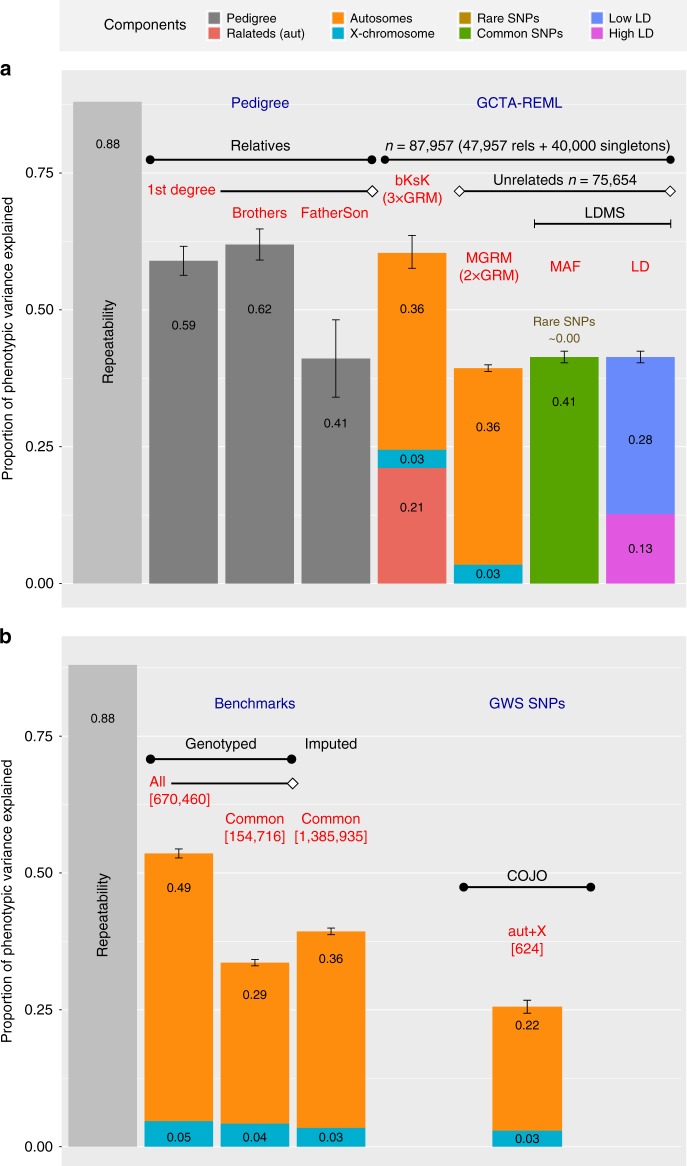
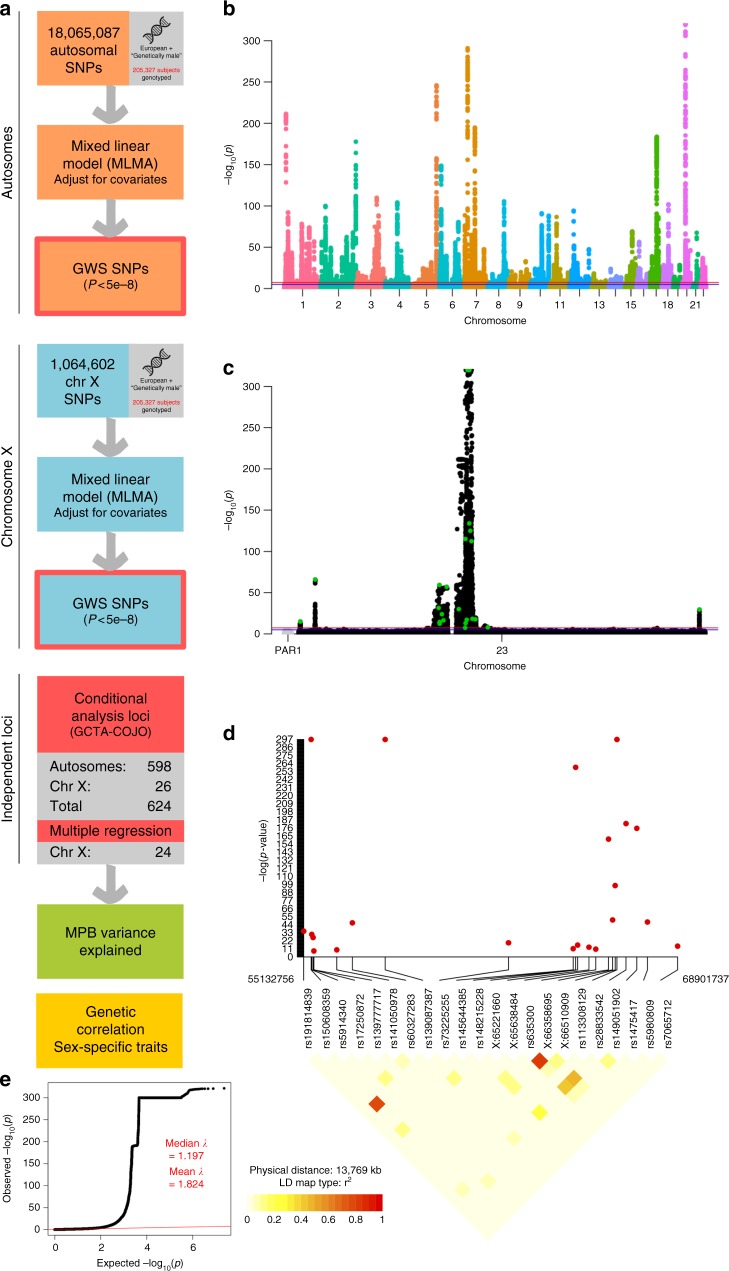
Male pattern baldness (MPB) is a sex-limited, age-related, complex trait. We study MPB genetics in 205,327 European males from the UK Biobank. Here we show that MPB is strongly heritable and polygenic, with pedigree-heritability of 0.62 (SE = 0.03) estimated from close relatives, and SNP-heritability of 0.39 (SE = 0.01) from conventionally-unrelated males. We detect 624 near-independent genome-wide loci, contributing SNP-heritability of 0.25 (SE = 0.01), of which 26 X-chromosome loci explain 11.6%. Autosomal genetic variance is enriched for common variants and regions of lower linkage disequilibrium. We identify plausible genetic correlations between MPB and multiple sex-limited markers of earlier puberty, increased bone mineral density ( r g = 0.15) and pancreatic β-cell function ( r g = 0.12). Correlations with reproductive traits imply an effect on fitness, consistent with an estimated linear selection gradient of -0.018 per MPB standard deviation. Overall, we provide genetic insights into MPB: a phenotype of interest in its own right, with value as a model sex-limited, complex trait.
Overview
The claims and statistics of this paper haven’t been checked yet.
Free: it reads the open-access text and checks the first 5 claims that cite a source we can check. Create a free account to check every claim.
Integrity signals
Registry
Cites
Statistics
Figures
Verification
Claims the paper makes
The claims and statistics of this paper haven’t been checked yet.
Free: it reads the open-access text and checks the first 5 claims that cite a source we can check. Create a free account to check every claim.
Claims other papers make about this one
Each is checked against this paper’s own text: does it say what the citing paper says it does?
The check wasn’t confident either way, so it gives no verdict — never disputed.
In the citing paper
“Variants in or near HAS2 have been previously associated with face morphology [8], body height [9], and male pattern baldness [10].”
From Combined genome-wide association study of 136 quantitative ear morphology traits in multiple populations reveal 8 novel loci (2023) · cites this paper as [10]
Experimental — accuracy not yet measured
Self-check
Percentages, sums and reported differences re-computed from the paper’s own numbers.
The self-check needs the paper’s full text.
Citations
Cites
Second-generation PLINK: rising to the challenge of larger and richer datasets
Chang, C. C., Chow, C. C., Tellier, L. C., Vattikuti, S., Purcell, S. M., & Lee, J. J. (2015) · Gigascience · doi:10.1186/s13742-015-0047-8 · Cited by 12,709
The UK Biobank resource with deep phenotyping and genomic data
Bycroft, C., Freeman, C., Petkova, D., Band, G., Elliott, L. T., Sharp, K., Motyer, A., Vukcevic, D., Delaneau, O., O’Connell, J., et al. (2018) · Nature · doi:10.1038/s41586-018-0579-z · Cited by 8,876
GCTA: a tool for genome-wide complex trait analysis
Yang, J., Lee, S. H., Goddard, M. E., & Visscher, P. M. (2011) · The American Journal of Human Genetics · doi:10.1016/j.ajhg.2010.11.011 · Cited by 8,279
Self-citationLD Score regression distinguishes confounding from polygenicity in genome-wide association studies
Schizophrenia Working Group of the Psychiatric Genomics Consortium, Bulik-Sullivan, B. K., Loh, P.-R., Finucane, H. K., Ripke, S., Yang, J., Patterson, N., Daly, M. J., Price, A. L., & Neale, B. M. (2015) · Nature Genetics · doi:10.1038/ng.3211 · Cited by 5,559
Self-citationCommon SNPs explain a large proportion of the heritability for human height
Yang, J., Benyamin, B., McEvoy, B. P., Gordon, S., Henders, A. K., Nyholt, D. R., Madden, P. A., Heath, A. C., Martin, N. G., Montgomery, G. W., et al. (2010) · Nature Genetics · doi:10.1038/ng.608 · Cited by 4,446
Self-citationAn atlas of genetic correlations across human diseases and traits
ReproGen Consortium, Bulik-Sullivan, B., Psychiatric Genomics Consortium, Genetic Consortium for Anorexia Nervosa of the Wellcome Trust Case Control Consortium 3, Finucane, H. K., Anttila, V., Gusev, A., Day, F. R., Loh, P.-R., Duncan, L., et al. (2015) · Nature Genetics · doi:10.1038/ng.3406 · Cited by 4,255
Functional mapping and annotation of genetic associations with FUMA
Watanabe, K., Taskesen, E., van Bochoven, A., & Posthuma, D. (2017) · Nature Communications · doi:10.1038/s41467-017-01261-5 · Cited by 4,083
Partitioning heritability by functional annotation using genome-wide association summary statistics
ReproGen Consortium, Finucane, H. K., Schizophrenia Working Group of the Psychiatric Genomics Consortium, The RACI Consortium, Bulik-Sullivan, B., Gusev, A., Trynka, G., Reshef, Y., Loh, P.-R., Anttila, V., et al. (2015) · Nature Genetics · doi:10.1038/ng.3404 · Cited by 2,604
New genetic loci implicated in fasting glucose homeostasis and their impact on type 2 diabetes risk
DIAGRAM Consortium, Dupuis, J., GIANT Consortium, Global BPgen Consortium, Anders Hamsten on behalf of Procardis Consortium, the MAGIC investigators, Langenberg, C., Prokopenko, I., Saxena, R., Soranzo, N., et al. (2010) · Nature Genetics · doi:10.1038/ng.520 · Cited by 2,166
Heritability in the genomics era — concepts and misconceptions
Visscher, P. M., Hill, W. G., & Wray, N. R. (2008) · Nature Reviews Genetics · doi:10.1038/nrg2322 · Cited by 1,921
Self-citation
Cited by
Yuan, A., Xia, F., Bian, Q., Wu, H., Gu, Y., Wang, T., Wang, R., Huang, L., Huang, Q., Rao, Y., et al. (2021) · ACS Nano · doi:10.1021/acsnano.1c05272 · Cited by 208
Protein-coding repeat polymorphisms strongly shape diverse human phenotypes
Mukamel, R. E., Handsaker, R. E., Sherman, M. A., Barton, A. R., Zheng, Y., McCarroll, S. A., & Loh, P.-R. (2021) · Science · doi:10.1126/science.abg8289 · Cited by 178
An epigenome-wide association study of sex-specific chronological ageing
McCartney, D. L., Zhang, F., Hillary, R. F., Zhang, Q., Stevenson, A. J., Walker, R. M., Bermingham, M. L., Boutin, T., Morris, S. W., Campbell, A., et al. (2020) · Genome Medicine · doi:10.1186/s13073-019-0693-z · Cited by 152
Self-citationRare and common genetic determinants of metabolic individuality and their effects on human health
Surendran, P., Stewart, I. D., Auyeung, V. P. W., Pietzner, M., Raffler, J., Wörheide, M. A., Li, C., Smith, R. F., Wittemans, L. B. L., Bomba, L., et al. (2022) · Nature Medicine · doi:10.1038/s41591-022-02046-0 · Cited by 169
Biological Role of Unsaturated Fatty Acid Desaturases in Health and Disease
Czumaj, A., & Śledziński, T. (2020) · Nutrients · doi:10.3390/nu12020356 · Cited by 150
“rs174592-G rs174581-A Balding (type 1, male-pattern baldness) Specific variant more common in subjects with the disease European [133,142,143]”
BackgroundRecent advances in Forensic DNA Phenotyping of appearance, ancestry and age
Kayser, M., Branicki, W., Parson, W., & Phillips, C. (2023) · Forensic Science International Genetics · doi:10.1016/j.fsigen.2023.102870 · Cited by 187
Bovo, S., Ribani, A., Muñoz, M., Alves, E., Araújo, J. P., Bozzi, R., Čandek‐Potokar, M., Charneca, R., Palma, F. D., Etherington, G., et al. (2020) · Genetics Selection Evolution · doi:10.1186/s12711-020-00553-7 · Cited by 139
Ding, Y., Li, Y., Zhang, Z., Dao, J., & Wei, D. (2024) · Bioactive Materials · doi:10.1016/j.bioactmat.2024.04.020 · Cited by 168
“The majority of hair loss patients are due to Androgenetic alopecia (AGA) [3,4], primarily caused by dysregulation in the microenvironmental niche surrounding hair follicles, including vascular insufficiency or oxidative stress [5 – 7].”
BackgroundDissolving Microneedle Patch Integrated with Microspheres for Long-Acting Hair Regrowth Therapy
Yin, M., Zeng, Y., Liu, H., Zhang, W., Wang, C., Chen, C., & Li, W. (2023) · ACS Applied Materials & Interfaces · doi:10.1021/acsami.2c22814 · Cited by 102
Causal inference for heritable phenotypic risk factors using heterogeneous genetic instruments
Wang, J., Zhao, Q., Bowden, J., Hemani, G., Davey Smith, G., Small, D. S., & Zhang, N. R. (2021) · PLOS Genetics · doi:10.1371/journal.pgen.1009575 · Cited by 88
Gu, Y., Bian, Q., Zhou, Y., Huang, Q., & Gao, J. (2022) · Asian Journal of Pharmaceutical Sciences · doi:10.1016/j.ajps.2022.04.003 · Cited by 133
“[13] Yap CX , Sidorenko J , Wu Y , Kemper KE , Yang J , Wray NR , et al.”
BackgroundOuidir, M., Mendola, P., Buck Louis, G. M., Kannan, K., Zhang, C., & Tekola-Ayele, F. (2020) · Clinical Epigenetics · doi:10.1186/s13148-020-00894-6 · Cited by 83
Next-generation drug repurposing using human genetics and network biology
Nabirotchkin, S., Peluffo, A. E., Rinaudo, P., Yu, J., Hajj, R., & Cohen, D. (2020) · Current Opinion in Pharmacology · doi:10.1016/j.coph.2019.12.004 · Cited by 75
Heilmann‐Heimbach, S., Hochfeld, L. M., Henne, S. K., & Nöthen, M. M. (2020) · Experimental Dermatology · doi:10.1111/exd.14130 · Cited by 70
Wang, R., Zhong, T., Bian, Q., Zhang, S., Ma, X., Li, L., Xu, Y., Gu, Y., Yuan, A., Hu, W., et al. (2022) · Small Methods · doi:10.1002/smtd.202201293 · Cited by 65
Suzuki, K., Inoue, M., Cho, O., Mizutani, R., Shimizu, Y., Nagahama, T., & Sugita, T. (2021) · Microorganisms · doi:10.3390/microorganisms9102132 · Cited by 57
Young, W. J., Lahrouchi, N., Isaacs, A., Duong, T., Foco, L., Ahmed, F., Brody, J. A., Salman, R., Noordam, R., Benjamins, J.-W., et al. (2022) · Nature Communications · doi:10.1038/s41467-022-32821-z · Cited by 49
MendelVar: gene prioritization at GWAS loci using phenotypic enrichment of Mendelian disease genes
Sobczyk, M., Gaunt, T. R., & Paternoster, L. (2021) · Bioinformatics · doi:10.1093/bioinformatics/btaa1096 · Cited by 40
Zhang, S. M., Zhou, H. W., Chen, X., Zhu, S., Chen, D., Luo, D., Chen, S., & Liu, W. (2024) · ACS Applied Materials & Interfaces · doi:10.1021/acsami.3c16608 · Cited by 46
Liu, Y., Tosti, A., Wang, E. C. E., Heilmann‐Heimbach, S., Aguh, C., Jiménez, F., Lin, S., Kwon, O., & Plikus, M. V. (2025) · Nature Reviews Disease Primers · doi:10.1038/s41572-025-00656-9 · Cited by 64
“Numerous genome-wide association studies (GWAS) have identified an association between variants in >380 genomic loci with the development of AGA 55,110,113–119 .”
InfluentialAndrogenetic Alopecia: Relationship to Anthropometric Indices, Blood Pressure and Life-Style Habits
Danesh-Shakiba, M., Poorolajal, J., & Alirezaei, P. (2020) · Clinical Cosmetic and Investigational Dermatology · doi:10.2147/ccid.s231940 · Cited by 37
“Although the true pathogenic mechanism of androgenetic alopecia is not fully recognized, it is currently believed that a polygenic contribution as well as endocrine interaction is involved in its pathogenesis.(22,23) The androgen receptor gene on chromosome Xq12 was probably one of the first genes related to androgene…”
BackgroundLi, P., Wang, P., Gao, S., & Dong, D.-Y. (2020) · BioMed Research International · doi:10.1155/2020/2901589 · Cited by 35
“rs833268 SOX2-OT intron_variant Male-pattern baldness 30573740 [71]”
Fernández‐Rhodes, L., Graff, M., Buchanan, V. L., Justice, A. E., Highland, H. M., Guo, X., Zhu, W., Chen, H., Young, K. L., Adhikari, K., et al. (2022) · Human Genetics and Genomics Advances · doi:10.1016/j.xhgg.2022.100099 · Cited by 44
“Other PAX3 variants in lower LD with the lead SNP have also been associated with nasion position,(77) monobrow, and male-pattern baldness.(78,79) PAX3 is a well-known transcription factor in normal embryonic neural crest development and differentiation.”
Genetic prediction of male pattern baldness based on large independent datasets
Chen, Y., Hysi, P. G., Maj, C., Heilmann‐Heimbach, S., Spector, T. D., Liu, F., & Kayser, M. (2022) · European Journal of Human Genetics · doi:10.1038/s41431-022-01201-y · Cited by 31
“As next further step, all of the 624 MPB-associated loci identified in the entire UKBB data resource of >200,000 male subjects [2] shall be used for prediction modelling.”
BackgroundPredicting Physical Appearance from DNA Data—Towards Genomic Solutions
Pośpiech, E., Teisseyre, P., Mielniczuk, J., & Branicki, W. (2022) · Genes · doi:10.3390/genes13010121 · Cited by 28
“In turn, pedigree heritability may be biased by the common environmental factors to which families are typically exposed [43,45].”
BackgroundRauner, M., Foessl, I., Formosa, M. M., Kague, É., Prijatelj, V., Alonso, N., Banerjee, B., Bergen, D. J. M., Busse, B., Calado, Â., et al. (2021) · Frontiers in Endocrinology · doi:10.3389/fendo.2021.731217 · Cited by 29
Innovative Strategies for Hair Regrowth and Skin Visualization
Mai, Q., Han, Y., Cheng, G., Ma, R., Zhao, Y., Chen, X., Yu, G., Chen, T., & Zhang, S. (2023) · Pharmaceutics · doi:10.3390/pharmaceutics15041201 · Cited by 23
Liang, J., Cade, B. E., He, K. Y., Wang, H., Lee, J., Sofer, T., Williams, S., Li, R., Chen, H., Gottlieb, D. J., et al. (2019) · The American Journal of Human Genetics · doi:10.1016/j.ajhg.2019.10.002 · Cited by 21
Microenvironment of pancreatic inflammation: calling for nanotechnology for diagnosis and treatment
Liu, L., Zhang, Y., Li, X., & Deng, J. (2023) · Journal of Nanobiotechnology · doi:10.1186/s12951-023-02200-x · Cited by 25
Evolution and genetic architecture of sex-limited polymorphism in cuckoos
Meröndun, J., Marques, C. I., Andrade, P., Meshcheryagina, S. G., Galván, I., Afonso, S., Alves, J. M., Araújo, P. M., Николаевич, Б. Г., Balacco, J., et al. (2024) · Science Advances · doi:10.1126/sciadv.adl5255 · Cited by 23
“Prominent examples include aposematic defense traits against predators in Papilio butterflies ( 6 ), the reduction of sexual conflict in damselflies ( 7 ), adaptive mechanisms related to ecology, social conflict, or migration in humming-birds ( 8 ), and androgenetic alopecia in humans ( 9 ).”
Chen, H., Tang, X., Huang, Y., Chen, C., Yang, Y., Hao, C., Xie, W., Huang, T., Cheng, X., Xu, Q., et al. (2024) · Nano Research · doi:10.1007/s12274-024-6619-0 · Cited by 22
Kar, S. P., Considine, D. P. C., Tyrer, J. P., Plummer, J. T., Chen, S., Dezem, F. S., Barbeira, A. N., Rajagopal, P. S., Rosenow, W. T., Moreno, F., et al. (2021) · Human Genetics and Genomics Advances · doi:10.1016/j.xhgg.2021.100042 · Cited by 18
“ETAA1 (MIM: 613196) harbors lead variants associated at genome-wide significance with pancreatic cancer(39) and the hormone-related traits of age at menopause(40) and male-pattern baldness.(41) It encodes an activator of ATR kinase that accumulates at DNA damage sites and promotes replication fork progression and inte…”
Moix, S., Sadler, M. C., Kutalik, Z., & Auwerx, C. (2024) · Genome biology · doi:10.1186/s13059-024-03269-9 · Cited by 20
Fernández‐Rhodes, L., Graff, M., Buchanan, V. L., Justice, A. E., Highland, H. M., Guo, X., Zhu, W., Chen, H., Young, K. L., Adhikari, K., et al. (2021) · bioRxiv (Cold Spring Harbor Laboratory) · doi:10.1101/2021.05.27.445969 · Cited by 17
Uncovering the complex relationship between balding, testosterone and skin cancers in men
Ong, J., Seviiri, M., Dusingize, J. C., Wu, Y., Han, X., Shi, J., Olsen, C. M., Neale, R. Ε., Thompson, J. F., Saw, R. P. M., et al. (2023) · Nature Communications · doi:10.1038/s41467-023-41231-8 · Cited by 20
Self-citationApproaching precision medicine by tailoring the microbiota
Ryu, G., Kim, H., & Koh, A. (2021) · Mammalian Genome · doi:10.1007/s00335-021-09859-3 · Cited by 17
Henne, S. K., Nöthen, M. M., & Heilmann-Heimbach, S. (2023) · Medizinische Genetik · doi:10.1515/medgen-2023-2003 · Cited by 24
“At individual loci, overlapping associations have been reported for prostate cancer and cardiovascular traits, although these did not reflect in a significant genome-wide genetic correlation [13], [18], [37], [40].”
BackgroundMethodInfluentialCesarato, N., Schwieger‐Briel, A., Gossmann, Y., Henne, S. K., Hillmann, K., Frommherz, L. H., Wehner, M., Xiong, X., Thiele, H., Oji, V., et al. (2023) · British Journal of Dermatology · doi:10.1093/bjd/ljad314 · Cited by 15
Scholz, M. R., Horn, K., Pott, J., Wuttke, M., Kühnapfel, A., Nasr, M. K., Kirsten, H., Li, Y., Hoppmann, A., Gorski, M., et al. (2024) · Nature Communications · doi:10.1038/s41467-024-44709-1 · Cited by 20
“Accordingly, associations at the eGFR loci 4, 7A, 8, 12, 14, and 15 shared the same causal variant with the UA loci 16, 18, 19, 20, 21 and 22.”
Taeubert, M. J., de Prado-Bert, P., Geurtsen, M. L., Mancano, G., Vermeulen, M. J., Reiss, I. K. M., Caramaschi, D., Sunyer, J., Sharp, G. C., Julvez, J., et al. (2022) · Clinical Epigenetics · doi:10.1186/s13148-022-01276-w · Cited by 14
A genome-wide scan for pleiotropy between bone mineral density and nonbone phenotypes
Christou, M., Ntritsos, G., Markozannes, G., Koskeridis, F., Nikas, S. N., Karasik, D., Kiel, D. P., Εvangelou, Ε., & Ntzani, E. (2020) · Bone Research · doi:10.1038/s41413-020-0101-8 · Cited by 13
Analysis of 72,469 UK Biobank exomes links rare variants to male-pattern hair loss
Henne, S. K., Aldisi, R. S., Sivalingam, S., Hochfeld, L. M., Borisov, O., Krawitz, P. M., Maj, C., Nöthen, M. M., & Heilmann‐Heimbach, S. (2023) · Nature Communications · doi:10.1038/s41467-023-41186-w · Cited by 14
Evidence for a functional interaction of WNT10A and EBF1 in male-pattern baldness
Hochfeld, L. M., Bertolini, M., Broadley, D., Botchkareva, N. V., Betz, R. C., Schoch, S., Nöthen, M. M., & Heilmann‐Heimbach, S. (2021) · PLoS ONE · doi:10.1371/journal.pone.0256846 · Cited by 14
“decade genome-wide association studies (GWAS) have proven to be a powerful tool in the identification of contributing genetic risk factors [2, 3].”
Kim, I., Kim, J., Choi, J., Yu, S. O. J., Kim, J. H., Kim, S. R., Choi, M. S., Kim, M. H., Hong, K., & Park, B. C. (2022) · Journal of Cosmetic Dermatology · doi:10.1111/jocd.15187 · Cited by 14
Pilli, E., Palamenghi, A., & Cattaneo, C. (2025) · Annals of the New York Academy of Sciences · doi:10.1111/nyas.15398 · Cited by 19
Regulation of Skeletogenic Pathways by m6A RNA Modification: A Comprehensive Review
Ahi, E. P. (2025) · Calcified Tissue International · doi:10.1007/s00223-025-01367-9 · Cited by 18
Slotkin, T. A., Levin, E. D., & Seidler, F. J. (2021) · Toxicological Sciences · doi:10.1093/toxsci/kfab117 · Cited by 12
“on DA systems is that the effects on gene expression interact with hormonal status; indeed, this is the case for male-pattern baldness, which involves multigenic effects including some involving genes on the X-chromosome (Yap et al., 2018).”
BackgroundKondrakhina, I. N., Анатольевич, В. Д., Затевалов, А. М., Kubanov, A. A., & Deryabin, D. G. (2019) · Annals of the Russian academy of medical sciences · doi:10.15690/vramn1141 · Cited by 13
Regulation and dysregulation of hair regeneration: aiming for clinical application
Yue, Z., Yang, F. Y., Zhang, J., Li, J., & Chuong, C. (2022) · Cell Regeneration · doi:10.1186/s13619-022-00122-x · Cited by 15
Wang, X., Li, F., Sun, Y., Meng, F. G., Song, Y., & Su, X. (2025) · mSystems · doi:10.1128/msystems.00548-25 · Cited by 13
Li, Y., Xiong, Z., Zhang, M., Hysi, P. G., Qian, Y., Adhikari, K., Weng, J., Wu, S., Du, S., Gonzalez-Jose, R., et al. (2023) · PLOS Genetics · doi:10.1371/journal.pgen.1010786 · Cited by 9
“22 UQCC1), which were particularly associated with earlobe phenotypes in our study, were previously reported to have association with male pattern baldness in the GWAS catalog [10], and two of our ear loci, including 2q12.”
BackgroundIm, S. T., Mun, H., Kang, N., Heo, S., & Lee, S. (2025) · Toxicology in Vitro · doi:10.1016/j.tiv.2025.106017 · Cited by 13
Hormonal and Genetic Etiology of Male Androgenetic Alopecia
Anastassakis, K. (2022) · Springer eBooks · doi:10.1007/978-3-030-76111-0_11 · Cited by 15
The Role of Chromosome X in Intraocular Pressure Variation and Sex-Specific Effects
Simcoe, M. J., Khawaja, A. P., Mahroo, O. A., Hammond, C. J., & Hysi, P. G. (2020) · Investigative Ophthalmology & Visual Science · doi:10.1167/iovs.61.11.20 · Cited by 10
“34”
Genomic Markers and Personalized Medicine in Androgenetic Alopecia: A Comprehensive Review
Vila-Vecilla, L., Russo, V. M., & de Souza, G. T. (2024) · Cosmetics · doi:10.3390/cosmetics11050148 · Cited by 11
Clock Regulation of Skin Regeneration in Stem Cell Aging
Welz, P.-S. (2020) · Journal of Investigative Dermatology · doi:10.1016/j.jid.2020.10.009 · Cited by 11
Patient-convenient long-term alopecia treatment via PLGA microsphere-loaded candlelit microneedles
Shin, J., Cho, S. M., Kim, Y.-S., Kang, G., Braun, T., Tenor, H., Ludin, C., Naef, R., & Jung, H. (2025) · Journal of Materials Chemistry B · doi:10.1039/d5tb00118h · Cited by 9
Fu, H., Zhao, W., Jiang, L., & Shan, S. (2025) · Journal of Inflammation Research · doi:10.2147/jir.s522458 · Cited by 9
“3,4 While factors such as androgen, vascular insufficiency and oxidative stress are often mentioned, 5,6 the role of the inflammation has emerged as a critical component in the pathophysiology of AGA.”
Lv, Y., Zhang, Y., Zhou, X., Yang, W., Zhang, T., Zhang, H., Li, Y., Zhao, R., & Kong, X. (2025) · International Journal of Biological Macromolecules · doi:10.1016/j.ijbiomac.2025.146316 · Cited by 15
Uncovering the genetic architecture and evolutionary roots of androgenetic alopecia in African men
Janivara, R., Hazra, U., Pfennig, A., Harlemon, M. S., Kim, M. S., Eaaswarkhanth, M., Chen, W. C., Ogunbiyi, A. O., Kachambwa, P., Petersen, L. N., et al. (2025) · Human Genetics and Genomics Advances · doi:10.1016/j.xhgg.2025.100428 · Cited by 8
Backenroth, D., & Carmi, S. (2019) · Heredity · doi:10.1038/s41437-019-0233-z · Cited by 10
Sun, G., Liu, J., Jin, G., Zhao, J., Li, X., Yu, X., & Mi, Y. (2025) · Journal of Nanobiotechnology · doi:10.1186/s12951-025-03944-4 · Cited by 9
“AGA significantly impacts patients’ psychological health and quality of life [1, 2].”
Yin, Y., Zhao, Q., Wang, Z., Li, Z., Liu, H. Y., Eghbalitabar, F., Shang, J., Tang, L., & Wang, W. (2026) · Acta Pharmaceutica Sinica B · doi:10.1016/j.apsb.2026.01.021 · Cited by 10
Ingold, N., Seviiri, M., Ong, J., Gordon, S. D., Neale, R. Ε., Whiteman, D. C., Olsen, C. M., MacGregor, S., & Law, M. H. (2024) · Journal of Investigative Dermatology · doi:10.1016/j.jid.2024.02.019 · Cited by 7
Ambra, R., Mastroeni, S., Manca, S., Mannooranparampil, T. J., Virgili, F., Marzani, B., Pinto, D., & Fortes, C. (2025) · Nutrients · doi:10.3390/nu17020299 · Cited by 6
“However, a recent, large, pedigree-based heritability analysis reduced the contribution of genetics and SNPs to AGA phenotypic variance at 60% and 39%, respectively [6], supporting the role of other factors in the etiology of AGA, including lifestyle and nutritional factors.”
Kar, S., Lindström, S., Hung, R. J., Lawrenson, K., Schmidt, M. K., O’Mara, T. A., Glubb, D. M., Tyrer, J. P., Schildkraut, J. M., Chang-Claude, J. C., et al. (2020) · bioRxiv (Cold Spring Harbor Laboratory) · doi:10.1101/2020.06.16.146803 · Cited by 6
Gupta, M. K., Gouda, G., & Vadde, R. (2024) · Functional & Integrative Genomics · doi:10.1007/s10142-024-01451-7 · Cited by 4
“…with various human traits and diseases, including metabolite levels (Rhee et al. 2013), fasting insulin (Chen et al. 2021), male-pattern baldness (Yap et al. 2018), vertigo (Skuladottir et al. 2021), ischemic stroke in diabetes mellitus (Song et al. 2021), prostate cancer (Conti et al. 2021),…”
Taraszka, K., Zaitlen, N., & Eskin, E. (2022) · PLoS Genetics · doi:10.1371/journal.pgen.1010447 · Cited by 7
Genetic correlation analysis does not associate male pattern baldness with COVID-19
Tanha, H. M., Medland, S. E., Martin, N. G., & Nyholt, D. R. (2021) · Journal of the American Academy of Dermatology · doi:10.1016/j.jaad.2021.05.009 · Cited by 4
Zhou, F., Wang, S., Qin, H., Zeng, H., Ye, J., Yang, J., Cai, G., Wu, Z., & Zhang, Z. (2023) · BMC Genomics · doi:10.1186/s12864-023-09803-6 · Cited by 4
“The numerical value represents the -log10( P -value), with colors ranging from red to blue indicating increasing significance morphology, focal hair loss, Male-pattern baldness, and abnormal hair cortex morphology [24–27].”
BackgroundSelf-citationGenetic and environmental factors affecting hair density in East Asian populations
Qian, Q., Gu, Y., Luo, J., Wu, S., Li, J., Li, J., Peng, Q., Chen, W., Yang, Y., Wang, J., et al. (2025) · British Journal of Dermatology · doi:10.1093/bjd/ljaf149 · Cited by 8
Ma, Y., Zhao, J., Ning, Y., Gou, J., He, H., Yin, T., Tang, X., & Zhang, Y. (2025) · International Journal of Pharmaceutics · doi:10.1016/j.ijpharm.2025.126068 · Cited by 5
Wade, T. J., Fisher, M. L., & Burch, R. L. (2021) · Evolutionary Psychological Science · doi:10.1007/s40806-021-00303-y · Cited by 4
“Further, bald men have slightly but significantly fewer children than men without baldness despite also hitting puberty younger (Yap et al., 2018).”
BackgroundGalica, J., Saunders, S., Pan, Z., Silva, A., & Ling, H. K. (2024) · Cancer Causes & Control · doi:10.1007/s10552-023-01846-0 · Cited by 6
Faquih, T. O., Potts, K. S., Nagarajan, P., Yu, B., Kaplan, R. C., Isasi, C. R., Qi, Q., Taylor, K. D., Liu, P. Y., Strausz, S. J., et al. (2025) · EBioMedicine · doi:10.1016/j.ebiom.2025.105881 · Cited by 5
“Previous GWA studies reported associations between the SRD5A2 locus has been associated with testosterone levels 90 and hair loss/balding 90,91 in men.”
Genetic Pleiotropy of Bone-Related Phenotypes: Insights from Osteoporosis
Christou, M., Ntzani, E., & Karasik, D. (2020) · Current Osteoporosis Reports · doi:10.1007/s11914-020-00618-y · Cited by 3
X centromeric drive may explain the prevalence of polycystic ovary syndrome and other conditions
Moore, T. (2024) · BioEssays · doi:10.1002/bies.202400056 · Cited by 3
“[75] KLF8 is implicated in adipocyte differentiation in multiple species, [76] and may therefore contribute to abnormal adipocyte function in PCOS.”
Henne, S. K., Hochfeld, L. M., Maj, C., Nöthen, M. M., & Heilmann‐Heimbach, S. (2021) · Skin Health and Disease · doi:10.1002/ski2.72 · Cited by 3
“We established PRS based on SNPs associated with AGA (p < 5 � 10 and p < 5 � 10) in the AGA GWAS.(15) These AGA‐PRS were calculated using PRSice‐2(17) in sum‐calculation mode using autosomal and X‐chromosomal variants without regression on phenotype.”
MethodA Conceptual Framework for the Clinical Translation of Human Genetic Studies
Simmonds, F., Larisch, R., & Petukhova, L. (2025) · Journal of Investigative Dermatology · doi:10.1016/j.jid.2025.07.019 · Cited by 2
de Souza, G. T. (2025) · Cosmetics · doi:10.3390/cosmetics12050228 · Cited by 2
“Subsequent UK Biobank analyses expanded the picture to more than 200,000 men, cata-loguing over 600 near-independent loci and confirming a SNP-heritability of about 0.39 with pedigree estimates at 0.62 [71].”
InfluentialThe Polygenic Architecture of Human Diseases Affecting the Hair Follicle
Brinks, A. L., Needle, C. D., Perez, O. D., Shapiro, J., Sicco, K. I. L., Occidental, M. A., Tsirigos, A., & Petukhova, L. (2025) · Journal of Investigative Dermatology · doi:10.1016/j.jid.2025.09.012 · Cited by 4
de Souza, G. T., Williams, G., Silva, C. C. V., Chiovatto, C. B., Epstein, G. K., Vila-Vecilla, L., & Russo, V. M. (2026) · Frontiers in Pharmacology · doi:10.3389/fphar.2026.1765808 · Cited by 3
Suzuki, R., Takashima, K., Manse, Y., Nishikawa, H., Ashidate, M., Marumoto, S., Ishikawa, F., Morikawa, T., & Tanabe, G. (2026) · RSC Medicinal Chemistry · doi:10.1039/d6md00273k · Cited by 2
Kondrakhina, I. N., Затевалов, А. М., Gatiatulina, E. R., Nikonorov, A. А., Deryabin, D. G., & Kubanov, A. A. (2021) · Annals of the Russian academy of medical sciences · doi:10.15690/vramn1617 · Cited by 3
Martinez-Chapoy, D., Cruz-Arroyo, F. J., Ancer-Leal, F. D., Rodriguez-Leal, R. A., Camacho-Zamora, B. D., Guzman-Sanchez, D., Espinoza-González, N. A., Martínez-Jacobo, L. A., & Marino-Martínez, I. A. (2022) · PubMed · Cited by 2
Harries, M. J., Holmes, S., McMichael, A. J., & Messenger, A. G. (2024) · Wiley eBooks · doi:10.1002/9781119709268.rook087 · Cited by 3
Isolating the genetic component of mania in bipolar disorderPreprint
Merola, G. P., Zvrskovec, J., Wang, R., Li, Y. K., Castellini, G., Ricca, V., Coleman, J. R. I., Vassos, E., & Breen, G. D. (2024) · medRxiv · doi:10.1101/2024.08.30.24312859 · Cited by 2
“1) has been connected with bipolar disorder, general psychiatric risk, cholesterol, triglyceride measurements, and male baldness (17,59–62).”
de Oliveira, M. M., Dalmagro, M., Pinc, M. M., Maccari, M. C., da Silva, C., Prochnau, I. S., de Aguiar, K. M. F. R., Jacomassi, E., Boleta-Ceranto, D. D. C. F., & Hoscheid, J. (2025) · Oriental Pharmacy and Experimental Medicine · doi:10.1007/s13596-025-00831-z · Cited by 1
“The condition often begins in the frontal or crown regions of the scalp and is strongly influenced by hormonal factors, particularly the action of DHT on genetically predisposed hair follicles (Yap et al. 2018; Asfour et al. 2023).”
Wang, W., Wang, X., Liu, N., 侯小江, Liu, T., Cao, T., & Liu, L. (2026) · Materials Today Chemistry · doi:10.1016/j.mtchem.2026.103512 · Cited by 2
Die Rolle seltener Varianten bei häufigen Krankheiten
Ludwig, K. U., Degenhardt, F., & Nöthen, M. M. (2019) · Medizinische Genetik · doi:10.1007/s11825-019-0246-2 · Cited by 1
Forensic DNA Phenotyping: Male Pattern Baldness: Traditional Review
ŞENIŞIK, M., Bülbül, Ö., & Filoğlu, G. (2023) · Turkiye Klinikleri Journal of Forensic Medicine and Forensic Sciences · doi:10.5336/forensic.2023-95361 · Cited by 1
Durbin, H. J. (2020) · MOspace Institutional Repository (University of Missouri) · doi:10.32469/10355/81561 · Cited by 2
He, G., Su, H., Sun, Q., Tang, R., Yang, Q., Luo, L., Zhong, J., Sabitov, Z. M., Cheng, J., Bu, F., et al. (2025) · medRxiv · doi:10.1101/2025.08.26.25334450 · Cited by 1
Satterstrom, F. K., Jodeiry, K., Mahjani, B., Hatem, G., Park, S. J., Klei, L., Fu, J. M., Wigdor, E. M., Betancur, C., Daly, M. J., et al. (2026) · medRxiv · doi:10.64898/2026.05.04.26352380 · Cited by 2
“Indeed, an analysis of male pattern baldness [55] provides a natural example of how differential sex prevalence arises.”
Taraszka, K., Zaitlen, N., & Eskin, E. (2020) · bioRxiv (Cold Spring Harbor Laboratory) · doi:10.1101/2020.05.17.100172
“Some examples of pleiotropic effects include muscle mass and bone geometry, male pattern baldness and bone mineral density, as well as between multiple psychiatric disorders [Karasik and Kiel, 2010, Yap et al., 2018, Consortium, 2013].”
BackgroundComplex Traits in Natural Populations
Hartl, D. L. (2020) · Oxford University Press eBooks · doi:10.1093/oso/9780198862291.003.0009
Vicuña, L., Barrientos, E. E., Leiva-Yamaguchi, V., Alvares, D., Mericq, V., Pereira, A., & Eyheramendy, S. (2023) · medRxiv · doi:10.1101/2023.06.29.23292039
“Trait category Trait subcategory Genes Testosterone levels TNS3 , KRAS , MFSD9 , FGFRL1 s [35] Sex hormone-binding globulinlevels KRAS g [36], FGFRL1 s [35] Age at first birth LARS2 gesES [37] Puberty, growth and Age at onset of menarche FAM83B, RBFOX1 g [38], WSCD1 eE [38] endocrine function Several male pubertal phe…”
BackgroundUncovering the genetic drivers of cutaneous melanoma and its risk factors
Ingold, N. (2024) · Queensland University of Technology · doi:10.5204/thesis.eprints.247498
Stevenson, A. W., Cadby, G., Wallace, H. J., Melton, P. E., Martin, L. J., Wood, F. M., & Fear, M. W. (2024) · Burns · doi:10.1016/j.burns.2024.05.004
Androgenetic Alopecia in Al-Qalyubia Governorate: A Comprehensive Review
(2024) · The Egyptian Journal of Hospital Medicine · doi:10.21608/ejhm.2024.357762
“Genetic predisposition and hormonal changes are involved in AGA pathogenesis; for instance, a genome-wide association study identified 624 genomic sites related to AGA [2] .”
Background
Metadata
- Authors
- Yap, C. X., Sidorenko, J., Wu, Y., Kemper, K. E., Yang, J., Wray, N. R., Robinson, M. R., & Visscher, P. M.
- Affiliations
- The University of Queensland (AU)
- SIB Swiss Institute of Bioinformatics (CH)
- Corresponding author
- Visscher, Peter M.
- ORCID
- Venue
- Nature Communications
- Published
- 2018-12-20
- Volume
- 9
- Issue
- 1
- Pages
- 5407-5407
- ISSN
- 2041-1723 (ISSN-L)
- PMC
- PMC6302097
- OpenAlex
- W2905138054
- Cited by
- 124
- References
- 72
- Citations by year
- 2026: 14 · 2025: 24 · 2024: 24 · 2023: 13 · 2022: 14 · 2021: 15 · 2020: 15 · 2019: 5
- FWCI
- 11.68
- Type
- journal article
- Language
- en
- Open access
- gold
- doi.org
- Licence
- cc-by
- creativecommons.org/licenses/by/4.0 (tdm)
- creativecommons.org/licenses/by/4.0 (vor)
- Locations
- Nature Communications (publishedVersion, cc-by)
- Europe PMC (PubMed Central) (publishedVersion, cc-by)
- PubMed Central (publishedVersion, cc-by)
- PubMed (publishedVersion)
- SERVAL (Université de Lausanne) (publishedVersion, other-oa)
- IRIS (submittedVersion)
- RePEc: Research Papers in Economics (submittedVersion)
- DOAJ (DOAJ: Directory of Open Access Journals) (submittedVersion, cc-by-sa)
- DOAJ (DOAJ: Directory of Open Access Journals) (submittedVersion)
- Funders
- Medical Research Council (MC_PC_17228)
- Topics
- Health Sciences › Medicine › Dermatology › Hair Growth and Disorders
- Life Sciences › Biochemistry, Genetics and Molecular Biology › Genetics › Genetic Associations and Epidemiology
- Life Sciences › Biochemistry, Genetics and Molecular Biology › Genetics › Genetic Mapping and Diversity in Plants and Animals
- Keywords
- androgenetic alopecia, heritability, pleiotropy, genetic correlation, sex-limited traits, puberty timing, bone mineral density, beta-cell function, reproductive traits, selection gradients
- MeSH terms
- Age Factors, Alopecia, United Kingdom, Humans, Genetic Variation, Bone Density, Linkage Disequilibrium, Polymorphism, Single Nucleotide, Genetic Pleiotropy
About these checks
Registry, retraction, Cites and statistics results are computed, not judged, with one exception: a printed reference that no index lists is read once by a model before it counts as a citation error. Claims are extracted by a model and kept only when their quote appears verbatim in the text; each cited source is then checked, with a model’s help, for whether it says what the claim relies on. Those verdicts can be wrong — read the claim’s quote and the cited source before relying on one.
Statistics and arithmetic are recomputed, not judged.
Confidence bands are shown only for fields calibrated on our annotated test set. None is calibrated yet, so no band is shown.
What counts as a claim ›How we measure confidence ›How we check this ›
Are you an author, or do you see a problem with this page? Request a review
Data sources
Bibliographic data: Semantic Scholar, OpenAlex, Crossref.
Contains information from the Semantic Scholar Academic Graph Datasets, made available under the ODC Attribution License (ODC-BY 1.0).
Semantic Scholar’s data is described in: Kinney, R., et al. (2023). The Semantic Scholar Open Data Platform. arXiv:2301.10140.
