

BRCA2 deficiency instigates cGAS-mediated inflammatory signaling and confers sensitivity to tumor necrosis factor-alpha-mediated cytotoxicity
Open accessThe DOI matches its Crossref record; 71 of the 71 references it cites were found in a registry or an index.
Abstract
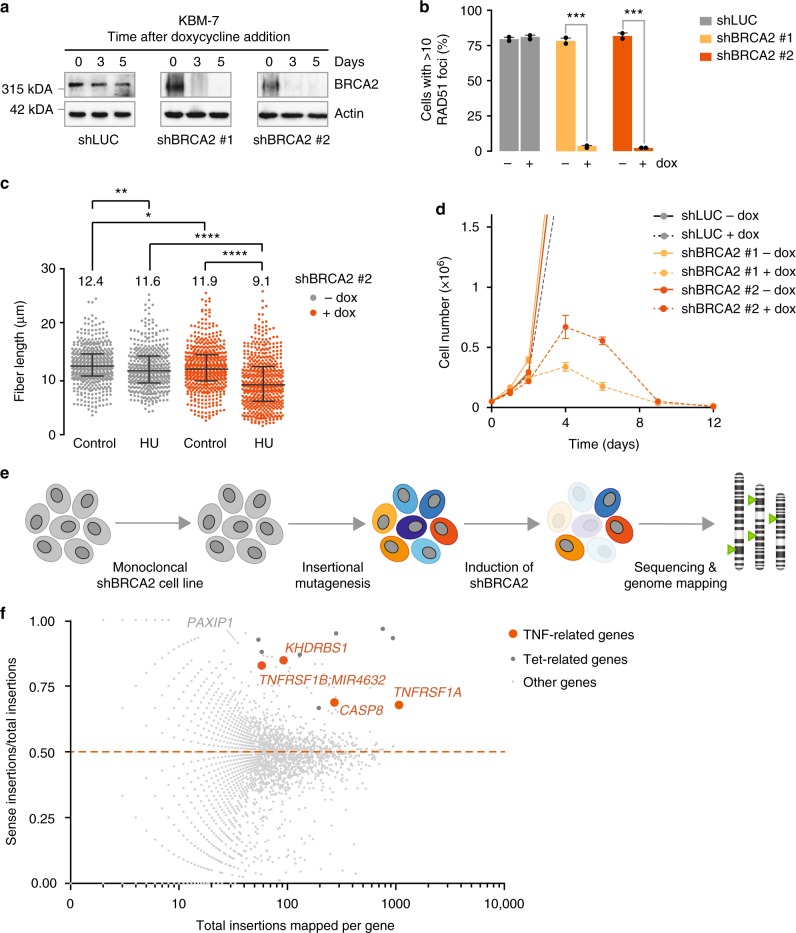
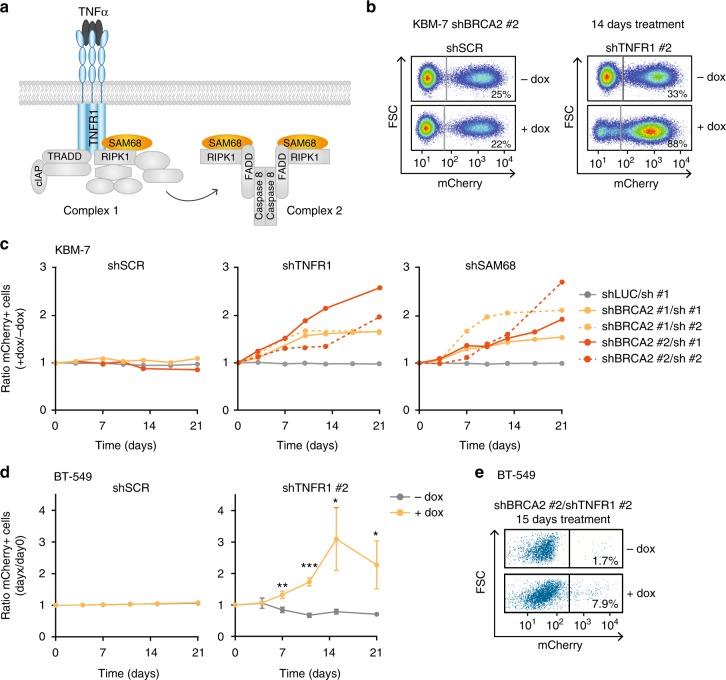
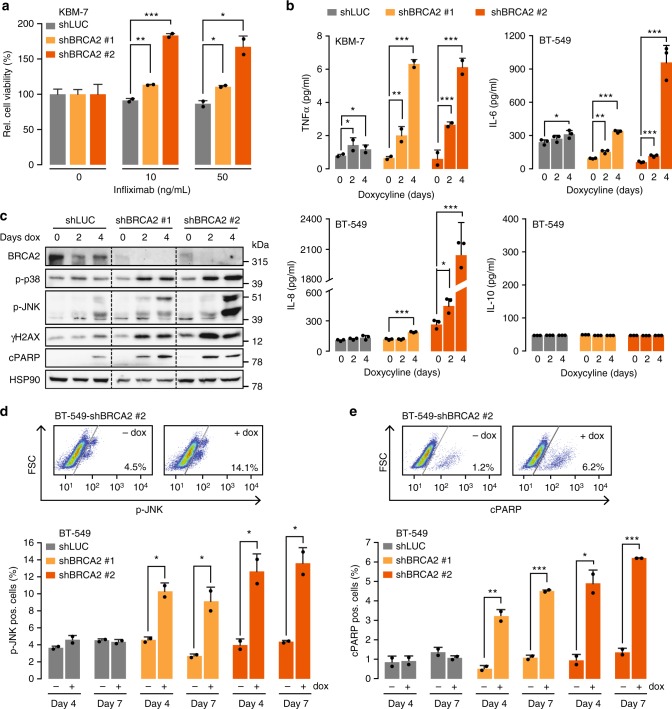
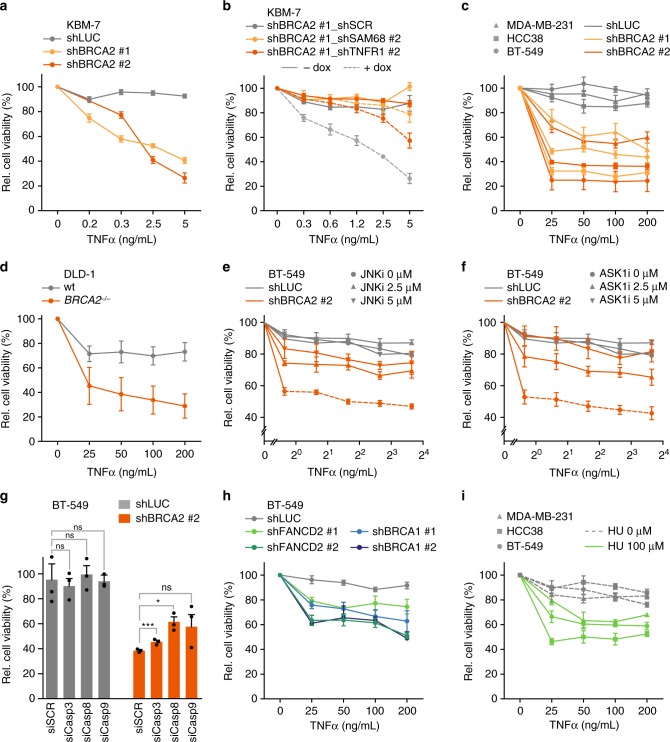
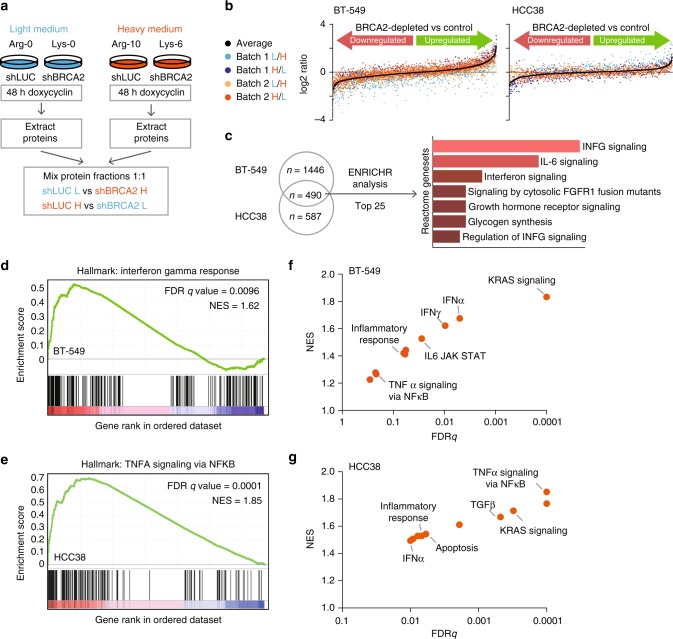
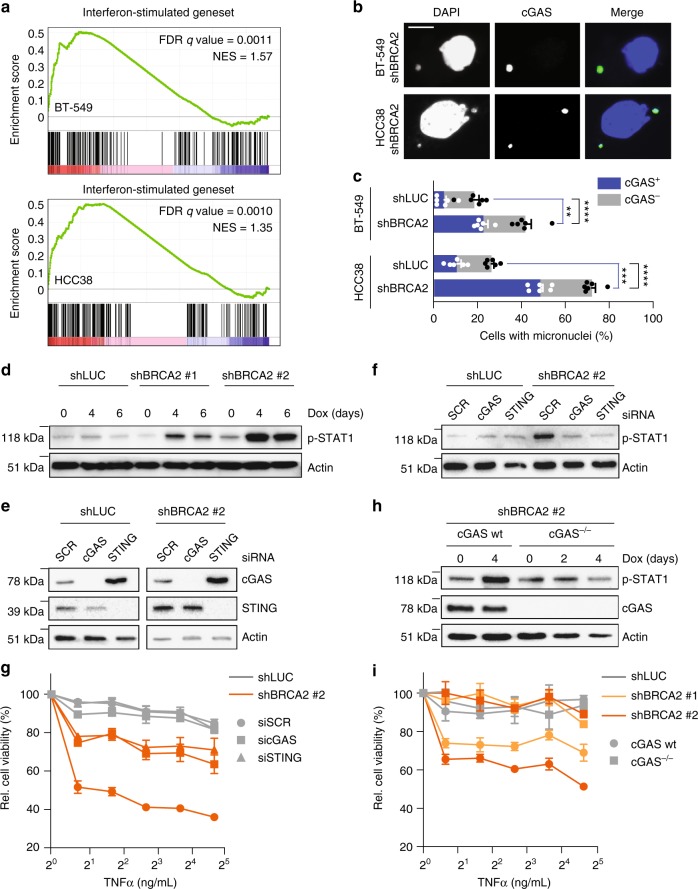
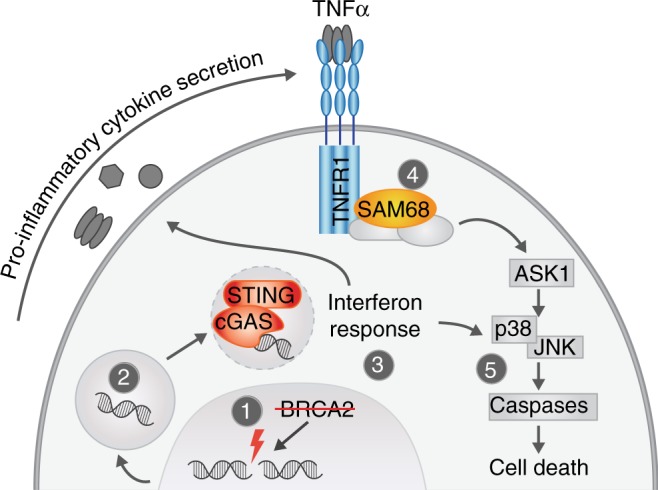
Loss of BRCA2 affects genome stability and is deleterious for cellular survival. Using a genome-wide genetic screen in near-haploid KBM-7 cells, we show that tumor necrosis factor-alpha (TNFα) signaling is a determinant of cell survival upon BRCA2 inactivation. Specifically, inactivation of the TNF receptor (TNFR1) or its downstream effector SAM68 rescues cell death induced by BRCA2 inactivation. BRCA2 inactivation leads to pro-inflammatory cytokine production, including TNFα, and increases sensitivity to TNFα. Enhanced TNFα sensitivity is not restricted to BRCA2 inactivation, as BRCA1 or FANCD2 inactivation, or hydroxyurea treatment also sensitizes cells to TNFα. Mechanistically, BRCA2 inactivation leads to cGAS-positive micronuclei and results in a cell-intrinsic interferon response, as assessed by quantitative mass-spectrometry and gene expression profiling, and requires ASK1 and JNK signaling. Combined, our data reveals that micronuclei induced by loss of BRCA2 instigate a cGAS/STING-mediated interferon response, which encompasses re-wired TNFα signaling and enhances TNFα sensitivity.
Overview
The claims and statistics of this paper haven’t been checked yet.
Free: it reads the open-access text and checks the first 5 claims that cite a source we can check. Create a free account to check every claim.
Integrity signals
Registry
Cites
Statistics
Figures
Verification
Claims the paper makes
The claims and statistics of this paper haven’t been checked yet.
Free: it reads the open-access text and checks the first 5 claims that cite a source we can check. Create a free account to check every claim.
Claims other papers make about this one
Each is checked against this paper’s own text: does it say what the citing paper says it does?
The cited source doesn’t support the claim as written.
In the citing paper
“TBK1 plays a central role in coordinating the innate immune response in response to cytosolic nucleic acids (e.g. cGAS-STING-TBK1-IRF3-IFN type I pathway) 3 , and enhanced sensitivity to TNF α has been shown to drive cGAS-STING-dependent interferon response and impact cell viability 42 .”
From Targeting TBK1 to overcome resistance to cancer immunotherapy (2023) · cites this paper as [42]
Checked by a reasoning model — may be wrong.
Experimental — accuracy not yet measured
Self-check
Percentages, sums and reported differences re-computed from the paper’s own numbers.
The self-check needs the paper’s full text.
Citations
Cites
Hallmarks of Cancer: The Next Generation
Hanahan, D., & Weinberg, R. A. (2011) · Cell · doi:10.1016/j.cell.2011.02.013 · Cited by 66,590
Genome engineering using the CRISPR-Cas9 system
Ran, F. A., Hsu, P. D., Wright, J., Agarwala, V., Scott, D. A., & Zhang, F. (2013) · Nature Protocols · doi:10.1038/nprot.2013.143 · Cited by 11,133
Enrichr: a comprehensive gene set enrichment analysis web server 2016 update
Kuleshov, M. V., Jones, M. R., Rouillard, A. D., Fernandez, N. F., Duan, Q., Wang, Z., Koplev, S., Jenkins, S. L., Jagodnik, K. M., Lachmann, A., et al. (2016) · Nucleic Acids Research · doi:10.1093/nar/gkw377 · Cited by 10,799
Integrated genomic analyses of ovarian carcinoma
Perou, C. M. (2019) · Carolina Digital Repository (University of North Carolina at Chapel Hill) · doi:10.17615/hvp3-wg08 · Cited by 7,925
The DNA-damage response in human biology and disease
Jackson, S. P., & Bartek, J. (2009) · Nature · doi:10.1038/nature08467 · Cited by 6,092
A Strong Candidate for the Breast and Ovarian Cancer Susceptibility Gene BRCA1
Miki, Y., Swensen, J., Shattuck-Eidens, D., Futreal, P. A., Harshman, K., Tavtigian, S., Liu, Q., Cochran, C., Bennett, L. M., Ding, W., et al. (1994) · Science · doi:10.1126/science.7545954 · Cited by 6,071
The DNA Damage Response: Making It Safe to Play with Knives
Ciccia, A., & Elledge, S. J. (2010) · Molecular Cell · doi:10.1016/j.molcel.2010.09.019 · Cited by 4,368 · cited 1×
“BRCA2 inactivation (1) leads to micronuclei formation (2) and cGAS/ STING-dependent activation of an interferon response (3).”
BackgroundRegulation and function of the cGAS–STING pathway of cytosolic DNA sensing
Chen, Q., Sun, L., & Chen, Z. J. (2016) · Nature Immunology · doi:10.1038/ni.3558 · Cited by 2,333
Localization of a Breast Cancer Susceptibility Gene, BRCA2 , to Chromosome 13q12-13
Wooster, R., Neuhausen, S. L., Mangion, J., Quirk, Y., Ford, D., Collins, N., Nguyen, K., Seal, S., Tran, T., Averill, D., et al. (1994) · Science · doi:10.1126/science.8091231 · Cited by 1,924
A Lentiviral RNAi Library for Human and Mouse Genes Applied to an Arrayed Viral High-Content Screen
Moffat, J., Grueneberg, D. A., Yang, X., Kim, S. Y., Kloepfer, A. M., Hinkle, G., Piqani, B., Eisenhaure, T. M., Luo, B., Grenier, J. K., et al. (2006) · Cell · doi:10.1016/j.cell.2006.01.040 · Cited by 1,798
Cited by
Items 101–156 of 156
The entanglement of DNA damage and pattern recognition receptor signaling
Ha, C. T., Tageldein, M. M., & Harding, S. M. (2023) · DNA repair · doi:10.1016/j.dnarep.2023.103595 · Cited by 6
Genetic Screening for Novel Regulators of Immune Checkpoint Molecules
Arens, R., & Scheeren, F. A. (2020) · Trends in Immunology · doi:10.1016/j.it.2020.06.005 · Cited by 7
Awaji, A. A., Maigoro, A. Y., Aborode, A. T., Akintola, A. A., Fatoba, D. O., Idris, E. B., Idris, A. B., Jafri, S., Shoaib, E. A., Onifade, I. A., et al. (2024) · Genome Instability & Disease · doi:10.1007/s42764-024-00133-9 · Cited by 5
Tuppurainen, H., Laurila, N., Nätynki, M., Eshraghi, L., Tervasmäki, A., Erichsen, L., Sørensen, C. S., Pylkäs, K., Winqvist, R., & Peltoketo, H. (2024) · Cellular and Molecular Life Sciences · doi:10.1007/s00018-024-05183-6 · Cited by 5
Targeting mitotic regulators in cancer as a strategy to enhance immune recognition
Gregorczyk, M., & Parkes, E. E. (2023) · DNA repair · doi:10.1016/j.dnarep.2023.103583 · Cited by 4
Spotlight on cGAS-STING: role in disease pathogenesis and therapeutic potential
Yan, D., Hu, J., Liu, Z. H., & Ouyang, W. (2026) · Molecular Biomedicine · doi:10.1186/s43556-026-00478-5 · Cited by 4
Innate immune sensing of macromolecule homeostasis
Yang, K., Jeltema, D., & Yan, N. (2024) · Advances in immunology · doi:10.1016/bs.ai.2024.03.004 · Cited by 4
Genomic landscape and precision therapy in prostate cancer: current status and future directions
Ligon, J. A., Anand, S., Singh, S., Siddiqui, J. A., Henegan, J. C., & Singh, A. P. (2026) · npj Precision Oncology · doi:10.1038/s41698-026-01368-3 · Cited by 4
Genomics guiding personalized first-line immunotherapy response in lung and bladder tumors
Iglesias, J. B., Gallardo‐Gómez, M., Oitabén, A., Lázaro-Quintela, M., León‐Mateos, L., Alves, J. M., Pino-González, M., Juaneda‐Magdalena, L., García-Benito, C., Abdulkader, I., et al. (2025) · Journal of Translational Medicine · doi:10.1186/s12967-025-06323-7 · Cited by 3
Conant, A., Suzuki, T., McGivney, K., Ayyadevara, V. S. S. A., Asariah, S., Deng, J., Nyein, E., Coats, J. S., Yu, G., Ioffe, Y., et al. (2026) · Molecular Oncology · doi:10.1002/1878-0261.70305 · Cited by 2
Stukan, А. I., Goryainova, А. Y., Riger, N. A., Викторович, Ш. С., Станиславовна, Ш. А., Chukhray, O. Y., & Andreev, D. V. (2021) · Cancer Urology · doi:10.17650/1726-9776-2021-17-3-85-94 · Cited by 2
DNA-repair-driven cell death compels us to rethink cancer therapies
Szmyd, R., Gee, H. E., & Cesare, A. J. (2025) · Nature Reviews Molecular Cell Biology · doi:10.1038/s41580-025-00879-4 · Cited by 2
Ma, J., Tang, D., Cui, G., Zhang, X., Wang, X., Li, Y., Hu, E., Zhou, X. H., Liu, H., Peng, Q., et al. (2025) · Scientific Reports · doi:10.1038/s41598-025-99853-5 · Cited by 2
Bui, T. M., & Sumagin, R. (2022) · Mutation research. Fundamental and molecular mechanisms of mutagenesis · doi:10.1016/j.mrfmmm.2022.111778 · Cited by 2
Jin, Y., Wang, L., Jin, C., Zhang, N., Shimizu, S., Xiao, W., Guo, C., Liu, X., & Si, H. (2024) · Chemical Research in Toxicology · doi:10.1021/acs.chemrestox.3c00343 · Cited by 2
Tissue specificity and chromosomal alterations shape divergent immune programs in HRD tumorsPreprint
Gulhan, D., Barras, D., Mina, M., Ghisoni, E., Kim, Y., Viswanadham, V., Jin, H., Huber, F., Homicskó, K., Bassani‐Sternberg, M., et al. (2025) · bioRxiv (Cold Spring Harbor Laboratory) · doi:10.1101/2025.10.13.681986 · Cited by 2
Song, X., Ling, X., Liu, H., Zhao, Q., Li, X., Lai, W., & Wang, H. (2024) · Chemical Research in Chinese Universities · doi:10.1007/s40242-024-4120-7 · Cited by 1
BRCA2-deficiency Causes Global Transcriptomic Alterations in Endothelial CellsPreprint
Nikfarjam, S., Singh, A. P., Bu, S., Nguyen, H. C., & Singh, K. K. (2025) · bioRxiv (Cold Spring Harbor Laboratory) · doi:10.1101/2025.09.14.676113 · Cited by 1
Liu, Y., Hu, Y., & Shan, Z. (2025) · World Chinese Journal of Digestology · doi:10.11569/wcjd.v33.i5.344 · Cited by 1
The Fundamentals of Cancer Immunity
Jia, H., Yang, L., & Liu, J. (2025) · Royal Society of Chemistry eBooks · doi:10.1039/9781837675739-00098 · Cited by 1
Immunopathogenesis of Liver Cirrhosis
Guillot, A., & Gao, B. (2020) · Springer eBooks · doi:10.1007/978-3-030-51709-0_35 · Cited by 1
Beyond cancer: breast cancer gene 2 emerges as a new player in atherosclerosis
Michels, D., Singh, A., Patel, M., Rasheed, B., Nikfarjam, S., Bu, S., Ehsan, M., Feng, B., German‐Castelan, L., Gros, R., et al. (2026) · American Journal of Physiology-Heart and Circulatory Physiology · doi:10.1152/ajpheart.00790.2025 · Cited by 1
The contribution of rare germline variants to the immune landscape of breast cancer
Rojas-Rodríguez, F., Canisius, S., Keeman, R., Bernstein, A., Hurson, A. N., Ahearn, T. U., Andrulis, I. L., Antoniou, A. C., Behrens, S., Białkowska, K., et al. (2026) · Genome Medicine · doi:10.1186/s13073-026-01662-6 · Cited by 1
BRCA2-deficient endothelium: a hidden catalyst in angiotensin II-induced vascular injury
Singh, A., Bu, S., Perron, A., Bhatt, K. S., Sandhu, I. S., Frisbee, J. C., & Singh, K. K. (2026) · Journal of Hypertension · doi:10.1097/hjh.0000000000004407 · Cited by 1
Pailas, A., de Almeida, A. C. V., Torres-Fernández, M., Chalmers, A. J., Mittelbronn, M., & Dyck, E. V. (2026) · Neuro-Oncology Advances · doi:10.1093/noajnl/vdag177 · Cited by 1
Shining a Spotlight on RNA m6A Modifications and Potential Targeted Immunotherapy in Ovarian Cancer
Pang, H., Zheng, W., Lu, Q., & Zhang, H. (2024) · Clinical and Experimental Obstetrics & Gynecology · doi:10.31083/j.ceog5112276 · Cited by 1
van Wezel, M. D., Kool, H., van den Heuvel, D., van Schendel, R., Barazas, M., Luijsterburg, M. S., Tijsterman, M., & Schimmel, J. (2026) · Nucleic Acids Research · doi:10.1093/nar/gkag783 · Cited by 1
CDK10 inhibits innate sensing to constrain antitumor immunity
Firmino, N. S., & West, N. R. (2026) · Nature Cancer · doi:10.1038/s43018-025-01101-2 · Cited by 1
Maru, Y. (2021) · Springer eBooks · doi:10.1007/978-981-16-1757-7_14
Radiation-induced cell-death states in cancer: Toward biomarker-guided radioimmunotherapy
Wang, X., (2085), W. G., Wang, Q., He, S., & Zou, B. (2026) · Cancer Letters · doi:10.1016/j.canlet.2026.218860
Iqbal, J. (2023) · Qeios · doi:10.32388/0er6z3
The Pathogenesis and Research Progress of Immunogenic Micronuclei in Tumors
周, 晶. (2024) · Advances in Clinical Medicine · doi:10.12677/acm.2024.14102829
Radiation-dependent Nucleic Acid Sensing, and Its Possible Impact on Radiotherapy
Pickering, R. J., & Zierhut, C. (2025) · The Cancer Journal · doi:10.1097/ppo.0000000000000775
Conant, A., Badiner, N. M., Asariah, S., McGivney, K., Shah, V., Suzuki, T., Ioffe, Y., & Unternaehrer, J. (2026) · Molecular Oncology · doi:10.1002/1878-0261.70311
Repair of replication-born DNA lesions before and during mitosis
de Boer, H. R., & van Vugt, M. A. T. M. (2026) · DNA repair · doi:10.1016/j.dnarep.2026.103976
RNA ‐related functions of BRCA2 in transcription, replication, and genome stability
Alvaro-Aranda, L., Sridhara, S. R. C., & Carreira, A. (2026) · FEBS Letters · doi:10.1002/1873-3468.70461
Suppression of Homologous Recombination by RAD51 Functional Inactivation In Vivo in Mice
Matos-Rodrigues, G. E. (2020) · theses.fr (ABES) · doi:10.70675/6c3cf7f3za3a0z4ed4z97a2zeb1353824f3d
R-loops and G4-structures: from DNA damage to innate immune response gene activation
Arleo, A. (2023) · AMS Dottorato Institutional Doctoral Theses Repository (University of Bologna) · doi:10.48676/unibo/amsdottorato/10860
Landelouci, K. (2026) · Le dépôt institutionnel (Université du Québec à Trois-Rivières)
Phosphoinositide Regulation of Intracellular Nucleic Acid Sensors
Barnett, K. C. (2019) · Digital Access to Scholarship at Harvard (DASH) (Harvard University)
Liu, K., Gong, X., Li, Y., Li, M. W., Si, C., & Zhou, L. (2026) · Biochemistry and Biophysics Reports · doi:10.1016/j.bbrep.2026.102445
Rickman, K. A., Sun, I. Q., Parameswaran, R., Zhu, X. G., Cai, E. Y., Rossi, V., Ziper, N., Song, H., Thai, C., Li, Y., et al. (2026) · bioRxiv (Cold Spring Harbor Laboratory) · doi:10.64898/2026.11.11.765808
BRCA2 loss induces an innate immune response via activation of the cGAS-STING pathway
Reisländer, T. (2019) · Oxford University Research Archive (ORA) (University of Oxford) · doi:10.5287/ora-0zeg1pevz
Zhao, S., Ruiz, J. A. G., Sebastian, M., & Kidane, D. (2022) · doi:10.3389/fimmu.2022.1039009.s002
Chiaka Akuwudike, P. (2023) · DiVA (Stockholm University)
Schoeftner, S., Framarini, A., Parlante, A., Etengene, E., Giaquinto, M., Zampa, E., Cechutti, G., Ferrando, A., Bertolio, R., Frossi, B., et al. (2026) · Research Square · doi:10.21203/rs.3.rs-11048758/v1
Stukan, А. I., Vtorushin, S. V., Bogdan, A. P., Semiglazova, Т. Y., Tovbulatova, K. R., Bodnya, V. N., Porkhanov, V. A., Dovlatbekyan, A. A., Chagiev, M. A., & Khoreva, D. V. (2025) · Cancer Urology · doi:10.17650/1726-9776-2025-21-2-104-118
Russo, M. V. (2020) · AMS Dottorato Institutional Doctoral Theses Repository (University of Bologna) · doi:10.6092/unibo/amsdottorato/9253
Endothelial Cell-specific Loss of Breast Cancer Susceptibility Gene 2 Exacerbates AtherosclerosisPreprint
Michels, D., Nikfarjam, S., Rasheed, B., Patel, M., Bu, S., Ehsan, M., Nguyen, H. C., Singh, A., Feng, B., McGuire, J., et al. (2023) · arXiv (Cornell University) · doi:10.48550/arxiv.2306.10993
The roles of BRCA2 in chromosome integrity
Groelly, F. J. (2021) · Oxford University Research Archive (ORA) (University of Oxford) · doi:10.5287/ora-qaemgvmkn
Yang, Y., Zhu, Q., Du, Y., Huang, L., & Qian, B. (2026) · Scientific Reports · doi:10.1038/s41598-026-80306-6
Dagg, R. A., Paulsen, T., Prasad, B., Gregoriis, G. D., Seung, Y., Groelly, F. J., Draganov, S. D., Pedretti, F., Herencia-Ropero, A., Serra, V., et al. (2026) · Nature Communications · doi:10.1038/s41467-026-78554-1
Ding, K., He, Y., Wei, J., Fu, S., Wang, J., Chen, Z., Zhang, H., Qu, Y., Liang, K., Gong, X., et al. (2022) · doi:10.3389/fimmu.2022.943090.s015
Metadata
- Authors
- Heijink, A. M., Talens, F., Jae, L. T., van Gijn, S. E., Fehrmann, R. S. N., Brummelkamp, T. R., & van Vugt, M. A. T. M.
- Affiliations
- University Medical Center Groningen (NL)
- Ludwig-Maximilians-Universität München (DE)
- Austrian Academy of Sciences (AT)
- Venue
- Nature Communications
- Published
- 2019-01-09
- Volume
- 10
- Issue
- 1
- Pages
- 100-100
- ISSN
- 2041-1723 (ISSN-L)
- PMC
- PMC6327059
- OpenAlex
- W2911100007
- Semantic Scholar
- 798be3623ee21c4f1446ec54fefc1b78b744cdad
- Cited by
- 140
- References
- 70
- Citations by year
- 2026: 14 · 2025: 21 · 2024: 19 · 2023: 21 · 2022: 21 · 2021: 18 · 2020: 19 · 2019: 7
- FWCI
- 6.48
- Type
- journal article
- Language
- en
- Open access
- gold
- doi.org
- Licence
- cc-by
- creativecommons.org/licenses/by/4.0 (tdm)
- creativecommons.org/licenses/by/4.0 (vor)
- Locations
- Nature Communications (publishedVersion, cc-by)
- Europe PMC (PubMed Central) (publishedVersion, cc-by)
- PubMed Central (publishedVersion, cc-by)
- PubMed (publishedVersion)
- Zurich Open Repository and Archive (University of Zurich) (acceptedVersion, cc-by)
- RePEc: Research Papers in Economics (submittedVersion)
- DOAJ (DOAJ: Directory of Open Access Journals) (submittedVersion)
- DOAJ (DOAJ: Directory of Open Access Journals) (submittedVersion, cc-by-sa)
- Open access LMU (Ludwid Maxmilian's Universitat Munchen) (submittedVersion, cc-by)
- University of Groningen research database (University of Groningen / Centre for Information Technology) (submittedVersion, cc-by)
- Zurich Open Repository and Archive (University of Zurich) (submittedVersion, cc-by)
- University of Groningen research database (University of Groningen / Centre for Information Technology) (submittedVersion)
- Zurich Open Repository and Archive (University of Zurich)
- Funders
- Nederlandse Organisatie voor Wetenschappelijk Onderzoek (NWO-VIDI 917-13334, 917.13334)
- KWF Kankerbestrijding
- H2020 European Research Council (682421)
- Topics
- Life Sciences › Immunology and Microbiology › Immunology › interferon and immune responses
- Life Sciences › Biochemistry, Genetics and Molecular Biology › Molecular Biology › DNA Repair Mechanisms
- Life Sciences › Biochemistry, Genetics and Molecular Biology › Molecular Biology › Cell death mechanisms and regulation
- Keywords
- BRCA2 deficiency, cGAS-STING pathway, interferon response, TNF receptor 1, Sam68, micronuclei, genomic instability, ASK1, JNK signaling, BRCA1, FANCD2, hydroxyurea, inflammatory signaling, cell death
- MeSH terms
- Cyclic Guanosine Monophosphate-Adenosine Monophosphate Synthase, Cell Line, Cell Survival, Humans, Inflammation, Nucleotidyltransferases, Tumor Necrosis Factor-alpha, Signal Transduction, Gene Deletion, BRCA2 Protein
About these checks
Registry, retraction, Cites and statistics results are computed, not judged, with one exception: a printed reference that no index lists is read once by a model before it counts as a citation error. Claims are extracted by a model and kept only when their quote appears verbatim in the text; each cited source is then checked, with a model’s help, for whether it says what the claim relies on. Those verdicts can be wrong — read the claim’s quote and the cited source before relying on one.
Statistics and arithmetic are recomputed, not judged.
Confidence bands are shown only for fields calibrated on our annotated test set. None is calibrated yet, so no band is shown.
What counts as a claim ›How we measure confidence ›How we check this ›
Are you an author, or do you see a problem with this page? Request a review
Data sources
Bibliographic data: Semantic Scholar, OpenAlex, Crossref.
Contains information from the Semantic Scholar Academic Graph Datasets, made available under the ODC Attribution License (ODC-BY 1.0).
Semantic Scholar’s data is described in: Kinney, R., et al. (2023). The Semantic Scholar Open Data Platform. arXiv:2301.10140.
