

BRCA2 deficiency instigates cGAS-mediated inflammatory signaling and confers sensitivity to tumor necrosis factor-alpha-mediated cytotoxicity
Open accessThe DOI matches its Crossref record; 71 of the 71 references it cites were found in a registry or an index.
Abstract
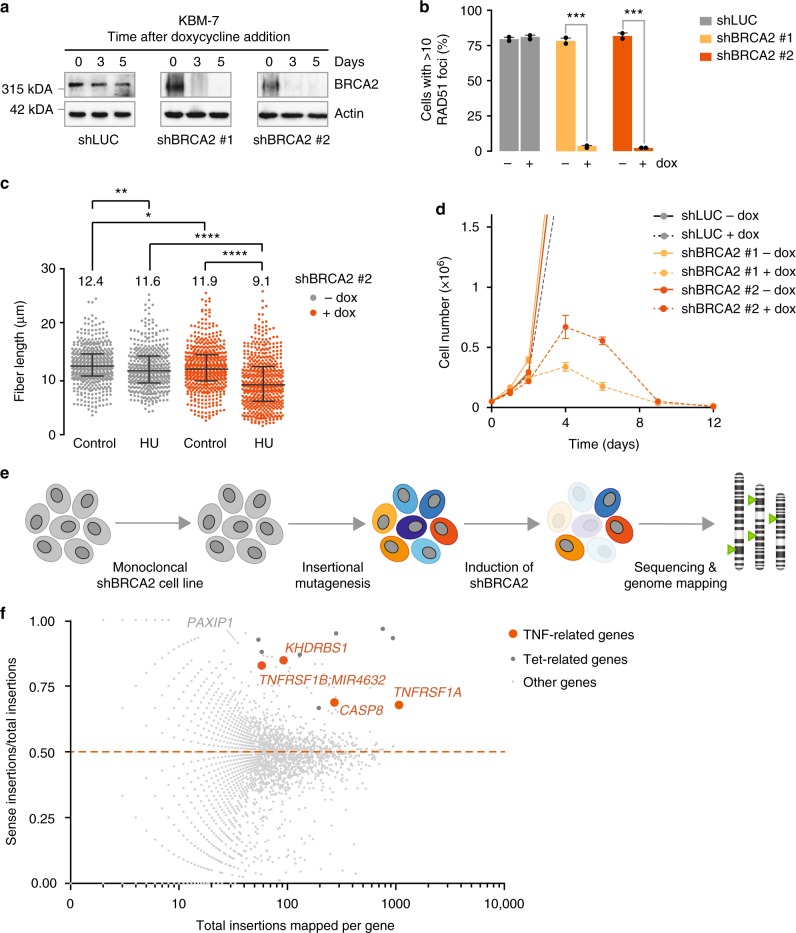
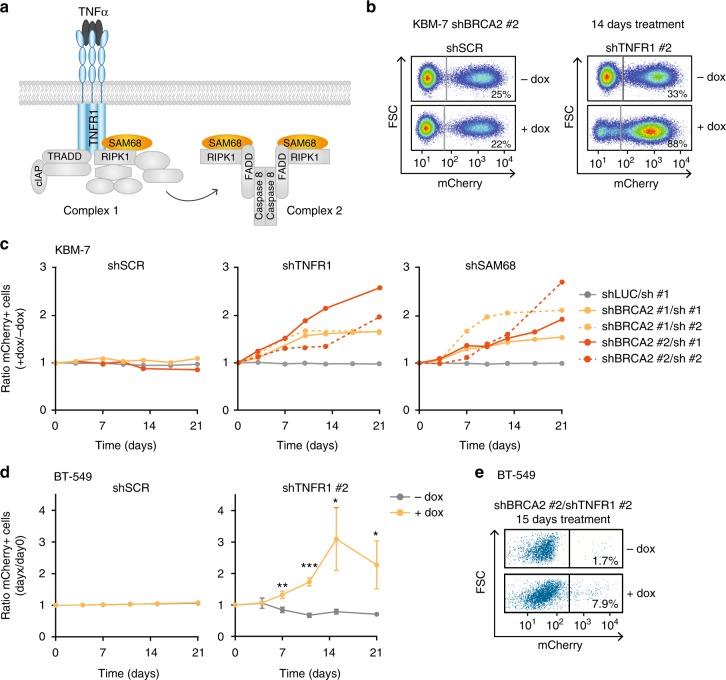
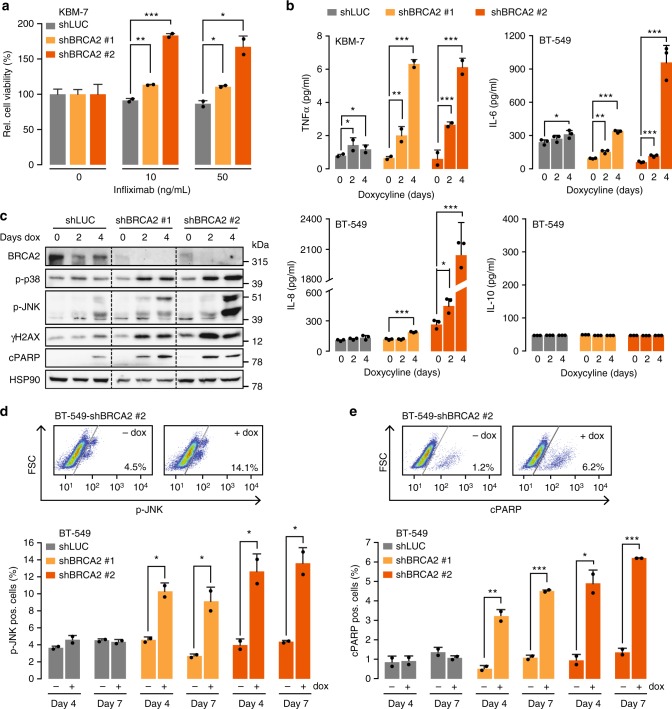
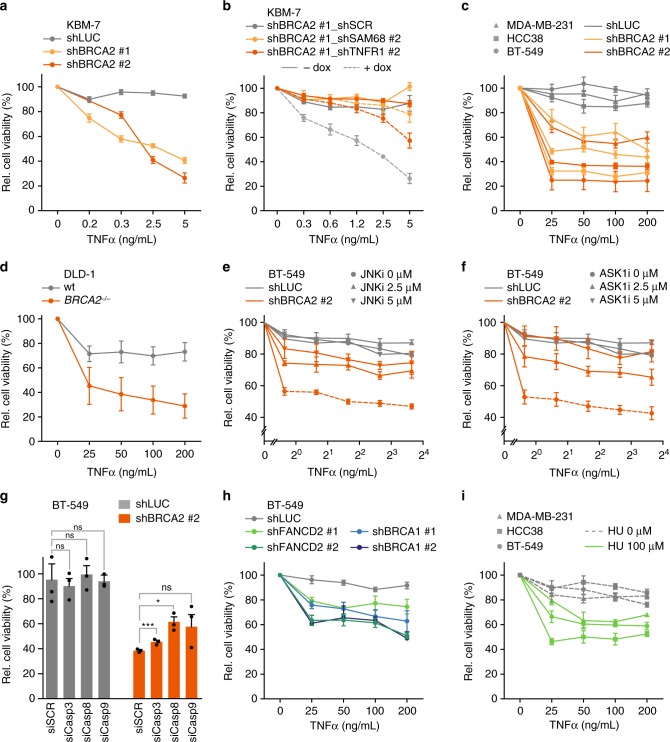
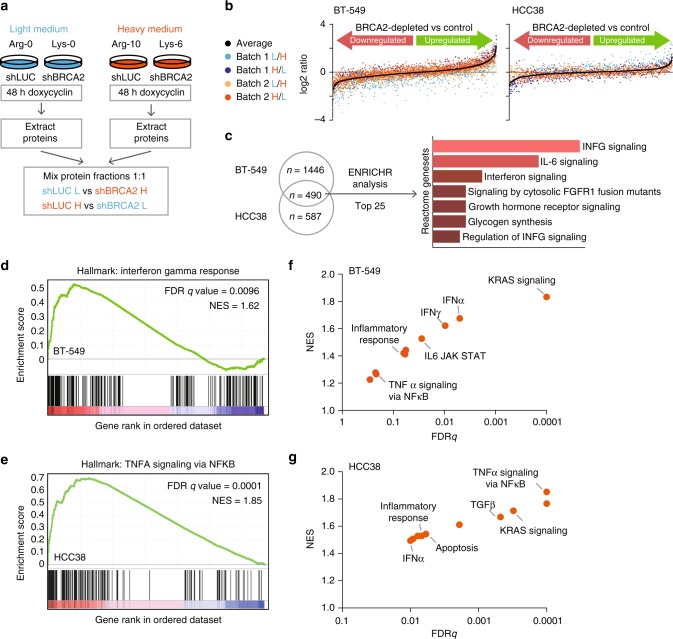
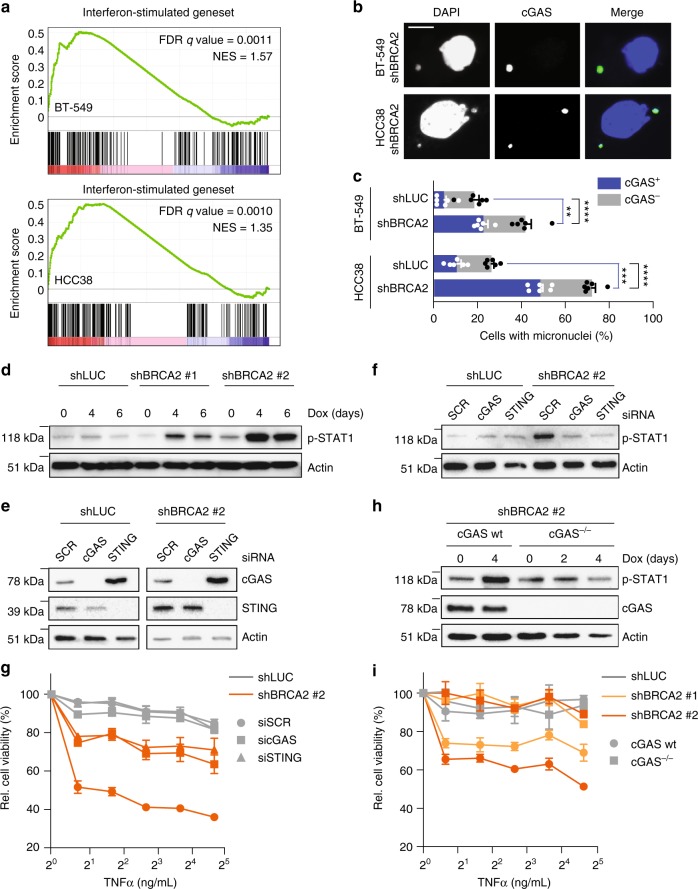
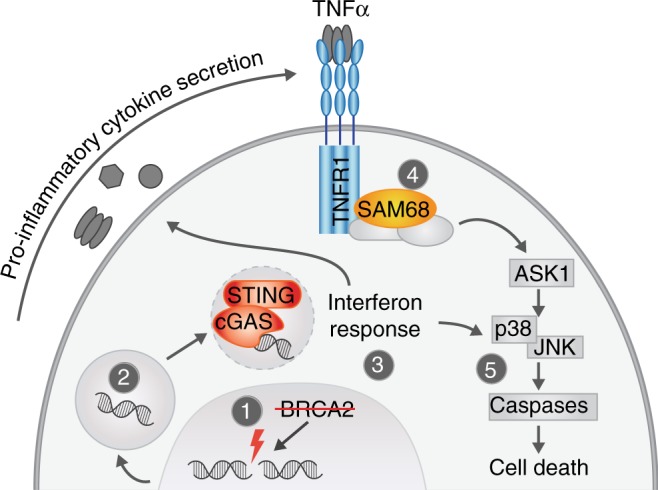
Loss of BRCA2 affects genome stability and is deleterious for cellular survival. Using a genome-wide genetic screen in near-haploid KBM-7 cells, we show that tumor necrosis factor-alpha (TNFα) signaling is a determinant of cell survival upon BRCA2 inactivation. Specifically, inactivation of the TNF receptor (TNFR1) or its downstream effector SAM68 rescues cell death induced by BRCA2 inactivation. BRCA2 inactivation leads to pro-inflammatory cytokine production, including TNFα, and increases sensitivity to TNFα. Enhanced TNFα sensitivity is not restricted to BRCA2 inactivation, as BRCA1 or FANCD2 inactivation, or hydroxyurea treatment also sensitizes cells to TNFα. Mechanistically, BRCA2 inactivation leads to cGAS-positive micronuclei and results in a cell-intrinsic interferon response, as assessed by quantitative mass-spectrometry and gene expression profiling, and requires ASK1 and JNK signaling. Combined, our data reveals that micronuclei induced by loss of BRCA2 instigate a cGAS/STING-mediated interferon response, which encompasses re-wired TNFα signaling and enhances TNFα sensitivity.
Overview
The claims and statistics of this paper haven’t been checked yet.
Free: it reads the open-access text and checks the first 5 claims that cite a source we can check. Create a free account to check every claim.
Integrity signals
Registry
Cites
Statistics
Figures
Verification
Claims the paper makes
The claims and statistics of this paper haven’t been checked yet.
Free: it reads the open-access text and checks the first 5 claims that cite a source we can check. Create a free account to check every claim.
Claims other papers make about this one
Each is checked against this paper’s own text: does it say what the citing paper says it does?
The cited source doesn’t support the claim as written.
In the citing paper
“TBK1 plays a central role in coordinating the innate immune response in response to cytosolic nucleic acids (e.g. cGAS-STING-TBK1-IRF3-IFN type I pathway) 3 , and enhanced sensitivity to TNF α has been shown to drive cGAS-STING-dependent interferon response and impact cell viability 42 .”
From Targeting TBK1 to overcome resistance to cancer immunotherapy (2023) · cites this paper as [42]
Checked by a reasoning model — may be wrong.
Experimental — accuracy not yet measured
Self-check
Percentages, sums and reported differences re-computed from the paper’s own numbers.
The self-check needs the paper’s full text.
Citations
Cites
Hallmarks of Cancer: The Next Generation
Hanahan, D., & Weinberg, R. A. (2011) · Cell · doi:10.1016/j.cell.2011.02.013 · Cited by 66,590
Genome engineering using the CRISPR-Cas9 system
Ran, F. A., Hsu, P. D., Wright, J., Agarwala, V., Scott, D. A., & Zhang, F. (2013) · Nature Protocols · doi:10.1038/nprot.2013.143 · Cited by 11,133
Enrichr: a comprehensive gene set enrichment analysis web server 2016 update
Kuleshov, M. V., Jones, M. R., Rouillard, A. D., Fernandez, N. F., Duan, Q., Wang, Z., Koplev, S., Jenkins, S. L., Jagodnik, K. M., Lachmann, A., et al. (2016) · Nucleic Acids Research · doi:10.1093/nar/gkw377 · Cited by 10,799
Integrated genomic analyses of ovarian carcinoma
Perou, C. M. (2019) · Carolina Digital Repository (University of North Carolina at Chapel Hill) · doi:10.17615/hvp3-wg08 · Cited by 7,925
The DNA-damage response in human biology and disease
Jackson, S. P., & Bartek, J. (2009) · Nature · doi:10.1038/nature08467 · Cited by 6,092
A Strong Candidate for the Breast and Ovarian Cancer Susceptibility Gene BRCA1
Miki, Y., Swensen, J., Shattuck-Eidens, D., Futreal, P. A., Harshman, K., Tavtigian, S., Liu, Q., Cochran, C., Bennett, L. M., Ding, W., et al. (1994) · Science · doi:10.1126/science.7545954 · Cited by 6,071
The DNA Damage Response: Making It Safe to Play with Knives
Ciccia, A., & Elledge, S. J. (2010) · Molecular Cell · doi:10.1016/j.molcel.2010.09.019 · Cited by 4,368 · cited 1×
“BRCA2 inactivation (1) leads to micronuclei formation (2) and cGAS/ STING-dependent activation of an interferon response (3).”
BackgroundRegulation and function of the cGAS–STING pathway of cytosolic DNA sensing
Chen, Q., Sun, L., & Chen, Z. J. (2016) · Nature Immunology · doi:10.1038/ni.3558 · Cited by 2,333
Localization of a Breast Cancer Susceptibility Gene, BRCA2 , to Chromosome 13q12-13
Wooster, R., Neuhausen, S. L., Mangion, J., Quirk, Y., Ford, D., Collins, N., Nguyen, K., Seal, S., Tran, T., Averill, D., et al. (1994) · Science · doi:10.1126/science.8091231 · Cited by 1,924
A Lentiviral RNAi Library for Human and Mouse Genes Applied to an Arrayed Viral High-Content Screen
Moffat, J., Grueneberg, D. A., Yang, X., Kim, S. Y., Kloepfer, A. M., Hinkle, G., Piqani, B., Eisenhaure, T. M., Luo, B., Grenier, J. K., et al. (2006) · Cell · doi:10.1016/j.cell.2006.01.040 · Cited by 1,798
Kamata, H., Honda, S.-I., Maeda, S., Chang, L., Hirata, H., & Karin, M. (2005) · Cell · doi:10.1016/j.cell.2004.12.041 · Cited by 1,792
cGAS surveillance of micronuclei links genome instability to innate immunity
Mackenzie, K. J., Carroll, P., Martin, C.-A., Murina, O., Fluteau, A., Simpson, D. J., Olova, N., Sutcliffe, H., Rainger, J. K., Leitch, A., et al. (2017) · Nature · doi:10.1038/nature23449 · Cited by 1,752
Small Molecule Inhibitor of Mitotic Spindle Bipolarity Identified in a Phenotype-Based Screen
Mayer, T. U., Kapoor, T. M., Haggarty, S. J., King, R. W., Schreiber, S. L., & Mitchison, T. J. (1999) · Science · doi:10.1126/science.286.5441.971 · Cited by 1,727
53BP1 Inhibits Homologous Recombination in Brca1-Deficient Cells by Blocking Resection of DNA Breaks
Bunting, S. F., Callén, E., Wong, N., Chen, H.-T., Polato, F., Gunn, A., Bothmer, A., Feldhahn, N., Fernandez-Capetillo, O., Cao, L., et al. (2010) · Cell · doi:10.1016/j.cell.2010.03.012 · Cited by 1,671
Chromosomal instability drives metastasis through a cytosolic DNA response
Bakhoum, S. F., Ngo, B., Laughney, A. M., Cavallo, J.-A., Murphy, C. J., Ly, P., Shah, P., Sriram, R. K., Watkins, T. B. K., Taunk, N. K., et al. (2018) · Nature · doi:10.1038/nature25432 · Cited by 1,593
Mitotic progression following DNA damage enables pattern recognition within micronuclei
Harding, S. M., Benci, J. L., Irianto, J., Discher, D. E., Minn, A. J., & Greenberg, R. A. (2017) · Nature · doi:10.1038/nature23470 · Cited by 1,508
Schlacher, K., Christ, N., Siaud, N., Egashira, A., Wu, H., & Jasin, M. (2011) · Cell · doi:10.1016/j.cell.2011.03.041 · Cited by 1,255
Brca1 Controls Homology-Directed DNA Repair
Moynahan, M. E., Chiu, J. W., Koller, B. H., & Jasin, M. (1999) · Molecular Cell · doi:10.1016/s1097-2765(00)80202-6 · Cited by 1,245
Fenech, M., Kirsch-Volders, M., Natarajan, A. T., Surralles, J., Crott, J. W., Parry, J., Norppa, H., Eastmond, D. A., Tucker, J. D., & Thomas, P. (2011) · Mutagenesis · doi:10.1093/mutage/geq052 · Cited by 1,244
Varfolomeev, E. E., Schuchmann, M., Luria, V., Chiannilkulchai, N., Beckmann, J. S., Mett, I. L., Rebrikov, D., Brodianski, V. M., Kemper, O. C., Kollet, O., et al. (1998) · Immunity · doi:10.1016/s1074-7613(00)80609-3 · Cited by 1,234
ASK1 is required for sustained activations of JNK/p38 MAP kinases and apoptosis
Tobiume, K., Matsuzawa, A., Takahashi, T., Nishitoh, H., Morita, K., Takeda, K., Minowa, O., Miyazono, K., Noda, T., & Ichijo, H. (2001) · EMBO reports · doi:10.1093/embo-reports/kve046 · Cited by 1,210
BRCA1 Mutations in Primary Breast and Ovarian Carcinomas
Futreal, P. A., Liu, Q., Shattuck-Eidens, D., Cochran, C., Harshman, K., Tavtigian, S., Bennett, L. M., Haugen-Strano, A., Swensen, J., Miki, Y., et al. (1994) · Science · doi:10.1126/science.7939630 · Cited by 1,205
Biallelic Inactivation of BRCA2 in Fanconi Anemia
Howlett, N. G., Taniguchi, T., Olson, S., Cox, B., Waisfisz, Q., de Die-Smulders, C., Persky, N., Grompe, M., Joenje, H., Pals, G., et al. (2002) · Science · doi:10.1126/science.1073834 · Cited by 1,149
Embryonic lethality and radiation hypersensitivity mediated by Rad51 in mice lacking Brca2
Sharan, S. K., Morimatsu, M., Albrecht, U., Lim, D.-S., Regel, E., Dinh, C., Sands, A., Eichele, G., Hasty, P., & Bradley, A. (1997) · Nature · doi:10.1038/386804a0 · Cited by 1,072
Jonkers, J., Meuwissen, R., van der Gulden, H., Peterse, H., van der Valk, M., & Berns, A. (2001) · Nature Genetics · doi:10.1038/ng747 · Cited by 1,053
Bouwman, P., Aly, A., Escandell, J. M., Pieterse, M., Bartkova, J., van der Gulden, H., Hiddingh, S., Thanasoula, M., Kulkarni, A., Yang, Q., et al. (2010) · Nature Structural & Molecular Biology · doi:10.1038/nsmb.1831 · Cited by 1,001
Replication fork stability confers chemoresistance in BRCA-deficient cells
Ray Chaudhuri, A., Callen, E., Ding, X., Gogola, E., Duarte, A. A., Lee, J.-E., Wong, N., Lafarga, V., Calvo, J. A., Panzarino, N. J., et al. (2016) · Nature · doi:10.1038/nature18325 · Cited by 930
Escribano-Díaz, C., Orthwein, A., Fradet-Turcotte, A., Xing, M., Young, J. T. F., Tkáč, J., Cook, M. A., Rosebrock, A. P., Munro, M., Canny, M. D., et al. (2013) · Molecular Cell · doi:10.1016/j.molcel.2013.01.001 · Cited by 900
Repair of Strand Breaks by Homologous Recombination
Jasin, M., & Rothstein, R. (2013) · Cold Spring Harbor Perspectives in Biology · doi:10.1101/cshperspect.a012740 · Cited by 887
IKK/NF- B signaling: balancing life and death - a new approach to cancer therapy
Luo, J.-L. (2005) · Journal of Clinical Investigation · doi:10.1172/jci26322 · Cited by 878
Gene essentiality and synthetic lethality in haploid human cells
Blomen, V. A., Májek, P., Jae, L. T., Bigenzahn, J. W., Nieuwenhuis, J., Staring, J., Sacco, R., van Diemen, F. R., Olk, N., Stukalov, A., et al. (2015) · Science · doi:10.1126/science.aac7557 · Cited by 857
Self-citationInduction of gadd45β by NF-κB downregulates pro-apoptotic JNK signalling
De Smaele, E., Zazzeroni, F., Papa, S., Nguyen, D. U., Jin, R., Jones, J., Cong, R., & Franzoso, G. (2001) · Nature · doi:10.1038/35104560 · Cited by 732
Inhibition of JNK activation through NF-κB target genes
Tang, G., Minemoto, Y., Dibling, B., Purcell, N. H., Li, Z., Karin, M., & Lin, A. (2001) · Nature · doi:10.1038/35104568 · Cited by 721
T-helper-1-cell cytokines drive cancer into senescence
Braumüller, H., Wieder, T., Brenner, E., Aßmann, S., Hahn, M., Alkhaled, M., Schilbach, K., Essmann, F., Kneilling, M., Griessinger, C., et al. (2013) · Nature · doi:10.1038/nature11824 · Cited by 720
The Tumor Suppressor Gene Brca1 Is Required for Embryonic Cellular Proliferation in the Mouse
Hakem, R., de la Pompa, J. L., Sirard, C., Mo, R., Woo, M., Hakem, A., Wakeham, A., Potter, J., Reitmair, A., Billia, F., et al. (1996) · Cell · doi:10.1016/s0092-8674(00)81302-1 · Cited by 667
The shieldin complex mediates 53BP1-dependent DNA repair
Noordermeer, S. M., Adam, S., Setiaputra, D., Barazas, M., Pettitt, S. J., Ling, A. K., Olivieri, M., Álvarez-Quilón, A., Moatti, N., Zimmermann, M., et al. (2018) · Nature · doi:10.1038/s41586-018-0340-7 · Cited by 645
REV7 counteracts DNA double-strand break resection and affects PARP inhibition
Xu, G., Chapman, J. R., Brandsma, I., Yuan, J., Mistrik, M., Bouwman, P., Bartkova, J., Gogola, E., Warmerdam, D., Barazas, M., et al. (2015) · Nature · doi:10.1038/nature14328 · Cited by 593
Ludwig, T., Chapman, D. L., Papaioannou, V. E., & Efstratiadis, A. (1997) · Genes & Development · doi:10.1101/gad.11.10.1226 · Cited by 539
BRCA2 is required for ionizing radiation-induced assembly of Rad51 complex in vivo.
Yuan, S. F., Lee, S. Y., Chen, G., Song, M., Tomlinson, G. E., & Lee, E. Y.-H. P. (1999) · PubMed · Cited by 494
Haploid Genetic Screens in Human Cells Identify Host Factors Used by Pathogens
Carette, J. E., Guimaraes, C. P., Varadarajan, M., Park, A. S., Wuethrich, I., Godarova, A., Kotecki, M., Cochran, B. H., Spooner, E., Ploegh, H. L., et al. (2009) · Science · doi:10.1126/science.1178955 · Cited by 489
Self-citationNF-κB addiction and its role in cancer: ‘one size does not fit all’
Chaturvedi, M. M., Sung, B., Yadav, V. R., Kannappan, R., & Aggarwal, B. B. (2011) · Oncogene · doi:10.1038/onc.2010.566 · Cited by 473
Increased tumor necrosis factor alpha mRNA after cellular exposure to ionizing radiation.
Hallahan, D. E., Spriggs, D. R., Beckett, M. A., Kufe, D. W., & Weichselbaum, R. R. (1989) · Proceedings of the National Academy of Sciences · doi:10.1073/pnas.86.24.10104 · Cited by 464
Parkes, E. E., Walker, S. M., Taggart, L. E., McCabe, N., Knight, L. A., Wilkinson, R., McCloskey, K. D., Buckley, N. E., Savage, K. I., Salto-Tellez, M., et al. (2017) · Journal of the National Cancer Institute · doi:10.1093/jnci/djw199 · Cited by 462
Single-vector inducible lentiviral RNAi system for oncology target validation
Wiederschain, D., Susan, W., Chen, L., Loo, A., Yang, G., Huang, A., Chen, Y., Caponigro, G., Yao, Y.-M., Lengauer, C., et al. (2009) · Cell Cycle · doi:10.4161/cc.8.3.7701 · Cited by 441
Tumorigenesis and a DNA repair defect in mice with a truncating Brca2 mutation
Connor, F., Bertwistle, D., Mee, P. J., Ross, G. M., Swift, S., Grigorieva, E., Tybulewicz, V. L. J., & Ashworth, A. (1997) · Nature Genetics · doi:10.1038/ng1297-423 · Cited by 432
Silver, D. P., & Livingston, D. M. (2001) · Molecular Cell · doi:10.1016/s1097-2765(01)00295-7 · Cited by 293
Cao, L., Li, W., Kim, S., Brodie, S. G., & Deng, C.-X. (2003) · Genes & Development · doi:10.1101/gad.1050003 · Cited by 293
Ochs, K., & Kaina, B. (2000) · PubMed · Cited by 291
Brca2 is required for embryonic cellular proliferation in the mouse.
Suzuki, A., de la Pompa, J. L., Hakem, R., Elia, A., Yoshida, R., Mo, R., Nishina, H., Chuang, T., Wakeham, A., Itie, A., et al. (1997) · Genes & Development · doi:10.1101/gad.11.10.1242 · Cited by 287
Biallelic Mutations in BRCA1 Cause a New Fanconi Anemia Subtype
Sawyer, S. L., Tian, L., Kähkönen, M., Schwartzentruber, J., Kircher, M., University of Washington Centre for Mendelian Genomics, FORGE Canada Consortium, Majewski, J., Dyment, D. A., Innes, A. M., et al. (2015) · Cancer Discovery · doi:10.1158/2159-8290.cd-14-1156 · Cited by 283
NEMO and RIP1 Control Cell Fate in Response to Extensive DNA Damage via TNF-α Feedforward Signaling
Biton, S., & Ashkenazi, A. (2011) · Cell · doi:10.1016/j.cell.2011.02.023 · Cited by 262
Partial rescue of Brca15–6 early embryonic lethality by p53 or p21 null mutation
Hakem, R., de la Pompa, J. L., Elia, A., Potter, J., & Mak, T. W. (1997) · Nature Genetics · doi:10.1038/ng0797-298 · Cited by 252
Global gene disruption in human cells to assign genes to phenotypes by deep sequencing
Carette, J. E., Guimaraes, C. P., Wuethrich, I., Blomen, V. A., Varadarajan, M., Sun, C., Bell, G., Yuan, B., Muellner, M. K., Nijman, S. M., et al. (2011) · Nature Biotechnology · doi:10.1038/nbt.1857 · Cited by 223
Self-citationTumour necrosis factor and cancer
Waters, J. P., Pober, J. S., & Bradley, J. R. (2013) · The Journal of Pathology · doi:10.1002/path.4188 · Cited by 206
Jackson-Bernitsas, D. G., Ichikawa, H., Takada, Y., Myers, J. N., Lin, X. L., Darnay, B. G., Chaturvedi, M. M., & Aggarwal, B. B. (2007) · Oncogene · doi:10.1038/sj.onc.1209945 · Cited by 203
HELB Is a Feedback Inhibitor of DNA End Resection
Tkáč, J., Xu, G., Adhikary, H., Young, J. T. F., Gallo, D., Escribano‐Diaz, C., Krietsch, J., Orthwein, A., Munro, M., Sol, W., et al. (2016) · Molecular Cell · doi:10.1016/j.molcel.2015.12.013 · Cited by 171
NF-κB regulates DNA double-strand break repair in conjunction with BRCA1–CtIP complexes
Volcic, M., Karl, S., Baumann, B., Salles, D., Daniel, P., Fulda, S., & Wiesmüller, L. (2012) · Nucleic Acids Research · doi:10.1093/nar/gkr687 · Cited by 133
Morimatsu, M., Donoho, G. P., & Hasty, P. (1998) · PubMed · Cited by 131
Integrated genomic analyses of ovarian carcinoma
The Cancer Genome Atlas Research Network (2011) · Nature · doi:10.1038/nature10166 · Cited by 129
Zhang, S. (2004) · Carcinogenesis · doi:10.1093/carcin/bgh234 · Cited by 122
Elledge, S. J., & Amon, A. (2002) · Cancer Cell · doi:10.1016/s1535-6108(02)00041-7 · Cited by 121
Schoonen, P. M., Talens, F., Stok, C., Gogola, E., Heijink, A. M., Bouwman, P., Foijer, F., Tarsounas, M., Blatter, S., Jonkers, J., et al. (2017) · Nature Communications · doi:10.1038/ncomms15981 · Cited by 104
Self-citationDonoho, G., Brenneman, M. A., Cui, T. X., Donoviel, D., Vogel, H., Goodwin, E. H., Chen, D. J., & Hasty, P. (2003) · Genes, Chromosomes and Cancer · doi:10.1002/gcc.10148 · Cited by 97
Aberrant activation of stress-response pathways leads to TNF-α oversecretion in Fanconi anemia
Briot, D., Macé‐Aimé, G., Subra, F., & Rosselli, F. (2007) · Blood · doi:10.1182/blood-2007-07-099218 · Cited by 84
Central Role of ULK1 in Type I Interferon Signaling
Saleiro, D., Mehrotra, S., Kroczynska, B., Beauchamp, E. M., Lisowski, P., Majchrzak-Kita, B., Bhagat, T. D., Stein, B. L., McMahon, B., Altman, J. K., et al. (2015) · Cell Reports · doi:10.1016/j.celrep.2015.03.056 · Cited by 74
Sam68 Is Required for Both NF-κB Activation and Apoptosis Signaling by the TNF Receptor
Ramakrishnan, P., & Baltimore, D. (2011) · Molecular Cell · doi:10.1016/j.molcel.2011.05.007 · Cited by 67
Deroose, J. P., Grünhagen, D. J., van Geel, A. N., de Wilt, J. H. W., Eggermont, A. M. M., & Verhoef, C. K. (2011) · British journal of surgery · doi:10.1002/bjs.7621 · Cited by 63
Heijink, A. M., Blomen, V. A., Bisteau, X., Degener, F., Matsushita, F. Y., Kaldis, P., Foijer, F., & van Vugt, M. A. T. M. (2015) · Proceedings of the National Academy of Sciences · doi:10.1073/pnas.1505283112 · Cited by 63
Self-citationCarlos, A. R., Escandell, J. M., Kotsantis, P., Suwaki, N., Bouwman, P., Badie, S., Folio, C., Benitez, J. J., Goméz-López, G., Pisano, D. G., et al. (2013) · Nature Communications · doi:10.1038/ncomms3697 · Cited by 53
NF-κB is a critical mediator of BRCA1-induced chemoresistance
Harte, M. T., Gorski, J. J., Savage, K. I., Purcell, J. W., Barros, E. M., Burn, P. M., McFarlane, C., Mullan, P. B., Kennedy, R. D., Perkins, N. D., et al. (2013) · Oncogene · doi:10.1038/onc.2013.10 · Cited by 49
Sleijfer, S., Le, T. K. P., de Jong, S., Timmer‐Bosscha, H., Withoff, S., & Mulder, N. H. (1999) · Journal of Immunotherapy · doi:10.1097/00002371-199901000-00007 · Cited by 12
Cited by
Molecular mechanisms and cellular functions of cGAS–STING signalling
Hopfner, K.-P., & Hornung, V. (2020) · Nature Reviews Molecular Cell Biology · doi:10.1038/s41580-020-0244-x · Cited by 2,052
Turning Cold into Hot: Firing up the Tumor Microenvironment
Duan, Q., Zhang, H., Zheng, J., & Zhang, L. (2020) · Trends in Cancer · doi:10.1016/j.trecan.2020.02.022 · Cited by 934
Inflammatory microenvironment remodelling by tumour cells after radiotherapy
McLaughlin, M., Patin, E. C., Pedersen, M., Wilkins, A., Dillon, M. T., Melcher, A. A., & Harrington, K. J. (2020) · Nature Reviews Cancer · doi:10.1038/s41568-020-0246-1 · Cited by 883
Immunological impact of cell death signaling driven by radiation on the tumor microenvironment
Rodriguez-Ruiz, M. E., Vitale, I., Harrington, K. J., Melero, I., & Galluzzi, L. (2020) · Nature Immunology · doi:10.1038/s41590-019-0561-4 · Cited by 385
cGAS–STING drives the IL-6-dependent survival of chromosomally instable cancers
Hong, C., Schubert, M., Tijhuis, A. E., Requesens, M., Roorda, M., van den Brink, A., Ruiz, L. A., Bakker, P. L., van der Sluis, T., Pieters, W., et al. (2022) · Nature · doi:10.1038/s41586-022-04847-2 · Cited by 371
Metadata
- Authors
- Heijink, A. M., Talens, F., Jae, L. T., van Gijn, S. E., Fehrmann, R. S. N., Brummelkamp, T. R., & van Vugt, M. A. T. M.
- Affiliations
- University Medical Center Groningen (NL)
- Ludwig-Maximilians-Universität München (DE)
- Austrian Academy of Sciences (AT)
- Venue
- Nature Communications
- Published
- 2019-01-09
- Volume
- 10
- Issue
- 1
- Pages
- 100-100
- ISSN
- 2041-1723 (ISSN-L)
- PMC
- PMC6327059
- OpenAlex
- W2911100007
- Cited by
- 140
- References
- 70
- Citations by year
- 2026: 14 · 2025: 21 · 2024: 19 · 2023: 21 · 2022: 21 · 2021: 18 · 2020: 19 · 2019: 7
- FWCI
- 6.48
- Type
- journal article
- Language
- en
- Open access
- gold
- doi.org
- Licence
- cc-by
- creativecommons.org/licenses/by/4.0 (tdm)
- creativecommons.org/licenses/by/4.0 (vor)
- Locations
- Nature Communications (publishedVersion, cc-by)
- Europe PMC (PubMed Central) (publishedVersion, cc-by)
- PubMed Central (publishedVersion, cc-by)
- PubMed (publishedVersion)
- Zurich Open Repository and Archive (University of Zurich) (acceptedVersion, cc-by)
- RePEc: Research Papers in Economics (submittedVersion)
- DOAJ (DOAJ: Directory of Open Access Journals) (submittedVersion)
- DOAJ (DOAJ: Directory of Open Access Journals) (submittedVersion, cc-by-sa)
- Open access LMU (Ludwid Maxmilian's Universitat Munchen) (submittedVersion, cc-by)
- University of Groningen research database (University of Groningen / Centre for Information Technology) (submittedVersion, cc-by)
- Zurich Open Repository and Archive (University of Zurich) (submittedVersion, cc-by)
- University of Groningen research database (University of Groningen / Centre for Information Technology) (submittedVersion)
- Zurich Open Repository and Archive (University of Zurich)
- Funders
- Nederlandse Organisatie voor Wetenschappelijk Onderzoek (NWO-VIDI 917-13334, 917.13334)
- KWF Kankerbestrijding
- H2020 European Research Council (682421)
- Topics
- Life Sciences › Immunology and Microbiology › Immunology › interferon and immune responses
- Life Sciences › Biochemistry, Genetics and Molecular Biology › Molecular Biology › DNA Repair Mechanisms
- Life Sciences › Biochemistry, Genetics and Molecular Biology › Molecular Biology › Cell death mechanisms and regulation
- Keywords
- BRCA2 deficiency, cGAS-STING pathway, interferon response, TNF receptor 1, Sam68, micronuclei, genomic instability, ASK1, JNK signaling, BRCA1, FANCD2, hydroxyurea, inflammatory signaling, cell death
- MeSH terms
- Cyclic Guanosine Monophosphate-Adenosine Monophosphate Synthase, Cell Line, Cell Survival, Humans, Inflammation, Nucleotidyltransferases, Tumor Necrosis Factor-alpha, Signal Transduction, Gene Deletion, BRCA2 Protein
About these checks
Registry, retraction, Cites and statistics results are computed, not judged, with one exception: a printed reference that no index lists is read once by a model before it counts as a citation error. Claims are extracted by a model and kept only when their quote appears verbatim in the text; each cited source is then checked, with a model’s help, for whether it says what the claim relies on. Those verdicts can be wrong — read the claim’s quote and the cited source before relying on one.
Statistics and arithmetic are recomputed, not judged.
Confidence bands are shown only for fields calibrated on our annotated test set. None is calibrated yet, so no band is shown.
What counts as a claim ›How we measure confidence ›How we check this ›
Are you an author, or do you see a problem with this page? Request a review
Data sources
Bibliographic data: Semantic Scholar, OpenAlex, Crossref.
Contains information from the Semantic Scholar Academic Graph Datasets, made available under the ODC Attribution License (ODC-BY 1.0).
Semantic Scholar’s data is described in: Kinney, R., et al. (2023). The Semantic Scholar Open Data Platform. arXiv:2301.10140.
