

Lineage tracing using a Cas9-deaminase barcoding system targeting endogenous L1 elements
Open accessPublished version of a preprint
The DOI matches its Crossref record; 33 of the 33 references it cites were found in a registry or an index.
Abstract
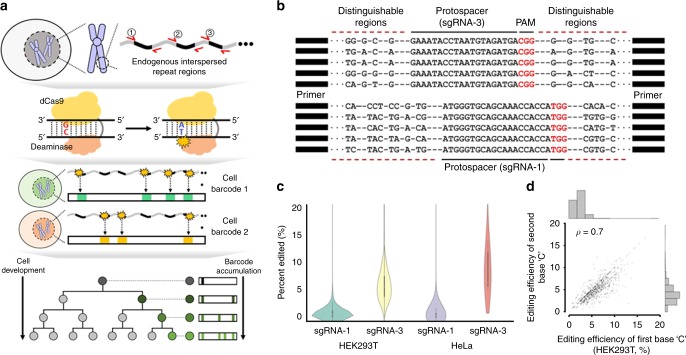
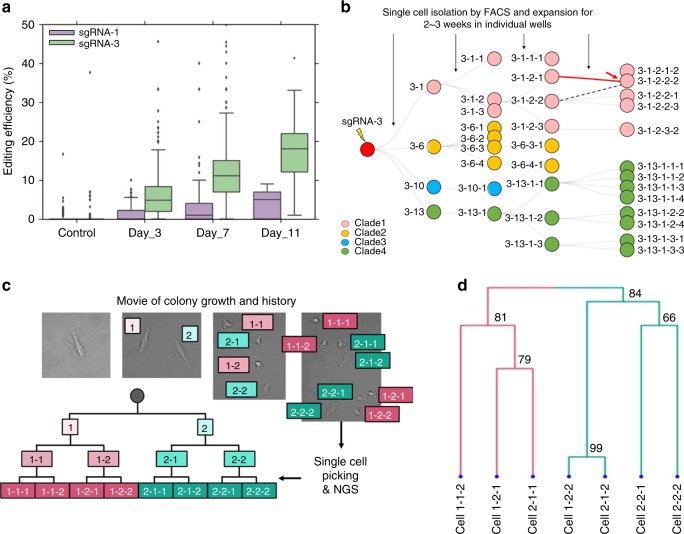
Determining cell lineage and function is critical to understanding human physiology and pathology. Although advances in lineage tracing methods provide new insight into cell fate, defining cellular diversity at the mammalian level remains a challenge. Here, we develop a genome editing strategy using a cytidine deaminase fused with nickase Cas9 (nCas9) to specifically target endogenous interspersed repeat regions in mammalian cells. The resulting mutation patterns serve as a genetic barcode, which is induced by targeted mutagenesis with single-guide RNA (sgRNA), leveraging substitution events, and subsequent read out by a single primer pair. By analyzing interspersed mutation signatures, we show the accurate reconstruction of cell lineage using both bulk cell and single-cell data. We envision that our genetic barcode system will enable fine-resolution mapping of organismal development in healthy and diseased mammalian states.
Overview
The claims and statistics of this paper haven’t been checked yet.
Free: it reads the open-access text and checks the first 5 claims that cite a source we can check. Create a free account to check every claim.
Integrity signals
Registry
Cites
Statistics
Figures
Verification
Claims the paper makes
The claims and statistics of this paper haven’t been checked yet.
Free: it reads the open-access text and checks the first 5 claims that cite a source we can check. Create a free account to check every claim.
Claims other papers make about this one
Each is checked against this paper’s own text: does it say what the citing paper says it does?
The source backs part of the claim, not all of it — or backs it for a different population, condition or comparison.
In the citing paper
“In fact, usage of a modified CRISPR-cas9 system has been expanded beyond genome editing, to RNA targeting, chromatin topology, chromatin imaging, and developmental trajectories as well as to lineage tracing (188, 304).”
From Epigenetic Modifications in Stress Response Genes Associated With Childhood Trauma (2019) · cites this paper as [304]
Experimental — accuracy not yet measured
Self-check
Percentages, sums and reported differences re-computed from the paper’s own numbers.
The self-check needs the paper’s full text.
Citations
Cites
A Programmable Dual-RNA–Guided DNA Endonuclease in Adaptive Bacterial Immunity
Jinek, M., Chylinski, K., Fonfara, I., Hauer, M., Doudna, J. A., & Charpentier, E. (2012) · Science · doi:10.1126/science.1225829 · Cited by 17,116
Multiplex Genome Engineering Using CRISPR/Cas Systems
Cong, L., Ran, F. A., Cox, D., Lin, S., Barretto, R., Habib, N., Hsu, P. D., Wu, X., Jiang, W., Marraffini, L. A., et al. (2013) · Science · doi:10.1126/science.1231143 · Cited by 15,339
Genome engineering using the CRISPR-Cas9 system
Ran, F. A., Hsu, P. D., Wright, J., Agarwala, V., Scott, D. A., & Zhang, F. (2013) · Nature Protocols · doi:10.1038/nprot.2013.143 · Cited by 11,133
Programmable editing of a target base in genomic DNA without double-stranded DNA cleavage
Komor, A. C., Kim, Y. B., Packer, M. S., Zuris, J. A., & Liu, D. R. (2016) · Nature · doi:10.1038/nature17946 · Cited by 5,437
Cpf1 Is a Single RNA-Guided Endonuclease of a Class 2 CRISPR-Cas System
Zetsche, B., Gootenberg, J. S., Abudayyeh, O. O., Slaymaker, I. M., Makarova, K. S., Essletzbichler, P., Volz, S. E., Joung, J., van der Oost, J., Regev, A., et al. (2015) · Cell · doi:10.1016/j.cell.2015.09.038 · Cited by 4,761
Programmable base editing of A•T to G•C in genomic DNA without DNA cleavage
Gaudelli, N. M., Komor, A. C., Rees, H. A., Packer, M. S., Badran, A. H., Bryson, D. I., & Liu, D. R. (2017) · Nature · doi:10.1038/nature24644 · Cited by 4,184
CRISPR-Cas systems for editing, regulating and targeting genomes
Sander, J. D., & Joung, J. K. (2014) · Nature Biotechnology · doi:10.1038/nbt.2842 · Cited by 3,153
In vivo genome editing using Staphylococcus aureus Cas9
Ran, F. A., Cong, L., Yan, W. X., Scott, D. A., Gootenberg, J. S., Kriz, A. J., Zetsche, B., Shalem, O., Wu, X., Makarova, K. S., et al. (2015) · Nature · doi:10.1038/nature14299 · Cited by 2,687
Rationally engineered Cas9 nucleases with improved specificity
Slaymaker, I. M., Gao, L., Zetsche, B., Scott, D. A., Yan, W. X., & Zhang, F. (2016) · Science · doi:10.1126/science.aad5227 · Cited by 2,414
Dynamic Imaging of Genomic Loci in Living Human Cells by an Optimized CRISPR/Cas System
Chen, B., Gilbert, L. A., Cimini, B. A., Schnitzbauer, J., Zhang, W., Li, G.-W., Park, J., Blackburn, E. H., Weissman, J. S., Qi, L. S., et al. (2013) · Cell · doi:10.1016/j.cell.2013.12.001 · Cited by 1,963
Cited by
Lineage tracing meets single-cell omics: opportunities and challenges
Wagner, D. E., & Klein, A. M. (2020) · Nature Reviews Genetics · doi:10.1038/s41576-020-0223-2 · Cited by 646
CRISPR in cancer biology and therapy
Katti, A., Diaz, B. J., Caragine, C. M., Sanjana, N. E., & Dow, L. E. (2022) · Nature Reviews Cancer · doi:10.1038/s41568-022-00441-w · Cited by 424
Integrating genetic and non-genetic determinants of cancer evolution by single-cell multi-omics
Nam, A. S., Chaligne, R., & Landau, D. A. (2021) · Nature Reviews Genetics · doi:10.1038/s41576-020-0265-5 · Cited by 378
Epigenetic Modifications in Stress Response Genes Associated With Childhood Trauma
Jiang, S., Postovit, L., Cattaneo, A., Binder, E. B., & Aitchison, K. J. (2019) · Frontiers in Psychiatry · doi:10.3389/fpsyt.2019.00808 · Cited by 288
Aging and Rejuvenation of Neural Stem Cells and Their Niches
Navarro Negredo, P., Yeo, R. W., & Brunet, A. (2020) · Cell Stem Cell · doi:10.1016/j.stem.2020.07.002 · Cited by 246
Temporal modelling using single-cell transcriptomics
Ding, J., Sharon, N., & Bar-Joseph, Z. (2022) · Nature Reviews Genetics · doi:10.1038/s41576-021-00444-7 · Cited by 195
Unravelling cellular relationships during development and regeneration using genetic lineage tracing
Baron, C. S., & van Oudenaarden, A. (2019) · Nature Reviews Molecular Cell Biology · doi:10.1038/s41580-019-0186-3 · Cited by 179
Precision genome editing using cytosine and adenine base editors in mammalian cells
Huang, T. P., Newby, G. A., & Liu, D. R. (2021) · Nature Protocols · doi:10.1038/s41596-020-00450-9 · Cited by 175
Connecting past and present: single-cell lineage tracing
Chen, C., Liao, Y., & Peng, G. (2022) · Protein & Cell · doi:10.1007/s13238-022-00913-7 · Cited by 104
“Using a dCas9-derived base editor, Hwang et al. proved the concept of tracing cell lineages by targeting the endogenous L1 retrotransposition elements (Hwang et al., 2019).”
BackgroundLineage tracing and analog recording in mammalian cells by single-site DNA writing
Loveless, T. B., Grotts, J. H., Schechter, M. W., Forouzmand, E., Carlson, C. K., Agahi, B. S., Liang, G., Ficht, M., Liu, B., Xie, X., et al. (2021) · Nature Chemical Biology · doi:10.1038/s41589-021-00769-8 · Cited by 80
Xu, W., Zhang, S., Qin, H., & Yao, K. (2024) · Journal of Translational Medicine · doi:10.1186/s12967-024-05957-3 · Cited by 85
Liu, K., Deng, S., Ye, C., Yao, Z., Wang, J., Gong, H., Liu, L., & He, X. (2021) · Nature Methods · doi:10.1038/s41592-021-01325-x · Cited by 63
Open-ended molecular recording of sequential cellular events into DNA
Loveless, T. B., Carlson, C. K., Helmy, C. A. D., Hu, V. J., Ross, S. K., Demelo, M. C., Murtaza, A., Liang, G., Ficht, M., Singhai, A., et al. (2024) · Nature Chemical Biology · doi:10.1038/s41589-024-01764-5 · Cited by 65
Askary, A., Chen, W., Choi, J., Du, L. Y., Elowitz, M. B., Gagnon, J. A., Schier, A. F., Seidel, S., Shendure, J., Stadler, T., et al. (2024) · Nature Reviews Genetics · doi:10.1038/s41576-024-00788-w · Cited by 43
“CRISPR base editors can generate specific point mutations at target sites 28,56,57 and have been used for DNA recording 30,58,59 .”
Base editors: development and applications in biomedicine
Liang, Y., Chen, F., Wang, K., & Lai, L. (2023) · Frontiers of Medicine · doi:10.1007/s11684-023-1013-y · Cited by 36
Beattie, R., Streicher, C., Amberg, N., Cheung, G., Contreras, X., Hansen, A. H., & Hippenmeyer, S. (2020) · Journal of Visualized Experiments · doi:10.3791/61147 · Cited by 33
Deep distributed computing to reconstruct extremely large lineage trees
Konno, N., Kijima, Y., Watano, K., Ishiguro, S., Ono, K., Tanaka, M., Mori, H., Masuyama, N., Pratt, D. R., Ideker, T., et al. (2022) · Nature Biotechnology · doi:10.1038/s41587-021-01111-2 · Cited by 33
“One strategy to mitigate this effect would be the use of CRISPR base editors that induce nucleotide substitutions with minimal DSB activities 29 .”
BackgroundMethodCell Lineage Tracing and Cellular Diversity in Humans
Abyzov, A. S., & Vaccarino, F. M. (2020) · Annual Review of Genomics and Human Genetics · doi:10.1146/annurev-genom-083118-015241 · Cited by 29
Reconstructing cell histories in space with image-readable base editor recordingPreprint
Chadly, D. M., Frieda, K. L., Gui, C., Klock, L., Tran, M., Sui, M. Y., Takei, Y., Bouckaert, R., Lois, C., Cai, L., et al. (2024) · bioRxiv (Cold Spring Harbor Laboratory) · doi:10.1101/2024.01.03.573434 · Cited by 33
“14,15 18 In all of these systems, lineage relationships between individual cells are reconstructed from each cell’s unique pattern of target site edits, in a manner analogous to sequence-based phylogenetic reconstruction.”
MethodA New Generation of Lineage Tracing Dynamically Records Cell Fate Choices
Yao, M., Ren, T., Pan, Y., Xue, X., Li, R., Zhang, L. J., Li, Y., & Huang, K. (2022) · International Journal of Molecular Sciences · doi:10.3390/ijms23095021 · Cited by 28
“Single-cell Cytidine deaminase scRNA-seq; Illumina C-to-T mutations No Yes [34]”
BackgroundMethodHigh-throughput dense reconstruction of cell lineages
Espinosa-Medina, I., García‐Marqués, J., Cepko, C. L., & Lee, T. (2019) · Open Biology · doi:10.1098/rsob.190229 · Cited by 20
“Their study demonstrated accurate single-cell lineage reconstruction in vitro using this method [19].”
MethodNew Tools for Lineage Tracing in Cancer In Vivo
Jones, M. G., Yang, D., & Weissman, J. S. (2023) · Annual Review of Cancer Biology · doi:10.1146/annurev-cancerbio-061421-123301 · Cited by 24
Kalamakis, G., & Platt, R. J. (2023) · Neuron · doi:10.1016/j.neuron.2023.04.021 · Cited by 21
Lu, X., Zhang, Q., Wang, Z., Cheng, X., Yan, H., Cai, S., Zhang, H., & Liu, Q. (2024) · Developmental Cell · doi:10.1016/j.devcel.2024.10.023 · Cited by 19
TEMPO enables sequential genetic labeling and manipulation of vertebrate cell lineages
Espinosa-Medina, I., Feliciano, D., Belmonte‐Mateos, C., Miyares, R. L., García‐Marqués, J., Foster, B., Lindo, S. E., Pujades, C., Koyama, M., & Lee, T. (2022) · Neuron · doi:10.1016/j.neuron.2022.10.035 · Cited by 21
“Advances in synthetic biology and sequencing technologies prompted the development of DNA recorders that allow retrospective analysis of both cell identity and lineages (Alemany et al., 2018; Chan et al., 2019; Cotterell et al., 2020; Espinosa-Medina et al., 2019; Garcia-Marques et al., 2021; Hwang et al., 2019; Kalho…”
Reconstructing cell lineage trees with genomic barcoding: approaches and applications
Li, Z., Yang, W., Wu, P., Shan, Y., Zhang, X., Chen, F., Yang, J., & Yang, J.-R. (2023) · Journal of genetics and genomics/Journal of Genetics and Genomics · doi:10.1016/j.jgg.2023.05.011 · Cited by 19
Single-cell lineage tracing approaches to track kidney cell development and maintenance
Yoon, B., Kim, H., Jung, S. W., & Park, J. (2024) · Kidney International · doi:10.1016/j.kint.2024.01.045 · Cited by 15
Advances in CRISPR ‐Cas9 in lineage tracing of model animals
Cao, J., Guo, Z., Xu, X., Li, P., Fang, Y., & Deng, S. (2025) · Animal Models and Experimental Medicine · doi:10.1002/ame2.70033 · Cited by 17
“…meth - ods may not face the same concern of excessive DNA damage and can avoid double-strand breaks using genetic recombination, 12,113 CRISPR-associated transposase systems (CAST and Vibrio cholerae Tn6677), 114,115 base-editing enzymes, 63,116 prime editing, 117 and other CRISPR-system nucleases.”
Ma, Y., Tan, Y., Li, J., Xiang, Q., Liu, S., Jin, X., Shao, S., Geng, W., Zhu, L., & Yang, D. (2024) · Analytical Chemistry · doi:10.1021/acs.analchem.4c03206 · Cited by 14
The art of lineage tracing: From worm to human
García‐Marqués, J., Espinosa-Medina, I., & Lee, T. (2020) · Progress in Neurobiology · doi:10.1016/j.pneurobio.2020.101966 · Cited by 13
Genetic Tools for Cell Lineage Tracing and Profiling Developmental Trajectories in the Skin
Nathans, J. F., Ayers, J., Shendure, J., & Simpson, C. L. (2024) · Journal of Investigative Dermatology · doi:10.1016/j.jid.2024.02.006 · Cited by 13
Dujardin, P., Baginska, A. K., Urban, S., & Grüner, B. M. (2021) · Cancers · doi:10.3390/cancers13164187 · Cited by 15
“, by shuffling specific sequences with recombinases [144,145] or by generating random mutations in the target sequence using CRISPR-Cas9 [146,147].”
BackgroundApplications of high-resolution clone tracking technologies in cancer
Morgan, D., Jost, T. A., Santiago, C. D., & Brock, A. (2021) · Current Opinion in Biomedical Engineering · doi:10.1016/j.cobme.2021.100317 · Cited by 12
Charting single-cell lineages with synthetic and natural barcodes
Rodriguez-Fraticelli, A., & Parreno, V. (2026) · Nature Reviews Genetics · doi:10.1038/s41576-026-00943-5 · Cited by 16
The molecular map of CLL and Richter's syndrome
Sud, A., Parry, E. M., & Wu, C. J. (2024) · Seminars in Hematology · doi:10.1053/j.seminhematol.2024.01.009 · Cited by 10
DNA writing at a single genomic site enables lineage tracing and analog recording in mammalian cellsPreprint
Loveless, T. B., Grotts, J. H., Schechter, M. W., Forouzmand, E., Carlson, C. K., Agahi, B. S., Liang, G., Ficht, M., Liu, B., Xie, X. S., et al. (2019) · bioRxiv (Cold Spring Harbor Laboratory) · doi:10.1101/639120 · Cited by 9
DNA Barcoding Technology for Lineage Recording and Tracing to Resolve Cell Fate Determination
Kim, I. S. (2023) · Cells · doi:10.3390/cells13010027 · Cited by 15
“Unlike the CCR5 region, Hwang and colleagues introduced base substitutions on the long interspersed nuclear element-1 (L1) in the genome [42].”
BackgroundZhong, Z., Hu, X., Zhang, R., Liu, X., Chen, W., Zhang, S., Sun, J., & Zhong, T. P. (2024) · Journal of genetics and genomics/Journal of Genetics and Genomics · doi:10.1016/j.jgg.2024.10.006 · Cited by 10
Theoretical modeling on CRISPR-coded cell lineages: efficient encoding and optimal reconstructionPreprint
Sugino, K., García‐Marqués, J., Espinosa-Medina, I., & Lee, T. (2019) · bioRxiv (Cold Spring Harbor Laboratory) · doi:10.1101/538488 · Cited by 8
“Using CRISPR, we can derive genetic barcodes through editing pre-selected sites that may exist as clustered exogeneous gRNA targets [15, 8, 6] or distribute widely , like transposon-related repeats, in the genome [10].”
BackgroundMethodTargeting transposable elements in cancer: developments and opportunities
Wang, Z.-Y., Ge, L., Ouyang, Y., Jin, X., & Jiang, Y. (2024) · Biochimica et Biophysica Acta (BBA) - Reviews on Cancer · doi:10.1016/j.bbcan.2024.189143 · Cited by 11
BASELINE: a CRISPR base editing platform for mammalian-scale single-cell lineage tracing
Winter, E., Emiliani, F. E., Cook, A., Abderrahim, A., & McKenna, A. (2026) · Nucleic Acids Research · doi:10.1093/nar/gkag769 · Cited by 16
“Base editors [ 16 , 17 ] and prime editors [ 18 ], originally developed for targeted sequence modification without double-stranded breaks, have been adapted for CRISPR/Cas-based lineage tracing [ 19–21 ].”
Molecular circuits for genomic recording of cellular events
Chen, W., & Choi, J. (2025) · Trends in Genetics · doi:10.1016/j.tig.2025.04.004 · Cited by 9
Clonal tracking in cancer and metastasis
Aalam, S. M. M., Nguyen, L. V., Ritting, M. L., & Kannan, N. (2023) · Cancer and Metastasis Reviews · doi:10.1007/s10555-023-10149-4 · Cited by 9
“Its expansive theoretical cell barcode diversity suggests broad applicability [87].”
Evolving strategies for lineage tracing: Genetic markers, synthetic barcodes, and natural variants
Kang, Z., Chen, H., Li, S., Wang, S., & Zhou, B. (2026) · Cell stem cell · doi:10.1016/j.stem.2026.05.001 · Cited by 11
Minkina, A., Cao, J., & Shendure, J. (2022) · bioRxiv (Cold Spring Harbor Laboratory) · doi:10.1101/2022.05.12.491602 · Cited by 6
Single-cell lineage tracing techniques in hematology: unraveling the cellular narrative
Deng, L.-H., Li, M., Huang, X., & Zhao, X. (2025) · Journal of Translational Medicine · doi:10.1186/s12967-025-06318-4 · Cited by 7
Inclusion of temporal information in single cell transcriptomics
Olivares‐Chauvet, P., & Junker, J. P. (2020) · The International Journal of Biochemistry & Cell Biology · doi:10.1016/j.biocel.2020.105745 · Cited by 5
Lineage tracing from cellular heritage to disease destiny
Zhu, H., Liu, X., Tang, M., Lui, K. O., & Zhou, B. (2026) · Nature Genetics · doi:10.1038/s41588-026-02628-5 · Cited by 6
“However, these systems often had low editing efficiency, limited information density and potential off-target effects, restricting their use primarily to in vitro models 75,76 .”
Sugino, K., Miyares, R. L., Espinosa-Medina, I., Chen, H.-M., Potter, C. J., & Lee, T. (2020) · bioRxiv (Cold Spring Harbor Laboratory) · doi:10.1101/2020.07.27.223321 · Cited by 1
“Labs have since worked to increase the encoding capacity by a number of techniques[16, 13, 17, 29].”
BackgroundRecording Biological Information with CRISPR ‐ Cas Systems
Cherepkova, M. Y., Tanna, T., & Platt, R. J. (2022) · Wiley eBooks · doi:10.1002/9781683673798.ch16 · Cited by 2
The landscape of cell lineage tracing
Ye, F., Guang, L., Li, H., & Cheng, L. (2025) · Science China Life Sciences · doi:10.1007/s11427-024-2751-6 · Cited by 3
“The interspersed mutation signatures were found to accurately reconstruct the cell lineage in vitro (Hwang et al., 2019).”
LAML-Pro: joint maximum likelihood inference of cell genotypes and cell lineage trees
Chu, G., Schmidt, H., & Raphael, B. J. (2026) · Bioinformatics · doi:10.1093/bioinformatics/btag219 · Cited by 4
“…measure the resulting edits (McKenna et al. 2016, Alemany et al. 2018, Raj et al. 2018, Spanjaard et al. 2018, Tang and Liu 2018, Chan et al. 2019, Hwang et al. 2019, Bowling et al. 2020, Chen et al. 2021, Chow et al. 2021, Loveless et al. 2021, Simeonov et al. 2021, Choi et al. 2022, Yang et al.…”
Toward DNA-Based Recording of Biological Processes
Jang, H., & Yim, S. S. (2024) · International Journal of Molecular Sciences · doi:10.3390/ijms25179233 · Cited by 2
“To address this, cellular recording at the single-cell level has been demonstrated through long-read sequencing of a ‘canvas’ with multiple target sites for base editing [69] or editing endogenous interspersed repeat regions for lineage tracing [70].”
BackgroundRecording Lineage History with Cellular Barcodes in the Mammary Epithelium and in Breast Cancer
Merle, C., & Fré, S. (2025) · Advances in experimental medicine and biology · doi:10.1007/978-3-031-70875-6_5 · Cited by 2
Beattie, R., Streicher, C., Amberg, N., Cheung, G., Contreras, X., Hansen, A. H., & Hippenmeyer, S. (2020) · Journal of Visualized Experiments · doi:10.3791/61147-v · Cited by 1
Charting Single Cell Lineage Dynamics and Mutation Networks via Homing CRISPRPreprint
Wang, L., Dong, W., Yin, Z., Sheng, J., Ezeana, C. F., Li, Y., Yu, X., Wong, S. S. Y., Wan, Z., Danforth, R. L., et al. (2024) · bioRxiv (Cold Spring Harbor Laboratory) · doi:10.1101/2024.01.05.574236 · Cited by 1
Full-Spectrum Targeted Mutagenesis in Plant and Animal Cells
Iaffaldano, B. J., & Reiser, J. (2021) · International Journal of Molecular Sciences · doi:10.3390/ijms22020857 · Cited by 1
“demonstrated lineage tracing using a base-editing strategy, in which a nCas9 was fused to a cytidine deaminase and targeted to endogenous repetitive L1 elements [59].”
MethodA comprehensive evaluation of CRISPR lineage recorders using TraceQCPreprint
Hu, J., Jeong, H.-H., Al‐Ouran, R., Bado, I., Zhang, W., Zhang, X. H.-F., & Liu, Z. (2021) · bioRxiv (Cold Spring Harbor Laboratory) · doi:10.1101/2021.10.29.466515
Engineering Cancer with Next-Generation Genome Editing Tools
Roth, J. F., Chen, E., Cevasco, H., & Rivera, F. J. S. (2025) · Annual Review of Cancer Biology · doi:10.1146/annurev-cancerbio-070824-123431
Dey, S., Bhattacharjee, S., Bhattacharya, S., Banerjee, S. B., & Bhattacharya, S. (2025) · Journal of Porphyrins and Phthalocyanines · doi:10.1142/s108842462550110x
CRISPR's impact on cancer: From fundamental models to clinical solutions
Hillary, V. E., Rajan, V., & Ceasar, S. A. (2025) · Life Sciences · doi:10.1016/j.lfs.2025.124087
The development of single-cell lineage tracing technology and its application in immunotherapy
Wang, J., Li, Z., Chen, J., Li, H., Chen, F., Tan, L., Chen, X., Liu, S., Zhang, W., & Shao, H. (2026) · Molecular Therapy Advances · doi:10.1016/j.omta.2026.201802
“52 Some researchers have further modified base editors to enable selective base conversions across multiple genes or locations in the genome, simplifying multi-site editing and expanding the diversity of generated barcodes.”
High-diversity base mutagenesis via simultaneous adenine, cytosine and guanine editing
Hong, M., Luan, C., Yuan, M., Huang, H., Guo, X., Meng, D., Huang, M., Xu, Y., Sj, Z., Chen, K., et al. (2026) · Nature Communications · doi:10.1038/s41467-026-76020-6
“Development of single-action and dual base editors has demonstrated their potential in genetic screening 20,65,66 and lineage tracing 67,68 beyond therapeutic application.”
Genomic repeats for single-cell molecular recordingPreprint
Dveirin, R. K., Lin, J. D., Vyas, P., Lu, J., Yan, Y., Lee, J. J., Dong, X., Kannan, S., Langmead, B., Reddy, S., et al. (2026) · bioRxiv (Cold Spring Harbor Laboratory) · doi:10.64898/2026.08.06.743335
Çetin, R., Bindels, E. M., van Staalduinen, J., Kuijpers, L., Picco, G., Sanders, M. A., Hoogenboezem, R. M., van Beek, G., Gribnau, J. H., Mulugeta, E., et al. (2026) · bioRxiv (Cold Spring Harbor Laboratory) · doi:10.64898/2026.10.14.759042
Metadata
- Authors
- Hwang, B., Lee, W., Yum, S.-Y., Jeon, Y., Cho, N., Jang, G., & Bang, D.
- Affiliations
- Yonsei University (KR)
- Seoul National University (KR)
- Corresponding author
- Jang, Goo
- Bang, Duhee
- Venue
- Nature Communications
- Published
- 2019-03-15
- Volume
- 10
- Issue
- 1
- Pages
- 1234-1234
- ISSN
- 2041-1723 (ISSN-L)
- PMC
- PMC6420643
- OpenAlex
- W2949307008
- Cited by
- 65
- References
- 32
- Citations by year
- 2026: 9 · 2025: 8 · 2024: 13 · 2023: 6 · 2022: 8 · 2021: 7 · 2020: 9 · 2019: 5
- FWCI
- 2.39
- Type
- journal article
- Language
- en
- Open access
- gold
- doi.org
- Licence
- cc-by
- creativecommons.org/licenses/by/4.0 (tdm)
- creativecommons.org/licenses/by/4.0 (vor)
- Locations
- Nature Communications (publishedVersion, cc-by)
- bioRxiv (Cold Spring Harbor Laboratory) (acceptedVersion, cc-by-nc-nd)
- Europe PMC (PubMed Central) (publishedVersion, cc-by)
- PubMed Central (publishedVersion, cc-by)
- PubMed (publishedVersion)
- RePEc: Research Papers in Economics (submittedVersion)
- DOAJ (DOAJ: Directory of Open Access Journals) (submittedVersion, cc-by-sa)
- DOAJ (DOAJ: Directory of Open Access Journals) (submittedVersion)
- Funders
- National Research Foundation
- National Research Foundation of Korea (2018R1A2A1A05079172, NRF-2018M3A9H3024850, 2016M3A9B6948494, NRF-2018R1A2A1A05079172, 2018M3A9H3024850, 2015R1A2A1A10055972, NRF-2016M3A9B6948494)
- Ministry of Science and ICT, South Korea (2018R1A2A1A05079172, 2016M3A9B6948494)
- Topics
- Life Sciences › Biochemistry, Genetics and Molecular Biology › Molecular Biology › CRISPR and Genetic Engineering
- Life Sciences › Biochemistry, Genetics and Molecular Biology › Molecular Biology › Single-cell and spatial transcriptomics
- Life Sciences › Biochemistry, Genetics and Molecular Biology › Molecular Biology › RNA regulation and disease
- Keywords
- lineage tracing, LINE-1 retrotransposons, endogenous retrotransposons, cytidine deaminase, DNA barcoding, targeted mutagenesis, single guide RNA, interspersed repeats, cell fate mapping, mammalian development
- MeSH terms
- Gene Editing, CRISPR-Associated Protein 9, RNA, Guide, CRISPR-Cas Systems, Cell Differentiation, Cytidine Deaminase, HeLa Cells, Humans, Mutagenesis, Cell Lineage, Long Interspersed Nucleotide Elements, HEK293 Cells, DNA Barcoding, Taxonomic, Time-Lapse Imaging, Single-Cell Analysis
About these checks
Registry, retraction, Cites and statistics results are computed, not judged, with one exception: a printed reference that no index lists is read once by a model before it counts as a citation error. Claims are extracted by a model and kept only when their quote appears verbatim in the text; each cited source is then checked, with a model’s help, for whether it says what the claim relies on. Those verdicts can be wrong — read the claim’s quote and the cited source before relying on one.
Statistics and arithmetic are recomputed, not judged.
Confidence bands are shown only for fields calibrated on our annotated test set. None is calibrated yet, so no band is shown.
What counts as a claim ›How we measure confidence ›How we check this ›
Are you an author, or do you see a problem with this page? Request a review
Data sources
Bibliographic data: Semantic Scholar, OpenAlex, Crossref.
Contains information from the Semantic Scholar Academic Graph Datasets, made available under the ODC Attribution License (ODC-BY 1.0).
Semantic Scholar’s data is described in: Kinney, R., et al. (2023). The Semantic Scholar Open Data Platform. arXiv:2301.10140.
